Tag: Sonar

  • Strengthening Software Trust in Modern DevOps Workflows

    Strengthening Software Trust in Modern DevOps Workflows

    At swampUP 2025 in Napa Valley, Alan Shimel sat down with Tariq Shaukat, CEO of Sonar, and Gal Marder, EVP of Strategy at JFrog, for a discussion on how partnerships across the DevOps and AI ecosystems are reshaping the way software is built, secured and delivered.

    Shaukat emphasized that Sonar’s relationship with JFrog is rooted in shared values around trust, transparency, and code quality. As AI continues to accelerate software creation, both companies see a growing need for solutions that help developers not only move faster but also maintain the highest levels of security and reliability. “It’s never been about how fast developers type,” Shaukat noted. “It’s about ensuring that what’s being built is safe, verifiable, and ready for production.”

    The discussion also touched on the rising influence of AI in DevOps workflows and the responsibility that comes with it. Shaukat and Marder agreed that as teams adopt AI tools to generate, test, and deploy code, governance must evolve to keep pace. That’s where the partnership between Sonar and JFrog becomes especially relevant—bridging code integrity with artifact management, vulnerability detection, and software supply chain security.

    Marder added that this collaboration exemplifies JFrog’s broader strategy to build a unified, secure DevOps ecosystem powered by trusted partnerships. Together, Sonar and JFrog are working to redefine how software quality and trust are measured in an era where AI agents, automation, and human developers all share the same pipeline.

  • Sonar Adds Secrets Detection to Code Analysis Portfolio

    Sonar Adds Secrets Detection to Code Analysis Portfolio

    Sonar has added a secrets detection capability to its portfolio of tools for analyzing code and DevOps workflows.

    Designed to be applied to both finding secrets in code repositories and as applications are developed using an integrated development environment (IDE), this capability is being added to SonarLint, SonarQube and the managed SonarCloud service to identify, for example, passwords, application programming interface (API) keys, encryption keys, tokens, database credentials and other private information.

    Sonar co-CEO Olivier Gaudin said the goal is to eliminate secrets that are accidentally or maliciously stored in source code to improve software supply chain security.

    While it’s important to discover secrets in codebases, Sonar is making a concerted effort to make it simpler for developers to discover secrets before they find their way into a codebase that is one step away from a production environment, noted Gaudin. The SonarLint static analysis tool the company provides can now discover secrets in microseconds using the syntactic and semantic analysis engines the company has now extended, he added. No developer is going to wait five to 10 minutes for a code scan to be completed, said Gaudin.

    A Learn as You Code tool also explains how each secret found in a code segment poses a security risk. The overall goal is not only to remove secrets but, ultimately, reduce the number of instances where secrets are discovered in code, said Gaudin.

    Most organizations today are at varying stages of embracing DevSecOps best practices to improve software supply chain security. It’s not clear how readily secrets management is being embraced as part of those modernization efforts, but as cybercriminals routinely scan for application secrets stored in clear text that can be used to compromise application security, the need to encrypt secrets becomes a higher priority.

    There is, of course, no shortage of tools for detecting secrets. Sonar is now simply making a case for managing secret detection as part of a larger effort to reduce vulnerabilities in code that cybercriminals can exploit. That approach should help reduce the total cost of securing a software supply chain at a time when forthcoming regulations are going to make organizations that deploy software more accountable for application security.

    In the meantime, thanks to the rise of generative artificial intelligence (AI), the volume of code that needs to be scanned will likely exponentially increase. The issue with general-purpose AI platforms such as ChatGPT is they were trained using code of varying quality that often contains vulnerabilities that are now sometimes incorporated into the code they generate. On the plus side, however, many developers have little to no application security expertise, so it’s just as feasible that ChatGPT will create more secure code than a human developer. Regardless of how the code was created, however, no one will know for sure how secure it is without scanning it first.

    Hopefully, as AI progresses, the quality of the code being generated will only continue to improve. Until then, DevOps teams should continue to assume all code is suspect until proven otherwise.

  • 31 Reference Architectures for DevOps and Continuous Delivery

    31 Reference Architectures for DevOps and Continuous Delivery

    At QCon London, David Farley (@davefarley77) told the audience that “continuous delivery changes the economics of software delivery”.  I could not agree more.

    If you have been drawn to the evangelists like David Farley, Jez Humble, and Gene Kim, you’ll know that high performance IT organizations are seeing a massive payoff in their continuous delivery investments.  Industry leaders big and small are sharing noticeable results:

    • 8x more frequent production deployments
    • 50% lower change failure rates
    • 12x faster service restoration times when something went wrong

    5 Principles

    How are they achieving these results?  They are following a few key principles that David and Jez outlined in their seminal book, Continuous Delivery (highly recommended).  The principles outlined in their book and in David’s QCon presentation are as follows:

    • Deliver fast
    • Automate almost everything
    • Keep everything in version control
    • Build quality In
    • Empower the team 

    Reference Architectures for DevOps and Continuous Delivery

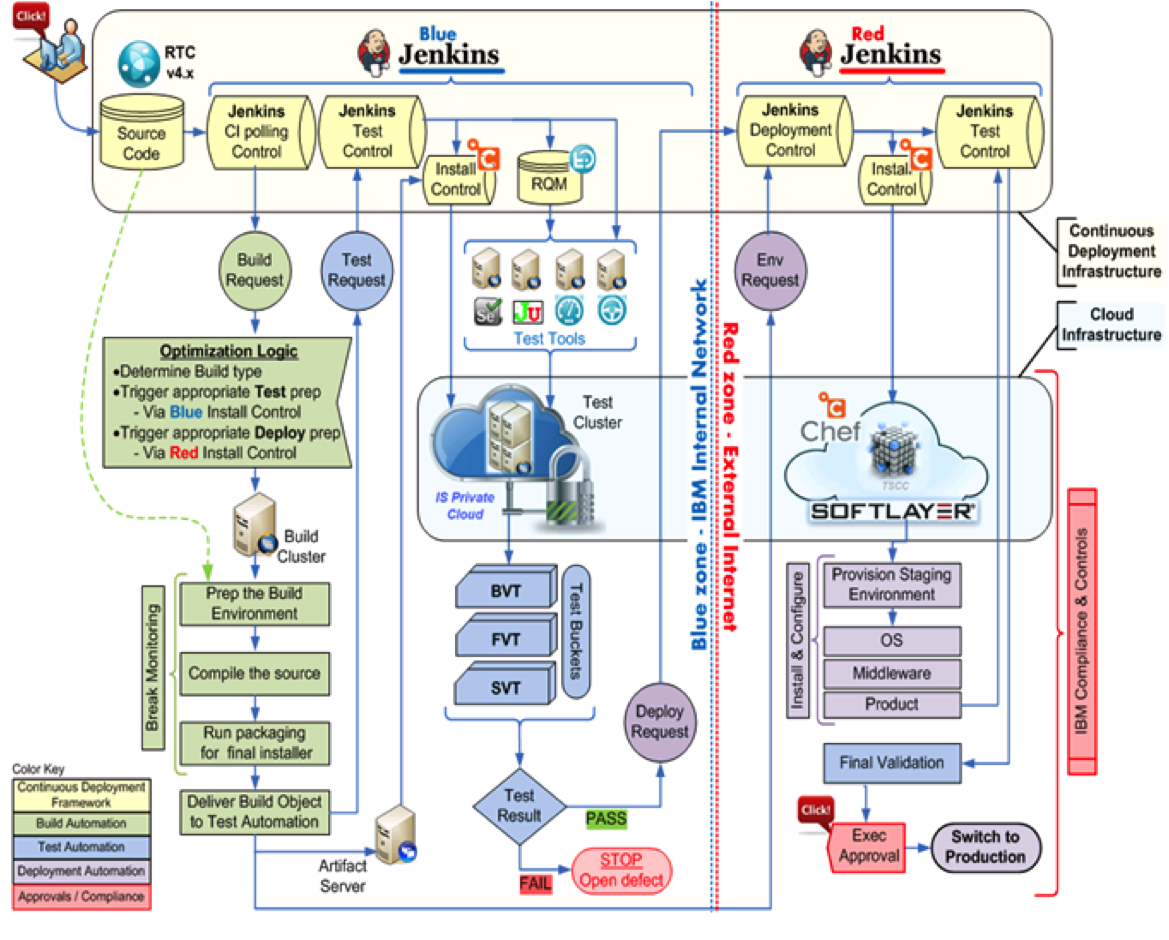
    In their book, they also provide insight to continuous delivery tool chains and processes which highlight build tools, CI platforms, testing suites, artifact repositories, and many other components. There are numerous examples of reference architectures available, and each of them vary in levels of detail, tools highlighted, and processes followed.  Yet, there is a constant theme among the tool sets: Jenkins, Maven, Nexus, Subversion, Git, Docker, Puppet/Chef, Rundeck, and Sonar seem to show up time and again.

    To help you along your continuous delivery and DevOps journey, I have compiled a set of 31 reference architectures created by users across the continuous delivery and DevOps communities.

     CD and DevOps tool chain

    Each architecture is accompanied by a link to the original presentation or blog where the architecture was referenced to ensure you have access to the full context of the discussion. You can also freely download the presentation from SlideShare where we now have over 7,000 views.

    Offer to help others: If you have a reference architecture to share, please consider posting a link to it in the comments section below.  I am sure others would love to see it and learn from it.