Tag: SolarWinds

  • SolarWinds Acquires VividCortex for Database Monitoring

    SolarWinds Acquires VividCortex for Database Monitoring

    SolarWinds announced this week it is extending its portfolio of DevOps tools with the acquisition of VividCortex, a provider of tools for monitoring a wide range of databases that is delivered as a set of software-as-a-service (SaaS) applications.

    Company president and CEO Kevin Thompson said the acquisition of VividCortex adds a database monitoring platform capable of monitoring so-called cloud-native databases such as MySQL, PostgreSQL, Amazon Aurora, MongoDB and Redis, complementing the company’s existing tools for monitoring databases to support legacy applications.

    In addition, Thompson noted the VividCortex tools are highly extensible; support for a new database can be added within 90 days.

    VividCortex claims to have nearly 300 customers today, including Etsy, GitHub, SendGrid, DraftKings and Yelp. SolarWinds, meanwhile, boasts more than 300,000 customers.

    Thompson said the number of databases organizations need to monitor is increasing as open source alternatives gain ground on proprietary databases. The result is a hybrid computing environment that requires tools to manage centrally since it’s not practical to try and master each set of monitoring tools provided for each database platform, added Thompson.

    SolarWinds VividCortex

    IT organizations also want to be able to compare and contrast the cost of deploying workloads on databases running in different environments, he added. Many IT organizations have already discovered that the cost of deploying certain types of workloads on public clouds is more expensive than anticipated.

    Thompson said it’s not really feasible to observe an application without being able to monitor the underlying database on which that application depends. In this respect, VividCortex adds a critical capability for DevOps teams, he said. SolarWinds intends to integrate VividCortex with a growing portfolio of DevOps tools that already includes a range of application performance management (APM) and infrastructure management tools. As is always the case, Thompson said IT organizations should also expect SolarWinds to drive the cost of employing database monitoring tools lower.

    As IT continues to evolve Thompson said SolarWinds believes many more organizations will embrace best DevOps practices. Much of that effort will involve retraining existing staff, because there are not enough college graduates to fill a rapidly expanding skills gap within IT organizations.

    It’s not clear to what degree lowering the cost of tools will accelerate the transition DevOps. Many organizations already rely on open source tools. However, the total cost of setting up and maintaining those tools often winds up being higher than a SaaS platform. In addition, all the upgrades to the SaaS platform are handled by the provider of the service.

    In many cases, developers wind up embracing open source tools to lower the cost of building an application, which the IT operations team then manages using commercial tools once that application is deployed in a production environment. In some cases, however, open source tools embraced by developers also end up being employed in the production environment. In either case, IT organizations now have more tools to choose from than ever.

    — Mike Vizard

  • Upping IT Skills: IT Pros Cite Significant Challenges

    Upping IT Skills: IT Pros Cite Significant Challenges

    Anyone who works within enterprise technology learns very quickly that if they want to stay relevant to the workforce, they’ll need to continuously learn new skills. But it’s certainly hard keeping up with new skill training while also keeping pace with day-to-day work demands.

    This is probably why a survey earlier this year from IT management software provider SolarWinds found that 70% of all technology professionals surveyed do not feel completely confident that they have all the necessary skills they’ll need to successfully manage their IT environments over the next three to five years.

    A certain amount of fear that one’s current skillsets may become antiqued by technological change is worthwhile, but that apprehension is only useful if technology professionals turn that energy into action. According to a more recent SolarWinds survey, 60% of technology professionals haven’t actively pursued learning a new skill or completed a certification in the last six months.

    The survey, Building Confidence for Tech Pros of Tomorrow, is based on an international survey of 177 technology professionals within both the public and private sectors. It was fielded in August 2019.

    The survey found roughly 50% of the technology professionals who did start a certification process did not finish. The primary reason was lack of time.

    Enterprises, aware that there exist challenges when it comes to finding the staff with the skills they need, are making efforts to mitigate their staffing challenges. These efforts predominately involve internal trainings, with 35% of respondents citing such training. Additionally, 54% of respondents said full-day in-person workshops provide the most value for the time spent.

    The survey also found soft skills are becoming increasingly important, with 46% of respondents stating interpersonal communications skills are the most critical for career growth. Other top skills were project management (56%) and public speaking/presentations (52%).

    Interesting, the majority of technology professionals surveyed said, while they are confident speaking with business leaders, they don’t believe they are adequately equipped with the support and tools they need to be effective at their work. According to the survey, the top two requirements for technology professionals to become confident managing current and future environments include increased budget/additional resources (64%) and more support from IT or business leadership (48%).

    Finally, and which could be a sign of the increased reliance of enterprises on software, the survey found application performance management (APM) skills are increasingly necessary for technology professionals. Survey respondents cited application support, troubleshooting and monitoring as tasks they are increasingly responsible. And 53% said user experience monitoring of applications is an additional skill of theirs that they are required to develop.

    — George V. Hulme

  • Survey Finds Reliance on APM Mainly Reactive

    Survey Finds Reliance on APM Mainly Reactive

    A survey of 358 strategic IT decision-makers in enterprise organizations across North America and Europe conducted by the market research firm GigaOm on behalf of SolarWinds, a provider of IT management tools, finds that roughly half of the respondents consider themselves proactive in their use of application performance management (APM) tools.

    That definition is based on those respondents either strongly agreeing or agreeing that their organization was employing APM tools within the context of all the following criteria:

    1. Engaged in a digital business transformation initiative.
    2. Makes use of a hybrid or multicloud computing strategy.
    3. Has a public-cloud first IT strategy.
    4. Makes use of best practices for IT operations.
    5. Line of business teams are driving technology change.

    Denny LeCompte, general manager for application management at SolarWinds, said that while significant progress is clearly being made it terms of APM adoption, it’s clear that half or more of the potential market is still wrestling with a variety of challenges that often stem from the cost and complexity associated with acquiring and employing an APM platform at scale.

    LeCompte said most of the use of APM is still reactive in that most organizations don’t actively engage an APM tool until there is an actual issue. The survey finds the primary driver for adopting APM is to fix problems (61%), followed by keeping on top of complex application environments (57%), delivering the best possible customer experience (52%) and managing costs and delivering efficient operations (34%). However, it’s worth noting that among the half of the respondents claiming to be proactive about employing APM, customer experience was the primary driver for adopting APM (61%).

    Even so, LeCompte noted reliance on APM platforms is often uneven at best. When it comes to adoption, he noted, most organizations are on a journey. Initially, the focus is on IT troubleshooting. Over time, however, customer experience with digital business processes becomes a much bigger factor. Different teams with the same organization are at different stages of that journey, he said.

    SolarWinds views the rising tide of APM awareness as the justification for jumping into the category, LeCompte said, claiming the company is committed to providing APM capabilities an IT organization is likely to require, at a fraction of the cost of rival platforms. That’s critical because many organizations have limited the number of applications they track using APM tools because of cost, he said.

    As IT environments become more complex in the age of microservices built using highly ephemeral containers, LeCompte said it’s only a matter of time before more IT organizations will need to embrace APM platforms proactively to optimize overall application performance. Individual IT administrators won’t be able to keep track of all the dependencies that might be impacting a “cloud native” application without relying on an APM platform, he noted.

    The issue now is finding a way to provide access to an APM platform that everyone on the IT team can regularly employ without breaking the IT budget.

    — Mike Vizard

  • SolarWinds Adds Ability to Profile Live Code to APM Platform

    SolarWinds Adds Ability to Profile Live Code to APM Platform

    SolarWinds is advancing its campaign to become a leading provider of DevOps tools by adding the ability to profile live code to SolarWinds AppOptics application performance monitoring (APM) platform.

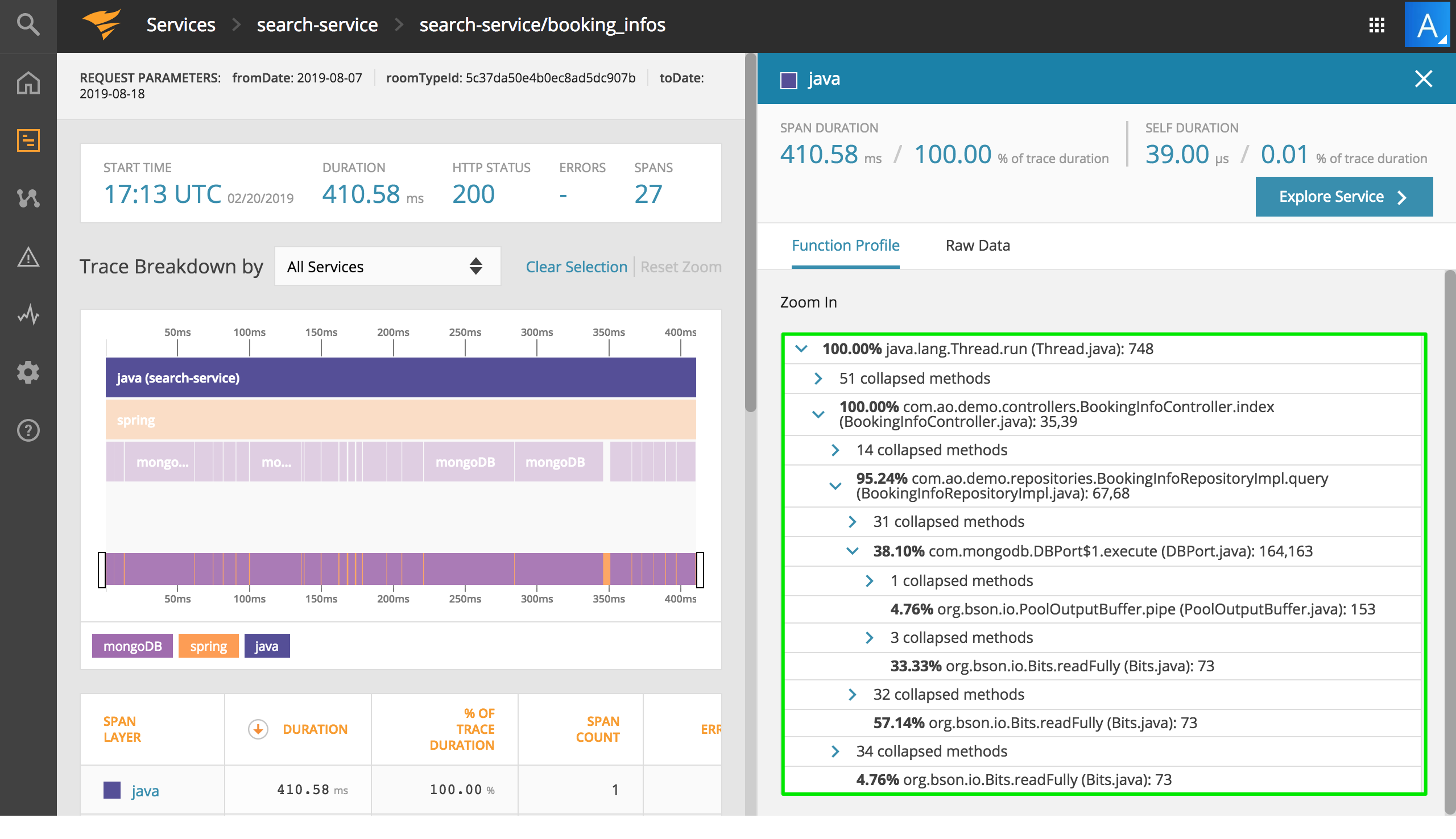
    Keith Kuchler, vice president of engineering for SolarWinds, said live code profiling provides a breakdown of the most frequently called functions and methods in a transaction, including class, method, filename and line number. That capability makes it possible for DevOps teams to identify what line of code might be causing a performance issue without requiring any changes to the code itself, he said.

    According to Kuchler, the ability to profile live code extends a distributed tracing capability that SolarWinds previously incorporated into SolarWinds AppOptics. Collectively, the two offerings show how committed SolarWinds is to providing DevOps teams with access to advanced capabilities at a fraction of the cost of rival APM platforms delivered as a software-as-a-service (SaaS) application, said Kuchler. Pricing for SolarWinds AppOptics starts at $7.50 per month. SolarWinds AppOptics is part of what SolarWinds describes as a DevOps Toolkit that also includes Pingdom, a website performance monitoring tool, Papertrail, a log management service, and Loggly, a log analytics service.

    The ability to profile live code supports applications written in Java and PHP, with support for additional programming languages forthcoming, said Kuchler. The goal is to reduce the amount of time DevOps teams need to spend guessing where the source of any issue might be after an application is deployed or updated, he added.

    As the rate at which applications continue to be deployed and updated, DevOps teams need to be able to pinpoint issues at the code level to enable developers to address that issue as soon as possible. Sharing a bunch of generic alerts typically doesn’t provide a developer with enough actionable intelligence to solve the problem. Not surprisingly, a recent survey of over 300 developers conducted by SolarWinds finds that most of them spend a lot more time troubleshooting existing applications versus writing new code. All that time spent troubleshooting code winds up having an adverse impact on the ability to make the transition to DevOps.

    In general, SolarWinds is trying to expand the total APM market by making its tools available as a service that organizations of any size can invoke. Historically, reliance on APM tools has been limited to mission-critical applications mainly due to cost. But over time, the number of applications deemed to be mission-critical has increased. In addition, because of the all interdependencies between applications, the potential impact a single line of code can have across the enterprise IT environment can be substantial. As a result, the need for an affordable approach to APM has become more acute.

    Naturally, it will be interesting to see how much pressure there is on APM pricing over the course of the coming year. Competition between providers of APM platforms is already fierce. The challenge will be finding a provider of an APM platform that not only provides all the capabilities required, but also has deep enough pockets to be around for the long haul.

    — Mike Vizard

  • SolarWinds Acquires Loggly to Add Analytics to DevOps Portfolio

    SolarWinds Acquires Loggly to Add Analytics to DevOps Portfolio

    An ongoing SolarWinds effort to drive down the cost of implementing DevOps has been extended by acquiring Loggly, a provider of log analytics software provided as a cloud service.

    Christoph Pfister, executive vice president of products at SolarWinds, says the Loggly service rounds out a portfolio of DevOps offerings spanning application and infrastructure monitoring, website monitoring and log management software.

    In keeping with the company’s overall DevOps strategy, SolarWinds will provide access to Loggly at substantially less cost than rival log analytics platforms such as Splunk, Pfister says. Pricing for the Loggly service starts at $99 per month. In contrast, other log analytics platforms charge IT organizations based on the amount of data being analyzed, which results in many of them limiting the amount of log data they analyze because of cost concerns.

    IT organizations have been making major investments in log analytics to more proactively discover anomalies indicative of either potential application performance issues or security breaches. The more log data being analyzed, the more accurate the analytics being applied to those logs becomes. The goal should be to make data science capabilities as broadly available as possible, says Pfister.

    Next up, Pfister says SolarWinds will be working on unifying the user interface experience between Loggly and the rest of its DevOps portfolio. In addition, SolarWinds is examining whatever opportunity there may be to bundle various cloud services together in a single suite of offerings, says Pfister.

    Log analytics has emerged as a foundational component of both DevOps and, by extension, digital business transformation. Developers are keenly interested in being alerted to events that might have a potential impact on their applications before they occur. IT operations teams, of course, are relying on analytics to enable them to be more proactive when it comes to making sure IT infrastructure resources are continuously available. At the same time, business users are discovering that log analytics can provide them insights into events that are indicative of how, for example, end users are employing new capabilities that have been added to a website.

    While most IT administrators have a lot of experience hunting through logs looking for specific events, the sheer volume of data in those logs prevents most of them from gleaning anything that approaches actionable intelligence. Advanced analytics applications provide the means through which all the log data being collected becomes more valuable to the business.

    As it becomes more affordable for more IT organizations to apply monitoring and log analytics, the number of IT organizations embracing DevOps practices should increase. Having access to tools, of course, is only one part of the equation. But most organizations wind up backing their way into DevOps, starting with tools that provide them additional capabilities and insights. Once they master those tools they begin to apply the knowledge and insights they gain to implement more sophisticated DevOps processes. For many IT organizations, however, the cost of acquiring those tools to get started down the path to DevOps has simply been too high.

    — Mike Vizard

  • SolarWinds Aims to Democratize Monitoring

    SolarWinds Aims to Democratize Monitoring

    In a move that has the potential to significantly expand the number of organizations embracing DevOps, SolarWinds announced it has expanded its IT management cloud service to include an integrated application and infrastructure monitoring offering dubbed AppOptics. Pricing for AppOptics starts at $7.50 per host per month.

    In addition, SolarWinds has updated Papertrail log management software to make searches faster and provide new visualization tools and the ability to resolve more complex problems such as application server errors and slow database queries. The company also updated Pingdom, a monitoring tool that can now provide views specific to a user, website or specific performance issues.

    Christoph Pfister, executive vice president of products for SolarWinds, says AppOptics should be make it much less expensive for organizations to embrace DevOps. Many organizations get caught up in a chicken-and-egg debate over whether to acquire tools before developing processes or vice versa. AppOptics renders that issue largely moot by making the cost of employing an integrated set of tools for monitoring infrastructure and applications nominal, says Pfister. That level of integration is now required to address digital business initiatives where the focus is more on the outcome than any one IT event, adds Pfister.

    Pfister says SolarWinds is the only provider of a software-as-a-service (SaaS)-based set of monitoring toils that support multiple programming languages, which he notes creates yet another opportunity for DevOps teams to reduce costs.

    AppOptics includes support for auto-instrumentation, distributed tracing and host agent software. That tracing software is based on technology SolarWinds gained when it acquired Librato. Adding instrumentation to any application can be accomplished using a single line of script, says Pfister. The host agent support is achieved using Snap and Telegraf plug-ins to monitor systems.

    By making it easier to add instrumentation, Pfister says SolarWinds expects the number of applications actively being monitored will increase substantially. Historically, only a small percentage of applications deployed in an enterprise are actively monitored. Pfister notes that a much higher percentage of new applications being developed are “systems of engagement,” which require much higher levels of instrumentation to gauge acceptance by end users, and not “systems of record.” Gartner says that only 5 percent of organizations today have implemented digital experience monitoring (DEM), a number it forecasts will rise to 30 percent by 2020.

    At a $7.50 per host per month price point, AppOptics should go a long way to commoditizing DevOps tools. That should not only spur more adoption, but also could force a wave of consolidation across a crowded category of monitoring tools as profit margins get squeezed. In many instances, it’s also likely that monitoring increasingly will be bundled with other tools and services as vendors aim to compensate for monitoring becoming a commodity by selling it alongside higher margin products and services.

    Long term, it’s apparent that cost is increasingly being removed as a factor in the DevOps equation. Not every organization is going to able to master every DevOps tool available. But when it comes to monitoring, going forward there should be no financial excuse for failing to have at the very least some minimal level of DevOps capability.

    — Mike Vizard

  • SolarWinds Powers Instacart’s DevOps Efforts

    SolarWinds Powers Instacart’s DevOps Efforts

    Instacart is an Internet-based home delivery service for groceries. Its mobile app and website enables consumers to leverage its service, which operates in 17 cities across the country. Customers order through the app, and Instacart’s personal shoppers fulfill those orders at local stores. Forbes magazine named Instacart the Most Promising Company of 2015, citing its growth since the company’s 2012 inception, notes Nick Elser, director of Engineering at Instacart.

    DevOps touches critical business applications at Instacart, including the apps and APIs for both iOS and Android mobile operating systems. It also supports back-end systems such as processes rooted in machine learning that assign grocery lists to shoppers and a pipeline that retrieves retail partner product data about available grocery items nightly.

    Key Mobile Development Challenges & Goals

    The Instacart DevOps shop is tasked with maintaining infrastructure in software, expanding the current business apps through innovations, and scoping and building future software for the company and its services. “We needed better infrastructure-monitoring solutions in place to save time and help scale parts of the infrastructure as the company continued to grow,” says Elser.

    Elser and his team looked at SolarWinds‘ capabilities, and were enticed by the Librato cloud-based monitoring tool’s potential to safeguard the performance and uptime of the company’s mobile APIs. “Our customers demand a high level of reliability from their consumer services,” says Elser. “Librato ensures the reliability of our mobile APIs by keeping a close eye on the health of our internal/external services.”

    Instacart hoped to use SolarWinds to support its infrastructure-scaling efforts. By enabling Instacart to leverage aggregates of logging data and statistics reports, Elser and his team could focus on creating an increasingly innovative and fruitful grocery delivery service. “We wanted to concentrate on scaling our operations, fleet of shoppers and metropolitan presence, as well as identifying processes that would enable us to move faster as a team,” explains Elser.

    Applying SolarWinds Tools

    With the software libraries they needed already present in the programming languages and environments they had on hand, implementing the SolarWinds tools to serve Instacart’s intended goals was relatively pain-free. One tool, Papertrail, required only a minor adjustment to existing config files to forward log records.

    Papertrail log management tool eased logging duties for the entire Instacart infrastructure. “I could have Papertrail on all my boxes, give it an endpoint and it would be aggregated into different buckets based on host names,” says Elser.

    Instacart also added SolarWinds’ Pingdom solution to notify the team about website downtime issues. This enabled the team to gauge real-world user experiences with uptime and to assess synthetic transactions for issues that could concern customers. “Pingdom was the most flexible uptime monitoring tool my team could find,” says Elser.

    Librato also proved worth the effort, thanks to its many value-adds. “We received a lot of free advantages with Librato because it came with Amazon CloudWatch integration,” says Elser. This made it fairly trivial to add instrumentation to our apps.”

    Using Librato ultimately enabled Instacart to create graphs to identify correlations in event data—instances where some relationship exists but falls short of cause and effect. Instacart could then use that data to pinpoint and resolve security breaches. “We also use the Librato CloudWatch integration to monitor database loads, as these affect the infrastructure’s health,” says Elser.

    By integrating Librato with Heroku and AWS CloudWatch and applying other SolarWinds apps, Instacart gained visualizations of important infrastructure elements and transparency into its entire software stack for monitoring stack health.

    Other Tools

    Instacart also uses other tools to help its DevOps, including Crashlytics mobile crash and usage tracking application, Urban Airship mobile push notification tool, Branch.io deep-linking application and the Rollbar exception tracking tool.