Tag: Software Supply Chain

  • JFrog Adds Module to Better Secure Software Supply Chains

    JFrog Adds Module to Better Secure Software Supply Chains

    JFrog today added a JFrog Advanced Security module to its Artifactory repository that enables DevOps teams to scan both binaries and source code for vulnerabilities and misconfigurations.

    Stephen Chin, vice president of developer relations for JFrog, said that approach will enable DevOps team to ensure applications are secure before they are deployed in a production environment.

    In addition to discovering vulnerabilities, the JFrog Advanced Security module also detects exposed secrets such as passwords, access tokens and private keys, said Chin. Leveraging existing scanning capabilities provided via the JFrog Xray software composition analysis tool, it can also be used to inspect the file used to provision infrastructure-as-code, he added.

    Most importantly, it provides development teams with the context needed to determine which components of an application are using containers that encapsulate code that is actually exploitable, noted Chin.

    One of the major issues DevOps teams encounter today is that they are often presented with a long list of vulnerabilities by cybersecurity teams—many of which don’t meaningfully impact applications that are not exposed to the Internet. DevOps teams then need to manually report why any given vulnerability doesn’t need to be remediated. The JFrog Advanced Security module helps automate that process, said Chin.

    In general, JFrog continues to pursue a binary-first approach to securing software supply chains, said Chin. While it’s important to address vulnerabilities in source code whenever possible, it is application binaries running in a production environment that cybercriminals are going to exploit, he noted.

    Cybercriminals have, in effect, opened a new front in their efforts to compromise IT environments by injecting malware into software components before they are deployed in a production environment. The hope is that, once deployed in those environments, malware can be activated at some later date. As a result, DevOps teams are now being required to improve cybersecurity hygiene across their software development processes, said Chin.

    It’s not clear at what rate organizations are embracing DevSecOps best practices to achieve that goal, but in the wake of an executive order issued by the Biden administration that requires federal agencies to better secure their software supply chains, the expectation is that more enterprise IT organizations will follow suit. The challenge is finding a way to build and deploy more secure applications without negatively impacting the rate at which they are built and deployed. Earlier this year, JFrog launched the open source Pyrsia project that employs blockchain technology to ensure open source software packages are not compromised by vulnerabilities and malicious code.

    In the longer term, it’s only a matter of time before the historic divide that has existed between DevOps teams and cybersecurity professionals starts to narrow as applications become more secure. The biggest immediate challenge is that many of the applications deployed in production environments already have known vulnerabilities. In the months ahead, many DevOps teams will be asked to assess the severity of those vulnerabilities as part of ongoing efforts to improve application security. Those patching efforts will undoubtedly have a significant impact on the amount of time available to write the code needed to build new applications or update existing ones with new capabilities.

    One way or another, however, the amount of technical security debt that has been allowed to build over the last several decades needs to be addressed.

  • Google Looks to Secure Software Supply Chains

    Google Looks to Secure Software Supply Chains

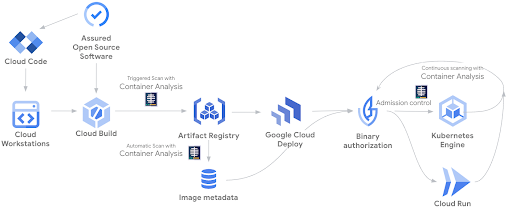
    At the Google Cloud Next ’22 conference, Google today launched a managed Software Delivery Shield (SDS) service to enable DevOps team to store, manage and secure the build artifacts in Artifact Registry. At its core, SDS is based on a trust-based policy engine to establish, maintain and verify a chain of trust across the software supply chain.

    In addition, Google has updated its container analysis tool to include vulnerability scanning for Maven and Go containers along with preview support for non-containerized Maven packages.

    The managed Software Delivery Shield service spans a range of Google runtimes environments, including Google Kubernetes Engine (GKE), Cloud Code, Cloud Build, Cloud Deploy, Artifact Registry and Binary Authorization. Cloud Build also now officially supports Supply chain Levels for Software Artifacts (SLSA) Level 3 best practices by default in addition to generating authenticated and non-falsifiable build provenance for both containerized applications and non-containerized Maven and Python packages.

    GKE, in preview now, provides detailed assessments, assigns severity ratings and surfaces the security posture of the clusters and workloads, including insights into operating system vulnerabilities, workload configurations and other actionable insights. Log data can now also be captured while security event information can be routed to, for example, a security information and event management (SIEM) platform.

    The Google Cloud Run serverless platform can also, in preview, display software supply chain security insights such as SLSA build-level compliance, build provenance and vulnerabilities found in running services.

    At the same time, Google is also making available in preview Cloud Workstations, which provide fully managed secure development environments on Google Cloud that can be accessed via a browser. Built-in security capabilities include virtual private cloud (VPC) controls, no local storage of source code, private ingress/egress, forced image updates and identity access management (IAM) policies.

    Finally, the Cloud Code plug-in for integrated development environments (IDEs) now includes a preview of Source Protect to give developers real-time security feedback in the form of vulnerability dependencies and license reporting as they write code.

    Collectively, Google claimed it now provides more than 250 curated packages across Java and Python with verified provenance. It also automatically generates a software bill of materials (SBOM) to create an inventory of all components and dependencies.

    Historically, cloud service providers have been advocating a shared responsibility approach to cloud security that required organizations to not only secure their applications but also the way cloud infrastructure is provisioned. The challenge is developers generally provision cloud infrastructure themselves even though they generally have limited cybersecurity expertise. Too many developers assume the underlying cloud infrastructure is more secure than it actually is.

    Now, cloud service providers are extending the security services they provide at a time when organizations are making security a bigger factor in determining where to build and deploy applications.

    Sunil Putti, vice president and general manager for Google Cloud Platform, said Google is attempting to make cybersecurity invisible to developers in the sense that guardrails will automatically be embedded within the platform.

    The issue is that cloud computing environments are becoming more complex as new classes of cloud-native applications are deployed alongside legacy monolithic applications. Complexity, as always, is the enemy of cybersecurity.

  • GitLab Allies With Google to Improve Developer Productivity

    GitLab Allies With Google to Improve Developer Productivity

    GitLab Inc., in collaboration with Google, today launched an open source Cloud Seed tool that makes it simpler for DevOps teams to consume Google Cloud Platform (GCP) resources.

    The Cloud Seed tool, announced at the virtual Google Cloud Next ’22 conference, is integrated within the GitLab web UI to make it simpler for developers to consume Google cloud resources—such as Cloud Run for building and deploying containerized applications—and the managed Cloud SQL database service.

    Nima Badiey, global vice president of alliances for GitLab, said the goal is to reduce friction that would otherwise be created by requiring developers to write code to consume these services using a set of lower-level application programming interfaces (APIs).

    That self-service approach not only improves productivity but provides the added benefit of reducing the odds those services might be misconfigured in a way that creates a cybersecurity vulnerability, he added.

    As it seeks to gain ground on Amazon Web Services (AWS) and Microsoft, Google has a vested interest in working with providers of DevOps platforms to make it simpler for developers to consume cloud resources. The challenge is that developers often make mistakes when they programmatically invoke cloud services. Those resulting misconfigurations are all too often not discovered and remediated until after there has been some type of cybersecurity incident.

    In the wake of a series of high-profile breaches of software supply chains, there is a lot more focus on security. The challenge, of course, is finding a way to ensure application development platforms are as secure as possible without slowing down the rate at which software is developed and deployed. Achieving that goal requires the right mix of policies, training and systems, said Badiey.

    Most organizations are trying to strike a balance between the need for greater security and their need to attract and retain developer talent. In theory, the rise of DevSecOps best practices is pushing more responsibility for security further left toward developers. However, most developers have little to no cybersecurity expertise, so it’s clear more guardrails need to be built into DevOps tools and platforms to prevent cybersecurity mistakes from being made.

    It’s not clear how much improved developer productivity and greater security will drive organizations toward one cloud platform versus another, but in an age where many more organizations now routinely employ two or more cloud platforms, it could make a significant difference. Developers don’t especially enjoy remediating applications after they are deployed in a production environment because they have generally already moved on to other projects. IT operations and cybersecurity professionals are also likely to nudge developers toward platforms that create the least amount of operational overhead for them.

    Regardless, one thing that is certain is compliance requirements are about to become stricter for all concerned as scrutiny of software supply chains intensifies in the months ahead. The issue now is how to proactively address those requirements before they become a much larger issue.

  • Protecting CI/CD Pipelines to Secure the Software Supply Chain

    Protecting CI/CD Pipelines to Secure the Software Supply Chain

    Cloud-native applications have become increasingly complex. Composed of an infrastructure stack of mash-up code, hundreds of open source and commercial components, services and APIs, today’s software supply chain is fraught with security risks. At the same time, the ability to manage existing application requirements while building innovation and taking on new areas of responsibility like security is stretching DevOps teams beyond their capacity. The concern for the number of connected and exploitable weaknesses across the software supply chain are now requiring organizations to take a proactive approach to protect their continuous integration and continuous delivery (CI/CD) systems, as they have become a target through which attackers infiltrate multiple production systems. But meeting this requirement is no easy feat as it often requires organizations to choose between how much security to enforce in the build cycle while quantifying their risk to build and deploy quickly. 

    A recent survey revealed that nearly all (97%) of an organization’s assets—and security issues—are now in the cloud. And yet, only 29% of an organization’s assets are associated with cloud-specific policies. Addressing this gap requires organizations to have a proactive approach to protect their technology infrastructure, especially securing the artery of their software supply chain: The CI/CD pipeline. By embracing new security and compliance strategies within their governance approach, organizations can better protect their CI/CD pipeline and cloud applications. 

    There is a growing shift toward programmable infrastructure and infrastructure-as-code (IaC) practices to build out infrastructure and manage configuration files. But with this practice comes the increased risk of exposing application credentials, API keys, encryption keys and digital certificates. Tools supporting the CI/CD pipeline have now become the artery of cloud applications, and it’s becoming more challenging to store, transmit and audit data securely. In addition, when CI/CD tools interact with other systems in the DevOps environment, it increases the risk of exposure for configuration files. A compromise in the build system, for example, can be used to get access to production systems that can result in the exposure of sensitive information or the injection of malicious code, corrupting the entire CI/CD pipeline and thus the software supply chain. 

    A recent Unit 42 Cloud Threat report revealed that overly permissive credentials created added risk opportunities in the CI/CD pipeline. The study found that 63% of IaC templates contained misconfigurations and 91% of container images contained high or critical security vulnerabilities. To address this, organizations need to catch security problems in the build process before cloud workloads are provisioned. During the SolarWinds compromise, for instance, attackers used custom malware designed for the company’s build cycle to observe each step. The sophistication of the intrusion in this attack during the software build process is a key lesson for DevOps and DevSecOps professionals and revealed how security needs to be approached. 

    One way to address this is by being able to identify CI pipeline misconfigurations, which can improve security in the software supply chain. Because CI pipelines are configured in the code, the same policy-as-code approach can be used to identify IaC misconfigurations or open source vulnerabilities to surface CI/CD weaknesses. DevOps and developer teams can keep configurations accessible to just a small group who are building for production release. By establishing enforceable permissions to the pipeline, there is better control over who can commit code changes to the repositories, create containers and deploy code to different environments. 

    Strong chains of trust throughout the build cycle are not commonplace today. But as organizations look at ways to strengthen their risk posture by shifting left, security and DevOps teams can work toward proactively hardening pipelines with the right CI/CD tools and frameworks and push the industry toward a more secure software supply chain. 

  • Business Leaders Will Trade Speed for Security

    Business Leaders Will Trade Speed for Security

    A global survey of 600 C-level executives conducted by CloudBees found that when it comes to building software, more than three-quarters of respondents said it is more important to be secure and compliant than fast and compliant.

    As a result, more than three-quarters (77%) also noted their organization is implementing a shift left strategy for implementing security and compliance even though 58% recognized that those efforts created additional burdens for developers.

    Three-quarters of respondents also conceded that compliance (76%) and security (75%) challenges limited their company’s ability to innovate. Nevertheless, 83% said shift left is important for them as an organization despite the fact that 88% of executives said their software supply chain is secure or very secure. However, only 33% of respondents said their software supply chain is completely compliant.

    Not surprisingly, 86% are focusing on compliance more now than they were two years ago and, in the wake of a series of high-profile breaches of software supply chains, 82% are more concerned about attacks.

    CloudBees CEO Anuj Kapur said it’s clear there is a greater need to reduce security and compliance burdens for developers by putting guardrails in place that automate DevSecOps processes. The survey noted that only 22% of executives believed their software delivery supply chain is completely automated, while another 37% said it is close to being automated. Only 22% said their compliance process is completely automated, with 35% believing it is almost completely automated.

    Three in five (59%) executives said they have all, or mostly all, external tools for security and compliance issues and 29% said they have a mix of internal and external tools. Only 11% use mostly internal tools. A full 90% said their risk management team has the tools, knowledge and expertise to build and/or maintain a secure software supply chain.

    The real challenge, of course, is that while compliance issues are relatively static, new security issues arise all the time. Developers make mistakes or a new zero-day vulnerability is discovered after an application has been deployed in a production environment. It’s critical for organizations to embrace automation to enable developers to address those issues as part of a continuously automated update cycle, noted Kapur.

    As more responsibility for compliance and security is shifted left, the degree to which DevOps workflows will need to be adjusted will naturally vary by organization. However, the days when developers could ignore security issues during the application development process are all but over. The leadership of organizations of all sizes are making it clear they want to see a reduction in the number of security and compliance issues that arise in production environments.

    Ideally, efforts to build more secure and compliant applications would not slow down the rate at which applications are being built and deployed. However, the CloudBees survey made it clear that more executives are willing to prioritize security and compliance over speed of application development. The issue is how to strike a balance between what are clearly two competing priorities.

  • GitBOM Tool Automatically Identifies Software Artifact Components

    GitBOM Tool Automatically Identifies Software Artifact Components

    An open source GitBOM tool, discussed at the Open Source Summit Europe conference this week, can automatically track every source code file incorporated into each built artifact.

    Nell Shamrell-Harrington, a principal software engineer for Microsoft, told conference attendees via a video link that the GitBOM tool, based on a compact Artifact Dependency Graph (ADG) technology, can verify which artifacts are being used across any programming languages, environments and packaging formats without any effort made by developers. To do this, GitBOM repurposes the directed acyclic graph made available in Git version control software.

    All that is required is for GitBOM identifier—a unique, content-addressable reference—to be inserted into the artifact at build time. That identifier then creates a Gitoid that can be consumed by ADG, Shamrell-Harrington said. Each Gitoid then views an artifact as a binary large object (BLOB) through which of all the components that went into it, including source files, dependencies and object files can be identified.

    Support is also included for the Software Package Data Exchange 2.3 format for sharing software bill of material (SBOM) information discovered by GitBOM.

    GitBOM can also detect potential vulnerabilities at runtime, regardless of the depth, in every software artifact that might be impacted to make it simpler for IT teams to remediate issues. That approach makes it simpler to find, for example, every instance of the Log4j vulnerability that might exist in an application environment. GitBOM only includes the minimum information required to create a fingerprint to enable efficient runtime scanning for a known-vulnerable artifact.

    The goal is not to replace SBOM tools but rather to make it easier for them to collect data about artifacts in the most frictionless way possible for developers, Shamrell-Harrington said. GitBOM enables any metadata to be linked to a specific set of corresponding software artifacts to make it easier to discover exactly how they were constructed. Artifact IDs can then be extended to produce GitBOM documents that can be consumed by other build tools.

    GitBOM is being shared at a time when the focus on securing software supply chains has never been higher. In the wake of the Log4j vulnerability disclosure, the Biden administration is requiring every federal agency to construct SBOMs to enable developers to find instances of vulnerable software components. Most large enterprise organizations are generally following suit.

    However, collecting SBOMs is only the first part of a bigger challenge. Organizations will then need to acquire tools to analyze SBOMs and provide feedback to application developers. In effect, eventually, organizations will be able to accept or reject software based on the components being used to create it. Armed with those insights, developers then have the option to upgrade software components to bring applications in line with any policy an organization defines.

    It may be a while before SBOMs proliferate across IT organizations, but the immediate issue at hand is simply finding the least-intrusive way possible to create them.

  • DevOps World 2022: Using SBOMs to Secure the Software Supply Chain

    DevOps World 2022: Using SBOMs to Secure the Software Supply Chain

    As supply chain attacks become increasingly prevalent, visibility is emerging as a necessity in cybersecurity. One way to improve visibility and secure your software supply chain is with a software bill of materials (SBOM). 

    An SBOM is a list of all the components within a codebase. By providing insight into open source and third-party components, SBOMs improve overall visibility and are integral to the identification of security or license threats. To properly secure the software supply chain, organizations must have an understanding of all the components in their applications; it is especially important to do so with containerized applications and those built using cloud-native, microservices-based architectures. That’s why SBOMs are becoming a cornerstone of a comprehensive application security strategy. 

    The Need for Visibility

    Gartner’s recent report Innovation Insight for SBOMs emphasizes the need for constant visibility into the software development life cycle and how SBOMs can help organizations and developers achieve that goal. While Gartner recognizes that open source software is a foundational component of modern software development, it also noted that it can be a major contributing factor in software vulnerabilities. 

    “While reusable components and open source software have simplified software development, this simplicity has exposed a critical visibility gap: Organizations are unable to accurately record and summarize the massive volume of software they produce, consume and operate,” the report said. “Without this visibility, software supply chains are vulnerable to the security and licensing compliance risks associated with software components.” 

    To mitigate the associated risks, Gartner’s report not only emphasizes the importance of SBOMs but the need to automate the SBOM creation and validation process. To achieve supply chain security at scale, organizations should automatically generate and verify SBOMs and use that data to constantly evaluate oncoming risks. 

    This ties directly into the continuous integration and continuous deployment (CI/CD) process, which uses SBOM data and assessments to ensure threats don’t slip under the radar and wreak havoc. You can more easily identify security vulnerabilities at any stage in the pipeline and remove them—because an SBOM gives you more granular visibility.

    The importance of SBOMs has even been noted by the U.S. federal government. As stated in president Biden’s Cybersecurity Executive Order 14028, any company that sells software to the federal government will be mandated to provide a complete SBOM. 

    The initiative has also spread to other branches of the government, with the Cybersecurity and Infrastructure Security Agency also emphasizing the significance of SBOMs. 

    “CISA will advance the SBOM work by facilitating community engagement, development, and progress, with a focus on scaling and operationalization, as well as tools, new technologies, and new use cases,” said CISA in a statement on its website.

    SBOM Requirements

    The U.S. Department of Commerce and the National Telecommunications and Information Administration (NTIA) have outlined the minimum elements required. For one, data fields with baseline information about each component are required. Also, automation support is needed, as SBOMs necessitate machine readability for support at scale. Finally, the need for practices and processes was outlined, calling for frequent SBOM generation, including transitive dependencies and widespread availability of this information to those who need it. 

    On many fronts, SBOMs have become non-negotiable throughout the software industry. In order to effectively detect and respond to threats, organizations must take preemptive steps to ensure visibility is maximized, and SBOMs accomplish just that.


    Want to learn more about this and other related topics? Join CloudBees for DevOps World 2022, held in Orlando, Florida, at the World Marriott Center. Use discount code DW22 when registering and get access to all the fantastic offerings, including keynotes, sessions, training and other interactive activities. We can’t wait to see you there for the DevOps Remix!

  • Supply Chain Security: Has the Next SolarWinds Already Happened?

    Supply Chain Security: Has the Next SolarWinds Already Happened?

    More than two years after the now-infamous hack of the firm SolarWinds, the incident is very much in the foreground of conversations about cybersecurity defense, threat detection and incident response. As evidence of that: The SolarWinds incident was the subject of five separate talks and panels at the recent RSA conference in San Francisco. Dozens more talks addressed issues related to supply chain security that–directly or indirectly–invoked the SolarWinds incident. 

    That’s because the SolarWinds attack raises important—if not existential—questions for both software development and DevOps teams and the companies running the software. First: If sophisticated cybercriminals can insert malicious backdoors directly into application code from reputable developers, what organization can afford to blindly trust software? Second: If it is now the responsibility of software teams  to spot sophisticated, methodical compromises of their development pipelines, what is the best and most reliable means of doing that? Finally, if it is also now the job of software consumers to monitor for—and detect—compromised binaries from otherwise reputable vendors (like SolarWinds), how should they go about doing that given ongoing staffing and technology constraints? 

    The answers to these questions are matters of debate within DevOps, software development and information security communities. What is beyond debate is that the SolarWinds incident was not a fluke. In the months since that attack, attackers—both criminal and nation-state-backed—have leveraged software supply chain security blindspots to target development organizations as means of gaining access to sensitive IT environments. While we haven’t yet heard of another incident of the scale or importance of SolarWinds, it is entirely reasonable to assume that the next SolarWinds-caliber compromise could already be unfolding, but has yet to be discovered and/or publicly acknowledged. 

    Software Supply Chain Security Weaknesses

    SunBurst, the malicious implant in SolarWinds software, endures as a topic of interest and conversation for information security professionals and for DevOps and development organizations precisely because of the ways it exposed glaring weaknesses in the security of development organizations and software supply chains. As noted in my analysis of the hack in December 2020 and FireEye’s analysis of the same compromise, the SolarWinds hackers gained access to the company’s development environment months before they actually launched their attack. During that time, they closely studied the underlying source code and mimicked SolarWinds style and nomenclature as they added malicious code and integrated it into the SolarWinds Orion application via a compromise of the company’s build system.  

    Though carefully planned and conducted, the SolarWinds attack wasn’t foolproof. The attackers left clues, such as their additions of native Windows functions, use of cryptography, compression and more. The attackers obfuscated these using compression and Base64 encoding designed to fool simple threat hunting rules that looked for their plaintext variants and other suspicious strings. Still, the obfuscation repeated throughout the implanted code was enough to send up a red flag to anyone who bothered to look closely. That left the attack open to discovery. 

    The problem is this: Very few software publishers have the staff, expertise or tooling to comb through massive codebases to spot a handful of sketchy obfuscated strings or analyze large binaries for deviant behaviors before deploying them. As evidence of this, ReversingLabs sponsored a survey of more than 300 IT professionals at software-driven enterprises. It found that 87% were aware that software tampering, like what occurred in the SolarWinds attack, could lead to enterprise security breaches. About 40% of those surveyed said CI/CD toolchain exposures posed a risk to their organization. Still, barely a third of respondents (37%) said they had the means to detect such software-tampering attacks. 

    Threats to Software Development Organizations Grow

    Attackers are aware of this weakness within the software development pipeline, which is why threats to development organizations are metastasizing. Just in the last year alone, we have seen a series of attacks on development infrastructure and software supply chains. In one April 2021 incident, attackers were successful in pushing malicious, unreviewed code directly to the PHP main branch, ultimately resulting in a compromised, formal version of PHP being pushed to all PHP websites. That same month, there was a breach at the firm CodeCov, which involved unauthorized access to and modifications of the company’s Bash Uploader script. An investigation of that incident ultimately concluded that the alteration of a single line of code in that script by an unauthorized third party enabled the attackers to (potentially) export information stored in the users’ continuous integration (CI) environments. 

    More recently, ReversingLabs observed proof-of-concept and “white hat” activities testing so-called “dependency confusion” attacks, in which attackers set up malicious packages in public repositories like GitHub that squat on the names of private, non-public repositories and sport high version numbers. Misconfigurations in package management systems can result in these malicious components being imported in lieu of the legitimate, privately managed namesakes. As ReversingLabs found, a number of malicious modules discovered on the npm platform were used to target German technology, manufacturing and entertainment firms. It was later revealed to be the work of a white hat firm conducting red team exercises on behalf of those firms. Red team exercises aside, RversingLabs research also detected other, malicious packages in npm, as well as similar attacks targeting Ruby Gems and Python Package Index (PyPi). 

    And that doesn’t even count issues like the Travis CI flaw that exposed (potentially) millions of credentials to developers’ accounts on GitHub, Amazon Web Services and Docker Hub. Lapses like that can fuel supply chain attacks, giving malign actors the ability to insert malicious code into otherwise legitimate open source or proprietary code repositories. After reading such headlines, and without the means to check code intent, how can developers trust their software to update? And how can they do so while at the same time being forced to frequently update their dependencies to reduce or eliminate critical software vulnerabilities?

    Dev Teams Need New Tools

    For software development organizations struggling to meet delivery deadlines and satisfy customer expectations, reorienting to address amorphous software supply chain threats and attacks is a bridge too far. The same is true for enterprises struggling to staff security teams and simply keep on top of targeted phishing attacks or threats to public-facing IT assets. Too often, these entities only find religion about software supply chain attacks after they have occurred. 

    What software development organizations need is a way to secure the CI/CD pipelines and release packages, ensuring that their software builds are free of code tampering and other supply chain risks introduced through build systems. That should include the ability to detect compromises by monitoring for malicious software changes and enforcing security controls and failure conditions on software build processes to ensure that you can release your code with confidence.

    On the customer end, organizations need a way to detect malicious behaviors and unauthorized software changes in compiled binaries before they are released into production, while also monitoring for risks like exposed secrets or exploitable software vulnerabilities that might lurk in compiled code. 

  • GitHub Brings 2FA to JavaScript Package Manager

    GitHub Brings 2FA to JavaScript Package Manager

    GitHub has made generally available a two-factor authentication tool for the package manager for JavaScript applications maintained by its NPM, Inc. arm.

    In addition, all npm packages have been re-signed and there is now an npm command line interface (CLI) command to audit package integrity.

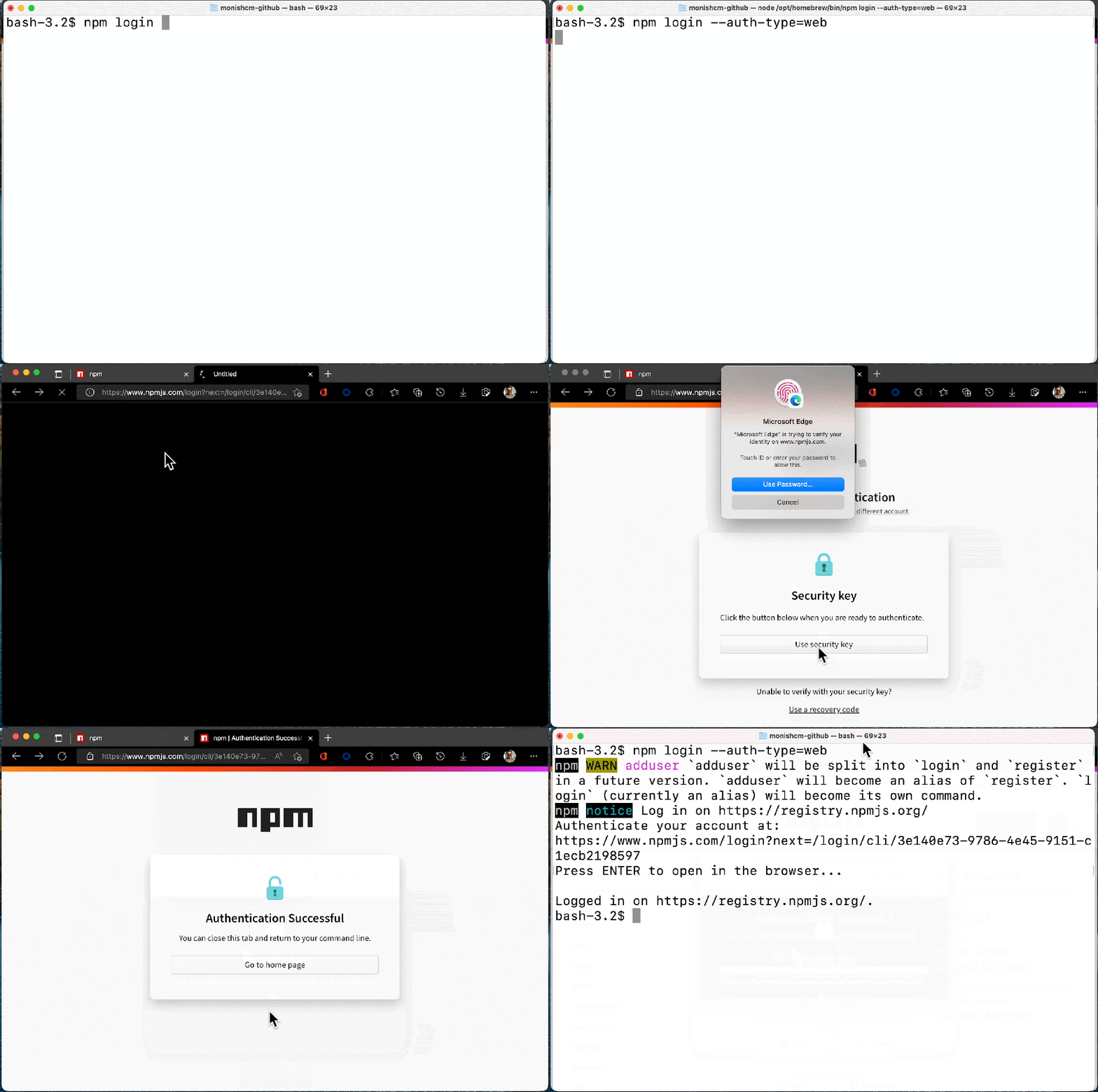
    Finally, GitHub has added the ability to connect GitHub and Twitter accounts to npm along with a streamlined login and publishing experience with the npm CLI.

    Myles Borins, staff product manager for open source at GitHub, said these enhancements are part of an ongoing effort to enable organizations to better secure their software supply chain by better protecting credentials against being used to take over GitHub accounts.

    There isn’t a huge volume of these types of attacks, but it’s apparent cybercriminals are attempting to compromise the security of software supply chains by gaining illicit access to the platforms used to build applications, noted Borins. Once cybercriminals gain access, they could potentially insert malware in software components that could find its way into any number of downstream applications. That malware can then be used to, for example, potentially launch a ransomware attack or simply exfiltrate data. More troubling still, that malware might begin to spread laterally across an entire application environment.

    GitHub is currently dealing with the fallout from a report that its repositories were attacked; that turned out to be a false alarm. The repositories attacked turned out to be either forks or clones of real, popular repositories with names similar to legitimate repositories on the GitHub platform. No malicious code was actually merged into any of the original repositories; however, it’s apparent cybercriminals are using a technique known as spoofing commit metadata to attempt to trick developers into committing code to a fake repository.

    The challenge that GitHub is trying to navigate is the degree to which some security controls should be enabled by default based on the level of risk, said Borins. Individual developers, for example, might have a higher tolerance for risk than an enterprise IT organization building an application that is core to the processes that drive the business, he noted. In some cases, organizations may opt to restrict access altogether whenever a user name/password can’t be remembered while others will simply limit access to ensure productivity is maintained, added Borins.

    In general, the average enterprise IT organization is likely to have a higher tolerance for disrupting workflows to make sure critical intellectual property is always protected, he added.

    The critical issue, of course, is no one knows for sure what open source component might one day wind up in what application. Regardless of the type of application, developers now routinely reuse code that could contain any number of known vulnerabilities or zero-day vulnerabilities that have yet to be discovered. The foundation for building secure DevSecOps workflows for most organizations at a bare minimum is going to start with implementing two-factor authentication, said Borins.

    Regardless of the DevSecOps approach, just about everyone recognizes there is a need to better secure software supply chains. The one thing that remains to be determined is what impact achieving that goal might actually have on the rate software is being built and delivered.

  • CREST Defines Quality Verification Standard for AppSec Testing

    CREST Defines Quality Verification Standard for AppSec Testing

    At the Black Hat USA 2022 conference, CREST today shared a quality assurance verification standard to improve application security testing. The standard is based on the open source framework defined by the Open Web Application Security Project (OWASP).

    Tom Brennan, executive director for Americas at CREST, said the OWASP Verification Standard (OVS) measures an organization’s ability to execute and deliver assessments related to Level 1 and Level 2 of the OWASP Application Security Verification Standard (ASVS) and OWASP Mobile Application Security Verification Standard (MASVS).

    The goal is to provide a consistent methodology for accrediting companies that provide application security testing services, said Brennan. Ultimately, organizations of all sizes will then be able to require application software providers to pass an OWASP accreditation test rather than testing the security of every application they use, he noted.

    Organizations need to be accredited through CREST Penetration Testing to apply for the OVS program, which requires companies to demonstrate that they can meet the program requirements and execute and deliver Level 1 and Level 2 ASVS and MASVS services. Level 1 determines whether or not applications store or handle sensitive data; that determination then defines whether or not they need the more rigorous controls of Level 2 or 3. Level 1 controls can be checked either automatically using tools or manually without access to source code. Level 2 ensures that security controls are in place, effective and used within the application. In addition, all organizations will need to ensure that their teams have completed CREST’s Skilled Person Register and have each signed the CREST code of conduct.

    CREST is a nonprofit organization that was originally known as the Council of Registered Ethical Security Testers. CREST works with governments, regulators and multinational organizations to improve application security using CREST OVS Mobile and CREST OVS Apps accredited services. It’s becoming more common for organizations to require OVS to better ensure application security in much the same way they require compliance with frameworks such as the System and Organization Controls (SOC) framework, said Brennan.

    OWASP is administered by a separate nonprofit foundation that works to improve the security of software by sponsoring community-led open-source software projects and training application developers. By aligning with OWASP, CREST creates a verification standard to provide a more structured approach to implementing ASVS and MASVS, noted Brennan.

    OVS, of course, is arriving at a time when there is now a much greater focus on software supply chain security in the wake of a series of high-profile breaches. It is apparent cybercriminals have become more adept at discovering and exploiting a wide range of known software vulnerabilities. The Biden administration has even gone so far as to issue an executive order requiring federal agencies to review the security of their software supply chains.

    It may be a while before application testing using OVS becomes routine, but as more organizations embrace DevSecOps best practices to secure their software supply chain it’s clear there is a greater need for application security testing standards. Especially those that organizations can extend versus reinventing the wheel.