Tag: skills

  • Industry benchmarking tools to fill skills gap

    Cloud Academy, an enterprise-ready training platform that accelerates teams and digital transformation, is announcing industry benchmarking tools designed to help organizations define the critical job roles and technical skills needed for cloud adoption and ongoing competitiveness.

    One example of Cloud Academy’s data includes a comparison of AWS, Microsfot Azure and Google Cloud. The data indicates knowledge of AWS is far above the other two (image below). Other examples include required skills (image below), trending skills and job role demand by geo, trending technology and real-time, data-driven definition of cloud job roles.

    Any interest in speaking to Cloud Academy? Or, would you like to speak to customers (such as Turner or Pokemon’s head of security), receive data and visuals, or review the embargoed release?

    Screen Shot 2018-10-12 at 2.36.45 PM.png

    Screen Shot 2018-10-12 at 1.34.30 PM.png


    Comparison between R and Python: While R is getting significant hype, the data shows that Python is actually the language most organizations require prospects know.

  • How to Find and Hire Android Developers in 2018

    How to Find and Hire Android Developers in 2018

    A brilliant app idea demands no less a brilliant mobile development team. That means you have to take the time to search and recruit skilled Android developers and, correspondingly, overcome lots of challenges for this. Here are some tips to help you overcome the difficulties and mitigate possible problems in finding qualified Android developers.

    Roles and Responsibilities of Android Developers

    It’s always a good idea to dive deeper into your employees’ responsibilities. So if you have no technical background, this section will be rather useful for you as it tells more about the skills of a proficient Android developer.

    It’s worth mentioning that the technical skills of Android and iOS developers differ due to the OS differences. A particular set of technologies is used for each OS and if you want to hire iOS developers, you should check the skills they need to have according to the latest market demands.

    Skill Level

    In the IT industry, developers are divided into levels specifying their proficiency. These levels are:

    • Entry level means a developer hasn’t had much experience in developing software products. Junior Android developers typically work on simple projects and they’re curated by more experienced colleagues.
    • Experienced developers work on complex projects and don’t have managerial responsibilities.
    • Senior developers typically have 5+ years of experience and often lead big projects as well as supervise the performance of technical tasks.

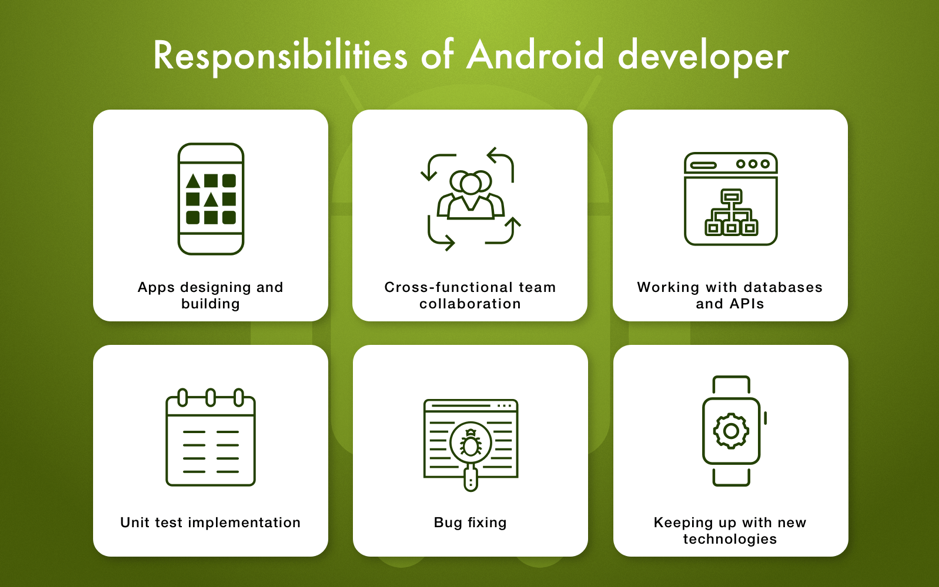
    Responsibilities

    Let’s consider Android developers responsibilities in more details.

    UI Engineering and Business Logic Development

    Developers have to re-create the app’s design as well as develop its functionality. Additionally, they should predict what bugs may occur and prevent their appearance.

    Collaborative Skills

    In most cases, developers don’t work on a project alone. They are surrounded by other specialists and need to effectively collaborate with them in order to achieve a common goal: a well-functioning end product.

    Databases and Third-Party APIs

    Android developers should be good enough at reading code written by other developers since they will have to work with external APIs and databases during their projects.

    Unit Testing

    Modular testing is a kind of industry standard. Android developers have to perform it to test a certain part of the app’s functionality and fix any bugs. Unit testing is a part of agile software development that’s designed to create high-quality apps fast.

    Bug Fixing

    Android developers should make everything possible to deliver a bug-free and stable-working product.

    Types of Android Developers

    There are several types of developers you can choose from. Which one to pick depends on your preferences and project.

    • Freelance developers. This type can be a good choice if you are on a limited budget and you want to save as much money as possible. However, bear in mind that, in fact, you have no control over freelancer’s work and all that remains is to rely on their responsibility.
    • In-house developers. These are the ones working on your project at your company’s office. It’s a good option in case you already have an office space and you want to manage the development on your own.
    • Outsourced team. The scheme is simple: You hire a software offshoring company, explain to them your requirements and they build a project for you from scratch.

    Technical Skills of Android Developers

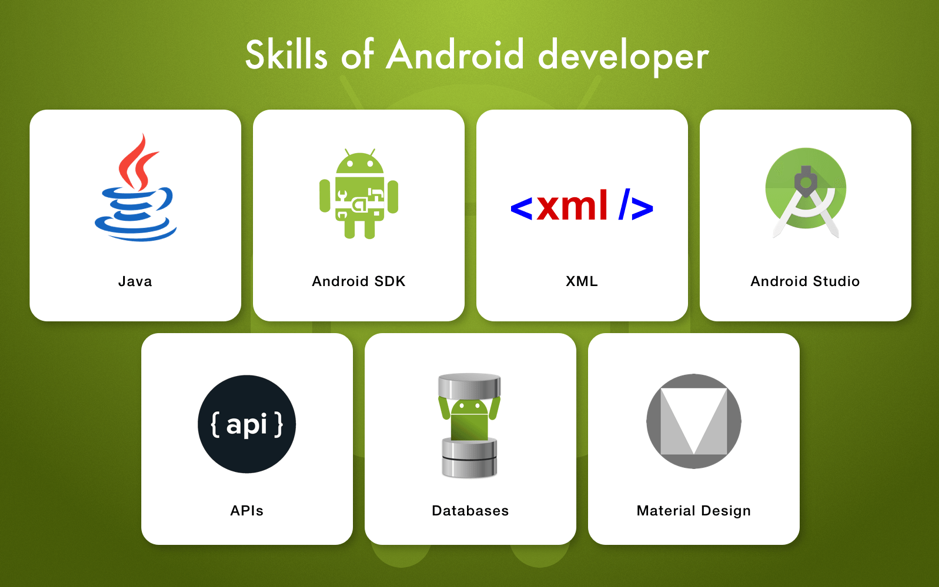
    Android developers must have a set of technical skills that actually make the app development possible. Underneath, we’ve listed basic technologies every Android developer should be able to work with.

    • Java: This is the official language for developing Android apps. This object-oriented language was created in 1995 and currently it’s the world’s most popular programming language. Every Android developer must have a decent knowledge of this language to build software.
    • Kotlin: This is the second official language for Android development and many programmers are switching to it for various reasons.
    • XML: Extensive Markup Language is broadly used for web development, but it is a necessary technology for Android development as well. In simple terms, XML is designed to provide the information exchange via the internet. So, if your app needs to be connected with the internet, developers have to use XML.
    • Android SDK. Android software development kit is a set of programs for various purposes. For instance, it has the integrated tools for debugging, code testing, checking the compatibility with different OS versions, etc.
    • Android Studio. It is an integrated development environment (IDE) developers use to write source code conveniently. This is possible due to a variety of built-in instruments (e.g. preview app for different OS versions).
    • APIs: The ability to work with third-party APIs and integrate them into software is another requirement for Android developers. For example, if you need in-app payments, developers can use Stripe API and adapt a ready-made code to the app’s needs instead of architecting the payment system from scratch.
    • Databases: Android developers should have skills of integrating cloud databases such as Firebase or local ones such as SQL for storing your app’s data.
    • Material Design. It is the Android design language and developers should be acknowledged with its guidelines to build the app’s user interface in the right way.

    Android Developer Rates

    The price for IT services is typically indicated for one working hour. The prices also heavily depend on a region.

    • North America: $150-170/h
    • Australia: $110/h
    • Western Europe: $70/h
    • Eastern Europe: $35-50/h

    Now you know what it takes to find a qualified Android developer!

    — Nataliia Kharchenko

  • Updating Your Skills for the Internet of Things

    Updating Your Skills for the Internet of Things

    The internet of things (IoT) is breaking rules. For example, in many cases IoT designers purposely limit the processing power and connectivity of IoT devices. Making devices with less processing power and connectivity may buck the IT trends of recent years, but IoT is changing some of the assumptions and approaches of traditional IT. IT professionals moving toward IoT will need to learn some new skills, strategies and technologies.

    IoT devices are smart (having their own embedded processor) and connected (often using wireless networks). But setting up, configuring, programming and maintaining an IoT device is very different from doing those tasks on a traditional computer. The typical IoT device is purposely configured with extremely limited processing power, memory and data communication capabilities. A device may not have a user interface other than perhaps a power button and a few LED lights. These constraints have positive effects; they make IoT devices both inexpensive to produce and downright miserly in their use of electrical energy. And IoT devices may even extract energy from the environment around them, a feat called energy harvesting. This design strategy enables devices to be located anywhere, even in remote locations where electrical power sources and connectivity may be limited.

    Sensors on IoT devices can collect a mind-boggling variety of readings, such as the temperature of frozen food in a delivery truck, the volume of traffic passing through an intersection, the quality of soil in a particular location of a farmer’s field and countless other measurements. The sheer volume of data produced by IoT devices must be processed, interpreted and handled securely. At the same time that IoT is dramatically increasing data volumes, it is also creating new challenges to keep that data secure and private.

    Real-time data processing and networking enable data to be collected, processed and acted on very quickly. Based on intelligence provided by the data, an immediate, automated response may need to be triggered. For example, the temperature in the refrigerated delivery truck may need to be adjusted. The brakes in a smart car may need to be activated to avoid a collision. Or the mix of chemicals may need to be modified as a spraying machine advances through a farmer’s field, based on soil samples taken at the sprayer’s exact geographic location. The ability to process and act upon data so quickly seems at odds with the limited power and capabilities of the typical IoT device. But special operating systems and data processing strategies enable these real-time operations to be performed efficiently.

    Edge computing provides another strategy for processing the data from IoT devices. Rather than perform all heavy processing tasks in the cloud, edge computing moves some processing tasks back to the edge—where the local network meets the cloud. This means placing some sort of heavy processing capability near the IoT devices, and using an IoT gateway to “do the heavy lifting” on behalf of IoT devices. The gateway can handle all communication with the cloud, so the IoT devices themselves can use lightweight communication protocols and (safely behind a firewall) won’t require the same security capabilities (such as heavyweight encryption processing) that they would require if they were directly connected to the internet.

    New methods of data processing and analysis are used to make sense of the massive quantities of data produced by IoT. Data analytics tools such as Azure Stream Analytics, Vitria, and Statistica are geared toward IoT. Big data and cloud storage technologies, such as Hadoop and NoSQL database systems, take on new importance with IoT.  So do more traditional skills such as SQL. Machine learning and artificial intelligence technologies will also play a critical role for processing IoT data.

    IT professionals preparing to move to IoT should consider adding some of the following skills to their portfolio:

    • Working with microcontrollers, sensors and actuators.
    • Programming real-time operations on microcontrollers.
    • Embedded device power management and deployment of energy harvesting technologies.
    • Selecting, installing and configuring real time operating systems.
    • Setting up and configuring sensor networks and IoT gateways, including communication technologies geared toward these networks, such as MQTT, 6LoWPAN, Thread and Zigbee.
    • Managing cybersecurity on embedded devices and sensor networks.
    • Working with data analytics tools, advanced SQL, cloud storage and NoSQL databases, artificial intelligence and machine learning.

    CertNexus is looking for IT professionals to take the CIoTP beta exam. The Certified IoT Practitioner is meant for those seeking vendor-neutral, cross-industry, foundational knowledge on the internet of things. If you are interested in taking the CIoTP beta exam, please email info@certnexus.com.

    — Brian Wilson

  • Finding, and Landing, the Right Job for You

    Finding, and Landing, the Right Job for You

    Following my article discussing the “7 Steps to DevOps Hiring Success,” it seemed fitting that I continue and discuss the seven steps to DevOps job-search success, with the focus on candidates rather than hiring managers.

    Whether you’re a hands-on DevOps practitioner or a lead, VP, director or any other title, in this space you’re in hot demand. However, some of you are reading this and thinking, “What is this guy talking about!? I’ve been searching for a new job for two months and haven’t even got past the recruiter interview to speak with the hiring manager.” Well, this article may be for you—or it may be for someone you know.

    Are You Selling Yourself Correctly?

    Your resume, LinkedIn profile, URL to your personal website and any other methods you may be using, make sure you’re making those first impressions count. Your LinkedIn profile should be up to date with relevant content. Do hiring managers need to know that you worked in a part-time job in the local grocery store 10 years ago? No. They do, however, want to see what you have achieved in your current and previous roles.

    Many who come from systems administration or infrastructure backgrounds aren’t selling themselves correctly. If you have been using configuration management tools such as Chef, Puppet, Ansible or Saltstack, you should include this in your resume. The same goes for container orchestration tools, such as Docker and Kubernetes, continuous integration tools and so on. Don’t create an exhaustive list, but note which you have used and how they allowed you to achieve the goals of the project.

    Market Yourself on the Right Platform

    Don’t bother uploading your resume onto every single job board; this just wastes yours and other people’s time. Definitely upload your resume to the right locations, though. Dice.com, Indeed.com, Ladders.com, Hired.com and Monster.com are some of the go-to job boards. (There are others, of course, and I’d be happy for others to comment with opinions on other job boards through which they have found success.) There aren’t many specialist DevOps recruitment companies out there, but I can drop a shameless plug and mention that my team at Salt are always worth speaking to, whether it’s for consultation on the current market trends or to actively search for your next move.

    Drop Your Ego, Too!

    In my last blog I told hiring managers to drop their ego when it comes to hiring. Sometimes candidates need to drop theirs, too.

    “I won’t consider working at any company that won’t let me wear a batman outfit every day of the year, barefoot and with an automated snack machine that unwraps protein bars before passing them directly into my mouth.” Stop being so entitled.

    Don’t get me wrong: I love freedom of expression and the idea of wearing whatever you want. I’d also love an automated protein-bar snack machine that feeds me! But be open-minded and don’t put roadblocks in your own way—it’s no good for anyone. It’s all about opening as many doors as possible at the start and focusing your options once you truly know what you’re looking at. That one company you may have declined to even consider might have given you the opportunity to work with the best people you’ve ever met, on the coolest and most innovative products you’ve ever imagined. And who knows, maybe they would have been the next Netflix, Twitter or Snapchat. Stay open-minded.

    Is the Recruiter You’re Speaking With Reputable?

    Some recruiters are generalists. That’s not a bad thing all the time, but when we are talking about a niche area with a plethora of technical skills to understand, it helps to speak with people who know what they are talking about and can easily decode your likes, dislikes and overall background. Check out the recruiter’s LinkedIn profile: Do they have recommendations from other clients and candidates in the same tech space, or have they only been referred by other recruiters? If you’re going to trust them with finding your next career move or contract, it’s worth ensuring that you’re speaking to the right person to support your needs. Speak to other folks in the space—who did they use to find their dream job? That could be a good start.

    Rapport Isn’t Just for Salespeople

    Do you have amazing technical skills but no knowledge of the company? You’re starting off on the wrong foot. It doesn’t take five minutes to research the company prior to your interview. Go to the company’s website and click on the “About Us” section. To show you actually care, think about your own passions and values and demonstrate how they align with those of the company. Hiring managers love this, so try to make it genuine.

    Now to really make a good impression, why don’t you check out the interviewer on LinkedIn? Look up their background: What are their hobbies? Where did they work previously? Do you have any mutual connections? You’d be surprised: Asking them about their triathlon last month or mentioning that you both worked with Rita Smith on X project five years ago often can go as far as passing the technical test with flying colors. Remember, this doesn’t need to be time-consuming; just take a quick look and find something you have in common to build some rapport.

    Stay Relevant

    Searching for a new job doesn’t just mean sitting behind your laptop or making calls. Be sure to attend events and conferences to continue learning and networking. You’ll often bump into hiring managers or other team members who could end up being future colleagues. Also, promote yourself at events via social networks; for example, take some pictures, tweet about the event and/or share some content from the event on sites such as LinkedIn. This reinforces that you are part of this DevOps community and someone worth connecting with. Meetups for New Yorkers, for example, include DockerNYC, AWS NYC, ServerlessNYC, Continuous Delivery NYC and many more. There are also conferences such as DevOpsDays, Container Days and CloudExpo, among others. There are plenty of options in other cities and countries, too.

    Making the Right Decision for You

    Figure out what drives you, be it interesting projects, money, great working environments, awesome teams, job titles, making an impact or a mix of all the above. Now it’s rare to have two perfectly identical opportunities on the table, but if you’re lucky enough, you will have two, three or more job offers to choose from prior to signing on the dotted line. Deciding can be tough, and this is something I have to support people with on a daily basis from a non-biased perspective. I’ve seen people walk away from $250,000 to $300,000-level salaries to take a job paying $180,000. Why? Because they looked internally and realized that the other role suited their lifestyle, allowed them to continue playing an important role in their family life and the work was way more stimulating. In a different scenario, another individual might have been way more suited to taking the other position.

    Once you’ve decided what really matters to you, there are a few simple things you can do to help with making these tough decisions. Start with getting a pen and paper to list out the pros and cons of each job. You’d be surprised how effective such a simple process can be for visualization and helping to clear your mind. Once you’ve had this internal discussion and opportunity to visualize, you should engage with some trusted resources. Speak to your partner, family members and former colleagues who know how it is to work with you. Finally, consult with your recruiter if you’ve been using one; a good recruiter should provide non-biased advice with the goal of helping your career.

    As a final point, I know the job-searching process can be arduous for many people, but for those who have many options to choose from, enjoy it! Realize how lucky you are; don’t take these times for granted and be proud that you have such in-demand skills.

    About the Author / Conor Delanbanque

    conordelanbanque

    Conor Delanbanque has been recruiting and leading recruitment teams in the DevOps space for the past few years. As well as being exclusively responsible for growing some of the most innovative DevOps & SRE teams in the US and Europe as an external consultant and recruiting partner, Conor also founded the Future of DevOps Thought Leaders Debate, sponsors DockerNYC Meetup on a regular basis and co-hosts ServerlessNYC. You can tweet him at @ConorDevOps, find him on LinkedIn or at events, expos and writing articles on devopsy.kinsta.cloud.

  • 7 Steps to DevOps Hiring Success

    7 Steps to DevOps Hiring Success

    As many of us in the DevOps scene know, most companies are hiring, or, at least, trying to do so. The required skills and job descriptions can change entirely from company to company. As a broad overview, most teams are looking for a candidate from either an operations and infrastructure background or someone from a software engineering and development background, then combined with key skills relating to continuous integration, configuration management, continuous delivery/deployment and cloud infrastructure. Currently in high-demand is knowledge of container orchestration.

    In the ideal world, the two backgrounds will meet somewhere in the middle to form Dev and Ops, but in most cases, there is a lean toward one side or the other while maintaining sufficient skills to understand the needs and demands of their counterparts to work collaboratively and achieve the end goal of continuous delivery/deployment. Every company is different and there isn’t necessarily a right or wrong here. It all depends on your infrastructure, tech stack, other team members’ skills and the individual goals you hope to achieve by hiring this individual.

    Focus Your Hiring

    Now, given the various routes to becoming a DevOps practitioner, how do hiring managers focus their search and selection process to ensure that they’re hitting the mark?

    Decide on the Background

    Assess the strengths of your existing team. Do you already have some amazing software engineers but you’re lacking the infrastructure knowledge? Aim to close these gaps in skills. You may have been given the budget to hire for DevOps, but you don’t have to spend weeks/months searching for the best software engineer who happens to use Docker and Kubernetes because they are the current hot trends in this space. Find the person who will provide the most value in your environment and go from there.

    Contractor or Permanent Employee? 

    Many hiring managers will automatically start searching for a full-time permanent employee when their needs may suggest that they have other options. Sometimes a contractor is your best bet or maybe contract-hire. If you’re aiming to design, implement and build a new DevOps environment, why not find a senior person who has done this a number of times already? Try hiring a senior contractor and bring on a junior full-time hire in parallel; this way, you’ll be able to retain the external contractor knowledge by having them work alongside the junior hire. Contractors can be expensive, but the knowledge they bring can be invaluable, especially if the work can be completed over a shorter time frame. Again, this is just another point of view and you might be best off with a full-time hire to grow the team.

    CTRL F is not the Solution

    Focus on their understanding of DevOps and CI/CD-related processes over specific tools. I believe the best approach is to focus on finding someone who understands the methodologies over the tools. Does your candidate understand the concept of continuous integration or the concept of continuous delivery? That’s more important than asking whether your candidate uses Jenkins versus Bamboo versus TeamCity and so on. Try not to get caught up in the exact tool chain. The focus should be on the candidates’ ability to solve problems. Are they obsessed with increasing efficiency, saving time, automating manual processes and constantly searching for flaws in the system? They might be the person you were looking for, but you missed them because you didn’t see the word “Puppet” on the resume.

    Work Closely with your Internal Talent Acquisition Team and/or an External Recruiter

    Be clear and precise with what you’re looking for and have an ongoing, open communication with recruiters. They can and will help you if used effectively. The job of these recruiters is to save you time by sourcing candidates while you’re focusing on your day-to-day role. Work closely with them and deliver in the same way that you would expect them to deliver for you. If you say you will review a candidate by X time, do it. If they say they’ll have a candidate in your inbox by Y time, make sure they do it, too. Start by setting up an initial call to talk through your requirement, lay out a timeline in which you expect candidates by a specific time and explain your process in terms of when you will interview, how many interview rounds and how soon after you will be able to make a final decision on whether to offer or reject the candidates. If you can get this relationship working well, you’ll save lots of time. And make sure your internal teams are focused on supporting your process, not blocking it.

    $$$

    Decide how much you want to pay. It’s not all about the money, but you can waste a lot of your and other people’s time if you don’t lock down the ballpark salary or hourly rate that you can afford. If your budget doesn’t stretch as far as your competitors’, you need to consider what else can help sell the opportunity. Flexible working hours and remote working options are some great ways to do this. Most companies have snacks, beer and cool offices nowadays, so focus on the real value such as the innovative work your team is doing and how awesome your game-changing product might be.

    Drop the Ego

    You may have an amazing company and/or product, but you also have some hot competition. Everyone is hiring in this space and candidates have a lot of the buying power. It is no longer as simple as saying, “We are hiring” and the awesome candidates come flowing in. You need to sell your opportunities. Maintaining a reputation as a great place to work is also important. A poor hiring process, such as interviewing without giving feedback, can contribute to bad rumors being spread across the industry. It only takes a few minutes to leave a sour review on Glassdoor.

    A Smooth Process is a Successful One

    “Let’s get every single person within the company to do a one-hour interview with the new DevOps person we are hiring!” No, let’s not do that. Two or three stages should be sufficient. You have managers and directors for a reason. Trust your instinct and use your experience to make decisions on who will fit into your organization. Some of the most successful companies can do one phone screen followed by an in-person meeting. During the in-person interview, spend a morning or afternoon allowing the candidate to meet the relevant leaders and senior members of their direct team, then take them for lunch, dinner or drinks where you can see how they are on a social level. If you can’t have a simple conversation with them, then you probably won’t enjoy working with them. If the thumbs are up, make the hire and don’t wait around. A good candidate will usually have numerous offers on the table at the same time.

    If all goes well, you should be inviting your shiny new employee or contractor into the office in the next few weeks and hopefully many more throughout the year.

    About the Author / Conor Delanbanque

    conordelanbanque

    Conor Delanbanque has been recruiting and leading recruitment teams in the DevOps space for the past few years. As well as being exclusively responsible for growing some of the most innovative DevOps & SRE teams in the US and Europe as an external consultant and recruiting partner, Conor also founded the Future of DevOps Thought Leaders Debate, sponsors DockerNYC Meetup on a regular basis and co-hosts ServerlessNYC. You can tweet him at @ConorDevOps, find him on LinkedIn or at events, expos and writing articles on devopsy.kinsta.cloud.
     

  • 3 Skills Developers Should Master in 2016

    3 Skills Developers Should Master in 2016

    The era of mobile and web is upon us, which has caused nearly every business decision-maker to ask the question, Is now the time to hire a developer to build our app or website? In 2016, businesses are going to be looking for the best developers to join their team and help scale their business. We’ve already started to see this trend, as a recent Harvey Nash Technology Survey 2016 found that developers are the most sought-after of all technology personnel.

    To stand out from the pack, developers must master the critical skills businesses are looking for. The most valuable developers will be those who can adapt to the changing technology landscape and further hone their craft to help companies scale and solve specific business challenges.

    To stay competitive in today’s market, developers need to invest in these three skills to be relevant in 2016 and beyond.

    Master the Skills to Scale a Product or Service

    Startups increasingly are evolving from early stage concepts to building a growth model to take their business to the next level. To be an asset today, developers need to master and specialize in scaling technologies that are key for businesses looking to expand their customer base and focus on technological innovation.

    There is a demand for developers that have not only a breadth of experience in bringing an organization up to scale but also depth in their technical skill set. Having the ability to work on major systems, support large amounts of traffic and customers and maintain the system for several years are critical competencies that companies will be looking for.

    Also, having a data model or database experience is very important—NoSQL solutions such as Cassandra, CouchDB or Riak, as well as traditional data sources such as MySQL, are in high demand. Middleware languages such as Java and Golang also are an important part of a developer skill set when building services and APIs.

    Understand the Customer Perspective

    When building a technology solution, an engineer must be able to look at the product from a customer’s perspective to understand what problem the product is fixing. While technical skills in developing a product and user experience (UX) are very important, the ability for a developer to understand and create a product that solves a customer challenge far outweighs the focus on building the most elegant software.

    Engineers who are able to demonstrate project management skills and have experience around scaling infrastructure and ensuring the platform is robust will be in high demand. Businesses increasingly are seeing a need to support growing customer bases and traffic with utmost end-user reliability.

    Become a Subject Matter Expert

    There is a gradual shift in the developer community, in which engineers are focusing on specializations and becoming subject matter experts. There is an opportunity for developers to create career highlights by merging their talent and passion with opportunities.

    Developers are encouraged to identify an area they are passionate about and focus on refining those skills. By being able to find these opportunities that build on their passion, these developers can demonstrate they are able to solve a challenging problem for a large number of users—a competitive skill in high demand across the industry.

    The overarching strategy of a successful developer career is to invest in learning how to scale a product or service, understanding the customer perspective and becoming a subject matter expert. Investing in your skills as a developer in 2016 can lead to a longer, more fulfilling career.

    About the Author/Sha Ma

    Sha Ma_SendGridSha Ma is the senior director, Software Engineering at SendGrid. She led development teams at both startups and Fortune 500 companies prior to joining SendGrid. In her current role, she drives strategic planning, development and management of large scale projects. Ma is a graduate of MIT where she earned both her bachelor’s and master’s degrees.