Tag: services delivery

  • Nobl9 Makes SLO Specification Open Source

    Nobl9 Makes SLO Specification Open Source

    During an online SLOconf event today, Nobl9 revealed that the platform it created to enable IT teams to achieve service level objectives (SLOs) is now available under an open source Apache license.

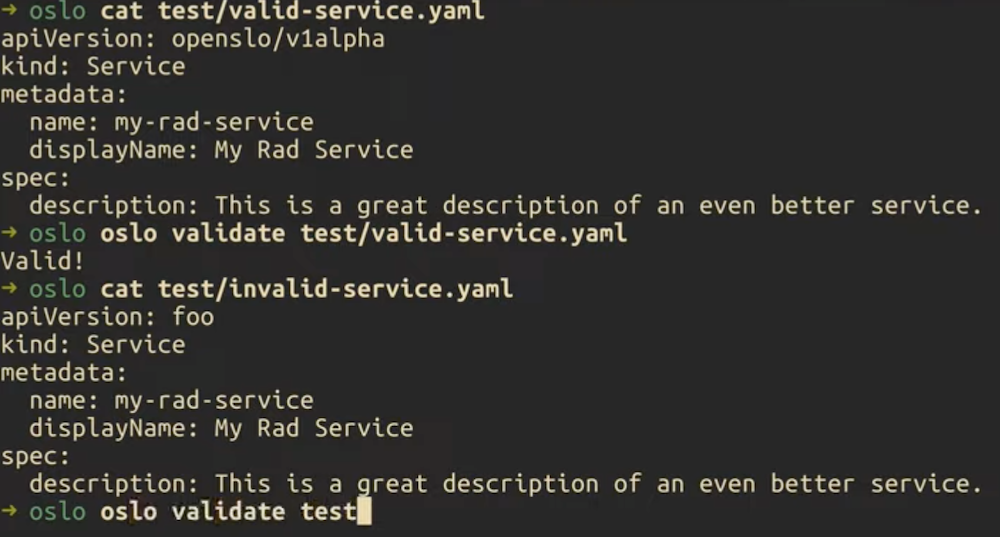
    Brian Singer, chief product officer for Nobl9, said the goal is to make a YAML specification format for defining SLOs that includes a parser and basic validation and testing capabilities more accessible via an OpenSLO project. Achieving that goal is critical at a time when organizations are deploying microservices-based applications that have dependencies that often adversely impact performance and availability.

    While the concept of an SLO and/or a service level agreement (SLA) has been around for a long time, IT teams that have embraced DevOps best practices by hiring site reliability engineers (SREs) are programmatically attempting to assure that SLOs are attained and, just as importantly, maintained, said Singer. Most SLAs have, historically, not been well-enforced. OpenSLO makes it possible to achieve that goal by embedding SLO objectives within a YAML file that become part of a Git-based workflow, he noted.
    SLOs

    Niall Richard Murphy, author of the book, Site Reliability Engineering, has signed on to be a core OpenSLO contributor working alongside committers from GitLab, Dynatrace and Nobl9. The ultimate goal is to make it simpler to share and migrate portable SLO specifications across multiple application development projects by constructing them using an object model, said Singer.

    Nobl9, meanwhile, will continue to operate a software-as-a-service (SaaS) platform for managing SLOs based on OpenSLO. Singer noted there will be an increased need for OpenSLO as it becomes more widely employed. The Nobl9 SLO platform is compatible with monitoring platforms such as Datadog, New Relic and Prometheus, and uses data collected from monitoring and observability platforms to calculate acceptable rates of error per service. It can be configured to trigger alerts and even workflows in anticipation of outages.

    Accessible via a CLI/GUI/API, the platform also enables DevOps teams to create business rules and define “facets” of users based on the application experiences required. DevOps teams can identify users who are being serviced poorly in addition to tracking groups of users. They also can associate contractual obligations to an SLO for a critical business period.

    The platform also makes it easier to determine how to make systems more reliable or lower reliability goals to reduce costs when possible. IT organizations will also spend much less time determining the root cause of any issue using a combination of real-time and historical data that is more accessible. Today, it’s not uncommon for IT teams to spend weeks looking for the source of an application degradation issue, only to discover the problem can be fixed in a matter of minutes.

    It’s still early days as far as adoption of SLO-as-code is concerned, but the days when SLAs or SLOs were, at best, aspirational statements of intent are coming to an end. The expectation is SLOs will soon be maintained via YAML files embedded within application code and distributed across a rapidly expanding enterprise with more interdependencies than any IT team can manually track.

  • Empowering BizDevOps Teams With SLOs

    Empowering BizDevOps Teams With SLOs

    When BizDevOps teams are drowning in logs and false alerts and are spending more time on manual processes than on building and deploying new applications and features, the work suffers, morale suffers and the organization as a whole suffers. Releasing better and more secure software, faster and with real business impacts starts with a robust BizDevOps practice. A crucial step IT leaders can take to align the developer, operations and business teams is to create a shared language of service-level objectives (SLOs).

    SLOs are metrics for validating that software is meeting its technical and business objectives. Defining and implementing SLOs help align developer, operations and business teams, not only ensuring everyone is moving toward the same goals, but also providing a way to reliably measure how BizDevOps teams are progressing toward these goals.

    Here are three of the most impactful ways SLOs can empower your BizDevOps teams.

    1. Establish a Common Language Across the Delivery Cycle

    The best SLO gives you precise and actionable insight into your system. Take performance and resiliency engineering, for example. By defining SLOs for performance and error rates, teams can use common measurements to track progress toward meeting their quality criteria to ensure they are staying within their error budget.

    In this way, teams can use SLOs as a common language across the delivery cycle – something everyone from developers to operations to business teams can rally around, ensuring everyone is working toward the same outcomes. This aligns teams into a coordinated BizDevOps practice, where all sides have better insight into how each piece of the business feeds into the others. If an incident occurs, operations can use an AI-based observability platform to observe its trends and impacts across different product or service releases and automatically feed that information back to the developers, who can modify their builds accordingly. When everyone is using the same SLOs to speak the same language, BizDevOps teams can coordinate and communicate more easily and effectively.

    2. Creating a Culture of DevOps Resiliency by Shifting SLOs Left

    BizDevOps isn’t just a technical practice defined by tools and platforms. It’s also a culture change and a shift in mindset. SLOs can play a major part in this change. Shifting SLOs left into the delivery pipeline means giving developers feedback about the outcome of their work and real-time visibility into their business KPIs using consistent SLO measurements – ideally, on every code commit. This consistency gives them answers at their fingertips to make data-backed decisions that consistently deliver better business outcomes. Using SLOs for developer feedback is a fundamental building block of DevOps, but it’s also key to creating a culture and mindset of resiliency within BizDevOps.

    A resilient BizDevOps culture is more than just making changes to your technology stack; it’s about changing the mindsets of individual engineers and developers. Resiliency means strength and reliability; the trust that when something goes down, it’ll go right back up. It’s about building the processes and systems that guarantee flexibility for anything from managing crisis events to delivering service continuity. Shifting SLOs left helps facilitate this culture change by giving developers greater exposure to the impact their work has when it’s in production and when it’s deployed. It makes everyone feel they’re in the same boat, and recognizes developers, operations and the business teams as one cohesive unit.

    3. Integrating SLOs Into Remediation

    BizDevOps teams can use SLOs to enhance remediation and incident response efforts. With everyone working with the same metrics, BizDevOps knows with certainty when something is broken, can identify root causes more quickly and can develop agreed-upon incident responses to accelerate time to resolution. BizDevOps teams can then feed this incident response knowledge back into quality gates earlier in the development cycle to avoid future problems. This develops SLOs that have been “battle tested” and can be easily automated to make quality gate testing better on the development side, and incident response better and faster for the operations side.

    SLOs bridge the gaps between BizDevOps

    SLOs already serve a useful role in production, but they also can influence the ability to create a robust, resilient BizDevOps practice. Shifting SLOs closer to developers and using them as a shared language across the delivery cycle provides space for greater experimentation, more innovation and a culture of resiliency. SLOs can also be defined along business-relevant metrics, such as conversion rates, user experience or feature adoption. As a result, SLOs empower BizDevOps teams to respond more quickly to issues and deliver better digital experiences and business outcomes.

    SLOs aren’t just performance metrics – they’re a powerful tool for bridging the divides between the developer, operations, and business teams. SLOs can help cultivate a BizDevOps culture that delivers innovative, secure software faster and with tangible business value.