Tag: Service Level Objectives

  • Nobl9 Unfurls Reliability Center for Managing SLOs

    Nobl9 Unfurls Reliability Center for Managing SLOs

    Nobl9 today launched a next-generation platform for managing service level objectives (SLOs) in a way that promised to improve overall reliability.

    Brian Singer, chief product officer for Nobl9, said in addition to enabling DevOps teams to meet SLOs, the Nobl9 Reliability Center also now provides a single source of truth about the state of reliability in an application environment.

    That capability is critical because as DevOps teams add new features to applications, they need insights into how they are impacting the reliability of the software environment, said Singer. No matter how great any new capabilities might be, it won’t matter much if the application environment slows to a crawl or outright crashes, he added.

    Nobl9 Reliability Center addresses that need by providing dashboards and reports to assign reliability scores based on the metrics collected from the SLOs defined. Those scores can then be shared with senior business and IT leaders so they can better understand the actual state of an application environment, noted Singer.

    In addition, the platform will recommend SLOs and policies and can be used to automate runbooks to improve reliability. The goal is to enable DevOps teams to continuously monitor and manage using SLOs via alerts that are received in a way that is timely enough to act on, added Singer.

    That approach enables DevOps teams to make sense of conflicting alerts generated today by multiple monitoring and management tools. A recent survey published by Nobl9 found 72% of respondents are using six or more monitoring and observability tools.

    The Nobl9 platform collects SLOs by tracking workflows through more than 50 integrations with various DevOps tools and platforms.

    SLOs, of course, are not a new idea. They have been used as a metric to track the performance of IT services for decades.

    However, as more microservices-based applications are built and deployed, it’s becoming more challenging to maintain SLOs across applications that have many more dependencies than legacy monolithic applications. Ultimately, each IT team needs to provide some sort of objective benchmark that assesses their overall effectiveness at delivering application services. The Nobl9 platform makes it simpler to track whether SLOs are achieved and maintained.

    That’s crucial because as more organizations depend on software to deliver digital services, any disruption is likely to have a direct impact on profit and revenue. As such, the reliability of application environments has become a major concern. The issue, of course, is that many of those application environments have dependencies on legacy platforms that, in some cases, have been running for years. Each feature and application programming interface (API) added over time conspires to adversely impact performance. In an era where IT teams are now trying to manage distinct services rather than individual applications, latency can significantly slow down response times.

    Each organization will need to determine for themselves how aggressively they need to manage SLOs. But thanks to the rise of digital business transformation, more senior IT and business leaders are focused on them than ever.

  • Driving DevOps Excellence: Implementing SLOs for Your DevOps Team

    Driving DevOps Excellence: Implementing SLOs for Your DevOps Team

    In today’s fast-paced world of software development, when continuous deployment and frequent releases are the norm, DevOps teams are essential to facilitating smooth communication between development and operations. In a blog post on LinkedIn, I talked about the importance of service level objectives (SLOs) for the testing team to improve the overall product quality. On top of that, let’s look at how adding SLOs to your DevOps team can improve productivity, dependability and client happiness.

    The Role of SLOs for DevOps Teams

    • Aligning DevOps Goals with Business Objectives:

    SLOs help DevOps teams coordinate their efforts with business objectives. The DevOps team can concentrate on delivering real business value by setting precise performance indicators, such as deployment success rates or infrastructure provisioning timeframes.

    • Promoting Collaboration and Accountability:

    By implementing SLOs, several stakeholders—including development, operations, quality assurance and business teams—are encouraged to work together. Over each stage of the software development life cycle, this shared responsibility promotes a sense of ownership and accountability.

    • Driving Reliability and Stability:

    SLOs play a key role in ensuring the stability and dependability of the system. You can be sure that your services consistently fulfill client expectations when your DevOps pipeline adheres to defined SLOs.

    • Proactive Issue Mitigation:

    Monitoring and alerting systems are used together with SLOs. The DevOps team could avoid service outages and downtime by aggressively identifying possible problems and resolving them before they become more serious by regularly monitoring important indicators.

    • Data-Driven Decision Making:

    Decision-making is driven by quantitative data. With the help of such indicators, the team is able to identify bottlenecks, prioritize improvements and streamline processes based on quick feedback.

    Now, let’s explore some key areas where DevOps teams can set SLOs to improve their performance:

    1. Continuous Integration (CI):
    SLO: “xx% of builds complete within Y minutes.”
    Measurement: Monitor build times and queue times regularly.
    Action: Optimize CI infrastructure and configurations to meet the SLO.

    2. Continuous Deployment (CD):
    SLO: “xx% of deployments are successful.”
    Measurement: Track deployment success rate.
    Action: Improve the deployment process to meet the SLO and reduce deployment failures.

    3. Infrastructure Management:
    SLO: “xx% of infrastructure is provisioned within Y minutes.”
    Measurement: Monitor infrastructure provisioning time.
    Action: Optimize infrastructure provisioning scripts to meet the SLO.

    4. Monitoring and Logging:
    SLO: “DevOps tools and system uptime should be at least xx%.”
    Measurement: Monitor the availability of the DevOps pipeline, deployment system and other tooling, including monitoring and logging systems.
    Action: Ensure high availability for DevOps tools and components.

    5. Artifact Management:
    SLO: “Artifact retrieval time should be less than x seconds on average.”
    Measurement: Monitor artifact retrieval time and availability.
    Action: Optimize artifact storage and distribution mechanisms.

    6. Testing and Quality Assurance:
    SLO: “Code must have at least xx% unit test coverage.”
    Measurement: Track test coverage regularly.
    Action: Encourage developers to write more tests.

    7. Security and Compliance:
    SLO: “xx% of compliance checks must pass.”
    Measurement: Monitor the results of compliance checks.
    Action: Ensure necessary security measures to meet the compliance SLO.

    8. Standardized Tools Selection:
    SLO: “xx% of teams must use the approved CI/CD tools stack.”
    Measurement: Track the percentage of teams using the approved tools stack.
    Action: Encourage teams to adopt standardized tools and provide necessary training and support.

    9. Training and Skill Development:
    SLO: “xx% of team members should undergo relevant DevOps training annually.”
    Measurement: Monitor training completion rates.
    Action: Provide training opportunities and resources to help team members enhance their skills.

    Initially, teams should baseline which percentage values to track by observing the current state. In the event they don’t have the bandwidth to baseline, start with any reasonable arbitrary number over a period of time, and it will be automatically refined.

    Implementing service-level objectives empowers DevOps teams to focus on delivering reliable and high-performing services that meet user expectations. By setting clear performance and reliability targets, teams can proactively identify and resolve issues, leading to improved collaboration, efficiency and overall user satisfaction.

    SLOs are not rigid constraints but are a means to drive continuous improvement and foster a culture of excellence within the DevOps ecosystem. As organizations strive to keep up with the ever-changing demands of the digital world, embracing SLOs is a crucial step toward achieving DevOps excellence and ensuring a competitive edge in the market.

  • Nobl9 Adds Tools to Make SLO Queries More Efficient

    Nobl9 Adds Tools to Make SLO Queries More Efficient

    At its SLOconf event today, Nobl9 added a Query Tester tool that validates whether queries made against the data its service level objectives (SLO) management platform collects will deliver meaningful results. Nobl9’s SLO management platform collects data in real-time from data sources such as New Relic, Datadog and Dynatrace to help customers meet SLOs.

    In addition, a Query Checker tool will now automatically put any new SLO into a testing state to automatically validate that the query against that SLO will run correctly.

    The company has also improved the precision of its calculations to provide DevOps teams with more accurate, reliable and actionable insights into the performance of services and added a Metrics Health Notifier toolset that provides insights into anomalous data being collected from various sources as well as what data might be missing. Nobl9 has also added a Custom Query Delay tool that gives DevOps teams more control over when data is pulled along with access to data source logs.

    Kit Merker, chief growth officer for Nobl9, said the overall goal is to improve the overall resiliency of its platform for managing SLOs.

    Finally, Nobl9 also announced that its platform is now available for the Google Cloud Platform (GCP) in addition to existing support for Amazon Web Services (AWS). As part of that GCP support, Nobl9 made available an educational site that provides example of how DevOps team can take advantage of the large language models (LLMs) that Google is making to improve SLOs or generate an SLO that is automatically converted into a set of YAML files.

    A survey of 314 IT professionals conducted by Dimensional Insight on behalf of Nobl9 found 69% have implemented SLOs, with more than three-quarters of those respondents crediting SLOs for preventing business disruptions. A total of 80% also noted their organization has an increased focus on system reliability, with just over a quarter (27%) saying SLOs saved their organizations a half million dollars or more. A full 95% said SLOs are also driving better business decisions.

    However, 97% also reported it is difficult to manage SLOs because of a lack of reporting, lack of application and environment support and interoperability issues.

    Nobl9 is trying to spur greater adoption of SLOs by making available an open source SLO specification that defines a common interface for constructing SLOs across a Git-based workflow. Nobl9’s platform based on that specification has now been integrated with 24 data sources, said Merker.

    SLOs, of course, are not a new idea. They have been employed as a metric to track the performance of IT services for decades. However, as more microservices-based applications are built and deployed, it’s becoming more challenging to maintain SLOs across applications that have many more dependencies than legacy monolithic applications.

    Ultimately, each IT team needs to provide some sort of objective benchmark that assesses their overall effectiveness at delivering application services. SLOs-as-code are intended to make it simpler to gather the metrics that confirm whether service levels are being achieved. Those SLOs are then tracked and integrated across any set of application services a DevOps team cares to track.

  • The Hidden Configuration Tax Affecting Uptime SLO

    The Hidden Configuration Tax Affecting Uptime SLO

    This article is a preview of a talk by Greg Arnette for SLOconf 2023 on May 15 – 18. To watch this talk and many more like it, register for free at sloconf.com.

    Tax season was just a few weeks ago, and that got me thinking about how frustrating it is to get hit with a surprise tax bill and how that can relate to uptime: Configuration sprawl. DevOps practitioners constantly strive to maintain uptime service level objectives (SLO) while working with complex and ever-evolving infrastructure and applications. Configuration sprawl is a significant challenge many teams face, negatively impacting system performance and reliability.

    My company’s recent survey of 900 DevOps and platform engineering leaders revealed a startling (but not too surprising) conclusion: Most teams struggle managing secrets and configs at scale for infrastructure and applications.

    Where Does Configuration Sprawl Come From?

    As organizations scale their operations, the number of configuration files and settings grows, making it increasingly difficult to manage and maintain consistency across the board. They may have multiple environments, such as development, staging and production environments, often requiring different configurations, leading to duplicated settings and increased complexity.

    Configuration sprawl may also lack standardization as teams adopt different naming conventions, file formats and storage locations without enforced configuration standards, resulting in fragmentation and confusion. Relying on manual processes for configuration management increases the likelihood of errors and inconsistencies.

    Grinding to a Halt

    So you’ve got a lot of configuration–why should you care? Sure, it means more files to manage, but does it really impact your environment? There are a few places where configuration sprawl will negatively impact you. You might see an increase in error rates because as complexity grows, the likelihood of errors and misconfigurations increases, leading to system instability and downtime.

    Increased configuration complexity also means slower troubleshooting. Identifying the root cause of issues becomes more challenging and time-consuming when configurations are disorganized and fragmented. Ultimately this means less agility as you are forced to slow the deployment of new features and updates, impeding the organization’s ability to respond to market demands.

    How to Overcome Configuration Sprawl

    Don’t worry–you can tackle configuration sprawl, keep your SLOs on track and reduce the efforts required to manage and maintain configurations. To mitigate the harmful effects of configuration sprawl, consider adopting these best practices:

    Don’t repeat yourself (DRY)
    DRY config means variable names are declared once. Then flexible variable values are injected across build, deploy and runtime phases as defaults, inheritances and overrides. DRY avoids errors by allowing single changes to propagate where they are needed.

    DRY solves the common problem of forgetting to update critical secrets or parameters and failing to synchronize related changes (e.g., client and server port numbers or rotating a database password.)

    Decouple and abstract
    Decoupling and abstracting config means externalizing config from source code, separating how code and configuration interact, and isolating the specific values (log level) from the configuration interface (how the log level value is fetched.)

    This approach allows the same code to run in different environments using parameterized config. Abstracting config supports a best practice of implementing independent “code and config change” life cycles. Teams that frequently need to change config independently from code should decouple and abstract.

    Centralized config
    Consolidate configuration complexity into a single location because it’s easier to manage complexity within a single location versus multiple locations. Syncing config to the edge (where it is consumed) mitigates downtime. For example, it’s easier to fetch the configuration for service X versus coding all the logic needed to generate the configuration for service X.

    Standardize your configuration management by enforcing consistent naming conventions, file formats and storage locations across teams to reduce confusion and streamline configuration management. Centralizing the configuration and generating that configuration with transformations allows all the places that consume the configuration to be simple. Simple equals easy to understand and troubleshoot.

    Version control & monitoring
    Use a version control system like Git to track config changes to configuration files, making identifying and resolving issues easier. And continue to monitor changes and identify potential problems before they impact system performance.

    Train your team
    Ensure all team members know your best practices and patterns for configuration management. The proliferation of microservices and teams operating in parallel, establishing their unique naming schemes and patterns, exacerbates this problem for DevOps teams.

    Cutting the Uptime Tax

    By understanding the causes of configuration sprawl and implementing best practices to manage and reduce its impact, teams can improve their uptime SLOs and maintain a more reliable, high-performing infrastructure. Remember, investing in the proper tools and processes for configuration management is not only a best practice but also a critical factor in ensuring the long-term success of your DevOps initiatives. Those are tax cuts I can get behind.

  • Decidability: SLOs to Measure Quality Attributes

    Decidability: SLOs to Measure Quality Attributes

    You may be familiar with the “-ilities”–the quality attributes that define a system’s so-called “non-functional” parts. One that isn’t on the list is decidability, which is the ultimate quality attribute because it focuses on what truly matters to your team and your customers.

    You can’t do it all. Fast, cheap and good? Here in the real world, we have tradeoffs. Software is the mouth that keeps on eating, but it isn’t a digital free lunch. When we decide what not to do, we bring greater clarity and productivity to the team.

    Of course, the world is full of “shoulds.” We should make our product accessible, we know. It should be secure; it should be reliable. Of course. But how do you decide the limit of your shoulds? To enable decidability, you need context. To gain a contextual understanding of your most critical quality attributes, you must talk to real people and reason about your situation. There’s no other way.

    New Design, Wrong Decision

    I had an eye-opening experience that demonstrated firsthand how quality attributes don’t necessarily deliver business results. Six years ago, I was working on e-learning software for public schools. One of the main problems was user management. We were selling to massive institutions that often had only one administrator responsible for onboarding all the users across hundreds of schools. While school was out, they had to enter data for the schools, create classes and assign teachers.

    Once we had a design for improving the workflow (luckily, before implementing it), we took the mockups to a customer to show the fancy ideas we had built. They surprised us by showing us “what it looks like for them”–a spreadsheet! They were copying/pasting everything by hand.

    So we asked them, “What if we gave you a way to upload the spreadsheet? Would that work?” And, of course, the answer was yes! So we scrapped our plans to build a fancy form and made a drag-and-drop input field to validate and upload the sheet. The decision was clear.

    Measuring Decidability

    How do we measure the critical business drivers and turn them into decidability? The closest answer I’ve found is service level objectives (SLOs). These take the fuzzy -ilities and turn them into metrics and goals that can quickly inform decisions.

    SLOs are a universal tool for measuring quality attributes from an indicator expressed as a proportion of “good” events for a given quality like reliability or scalability. Decidability comes from aggregating the SLO data across your services, geographies, user groups and quality attributes over time.

    Comparing an indicator to a particular goal (tuned over time as the business and engineering context changes), we can derive an allotment of allowable “bad” time or events–an error budget. Setting an error budget for reliability, performance, scalability, etc., allows you to decide how poorly your service can operate and still keep customers happy. Further, you can find the breaking point of user behavior and defend your service proactively from violating the quality attributes you expect.

    Technical debt inevitably stems from all the -ilities you should focus on but couldn’t quite get to, given your situation. Some technical debt is deliberate and even prudent. To tackle technical debt, you must decide which new features to put on hold to make space in the roadmap. SLOs provide a data-driven baseline to make this decision quickly and accurately by telling you when your -ilities are within error budget or out of whack.

    Scaling Decidedly

    You might start on a small, single-purpose project that’s rarely used. But if that changes, you must decide how to invest, redesign and maintain it. Suddenly, you might care about performance, scalability, security and the rest. First, you need decidability so you can prioritize your work. So you gather the people together who care about the service, and you start to think and talk and stack rank. You use your instrumentation to build metrics, set clear goals and do what it takes to keep the system running within expectations.

    Automating action based on error budgets is the magic of setting SLOs. They aren’t just for sophisticated, highly available services. Error budgets are extremely valuable in systems when you aren’t sure what to do. SLOs create decidability in all the trade-offs of all the quality attributes and the functional needs of the app or service you’ve carefully built.

    If you put decidability first, the rest will fall into place.

  • Nobl9 Shares SLO-as-Code Methodology

    Nobl9 Shares SLO-as-Code Methodology

    Nobl9 has released version 1.0 of an open specification for defining service level objectives, dubbed OpenSLO, and, in addition, has defined a repeatable SLO methodology.

    Kit Merker, Nobl9 COO, said the Service Level Objective Development Lifecycle (SLODC) methodology represents an effort to create a set of best practices for achieving and maintaining SLOs that are implemented as code within an application environment.

    A survey of more than 300 IT managers and executives conducted by Dimensional Research on behalf of Nobl9 found only 29% of respondents had no plans to implement SLOs. A full 94% of respondents that have or plan to implement SLOs intend to map them directly to business operations, with 91% reporting they expect that effort to improve decision-making. More than 80% also said their organizations are planning to increase the use of SLOs, with 87% indicating SLOs should improve overall microservices performance.

    The challenge is that most organizations have limited visibility into their IT environments. The survey, for example, found less than half of respondents (46%) had visibility into all their IT environments. Only 45% and 35% claim to have visibility into containers and microservices, respectively. More than three-quarters (78%) said hybrid clouds make observability more difficult.

    Ironically, 45% of companies reported they already employed 11 or more observability and monitoring tools. On the plus side, 31% have hired site reliability engineers (SREs), while nearly half (46%) planned to create that role.

    Nobl9 is trying to spur greater adoption of SLOs by making available an open source SLO specification that defines a common interface for constructing SLOs across a Git-based workflow. Since OpenSLO was initially launched, more capabilities have been added including a DataSource object that makes it easier to reuse connection details and which makes creating SLOs less verbose and three alerts have been defined: AlertCondition, AlertPolicy and AlertNotifcationTarget.

    Nobl9 is also releasing an OpenSLO-to-Nobl9 converter to transition OpenSLO YAML files into Nobl9 YAML when required.

    SLOs, of course, are not a new idea. They have been employed as a metric to track the performance of IT services for decades. However, as more microservices-based applications are built and deployed, it’s becoming more challenging to maintain SLOs across applications that have many more dependencies than legacy monolithic applications. Ultimately, each IT team needs to provide some sort of objective benchmark that assesses their overall effectiveness at delivering application services. SLO-as-code is intended to make it simpler to gather the metrics that confirm whether service levels are being achieved. Those SLOs are then tracked and integrated across everything from financial operations to supply chains, noted Mercer.

    It’s not clear to whether reliance on SLOs has waned over the years or if application environments simply became too complex to track meaningful metrics. However, as applications are increasingly viewed as services, it’s now only a matter of time before SLOs become more widely adopted across a modern application environment. The challenge, of course, is that defining an SLO is a lot easier than maintaining it—especially within today’s highly dynamic application environments where services tend to come, change and eventually go unexpectedly.

  • Nobl9 Adds Hydrogen Platform to Surface Technical Debt Issues

    Nobl9 Adds Hydrogen Platform to Surface Technical Debt Issues

    Nobl9 today unveiled a Hydrogen platform that makes it simpler for DevOps teams to identify technical debt issues as they manage service level objectives (SLOs) as code.

    Hydrogen enables DevOps teams to define SLOs using a simple wizard or by embedding code within their application as part of a DevOps workflow. That code is then used to automatically collect data from platforms such as Datadog, New Relic, Prometheus, Splunk and others with requiring any additional instrumentation.

    Nobl9 COO Kit Merker said that approach also makes it possible to surface technical debt that inhibits achieving those goals via the Hydrogen platform. Armed with those insights, it then becomes easier for DevOps teams to focus on reducing or eliminating that technical debt because Hydrogen automatically generates a ticket in the Jira project management application—widely used by DevOps teams—to make sure the issue is addressed. Otherwise, in the heat of a DevOps sprint, the issue is likely to be forgotten as the application development project continues to move forward, noted Merker.

    The ability to identify that technical debt is an outgrowth of the ability to manage SLOs as code that is enabled by the core Nobl9 software-as-a-service (SaaS) platform. Hydrogen extends that capability by automating workflows whenever a specific service shows indications that it cannot meet objectives because of a dependency on a legacy platform that needs to be upgraded, added Merker.

    There is also a service health dashboard that organizes SLOs into logical groups that are mapped to features via labels, which Merker noted makes it possible for multiple stakeholders to easily identify which issues affect a particular service most. Hydrogen can also trigger a variety of automated workflows to prompt additional investigations that escalate as services worsen.

    Overall, Hydrogen is designed to provide engineering teams with more accurate context that can be used to prioritize which issues should be addressed first during any technical debt planning cycle, said Merker. Hydrogen can enforce code release policies based on technical debt budgets that are enforced via integrations with continuous integration/continuous delivery (CI/CD) platforms.

    Technical debt generally refers to any code change that is required to optimize a service that is not immediately addressed. The more legacy platforms there are in an IT environment, the higher that technical debt tends to become. At a time when more organizations are building and deploying microservices-based applications, that technical debt, over time, tends to adversely affect applications that are much more dependent on external services than a traditional monolithic application. A single technical debt issue can have a cascading impact on multiple microservices-based applications that would, otherwise, would be difficult to detect.

    The challenge, of course, is that technical debt doesn’t always get the attention it deserves when most of the IT team is focused on rolling out the next great application. However, as application environments become more complex it may only be a matter of time before all the technical debt that is being accumulated becomes unsustainable.

  • SREs: Stop Asking Your Product Managers for SLOs

    SREs: Stop Asking Your Product Managers for SLOs

    One of the fundamental premises of software reliability engineering is that you should base your reliability goals—i.e., your service level objectives (SLOs)—on the level of service that keeps your customers happy. The problem is, defining what makes your customers happy requires communication between software reliability engineers (SREs) and product managers (PMs) (aka business stakeholders), and that can be a challenge. Let’s just say that SREs and PMs have different goals and speak slightly different languages.

    It’s not that PMs fail to appreciate the value that SREs bring to the table. Today, in the era of software as a service, features such as security, reliability and data privacy (which used to be considered “non-functional requirements”) are respected as critical features of the service-product a SaaS company delivers. Modern application users and customers of software services care a lot about data privacy, cybersecurity and uptime; therefore, PMs care, too. In fact, it’s not uncommon to see these features touted prominently on a company’s website (I saw one today claiming “99.99% uptime for every customer!”) because the folks in marketing know that customers are making purchasing decisions based on whether the company can deliver reliability, speed, security and performance quality. So, yes, PMs do care.

    The difficulty lies in the negotiation between the PM and the SRE about the value of providing that level of service and the cost associated with it:

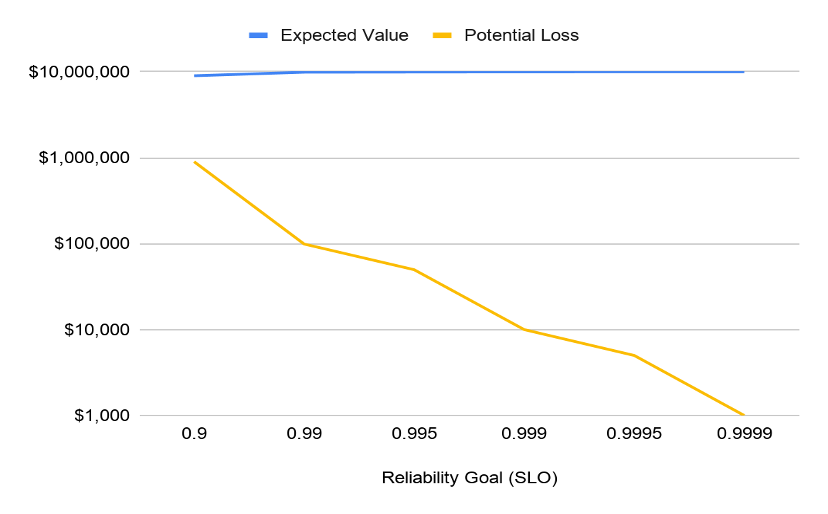
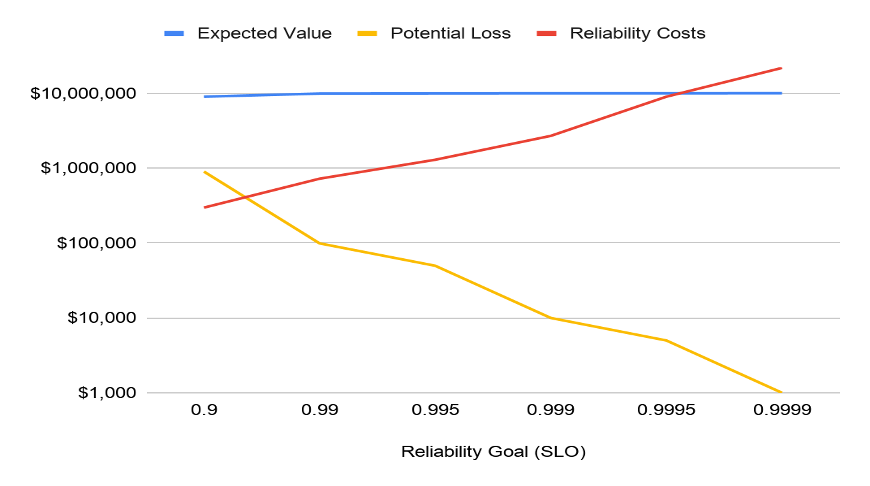
    The people and infrastructure costs associated with providing the next level of reliability increase geometrically for a host of reasons, but the expected value to a $10 million business of losing out on that one in 1,000 transactions versus one in 10,000 is only $1,000.

    But translating “customer happiness” into actual objectives derived from observable metrics is easier said than done, particularly for companies that are just getting started with SLOs. Let’s face it, all the talk about “nines” can be difficult to conceptualize. Fortunately, there’s an easy way for PMs and SREs to get on the same wavelength.

    Engineers, stop asking your PMs for SLOs!  Instead, convert user stories into reliability goals.

    User stories are a great way for PMs to express a customer’s experience and expectations to the engineering team. SREs can then translate the user stories into SLOs in a few simple steps.

    What is a User Story?

    User stories are narratives that describe how a particular type of user engages with the service. The first-person plotline might go like this: I am this type of person, and this is what I need and expect to be happy, and if I’m not happy, this is what it’s going to cost you.

    Note: In this user story, we’ve taken the liberty of including empathy for the reliability expectations of the user.

    Retail example: I’m a shopper on your online store on Black Friday, and I want to take advantage of your Black Friday sale. I want to log on, peruse your Black Friday deals, pick the products and features I prefer, and make my purchase in just a moment or two. If it takes too long to log on, or if I get hung up in the system, I’ll easily get frustrated and move on to other retailers. I don’t want to miss the deals!

    An SRE can take that user story, ask the PM a few questions to gather just a few more critical bits of information, then do some simple math to derive the SLO for your Black Friday.

    Ask Your PM These Questions

    To determine the reliability goals for a user story, you need to add three pieces of context:

    Step 1 – Identify the Top Critical User Transactions

    First, determine the relative priority or criticality of the transaction being successful. Not all transactions are created equally, so we need to understand what kind of transaction we’re talking about here. For example, browsing a catalog page (which could be refreshed if unsuccessful) is different from the shopper’s checkout experience.

    Retail example: We have several transactions in a retail business, including:

    1. Inventory catalog search.
    2. Order fulfillment.
    3. Payments processing.
    4. Price and discount.
    5. Checkout experience/shopping cart abandonment.

    For our example, let’s develop the SLO for payments processing, which is a throughput metric—the total number of transactions a retailer can handle in a given period of time.

    Step 2 – Estimate the Volume of Transactions at Various Times

    Now that we know the transaction we’re talking about (payment processing throughput), we can estimate the rough volume of transactions or user interactions that will occur in each of those categories, rounded to the closest order of magnitude (see Fermi Estimation). How much of your business happens during this time? Do you have a critical time of day? Do you have a critical season? Do you have a critical day(s) of the year?

    The same transaction at a different time may be more or less valuable. Think about an ad playing during the Superbowl or stock prices while the market is open. Or when your CEO is giving a critical customer presentation. Timing matters.

    Retail example: Our hypothetical retailer has critical periods in the holiday shopping season and a critical day called Black Friday. Typically, 4% of annual business happens during Black Friday weekend, and 16% of annual business happens during the remaining holiday season.

    Adobe Analytics estimates that sales for the full weekend (Thanksgiving through Cyber Monday) is 20% of total revenue for the full holiday season. According to the National Retail Federation, 2019 holiday sales were $730.2 billion, accounting for 20% of annual sales.

    Step 3 – Estimate the Business Value of Transactions in Each Circumstance

    Finally, we can now understand how the reliability of this transaction affects business outcomes. This could be the risk of lost revenue or perhaps a brand reputation metric such as reduced CSAT. Now you have a pretty clear picture of the business impact of unreliability.

    Retail example: If our imaginary retailer has revenue of $10 million, it would make $400,000 of that during Black Friday weekend, and $1.6 million during the rest of the holiday season. On Black Friday shopping carts are worth $100, $80 during the holiday season and $50 the rest of the time. There are 800 transactions per day on Black Friday, 625 per holiday season day and 488 any other day.

    Now that you have this input, you can start to calculate appropriate SLOs based on the value at risk and the cost to meet that reliability goal.

    If possible, you can estimate the cost to deliver each level of reliability. Consider not only the cloud computing and direct operational costs, but also the reliability investments in testing, performance, security, chaos engineering, release management, rollback, monitoring, on-call, automation, etc., that would be required to achieve the reliability level at each point. By plotting this cost (at least to the order of magnitude) you can find a break-even point where the value at risk and cost of reliability crossover. This is the business-justifiable SLO for these transactions.

    Plot the value-at-risk as a function of value x volume x SLO. The value-at-risk will decline sharply as the reliability is increased; however, the cost to achieve this reliability also increases exponentially. It’s simply not worth investing more than that at-risk amount for any given user story, so the SLO determination is clear. Note that the SLO may not be achievable for the team currently, but you have a precise idea of what matters to the business and the break-even point of your reliability investments.

    Instead of asking PMs to “speak SRE,” span the communication gap by using the common language of user stories to build business-cogent SLOs.

  • Nobl9 Ties Business Goals to Observability Data

    Nobl9 Ties Business Goals to Observability Data

    Nobl9 today announced it has made available via an open public beta program a software-as-a-service (SaaS) platform for correlating business goals against data collected by observability tools.

    Unlike observability platforms that only aggregate metrics, the Nobl9 Service Level Objective (SLO) Platform applies that data to specific reliability targets defined by the business, company CEO Marcin Kurc said.

    Compatible with monitoring platforms such as Datadog, New Relic and Prometheus, Nobl9 SLO Platform calculates uses monitoring data to calculate acceptable rates of error per service threshold and can be configured to trigger alerts and even workflows in anticipation of outages, Kurc said. The critical difference is knowing which metrics are truly impacting customer experiences.

    The platform also enables DevOps teams to create business rules and define “facets” of users based on application experiences required. DevOps teams can identify users who are being serviced poorly in addition to tracking groups of users. They also codify contractual service level agreements (SLAs) down to critical business periods, said Kurc. The Nobl9 SLO Platform is accessible via a CLI/GUI/API for everything, Kubernetes-like YAML SLO-as-code or a sloctl command line.

    This approach also has a significant impact on the cost of monitoring because the Nobl9 SLO Platform makes it easier to identify what data needs to be stored versus deleted, noted Kurc.

    Armed with those insights, Kurc said it then becomes easier for DevOps teams to either determine how to make systems more reliable or lower reliability goals to reduce costs when possible. IT organizations will also spend much less time finger-pointing because the root cause of any issue will be much more readily apparent, he noted, adding the Nobl9 SLO Platform provides access to both real-time and historical reports to enable DevOps teams to achieve both those goals.

    In the wake of the COVID-19 pandemic, there’s a lot more focus on observability than ever. Organizations are relying more on digital business process to survive. The difference between surviving and thriving in this new era will come down to observability of not just the IT environment but also the entire digital business process.

    It may be a while before most organizations fully equate profit and revenue to the performance of their IT environments. However, it’s becoming increasingly clear that it’s not enough to simply make sure IT environments are available. Customers are judging organizations by their ability to drive a quality experience within the context of a digital business process spanning multiple applications. Organizations that are unable to meet those expectations will soon find themselves being cast aside in favor of those that can.

    Naturally, those requirements will put a lot of pressure on IT teams that often don’t have a lot of visibility into a business process. There is no end of alerts being generated by the system that are closely monitored, but the bulk of those alerts lack business context. Undoubtedly, there soon will be plenty of ways to gain that context. The challenge now is explaining to business leaders now why it’s needed before it’s too late.