Tag: sanjeev sharma

  • State of Software Delivery Management Report 2020

    State of Software Delivery Management Report 2020

    Accelerated Strategies Group conducted the State of Software Delivery Management 2020, surveying software delivery practitioners and key industry leaders to assess the current state of software delivery management (SDM) and examine the impact of SDM adoption as a capability. The primary research, commissioned by CloudBees, was published on Tuesday, July 21.

    The State of Software Delivery Management Report 2020 defined SDM as “a core competency for any organization or team responsible for delivering business value via software applications and systems.” The report studies the impact of SDM and how it helps organizations accelerate their digital transformation by providing the necessary tools to effectively and efficiently deliver software.

    The report identified three key SDM capabilities to help organizations increase their software delivery efficiency and effectiveness:

    • Organizations must quantify the impact of their investment in software delivery.
    • Organizations must enhance the ability of software delivery teams to communicate and collaborate.
    • SDM can provide end-to-end visibility into the value flow of their software delivery streams.

    Based on the results of the research, adopting SDM strategies can help mitigate major challenges faced by software delivery practitioners, IT management, product stakeholders and executive leadership, and improve an organization’s ability to deliver software in a lean and agile manner. SDM capabilities provide businesses the ability to effectively make decisions on where in the value stream to invest, and to quantify the impact of their investments.

    Download the State of Software Delivery Management 2020 to learn more about SDM and to get insights and access to all the data Accelerated Strategies Group gathered from one-on-one interviews with key industry experts.

  • 3 Ways to Become a More Agile IT Organization

    3 Ways to Become a More Agile IT Organization

    In 1960, the average life expectancy of a Fortune 500 company was 75 years. Today, the average lifespan is just 15 years and declining further. So what gives? We only have to look as far as the “Uber-effect” to understand why so many companies fail. Uber very simply and quickly disrupted a centuries-old industry with the touch of a button—making cab service part of the On-Demand Economy, where consumers get what they want, when they want it, with no delays. Today, agile companies are winning.

    So, ask yourself, is your company a disruptor or a disruptee? The reality is, most companies are the latter, with IT organizations under more pressure today than ever before. Whether it’s the fear of being “ubered” by the competition, or business demands to pick up the pace, IT organizations face a balancing act of ensuring the operation of core applications and being innovative. But the truth is, innovation and maintaining the efficiencies of legacy systems can co-exist.

    While the prospect of competing with born-on-the-web companies such as Uber or Airbnb might seem daunting, there are a few things you can do to become a more agile IT organization:

    Automate manual processes

    How long does it take your organization to deliver a simple, new feature in an application? Two days? A week? A quarter? Traditional approaches to software delivery are too slow for today’s speed of business. These often-manual processes are fragmented, error-prone and time-consuming. A recent Forrester Total Economic Impact study revealed organizations that automated their app deployments experienced an increase in speed-to-market and reduced development cycle times up to 75 percent.

    Take a look at your delivery pipeline and assess where you’re testing and deployments could be automated. Are developers able to easily deploy applications to a test environment, or are they bogged down with unnecessary wait times and manual deployment and configuration steps that are susceptible to errors? If you’re facing a development-testing cycle of two to five days, that’s simply too long. Look to adopt DevOps by automating release and deployment processes wherever you can and aim for continuous delivery, so you can push apps out quickly and be more agile.

    Lean and Mean Equals Agile

    No company will risk its core systems of record for the sake of innovation. At the same time, you cannot invest in becoming innovative if the delivery and maintenance of your core systems are inefficient. The goal is to make these core systems as lean as possible by automating repetitive tasks, freeing resources that can be directed toward speeding innovation. Today there are cloud technologies and services and API management systems that can help organizations streamline the maintenance and operations of these core systems and expose their services as APIs for consumption by new applications.

    Create a multispeed IT process

    While you’re making your core systems as lean and agile as possible, create a second layer, where innovation and agility are the key focus. As your core systems are exposed as APIs, you can begin to use their business functions and services to experiment and innovate. Cloud-based development platforms allow organizations to stand up complete development, test and production environments quickly to incubate and deliver new, innovative applications that consume these services from the core systems, delivering new and innovative business capabilities in a fraction of the time traditional methods would take. These innovative apps can be delivered and decoupled from the speed of delivery of the core systems, enabling what is known as multispeed IT.

    While the status quo might seem like an easier option, by doing nothing, you risk not only being passed by the competition, but your line of business leaders may bypass you altogether, turning to “shadow-IT” and outside vendors to meet their needs. While this hypergrowth of the tech industry is unprecedented, it is not a fad. The pace of innovation will only get faster and your only options are to fail or adapt and be agile.

    About the Author / Sanjeev Sharma

    sanjeev-sharma

    Sanjeev Sharma, CTO and Distinguished Engineer – DevOps Technical Sales and Adoption, IBM Cloud Unit, is a 20-year veteran of the software industry with expertise in DevOps, mobile development and UX, lean and agile transformation, application lifecycle management and software supply chains. He is a DevOps thought leader at IBM and speaks regularly at conferences. He has written several papers and is the author of the “DevOps for Dummies” book.

    Connect with Sanjeev LinkedIn | Twitter

  • DevOps and Agility for Multi-Speed IT

    DevOps and Agility for Multi-Speed IT

    Let’s step back for a moment and look at the IT world a bit differently from the traditional technology-centric lens through which most of us IT peeps tend to look at things. Line of business (LOBs) need us, the IT organizations, to deliver capabilities to their customers and users that deliver business value. They also rely on these systems to provide feedback on how customers and users are consuming the business capabilities and deriving value; how they are interacting the business systems; and what capabilities and features they need to get better value. The LOBs are asking the IT organizations to deliver these capabilities with:

    • Velocity
    • Agility
    • Innovation
    • Cost Management

    IT organizations, in most cases, are not designed for velocity, agility or innovation. They are large organizations hindered in their ability to deliver these by legacy systems, myriad practices and tools, overbearing governance and compliance regimes, archaic and siloed organizational structures and cultural inertia. This lack of ability of the IT organizations to deliver agility, velocity and innovation in some cases even results in LOBs creating their own “Shadow IT” organizations to deliver their IT needs.

    Finding Velocity, Agility and Innovation

    The solution of late has been to undergo a DevOps transformation that enables IT organizations to adopt the necessary practices, automation tools and organizational and cultural change to deliver with velocity and agility, and become innovative by being able to deliver rapid experimentation. The origins of DevOps lie in Lean IT, and adopting DevOps is really applying Lean principles to help achieve agility, velocity and innovation.

    DevOps does so by making organizations that are delivering IT systems and software more efficient and lean. Organizations that have adopted DevOps are able to:

    • Get ideas out to production faster
    • Have users/user surrogates use them
    • Get rapid feedback

    Using this feedback the organizations can improve three things:

    1. Applications delivered
    2. The infrastructure delivered
    3. The process by which IT systems and software are delivered

    However, large organizations have been struggling to achieve the results promised by DevOps and achieved by the poster children of DevOps, with whom the movement started. For every Netflix and Etsy out there, there is a large, complex, organization that has been struggling with simply where to start. They may be able to achieve success in some parts of their IT organization—with small, innovative ‘two pizza’ teams working on isolated projects—but not at enterprise scale. They struggle with how to achieve even the results of DevOps adoption they see in their own successful teams, at scale. The organizational and cultural inertia appears to be too difficult to overcome.

    The major reason of this inability to achieve at scale is the persistent struggle in all large organizations between the desire to innovate, and the need for stability. This push-and-pull exists in all organizations—even an innovative startup feels it. The Dev teams are focused on creating innovation thru rapid change and experimentation, and the Ops teams are focused on creating stability and continuity. DevOps addresses this existential struggle by adopting a series of practices that drive cultural change, automation and process adoption that allow these Dev and Ops teams to work toward common goals and balance their needs. Even in large organizations, this can be achieved on small teams that are able to circumvent the legacy organizational structures and practices and figure out how to get all the stakeholders working toward common goals. That is why this works great on small, strategic projects that have well-defined goals and timelines and can “fly below the radar” of corporate governance enforcers. As we move to larger projects with large, potentially distributed teams, spread across different groups and corporate “fiefdoms,” adoption struggles and often fails.

    The Rise of Multi-Speed IT

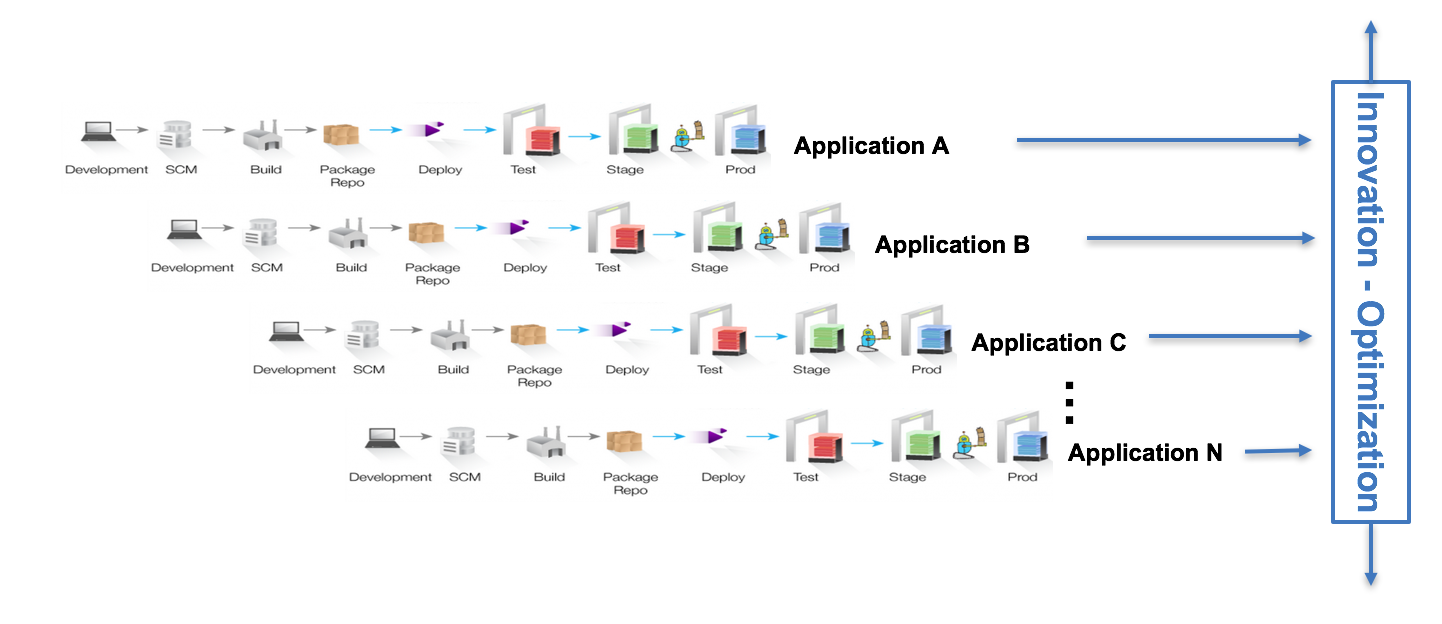
    One fact these large organizations need to recognize is that they really must have two modes of delivering IT: one focused on innovation (and velocity and agility) and the other focused on optimization (stability and continuity, with agility and velocity). This view is being referred to in the industry as “bi-modal IT” and is actually more of a continuum than a clear-cut two modes model. Hence, the term is evolving now to “multi-speed IT.” However, classifying the continuum into two broad categories based on the business intents of innovation or optimization serves the purpose of determining how to adopt DevOps very well.
    Multi-Speed ITMulti-Speed IT

    One interesting way to look at these two modes is to classify them as:

    1. The ‘Industrialized Core’ that delivers core business capabilities—things that keep the business going, and the primary business intent is optimization
    2. The ‘Innovation Edge’ where experimentation happens and new systems get identified and developed; in other words, the primary business intent is innovation
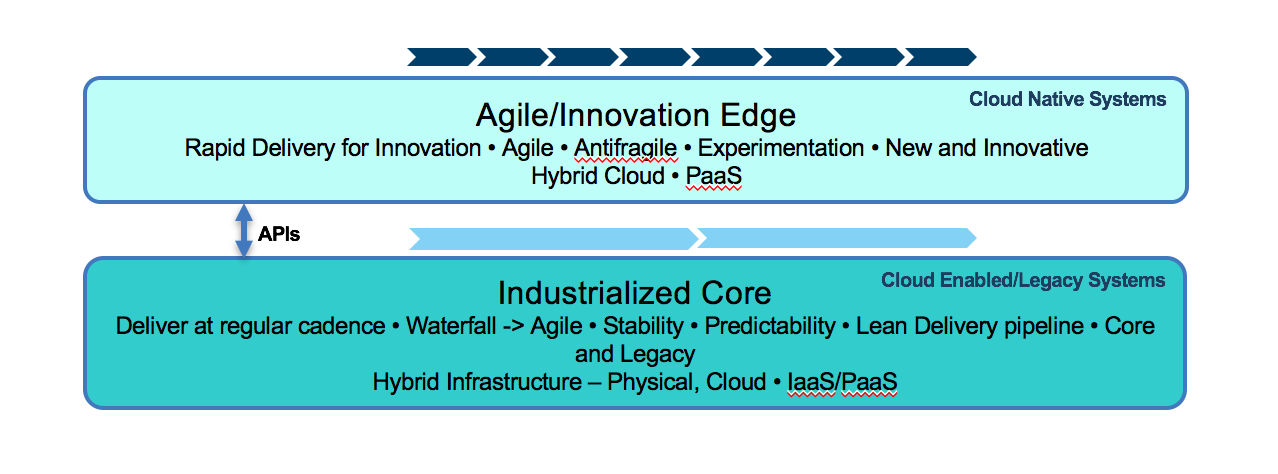
    Innovation vs OptimizationInnovation vs. Optimization

    The goal of the Innovation Edge is to allow for rapid experimentation, development of minimum viable products (MVP), rapid delivery and fast failure. The goal of the Industrialized Core, on the other hand, is to be lean and efficient and deliver business capabilities in an optimized, predictable, stable and secure manner, with the ability to scale as needed. Note: Eventually systems from the Innovation Edge will need to be “industrialized” once they start serving a core business function. This is a continuum from innovation to optimization.

    The Industrialized Core itself needs to be continuously incrementally industrialized to provide the stability and reliability needed, while getting leaner and more efficient, at scale. The core needs to get to optimization, with agility and velocity, as it delivers the core systems, again at scale. The core, too, needs to adopt DevOps and agile development practices, even for legacy systems, including those on the mainframe. This Industrialized Core is, after all, what keeps the business going and delivers the ongoing business value as the Innovation Edge seeks out new and disruptive business capabilities and avenues to deliver them.

    However, they both need different DevOps approaches and platforms delivering Agility, Velocity and Innovation at different levels.

    These two systems to deliver business capabilities are, in reality, joined at the hip. The systems delivered on the Innovation Edge are dependent on the services provided by the Industrialized Core to deliver the innovations they are developing. The Industrialized Core, on the other hand, consumes most of the budget in typical large organizations, and needs to be optimized to free resources for innovation.

    Consider a typical mobile application (say, mobile banking). To deliver that application, there is a team charged with developing the mobile front end. These kind of applications are developed and delivered in the Innovation Edge. Does all of the data and business logic sit on your mobile phone when you use that application? Of course not. Most likely, the business logic and certainly the data are components of the application that are delivered by pre-existing systems or services in the Industrialized Core. So, the mobile application is hybrid, comprised of components running in both places. To deliver even some experimental features of this mobile app, the company needs to release a hybrid or composite application, delivering components delivered by both the Innovation Edge and the Industrialized Core.

    During the Dev/Test cycle, these two modes of application delivery must be as decoupled as possible, so the development schedules and cycles of one does not drag the other, to prevent the Core from becoming a drag on the Innovation. Creating an API ecosystem is thus essential to decouple the Industrialized Core from the Innovation Edge. The Core provides the business services consumed by the innovative applications being delivered by the Innovation Edge as APIs. A key benefit of developing this API-based architecture is that these APIs potentially can be monetized to third-party partners, generating a revenue source at the same time.

    It is important to note that the architectural and process needs for adopting DevOps in both of these modes are different in many ways. Their needs and how they deliver applications and services differ as they are serving different business goals. In my next post, I will start delving into these architectural and process needs for adopting DevOps for both the Innovation Edge and for the Industrialized Core, which allow the Innovative Edge to allow for experimentation and innovation, and for the Industrialized Core become more optimized.

    Watch this discussion between industry practitioners as to how they have adopted DevOps in a multi-speed IT model: the challenges faced, successes achieved and lessons learned.

    About the Author/ Sanjeev Sharma

    Sanjeev

    Sanjeev Sharma, CTO and Distinguished Engineer – DevOps Technical Sales and Adoption, IBM Cloud Unit, is a 20-year veteran of the software industry with expertise in DevOps, Mobile Development and UX, Lean and Agile Transformation, Application Lifecycle Management and Software Supply Chains. He is a DevOps Thought Leader at IBM and speaks regularly at conferences. He has written several papers and is the author of the DevOps for Dummies book.

  • Jenkins User Conference and CD Summit: Calling all London DevOps

    Jenkins User Conference and CD Summit: Calling all London DevOps

    I wanted to give a quick shout out to the large, vibrant and supportive London DevOps community. Later this month (June 23rd and 24th), there will be a joint conference at the Hilton Metropole, London. Combining the Jenkins User Conference and Cloudbees CD Summit, it is two days of CD/CI/DevOps learning.

    Speakers include:

    Kurt Bittner, Principal Analyst Forrester,

    Martin Croker, Managing Director, DevOps, Accenture,

    Sanjeev Sharma, CTO, DevOps Technical Sales & Adoption, IBM Distinguished Engineer, IBM,

    Viktor Clerc, Product Manager, XebiaLabs

    and more.

    The Jenkins User Conference (JUC) features another great lineup of speakers as well.  devopsy.kinsta.cloud as well as a host of others are sponsoring the event.

    In speaking to my friends at Cloudbees they mentioned that there were tickets still available. I found that hard to believe as I know what the community is like here in London.  So if you are going to be in town on the 23rd and 24th, don’t miss this event!  I will be there hosting a great panel on the 23rd as well.

    The Jenkins community is one of the most active that I have ever seen. I am looking forward to seeing many of you in London on the 23rd ad 24th.

    There are still sponsorships for CD Summit as well.  If interested you can contact Cloudbees for info.

    Also this Thursday is DevOps Connect: Rugged DevOps @Infosecurity Europe all day. Registration is free, so come down for a great day of DevOps tracks!

  • Webinar:  How Nationwide Insurance is Adopting DevOps for Variable Speed IT Systems

    Webinar: How Nationwide Insurance is Adopting DevOps for Variable Speed IT Systems

    To drive towards faster innovation, and also ensure the stability of the core business, the need arises for what is being termed as “two-speed or variable speed IT.” While innovative Systems of Engagement demand speed, agility and experimentation, legacy Systems of Record need governance and predictability. Two-speed IT enables adoption of DevOps capabilities by adapting them to the “speed” of delivery. It requires two-speed business planning and processes and even two-speed organizational structure and budgeting. Join Carmen DeArdo, Director of Application Development at Nationwide Insurance, Sanjeev Sharma, lead DevOps Technical Evangelist at IBM, and Lee Reid, executive IT specialist as they show how IBM’s solution is helping Nationwide adopt DevOps practices for variable speed IT systems.

    This webinar is the first in the Variable Speed DevOps – A Deep Dive series.

    Event recorded Tuesday May 5th, 2015

    SLIDES

    [seoslides embed_id=”be17733a1254″ script_src=”https://devopsy.kinsta.cloud/embed-script/webinar-how-nationwide-insurance-is-adopting-devops-for-variable-speed-it-systems/6643/” overview_src=”https://devopsy.kinsta.cloud/slides/webinar-how-nationwide-insurance-is-adopting-devops-for-variable-speed-it-systems/” site_src=”https://devopsy.kinsta.cloud” site_title=”devopsy.kinsta.cloud” title=”Webinar: How Nationwide Insurance is Adopting DevOps for Variable-Speed IT Systems” /]

    VIDEO


    Your Host:

    alan_new_head_shot Alan Shimel, Editor-in-Chief devopsy.kinsta.cloud, An often-cited personality in the security and technology community and a sought-after speaker at industry and government events, Alan has helped build several successful technology companies by combining a strong business background with a deep knowledge of technology.


    About Panelists:


     Carmen-Deangelo-300x225Carmen DeArdo, Nationwide – Director – Tools and Technology Leader

    Carmen DeArdo, Director – Tools and Technology Leader, Nationwide Insurance, An ardent advocate of DevOps and a leading speaker in the DevOps and technology related events, Carmen is responsible for driving continuous delivery utilizing DevOps, Lean and Agile techniques across Mobile, Distributed and Mainframe and other technologies.  


    Sanjeev Sharsanjeev-sharmama, IBM Worldwide Lead – DevOps Technical
    Sales and Adoption, IBM Cloud Unit

    Sanjeev Sharma, IBM Worldwide Lead – DevOps Technical Sales and Adoption, IBM Cloud Unit, is a 20-year veteran of the software industry with expertise in DevOps, Mobile Development and UX, Lean and Agile Transformation, Application Lifecycle Management and Software Supply Chains. He is a DevOps Thought Leader at IBM and speaks regularly at conferences. He has written several papers and is the author of the DevOps for Dummies book.


    leeLee Reid, IBM – Senior IT Specialist

    Lee Reid, Senior IT Specialist, IBM, is a senior solution architect with focus on practical adoption of software engineering tools, software delivery solutions, application life cycle management, and DevOps. He has over 25 years of experience in software engineering, design, programming, testing, development, tools & methodology, team leadership, and strategic planning.

  • Variable Speed DevOps

    Variable Speed DevOps

    I was lucky enough to be the host of a Google Hangout last week with some very smart folks who will be speaking at IBM InterConnect 2015. One of the topics that we discussed was Two-speed IT or as Carmen DeArdo of Nationwide called it, variable speed DevOps.

    What is meant by this term is the realization of the fact that different parts of an organization, even different parts of an IT team move at different speeds. Rather than forcing everyone to move at one speed, how can you use DevOps to allow these different size gears to mesh into one smooth functioning machine?

    Constraints and bottlenecks pop up when one part of the process is allowed to proceed untethered only to either be constrained from a lack of resources or data from a pre-requisite or to be wasted as the output then has to sit and wait around for another part of the process to proceed.  It is almost right out of The Goal by Goldratt.

    How do we achieve a “just in time” method of IT? This is a problem that agile has tried to tackle in the development world, but what about the larger canvas of IT? That is variable speed DevOps.

    Perhaps nowhere is this variable speed issue as visible then when talking about legacy mainframe systems working with modern cloud architectures. Yes IBM’s z/system team has numerous examples of exactly this taking place.  But don’t be fooled into thinking that this is about making old stuff work with new stuff, for it is not.

    I have discussed this with Sanjeev Sharma of IBM as well regarding a follow on panel on this subject that both he, Carmen and Rosalind Radcliffe will be participating in this month at the InterConnect 2015 event in Las Vegas (Mobile to Mainframe Experts: DevOps Best Practices for Systems of Engagement and Systems of Record, Session DEM-4399, Monday 2PM).

    The real key to a successful DevOps implementation is recognizing the variable speeds of the different parts of the organization operate at. Yes automate, yes do more faster, yes, yes, yes. But at the end of the day some processes move like Cheetahs, others like Sloths.  A Sloth is never going to be a Cheetah. The trick is making sure the Cheetah is not wasted behind the Sloth.

    To be successful in DevOps, you cannot focus on one process or part of the story without a keen understanding of the big picture, the whole story. That is part of what I like about DevOps. It is a big picture, big goal game. While it is easy for any one of you to focus in on one piece or gear of the machine, it is the machine that counts.  Machines have big gears and little gears, slow gears and fast gears. Getting them to function like clockwork is the key.

    I think too many people try to get all of these gears to function at the same speed. In most cases this is a strategy destined to fail. Understanding the variable speeds of the people and parts of the process is necessary to cook the perfect dish.

    So next time someone tells you that DevOps is about getting things done faster, remind them that we all can’t be the Cheetah. Sometimes speed kills. In real life we all move at variable speeds. So do different parts of the IT stack. Orchestrating them to be most efficient is really where DevOps wins.

  • DevOps and PaaS: ‘Give me a platform. Let’s rock, let’s rock, today’

    DevOps and PaaS: ‘Give me a platform. Let’s rock, let’s rock, today’

    Give me a platform. Let’s rock, let’s rock, today.

    – Dewey Finn, School of Rock

    The term Platform as a Service (PaaS) has become overloaded to define any ‘platform’ that provides ‘services’ to its users. The term PaaS is formally defined by NIST as:

    “The capability provided to the consumer is to deploy onto the cloud infrastructure consumer-created or acquired applications created using programming languages, libraries, services, and tools supported by the provider. The consumer does not manage or control the underlying cloud infrastructure including network, servers, operating systems, or storage, but has control over the deployed applications and possibly configuration settings for the application-hosting environment.”

    – The NIST Definition of Cloud Computing, NIST, US Department of Commerce, Sept. 2011

    Like most terms in the IT industry (or to really generalize, the human communication medium known as language), PaaS is overloaded, overused and misunderstood. A quick web search or even a visit to the Wikipedia page on PaaS proves my point.

    I prefer to look at such overloaded terms in context. In this post I am going to look at PaaS thru the lens of DevOps (no surprise to a reader of this website). I will explore what it means to an organization looking to adopt DevOps and leverage the services offered by utilizing a PaaS platform. I will explore and contrast a ‘build your own’ in-house platform as a Service or a subscription based commercial PaaS offered by a vendor. I will use PaaS offerings from IBM to illustrate my points. (Disclosure – IBM pays my mortgage).

    Lets start.

    Defining PaaS:

    The most critical section of NISTs definition of PaaS, that differentiates PaaS from an ‘Infrastructure as a Service’ (IaaS) consumption model for cloud is:

    “… The consumer does not manage or control the underlying cloud infrastructure including network, servers, operating systems, or storage, but has control over the deployed applications and possibly configuration settings for the application-hosting environment.”

    This picture better illustrates the differences.PaaS-IaaS

    As you can see in this picture, what distinguishes the two cloud adoption models – IaaS and PaaS – is how much of the stack is managed by the user (or client) vs how much is managed by the Cloud Platform provider. What is important to highlight is two things:

    1. Every capability in the stack is available as a managed service – this would be a shared, multi-tenant, service available to users, with the underlying implementation abstracted from the user
    2. The Client/user only has to be concerned about managing their own applications, data and user access, leveraging the services available on the platform, which manages the rest

    Platforms as a Service may be either public (IBM BlueMix, CloudFoundry from Pivotal, Google App Engine, etc) or private (hosted CloudFoundry; self built and hosted platform). Organizations may also build their own hosted and managed leveraging multiple technologies, self hosted on a private cloud. For a private instance of course, the organization hosting it in their own data center would be responsible for managing all the services hosted on the platform. Building a PaaS on an IBM PureApplication System, would be a good example.

    DevOps and PaaS:

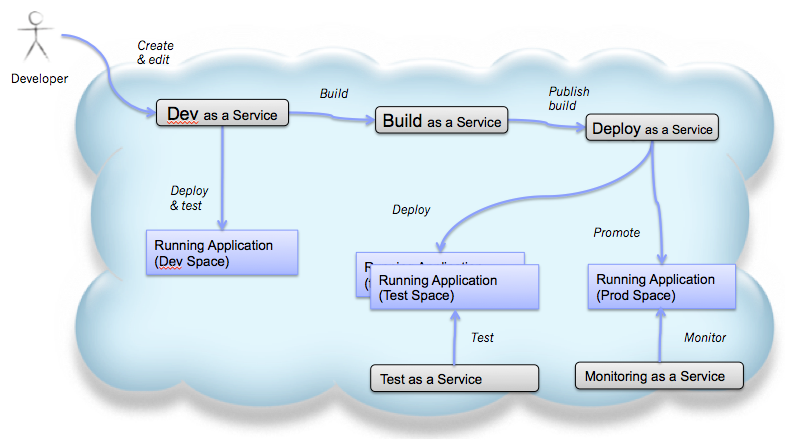
    When one looks at DevOps on PaaS one has to look at the services that need to be hosted on the platform in order to implement a DevOps services platform. If one looks at a DevOps pipeline and the core components that make up a delivery pipeline up, each of the components need to be available as a service, in order to provide a complete ‘DevOps on PaaS’ solution. Namely:

    DevOps Services

    • Development tools as a service (and/or an ability to connect the services on the platform to a desktop IDE)
    • Build as a service
    • Deploy as a service
    • Test as a Service
    • Monitoring as a Service

    These would be what one refers to ‘DevOps Services’.

    In IBM’s new PaaS offering – Codename: BlueMix (in open beta), these DevOps are services are an inherent part of the platform. There services on Bluemix are:

    • Git hosting as a Service
    • Web based IDE
    • Agile planning & tracking, team collaboration as a Service (Jazz.net)
    • Mobile Quality Assurance (MQA) as a Service
    • Continuous Integration as a Service (Jenkins as a Service)
    • Deployment Automation as a Service (powered by UrbanCode Deploy)
    • Performance Monitoring as a Service

    These capabilities working in concert, provide a Continuous Delivery Pipeline on IBM Codename: BlueMix.

    DevOps as a Service (DaaS?)

    So, to conclude. The value proposition for adopting a PaaS platform is self-evident. If you are an organization that delivers software, and is looking to adopt DevOps, a PaaS offering that includes DevOps services allows you to adopt DevOps at a very low cost of entry. You do not need to craft a Delivery Pipeline and implement the whole Continuous Delivery toolchain. Integrations, hosting, servicing – not your problem. Pay-as-you-go, and allow for scale. It is however, not a viable option for all organizations, as it is a drastic shift in corporate culture and potentially policies. Especially if you look at a public PaaS. If you are a born-on-the-web organization, or an enterprise with born-on-the-web applications, you should take a closer look. Check out Codename: BlueMix at www.bluemix.net.


  • Camp DevOps @ GlueCon 2014

    Camp DevOps @ GlueCon 2014

    campdetailsdevopsy.kinsta.cloud is very pleased to announce that in conjunction with Eric Norlin and Glue Conference 2014,  we will be presenting our inaugural Camp DevOps @ Gluecon on May 20th, one day before Gluecon 2014. Camp DevOps will take place from 8:30 am until 4:30 pm. The event will be held at the Atlas Institute Building at the scenic University of Colorado/Boulder campus. Here is a link to a flyer with more information here.  You can go also get more information by going to Campdevopsy.kinsta.cloud (site is still going up, so be patient if there is a problem) or our Eventbrite page.

    Moving devopsy.kinsta.cloud beyond the 4 walls of the website has always been part of our business plan. Camp DevOps is our own conference brand. Martin Logan, devopsy.kinsta.cloud co-founder has held Camp DevOps before, but this will be the first event since our commercial launch.  Over time what Camp DevOps is and what to expect we hope will be better understood. But since this is the first, let me quickly give some background.

    We recognize there are no shortages of conferences around DevOps. Camp DevOps is not meant to compete with DevOps Days and similar conferences. We think DevOps Days are great events and we will be working with local Meetup groups to help them with DevOps Days in the future.  Camp DevOps are also not meant to compete with Velocity or other enterprise events.  Instead Camp DevOps like devopsy.kinsta.cloud itself is meant to pitch a big tent. We will have content and activities for the different constituents of the growing DevOps community.

    CampDevOps @ Gluecon 2014 will feature keynote presentations (Sanjeev Sharma of IBM and author of “DevOps for Dummies”, Rajat Bhargava, CEO JumpCloud and Howard Diamond, CEO of MobileDay already confirmed), multi-track presentations with one geared for technical audiences and another aimed at business and cultural topics, panel discussions and what we are calling “Hello World”. Hello World will feature hands on learning with DevOps tools. Attendees will need their own computing device to follow along.

    There will also be table top displays, Continental breakfast and lunch served. We are hoping to have a sponsor for dinner as well. The cost to attend Camp DevOps is just $49.99. If you are already registered for Gluecon, you can attend for free. If you are not registered for Gluecon and register for Camp DevOps you will receive a $100 dollar credit towards Gluecon registration. There will also be complimentary shuttle service from the Gluecon hotel, The Omni to the Atlas building at CU/Boulder.

    Attendance is limited so please don’t wait to register!

    Besides the keynote speakers, we also will have presentations from AppDynamics, MongoDB, VictorOps and others. We will be updating the agenda and presenters daily.  We still have room for more track speakers, keynotes, panel and Hello World presenters. If you are interested contact us at CampDevOps@DevOps.com.

    Sponsorship packages are also still available. There are sponsorship opportunities in conjunction with Gluecon and CampDevOps or just Camp DevOps. Contact us at CampDevOps@DevOps.com for details.