Tag: SAFe

  • Copado Adds Value Stream Management to Salesforce DevOps Platform

    Copado Adds Value Stream Management to Salesforce DevOps Platform

    Copado, a provider of a DevOps platform for building applications that extend software-as-a-service (SaaS) applications from Salesforce, this week announced it has added value stream management capabilities.

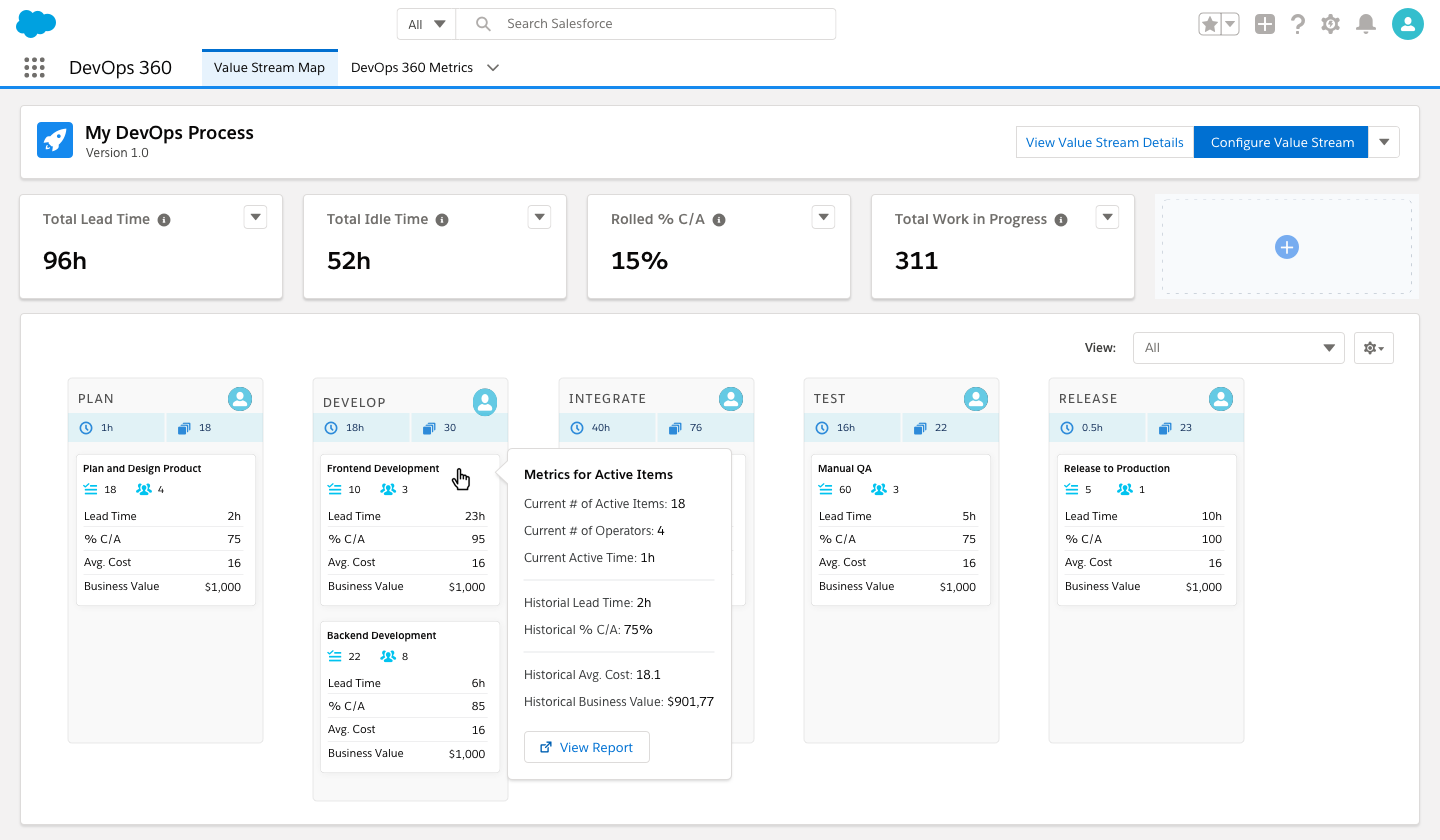
    Andrew Leigh, chief marketing officer for Copado, said providing a platform that accelerates the development and deployment of application code is no longer sufficient. The winter 2021 release of the Copado DevOps 360 platform now includes value stream management capabilities that enable organizations to better prioritize DevOps projects, he said.
    In response to the COVID-19 pandemic more organizations than ever are now relying more on SaaS applications that can be accessed easily by employees working from home. IT organizations are also now using platforms such as Salesforce to jumpstart digital business transformation initiatives. Rather than write develop entire applications from the ground up, many organizations are employing low-code tools from Salesforce and others to extend, for example, customer relationship management (CRM) platforms.

    Leigh said most of the activity revolves around professional developers who are increasingly applying best DevOps practices to build those applications. Copado has certified more than 25,000 developers on its platform, he said.

    Given the current state of the economy, Leigh said interest in DevOps platforms is rising among organizations building Salesforce applications because they want to ensure a return on investment (ROI). Organizations that are investing six figures to build these applications are especially interested in value stream management tools that help make sure these projects are delivered on time.

    The value stream management capabilities added by Copado include support for the Scaled Agile Framework (SAFe) for building complex applications more efficiently. It also provides the ability to synchronize stories from Jira and Agile Planning boards.

    The latest version of the Copado DevOps 360 platform also adds a suite of declarative pipeline builders that allow non-technical teams to define and manage value pipelines without a single line of code. That capability is intended to simplify version control and automation flows to enable developers and administrators who manage Salesforce instances to better align their efforts.

    Copado added deeper integrations to third-party testing tools that incorporate artificial intelligence (AI) and updated its static code analysis and compliance tools.

    Salesforce is clearly not the only SaaS application platform that organizations are looking to extend, but it is among the fastest-growing. For its most recent third quarter, the company posted revenues of $5.42 billion, an increase of 20% year over year. The company is now lifting its future guidance to slightly exceed pre-pandemic levels. Salesforce is projecting fiscal 2021 revenue at the end of its fourth quarter will total $21.11 billion. Revenue guidance for fiscal 2022 has been raised to $25.5 billion. Salesforce earlier this week also announced its intention to acquire Slack, a provider of a messaging platform that is used widely by DevOps teams.

    Leigh said a dedicated DevOps platform for Salesforce applications is necessary because Salesforce applications are constructed using a set of objects and tables unique to the platform versus traditional application code. Regardless of the reason for requiring a dedicated DevOps platform, interest in building and deploying custom applications on top of the Salesforce platform has increased sharply since the start of the pandemic.

  • Lessons from a Successful Large-Scale Agile Transition

    Lessons from a Successful Large-Scale Agile Transition

    Completing a large-scale agile transition can seem intimidating for any business. Agile pushes teams to change their cultural expectations and work processes—a combination that is tough on any work environment. Larger organizations, however, often face an especially daunting migration.

    The good news is that businesses don’t have to face these migrations alone. In my work, I’ve overseen plenty of examples of successful agile projects. Those efforts have taught me many lessons—with one major project standing out.

    An Agile Migration at a Glance

    I recently worked with a large automotive company to help it scale out to a more sophisticated agile development scheme. We applied a customized Scaled Agile Framework (SAFe) to the project. In doing so, we established a development environment with:

    • 15 scrum groups divided under four release trains.
    • A product feature team configuration to define user responsibilities.
    • Two-week sprint cycles.
    • A quarterly innovation and planning (IP) sprint.
    • A transition from VersionOne to Rally.
    • Weekly production deadlines.

    After six months, the company had a continuous delivery (CD) pipeline in place and we had laid the groundwork for a successful project. Of course, plenty of bumps arose along the road to a solid agile environment. Here are five lessons we learned during the project:

    Don’t Allow for Missed Connections Between Scrum-to-Scrum Teams

    We established a feature team setup for this project. In the setup, teams worked on specific feature sets instead of simply dividing components of the software and hoping it all worked when put together.

    The initial plan was to have quick sprints and an emphasis on features that would allow for relatively simple dependency management. In action, however, different understandings of features between groups led to some challenges, including issues linking feature teams and eventual defects after integration. This challenge reinforced the importance of a few key best practices, including:

    • The vital role of a “Scrum of Scrums” team featuring representatives from each scrum to provide cross-team collaboration and ensure work is coordinated.
    • The need to build out retrospective cross teams to minimize dependencies and identify the universal issues within the agile system.
    • The necessity of end-to-end testing that is clearly set forth in the Definition of Done (DoD) project framework. Creating clear DoD parameters can help teams ensure they minimize redundant work while avoiding mismatched data within the QA environment when compared to production.

    Continuously Inspect Sprint Expectations and Right-Size Project Guidelines

    Throughout the project, we found that, in some instances, teams struggled to identify the best velocity for sprints, even after four or five iterations. There was a lack of transparency into whether timelines were actually working because formal discussions around scrum velocity weren’t taking place. This resulted in technical debt adding up over time and incorrect ideas about what constitutes a completed project.

    Struggles to identify the right speed for scrum sprints created instability. We learned to counter this problem by formalizing scrum event planning so teams could identify the right velocity for their tasks and recognize times when they may need to adjust how they were working in light of shifting project demands. This included honestly assessing technical debt and setting timelines for dealing with it.

    Identify When ‘Done’ Doesn’t Really Mean Done

    A great deal of effort goes into identifying the DoD for a project. However, teams can easily struggle to pin down the Definition of Ready (DoR) for backlogged items that arise as the result of technical work. This situation can spiral as small items are left incomplete over multiple sprints until, near the end of the project timeline, testing and similar practices get less attention because everybody is scrambling to complete work. A few ways we overcame this issue included:

    • Using the INVEST criteria to prioritize tasks when trying to identify DoR. This is particularly important as teams that neglect small issues of technical debt risk falling into waterfall habits toward the end of project cycles.
    • Trying to minimize how many work-in-progress items we left unresolved at any time to avoid situations where dev teams are spending more time on backlog items than active sprint work.
    • Creating visualizations of the shared scrum space for better coordination and monitoring across teams.
    • Establishing consistent analysis and updates to the DoD to better reflect real results. This was best accomplished during the sprint retrospective event.

    Don’t Neglect Training

    Agile is all about getting projects moving quickly and eliminating waste. In that vein, many organizations will try to reduce training and spend a couple of weeks teaching workers about agile and expecting them to mature through their experiences on scrum teams.

    In action, scrums need an opportunity to go through storming mode together to develop their agile skill sets, but companies typically don’t set aside time for that type of training. Businesses must establish realistic expectations in terms of training, particularly for cross-functional and self-organizing groups, as these users need a deep understanding of best practices to work well together. Employees need time to adapt to change. Businesses that want to scale agile effectively must establish their core values, reduce direct accountability within new teams that feature interdependencies and, in general, be patient with employees as they adapt.

    Within this transition to agile, it is also important to train users on how to work effectively as a team. Technical skills and process education is key, but those capabilities can fall flat if employees are unable to work well together. For example, the landmark book, “5 Dysfunctions of a Team,” highlights a variety of typical challenges that teams face, including lack of trust or unwillingness to face up to conflict. Businesses need to train workers to counter these types of issues.

    Leverage Efficiency Tools, but Not with Excessive Rigidity

    In this project, we used Rally, an enterprise-class platform built to help businesses scale agile teams. Even in Rally, there are some limitations to how much the technology can support collaboration between teams and identify project dependencies.

    In practice, no single tool will be an agile silver bullet. Instead of expecting a platform to solve your problems, consider adopting practices that make sense for your situation, such as tracking dependencies on a whiteboard. Within this environment, it is vital that businesses also clearly define and manage their development and release processes through ongoing training that establishes a culture of transparency.

    — Tin Nguyen

  • Scaled Agile: Faster Feature Cycle Time, Improved Time to Value

    Scaled Agile: Faster Feature Cycle Time, Improved Time to Value

    Do you remember when the business imperative was improving feature cycle time? As if we just needed to deliver more stuff faster to win in the marketplace. I wouldn’t say that times have changed, but I would say we were just scratching the surface, and rightfully so. After all, we have to start somewhere. The adoption of agile methodologies have proven successful in helping redefine the characteristics and behavior of development teams and, in the process, have certainly helped speed feature delivery cycle time. Great! Is your business more successful now?

    Our goal then, and now, should have been to improve time to value. What good is it to deliver more stuff faster if it’s not the right stuff? How do you know whether it’s the right stuff? How do you make smarter decisions so that you know?

    Agile & Lean at Scale

    The Agile Manifesto explains the key tenets of agile transformations that lead us to this thought: It’s all about value, vision and quality—and rethinking what quality means—in terms of customer value. I didn’t make this up … a team of really smart people from different organizations and industries collaborated and the result is a truly inspiring set of guidance to help teams focus to deliver faster, smarter and better. The thing is, without adopting this guidance at scale, without thinking about what value means and how to prioritize investments into the delivery of value from the top down, we’re back to the same old decision-making process that often takes us off track.

    Business owners, portfolio managers, analysts, solution architects, product managers … all of these roles that operate largely on the “business” side need to think lean and agile and collaborate with engineering continuously to drive the organization as a whole to work faster, smarter, better. Aristotle said: “The whole is greater than the sum of its parts.” Think about that in terms of creating a unified, collaborative organization that marches to the same drum beat, uses the same language, follows the same process to make decisions and drive change. Regardless of whether you are operating at the portfolio or team level, or somewhere in between, you are essentially planning and executing, planning and executing. Your deliverables may be different but the goal is the same: deliver value faster, get feedback, rinse and repeat.

    Addressing the Whole Transformation

    Convinced? Maybe just intrigued? Fair enough. Let’s talk about how to do this, starting with my warning: Change is hard, especially when you’re trying to transform the mindset of an organization and do real work at the same time, so it’s not for the weak or meek. I’m not trying to scare you, just making sure you enter this with eyes wide open.

    With that out of the way, let me enforce the need to consider the whole transformation to be successful; this is not just about the process and it’s even less about the tools that support that process. It’s about the cultural change, first and foremost. There is no tool or magic pill for that. A well-defined, cohesive process is key, however, in uniting the tribes, so in this way it helps with the culture issue. Finally, embedding a well-defined process in tooling just makes things easier because you knock off the requirements related to collaboration, traceability and reporting with the tooling. Remember: people, process, tools.

    SAFe is the Recipe

    So what scaled agile process should you use? Well, I can tell you that you do not need to develop your own process, there are several out there. I favor the Scaled Agile Framework (SAFe) for a number of reasons: it is extremely well-defined, it covers nearly any size and complexity, and it is flexible despite what some may think. At the same time, it’s just a framework—there is no one size fits all and you do not have to adopt every aspect. But you don’t need to start from scratch, either. Be smart about this and take advantage of the invaluable insight that went into the development of SAFe 4.0. My team has done that and I’ve worked with several large enterprise organizations that have as well.

    I love analogies to illustrate a point and simplify what might otherwise be complex, so let me leave you with this one: scaled agile transformations are like cooking. Start with a simple recipe (especially if you’re an inexperienced cook), learn the art and how to adjust seasoning as you go, and fine-tune the dish after feedback from your family. Then try it again. Do you get it? Same with scaled agile: Start with a good framework (SAFe), learn about it, take what is valuable from it for your organizational needs and try it out for an iteration, get feedback from your team and make adjustments to the process for the next iteration. Simple.

    Please visit our SAFe landing page on jazz.net for all things “SAFe”! We are here to help you with your scaled agile transformation (SAFe or not), so don’t hesitate to reach out.

    The IBM SAFe Team (safeinfo@bg.vnet.ibm.com)

    About the Author/ Amy Silberbauer

    Amy is a Solution Architect charged with the definition and delivery of the Enterprise Scaled Agile and IBM DevOps Plan solutions and strategy for the IBM Watson IoT line of business. She is a recognized subject matter expert on scaled agile and software development lifecycle solutions, including enterprise modernization, SOA and collaborative DevOps. She has been with IBM for 29 years and has two decades of software development experience as an engineer, architect and manager. She is a certified SAFe Program Consultant experienced in leading and consulting on multiple internal and external SAFe (Scaled Agile Framework) transformations.

    Connect with Amy on LinkedIn.

  • 3 Rules for Successful SAFe Adoption

    3 Rules for Successful SAFe Adoption

    Startups and enterprises alike are redefining—some say disrupting—markets, industries and customer experiences by delivering innovative ideas at a rapid pace and responding to feedback. Often they fail, but they fail quickly and adjust. You know the ones: Spotify, Etsy, Netflix, Airbnb. How do they do it? What can we learn from them that will work in our own organizations? What is different? In a nutshell, all of these successful organizations innovate completely, not only in terms of what they do, but also how they do it. And the common thread is the application of lean and agile practices to improve their culture and deliver innovation to customers faster than the rest of us.

    Today’s business imperative is to be the disruptor and more and more organizations are turning to enterprise scaled agile as a set of practices to help lead transformations to achieve that goal. The Scaled Agile Framework (SAFe) is the industry-leading enterprise scaled agile framework with a proven track record in thousands of organizations for several reasons, not the least of which is the incredible breadth of definition and collateral so that you just don’t have to make this stuff up yourself. Nevertheless, there is not an one-size-fits-all framework and SAFe is no exception. But there are three key concepts prescribed by SAFe that, if you do nothing else, will help you be successful in your evolution toward becoming that disruptor.

    Go SAFe or Go Home

    1. Apply Lean Principles at an Enterprise level
    You’ve likely heard the term “MVP,” or minimum viable product. This is about investing “just enough” to deliver a capability—a solution, product or application—and get feedback. It is about avoiding the pitfalls of over-engineering. This is perfect embodiment of lean thinking. By focusing on investing only as much as necessary to get feedback quickly (and doing this continuously) you not only reduce or eliminate wasted resources but also speed time to feedback. Lean is also about the notion that “capacity rules”—in other words, only invest as you have capacity to follow through. Otherwise, what’s the point?

    2. Apply Economic Thinking
    Traditional methodologies typically focus on priority to rank at all levels, from business initiatives and projects down to team-level work that delivers changes into products and applications. In the agile world, story points (or complexity) also might be used. So what’s the problem with this? First, it is only a single dimension. What about business or customer value? What about cost of delivery or reducing risks or enabling market opportunities? Is timing a factor? All of these aspects should be considered when ranking because, at the end of the day, organizations are looking for the “biggest bang for the buck.” By applying economic thinking, you are maximizing the business’s ability to deliver the most value at the lowest cost in a timely manner.

    3. Focus on Delivery of Value
    I’ve often heard that revenue generation is the primary goal when organizations look to speed delivery cycle times. In fact, the goal should be delighting the customer; revenue is a bonus, a side effect of happy customers who use your stuff and pay for it! A focus on improving feature delivery is too narrow. What you really want to do is improve time to value. That means articulating what value means, associating the notion of value with features that are delivered, assessing that value and then tracking so you have insight into your organization’s ability to deliver value and get better at it.

    SAFe embraces all of these concepts through artifacts and activities anchored in lean and agile practices. Try it, you might be surprised at how impactful this can be in improving your ability to innovate and be the disruptor instead of being disrupted.

    Read how a typical enterprise dipped its toe in SAFe water to drive delivery of a critical project, and be sure to visit the SAFe landing page to learn more.

    About the Author/ Amy Silberbauer

    Amy SilberbauerAmy is a Solution Architect charged with the definition and delivery of the Enterprise Scaled Agile and IBM DevOps Plan solutions and strategy for the IBM Watson IoT line of business. She is a recognized subject matter expert on scaled agile and software development lifecycle solutions, including enterprise modernization, SOA and collaborative DevOps. She has been with IBM for 29 years and has two decades of software development experience as an engineer, architect and manager. She is a certified SAFe® Program Consultant experienced in leading and consulting on multiple internal and external SAFe (Scaled Agile Framework®) transformations.

    Connect with Amy on LinkedIn.

  • VersionOne® Spring 2016 Release Helps Organizations Successfully Scale Agility with SAFe® and DevOps

    VersionOne Enables Program Boards, PI Planning, and WSJF Ranking to Align with the Scaled Agile Framework®

    Atlanta, GA (PRWEB) April 22, 2016

    VersionOne, the independent leader in agile lifecycle management, today announced its Spring 2016 Release to help organizations successfully scale agility with SAFe and DevOps. New features in VersionOne Lifecycle that directly support SAFe include: a new Program Board for coordinating across teams and visualizing cross-team dependencies; interactive, multi-team Program Increment (PI) Planning capabilities; and Weighted Shortest Job First (WSJF) Ranking. In addition, VersionOne Continuum™ for DevOps now includes the ability to view a graphical timeline of work item history and a visual depiction of the development, test, and stage phases of a DevOps product workflow.

    VersionOne’s Spring 2016 Release includes the following:

    • Program Board – Coordinate efforts and visualize cross-team dependencies at the portfolio item level across each iteration in a release. These visualizations help teams avoid risks and costly delays that often result from unforeseen dependencies with other teams.
    • PI Planning – Plan complex, multi-team releases on a single screen with flexible, interactive team assignment and context sensitive filtering of backlog items during large-scale planning sessions.
    • WSJF Ranking – Rank portfolio items, epics, features, and capabilities based on the cost of delay. The cost of delay algorithm is based on estimated business value, risk reduction, time criticality, and effort.
    • DeliveryStream – Give teams the ability to trigger pre-configured Continuum actions within Lifecycle work items.
    • Continuum Product Workflow – Define the workflow for any product that is defined in Continuum and visualize the development phases.
    • Continuum Work Item History Visualization – See a visual representation of all the steps and automation a particular work item has participated in, all in a single place.
    • ALM Connect™ – Connect VersionOne to the world’s most popular application lifecycle management (ALM) systems and manage the integrations from one intuitive, web-based interface. ALM Connect ensures visibility and coordination across today’s complex development processes and heterogeneous environments.

    “While agile adoption continues to grow, ensuring successful large-scale agile implementations can be challenging without the right framework, solutions, and services,” said VersionOne CEO and Co-founder Robert Holler. “The Spring Release is further proof of our ongoing commitment to helping our customers successfully scale across the entire software delivery value stream.”

    Learn more about the VersionOne Spring 2016 Release.

    About VersionOne

    VersionOne is a recognized leader and visionary in agile lifecycle management software and services. Our mission is to help companies envision and deliver great software. Our promise is to promote and serve the best interests of the agile software development community with respect and humility. Every day, we work hard to make a difference in our community and with our customers.

    Today, more than 50,000 teams at 1,000 companies, including 33 of the Fortune 100, use our solutions to help scale their agile initiatives faster, easier, and smarter. Whether a small team just starting out with agile or a global enterprise scaling agile, VersionOne customers get the best solutions in the industry backed by the pioneers in agile lifecycle management. VersionOne has offices in Atlanta and in Amsterdam.

    VersionOne is a registered trademark and ALM Connect and Continuum are trademarks of VersionOne Inc. Scaled Agile Framework and SAFe are registered trademarks of Scaled Agile, Inc.

  • SAFe and DevOps – a recipe for a delivery smoothie!

    SAFe and DevOps – a recipe for a delivery smoothie!

    DevOps brings you the deep pink color of fresh strawberries and SAFe the rich, creamy texture of blueberry yoghurt!

    ‘Agile’ delivery is not always smooth. If not managed well, it can be a nightmare, as those of us who have seen rogue agile processes run amok know. That’s where the Scaled Agile Framework (SAFe) comes in. It blends with DevOps to bring agile delivery to the enterprise.

    A quick word about SAFe: Those familiar with SAFe would know that it divides the work of building a system into small time-boxed units. Each unit must typically be deliverable in around two weeks.

    For instance, if you run a factory then receiving and issuing material is likely to be part of what you want to automate. You may want to provide users with features, such as the ability to create issue vouchers online, modify vouchers, cancel vouchers, or search for a particular item while creating a voucher. Some of these features may be small enough to be delivered in two weeks. Others may need to be split up further into sub-features, and so on. Let’s suppose the item search feature is tiny enough to be implemented in a couple of weeks and can therefore be considered a unit (or ‘iteration’ in SAFe parlance). The system would be the sum of several similar units, each capable of being implemented in a couple of weeks. Typically, one would assign the units to various teams, and schedule them based on their inter-dependencies and various staff, infrastructure, and other resource constraints. This composite set of small units is called a ‘program’ in SAFe. More about SAFe in a later article.

    The DevOps culture: The SAFe methodology requires that each unit be made usable within the two week interval. That is, the unit must be developed and deployed to a production-like environment. The ‘agile team’ creating the unit must therefore have an ‘end-to-end’ perspective of the unit and not be constrained by artificial boundaries of development, testing, or operations. The members should have the skills, and be willing to work in each other’s domains, collaborate actively, communicate frequently, and provide feedback quickly and clearly.

    This active collaboration between developers, testers, and operations is what DevOps is about. An organization that has a DevOps culture will therefore find it easier to implement SAFe.

    Developing on cadence: A factor which makes project managers reluctant to use agile methodologies in large enterprise scale projects is the number of multiple units (and teams) operating in parallel. SAFe attempts to simplify the process of synchronization between teams by aligning the two-week windows so that they all start and end together. By ‘developing on cadence’, as this practice is termed in SAFe, the different agile teams can align common activities like planning, review and system demos. This makes it easier for the program to identify inter-team dependencies and assess how unit-level feedback and change requests can affect other units or teams. The cadence mitigates the complexity of synchronizing work across scores of teams.

    SAFe DevOps tools: While work synchronization helps, there are certain activities that still need tools. With often several hundred code changes being checked in every day, enterprise scale projects need sophisticated configuration management and deployment tools capable of tracking and maintaining the multiple versions of code, intelligently scheduling and triggering builds and automated tests, communicating feedback about test status, configuring and creating environments, creating installers, and deploying the builds to the appropriate environments. Tools like Docker make the deployment process quicker and more flexible. IBM® Rational® solution for Collaborative Lifecycle Management (CLM) provides a suite of tools capable of working across the spectrum of tasks and managing the complex delivery process end-to-end.

    Agility over the last mile: Because of the need to deliver usable code at short intervals, testers and operations personnel need to be as nimble as developers.   While developers may have achieved success in using Agile methodologies and have efficiently been churning out byte sized chunks of code at short intervals for a while, it is only more recently that operations teams have begun to accept agility as an achievable goal. DevOps, assisted by various collaborative and automation tools like CLM and Docker, has played a significant role in changing mind sets and transforming capabilities over the last mile.

    It is this end-to-end blend of the DevOps culture with SAFe, along with the various tools that are part of the DevOps ecosystem that will propel enterprise level software delivery towards the goal of smooth, continuous delivery.

    About the Author / Vidhya V Kumar

    Vidhya V Kumar

    Vidhya is an advisory software engineer at IBM.  An evangelist and practitioner of agile methodologies, continuous delivery, and documentation, she has around ten years of experience in the IT industry.  She is a subject matter expert in DevOps, Application Lifecycle Management, and Search methodologies.