Tag: rugged devops

  • Confessions from Fannie Mae, Liberty Mutual and Capital One

    Confessions from Fannie Mae, Liberty Mutual and Capital One

    Learn from real-world stories from presenters at the All Day DevOps conference …

    True Story

    Over the past few years, Fannie Mae transformed the way in which it delivered software. Deploys increased from 1,200 per month to 15,000 per month.  At the same time, productivity increased by 28 percent while costs were reduced by 30 percent.

    But, how did Fannie Mae do it?

    During the All Day DevOps conference, more than 13,500 practitioners from around the world came together to learn from their peers in the industry. Barry Snyder, senior manager of DevOps at Fannie Mae, was one of 57 practitioners who shared his real-world journey through his enterprise transformation.

    Choke Point or Checkpoint?

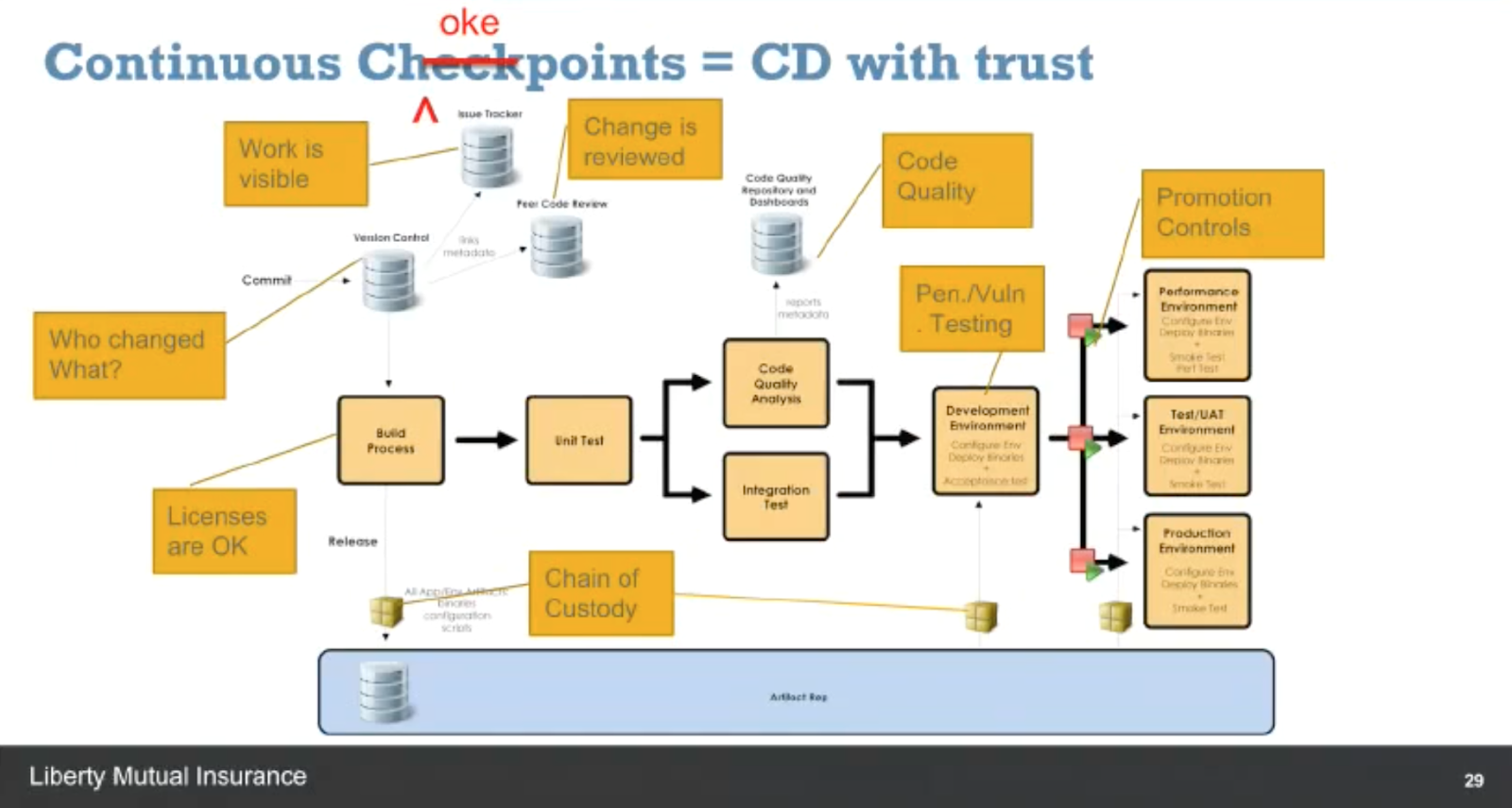
    Eddie Webb, director of Software Delivery Platforms at Liberty Mutual, also shared his organization’s journey into DevOps.  Eddie described how Liberty Mutual evolved its organization, tool chain and processes to go from 20 percent of builds being deployed to 60 percent over the past 18 months. He described how the company documented its value delivery chain and identified all of its choke points in the continuous delivery process that would need to be automated to achieve its new velocity and quality targets.

    Screen Shot 2016-12-05 at 11.35.04 AM.png

    Run the Gauntlet

    The All Day DevOps conference recorded more than 57 practitioner-led sessions (30 minutes each) including those from Barry and Eddie. Every session is now posted online and is free to watch. The conference itself had three tracks: CI/CD, Automated Security and Modern Infrastructure, including:

    • Application Secret Management with KMS – Andrey Utis of Capital One
    • Getting out of the Job Jungle with Jenkins – Damien Coraboeuf of Clear2Pay
    • Serverful Computing – Taking One for the Team – Paul Czarkowski of Blue Box Group

    One of the best ways to learn about DevOps is to hear from the experiences of others who have run the gauntlet. Take 30 minutes this morning, at lunch or at home this evening to watch your first online session with All Day DevOps On-Demand.

    — Derek E. Weeks

  • All Day DevOps

    All Day DevOps


    Over the past year, I have traveled to and delivered presentations at 18 DevOps events. I’ve also heard that over the past several years, John Willis has participated in more than 200 DevOps events. But not all of us have the time or budget to get ourselves and our teams out to these events where we can learn from other practitioners.

    This is why we’ve assembled the All Day DevOps Conference for Nov. 15.

    Free DevOps

    All Day DevOps will deliver 57 practitioner-led sessions over 15 hours and 15 time zones. No vendor pitches are allowed. To break the travel and budget barrier for you and your teams, we are delivering every session live, online and free of charge. Every session will also be recorded. We are doing this because we want to share global DevOps expertise with everyone.

    All Day DevOps

    DevOps Brains

    More than 3,500 people have now registered for the conference. We have an awesome speaker lineup covering three tracks: Modern Infrastructure, CI/CD and Automated Security. Here is a sample of some of the great sessions being delivered:

    • CI/CD
      • Meta Infrastructure as Code: How Capital One Automates our Automation Tools with an Immutable Jenkins, by George Parris (Master Software Engineer at Capital One)
      • Speaking for the Dead: Critical Positive Lessons from Waterfall and Monolithic Architectures, by Michael DeHann (Former CTO & Founder of Ansible)
      • I, For One, Welcome Our New Robot Overlords, by Mykel Alvis (DevOps Computational Demonologist at Cotiviti)
    • AUTOMATED SECURITY
      • Stop Changing Your Password, by Chris Swan (CTO Global Infrastructure at CSC)
      • System Hardening using Ansible: Application Deployment + Configuration Management + Continuous Delivery, by Akash Mahajan (Lead at OWASP Bangalore)
      • Building Codes for Building Code, by Josh Corman (Director of Cyber Statecraft at Atlantic Council)
    • MODERN INFRASTRUCTURE
      • Terraforming Your Infrastructure: From Beginner to Semi-Pro in 30 Minutes, Britt Treece (Production Engineer at PhishMe)
      • DevOps Friendly Doc Publishing for APIs & Microservices, by Mandy Whaley (Director of Developer Experience at Cisco)
      • Monitoring, Hold the Infrastructure – Getting the Most out of Lambda, Michael (DevOps Evangelist at DataDog)

    Don’t Just Listen, Talk DevOps

    One of the big pieces of input we have received from the community is that everyone wants an opportunity to interact. This is why we are building a dedicated team room in Slack for you. Every attendee will have the chance to interact with the speakers in the Slack room. Q&A will be live, online and freely accessible. We will also have Birds-of-a-Feather channels set up for those with questions to be helped by those with answers.

    Register Now

    If you would like to join us, can you register for free.  A big thanks goes out to Alan and his team at devopsy.kinsta.cloud for helping us spread word of the event here. We are really excited to have teams from North America, Europe, Asia, and Australia joining us for the event!

    www.AllDaydevopsy.kinsta.cloud

    screen-shot-2016-10-24-at-12-35-39-pm

    — Derek E. Weeks

  • Getting Ready for All Day DevOps

    Getting Ready for All Day DevOps

    DevOps Practitioners Unite

    On Nov. 15, we’ll be broadcasting 54 live sessions across 15 hours and 15 time zones. The All Day DevOps conference will be live, online and free. Anyone who registers can watch.

    We have invited some top-notch practitioners from around the world to speak at the event on topics ranging from DevOps transformations, to CI/CD, to automated security, to modern infrastructure (think serverless, microservices and containers). The speaker lineup will include:


    www.alldaydevopsy.kinsta.cloud

    Don’t Watch Alone – Host a Viewing Party!

    One of the best parts of attending a DevOps conference is getting to interact with others in the community. We have had many organizations including Capital One, Intuit and Fannie Mae approach us about hosting viewing parties at their offices—and opening the party to the public. Sound intriguing? Here’s how to do it:

    Secure the location. Pick your corporate auditorium, cafeteria or open meeting space. Secure it all day for Nov. 15. Make sure you have at least one internet-accessible viewing screen.

    Promote the session: One you have the approved locations and times, share them here with the All Day DevOps Conference organizers. We will help you promote your party on AllDaydevopsy.kinsta.cloud and through social media postings, directing them to your registration page.

    Invite People to Register: Set up a place for people to register for your location. You’ll want to know how many people to expect because you need to know how much pizza to order. Meetup.com and Eventbrite.com make event registration easy.

    Make it Fun. Order some pizza and drinks. We’ll send along some cool laptop stickers from the conference and some of the sponsors. Share pictures from the event online (@AllDayDevOps). Join the conversation in the conference Slack channels. Set up birds-of-a-feather stations. Play some music during breaks. Set up viewing screens for each of the conferences three tracks.


    Just to be clear: the All Day DevOps Conference is not a collection of vendor pitches.  In fact, we have tried our darnedest to ensure the agenda is purely focused on real DevOps practitioners sharing their craft.  Take a moment to look at the speakers participating in each of the tracks and you’ll see what we mean.

    Register today. Invite your colleagues to attend.  Then plan a viewing party at your office.

    — Derek E. Weeks

  • Fixing Flaws: Bridging InfoSec and DevOps

    Fixing Flaws: Bridging InfoSec and DevOps

    The Road to Creating More Secure Code and Interlocking two Traditionally Distinct Practices

    As DevOps continues to expand across verticals, including the financial and government sectors, security has become paramount in the minds of CIOs and CTOs. As such, more organizations have begun to integrate security early in the development process. While security always has been a theoretical part of DevOps, the number of breaches making headlines recently and costing many IT professionals their jobs has taught us that now it is more important than ever for companies to build security into each and every methodology and practice. “Build it in from the start” is a fitting mantra for any developer today—and even more so for his or her boss.

    Creating more secure code for products and platforms starts from day one in the planning stages, and some industries are doing it better than others. You must include security—not just in the end product and late development stages, but also throughout the life cycle. Organizations can do this by employing a defined methodology and unified tools that support that methodology, so developers make security not only a consideration for their end product, but something fundamentally baked into their build.

    To achieve this harmony between Development and InfoSec, developers and Operations staff must be included in decisions about tools, standards and methodologies that the organization will follow. They need to understand what requirements are coming down the road so they can recognize the need to address those requirements in advance, rather than than being caught off-guard by problems or issues after the fact.

    Build a DevOps Toolset with Dev, InfoSec Buy-in

    It’s important to recognize that the door swings both ways; InfoSec folks can’t simply give developers a laundry list. Developers must be able to communicate their needs when it comes to security, and also must take an active role in the security of their product.

    Part of the importance of this two-way street is recognizing the benefit of having developers involved in security decisions from the beginning. When Dev stakeholders are given the opportunity to participate in the purchase decisions of security tools at the outset of a project, they gain insight not only into the importance of incorporating that tool into their build as well as an understanding of what the capabilities of that tool are. After all, the most expensive part of application security is having to start from scratch because of poor initial planning.

    When it comes to tools and security, good security is not necessarily what you buy but what you build. A good place to invest is at the DevOps tool level, where developers can build a process and methodology that allows them to create secure code throughout the process. This is a crucial step that limits point-in-time testing after the product is built—which can lead to expensive re-engineering.

    Teach Teams: A Bug Fix is not a Security Risk

    One way to keep costs down and priorities straight when addressing security challenges is to keep security issues and bugs separate from each other. Bugs are bugs and we all want them fixed, but a flaw in a piece of software is not necessarily always a security risk and does not necessitate an immediate fix (despite what the stakeholders for that feature might tell you). Finding flaws certainly should be immediate, but the process of fixing those flaws should involve prioritization.

    This does mean, however, that evaluating flaws in a very timely manner is important, and one of the first questions you ask yourself when addressing potential flaws or bugs in your software product should be, “Does this pose a security risk?” If the answer is yes, you can quickly pinpoint the source of that risk and address it. The good news is that by doing this, you can greatly reduce the potential of your product having security risks you either a) didn’t know about or b) didn’t think were actually security issues. The challenge is that this is a constant and ongoing process. Be sure though, the benefits are well worth the time you’ll invest.

    Recognize Fixing Flaws is a High Priority

    It also can be difficult to balance the practice of fixing security flaws versus adding new features, particularly when developers are getting pressure from above to continue adding features and improving the end product.

    Again, you need to look at risk. By weighing the benefit of features against the risk of flaws, you will be able to make smart decisions for prioritization. For just about every software product out there, security flaws should be addressed before new features.

    It’s also worthwhile to consider the fact that bringing new features into a flawed environment is probably not a great idea. Not only does it mean you still have a fundamentally “broken” product, but that new feature may 1) not work as you expect or 2) increase the security risk further. If the second scenario is the case, now you not only have to fix the initial security flaw, but you also may have to reel that release back in—something you probably would rather avoid.

    It’s also important to remember that good tracking, knowledge preservation and collaboration let you pinpoint issues, understand dependencies and determine the trade-offs faster.

    Security is not an Option—It’s a Must

    If you are looking for inspiration on how to better incorporate DevOps security best practices into your development process, look no further than government, financial and pharmaceutical industries. These industries face heavier regulations than just about anyone when it comes to security requirements, so they are continuously delivering secure software. Not only do they have to include security in their development process, they also must test that security and have defined educational requirements for their developers. In this end, all of this leads to some of the best and most sophisticated security practices in all of DevOps. If you want to gain good insight into how you can improve your security and see some of the latest advances in software development security trends, these are the industries you should pay attention to.

    The surest way to provide a poor user experience and to compromise an organization’s success is to allow a security breach that could have been prevented with better foresight. That is why security best practices for DevOps (or rugged DevOps) are so important. By following the recommendations above and employing some of these tactics into your DevOps process, you can decrease risk for you and your company, and ultimately have more confidence in the success of your product.

    About the Author / Ward Osborne

    wardosborneWard Osborne serves as Information Security Officer at CollabNet and has more than 20 years of experience in Information Technology and Security Management. For the past 15 years he has focused on security integration and cloud security and has worked with dozens of companies of all sizes creating a culture of security and using security as an accelerator in business processes. Connect with him on LinkedIn and Twitter.

  • All Day DevOps: Bringing DevOps to the World

    All Day DevOps: Bringing DevOps to the World

    An Audacious Plan: Deliver DevOps to everyone.

    The global audience for DevOps is expanding faster than any one person or company can keep up with. While DevOps Days and other regional events provide invaluable support to their local communities, we wanted to create a global event, offering the very best lineup of speakers across North America, Europe and Asia.

    We also wanted to make sure that anyone, anywhere can attend. So, we set a high bar for our organizing team, and they delivered: $0 registration.

    By creating All Day DevOps as an online event, we are able to get many people to attend and present—many of whom ordinarily would not be available because of time or travel restrictions. We expect well over 1,000 people to attend throughout the day.

    15 Time Zones, 15 Hours, 3 Keynotes, 54 Sessions

    Nov. 15 will see the first truly global, online DevOps Conference: All Day DevOps. Starting at 9 a.m. Greenwich Mean Time/5 a.m. Eastern Standard Time and continuing through midnight GMT/8 p.m. EST, there will be three simultaneous tracks, each track containing 18, 30-minute presentations, for a total of 27 hours of presentations.

    Call for Papers

    We are inviting speakers from around the world to participate in this first-of-its-kind event covering 15 time zones. Timing for the conference is set for the EMEA sessions to begin at 9 a.m. GMT, then, at 9:30 a.m. EST, move the concentration of presentations to the east coast of the United States and ending with presentations on the west coast of the United States starting at 11 a.m. PST. All sessions will be recorded, but you will need to register for the event to have access to the recordings.

    The Call for Papers is now live. Please submit your paper soon. The deadline for submissions is Sept. 21.

    Conference Tracks

    The conference will host three tracks: Modern Infrastructure, Automated Security and CI/CD. We’ll have 54 sessions plus three keynotes on three tracks, running continuously for 15 hours.

    Track One: Modern Infrastructure

    Modern Infrastructure Track Hosts and Moderators: James Wickett, Signal Sciences, joined by Ernest Mueller, AlienVault and Karthik Gaekwad, Oracle

    In this track, we will be discussing novel architectures, approaches and tools for building out software and services. We are not looking for the standard approaches, but the way Infrastructure will be in the next three to five years.

    Track Two: DevSecOps & Automated Security — Living the Dream

    Automated Security Track Hosts and Moderators: Milton Smith, Oracle, and Shannon Lietz, Intuit

    You have a well-tuned development and delivery environment or you’re in the process of building one. AppSec is a top business concern. You moved DevSecOps from Big Foot and UFOs to reality, you sold the dream to staff, and now it’s beginning to pay off. This track explores DevSecOps tools and techniques to build a successful automated security program.

    Track Three: CI/CD — Continuous Everything

    CI/CD Track Hosts and Moderators: Derek Weeks, Sonatype, and Andi Mann, Splunk

    Continuous delivery is not magic, but it does take the right effort. The most successful practitioners have taken pragmatic steps to reduce cycle times, improve collaboration and build quality in without burning people out. This track asks you to share your frontline experiences of building CI/CD pipelines, aligning key stakeholders and measuring the results. Remember, what’s now an everyday experience for you is awesome to another pursuing that path.

    Conference FAQs

    How to I register to attend?

    Registration is open now at AllDaydevopsy.kinsta.cloud. The site will be constantly updated, sometimes multiple times per day, with the latest information. You can also follow us on Twitter under the handle @AllDayDevOps and using #AllDayDevOps.

    screen-shot-2016-09-12-at-4-44-16-pm

    How will the sessions be delivered?

    The sessions are delivered over Google Hangouts, allowing us to have an unlimited number of attendees on each of the three channels. All you need to deliver a presentation is a reliable internet connection.

    We are also arranging Slack channels for all sessions to host interactive Q&A sessions for everyone.

    If my talk is selected, can I post a notice or an article about the conference on my site?

    Not only is it OK, we would thank you profusely if you did. You’re welcome to use the banner and the conference icon if you need graphics for the article. Let us know when it goes up and we’ll give you a shout-out.

    Who is organizing All Day DevOps?

    The All Day DevOps Conference is organized by advocates in the DevOps community. We are working together to deliver a diversity of vendor-neutral sessions and speakers from around the globe to show practical usage and technical solutions of DevOps in small and large enterprises.

    • James Wickett, Signal Sciences
    • Derek Weeks, Sonatype
    • Shannon Lietz, Intuit
    • Milton Smith, Oracle
    • Andi Mann, Splunk
    • Mark Miller, Sonatype
    • Ernest Mueller, AlienVault
    • Karthik Gaekwad, Oracle
  • Dismantling Inefficiency: The DevOps Point of View

    Dismantling Inefficiency: The DevOps Point of View

    I recently caught up with Paula Thrasher, application delivery lead at CSC and DevOps pioneer in government circles. In our conversation, we discussed a number of important topics including cross-functional teams, software supply chains, paying down technical debt and her search for passionate people to hire. To succeed in managing large projects, she’s taking a different approach—one you might want to apply in your own organization.

    Thrasher: I’m Paula Thrasher with CSRA and I work for a division company we call Delivery Services Organization.

    Derek Weeks: What was your presentation at the Rugged DevOps conference about today?

    Thrasher: We had a panel about the people, process and cultural aspect of DevOps, and the security context, as well. When you’re moving to the Ops transformations, what kinds of behaviors are both challenges and opportunities.

    There was a comment at the beginning session about how any sort of transformation that relies on human nature has failed. So you can’t change how we work, but you can leverage how people are motivated to try and encourage the right behavior. I think that’s the thing that’ll resonate with the security professionals.

    blogpic1
    Link to Panel: https://www.youtube.com/watch?v=IbrY8mm9aI4&index=7&list=PLotLY1RC8HovW-XnZbItSBupjbTzFkfJw

    Weeks: You’re setting up a new organization and have a lot of projects that you’re going to take on. Is it possible to achieve a lot with smaller teams? Do you need a big team to do rugged DevOps?

    Thrasher: I think the main thing that we’ve been focused on is creating the team that is sort of the center of the universe. I think the most important thing is to have a team that is cross-functional. A lot of times when you think of teams … this is the development team, this is the Ops team, this is the security team … the question is, do you have all the players on the same team, or are they on different teams? I think if you find yourself in a situation where any one team has to deliver to another team, instead of actually being responsible for delivery of the actual business submission function, you’ve got some horrible web of dependency you’re going to have to untangle.

    The big focus of what we’re trying to do in the new organization is build that completely cross-functional team and to enable them as a team to be placed on different projects, different missions. So instead of doing single-band rotations, where a single employee moves onto a new project, we’re actually trying to move full teams. As a team, they learn how they work best and how they can deliver. It makes a really powerful solution for actually solving problems. I’m really excited about that.

    Weeks: A lot of people at the Rugged DevOps Conference are interested in the rugged DevOps phase because they’re concerned about being left behind by DevOps. Is that a real concern for security teams: getting left behind?

    Thrasher: Yes, we definitely see a dichotomy in the world of how security interacts with development teams—between the traditional showing up at the end and inspecting versus really embedded security. It’s so clearly going to this idea that you can’t just inspect security. Security can’t be this checkbox at the end. You really have to build it in from a computer. You have to actually make design decisions about security. You have to make sure the developers know secure coding practices. You have to have tools that scan, check all the time, and get feedback. You can’t just add that at the end.

    I think it’s a real challenge to security folks, just as it was for everyone—developers and Ops people—to change how you think to that systemwide view. You can’t just be a phase at the end. We actually have to be part of a whole equation, that whole systems thinking. I think that is so instrumental to what DevOps really is as a group.

    Weeks: One of the things that you recently talked to Mark Miller about was an idea of using pictures to help with collaboration and to get everyone on the same page. Can you tell me about that practice?

    Thrasher: Back to this human nature piece, I think humans are inherently really visual thinkers. I also think you’re asking people to bring cross-costuming across social teams. Well, if you’re a security person and you’re talking to an Ops person, you probably don’t speak the same language. Or if you’re a developer and you talk to a security person, again, you don’t necessarily speak the same language. But when you speak visually, you can understand each other better. You don’t bring your acronyms to the table. We’re talking about a diagram.

    I also think it takes the personal element out of it a little bit. We’re talking about the system. We’re not talking about each other. The security team is not accusing the developers of being a bunch of renegades. They’re talking to them about a process and how they process it. It keeps the conversation where it needs to be, which is on making the process better and delivering better software.

    Weeks: How is the growing interest in software supply chains changing the way you’re thinking about DevOps?

    Thrasher: I think simplicity is an underused tool in security. Recently, one of our DevOps teams that was going in their rapid fashion had a deployment that had a vulnerability in it. They had to respond quickly, and they actually did respond quickly. But when we unpacked it, in retrospect, we realized: “How did we get here? How did we let this vulnerability get in?” We had all sorts of scanning. We had, supposedly, all the right things to have prevented that security flaw. Yet, how we got there was this Venn diagram of all these things overlapping. It was one of those security bugs that slips through the cracks.

    We realized what happened is we had gone to over-engineering; we had over-engineered for performance. In doing that, we had overlooked the interaction of three components in a very particular circumstance. It was like a “every third Tuesday if you spun around three times” kind of bug. But I think that’s exactly what happens a lot. That’s super common in terms of those last defects, and there’s quite a bit that comes out of that overlap of complexity.

    Fewer, more secured suppliers reduces the lift of having to upgrade updated components. It also means if you find an issue, your unpacking of that issue is a lot easier because you have a lot less things going on. All engineers need the reminder of “keep it simple.” But I think that’s a real powerful thing. Fewer, better suppliers, from a supply chain standpoint, is one of the mantras that I really appreciate because I just see it match. It really makes a difference.

    Weeks: You’re working with a lot of government agencies across the board. What’s their interest in rugged DevOps practices, or just DevOps practices that you’re bringing into play?

    Thrasher: I think in the government space, and it’s true for any enterprise, everything has to have security. There is not an agency that we can work with that doesn’t have privacy data, or heavily secured data, in the defense and intel agencies, or just straight-up vulnerabilities from being a target. The scale of the enterprise means there’s a lot of potential systems and a potential surface area for attack. You can think to all the high-profile attacks that have occurred in the federal government recently, and it’s made people really alarmed!

    One of the things that’s very interesting is that the whole federal government did a “cyber sprint” last summer, where they did nothing but pay down technical debt, and get rid of systems and their vulnerabilities. It was wonderful! And I think every organization should do just that: spend one month a year doing nothing but eliminating old frameworks and applications. That really simple, easy thing often gets overlooked because businesses are always saying, “More, more, more, more, more.” However, we actually measured the metrics of the teams after the “cyber sprint,” and all of our teams’ velocity increased. After we let teams upgrade legacy components, all of them had an improvement, which is sort of like a “Well, duh!” But I think it’s a win-win really, that if we can allow ourselves to invest in paying down our technical debt we can get better results.

    I think that in a government space, it just has to be part of the equation. So much of what we do is so instrumental to everything.

    blogpic2
    Link to interview: https://www.youtube.com/watch?v=5veGeDAaJSI

    Weeks: As we started off the conversation, you have a new group. You have a lot of projects that are going to get underway. Are you hiring?

    Thrasher: Absolutely.

    Weeks: Who are the type of people that you’re looking for, if someone wants to get in touch with your company?

    Thrasher: We are at CSRA.com, and if you go to our jobs and our careers website, you can see some of the openings we have. Actually, I’m really excited. One of the projects we did internally was building a whole new hiring model. We used big data. We built in some DevOps, and we’re taking advantage of our own technology to do that.

    Like I said, what we are really trying to do is build good strong teams, and so that’s something we’re very focused on. So one of the pilots we’ll probably be doing shortly is a team-based hiring model where a team actually hires for themselves.

    We’re looking for folks who are just really passionate about solving digital government. And I think that’s the main focus of us is really just being passionate about the mission we’re trying to do. We’re trying to help the government be that digital agency. Looking at the interactions we have with some of these Silicon Valley apps, how come we don’t have that interaction with the government? That’s what we want to create. So we’re looking for people who are passionate about our mission and willing and interested in solving problems. Hopefully we can build a great team.

    Weeks: Excellent. Thank you.

    blogpic3If you loved this interview and are looking for more great stuff on Rugged DevOps, I invite you to download this awesome research paper from Amy DeMartine at Forrester, “The Seven Habits of Rugged DevOps.”

    As Amy notes, “DevOps practices can only increase speed and quality up to a point without security and risk (S&R) pros’ expertise. Old application security practices hinder speedy releases, and security vulnerabilities represent defects that can leave a company open to cyberattacks. But DevOps practitioners can leap forward with both increased speed and quality by including S&R pros in DevOps feedback loops and including security practices in the automated life cycle. These new practices are called Rugged DevOps.”

  • 3 Simple Steps to Rugged DevOps 101

    3 Simple Steps to Rugged DevOps 101

    As the CEO of WhiteSource, I regularly consult enterprises about building and enforcing their open-source security policies.

    In the course of my consultations, I discuss open-source security protocol with many software companies and enterprises, and I’m often baffled by the fact that many organization aren’t boosting their software development performance and speed by bringing their development and operations teams together via DevOps. In fact, only 25 percent of enterprises are currently doing DevOps. I mean, if you were a CTO and someone said you could make your software development 200 times faster and reduce unplanned work/rework by 22 percent, wouldn’t you jump at the chance?

    Now, I know DevOps still is not being implemented even though it has proven to improve deployment rates, so I shouldn’t be surprised that security isn’t joining the DevOps party. But I am. Just imagine the benefits of giving security the DevOps treatment. There’d be no more (or, at least, significantly fewer) last-minute security issues, no more unrealistic security policies, and engineers, IT and security professionals who actually understand each other and improve their own processes to work better together. This is the essence of rugged DevOps.

    Implementing rugged DevOps is a huge decision for any enterprise, and it requires a lot of planning and time to implement. However, you don’t need to completely remodel your organization to start enjoying some of what rugged DevOps has to offer.

    So, what can you start doing today?

    Shift Left Your Security

    DevOps is all about shifting left security to find security issues as early in the software development life cycle (SDLC) as possible. The earlier you find an issue, the cheaper and easier it is to fix.

    So, how can you shift left your security? Start by integrating security tools into your continuous integration (CI) process to find vulnerabilities as soon as they’re added to your build and sometimes even your repositories. Tools exist that can integrate with your build tools and identify potential issues in your build.

    Also available is a browser plug-in that allows developers to detect security vulnerabilities while they are searching for open-source components online. This tool helps developers say no to vulnerable components long before downloading or integrating them with their code.

    Shifting left security is the hardest part of any enterprise’s rugged DevOps journey. Yet by taking some small steps, you can start to enjoy the benefits of DevOps with a twist of security.

    Adopting a Micro Approach to Security

    Just as operations has adopted a DevOps mindset to understand and become involved in development, it’s now security’s turn.

    Security needs to stop being on the outside of development, looking to control it through detailed security policies. Instead, it needs to take an active part in it, steering it toward security. Security can do this by focusing on understanding development and deployment processes, and searching for possible quick wins.

    From my own experience, every time a security team takes the time to understand the peer code review process, small changes are made with significant contribution to code security.

    I also often notice that security teams are unaware that some developers may still use the old “copy and paste” method in using open-source components. This makes it impossible to track known open-source vulnerabilities. Once security teams understand this, they can improve guidelines to ensure they are not blindsided.

    The good news is you don’t have to overhaul your whole organization to give security a micro-makeover. Your security team simply needs to start getting into the finer details rather than planning long-term security programs and road maps.

    Speaking the Same Language

    A good sign that an enterprise is doing DevOps is when developers and operations call software issues by the same name. This means the two teams have defined their issues and objectives together, and are working toward joint goals. The same is 100 percent true for rugged DevOps.

    If development sees a problem in terms of unplanned work, operations sees a glitch and security sees a vulnerability, collaboration will be very difficult. Introducing a shared vocabulary for issues throughout software development is an effective way to get your professionals on the same page.

    With this shared vocabulary, development and security can sit together and define shared key performance indicators (KPIs). For example, development’s goal of faster deployments can be linked with security’s aim of reducing mean time to release (MTTR). Once each team knows what the other wants to achieve, they can understand how to help each other.

    At the end of the day, security is more likely to be taken seriously if it is understood. And this is key. With the typical enterprise ratio of 100:10:1 development, operations and security professionals, security needs all the friends it can get.

    Ready to Try Rugged DevOps on for Size?

    As you can see, you don’t need to turn your enterprise upside down or even have a rugged DevOps team to start getting some of its benefits. Just follow these three steps, and your enterprise can get a taste of what rugged DevOps has to offer.

    So what about you? Are you ready to take rugged DevOps for a test drive?

    About the Author / Rami Sass

    Rami SassRami Sass is an experienced entrepreneur with deep background in R&D and product management. At Eurekify. and later CA, became an expert in designing and implementing complex security management and compliance software systems, and in delivering them to the market. Currently he is co-founder and CEO of WhiteSource.

  • The DevOps Force Multiplier: Competitive Advantage + Security

    The DevOps Force Multiplier: Competitive Advantage + Security

    Several years ago, DevOps started hitting the eyes of enterprise business leaders when news outlets such as The Wall Street Journal and Forbes began reporting that the IT culture and methodology was helping adopters to gain a competitive advantage. Since then, we’ve seen story after story about how DevOps-focused employees are becoming the driving force behind the software and applications the world relies on for everything from mobile banking transactions to ride-hailing to gaming. Even the Pokemon company can’t get enough DevOps engineers.

    It looks as if DevOps soon may be recognized as more than just a force for fast and agile software development and deployment. Evidence is emerging that it also may be having a positive impact on security.

    Security Researcher Sees Trend

    Screen Shot 2016-07-21 at 9.03.00 AM
    Bugcrowd Security Researcher OJ Reeves

    Bugcrowd Researcher OJ Reeves sees his fair share of weak security. As a full-time white-hat penetration tester and researcher running attack simulations for enterprises that want to improve their defenses, he’s seen everything from unpatched vulnerabilities in software to the perilous journeys overshared credentials take as they’re passed between multiple administrators across various communications channels.

    Recently, Reeves noticed that in our facepalm-ridden world of security blunders, organizations with a DevOps focus seem to have better security.

    “DevOps is young and still being defined differently across organizations,” said Reeves. “I have noticed recently that when I engage with businesses that employ DevOps-focused people, a security mindset often accompanies.”

    The reasons behind why DevOps is assisting with creating more secure environments are wide and varied, Reeves cited several.

    DevOps Checks Boxes — All of Them

    “Check box security” can be a bit of a dirty-word term when it comes to protecting systems and data, as it frequently refers to compliance—something many cybersecurity and risk professionals consider to be the bare minimum when it comes to protecting data and systems. At the intersection of DevOps and security, it actually can mean something very different, Reeves said.

    “Organizations that actually have DevOps people in place tend to do a better job checking all boxes and making sure security is in place,” he said. “When you have a DevOps person who is doing the job properly, they (organizations) have a much better chance of defending themselves.”

    DevOps Makes Fewer Mistakes

    One company Reeves attacked had developers, operations and infrastructure employees in place but no DevOps-focused team members. He noticed right away that there was no clear definition of who was responsible for security or who was in charge of protecting application life cycles.

    “There were credentials everywhere—all spread out and all mismanaged in different ways,” he noted. “You don’t want anyone with malicious intent, who can compromise a developer’s’ desktop, to get access to credentials.”

    When running simulations for organizations with DevOps employees in place, he’s observed that those kinds of mistakes happen less frequently.

    “More often than not I’ve found that the credential management process is much better when DevOps people were present. When there is a person in charge, who is also conscious of how others are using credentials, a credential security champion tends to emerge,” he said.

    DevOps Communicates

    Reeves, like many other practitioners I’ve spoken with, emphasized that communication between IT members is critical to effective defense. That’s something he said DevOps-focused organizations seem to be especially good at doing.

    When privy to conversations taking place between developer, security and DevOps employees, Reeves has noticed that everyone involved is interested in improving processes all around—processes which include security.

    “Direct human interaction that takes place between those who are responsible for defense tends to result in improved security,” he added. “Just the fact that awareness for these [security] issues is being raised and discussions are taking place is having a positive impact.”

    Reeves indicated the discussions taking place within DevOps environments he’s observed are focused on the right things.

    “These human-to-human interactions make things more secure and they pay attention to organizational security, where we should be having our discussions,” he noted. “Let’s not talk about the latest AV (anti-virus), etc.; security is an organizational process and problem. The best security in the world doesn’t matter if employees in the organization aren’t aware of what’s taking place.”

    DevOps: Harder to Crack

    At the end of the day, companies such as Bugcrowd and pen testers such as Reeves are paid to find exploitable gaps in systems so they can be closed before the nefarious can take advantage of them. While DevOps isn’t typically thought of as a security enabler, organizations that don’t have dedicated DevOps employees may want to consider Reeves’ parting words: “When organizations I am researching have a DevOps focus, it is generally more difficult for me to compromise them.”

  • The 2016 State of Software Supply Chain Report is Here

    The 2016 State of Software Supply Chain Report is Here

    Our State of the Software Supply Chain Report has just been released.  Over the past year, we’ve amassed a great deal of data with respect to the staggering volume and variety of open source components flowing through software supply chains into development environments. This year, we assessed behaviors across 3,000 organizations and performed deep analysis on more than 25,000 applications.  

    The results we discovered ranged from staggering to surprising to sobering.  For example, we measured organizations consuming an average of 229,000 components annually.  The good news is, these components help companies accelerate their development and innovation.  At the same time, we saw 6.8% of components used in applications marked with at least one known security vulnerability — adding high levels of security debt.  Not all components are created equal.


    The 2016 State of the Software Supply Chain Report: software supply chains by the numbers.
    Software supply chain infographic from 2016 report.  See full image here.


    The 2016 State of the Software Supply Chain Report blends public and proprietary data with expert research and analysis to reveal the following:

    • Developers are gorging on an ever expanding supply of open source components.  Billions of open source components were downloaded in the last year.
    • Vast networks of open source component suppliers are growing rapidly.  Over 10,000 new versions of open source components are introduced daily.
    • Massive variety and volume of software components vary widely in terms of quality.  1 in 16 parts include a known security defect.
    • Top performing enterprises, federal regulators and industry associations have embraced the principles of software supply chain automation to improve the safety, quality, and security of software.

    We invite you to read the report and leverage the insights to understand how your organization’s practices compare to others. Then, let us know what you think @sonatype.

    If you would like to join a live discussion on this year’s report, please join us on Wednesday, July 13th. Save your seat here.

  • DevOps Security in Spotlight as Gartner Names vArmour Cool Vendor

    DevOps Security in Spotlight as Gartner Names vArmour Cool Vendor

    News Reports vArmour CEO Eades Nabbed $41 Million Ahead of Trump Presidency

    In May, Gartner named 2016 Cool Vendors in several security categories. Given the focus of this column, I was interested in several of the companies chosen for the designation, especially those named in the Cool Vendors in Cloud and Emerging Technology Security 2016 report. Interestingly enough, only vArmour, one of the new-era cloud security and visibility providers, was noted for supporting security in DevOps environments.

    Click to Tweet: Cloud Security #CoolVendor @varmour noted by @Gartner for #DevSecOps, datacenter vis. The latest @devopsdotcom: http://ctt.ec/uSRLd+

    In the report, analysts Joerg Fritsch and Brian Lowans wrote:

    Supporting the vision of a software-defined data center, all of the capabilities of the vArmour platform are exposed and consumable programmatically via APIs, providing support for highly automated and DevSecOps-type development workflows.

    The analysts also noted vArmour enables application-aware microsegmentation anywhere, from the data center to the cloud and all hybrid points in between. They also highlighted its capabilities that extend security to virtualized environments and containers—security anytime and all the time. Pretty cool, indeed.

    The report provides deep validation for a message vArmour has been pushing since its emergence from stealth—visibility. While many security vendors have interlaced the keyword into their marketing content, this report makes the claim for vArmour all the more true. According to the report:

    vArmour’s distributed security platform combines a scalable fabric with advanced security analytics that offer full visibility from a deep packet inspection engine. This deep visibility enables other cool use cases, such as network-based threat detection and the visualization of workload traffic. This is required in environments where the workload, the network and the security policies are interacting much more closely than we have been used to in traditional environments.

    Validation from firms such as Gartner can carry heavy weight among buyers, especially among deep-pocketed enterprise influencers. I’ve had conversations with C-level security execs at numerous mega corporations in the past who have stated point-blank that they won’t approve expenditures for any technologies that aren’t noted in recognized industry reports.

    vArmour also announced recently the closing of a $41 million round led by Redline Capital and Telstra. This D round lifts the software-defined security provider’s total investment to $83 million.

    In the official company release, vArmour stated it will use the capital for “global expansion and to accelerate worldwide software distribution of its Distributed Security System (DSS) through strategic partners in Asia-Pacific, EMEA and in North America.”

    Although the Presidential race wasn’t mentioned in the release, it was reported by CNBC’s Ari Levy that the real reason CEO Tim Eades sought funding now was in anticipation of a Donald Trump presidency. Eades was quoted in the CNBC story as having said:

    It really does matter what people think of the U.S. as we lead up to the election,” said Eades, a native of the U.K. who moved to the U.S. 18 years ago. With Trump, “the conversation he’s had around Mexico, trading abroad, his position on immigration — everybody outside America looks in and says, `What’s going to happen?’

    Levy continued:

    With Trump having closed the gap on Clinton in the polls less than six months before the election, Eades said it’s definitely time for start-ups to be padding their cash positions. He isn’t comforted by the fact that Trump is a businessman himself.

    To most reading this, vArmour being named a Cool Vendor and handily raising $41 million likely isn’t coming as a surprise. Starting with Eades, the company has an impressive cybersecurity and business leadership pedigree, especially when it comes to startups that are shaking up security thought and practices around the data center, cloud and DevOps movement. Eades is even viewed as a thought leader—likely one of the reasons why he is an occasional guest on global news shows such as Fox and Bloomberg, where he has been called to provide expert analysis on everything from cyberwar to breaches to investment.

    His vision to extend security to the rapidly growing trends of DevOps, cloud, containers  and automation is certainly smart, as these are directions most enterprise IT organizations are headed. Said Eades in a company issued release on the funding:

    It has been an amazing 18 months since we launched our company. We now have hundreds of customers adopting the vArmour Distributed Security System on a global scale, including some of the world’s largest telecom companies, banks, healthcare, retailers and U.S. government agencies. We believe Gartner’s ‘Cool Vendor’ recognition further validates the positive impact and true value we’re providing our customers. We’re offering them the industry’s simplest, integrated data center and cloud security solution to prevent, detect and remediate advanced persistent threats inside their network.