Tag: robots

  • How IoT Security Risks Derailing Robotics

    How IoT Security Risks Derailing Robotics

    Driven by advances in technologies such as artificial intelligence and deep learning, the mobile robots market is projected to grow to $54.1 billion by 2023 from $18.7 billion last year, according to Markets and Markets. But for robotics to progress, security for the internet of things (IoT) needs to be addressed fast, before the reputation of the entire industry suffers a permanent setback.

    Every industry segment has a journey to maturity that involves ramping up how seriously it takes security. For robotics, that time has come. Failing to start robotics projects on the right software foundations will see confidence continue to drop, impeding the rate at which new solutions are created.

    The future of robotics rests firmly on the shoulders of the IoT. Robots act as one part of intelligent ecosystems—they depend on IoT to link various sensors and smart meters, and pass data to and from third parties.

    The self-driving car, for example, is a robot orchestrated by various smaller devices and smart sensors. In fact, robots are being created to tackle every conceivable problem. Take the Google-funded RangerBot, an underwater machine designed to track down a species of starfish responsible for coral reef destruction, or Small Robot Company, a startup tackling farming deficiencies with bots that autonomously feed, seed and weed arable crops.

    However, while IoT is an established concept and connected devices are now mainstream, its full potential has not been realized in part because of security concerns. Ninety percent of consumers lack confidence in connected devices, according to a recent survey. These concerns are more than valid, as nearly half of companies are unable to detect when a breach occurs, and only 15% of budgets are earmarked for IoT security.

    With IoT security a lingering weak spot, one major attack within robotics, could have a domino effect on the entire industry. Add to this the verticals that robots are beginning to infiltrate—health care and agriculture, for example—and the threat becomes immediate and very real.

    Rising levels of sophistication within robotics go hand in hand with more targeted and damaging attacks. For example, telesurgery uses robotics to help surgeons perform procedures remotely. A malware bug in this scenario could mean the downing of tools, threatening the patient’s life.

    Researchers at Brown University proved how easy it is to hack robots. The industry simply will not be sustainable without the backing of a secure, connected IoT network.

    Robot manufacturers, therefore, must build with a security-by-design mindset. This begins by selecting a robust operating system from the outset—secure now, but also ready for future market demands.

    Hackers are constantly evolving their activities and businesses must be flexible in their approach to security, shedding the old hardware-centric view of IoT security.

    Software no longer can end when a device is shipped. It must align to the lifespan of a robot and be able to update whenever there is a potential flaw. The world of mobile took many years to get to grips with this. Robotics and IoT developers should learn from their mistakes.

    One way developers can safely build and secure software is through snaps, containerized software packages on an open platform for building and publishing applications to an audience of millions.

    If a security vulnerability is discovered in the libraries used by an application, the app publisher is notified so the app can be rebuilt quickly with the supplied fix and pushed out. This allowsr developers to stay focused on innovation while ensuring the longevity of the robotics hardware.

    It remains unclear where the onus lies for IoT security, with nobody holding anyone else to account. Market constraints often prevent device makers from putting more budget than what is necessary into design security, when there is so much pressure to innovate ahead of competitors.

    These issues need to be solved. Robotics has too much potential to let security concerns stunt their growth.

    — Tom Canning

  • Full-Time Employment in the Age of Automation

    Full-Time Employment in the Age of Automation

    Back in 1930, the economist John Maynard Keynes wrote a short essay, “Economic Possibilities for our Grandchildren,” in which he predicted that in a hundred years the 15-hour work week will be commonplace. Keynes made this assertion based on two factors: first, the increase in capital due to extraordinary yields from the compound interest that was made possible by increased foreign (global) investment; second, the growth of technological achievement made necessary by the competitive forces of capitalism and made possible by the availability of excess capital.

    Keynes pointed out that these events are recent in terms of the entirety of human history, taking place over the last 500 years. Before that time, things were stagnant. Gold reserves remained static until the opening of the New World and technology, save for a few episodic breakthroughs, was pretty much unchanged. For example, the way cloth was made during the time of Joan of Arc, around 1400 AD, was not that different than the way it was made when the Roman emperor Hadrian had a wall built across northern England in 100 AD.

    But, the growing availability of money and technology changed everything. By 1920, the more affluent in the population wore factory-manufactured clothing bought in a store. Those of lesser means might still be making clothes at home, but the cloth from which the garment was made came from a factory.

    Mass-market capitalism powered by technological innovation increased human productivity on a scale unique in the human experience. Abundance on a global scale seemed a real possibility within a few generations. According to Keynes,

    “If capital increases, say, 2 percent per annum, the capital equipment of the world will have increased by a half in 20 years, and seven and a half times in a hundred years. Think of this in terms of material things—houses, transport, and the like.”

    Yet, today most people work 40 hours a week, if not more. Considering that Keynes was essentially a quant who lived and breathed data, how could he get it so wrong?

    My thinking is not so much that Keynes got it wrong, but that we’re having a hard time accepting that he might have gotten it right.

    Allow me to elaborate.

    The Facade of Productivity

    I have a theory: For the average contributor-employee in a medium- to large-size corporation (with 500 employees and more), of all the tasks he or she performs during a 40-hour week, only about half—20 hours’ worth—actually add value to the enterprise. The rest is organizational overhead. Thus, there is a good argument to be made that when you do the math, what we can call real full-time employment is closer to Keynes’s prediction of the 15-hour work week than not. The remaining time, which I call “organizational overhead,” is really just a facade of productivity.

    This theory occurred to me a while back, when I was sitting in a sprint planning meeting observing a project manager and tech-leads do task assignments. The first thing the project manager did was to determine how much time each member of the project team had available to work on the project’s tasks. The agreed-upon number was 20 hours a week.

    The 20-hours a week number struck me as strange. All members of the project team were completely dedicated to the project. They had no side work. The project was their one and only focus. What were they doing with the other 20 hours?

    I asked the project manager and he answered, “Well, they have to do things like answer emails, go to meetings and sometimes there’s some firefighting to be done.”

    Oh.

    The Amazing Ability to Absorb the Cost of Organizational Overhead

    I wish I could say that the project manager’s response was unique. But, in my experience, it’s not. I’ve been in more than one company in which meetings, email and firefighting occupy at least half of a full-time employee’s work week. And, I’ve got to tell you that, except in the rarest instance of mission-critical firefighting, most of these situations have marginal productive value.

    Granted, my theory is based on experiences that are anecdotal. The actual numbers might prove me wrong. Obviously, a thorough, quantitative study is needed. Still, whether it’s five, 10, 20 or even 35 hours a week, what’s amazing is not that employees spend a lot of time in activities that have questionable productive value, but rather, that businesses can actually operate profitably despite these ongoing time-sinks. Why? Because of automation. Machines and software are allowing people to do more work in less time—and it’s not only confined to IT.

    The Dirty Little Secret of Working on an Assembly Line

    Doubling up has always been the dirty little secret of automotive factory work. Ben Hamper revealed the details of technique in his 1986 book, “Rivethead: Tales from the Assembly Line.” Here’s how it works: Imagine that you and I work in a GM plant and do jobs at the same location on an assembly line—say, putting headlights and taillights in a car. Your job is to put in the headlights; my job is to put in the taillights. One day I notice that I can probably put the headlights and taillights in a car in the same amount of time it takes two of us to do the tasks separately. So, I propose a deal to you: I’ll do your job and my job for four hours a day in exchange for you doing the same for me. This way we can both work half time for full-time pay. We might have to pay the line foreman a small bribe to look the other way, but what the heck? The benefits are obvious, so we do it. Win-win, as the saying goes.

    How can we pull this off? Simple: as stated earlier, automation.

    Without the technology of the assembly line, we just couldn’t double up. The car needs to be brought to us for us to increase productivity to the point where one person can do the work of two. The automation of the assembly line effectively reduced our work week while maintaining our productivity, just as Keynes predicted.

    As you can see, the 15-hour work week is quite possible—and, in many cases, quite real. It’s just that the facade of productivity, which exists in larger companies, hides its existence. But, what about the smaller companies such as construction companies, law firms, small manufacturers, dental offices and software startups that employ fewer than 100 people? These types of companies cannot afford a lot of non-productive activity. How do these companies get to the 15-hour work week? Is it possible?

    My answer is yes, but the world that will need to exist to make the 15-hour work week possible will look dramatically different than the one we have today. What will that world look like? Allow me to illustrate using my neighborhood cafe, the C&M, as an example.

    The Real Implications of the 15-Hour Work Week

    My favorite neighborhood cafe is the C&M. It’s a hangout sort of place with good food, good coffee and Wi-Fi. The C&M is usually staffed by two employees during its business hours—7 a.m. to 5 p.m., seven days a week. Between them, they take orders as well as make the food and deliver it to the tables.

    Let’s do the math. Let’s figure that the actual working day at the C&M is 12 hours—10 hours of operation time and two hours of setup and cleanup. That comes out to 84 hours a week. Thus, excluding the owners’ time, the number of employee hours needed to run the C&M is 168. (two employees at 84 hours a week.) This comes out to around four people required to staff the business using the current 40-hour work week model, again excluding the owner’s time.

    Now, let’s say the business is quite profitable and the owner can afford to pay employees $20 an hour, plus health insurance. Adding in payroll tax and workman’s compensation (more than $5 an hour) plus the cost of health insurance ($400 a month, for illustration purposes), the weekly cost of each employee working 40 hours is $1,100, which translates into a total weekly labor cost for the C&M of $4,400.

    So far, so good.

    This time, let’s interpret the C&M labor situation in terms of the 15-hour work week. To cover the 168 hours per week that the C&M is operational, at a 15-hour work week per employee, the C&M needs to employee 11 people—actually, it’s 11.2 employees, but I rounded down. So, under Keynes prediction, if each employee is entitled to the established full-time compensation of $1,100 as calculated earlier, the weekly payroll for the C&M goes from $4,400 a week to $12,100—an almost three times increase, which is not an affordable number. Even though the number of employees has gone up, the odds are that the actual sales will remain the same. Instead of having to employ four people producing $14,000 a week in sales—$2,000 a day over seven days, again for illustration purposes—now the owner of the C&M will be employing 11 people to produce the same amount. Bankruptcy is imminent.

    Clearly, the C&M cannot tolerate 11 people working 15 hours a week for a full-time wage under current conditions. So much for the 15-hour work week. Well, not so fast. Let’s reimagine the scenario from a different angle: Suppose that the number of employees stays at four, but instead of working 40 hours a week, each employee works 15. What could we add to the mix to make this scenario possible? Give up? OK, I’ll tell you: robots.

    Imagine that instead of having two people on hand to set up the cafe, take orders, make the food, bring it over to tables, bus the table and then clean up at the end of the day, we had one person on hand to do what we’ll call human essential work. All the other work gets done by robots. Then, the typical interaction looks like this: Customers enter orders directly into an iPad, the robotic coffee maker gets the order and makes the double espresso, a robot in the kitchen makes the food, with the intermittent help of a human when necessary, and a robot delivers the food to the table. The one human on hand interacts with customers and picks up the slack work the robot can’t do. You can think of the scenario as the restaurant equivalent of a driverless Uber ride.

    Is such a world possible? Yes. In fact, it’s happening as you read this article. There’s already a chain of waiterless sushi restaurants in Japan. As the technology drops in price, more restaurants will make the transition.

    The 15-hour work week could indeed become a real possibility provided that two conditions exist: affordable robotic technology with a high degree of manual dexterity is available, and the employer is willing to pay the higher wages necessary to support the model.

    In the past, workers such as Ben Hamper used their ingenuity to take advantage of the reduction in labor that automation made possible. Sadly, such efforts were clandestine and deceitful. All that GM needed to do to realize a better return on labor was to speed up the assembly line. Yet, when you think about it, back then GM wasn’t doing that badly when Hamper was doubling up. 1984 was a record-setting year in sales, despite his shenanigans. Speeding up the line would undoubtedly increase GM’s bottom line. But, would it double Hamper’s take home? Probably not. (Author’s Note:  GM’s sales dropped 26 percent in 1986, but profits were still a healthy $1.06 billion.)

    So here are two questions to contemplate: As companies, large and small, adopt robotics to increase productivity, will they indeed share the benefits of the increased productivity with the average worker so he or she can enjoy a 15-hour work week? And then, should the 15-hour work week indeed become standard, what will the average person do with all this newfound leisure? As the saying goes, idle hands make fretful minds. According to Keynes:

    “Yet there is no country and no people, I think, who can look forward to the age of leisure and of abundance without a dread. For we have been trained too long to strive and not to enjoy. It is a fearful problem for the ordinary person, with no special talents, to occupy himself, especially if he no longer has roots in the soil or in custom or in the beloved conventions of a traditional society.”

    For those of you that think about such things, I will leave up to you to answer these questions. As for me, I can’t wait for the robots to take over so I can go back to my studies, full-time.

    — Bob Reselman

  • Thinking About the Future in the Age of Automation

    Thinking About the Future in the Age of Automation

    Let’s do a thought experiment.

    Let’s imagine a world in which almost all the work required to sustain human life on the planet is performed by intelligent machines. Think about it: All the crops get planted, raised and harvested by robots. Same for livestock. Machines make all the clothing and build all the houses. People and things get transported by driverless vehicles on the ground, over the oceans and in the sky.

    Food gets delivered by an AI-controlled fulfillment service that brings groceries right to the front door. Refrigerators and storage cabinets are smart enough to request replenishment when supplies run low. Packaging and containers are IoT devices that integrate easily with refrigerators and storage cabinets. Everything is communicating everywhere all the time.

    Power sources are installed and maintained by robotic intelligence, some of which are supervised by a small cadre of humans. Power is delivered by AI, too. Most power is supplied by solar and nuclear energy. Given the high energy yield-to-weight ratio that fossil fuel and biofuel provide, internal combustion engines still power most aircraft.

    Humans login to online schools where the curriculum is designed by AI. Lessons are delivered by AI, too, and the teaching AI is equipped with nice, supportive voices. Each lesson is custom designed to the needs and ability of the learner. Progress is monitored minutely and reported back to interested, authorized parties at regular intervals—mom, dad and the university. Some school systems provide community centers where children and teenagers congregate to learn and practice basic social skills.

    Everybody’s DNA is registered in the cloud. Medical services are provided online. People are connected directly to a diagnostic cloud via a variety of fitness devices and smart apparel that constantly monitor the patient’s body, including but not limited to heart rate, blood pressure, lung capacity, daily calorie burn and current body fat index. The devices are smart enough to get blood samples painlessly on demand and then do perfunctory analysis in real time. More complex procedures are administered at a medical center staffed by robots expert in a given procedure, from administering a colonoscopy to resetting a broken bone or performing a liver transplant. A few highly educated, highly trained humans staff the medical centers to handle edge cases beyond the capability of current AI/robotic technology.

    Economic productivity is almost completely separated from human labor. Intelligent robotics continue to be the most efficient way to fuel the economy. Human purchasing power is determined by a combination of market-driven forces and social support systems. Those few who have the motivation and skills required to participate in the workforce are compensated for their activities. Such work requires a high degree of education, intelligence and creativity to do the inquiry, analysis and synthesis needed to provide economic value. Their compensation is quite luxurious. Those who are not in the workforce are provided with the purchasing power necessary to acquire the goods and services that are needed for a comfortable life. People who have inherited wealth live a life of luxury, too, for as long as they can manipulate their purchasing power to maintain or increase their wealth. Some wealth is still so immense that it’s inexhaustible.

    Crime exists in varying degrees, going up and down at predictable levels. All human activity is observable in the public space. Most humans allow parts of their private space to be monitored in exchange for some type of compensation.

    Policing data is analyzed continuously to improve crime prediction models. Humans perform law enforcement activities with the help of robotic assistants. The robots confront armed assailants. The humans supervise. Transgressions such as moving violations and drunk driving are rare, as most transportation is driverless. Violent crime still occurs—always has, always will. Persons exhibiting extreme criminal behavior are isolated in prisons that are run by robots who are supervised by well-compensated humans. Administering justice is still a human activity, as is politics.

    Warfare continues, but with fewer humans acting as belligerents. Warring states as well as non-state actors assault each other using physical robots that serve as an extension of the combatant. Cyberweaponry is powered by bots, but most weapons are controlled by a human operator. One human can control hundreds of weapons. Some weapons are self-directing, using artificial intelligence that can interpret predefined assault plans and act accordingly.

    Governing policy is created by artificial intelligence under the supervision of human oversight. AI creates legislation based on information gathered from data streams. One stream is data provided by analyzing the behavior and condition of the population. The other stream is polling data. Humans increase their purchasing power by participating in frequent polls administered by government agencies. The authenticity of polling data is verified directly against the DNA of the contributor.

    The daily activities of most people are to consume content from the internet and play interactive games either with other humans, AI endpoints or a combination of both. Also, most people use shared assets for amusement; for example, riding a motorcycle or skiing at a resort. Some of the shared assets are owned by individuals. Most are owned by multinational corporations.

    Movies are still popular. Some movie scripts are created by humans with AI assistants. Most movies are produced by pure AI, according to deep analysis of the past viewing behavior of a wide variety of audiences. Movies that are custom-designed according to the profile of the particular viewer and produced on demand continue to grow in popularity. Most of the actors in the movies are human emulations designed by AI.

    Sports such as baseball, football, soccer and basketball struggle for fans as spectatorship grows in the online gaming sector. Online gambling is still popular, as is the lottery. However, participants cannot use standard purchasing power to gamble. Rather, a special recreation token, considered an extreme luxury item, is used. Lottery tickets are available for free—one per person for a monthly drawing. The winner is compensated luxuriously.

    The Stuff of Science Fiction? Not Anymore

    If you’ve gotten to this point—and I hope you have—you might be thinking that the fully automated world I describe above is pure fantasy, a pipe dream, science fiction. It might be, but let’s go through the items.

    First, in terms of agriculture, in 1790 90 percent of the U.S. population was made up of farmers. Today, the number is around 2 percent, yet production far surpasses 1790 levels. How? Automation.

    As far as robots making clothing, check out the Jaeger Rapier Weaving Machine: It makes cloth in 45-foot widths. Also, check out the video from the Wall Street Journal that describes using robots to replace garment workers in Bangladesh.

    In terms of transportation, it’s not a question of if driverless vehicles will dominate the roadways of the world. Rather, it’s when. Also, IEEE is reporting that crewless container ships are on the horizon. Norway’s Yarla Birkeland is already here.

    Flying is already highly automated. Other than takeoff and landing, human crews serve more as a safety backup in case something goes wrong in flight. In the military, attack drones are still manned by remote human crews. But, again, the humans are there more for fail safety than operational purposes. Flying may never become a solely automated undertaking, but keep in mind that it takes only two humans to operate an Airbus a380, which can seat 850 passengers.

    Amazon and Walmart are already in the food delivery business. Right now, it’s a safe bet to assume that a human is doing the delivery. But, given the dramatic improvement in delivery robots, how long will it be until that whole process is run by a machine? Also, LG makes a smart refrigerator that provides many of the food provisioning services described above.

    Oh yeah, did I mention that China is presently collecting DNA samples, fingerprints, iris scans and blood types of all residents in Xinjiang between the age of 12 and 65? We’re talking millions of people. Granted, China is not a poster child for respecting the privacy of the individual. But, let’s say that here in the United States there was an offer to give anybody an ancestry report for free in exchange for a DNA sample—or, if “free” proved to have little motivational value, the offer was for $100. People sell their blood for a lot less.

    Robotic surgery is real. Right now the robot is an assistant to the human. But, as we’ve seen with the progression of other technologies, allowing surgical robots to have increasing degrees of autonomy is only a matter of time.

    In case you’re wondering about the real future of warfare, according to an article on the BBC’s website, “As early as 2005 the New York Times reported the Pentagon’s plans to replace soldiers with autonomous robots.” Interested in a high-powered robotic machine gun that can hit a target 1.5 miles away in the dead of night? Check out the Super aEgis II, manufactured by DoDAAM.

    I could go on and on, but I won’t, tl;dr and all that. Still, given the current rate of technical achievement, when you look at any of the scenes I described above, it’s not difficult to suppose that everything I imagined is very possible. From where I sit, we’re just not that far away from the endgame: AI and robots replacing most human labor in the economic sphere.

    So, what’s the missing link? What’s it going to take to make sure that, as human labor is replaced and never to return, purchasing power is still maintained? The first step, of course, is to have some reasonable articulation of what that path to a positive outcome can look like. Fortunately, there’s a good deal of thinking going on about the topic. I’ll share a reading/viewing list at the end of this article.

    But. more importantly, it seems as if no one in government is really talking about the inevitability of the dominance of AI and robotics or the consequences thereof. The powers that be are frightfully ignorant about what’s to come. I have yet to hear the words, “We need to start anticipating the consequences of a highly automated society,” come from the mouth of anyone in government. This needs to change.

    It’s a serious issue. Today, the impact has been felt mostly factory workers, here in the United States and worldwide. When it really hits, when all professions are subject to replacement—which some estimate to be within the next five years—the shock will be overwhelming. Then, unless government “gets it,” the best recourse is to own a lot of stock in pharmaceutical and cannabis companies, because most people will need to be anesthetized to their environment to tolerate the social and economic breakdown on the horizon. Or, we can start planning to work toward a future in which ubiquitous automation provides not only a luxurious life for a few but a comfortable life for the rest of the population.

    As for me, I wish we were planning.

    Read and Listen to  More:

    Book: “Rise of the Robots,” by Martin Ford

    Book: “The War on Normal People,” by Andrew Yang

    Video: “Humans Need Not Apply”

    Video: “Obsolete by 2030”

    Podcast: “Andrew Yang and Sam Harris Discuss Universal Basic Income“

    — Bob Reselman

  • The ‘Blockbuster Effect’ in the Age Of Automation

    The ‘Blockbuster Effect’ in the Age Of Automation

    Saying that new jobs will always be created to replace those that have been eliminated by automation is a mechanism for avoiding a real problem that’s lurking on the horizon.

    In 2004, at the height of its popularity, Blockbuster Video had more than 9,000 stores and employed more than 80,000 people worldwide. About 50,000 of the total workforce was employed in the United States. Going down to Blockbuster to pick up a movie was a Friday night ritual for many, this writer included.

    Blockbuster and other video rental stores, along with the advent of affordable Big Screen TVs, were significant contributing factors in the growth of the home theater. People now had an alternative to $10 movie tickets and battling weekend traffic to get to the cineplex. An entire family could view a recent movie in the comfort of their own home for about $5. The only thing that was needed to complete the movie going experience was the popcorn, which frugal families bought at Costco by the caseload. Those who were less thrifty could buy a box of microwave popcorn at the checkout counter of the video store. The $25 cost of a Friday night date was reduced to roughly $6.

    Blockbusters kept people on the couches and out of the movie theaters. Television had already put a damper on movie-going. In 1930, 65 percent of the population went to the movies once a week. By 1964, the number dropped to 10 percent. Despite the introduction of 3D projection technology and movie theaters offering added features such as in-seat dining, movie attendance is now at its lowest point since 1992.

    Blockbuster was a transformational business on the entertainment landscape. Today, the company is gone. Streaming technology combined with an “all you can eat” subscription model killed it. (See Figure 1.)

    Figure 1: As Blockbuster stock declined, Netflix’s grew.

    Just as Blockbuster did away with the need to go to a movie house to see a film, Netflix, Amazon and other video streaming services did away with the need to leave the house to get the evening’s entertainment. America stayed home and enjoyed movies on the internet for a fixed monthly fee. Blockbuster went out of business.

    Netflix employs around 5,500 people with gross yearly sales of $11.69 billion. Blockbuster’s gross sales in 2004 were $6 billlion. It’s astounding that Netflix does almost twice as much business as Blockbuster did at its height, with less than 10 percent of the Blockbuster workforce. Such is the benefit of automation.

    Whereas Blockbuster needed to staff a store in every neighborhood to do business, Netflix and other streaming services work from a central, virtual location without the added expense of redundant staffing. Blockbuster had 9,000 cash registers to man. Netflix has one, which is run by some sort of AI.

    So, where did all the out of work clerks and store managers go? Hopefully, they went on to other jobs, maybe ones that were far better than the day-in, day-out tasks that go with processing video cassette rentals. After all, that’s the conventional wisdom: There will always be new jobs to take the place of the ones eliminated by automation. But, let’s face a cruel truth: It takes a lot more knowledge and skill to work on video delivery at Netflix than it does to check out customer purchases at Blockbuster. And Netflix requires fewer people to make the business go. Would a Blockbuster employee in Sioux City, Iowa, have the skills and mobility necessary to go on to to work at Netflix in Los Gatos, California? Seems pretty far-fetched.

    Right now, things are pretty rosy in terms of the economy. So the conventional wisdom prevails: As automation eliminates one job, another new type of job takes its place.

    Yet, there is another way to look at it. There are good arguments to be made:

    • As automation eliminates jobs in the modern world, new jobs for humans will NOT be created at levels required to keep a workforce fully employed. Rather, AI will do more and require less.
    • The lead up to large-scale unemployment will not be slow. It will happen fast, over a period of a year or two. And, it very well might happen within a decade rather than decades in the future.

    Blockbuster’s demise came about pretty quickly. The company was at its peak in 2004. Six years later it filed for bankruptcy with $1 billion in debt. The music retailer Virgin Megastore closed its last North American store in 2009, a year after music streaming Spotify went public on the internet. (Spotify generated $3.8 billion in revenue in 2016 with an employee count of 2,162.)

    Productivity due to automation continues to accelerate. In the early 1980s, it took 10.4 man-hours of labor to make a ton of steel. By 2014, the number was down to 1.9 man-hours per ton. The increase in productivity is due to increased levels of automation (think: robots). Given the choice between buying a machine and hiring a worker, companies are more likely to choose the machine. Thus, it’s entirely possible to imagine that the day when a few humans will be supervising the work of many robots making steel is close. Not too soon after that, a single human will be supervising an entire robotic workforce. Then, finally, as AI continues to improve and further dominate the production landscape, no humans will be required. The robots will supervise themselves.

    How far off in the future is this time? Dunno. But I can tell you that robots are now assisting with surgery on humans. How long will it be until one surgeon can use automation to do the work of 10? Then, how long will it be until AI can do surgery unsupervised, five years? Ten years? Only 10 years ago driverless cars were still on the test tracks; today they are roaming the streets of Mountain View, California. An autonomous robot with a scalpel is no longer the stuff of science fiction. Once AI can do surgery unassisted, where will all the displaced surgeons find work? Maybe a few will go into research. What of the others?

    At one time there were 200,000 horses in the City of New York. They provided the labor for a good part of the city’s transportation system. Today there are fewer than 1,000 horses. Cars, trucks, planes and trains have taken over. There’s no benefit to employing a horse when a car can do the work better. As General AI continues to develop and improve its ability to connect the dots as only a human can, how long will it be until the labor of most humans is not needed? What will it be like when there is no benefit to employing large parts of the human population because a machine can do the work better? Yes, the ramifications are scary. But, the possibility needs to be considered. The sad fact is that few people are considering such a scenario, let alone coming up with ways to address the impact on the horizon. Saying there will always be employment for humans is an avoidance mechanism, particularly given the fact that modern machines are going beyond purely mechanical labor and doing more thinking work.

    In 1990, people thought there would always be movie rental until there wasn’t. In 2000, people thought there would always be a Virgin Megastore until there wasn’t. Today, Sears keeps closing stores. It will soon be gone from the face of the earth. Yes, Amazon is opening brick and mortar stores. This might be good news. But the fact that these stores are highly automated and have few employees cancels out the good feelings of the moment.

    These days when a company comes to an end, it’s not a drawn-out process. It happens fast, over a period of a year. Many of the people left behind are confronted with low-wage, “show up and do it” jobs. The more educated have access to a pool of better paying work that comes with an excruciatingly steep learning curve. Whether the job is low-wage retail work or high-paying tech work, each worker is—or will be—competing against AI-powered automation that can—or will—do the job better.

    It’s not a pretty picture. But it is one that can avoided if we decide to think about alternatives and put those ideas into action. Sadly, there are more people thinking about how to get to Mars than solving the problem of unemployment on a massive scale due to the proliferation of industrial automation powered by general AI. The problem is that we still seem to be stuck at, “There will always be jobs to replace the ones eliminated by automation.” To say otherwise is deemed Cassandra talk. Maybe so. But to not give the problem consideration is beyond folly. It’s a danger that will exact a heavy price from everyone who has to work to earn a living.

    — Bob Reselman

  • Automation: A Few Decades of Pain? Or, What Does Jack Ma Know That I Don’t?

    Automation: A Few Decades of Pain? Or, What Does Jack Ma Know That I Don’t?

    Recently I came across three articles that gave me pause. Each article was a bit disconcerting on its own merit, but when I considered them together, the result caused more than a momentary worry. One article was report in Bloomberg Technology quoting Jack Ma, head of Alibaba, the second richest man in China and a major player in the e-commerce space. He said:

    “In the next 30 years, the world will see much more pain than happiness.”

    Ma was referring the impending effects of automation and e-commerce on the economies and societies of the world .

    The second was from a piece written by Martin Neil Baily and published by the Brookings Institution in 2015. The article is titled, “U.S. manufacturing may depend on automation to survive and prosper.” Here is the quote, referring to U.S. manufacturing:

    “The manufacturing sector is still very much alive and reports of its demise are not just premature but wrong. … The sector will be revived not by blocking new technologies with restrictive labor practices or over-regulation but by installing them—even if that means putting robots in place instead of workers.”

    The last piece is by Joe McKendrick over at ZDNet. The subtitle to his article titled, “Containers, DevOps, IT automation seen as antidotes to complexity,” says it all:

    “Seven in 10 IT professionals agree: if we don’t automate, we die.”

    When I put the ideas in the articles together, I get a thought that goes like this: In the coming decades more automation will be put in place, a good many workers are going to be displaced by robots, and it’s going to be a world of pain.

    Do these notions seem far-fetched? Maybe not. The need is there, the will is there and the money has been allocated. The result is going to be great for the bottom line. For humans and workers, not so much.

    But, a thought is not reality. There are many people out there saying that automation is a blessing and in the short and long term, most of us will do well. Automation will create more jobs than it destroys.

    Predicating the Future is a Risky Business

    Predicating the future is a risky business. Could anybody have predicted that the underlying technology that powered Netscape back in the 1990s would produce today’s internet of things? Who would have thought that the first cell phones, selling for around $4,000 in 1984, would lead to mobile devices becoming the dominant computing device today? Not many. To quote Yogi Berra:

    “It’s tough to make predictions, especially about the future.”

    Yet, the three predictions I describe above bothered me. I wondered, Do these guys know something I don’t?

    So I decided to do take a look at some data.

    What the Data Says

    One of the metrics that I have found particularly interesting when considering automation is the relationship between the number of employees a company has and its revenue. This number is sometimes referred to as Revenue Per Employee (RPE). The simple assumption is that companies that have high revenue per employee are more productive because that productivity is realized via tools and machines; in other words, automation.

    Using data in both the NYSE and NASDAQ stock exchanges, I determined the Top 100 companies with the highest RPE in a given year. I excluded from consideration companies that had fewer than 1,000 employees. (A publicly listed trading company that deals in precious metals, with 30 employees generating revenue of $120 million will create a distortion that is atypical to the norm.) I looked at each year between 2007 and 2017. The result is shown in Figure 1, below.
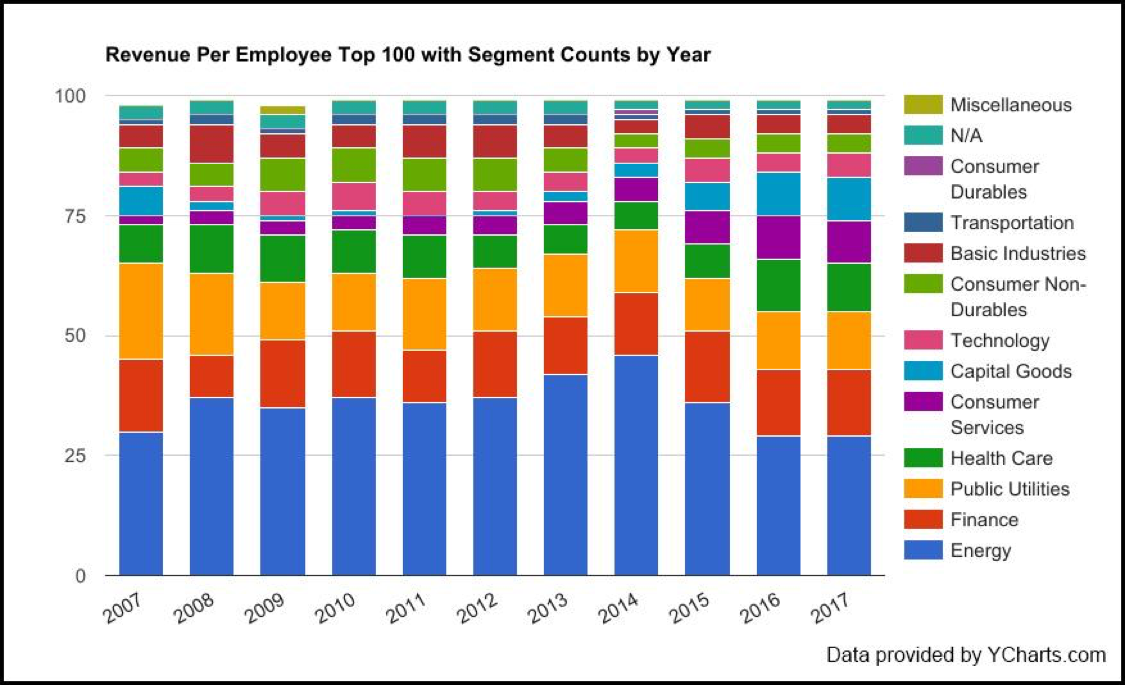
    Figure 1: Top 100 Companies by Revenue Per Employee excluding companies with less than 1.000 employers

    Given the large representation of the Energy sector in RPE, I decided to look at the Top 10 companies in terms of revenue from 2007 to 2016 to see if there was any correlation. I grouped the Top 10 revenue earners into sectors. The result is shown below in Figure 2:
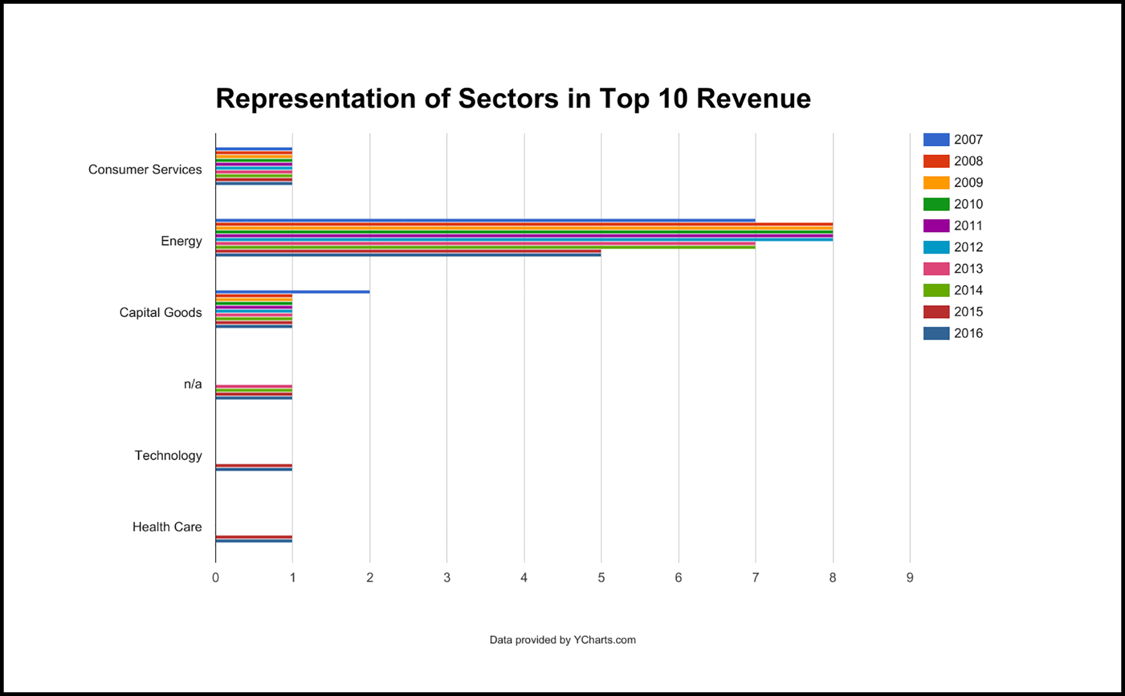
    Figure 2: Grouping of Top 10 Revenue Earners according to sector 2007 – 2016

    Notice that companies in the Energy sector have the largest representation in the Top 10 revenue earners throughout the years. This pattern is somewhat similar to that of representation of Energy shown Figure 1, in that Energy has the largest representation. There is a correlation.

    An Assumption Proved False

    My initial thinking was that there is something going on in the Energy sector that might be relevant to my simple assumption about RPE: The greater the RPE, the more automation in force. I looked that the individual RPE performance of Royal Dutch Shell (RDS.A), ExxonMobil (XOM) and Chevron (CHV), three companies in the Energy sector that always appeared in the Top 10 Revenue Earners from 2007-2017. I compared each company RPE to its Total Employees. Figure 3 below shows my findings:
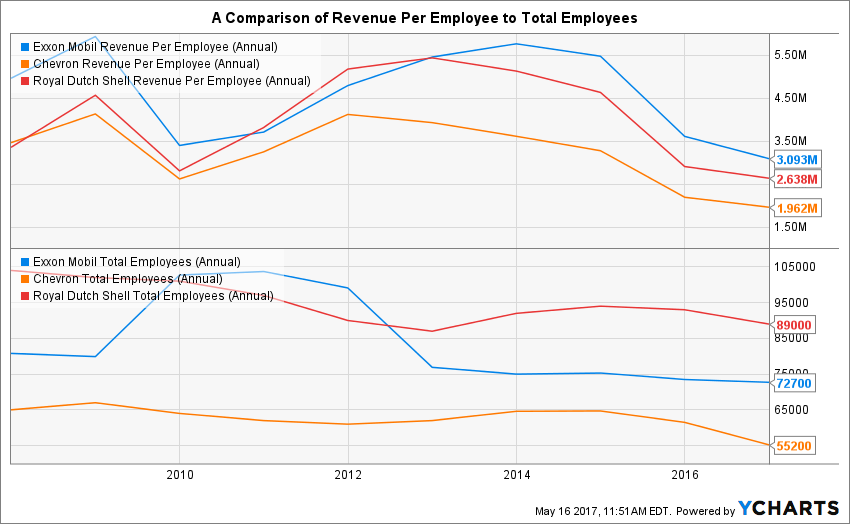
    Figure 3: Revenue Per Employee and Total Employees for  ExxonMobil (XOM), Royal Dutch Shell (RDS.A) and Chevron (CHV)

    As mentioned above, my initial assumption is that as automation increases, RPE should increase, while employee count remains steady or decreases. Figure 4 below illustrates the assumption.
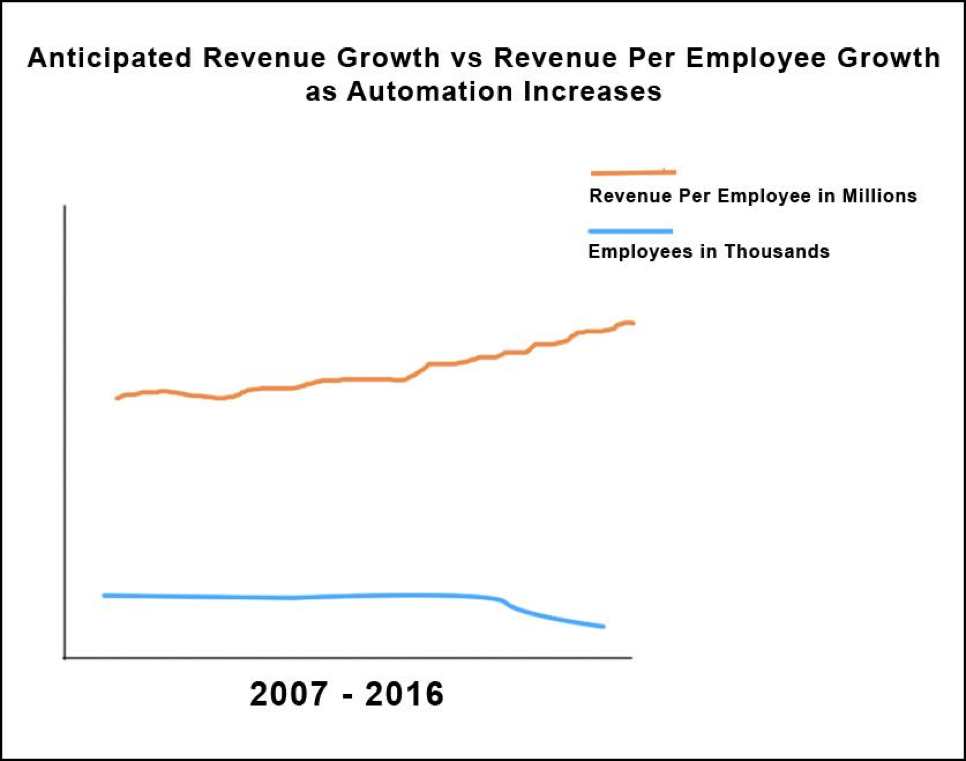
    Figure 4: One might assume that as automation becomes more prevalent, fewer employees should produce more revenue per employee

    Yet, as you can see in Figure 3, the numbers did not confirm my assumption. We see a significant dip in RPE from all three companies around 2010, while ExxonMobil acquired more than 20,000 employees. Also, we see that Royal Dutch Shell and Chevron have a decline in the number of employees over the number of years. If the efficiency that automation might be attributed to RPE were in force, revenue numbers would at the least mirror employee numbers, or hopefully increase due to more productivity achieved through automation. But revenue does not continue to map to increased revenue versus the number of employees. Revenue is all over the place.

    I was stumped until I considered the impact of price of oil. When I compare revenue to the historical price of oil according to Brent Crude Spot Price to oil company revenue during the years in question, a similarity occurs, as shown in Figure 5, below.
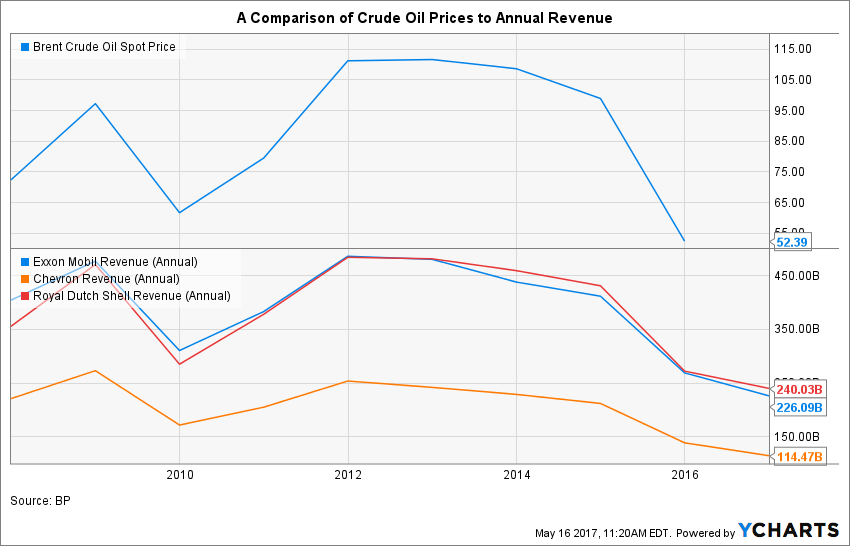
    Figure 5: Oil Company Revenue compared to Price of Oil, 2007-2015

    The shape of the lines in the lower chart in Figure 5, Revenue in Billions and the shape of the line for oil price, in the top chart look similar.

    A reasonable inference can be made that the while oil companies enjoy a sizeable return per employee due to capital investments in tools, technology and automation (ExxonMobil returned more than $3 million per employee in 2016, for example), market price conditions have a more significant effect on revenue.

    So it seems that in terms of the Energy sector, for this admittedly small sample size, automation does allow for significant revenue, but does not increase revenue by way of increased efficiency in terms of operational production. I went back to being stumped. When Jack Ma was talking about decades of pain, was he talking about continuing slump in revenue from the Energy sector? Or was he talking about something else? I decided to look at some data about the world’s largest commercial employer, Wal-Mart.

    All Roads Lead to Wal-Mart

    Wal-Mart employs more than 2 million people and is the leading revenue earner for the years 2014-2017. Yet, when we look at its RPE compared to other companies, Wal-Mart is at the bottom of the stack, as shown in Figure 6, below. As mentioned above, in 2016 Exxon earned more than $3 million per employee. Amazon had an RPE of ~$475,000. JPMorgan Chase came in at ~$401,000. Wal-Mart? $211,000. To put it in perspective, ExxonMobil did more than ten times as much in terms of RPE.
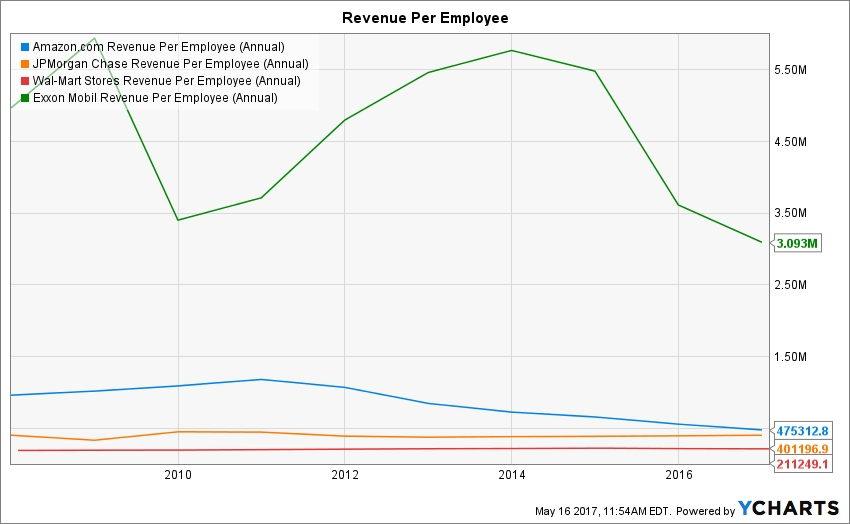
    Figure 6: Wal-Mart’s Revenue Per Employee of $211,000 in 201y puts it well below others

    I could not help but wonder, why does ExxonMobil have a higher RPE than Wal-Mart? Or, for that matter, why so to for JPMorgan Chase and Amazon? I have a theory to propose to answer the question.

    Energy, Finance and Amazon have historically been heavily automated industries. The size of a land-based crew drilling oil is between four to six employees per eight-hour shift. These people are not out there with picks and shovels. They are operating big machines with each machine having some amount of automation built in.

    Once the well is drilled, there is some maintenance labor, but revenue is derived from what comes out of the ground. A lot of machinery is used to get the oil out of the ground, processed and delivered for end use. Hence, a large automation factor. Human labor is secondary.

    Same with Finance. Computers have been at the heart of Finance industry—banking, investments and insurance—since the first mainframes were put into action. Is the revenue of some companies in the Finance sector subject to the whims of the market? Most likely, yes, particularly as one considers the events of 2008. But again, one trader with a single Bloomberg terminal can do a lot of work.

    And Amazon? The company has been the poster child for automation since Jeff Bezos sold the first book online.

    Still, as noteworthy as the facts were, there seemed to be no historical precedent to justify Jack Ma’s prediction doom. But, the dreadfully low RPE of Amazon might give us a clue. So went back to the drawing board and spent another afternoon making charts using data from NYSE and NASDAQ.I came up with the two charts you see in Figure 7 below. Then, the plausible became possible.

    The Plausible Becomes Possible

    The chart on on the top of Figure 7 below shows the annual revenue for Amazon, ExxonMobil and Wal-Mart. The chart on the bottom of the illustration shows the total employees for each company. The time span of each chart is 10 years. Wal-Mart shows a steady rise in revenue until 2016 when things start to go flat. ExxonMobile starts to lose revenue in 2012, while its total employee count remains relatively even. Amazon, on the other hand, shows a steady rise in revenue, as well as a rise in employee count. Both Amazon’s total employee count and revenue grows at a steeper growth trajectory than Wal-Mart.
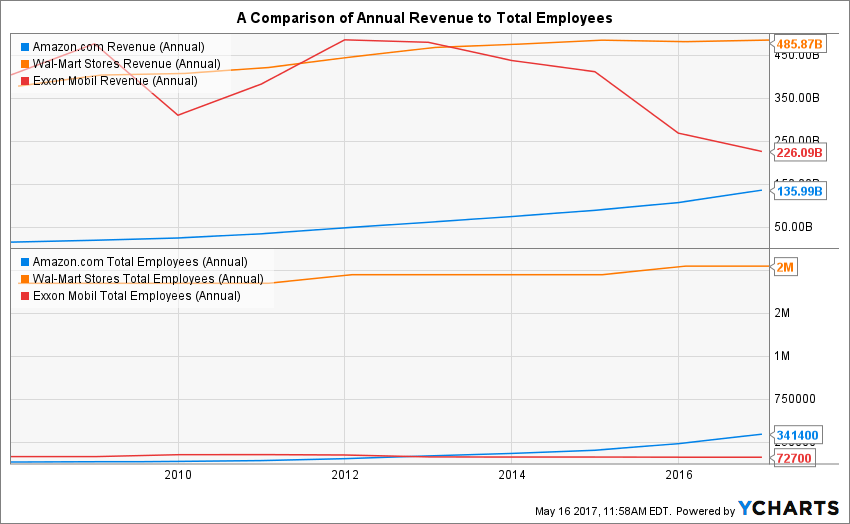
    Figure 7: Total Employees and Revenue: As Wal-Mart hires more employees revenue begin to flatten; Amazon revenue increases

    Is there something going on?

    Well, when we look at net income, there very well might be. Figure 8, below shows the net income of ExxonMobil, Wal-Mart and Amazon. This is where the rubber hits the road. Net income is the money that’s left over after all expenses and taxes have been paid. It all comes out in the wash when you look at net income. You can be a company doing $1 billion in revenue, but if your expenses are $999 million, your company is doing no better than one doing $10 million in revenue with $9 million in expenses. In terms of Amazon, Wal-Mart and ExxonMobil, as we move to the later years, 2016-2017, the numbers come into the same ballpark. And, in that ballpark Wal-Mart is showing some decline, ExxonMobil is showing a continuing big decline. Amazon is on the rise.
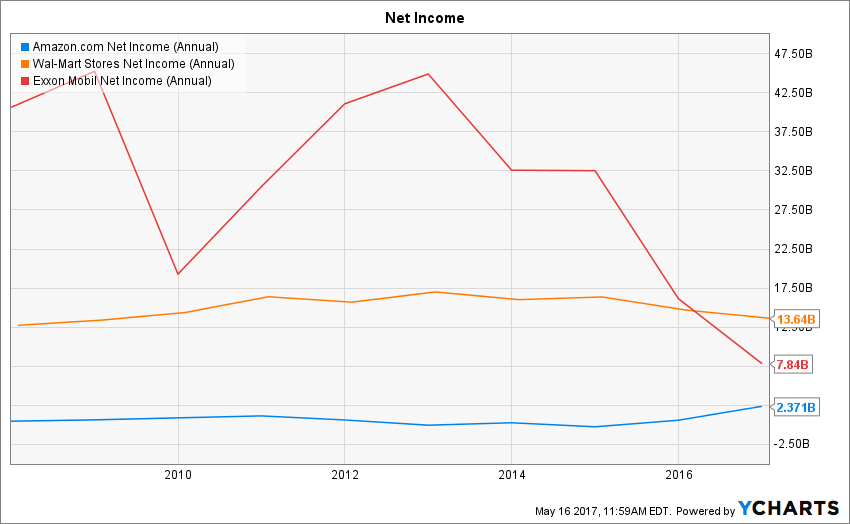
    Figure 8: Net Income: Wal-Mart and ExxonMobil show declining net income while Amazon is on on the rise

    So now is a good time to go back and review the assertions made at the beginning of the piece:

    • Jack Ma: “In the next 30 years, the world will see much more pain than happiness.”
    • Brookings Institution: “even if that means putting robots in place instead of workers.”
    • Joe McKendrick: “Seven in 10 IT professionals agree: if we don’t automate, we die.”

    Given that data presented, we see that industries that have a good deal of automation, Energy and Finance for example, have a high degree of employee efficiency as reflected in RPE. Also, we see that Energy is subject to the whims of market pricing. And lastly, we can see the country’s largest employer, Walmart, has poor RPE numbers, while Amazon, in many ways analogous to Wal-Mart in that Amazon has a significant presence in the retail space, albeit the online retail space, has very good RPE and increasing net income.

    Will Amazon continue to hire? A reasonable assumption is yes. Will Exxon continue to hire? If you go back to Figure 7, you will see that ExxonMobil employee count has been declining since 2010. Couple this fact with a continuing decline in revenue, we’re not going to get fired if we say that ExxonMobil is probably not going to increase employee count unless some sort of miraculous business pivot happens. But what about Wal-Mart?

    Wal-Mart has 2 million employees, a dreadful RPE number and declining net income. What will happen should Wal-Mart’s CxOs decide to more fully embrace automation? After all, hiring more people does not seem to help. It hired more and revenue declined. It’s a pretty good bet that Wal-Mart will go more toward the full automation end of things. How else will the company survive? So let’s play out this scenario.

    A Closing Hypothetical Scenario

    Let’s close with a hypothetical scenario. Let’s say that somehow Wal-Mart magically figures out a way to increase its RPE from the current $241,000 to $475,000 within the next five years.  ($475,000 is the current RPE of Amazon.) And, let’s say that Wal-Mart’s revenues continue to stay level at the current $482 billion a year. Thus, to calculate the number of employees required to achieve the desired RPE, we use the formula:

    $475K (RPE) = $482 bln/Number of Employees

    When we do the math, the number of employees that Wal-Mart needs to achieve $482 billion in revenue with an RPE of $475,000 is 101,4736,842—about half the size of its current workforce. Think about this. The implications are dramatic.

    Most likely, Wal-Mart will continue to automate. It must to survive. The question becomes, given its current dismal RPE, does the company somehow double its revenue to maintain the size of its current workforce. Or does, it accept current revenue trends and let 1 million people go.

    It seems that Jack Ma is predicting the latter. This might very well be but one of many examples in decades of pain he predicts, an outcome that is the result analysis offered by the Brookings Institution and 7 out of 10 IT professionals. Or, who knows? Maybe the future is one in which the Wal-Marts of the world double revenue and manage to keep the human workforce intact.

    As we have learned on the terrain, it’s easy to predict the future when it involves describing the outcome of writing a check for $100 when you have only $10 in the checking account. Predicting the impact of automation on future human employment is a more complicated terrain to travel. But no matter what, there will be a future and most likely, it will be more automated. What will happen to the employees at Wal-Mart? I’ll let you be the judge.

    A Special Thanks to YCharts.com

    Please allow me to extend a special thanks for the folks at YCharts.com for providing access to the data and charting tools used in this article. They were extremely helpful throughout the development of the ideas expressed herein which, by the way, are my own. — Bob Reselman

    — Bob Reselman