Tag: RHEL 8

  • AlmaLinux Foundation Delivers on CentOS Promise

    AlmaLinux Foundation Delivers on CentOS Promise

    A nonprofit organization launched this week to oversee future development of AlmaLinux, a distribution of Linux based on code originally contributed to the open source CentOS project.

    At the same time, CloudLinux, which created AlmaLinux in response to a decision by Red Hat to pull financial support for CentOS, announced that a stable version of the operating system is now available. CentOS itself was based on the Red Hat Enterprise Linux (RHEL) distribution that is made available via a subscription.

    Jack Aboutboul, community manager of AlmaLinux, said AlmaLinux is the result of the $1 million that CloudLinux committed toward creating a distribution of Linux based on a CentOS project used by hosting providers, such as CloudLinux, to run RHEL-compatible applications at a lower cost. AlmaLinux OS is a binary compatible fork of RHEL 8, which the foundation pledged to update to maintain that compatibility.
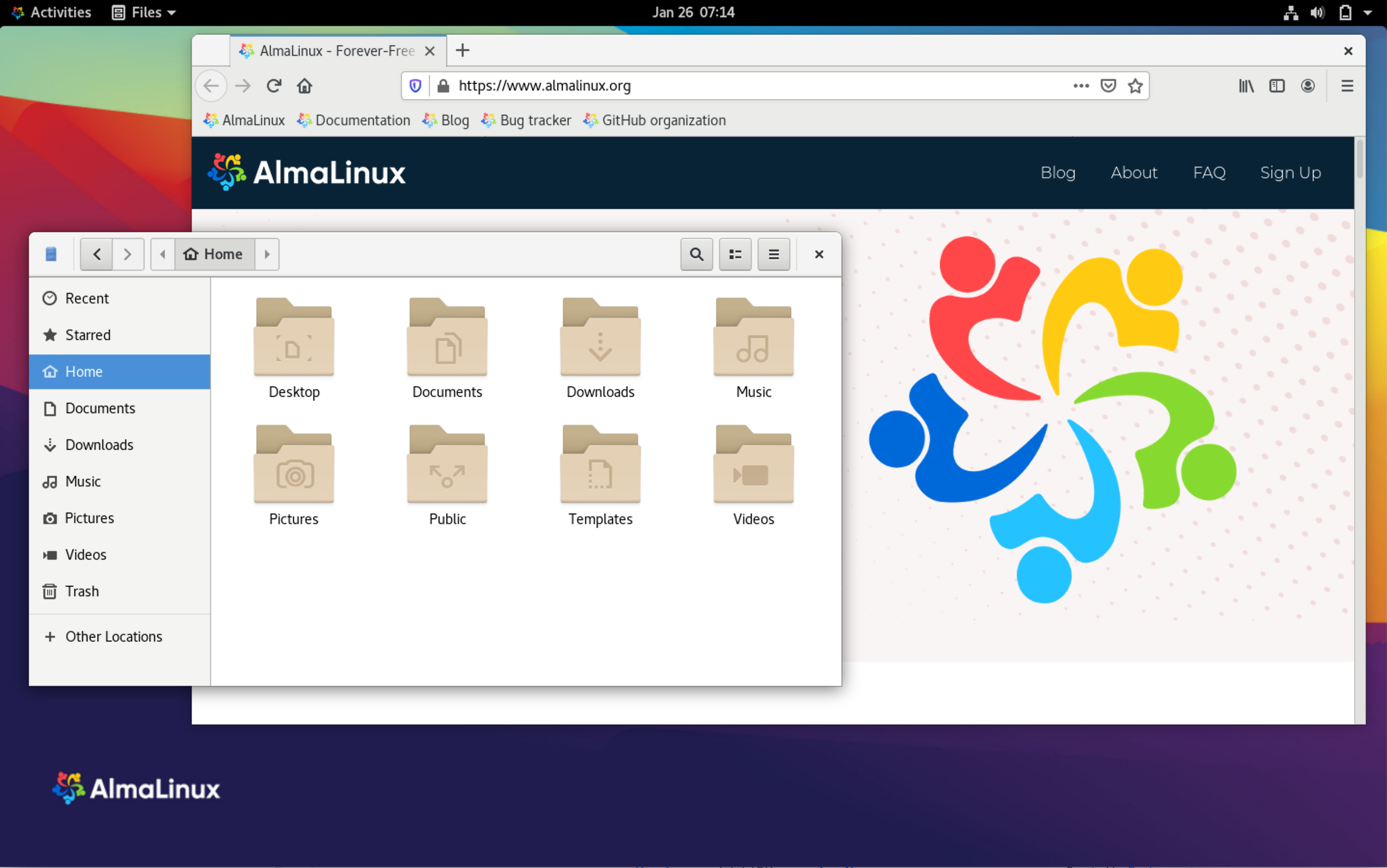
    AlmaLinux is one of two distributions based on CentOS that have been created. The other, RockyLinux was created by Gregory Kurtzer, one of the original creators of a CentOS project. Red Hat, in the meantime, has moved to make RHEL subscriptions available for free to individual developers.

    Aboutboul said AlmaLinux is more mature than RockyLinux, because it is based on a Linux distribution that has been battle-tested by IT service providers. AlmaLinux also added a SecureBoot capability as well as support for VMware and the Amazon Web Services (AWS) public cloud, noted Aboutboul.

    The AlmaLinux Foundation also decided to publicly share errata about the ongoing development of the operating system, to make it easier for IT teams to troubleshoot issues that might arise in a production environment.

    It’s not clear yet how much support either AlmaLinux or RockyLinux have. However, at this juncture, forks are becoming fairly common across the open source community. Those disruptions, however, don’t seem to be dampening enthusiasm for open source software. A global survey of 1,250 IT leaders conducted by Red Hat finds nearly 80% of respondents expect to increase their use of emerging open source software technologies over the next two years, with the top three use cases being infrastructure modernization (64%), application development (54%) and digital transformation (53%).

    As Winston Churchill famously said, democracies are messy, and the open source community is no exception. Passions run high. At the same time, the various business models that spring up around open source projects often conflict; because of animosity, greed or differences of opinion, it is not uncommon for multiple forks of an open source project to emerge and evolve over time.

    Despite that issue, IT organizations remain committed to open source for two primary reasons. First, no one needs permission to download open source software to a laptop. That enables developers to more easily experiment with new technologies. Second, cost. Many IT organizations prefer to use free open source software, rather than paying to license commercial software. They may one day pay for support, but the number of open source software users still dwarfs the number willing to pay for support; especially since knowledge and expertise is freely and equally shared across a growing open source community.

    Given those benefits, any friction in the open source community itself is largely seen as an acceptable risk and just the potential cost of doing business.

  • Red Hat Updates OpenStack Platform

    Red Hat today made available an update to its distribution of OpenStack that enables it to run on Red Hat Enterprise Linux (RHEL) 8 operating system.

    Sean Cohen, senior manager for product management at Red Hat, said Red Hat OpenStack Platform 16 combines three releases of OpenStack, known as “Rocky,” “Stein” and “Train” into a single update that the company plans to update on a streaming basis. In addition, future updates to Red Hat OpenStack Platform will be aligned with updates to RHEL 8, said Cohen.

    Red Hat OpenStack Platform 16 is also now being made available under a long-term support subscription as well.

    Red Hat Open Hybrid CloudCohen said Red Hat continues to see continued growth in terms of customers adopting OpenStack to build their own cloud computing platforms. Telecommunications companies have already made major investments in cloud frameworks that are now being extended to the network edge. Earlier this week, Orange Egypt announced it will be using Red Hat OpenStack Platform to deploy virtual network functions (VNFs) to manage network traffic. Enterprise IT organizations, meanwhile, are building their own private clouds on top of an open source platform.

    In some cases, enterprise IT organizations are relying on OpenStack to provide the foundation on which cloud-native applications based on Kubernetes are deployed, added Cohen. The goal is to take advantage of the virtual machines on which OpenStack is deployed to ensure isolation between instances of containerized applications running on top of Kubernetes. In other cases, IT organizations are taking advantage of tools such as Ironic to automate the deployment of Kubernetes cluster on bare metal machines, said Cohen.

    The relationship between OpenStack and Kubernetes, however, remains complicated because there are those organizations that are deploying Kubernetes clusters in on-premises IT environments without relying on any legacy infrastructure-as-a-service (IaaS) platforms such as OpenStack or VMware vSphere. Nevertheless, Cohen said Red Hat expects to see wider adoption of the Red Hat OpenShift application development and deployment platform, which is based on Kubernetes, on top of Red Hat OpenStack Platform 16.

    Cohen said there is a high correlation between organizations that have embraced best DevOps practices and usage of OpenStack as IT organizations move to automate the management of IT infrastructure at scale. The challenge organizations face is determining which modules of a very comprehensive OpenStack framework to employ. In fact, that challenge is why organizations rely on Red Hat to curate OpenStack on their behalf. In terms of adoption, Red Hat has the largest market share of any OpenStack distribution, said Cohen.

    It’s not clear to what degree the shift toward cloud-native applications based on Kubernetes might result in increased adoption of OpenStack. As organizations look to build hybrid cloud computing environments, the ability to deploy a common framework on-premises and in the public cloud has a certain appeal. However, public cloud computing platforms such as Amazon Web Services (AWS) already make available a proprietary platform for managing their IaaS environment. Many IT teams would naturally prefer to integrate with that AWS platform rather than replace it. Regardless of the approach to hybrid cloud computing, however, chances are high OpenStack will be in the mix in one form or another.

    — Mike Vizard

  • Red Hat Bolsters RHEL 8 Monitoring

    Red Hat Bolsters RHEL 8 Monitoring

    Red Hat is looking to expand the number of organizations embracing best DevOps practices by expanding the monitoring capabilities included in Red Hat Enterprise Linux (RHEL).

    The beta release this week of RHEL 8.2 includes an update to Performance Co-Pilot (PCP), a system performance toolkit that now includes collection agents for Microsoft SQL Server 2019 databases.

    Scott McBrien, a principal product manager for Red Hat, said by extending the scope of the performance toolkit, Red Hat is looking to make it easier for IT generalists and developers to collaborate across silos to better maintain application performance levels. Support for Microsoft SQL Server 2019 is an outgrowth of the alliance Red Hat formed with Microsoft way back in 2015. However, McBrien said IT organizations should expect Red Hat to continue to expand the reach of PCP.

    RHEL 8.2 Beta also simplifies the process of invoking the Red Hat Insights analytics service during the installation process and provides tighter integration with the extended Berkeley Packet Filter (eBPF) to better analyze network traffic.

    Finally, the latest version of RHEL extends an Applications Stream capability to segregate runtimes and languages to additional programming environments and provides a tool to test in-place upgrades to RHEL 8 from RHEL 6/7.

    McBrien said Red Hat is trying to keep to a six-month upgrade cycle of RHEL to provide IT organizations with a more predictable timetable. Of course, most of Red Hat customers are still running RHEL 6/7 releases. However, as the rate at which applications are built, deployed and updated continues to accelerate in the age of DevOps, the more pressure there will be on IT teams to maintain application performance levels across an increasingly extended enterprise. Inevitably, IT generalists will need access to a broader range of observability tools at all layers of the stack to keep pace.

    Adoption of DevOps practices across the enterprise remains uneven at best. However, as more IT generalists are exposed to richer monitoring tools at the operating system level, the easier it becomes to augment or supplant legacy ITIL-based approaches to managing IT. In fact, as tools at the disposal of IT generalists become more sophisticated, the need to rely on various classes of IT specialists declines. Most IT organizations are especially keen to achieve that goal because labor stubbornly remains the single biggest cost of IT.

    It remains to be seen to what degree the management of IT will be transformed in the months and years ahead. The one thing that is certain is IT will become more complex as new architectures based on microservices and serverless computing frameworks get adopted. Each additional layer of abstraction may make it easier for developers to build applications, but from the perspective of the IT operations teams, they tend to increase dependencies between systems that are already fairly fragile. The challenge now is to identify where bottlenecks exist between all those systems before a degradation in application performance becomes a full-blown catastrophic event.

    — Mike Vizard

  • With RHEL 8, Red Hat Adds More Automation to IT Ops

    With RHEL 8, Red Hat Adds More Automation to IT Ops

    At the Red Hat Summit 2019 conference, Red Hat today announced the general availability of Red Hat Enterprise Linux (RHEL) 8, which includes among other things a Smart Management add-on designed to make it easier to manage RHEL 8 across hybrid cloud computing environments.

    In addition, RHEL 8 includes Application Streams, a set of utilities for updating languages, frameworks and developer tools without impacting the core resources, as well as updating RHEL 7 to RHEL 8 in place.

    RHEL 8 also adds Red Hat Enterprise Linux System Roles, which provides modules to automate complex tasks using the Ansible automation framework along with support for the Red Hat container toolkit and the general availability of the Red Hat Universal Base Image, a userspace image derived from RHEL that makes it easier to build Linux containers certified to run on RHEL.

    Red Hat also revealed that Red Hat Insights, a set of predictive analytics tools, will be included with the RHEL 8 subscription and that RHEL 8 supports both the OpenSSL 1.1.1 and TLS 1.3 cryptographic standards.

    Gunnar Hellekson, director for product management for Red Hat, said Red Hat is focusing on automating as many tasks as possible as part of an effort to make the life of IT operations teams simpler. As part of that effort, Hellekson said Red Hat is moving to lower the barrier to becoming a RHEL administrator by abstracting away many of the complexities historically associated with trying to manage Linux environments using a command line interface (CLI). Much of that focus will manifest themselves via ongoing enhancements to the Compose and Cockpit tools Red Hat provides for deploying and managing instances of RHEL, said Hellekson.

    Red Hat is making it clear it wants to make RHEL much more accessible to a larger number of IT administrators, especially those that historically have favored a more graphical approach to managing operating system environments. At the same time, however, Red Hat is infusing more automation into RHEL 8 as part of an effort to make it easier to manage deployments at scale. That latter capability is crucial for DevOps teams that, for example, need to be able to update a development environment without waiting for an IT operations team to reconfigure and reboot an operating system. Via add-ons to the core RHEL platform, Red Hat is now starting to expand those automation capabilities across both on-premises and public cloud computing environments.

    It’s unclear going forward how many instances of RHEL any one IT administrator might be able to manage on their own. Trying to determine that number might not even be worth the effort because advances in automation are now coming so rapidly that trying to determine that right number of IT administrators per environment is not possible to determine consistently. Instead, IT organizations should just assume that, thanks to automation enabled by machine learning algorithms and predictive analytics, the operating system environment is now flexible enough to scale up and down as needed.

    — Mike Vizard