Tag: Rezilion

  • Rezilion Updates Open Source MI-X Tool to Better Secure App Development

    Rezilion Updates Open Source MI-X Tool to Better Secure App Development

    Rezilion has updated its open source MI-X vulnerability discovery tool to include mitigation and remediation recommendations.

    In addition, the tool can now produce machine-readable output in either a JSON or CSV format.

    Finally, the company added Windows support for Heartbleed and SpookySSL vulnerabilities in Windows environments.

    MI-X makes it possible to use a command line interface (CLI) tool to identify and establish the exploitability of more than 20 well-known common vulnerabilities and exposures (CVEs).

    Yotam Perkal, director of vulnerability research for Rezilion, said Rezilion created the tool as part of its efforts to create a platform that enables organizations to better secure their software supply chains. The primary purpose of the platform is to prevent vulnerabilities from being introduced into applications in the first place by providing developers with the context required to understand the potential severity of a vulnerability, he added.

    There’s no doubt that developers need tools that enable them to easily identify vulnerabilities while writing code. However, shifting responsibility for vulnerabilities entirely left toward developers is not a panacea for application security. DevOps teams need to embrace DevSecOps best practices to ensure that the build created by multiple developers is secure and that the runtime environment where applications run is also free of malware.

    The challenge is that achieving that goal needs to go beyond adding additional tools to a DevOps workflow. The biggest challenge is narrowing the historic cultural divide between developers and cybersecurity teams tasked with discovering vulnerabilities. Most cybersecurity professionals don’t understand how applications are developed, so every instance of vulnerability found in an application looks the same to them—regardless of whether the actual code is externally accessible.

    DevOps teams, meanwhile, are trying to strike a delicate balance between patching innumerable vulnerabilities and building and deploying additional applications. More than anything, those teams need to be able to prioritize their patching efforts based on the actual versus theoretical severity of a vulnerability, noted Perkal.

    It may never be possible to address all the application security debt application environments have accrued over the years. However, as apps are built and application security issues are addressed more proactively, the state of cybersecurity should improve. The issue, of course, is that cybercriminals are now targeting software supply chains; inserting malware into a DevOps workflow creates a potential opportunity to compromise any number of downstream applications. Organizations are now racing against time to secure their software supply chains.

    The good news is that no developer intentionally sets out to build an insecure application. It’s just that far too many of them have been conditioned to think of security as an obstacle they need to overcome rather than address. However, the more tools they are provided to remediate as many vulnerabilities as possible, the better off everyone concerned will be.

  • Rezilion Adds Windows Support to Dynamic SBOM Tool

    Rezilion Adds Windows Support to Dynamic SBOM Tool

    Rezilion has added support for Windows applications to its tool for dynamically generating software bills of materials (SBOMs).

    Rezilion CEO Liran Tancman said in addition to existing support for Linux applications, it’s now possible to analyze all the components that make up a Windows application runtime environment in real-time.

    That capability also makes it possible to search for and pinpoint the location of components, such as the Log4j vulnerability, across millions of files and on thousands of hosts, containers and applications, he added.

    Rezilion has created a searchable proprietary next-generation vulnerability database (NGVDB) that identifies which issues impact specific classes and functions. In addition to surfacing remediation suggestions, the capability also reduced the number of false positives that IT teams would otherwise have to track down.

    The SBOM tool the company provides builds on that capability to provide insights into the complete attack surface of an application that could be exploited by cybercriminals.

    In general, the components of a Windows application are more challenging to track and analyze because of the many different frameworks created to build them over the last few decades. However, with more than half of all applications running on Windows, the need to create SBOMs for those applications has become a more pressing concern, especially in the wake of an executive order issued by the Biden administration that requires federal agencies to provide SBOMs for every application they use.

    It’s not clear how many enterprise IT organizations will be following suit, but the general expectation is that SBOMs will soon be a lot more prevalent than they have been. In the wake of a series of high-profile cybersecurity breaches, there is now more scrutiny of software supply chains than ever.

    The challenge, of course, is determining which vulnerabilities to remediate first once they are identified in an application. There are simply too many vulnerabilities to patch all at once, so DevOps teams need to be able to identify which vulnerabilities are the most severe. For years, cybersecurity teams have been creating spreadsheets filled with long lists of vulnerabilities, but there is usually no context provided in terms of how severe a vulnerability is. As a result, developers would allocate a small portion of their time to applying patches that are prioritized based on intuition and level of complexity rather than severity.

    It may still be a while before most organizations that build software are able to consistently create accurate SBOMs. It may be even longer before the organizations that consume those SBOMs have the processes in place to operationalize them. In theory, an organization, if necessary, should be able to prevent software from being deployed based on the list of components included in the SBOM. However, that decision is not always straightforward. There is usually a range of reasons for including a potentially vulnerable component in an application that needs to be considered.

    One way or another, the overall security of applications is about to steadily improve. The only issue is how much pain will need to be experienced to achieve that goal.

  • Survey Surfaces Massive Number of Application Vulnerabilities

    Survey Surfaces Massive Number of Application Vulnerabilities

    A survey of 16,510 IT and IT security practitioners published today by Rezilion, a provider of a platform for automating the remediation of software vulnerabilities, found nearly half of respondents (47%) worked for organizations that have a backlog of vulnerable applications. More than half (66%) said their backlog consisted of more than 100,000 vulnerabilities and the average number of vulnerabilities that need to be remediated is 1.1 million.

    The survey, conducted by the Ponemon Institute, also found more than half of respondents ( 54%) said they can only patch less than 50% of the vulnerabilities.

    Factors that keep teams from remediating included an inability to prioritize what needs to be fixed (47%), a lack of effective tools (43%), a lack of resources (38%) and not enough information about risks that would exploit vulnerabilities (45%).

    More than a quarter (28%) also said remediation is too time-consuming. The survey found that 77% of respondents said it takes longer than 21 minutes to detect, prioritize and remediate just one vulnerability in production.

    In addition, 85% said they spend more than 16 minutes detecting one vulnerability in development. A full 82% also noted it takes longer than 21 minutes to remediate one vulnerability in development. A majority of respondents said it is either very difficult (36%) or difficult (25%) to remediate vulnerabilities in applications.

    On the plus side, more than half (56%) said they use automation for vulnerability remediation, with 43% reporting times to respond are significantly shorter as a result.

    Rezilion CEO Liran Tancman said the survey makes it clear there’s still plenty of room for improvement. The number of vulnerabilities that need to be addressed is staggering, he said. IT teams need to focus their immediate efforts on identifying the vulnerabilities that are the most critical, he noted.

    Remediating those vulnerabilities will soon become a higher priority as more regulations focused on securing software supply chains come into effect. In fact, the software bills of material (SBOMs) that these regulations require will expose much of the dirty laundry that currently exists in application environments, said Tancman.

    Ultimately, the goal needs to be enabling organizations to address vulnerability issues without slowing down the rate at which applications are being built and deployed, Tancman added. The degree to which that goal can be achieved will vary widely as more responsibility for security is shifted left toward application developers. However, the need to provide tools to developers that enable them to address vulnerability issues has never been more apparent, noted Tancman.

    It’s clear the level of application security vulnerability debt that organizations will need to address can no longer be ignored. The issue now is to determine how best to resolve these issues either by fixing existing applications or replacing them with new ones. Either way, it’s clear that there is a need to adopt DevSecOps best practices to better secure software.

    In the meantime, as application security becomes a boardroom-level issue, there be a lot more scrutiny applied all across the software supply chain.

  • Rezilion Launches Vulnerability Prioritization Platform

    Rezilion Launches Vulnerability Prioritization Platform

    Rezilion today announced general availability of a platform that enables DevOps teams to better prioritize remediation efforts by identifying which vulnerabilities both run in memory and actually impact a class or function that can be executed.

    Liran Tancman, Rezilion CEO, said the biggest DevSecOps challenge organizations face today is that the bulk of vulnerabilities that developers are tasked with remediating don’t constitute a significant cybersecurity threat.

    Rezilion has created a searchable proprietary next-generation vulnerability database (NGVDB) that identifies which issues impact specific classes and functions. That capability enables DevOps teams to de-prioritize close to 95% of software vulnerabilities, said Tancman.

    In addition, the Rezilion platform will surface remediation suggestions that lower the amount of disruption and/or cost, he said. A fully-automated remediation capability, for example, will automatically upgrade and test vulnerable software components and packages within a continuous integration (CI) pipeline that were found to be exploitable. In the longer term, Rezilion is also working toward surfacing remediation suggestions that might be addressed using an alternative to patching, said Tancman.

    The Rezlion platform is also integrated with IT service management platforms such as ServiceNow and project management tools such as Jira to make it easier to address vulnerabilities as part of existing workflows, he added.

    Most developers today are simply overwhelmed by the number of vulnerabilities that cybersecurity teams routinely ask them to patch, noted Tancman. The goal should be to enable developers to focus their limited time and effort on remediating the vulnerabilities that truly matter to ensure application security, he said.

    In addition, developers need to have more confidence in the fact that the patch they are being asked to make won’t break their existing applications, added Tancman.

    Vulnerability prioritization is, of course, at the heart of the long-standing divide that exists between DevOps and cybersecurity professionals. Spreadsheets filled with long lists of vulnerabilities are regularly created, but there is usually no context provided in terms of how severe a threat any given vulnerability poses. As a result, developers would allocate a small portion of their time to applying patches that are prioritized based on intuition and level of complexity rather than severity.

    Naturally, developers are going to allocate most of their time to creating new applications and features. For any DevSecOps initiative to succeed, it’s critical to ensure optimal use of the time allocated to remediation. Cybersecurity teams will continue to compile lists of vulnerabilities, but that list can now be triaged in a way that causes the least amount of friction.

    In the wake of a series of high-profile security breaches, there is now more focus than ever on securing software supply chains. The challenge is to find a way to better secure applications both before and after they are deployed in a production environment. There will always be vulnerabilities that are discovered after an application has been deployed. However, just because a vulnerability exists, that doesn’t mean it’s exploitable. The trouble with application security today is that, all too often, remediation efforts turn out to be a waste of time.

  • Report Finds Most Log4Shell Vulnerabilities Unpatched

    Report Finds Most Log4Shell Vulnerabilities Unpatched

    A report published today by Rezilion, a provider of a platform for tracking and analyzing software vulnerabilities, found that despite all the attention the Java zero-day Log4Shell vulnerability attracted, it appears that nearly 60% of the affected software packages remain unpatched.

    Rezilion used Google’s Open Source Insights tool to scan open source software packages, including dependencies, and found that out of a total of 17,840 affected Java software packages, only 7,140 have been patched.

    In addition, the Rezilion report cited a Log4j vulnerability resource center maintained by Sonatype indicated that 36% of the vulnerable versions of the Log4j Java log management tool that were actively downloaded from Maven Central are still vulnerable to Log4Shell.

    Rezilion also made use of dive, an open source tool for exploring Docker container images, to verify what version of Log4j might be present in containers, and Shodan.io, a search engine for discovering internet-connected devices.

    Yotam Perkal, director of vulnerability research for Rezelion, said that the results suggested that many organizations that have deployed a Java application have no way of knowing whether it includes the widely used open source Log4j tool for tracking logs within Java application. Many of the instances of that tool are subject to a recently discovered zero-day vulnerability that can be easily used to execute malicious code within a Java application.

    The challenge is that many organizations are using Java software components provided to them by a third party, and they assume that software is secure. However, that third party is often not aware of how that software may have been deployed, noted Perkal.

    More troubling still, many organizations that deploy software today don’t actively manage anything that might be considered a software supply chain, he added. Software is deployed as needed with little to no regard for provenance, said Perkal.

    Even when organizations can track software components, patching Log4j is a challenge. Java files can be nested layers deep into other files. Java applications can also be packaged in ways that make searching for vulnerabilities more difficult.

    Naturally, much of the responsibility for discovering instances of vulnerable Java applications falls to DevOps teams. As organizations embrace DevSecOps best practices that revolve around a software bill of materials (SBOM), it becomes easier to track vulnerable software packages. The issue is that most organizations either don’t have an SBOM or fail to update it as applications are upgraded. In the absence of an SBOM, many DevOps teams are still looking for instances of Log4jShell four months after the initial vulnerability was disclosed.

    Unfortunately, this latest vulnerability crisis doesn’t appear to be the wake-up call that drives more organizations to implement DevSecOps workflows, said Perkal. While some organizations are proactively patching applications, many others are still waiting on updates from a third party they hope will address the issue. Those updates, however, may not arrive in time to prevent cybercriminals that know about the Log4jShell vulnerability from wreaking havoc.

  • GitLab Allies With Rezilion to Add Workload Analysis Tool

    GitLab Allies With Rezilion to Add Workload Analysis Tool

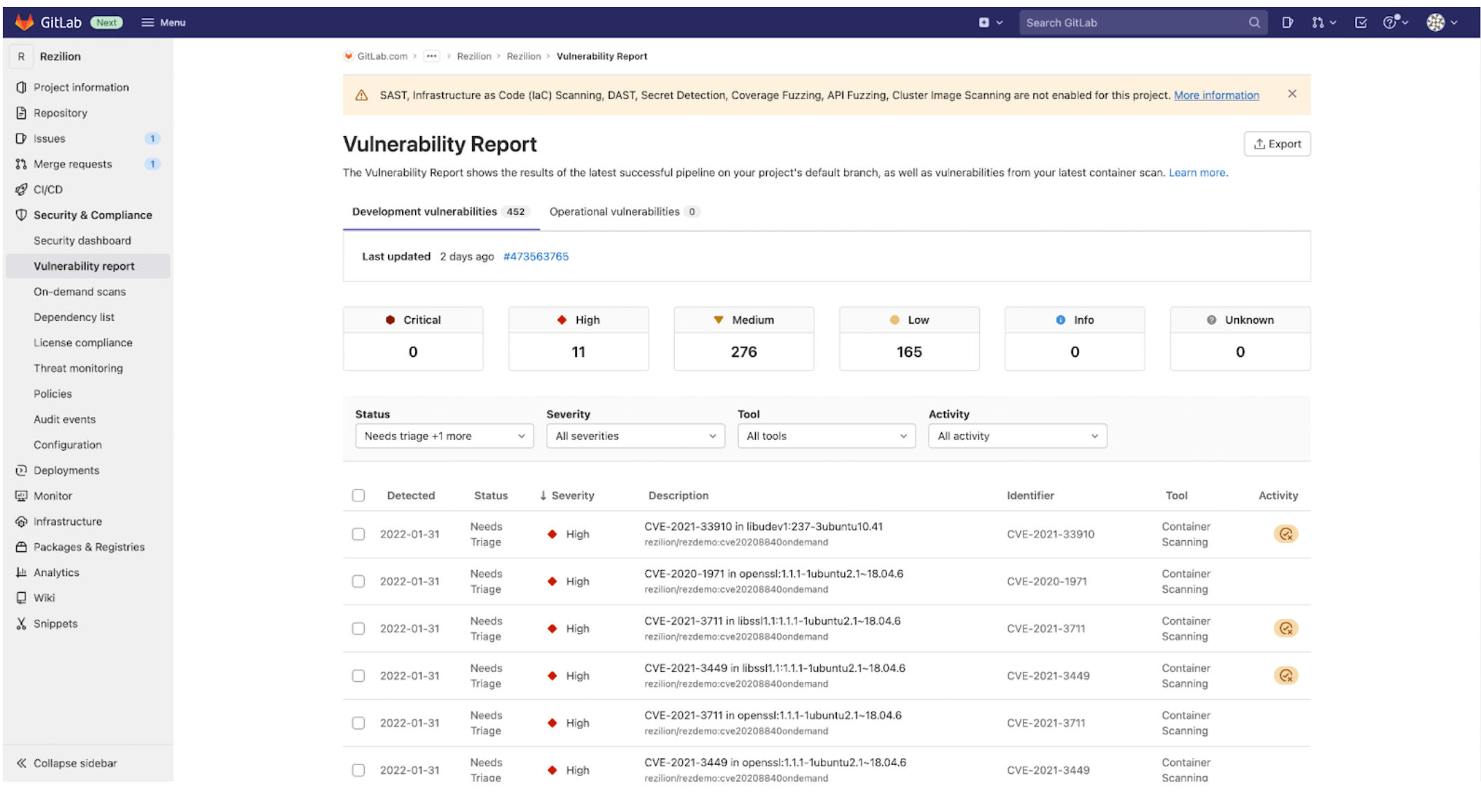
    Rezilion has integrated its workload analysis tool with the continuous integration (CI) framework provided by GitLab. The move is part of an effort to make it simpler for developers to discover issues such as vulnerabilities before they upload code into a repository.

    Sam White, a senior product manager for GitLab, said this integration will provide developers with an instant feedback loop that will enable them to address a wide range of issues before their code is ever reviewed. Rather than experiencing the shame of, for example, missing a vulnerability, the Rezilion platform enables developers to quickly write code while relying on a code analytics tool to surface common mistakes that they can remediate as they see fit, he added.

    Rezilion CEO Liran Tancman added that the proprietary workload composition analysis engine, dubbed Unison, on which the Rezilion platform is based makes it feasible to shift more responsibility for application security further left without requiring developers to become cybersecurity experts.

    Unison automatically creates a model of all the applications that include the underlying infrastructure and runtime environments. It reverse-engineers and maps that environment in memory to dynamically track the inventory, provenance, runtime execution, exposure and interdependencies between each piece of code and can generate a software bill of materials (SBOM).

    The code that is most in need of immediate attention is also surfaced directly with the GitLab user interface, said Tancman. That capability can reduce remediation time of the vulnerability backlog an organization might be working through by as much as 70% over time, he added. Rezilion enables organizations to achieve that goal because non-exploitable vulnerabilities are marked as “false positives” that shouldn’t hold back a release.

    Tancman said that without this level of automation it would be extremely challenging for an organization to implement a set of DevSecOps best practices. It might take developers years to attain the level of cybersecurity training that would be required in the absence of the automation enabled by the Unison engine, he noted.

    Historically, the relationship between application developers and cybersecurity teams has been tense. Cybersecurity teams tend to put off code review until it’s about to be deployed in a production environment. It’s not uncommon for an application to be pulled at the last minute because of a vulnerability discovered by a cybersecurity team. In some instances, that vulnerability is a legitimate concern but in others, it turns out to be a false positive because the flagged piece of code isn’t actually included in the application.

    By providing developers with a workload composition analysis tool within the context of a CI framework, GitLab is trying to reduce the level of friction that the process tends to create between developers and cybersecurity teams.

    It may be some time before most organizations fully master DevSecOps, but it’s clear that merely telling developers they will be held accountable for application security without providing the appropriate tools isn’t going to make applications any more secure.