Welcome to The Long View—where we peruse the news of the week and strip it to the essentials. Let’s work out what really matters.
This week: The npm registry suffers spam infestation, and Microsoft makes Google sad. (more…)

Welcome to The Long View—where we peruse the news of the week and strip it to the essentials. Let’s work out what really matters.
This week: The npm registry suffers spam infestation, and Microsoft makes Google sad. (more…)

Recently, GitHub upgraded the internal version of Git they use to produce repository archives. You’ve probably used these archives before if you’ve downloaded a .zip or .tar.gz file from a repository at a particular version. GitHub produces those archives on demand using Git archive and caches them for a short time.
Upgrading Git regularly is a generally good idea, but this change regrettably broke a huge number of Bazel projects. Bazel is a widely used, free, open source tool for building and testing software, so this breaking change is a big deal. What happened? Most Bazel projects fetch at least some of their dependencies using rules in their WORKSPACE files like this:
http_archive(
name = “com_github_bazelbuild_buildtools”, sha256 =
“05eff86c1d444dde18d55ac890f766bce5e4db56c180ee86b5aacd6704a5feb9”, strip_prefix = “buildtools-6.0.0”,
urls =
[“https://github.com/bazelbuild/buildtools/archive/refs/tags/6.0.0.ta
r.gz”],
)
See that /archive/refs/tags/ part of the path? That’s the endpoint I’m talking about.
This is bare-bones dependency management: Bazel attempts to download an archive from the first URL in the list; it tries the next URL if the first is not available and so on. Bazel then checks the file’s SHA-256 sum against the known value and, if it’s correct, extracts the archive and proceeds with the build.
The Git upgrade caused a change in archives’ SHA-256 sums. I think there was a small change in zip compression, but it doesn’t really matter—any variation in file ordering, alignment or compression causes the archives’ SHA-256 sums to change even though the extracted contents are the same.
This is at least the third time Bazel builds have broken that I can remember. This has also been discussed extensively before. I’m writing this in the hope that we can make our systems more resilient and avoid these kinds of problems in the future.
Since GitHub made the change that triggered this, they naturally get the immediate blame from the community, though I think it’s mostly undeserved. Upgrading dependencies (especially Git and especially if you’re GitHub) is a reasonable thing to do. To my knowledge, GitHub has not documented a guarantee that files returned by the archive endpoints have stable SHA-256 sums. It’s a mistake for users to rely on a guarantee that was never made. It’s tempting, of course, because it’s easy, but it’s a mistake nonetheless.
This is a classic example of Hyrum’s Law:
“With a sufficient number of users of an API, it does not matter what you promise in the contract: All observable behaviors of your system will be depended on by somebody.”
Since these updates have broken Bazel (and presumably others) a few times now, I’d really like to see GitHub clarify in documentation whether users should or should not depend on stable archive SHA-256 sums. A GitHub engineer commented that this is not stable, but product managers and support engineers have commented at other times that is stable. I don’t really think discussion comments count since they’re not discoverable. Only official documentation is authoritative.
I haven’t actually found any documentation for these release archive URLs, so I’m not sure where this clarification should go. It’s not part of the REST API. Linking to releases is pretty close.
If archive SHA-256 sums are guaranteed to be stable (now or in the future), I think documenting and testing that would let us all sleep easier at night.
If archive SHA-256 sums are not guaranteed to be stable, it wouldn’t be a terrible idea to inject a little chaos to prevent people from depending on them. For example, in Go, the iteration order of elements in a map is undefined. To prevent developers from depending on iteration order (and tests from breaking when the hashing algorithm is tweaked), the Go runtime adds a random factor into the hashing algorithm, so the iteration order is different every time a program runs. Something similar could be done here with archive file order or alignment. I wouldn’t suggest gratuitously breaking this API, but if it needs to change anyway for some reason in the future, it would be a good idea to add something like this.
Bazel developers should not rely on stable archive SHA-256 sums unless that stability is guaranteed and documented by GitHub. More importantly, developers should not rely on dependency artifacts being available on GitHub at all: A library author could delete their project at any time.
I’ll point to Go modules as a model of a great dependency management system designed to solve this exact problem. The Go team operates proxy.golang.org, a mirror for all publicly available Go modules. Internally, the proxy stores actual files for each module and does not need to regenerate them. The proxy protocol is open and easy to implement as an HTTP file server, so you can run your own proxy service for better availability. I’d love to see something like this happen for Bazel, especially if it’s operated by Google. It is not technically difficult to build a service like this, but there are a lot of thorny issues around handling abuse and legally distributing software with unrecognized licenses, and Google has already figured out those issues for Go.
Until such a service exists, developers can protect themselves by copying their dependencies to their own mirror. A GCS or S3 bucket works fine.
Library authors can and should protect their users by providing static release artifacts (not dynamically generated archives), and mirroring those. For example, check out the http_archive boilerplate for rules_go:
http_archive(
name = “io_bazel_rules_go”,
sha256 =
“dd926a88a564a9246713a9c00b35315f54cbd46b31a26d5d8fb264c07045f05d”, urls = [
“https://mirror.bazel.build/github.com/bazelbuild/rules_go/releases/d ownload/v0.38.1/rules_go-v0.38.1.zip”,
“https://github.com/bazelbuild/rules_go/releases/download/v0.38.1/rul es_go-v0.38.1.zip”,
],
)
The file rules_go-v0.38.1.zip is created by the rule authors and attached to the release; it’s not dynamically generated.
It’s also copied to mirror.bazel.build, which is a thin frontend on a GCS bucket shared by many rule authors in the Bazelbuild organization.
One other tip: If you’re feeling adventurous enough to use an experimental, undocumented feature (to make your build more stable! Really!), you can configure Bazel’s downloader to rewrite those GitHub URLs to point to your own mirror.
Aside: SHA-256 of archives or contents?
It’s unfortunate that a change to the Git archive that does not affect extracted contents of an archive can still change its SHA-256 sum. Bazel absolutely does the right thing by checking the sum of the downloaded file before extracting its contents.
This is the (delightfully named) Cryptographic Doom Principle. If Bazel only authenticated the contents of an archive, it might be possible for an attacker to exploit a vulnerability in Bazel’s zip parser before the archive is authenticated. Since Bazel authenticates the archive before extracting it, the pre-authentication attack surface is very small.
When you’re designing software, think carefully about how it’s going to be used. If there’s a right way and a wrong way to do something, make sure the right way is easier and more obvious. Better yet, make the right way the only way.
I think this is a case where Bazel’s dependency management is too limited: To use http_archive safely, you need to set up an HTTP mirror with copies of your dependencies. That’s too much work for users, especially new users who aren’t aware of the hazards. A more complete dependency management system should include an artifact registry or a read-through caching system with at least one public implementation. I was hoping Bazel modules and the Bazel central registry would provide that, but the central registry only includes module metadata: Module content is separate, specified in URLs that still frequently refer to the unstable GitHub endpoint.

GitHub today at its GitHub Satellite virtual conference announced it has made it easier for developers to either launch a project or join an existing project on its repository and has added collaboration tools directly within the platform.
GitHub is also moving to advance DevSecOps by adding code scanning tools and making secret scanning tools available for private repositories, in addition to making available GitHub Private Instances to provide organizations in highly regulated industries access to a more secure managed implementation of the GitHub repository.
Max Schoening, VP of Product Design, said GitHub Codespaces removes a lot of friction associated with starting or joining a project by enabling developers to spin up a project in seconds. In many cases, he said, developers never launch a project simply because the effort required was too great relative to the value of the effort.
Available in limited public beta, GitHub Codespaces should not only improve developer productivity but also significantly increase the number of projects being hosted on GitHub, said Schoening.
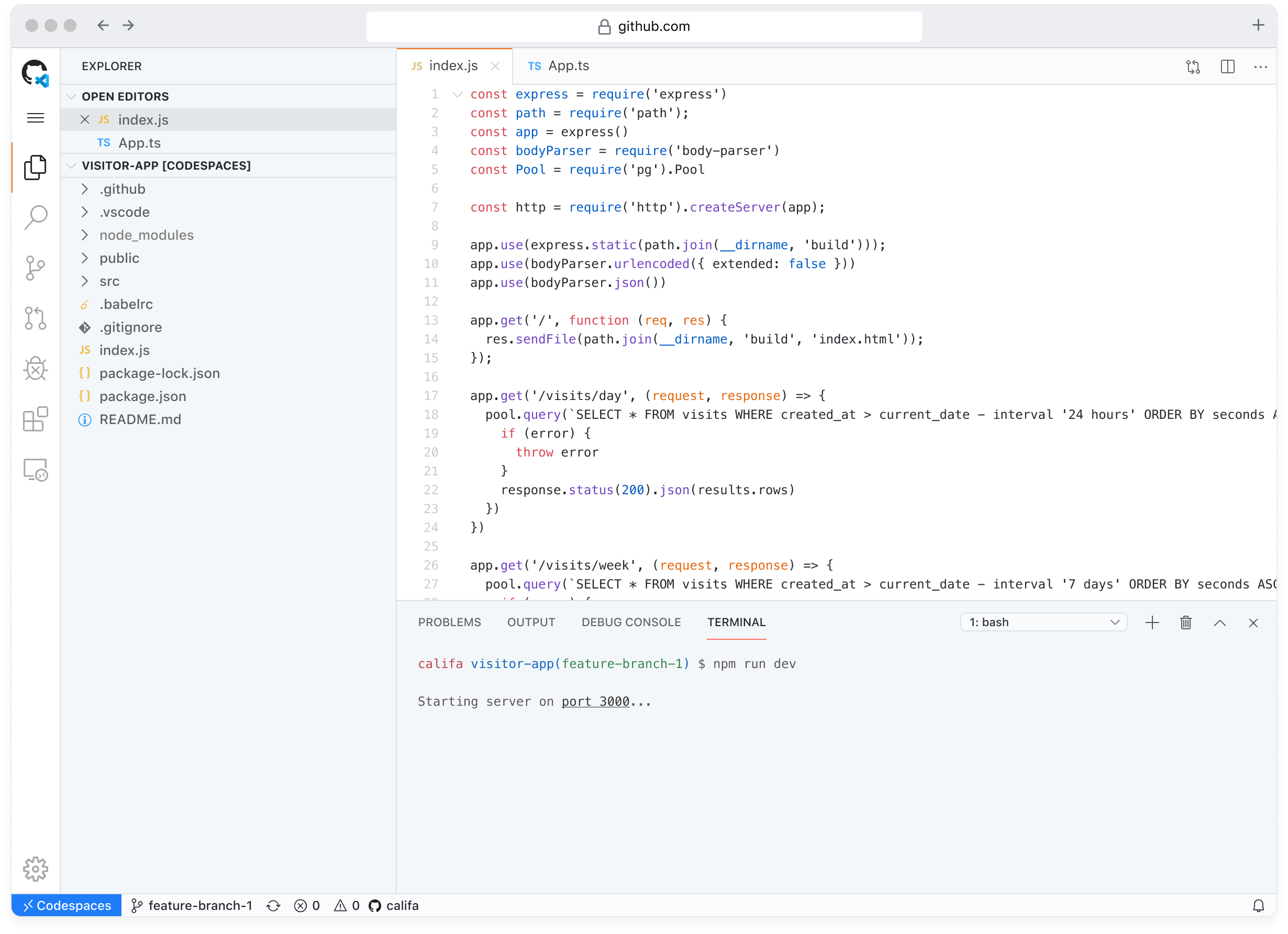
GitHub Discussions, meanwhile, will provide a threaded format to organize unstructured conversations without having to leave the GitHub repository. Scheduled to be available in beta shortly, GitHub Discussions should increase developer productivity in addition to providing a place for developers to maintain a frequently asked questions document. Over time, Schoening said GitHub expects millions of communities to be formed around GitHub Discussions.
GitHub is also moving to make DevSecOps a natural extension of any application development project. GitHub Advanced Security Cloud provides access to native code scanning and secret scanning tools that can be embedded within the developer workflow. Currently in beta, GitHub Advanced Security Cloud is based on security tools it gained via its acquisition of Semmle last year. Every Git push can now be scanned using a CodeQL semantic analysis engine to discover vulnerabilities. GitHub Advanced Security Cloud is designed to be an extension of an existing GitHub Advanced Security service.
Finally, GitHub Private Instances will provide a fully managed alternative that, among other things, allows for bring-your-own-key encryption, backup, archiving and compliance with various regional data sovereignty requirements. GitHub did not reveal, however, when GitHub Private Instances will be available.
As GitHub continues to evolve as an arm of Microsoft, there is no doubt more IT teams will be embracing DevOps. The biggest challenge is often making it easy to get started. In fact, many developers may find themselves unconsciously embracing best DevOps and DevSecOps processes as they, for example, employ scanning tools baked into the GitHub repository.
Of course, no one knows for sure whether organizations will continue the pace of application development projects in the wake of the economic downturn brought on by the COVID-19 pandemic. However, Schoening noted the amount of time between pull requests has declined on the GitHub repository, which he suggests is an indication of increased activity and productivity now that more developers are working away from the office.

Laurie Voss, COO and co-founder at npm (@seldo), tweeted recently that JavaScript packages downloaded from their repository has topped 4 billion. On an annual basis, that would be more than 200 billion downloads. Wow.

Just as open source software turns 20 years old this year, these numbers are a testament to the incredible magic that happens when communities of developers openly share innovations.
Laurie estimated that 12 million developers were responsible for the downloads. That means, on an annual basis, each JavaScript developer will download nearly 17,000 components. Imagine the time saved by not needing to code each of those functions from scratch simply by downloading a package in a millisecond from the internet.
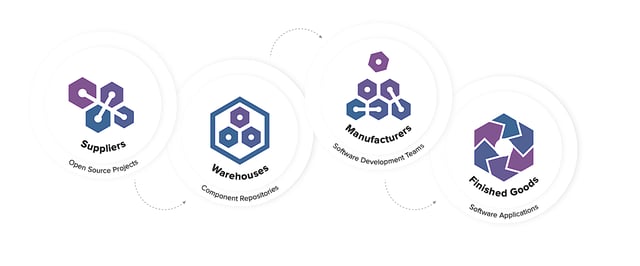
What we’re witnessing here is a software supply chain in full effect. Open source projects contribute packaged code to the community, place it in public warehouses, and it’s then consumed by development teams around the globe to create new front-end, back-end or mobile applications for all of us. Every development team on the planet now utilizes a software supply chain that operates at insane speeds with massive throughput.
In a second tweet, Laurie wrote, “Since we have ~12 million users, that means the average user installed the neatly round number of 1000 packages in 7 days. In reality, most individuals installed very few packages, and a bunch of CI build boxes installed 10s or 100s of thousands of packages each.”
Essentially, there is an army of robots (automated CI tools) downloading billions of components from the web. While this type of automation is efficient, by itself it does not serve teams well.

At Sonatype, we saw similar behavior by developers in the early days of Maven. Individual developers would download Java components directly from Maven Central. Maven users sitting right next to one another in the same room and on the same team would download the same versions of the same components needed for their builds, repeatedly. It was for this reason, among others, that our founders invented the Nexus repository manager.
While repository managers have been used for quite some time in the Java community, Laurie’s post tells us that adoption of the technology still lags in younger, less mature, packaged code ecosystems.
Companies looking for repository managers can look toward solutions like e-npm, an on-premises technology exclusively for JavaScript packages. For companies with polyglot development teams, universal repository managers provide full-function, (sometimes) free support for npm and 12 other component types, including Docker containers.
I have often said that if you have 100 developers, you have 100 front doors open into your organization. If you have 1,000 developers? Then there are 1,000 front doors.
If you dissect Laurie’s comment further, you will also realize that any developer can bring any package into your organization at any time. While this does make them more efficient, it also points to security and governance concerns. Every component was developed by someone else, donated out to the internet and consumed in the millions. But you have no true idea of the source or origin of many of the components.

Research I have done in previous years at Sonatype demonstrated that 5.5 percent (1 in 18) of components downloaded by repository managers had known security vulnerabilities. While the percentage is not very large, keep in mind that a repository manager will only download a component once. Once cached, future downloads of that component are unnecessary and the components can be reused infinitely by that team.
Sonatype analysis of more than 40,000 Nexus repositories reveals that the average repository holds more than 1,600 components. Deeper analysis of the 1,600 components housed in the average repository manager found 192 security vulnerabilities were present among the components (some components having more than one security vulnerability).
Within software supply chains, repository managers and private container registries represent procurement gates into the development organization. The gates can be left wide open where component flows are not governed or they can represent opportunities for quality and security checkpoints that ensure defects are not passed downstream.
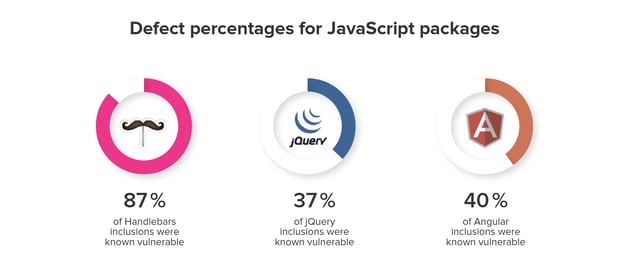
Using data from more than 133,000 websites, researchers from Northeastern University showed that “37% include at least one JavaScript library with a known vulnerability. From a per-library perspective, at least 36.7% of jQuery, 40.1% of Angular, 86.6% of Handlebars, and 87.3% of YUI inclusions use a vulnerable version.
“Alarmingly, many sites continue to rely on npm packages like YUI and SWFObject that are no longer maintained,” the researchers continued. “In fact, the median website in [NU’s] dataset is using a library version 1,177 days older than the newest release, which explains why so many vulnerable libraries tend to linger on the Web.”
Nothing from an innovation standpoint. It’s awesome and we can all celebrate this achievement with Laurie.
At the same time, it gives us pause to reflect upon other concerns of our day, including cybersecurity threats, technical debt and wasteful context switching.

Over the last several years GitHub has emerged as one of the primary repositories around which application development now revolves. At its recent GitHub Universe 2017 conference, the company revealed how it is extending that central role to provide DevOps teams with the addition of a dependency graph that can be employed to alert DevOps teams when a module of code has been updated and a security alert service that will notify them anytime a patch has been made available for a specific module.
Miju Han, engineering manager for data science for GitHub, says both new capabilities are examples of how the company is applying advanced algorithms and data science techniques to make it easier to manage DevOps processes that revolve around GitHub.
In addition, Han says GitHub is making available a news feed through which DevOps teams can track updates to groups of modules stored in the repository, as well as a tool through which they can explore a curated set of modules.
Han says his company intends to combine a variety of emerging data science tools to simplify the daily workflow that revolves around GitHub. As the repository has become more widely used, the sheer volume of code and related updates a DevOps team is supposed to track has become, in many cases, overwhelming. That’s why the company is now pouring resources in several data science research projects with an eye toward making it simpler to navigate the repository.
The latest annual edition of an Octoverse report published by GitHub finds that there are now more than 24 million developers in 1.5 million organizations around the world accessing 67 million GitHub repositories. A total of 25 million of those repositories are public. The most popular programming languages in use across GitHub are JavaScript (2.3 million projects); Python (1 million projects); Java (986,000 projects) and Ruby (870,000 projects). In terms of pull requests, GitHub notes that Python surpassed Java in popularity in the last year. The company also notes that half of the largest companies in the U.S. based on revenue are employing GitHub repositories.
There is no shortage of repositories being employed inside and out of enterprise IT organizations, including an enterprise edition of GitHub that the company claims has been implemented by 45 percent of the Fortune 100 list of the world’s largest companies.
Arguably, the biggest challenging many organizations now face is trying to reconcile the various code repositories in use. Just about every provider of an application development platform provides access to a code repository. In addition, providers of everything from container frameworks to application lifecycle management (ALM) often provide similar capabilities. Keeping track of what version of any given piece of code resides where at any given time has become a significant challenge.
The good news is that providers of repositories are starting to address that issue on their own platforms, which means it stands to reason that one day soon tools for managing code across heterogeneous repositories may not be all the far off. In the meantime, DevOps teams can take some comfort in the fact that the management tools they rely to manage all the code are about to become a whole lot smarter.