Tag: report

  • Chef Report: DevOps Feeds the Need for Speed

    Chef Report: DevOps Feeds the Need for Speed

    “I feel the need … the need for speed!” ~ Maverick

    According to a recent report from Chef, one of the driving motivations for companies is based on this Maverick quote from the movie “Top Gun”: The need for speed. Getting better products to market faster is a competitive advantage that gives companies an edge over rivals—and DevOps, microservices and containers provide the fuel to speed things up.

    Chef conducted a survey to gain a better understanding of trends and technology adoption within the Chef customer community. A Chef blog post explains, “In the first few weeks of January we received over 1,500 responses. While that’s a small slice of our user base, we received responses from around the world, across all industry verticals. This varied sample pool allows us to get a pulse on the challenges most directly impacting the Chef community.”

    In a nutshell, the Chef survey found that DevOps is having a fundamental impact on the shape and practices of IT organizations. Companies are embracing DevOps, cloud infrastructure, virtualization, microservices and containers—all in an effort to streamline development and deploy faster.

    Here are a few of the highlights from the Chef report:

    • The majority of teams surveyed are releasing changes to production not monthly, weekly or even daily, but on demand. Likewise, teams overwhelmingly report reducing the time it takes between an initial software commit and running code in production to mere hours from weeks and days.
    • Cross-functional teams are 17 percent more likely than application teams to release changes to production on a continuous, on-demand basis. Further, cross-functional teams are 23 percent and 24 percent more likely than infrastructure and security teams, respectively, to release changes to production on demand.
    • When a failure occurs in production, the majority of respondents (55 percent) are able to recover in one hour, the shortest possible recovery time in the survey. One-third of respondents (33 percent) are able to recover in the next window of four hours.
    • The overwhelming majority (86 percent) of respondents have completed or are in progress of managing a project to migrate infrastructure from physical to virtual.
    • Three quarters of all respondents are running cloud-based apps in a public or hybrid cloud and only 25 percent are running them purely in a private cloud.
    • More than two-thirds of respondents (67 percent) are already running or plan to run containers in their infrastructure.

    Chef sums up with an analysis of the survey results. The report states that building and maintaining a continuous enterprise requires teams to embrace emerging technologies to increase velocity.

    Virtualization and automation drive speed. Chef also suggests, however, that teams should embrace the preferred services and tools of developers, and adopt those across other teams. The report also stresses that organizations should strive to integrate security and compliance earlier in the production cycle.

    These tidbits only scratch the surface of the report. I recommend that you download the report and read it in full. The bottom line, basically, is that speed provides a competitive edge, and that technologies and practices such as DevOps, virtualization, microservices and containers enable organizations to produce better products faster.


    — Tony Bradley

  • Security @ the Speed of DevOps Survey: Efforts Still Lag

    Security @ the Speed of DevOps Survey: Efforts Still Lag

    Enterprises today are in a relentless race to digitize or die. If they don’t digitize business processes, services or internal workflows and their competitors do, they will be at a steep disadvantage—and perhaps soon an irrecoverable one.

    In more and more companies these efforts are being driven by DevOps. According to IDC, the vast majority of businesses today think—and rightly so—that it is essential for them to put into place the right resources and IT processes to support a digital business model. Unfortunately, about 75 percent of organizations don’t think that their IT organization is actually scalable enough to deliver and support a comprehensive digital business model.

    There are many reasons why so many organizations have a challenging time with their digital transformation efforts. Many of these are cultural: IT commands tightfisted control over all information technologies used throughout the organization, yet being unable to deliver the infrastructure and digital services enterprises need to succeed, for example. Or, others within the organization still are unable to see how rapidly the world is being changed by digital technologies and so aren’t taking the necessary steps.

    Another reason is security. That’s because this rapid digitization of business processes can have a profound impact on how enterprises secure their data, applications and software development and delivery. In devopsy.kinsta.cloud’s inaugural annual “Security @ the Speed of DevOps” survey, we queried 255 security IT decision makers within organizations currently practicing DevOps or that are on a path to DevOps adoption. The survey found that enterprises of all sizes are embracing DevOps, cloud, continuous integration and deployment. But in securing these processes, however, we found vast differences in maturity.

    When it comes to DevOps practices, larger companies are outperforming. For organizations with 5,000 to 9,999 employees, a full 90 percent have either adopted or started DevOps practices. However, only 38 percent of organizations with 500 or fewer employees have started DevOps or widely adopted such practices.

    As I wrote in our report on the survey, smaller organizations also have a way to go with automated security testing. Only 6.5 percent of those with fewer than 100 employees have automated large parts of their application security testing, while 29 percent have automated some of their application security testing. For firms with 5,000 to 10,000 employees, 38 percent have automated large parts of their testing, and nearly 50 percent some of their testing. For those with more than 10,000 employees, these figures are 20 percent and 48 percent, respectively.

    The challenge here, for many organizations, is the same with enterprise security in general: the view that security slows things down. For the business, it’s about getting more digital capabilities out as quickly as is possible. It’s the same for developers. Security too often is seen as standing in the way of this.

    When this conflict is experienced at DevOps speed, there is the risk not only of development slowing down but also security processes breaking. To succeed, enterprises can’t take the same approaches to security as they did in the past. They must find tools and processes that are designed for the highly automated and continuous world of DevOps.

    Have a look at our survey and report to see how enterprises are tackling this challenge today.

    — George V. Hulme

  • F5 Networks’s State of Application Delivery, 2017

    F5 Networks’s State of Application Delivery, 2017

    For the last three years, F5 Networks has surveyed its users and presented the “State of Application Delivery” report. This year’s report is already a couple of weeks old, and I’ve had the opportunity to read through it. There is good information in there for “NetOps” people—those who are focused on the network but want DevOps-style management. The report discusses the trends and what its customers—which lean to the larger, more established organizations—are doing.

    DISCLOSURE: I’m a former F5 employee, and overall, I loved the company. Its upper management has managed to navigate bad times and thrive in good times, and the direction of the company was generally excellent while I was there. My reasons for leaving had nothing to do with top-level management or product. In short, I’m a fan of F5. Also, my wife is still an employee of the company and—worse than that—had a hand in creating both the survey and the resulting document. And Lori sometimes also writes for devopsy.kinsta.cloud. Thus, any criticisms I offer here I will have to be willing to defend on social media, at editorial meetings and at the dinner table.

    With all that said, since readers can download the report and form their own opinions, I’m comfortable writing about this report. And I’ll even risk doing battle over the steak fries for my loyal readers.

    F5 asked nearly 2,200 users of its gear from a variety of industries a series of questions regarding how they use application services—those things such as load balancing, web application firewalls or DDoS protection that exist for an application but aren’t part of it. Included also were DevOps questions and automation questions outside the realm of DevOps.

    While much of the report is of general interest for any IT practitioner, some of it is specifically of interest to DevOps practitioners. So, with the exception of a few sweeping statements, I’ll restrict myself to the DevOps-relevant portions of the report.

    Insider side note: Lori has mentioned F5 has a metric ton of data it was unable to squeeze into this report, and she would be talking about off-and-on for a while at her F5 blog. If this topic interests you, it might be worthwhile to follow her.

    The first thing to visit is the overall list of takeaways. The report offers four “Key Findings” and, interestingly enough, three of them are relevant to DevOps. When you dig into the fourth (security-related) key finding, you discover that it, too, is at least tangentially related to DevOps.

    While I don’t want to give away the entire report, I will mention the three items directly related to DevOps:

    1. Digital Economy drives application services adoption.
    2. Cloud is growing and skills are needed.
    3. Cost savings are the primary driver for DevOps in their survey base.

    An increase in application services that can be automated kind of strongly implies DevOps, while cloud and DevOps go hand in hand, and the last point explicitly is DevOps.

    The report is packed with information about what F5’s customers are doing, what’s important to them moving into 2017 and what they plan to implement soon. Overall, it is a great read, and might bolster your appeals for executive backing or increased funding.

    There are some oddities in the report, though. I’m not a fan of the editing; some sentences seem clunky (using the same word twice in a sentence with different assumed context, for example); and one list of percentages is for some reason organized least to greatest, while all others are organized greatest to least.

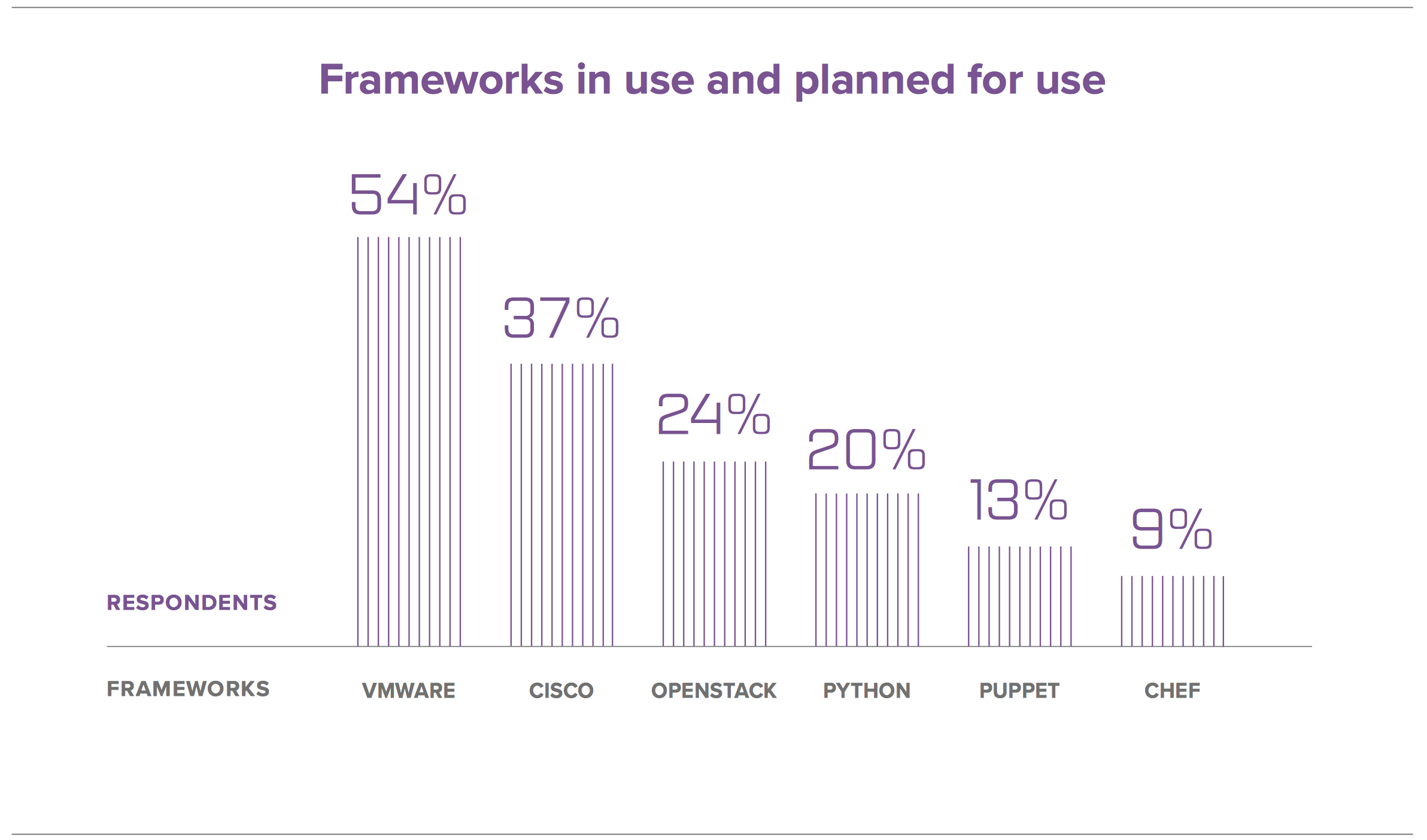
    While editing errors are distracting, the biggest issue I had with the report was the inclusion of Python as a “framework” (along with VMware, OpenStack, Puppet, Chef …). The assumption is made in the accompanying text that this indicates the level of homegrown automation, but since there are many ways to implement homegrown automation, this is at best a low point indicator of that. Overall, it feels out of place in the list:

    DevOpsTools
    DevOps tools as surveyed by F5 Networks.

    But honestly, there is enough other information about trends and number of these “frameworks” in use per org packed into this section that I’m willing to view inclusion of a language as a simple oversight that can be explained away because lots of organizations are using python for automation (I have, at more than one organization).

    The report also talks about the average application having double digits of application services deployed for it. This seems high to me, but it is data from a survey of F5’s customers, and if you’ve already paid for this bundle of services, perhaps you are more likely to make use of as many as possible. What this points to, for me, is an automation of the overall application environment. Considering the commentary F5 received in response to skills questions, it makes sense that automating solutions that can easily be automated would be an easy choice for their respondents.

    Note that in the graphic above, the company did not restrict users to “What frameworks are you using for network configuration?” It might be a reasonable assumption to think it did, as F5 is primarily a networking company (don’t tell the execs I said that—they seem to be repositioning as an application services company these days), but I asked, and the company put no limits on responses. That shows uptake of Puppet among its customers to be far smaller than I would have expected, personally, considering the core of its customer base should be Puppet’s sweet spot—traditional enterprises in a variety of industries.

    The weighting of respondents across roles might have some play in how these are ranked, though. There is a preponderance of networking and management types in the response list, with fewer security, dev, architecture and DevOps types. This could skew results, even if the organization list is relatively balanced across industries.

    Overall, take a look. It’s solid information, with some interpretation available and more commentary on verticals and use cases. It’s definitely a document worth having on hand when explaining the value of what you’re doing, or attempting to expand what you’re doing.

    — Don Macvittie

  • Addressing Container Security Challenges

    Addressing Container Security Challenges

    From month to month or even week to week, more organizations are developing with containers. The concept of containers isn’t all that new, but the dramatic rise in adoption of container technologies and the support from major tech vendors and platforms has helped containers become mainstream quickly. As with most emerging technologies, now that containers are hot there is a greater focus on some of the security issues of containers. So devopsy.kinsta.cloud worked with leading vendors to address that issue.

    A new report from devopsy.kinsta.cloud, sponsored by Aqua Security and Microsoft, examines the weaknesses of containers and that the security concerns introduced by using containers, and provides a look at some of the approaches to addressing those issues. “Containers: Security Challenges and How to Address Them” contains insights from DevOps and containers experts to help you understand the challenges and how to solve them.

    The report explains, “There is a general lack of awareness of existing container security concerns and best practices. Organizations need to understand the security issues that arise due to the differences in how VMs and containers function. Enterprises need to prepare for the glut of additional files that need protection with containers and the unwieldy nature of third-party libraries that containers use. Businesses also must consider configuration mistakes including those that grant root status to containers or simply make containers overly complex. Most importantly, organizations that adopt containers need to accept responsibility for security them, and should expect to keep tabs on new container vulnerabilities as the industry discovers them.”

    “Containers add a layer of obscurity that reduces visibility,” warns Amir Jerbi, CTO of Aqua Security. “You have an operating system running a container engine, which in turn runs containers. The OS is not aware what containers are running—it only sees the container engine. The container engine knows what containers are running, but has no clue what the containers are actually doing. So, if you’re running a host-based security tool to monitor the OS, you will not see what containers are running and what they’re doing.”

    Thankfully, there are solutions and best practices you can employ. The report describes how to use a combination of preventive measures, active detection and active response to protect container environments. It also covers some of the approaches to creating a more secure container in the first place using concepts such as isolating the containers with virtualization, as Microsoft does with Hyper-V Containers.

    “What’s really important about Hyper-V Containers is that rather than trying to close existing holes, now we can implement a solution that is secure by default and already meets compliance requirements,” explains Taylor Brown, principal lead program manager at Microsoft.

    You can download the free report from devopsy.kinsta.cloud by clicking here: “Containers: Security Challenges and How to Address Them.”

    — Tony Bradley

  • Simplify and Streamline Hybrid Cloud with DevOps

    Simplify and Streamline Hybrid Cloud with DevOps

    The cloud is not new. The virtues of the cloud have been proclaimed incessantly for years, and most businesses have embraced cloud servers and services on some level. The realities of data security and the need to leverage existing investments in IT infrastructure, however, generally result in some sort of hybrid cloud setup, with servers and applications that span both local data centers and cloud providers. Hybrid cloud deployments can be complex and volatile, which is where DevOps comes in.

    I wrote a report recently for devopsy.kinsta.cloud that takes a closer look at the pros and cons of hybrid cloud, and the symbiotic relationship with DevOps. “DevOps Enabling the Hybrid Cloud” examines how DevOps tools and practices streamline management of such an environment. It also looks at some of the security implications and how DevOps can address those concerns.

    The report explains, “Speed and flexibility are imperative for organizations that want to remain competitive. Organizations that strive to lead understand that IT must be viewed as a strategic advantage—a powerful tool for driving innovation and creativity. The hybrid cloud provides a bridge from legacy hardware and assets to cutting-edge concepts such as containers and serverless computing for organizations that do it right.”

    One truism addressed in the paper is that customers—whether they’re external customers of your company or the users within the company that rely on IT services and applications—don’t know or care where your applications or data are delivered from. They know that they want stuff to just work when they need it to work. It’s up to IT to determine the most efficient and effective way to achieve that goal, and to provide a seamless, frustration-free experience. Sometimes that means relying on cloud servers and services, and sometimes it means using local infrastructure.

    I spoke with Justin Foster from Trend Micro about the overlap of hybrid cloud and DevOps, and specifically about unique security issues with hybrid cloud environments. He stressed that legacy tools and traditional approaches to security are not sufficient for the more dynamic hybrid cloud environment. As explained in the report, “Security has to be baked in from the beginning and throughout the development life cycle.”

    A pure cloud infrastructure is unlikely for any established company. It may be achieved eventually through attrition, but there’s no getting around the fact that there already are servers and applications in place. The hybrid cloud approach is the right solution in most cases, and DevOps tools and practices are essential to help manage and secure the hybrid cloud effectively.

    Click here to download the report: “DevOps Enabling the Hybrid Cloud.”