Tag: reliability

  • Google Taps Nobl9 to Improve Services Reliability

    Google Taps Nobl9 to Improve Services Reliability

    Google announced this week it has added a capability for tracking reliability based on how service level objectives (SLOs) are being met that is based on a platform developed by Nobl9.

    Nobl9 launched a Nobl9 Reliability Center earlier this year that provides a single source of truth about the state of reliability in an application environment. Included in that platform is SLOgpt.ai, a generative artificial intelligence (AI) tool for programmatically creating SLOs and launching natural language queries to determine how well they are being adhered to across a distributed computing environment. The generative AI tool developed by Nobl9 is based on Vertex, a foundational large language model (LLM) provided by Google.

    Kit Merker, chief growth officer for Nobl9, said the generative AI tool also makes managing SLOs more accessible to a wider range of stakeholders.

    The expansion of the alliance with Google is the latest in a series that will make it simpler to manage SLOs across multiple ecosystems, including, most recently, partnerships that have been established with Microsoft and Cisco, noted Merker.

    The Nobl9 Reliability Center is already integrated with more than 50 DevOps, observability and incident management tools. It collects metrics, events, logs, traces and alerts to track incidents, releases, rollbacks, runbooks and other documentation. Those integrations will make it simpler for IT teams to create SLOs using historical data that would otherwise be challenging to define from scratch.

    In time, there is no doubt tools for managing SLOs will become more widely available, but given the dependencies that exist between applications and systems, DevOps teams will need an approach that can be employed across hybrid IT environments, said Merker.

    In general, as more microservices-based distributed applications are built and deployed, it’s becoming more challenging to maintain SLOs across them since they have many more dependencies than legacy monolithic applications. Each feature and application programming interface (API) added over time can adversely impact performance and reliability. The challenge is that it’s not so much that any given service will outright fail as much as it is determining where degradations are occurring that result in SLOs not being met.

    Each IT team needs to provide some sort of objective benchmark that assesses their overall effectiveness at delivering application services by making it simpler to track whether SLOs are achieved and maintained. Not every service needs to necessarily meet a stringent requirement, but IT teams do need to have confidence in the fact that, on average, certain levels of service are being consistently maintained.

    When it comes to SLOs, the challenge is first determining which dependencies might impact the level of reliability that can be maintained in the event of an outage and then, second, making sure whenever necessary workarounds—such as rerouting application programming interface (API) calls to other services—can be easily invoked.

    SLOs, of course, as a concept, have been around for decades, but with the rise of digital services that span multiple organizations, the level of reliability DevOps teams are expected to provide is now being written into business contracts. As a result, the overall level of stress related to managing SLOs is only going to increase in an era where businesses have never been more dependent on software.

  • Nobl9 Allies With Microsoft to Simplify SLO Creation

    Nobl9 Allies With Microsoft to Simplify SLO Creation

    Nobl9 this week revealed it has integrated its reliability center platform for managing service level objectives (SLOs) as code with the Microsoft Azure Monitor service to make it simpler to both create and track service levels.

    The Nobl9 Reliability Center provides access to dashboards for a single source of truth about the state of reliability in an application environment based on the metrics collected from the SLOs that have been defined.

    Nobl9 Chief Growth Officer Kit Merker said the integration with Microsoft Azure Monitor is the first in a series that will ultimately make it easier to define SLOs using historical data collected by third-party tools.

    The Nobl9 Reliability Center is already integrated with more than 50 DevOps, observability and incident management tools through which it collects metrics, events, logs, traces, alerts to track incidents, releases, rollbacks, runbooks and other documentation.

    Those integrations will ultimately make it simpler for IT teams to create SLOs using historical data that today are still challenging to define from scratch, noted Merker. In fact, the data tracked by Nobl9 can be used to automate remediations via those integrations, he noted.

    As more microservices-based applications are built and deployed, it’s becoming more challenging to maintain SLOs across applications that have many more dependencies than legacy monolithic applications. Each feature and application programming interface (API) added over time conspires to adversely impact performance. It‘s not so much that any given service will outright fail as much as it is determining where degradations are occurring that result in SLOs not being met.

    Ultimately, each IT team needs to provide some sort of objective benchmark that assesses their overall effectiveness at delivering application services by making it simpler to track whether SLOs are achieved and maintained. Not every service needs to necessarily meet a stringent requirement. Instead, IT teams need to have confidence in the fact that, on average, certain levels of performance are being consistently maintained.

    That’s crucial because as more organizations depend on software to deliver digital services, any disruption is likely to have a direct impact on profit and revenue. As such, the reliability of application environments has become a major concern in an era where IT teams are now trying to manage distinct services rather than individual applications.

    The challenge and the opportunity now is to find a way to proactively reduce that stress by programmatically managing SLOs as code rather than having to overprovision infrastructure resources to ensure maximum availability at the highest cost possible. At a time when more organizations are encountering economic headwinds, that’s no longer a luxury they can afford.

    Each organization will need to determine for themselves how aggressively they need to manage SLOs. Of course, SLOs as a concept have been around for decades, but with the rise of digital services that span multiple organizations, the level of reliability DevOps teams are expected to provide is now being written into business contracts. Not surprisingly, the overall level of associated stress DevOps teams are experiencing has correspondingly increased.

  • Declarative Compliance With Policy-as-Code and GitOps

    Declarative Compliance With Policy-as-Code and GitOps

    In recent times, the quest for greater agility, faster releases, enhanced scalability, security and performance brought forth the advent of several automation tools, technologies and frameworks. Software development has evolved considerably over the years to mitigate these challenges.

    Monoliths have been split into microservices for improved scalability, maintenance and faster releases. Since DevOps is adept at bridging the gap between development and operations teams, now these two teams can work together to improve productivity and speed up release cycles.

    The Need for Compliance

    One of the critical strategies for business success is to stay compliant since processes are always improving and evolving. Compliance ensures that your DevOps processes and practices are consistent and meet regulations or regulatory standards.

    An organization with a compliance-driven DevOps culture can cut down on operational costs, improve efficiency and reduce risks considerably.

    What is Declarative Compliance?

    Declarative compliance is defined as the process of managing and enforcing compliance in which policies are defined using code, and the system’s desired state is declared rather than explicitly programmed. To enforce compliance policies, you don’t write scripts or programs; instead, you use a high-level language or configuration file.

    Declarative Compliance provides several benefits:

    • Increased efficiency
    • Better managed compliance
    • Minimized risk of human errors
    • Enhanced security
    • Faster deployment
    • Better collaboration

    With declarative compliance tools, the system’s state is defined as a set of policies, and the tool makes sure it matches the desired state. The tool will automatically fix anything out of compliance, bringing the system back into compliance if there’s a deviation.

    Tools for Declarative Compliance

    Some of the popular declarative compliance tools are:

    • Open Policy Agent (OPA)
    • Terraform
    • Kubernetes Policy Controller
    • Chef Compliance
    • AWS Config

    Declarative Compliance for Infrastructure and Application Deployment

    Often, declarative compliance is used in infrastructure management and application deployment, where policies are written as code and enforced across multiple environments. In addition to managing compliance at scale, declarative compliance tools ensure that the system’s desired state stays consistent across multiple systems and applications over time.

    With declarative compliance, organizations can manage compliance more efficiently, effectively and securely since they can define policies as code and enforce them automatically. In addition to reducing errors, downtime and security breaches, this approach enables organizations to stay compliant and maintain their system consistently.

    Introduction to Policy-as-Code

    A policy-as-code approach allows you to write programs that govern security, compliance and rules throughout your application’s life cycle. It entails defining and applying code to manage and automate policies. It shares the same ideas as infrastructure-as-code (IaC) and other DevOps practices like continuous integration and continuous delivery (CI/CD).

    A policy enforces constraints and restrictions to prevent unauthorized access to resources such as databases, storage, services, etc. By codifying policies, you can enforce rules and constraints throughout the development life cycle to prevent non-conforming resources from being deployed by integrating these policies into the software development life cycle.

    compliance policy-as-code

    Figure 1: Policy-as-Code at work!

    Why Policy-as-Code?

    Typically, businesses have the required processes, tools and procedures to guarantee the deliverable’s quality. Performance, scalability, ease of use and accuracy are typical quantifiable quality metrics used to ascertain the quality.

    You can examine the quality of your application using these metrics, but a manual procedure will take time and is prone to mistakes. A better alternative is to leverage policy-as-code.

    The traditional policy enforcement processes have certain drawbacks. It is challenging to perceive that your policies would be entirely adhered to, i.e., they will not be broken. It is cumbersome to check against a list of policies manually.

    Moreover, the traditional policy enforcement method cannot scale in today’s agile world, where organizations have been growing continuously with more and more employees, services and teams.

    Here are the key benefits of policy-as-code at a glance:

    • Faster and more efficient deployments
    • Automated governance, approvals and policy enforcement
    • More reliable and secure applications
    • Centralized policy management
    • Leverages version control
    • Better visibility of policies
    • Enhanced collaboration

    How Does it Work?

    Policy-as-code involves three key elements:

    1. The policy itself, which contains the required code to model the decision-making process
    2. The data and information about the environment, service or application
    3. The query that is responsible for triggering the decision-making process

    Here’s how policy-as-code works:

    1. Policies are defined as code in a human-readable format
    2. These policies are then translated into machine-readable code using Rego or HCL
    3. The policies are integrated with the IaC pipeline
    4. A policy engine evaluates the infrastructure and the application resources against these policies
    5. The policy engine accepts the policies as input, processes them and then produces a query result
    6. The policy engine reports violations (if any) to the respective stakeholders, such as the development or security teams
    7. If violations are reported, the necessary remediation is performed automatically or manually

    Types of Policies

    • Security policies: Security is enforcing adequate technological controls to safeguard company assets.
    • Compliance policies: Compliance policies are designed to help organizations adhere to governance standards. Typical examples include PCI DSS, GDPR, HIPPA, etc.
    • Operational excellence: This encompasses policies pertaining to service degradation or interruption.

    What is GitOps? How can GitOps Help With Compliance?

    GitOps is a subset or extension of DevOps encompassing a collection of practices that can simplify deployments using Git. It is an operating model for cloud-native applications that leverages Git as a single source of truth for declarative applications and infrastructure. Using GitOps, you can implement a standardized policy-as-code approach across your CI/CD and GitOps pipelines.

    The key principles of GitOps are:

    • The state of the system is captured and stored in a Git repository
    • The entire system is configured declaratively
    • Automated deployment

    You can create policies in Git and store them in a particular repository, which is essential since Git offers sophisticated change management tools like version control. Only the compliance team would have admin access to the repository.

    It’s easy to enforce policies with Git, and you can apply them to any execution engine, like CI or CD. With GitOps, you can audit and document every action that affects data consumption.

    You can expose system changes, optimize deployment and use a version-controlled infrastructure. By managing compliance with GitOps, you can make sure that the changes are visible, verifiable and auditable.

    GitOps

    Figure 2: GitOps at work!

    Using GitOps as the Execution Engine in a GitOps Process

    There are several benefits to using GitOps as a process execution engine, including:

    • Increased automation: GitOps automates software delivery, reducing manual intervention and increasing deployment accuracy and speed.
    • Better transparency: GitOps records all changes to the system in a transparent and auditable way so that you can track compliance easily.
    • Maintaining consistency: GitOps keeps the system in the desired state defined in the Git repository, reducing non-compliance risk.
    • Fosters collaboration: All changes to the system are made through the Git repository, so GitOps encourages collaboration across teams.

    Using Policy-as-Code and GitOps: Policy-Based Compliance

    By using GitOps and policy-as-code, teams can manage compliance-as-code in an auditable, declarative way and enforce it via GitOps, ensuring that the desired state is always maintained. This can help your teams to codify compliance requirements as code, store them in version control and automatically enforce them through GitOps.

    Organizations can improve the consistency and reliability of their systems by defining and enforcing compliance requirements using policy-as-code and managing their deployment processes with GitOps. While this can minimize compliance violations, it can also maximize efficiency.

    By following policy-based compliance declaratively, businesses can define policies as code and enforce them automatically and repeatedly. By adopting such an approach to compliance management, you can better manage compliance in complex systems in a consistent, scalable, agile, transparent and collaborative manner.

    For example, you can leverage policy-as-code to define policies for infrastructure provisioning and configuration management to ensure that the infrastructure complies with organizational policies and industry standards. Typical examples are defining policies for network configuration, access control and resource allocation.

    Use Cases: Using Policy-as-Code and GitOps in a Production Environment

    Infrastructure Provisioning

    Open Policy Agent (OPA) can define policies for infrastructure resources like AWS Elastic Compute Cloud (EC2) servers. You can use GitOps to manage the deployment of infrastructure resources by storing IaC files in a Git directory. When the IaC files are changed, GitOps is adept at automatically deploying the changes while OPA checks for policy compliance.

    Deployment

    You can use policy-as-code tools such as OPA to create application deployment policies requiring specific security settings, while GitOps manages the application deployment by storing manifests.

    Manage Kubernetes Clusters

    You can leverage policy-as-code to better manage your Kubernetes clusters. So, you can write your code to define policies to manage Kubernetes resources, such as nodes, pods, clusters, etc., declaratively.

    Compliance Management

    You can use policy-as-code to establish and implement rules and regulations, such as those pertaining to security, to help businesses ensure that their systems comply with industry regulations and standards.

    OPA can be used to set compliance policies, like restricting access to sensitive data to authorized users only. You can use GitOps to manage the deployment of compliance policies seamlessly.

    Trusted Delivery: Policy-as-Code Integrated With GitOps Workflows

    Trusted application delivery is a software delivery approach emphasizing security and trust in the software supply chain. This ensures that any software delivered to the clients is devoid of security flaws, malicious code and other attacks.

    This approach prioritizes security and trust at the development, testing, packaging and deployment stages and integrates security and compliance checks into the GitOps pipelines. This quality check reassures clients about the product’s quality and ensures that any modifications adhere to predetermined rules and principles.

    Trusted application delivery allows for quick deployment while securing apps with automated guardrails. These guardrails are implemented using policy-as-code. By enforcing these guardrails, you encourage frequent deployments while ensuring that the reliability and security of the application are not compromised.

    Conclusion

    Declarative compliance with policy-as-code and GitOps is a best practice for achieving greater compliance, reliability and agility in software development and deployment processes. You can simplify defining and enforcing compliance policies using declarative configuration files and automation tools. Using Git as the single source of truth for all configuration changes, an organization can achieve greater efficiency, visibility and auditability in the compliance process.

  • Debunking Myths About Reliability

    Debunking Myths About Reliability

    “Our service should always be up.” Some myths just won’t die.

    Engineering for reliability is well understood by engineering leaders, less so by bosses demanding unreasonable uptime with minimal resources and immense feature pressure. Business leaders tend to waffle between ignoring reliability with a hand wave and freaking out after an outage. How can they understand the reality of reliability and forget the myths?

    Myth One: Our Service Should Always be Up

    Reality: Our Service is Engineered to Consistently Exceed Expectations

    Some might imagine reliability like a light switch—it is either on or off. But reliability is about consistent repetitions and managing the risk of minor, occasional, recoverable failures. Can we consistently exceed customer expectations?

    Understanding customer expectations is challenging because you can’t ask people what they expect from you (unless you have a peculiar customer). So instead, we want to define and quantify the impact of our service not working and how that could negatively impact customer experience based on observed behavior. For example, “People abandon their shopping cart when our checkout experience takes more than 10 seconds to load, which means we lose money.”

    We reflect business impact in our reliability goals and then engineer our system and processes to meet this goal. We might change how we do releases, ensure tests pass or avoid changes during times of peak usage. These engineering decisions use reliability as a business metric based on customer expectations.

    Myth Two: Innovation is More Valuable Than Reliability

    Reality: You Need to Balance Innovation and Reliability Engineering Work

    The constant drive for new features over reliability is the most frustrating myth. “We need to release new feature X, or we won’t have customers; we can worry about reliability later.” In reality, most customers care about reliability; they don’t mention it until it’s a problem.

    You can have the most fantastic whizbang feature in the world, but if it doesn’t work–and Murphy’s Law will make sure that it doesn’t work at the worst possible time–no one can use it, no one will be impressed and it will turn your technology into a laughingstock.

    Innovation excites customers, but trust comes from reliability, which you must earn through hard work and clever engineering. Depending on your business context, you may require reliability more than ever. If you are facing headwinds, you may need to scale back your ambitions regarding innovative features. Still, you can’t scrimp on reliability or customers will justifiably leave.

    Myth Three: Five Nines is Normal and Incremental From Four Nines

    Reality: Five Nines is Expensive—10X the Cost of Four Nines

    No one–not even massive cloud providers or telcos–can consistently deliver at 99.999% across all their services by accident. Reliability at that level–less than six minutes downtime per year!–is an engineering marvel. A bridge or a dam might look simple after completion, but the engineering required to create a reliable physical infrastructure is immense, as everyone knows. Why is it so hard to understand the complexity, design, engineering and redundancy required to deliver a highly available and performant digital system? Further, it’s easy to think that 99.999% is just a bit more than 99.99%. After all, it’s “just one more nine.” Remind your less-technical counterparts that each nine requires ten times more effort!

    Why is it so expensive to deliver? Because the failure tolerance (also known as an error budget) is 1/10th the size but the risk of missing the goal increases exponentially. You’ll need more redundancy, careful testing and certification of releases, increased on-call rotations, extra hardware or cloud capacity and extensively tested backup plans to achieve this goal.

    Worst of all, higher reliability will slow you down. You can’t innovate or deliver updates as fast when you need to ensure absolute uptime.

    But what if there was a limit to how much reliability we need?

    Myth Four: More Reliability is Always Good

    Reality: Reliability Engineering Has Diminishing Returns

    There is a point at which being “too reliable” is terrible for business. It’s expensive to build all that redundancy, testing, responding to tiny glitches and all the rest. And most of your users won’t notice. We must avoid the large blowups that put us in the headlines and manage expectations everywhere else. The significant outages that can impact thousands, if not millions of customers come from this reductionist view of reliability as a by-product of conscientious work rather than an engineering problem with well-defined tolerances and thresholds. You earn the trust of your customers by properly engineering reliability into your delivery process.

    Consider tardiness at meetings. If you wanted to be 99% on time, you’d need to join a one-hour call within 36 seconds and at 99.9%, you would need to enter a Zoom within 3.6 seconds of its start time, a timescale so small you don’t even notice it. You would have to do this for every meeting you attended, no excuses–bio breaks, last meeting ran long, someone at the door, etc. None of these things matter when defining and measuring reliability. This metaphor also provides a common sense way to think about risk and error budgets. Your other meeting attendees can’t possibly notice (or care) if you’re 3.6 seconds late, no matter how prestigious or impatient the other party is.

    You could apply this same reasoning to catching a flight, picking up your kids from school, completing an exam, building a woodworking project or any human endeavor. The concept is so intuitive to daily life that even pointing it out seems absurd. But this is the fundamental concept from which reliability engineering stems. To build a reliable system, we must define acceptable failure boundaries. Otherwise, we will spend precious time and resources to eliminate the 3.6 seconds of delay that no one cares about and miss the more significant issues–like being present and engaged in the discussion.

    Busting Reliability Myths

    Understanding reliability is vital for engineers and business people alike. It all comes down to intentionally designing a customer experience, keeping up with expectations and, in some cases, even promises. Right-sizing reliability lets you find the perfect balance between delivering excellent service and efficiently running your organization.

    Image Source: Indira Tjokorda via Unsplash 

  • Nobl9 Adds Service Level Analyzer to SLO Management Platform

    Nobl9 Adds Service Level Analyzer to SLO Management Platform

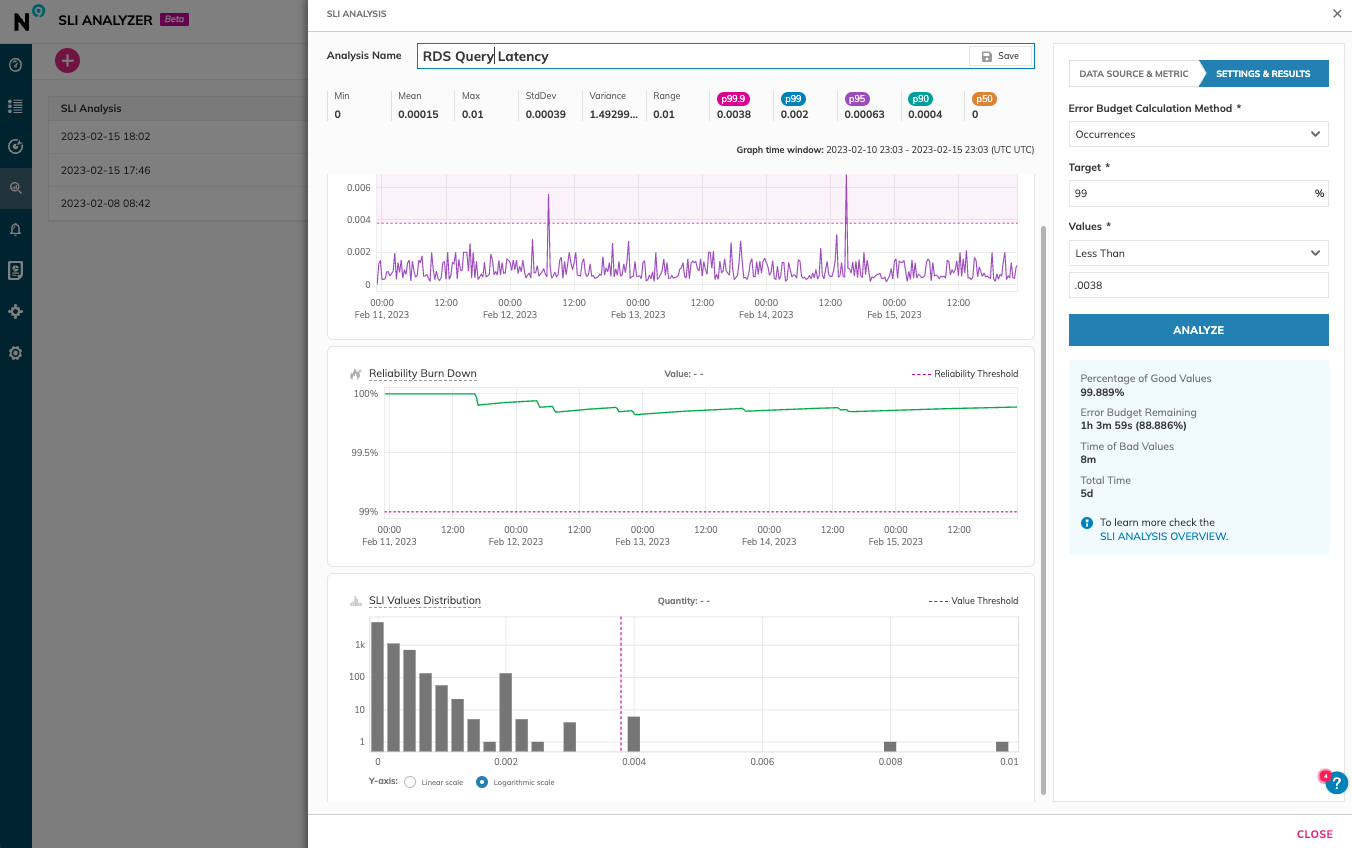
    Nobl9 today added a free tool for analyzing service level objectives (SLOs) to its platform to enable DevOps team to more accurately set reliability goals.

    Brian Singer, chief product officer for Nobl9, said Service Level Analyzer collects metrics and observability data from more than 24 DevOps tools and platforms that can then be used to create an SLO via a single click.

    Included as part of the free tier of the Nobl9 service, Service Level Analyzer also enables DevOps teams to more easily update SLOs as error budgets and error budget burn rates change over time based on actual incidents that have occurred, added Singer.

    DevOps teams can also perform “what-if” analysis to test out the impact of different targets and thresholds on error budgets, he added. That capability ultimately reduces costs because DevOps teams become less likely to overprovision resources to ensure application performance and resiliency, noted Singer. In effect, Service Level Analyzer is providing DevOps teams with an observability tool that spans the entire software development life cycle, said Singer.

    Nobl9 is trying to spur greater adoption of SLOs by making available an open source SLO specification that defines a common interface for constructing SLOs across a DevOps workflow. SLOs, of course, are not a new idea. They have been employed as a metric to track the performance of IT services for decades. However, as more microservices-based applications are built and deployed, it’s becoming more challenging to maintain SLOs across applications because they have many more dependencies than legacy monolithic applications.

    Ultimately, each DevOps team needs to provide some sort of objective benchmark that assesses their overall effectiveness at delivering application services. SLO-as-code is intended to make it simpler to gather the metrics that confirm whether service levels are being achieved. As organizations become more dependent on software to drive digital processes, those SLOs are then tracked across everything from financial services to supply chains.

    In general, DevOps teams are more comfortable with the SLO concept, said Singer. The biggest challenge is making them simpler to implement, he added. The Service Level Analyzer lowers the bar for implementing an SLO by making historical data stored in DevOps tools and platforms more accessible, noted Singer. Rather than having to manually collect that data and then normalize it in an external repository, Nobl9’s Service Level Analyzer automates that process on behalf of a DevOps team using actual data versus relying on less precise statistical analysis, said Singer.

    As IT environments become more distributed, the number of dependencies that exist across application environments only continues to expand. IT teams can spend weeks trying to discover the root cause of issues that are negatively impacting application performance, only to discover that, for example, calls to an application performance interface (API) are being rerouted in a way that significantly increases latency. Tools that enable DevOps teams to more easily understand the relationships between all the services that make up an application environment are more crucial than ever.