Tag: relational database

  • Common RDS Misconfigurations DevSecOps Teams Should Know

    Common RDS Misconfigurations DevSecOps Teams Should Know

    Relational databases have become the option of choice for organizations wishing to streamline and scale the use, storage and retrieval of data. Many organizations choose AWS Relational Database Service (RDS) to forego the resource-intensive tasks related to database administration including management and continuous oversight. RDS is a fully managed service that simplifies and automates these processes, making it easy to set up, operate and manage relational databases in the cloud—including MySQL, PostgreSQL, MariaDB or Aurora—and their various time-consuming activities. Reducing costs and automating processes makes significant business sense and allows organizations to focus on performance, scalability and cost-effectiveness as data grows.

    That said, AWS is not the owner or the party responsible for securing your data—this duty remains in the hands of the organization. As the cloud provider, AWS does offer an impressive suite of security measures for protecting the infrastructure that runs its cloud services, including access controls, database snapshots and encryption. Their policies, however, clearly state that safeguarding data is within the responsibility of the organization and, as the moderator of your environment, you will be accountable for what occurs within it.

    The following are the six most common RDS misconfigurations related to security and compliance that DevSecOps teams should be aware of to secure their data stores and organizational assets.

    Broken Geo-Trust (aka Data Sovereignty): RDS provides the convenient option to distribute data across various AWS regions. There are various benefits to this data migration including minimizing latency, disaster recovery capabilities and scaling operations. However, the security and governance risks of cross-geo replication may significantly outweigh these benefits. A common misconfiguration includes migrating replicas or storing backups and snapshots in another location. When sensitive data travels and is stored in another geographic location, the organization may be at risk of violating international compliance requirements such as Schrems II (for EU-to-U.S. data transfer). Additionally, data traveling to various locations may not be visible to security teams or managed by DevOps teams—without a continuously updated inventory, data will spread unobstructed and ungoverned. 

    The screenshot below displays a copy-snapshot operation of a U.S.-based RDS datastore to an EU region.


    Inadequate Retention Periods: AWS allows organizations to retain database instances for a specific period of time as configured by the user. A common misconfiguration of this feature is the existence of unmonitored standalone snapshots, short-lived backups and a failure to permanently delete records. Organizations that retain records for a long period of time may be in breach of their GDPR obligations, whereas short-lived backups may jeopardize the organization’s ability to recover critical data in case of data loss or a ransomware attack. Clear guidelines and open communication between DevOps teams and compliance leads is the first step toward a healthy environment.

    The screenshot below presents a recommended and comprehensive backup retention period configuration from an RDS datastore creation process.

    Exposed Resources (Network Access): Publicly accessible database ports and RDS instances are a lucrative configuration loophole for malicious actors. Common misconfigurations may cause RDS database snapshots to be publicly accessible, thus providing unauthenticated users with privileges to access and abuse it through brute-force attacks, known CVEs and DDoS attacks—thereby exposing sensitive data. This risk will also impact the organization’s ability to comply with international regulatory requirements and should be a high-priority configuration when creating and maintaining such resources.

    The screenshot below presents recommended network (public) access and default port configuration from an RDS datastore creation process.

    Weak Encryption: Encryption of sensitive data—both at rest and in transit—is a necessary security baseline to ensure the integrity and confidentiality of organizational data and make it inaccessible to unauthorized users. Common encryption misconfigurations may include implementing inadequate encryption for communication channels such as TLSv1.2 (and higher), weak cipher suites or untrusted CA which may lead to a false sense of security. For data at rest, another common misstep is a lack of key rotation or exposure of the encryption key to unauthorized entities.

    The screenshot below presents the recommended basic encryption-at-rest configuration to be enforced when creating an RDS datastore.

    The screenshot below presents recommended basic encryption-in-transit configuration to be enforced when creating an RDS datastore.

    Improper Authentication & Authorization (RBAC): A cornerstone of adequate data security hygiene is ensuring that access is only associated with a unique account based on the principle of least-privilege, using strong identification methods with appropriate justification. With RDS, users may not use IAM accounts, provide over-privileged access and permissions to either the main instance or to backups and refrain from implementing a user-access quarterly review.

    The screenshot below presents the recommended authentication configuration to be enforced when creating an RDS datastore.

    Incomplete Audits: Visibility cannot be considered a point-in-time activity. Monitoring of access and use of sensitive data is an essential component of tracking organizational assets and will provide crucial information in case of an incident or potential data breach. Incomplete or misplaced audit records including login/logout events, short-lived audits or leakage of sensitive data from RDS to audit logs increases the risk. 

    The screenshot below presents the recommended audit and log configurations when creating an RDS datastore.

    Misconfigurations and single points of failure in cloud environments may be unavoidable for all organizations, especially those operating at scale, due to knowledge gaps, high velocity of data and changes and a lack of visibility as the amount of data increases. While the security baseline may be covered by RDS configurations, these are only the minimum required to protect your environment. DevSecOps teams are encouraged to work closely with their compliance leads to ensure that customer data is secured; leveraging RDS for its benefits is a complex and entirely more substantial responsibility. Organizations must view their data as an inherent part of their internal assets. As its owner, they should create appropriate ecosystems that allow continuous oversight and monitoring of the data, gaps that may arise and, most importantly, the controls in place to secure it. 

  • Oracle Launches Managed JSON Database Service

    Oracle Launches Managed JSON Database Service

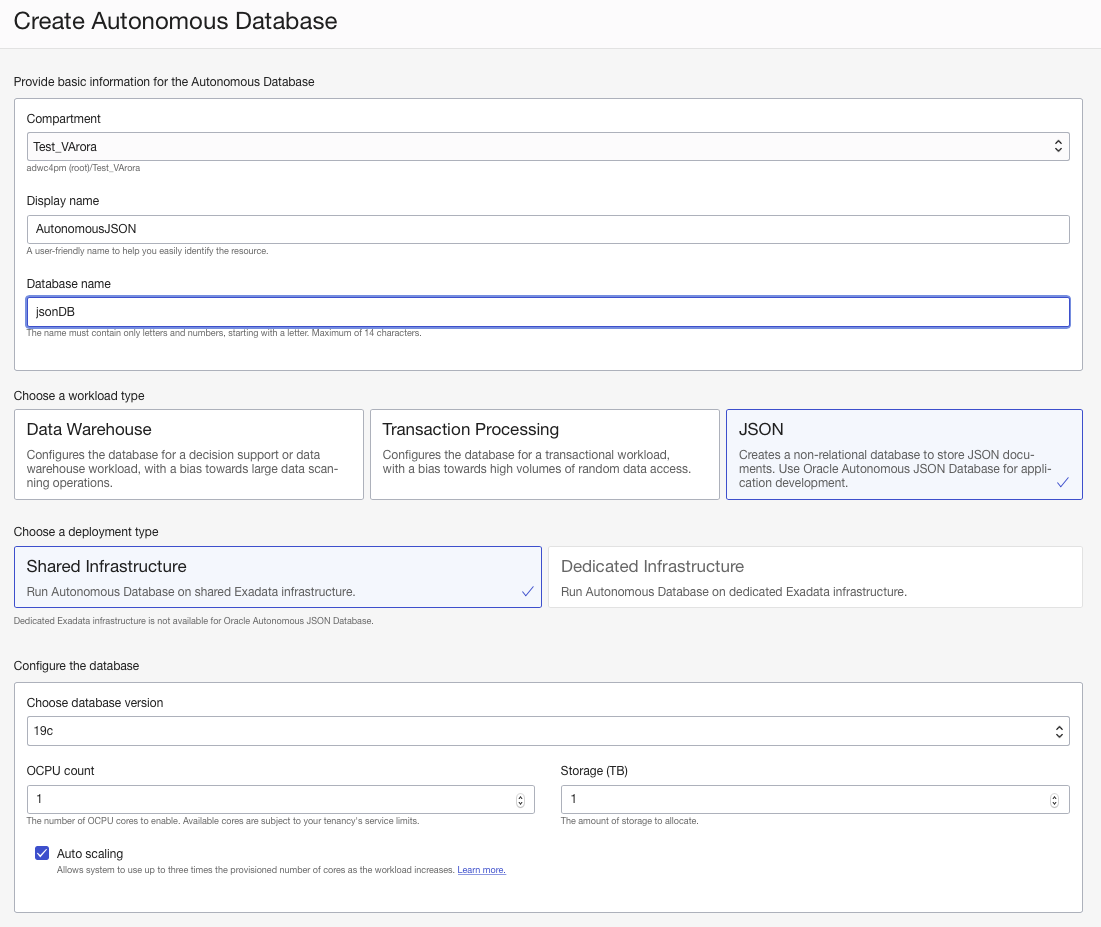
    Oracle today unfurled as standalone Autonomous JSON Database service that it will manage on behalf of developers that require a document database.

    Gerald Venzl, a developer evangelist and distinguished product manager for Oracle, said the Autonomous JSON Database service is based on support for JSON data types that Oracle currently provides in its Autonomous Database service based on its relational database.

    Priced at a quarter of Oracle Autonomous Database service, Oracle is also targeting rivals such as MongoDB by also pricing Autonomous JSON Database service at roughly 30% less than rival managed database service, Venzl noted.

    In addition, because Autonomous JSON Database service is based on the same platform Oracle employs to deliver its Autonomous Database Service, developers can add support for a wide variety of other data types by upgrading to the Autonomous Database Service with a single click, added Venzl.

    That approach provides developers with more flexibility should their data requirements change, or they simply initially chose the wrong type of database for their application, said Venzl.

    Other capabilities provided by the Autonomous JSON Database include support for built-in machine learning algorithms and spatial queries; fine-grained access controls; a server-side procedural language; low-code development tools; support for ACID-compliant transactions with no time or transaction size limits, support for cross-collection joins and/or aggregations and a search index for JSON documents.

    Oracle also makes available an open source document store application programming interface (API) dubbed Simple Oracle Document Access (SODA) that makes it simpler for developers to employ programming languages such as Java, JavaScript and Python to build applications on top of a JSON data store. Autonomous JSON Database stores JSON documents in a native tree-oriented binary format that Oracle claims is optimized for fast reads simplified updates.

    It’s not clear to what degree IT organizations will embrace managed database services. Oracle is making a case for managed database services that essentially eliminates the need to rely on database administrators to manage the infrastructure the database is deployed on as well as any upgrades made to the database itself.

    Developers in recent years have embraced document databases in part because they are easier for them to provision. In most cases, developers download a document database that they at least initially manage themselves. The challenge IT organizations inevitably encounter is the number of document databases that need to be supported grows rapidly. Developers who are focused on building applications don’t always have the time required to manage fleets of databases.

    Oracle is, of course, making a case of managing a variety of classes of databases. As enterprise applications continue to evolve in organizations the number of data types organizations are supporting continues to expand. A managed service focused on only one class of database may not be as appealing as a suite of managed service options.

    Regardless of approach, it’s clear database management is getting more automated. The opportunity and challenge now are finding the best way to incorporate database management with a larger set of DevOps practices.

  • MongoDB Addresses Host of DevOps Issues

    MongoDB Addresses Host of DevOps Issues

    At its MongoDB Europe conference this week, MongoDB updated its open-source document database with the addition of MongoDB Ops Manager to simplify management of distributed instances of version 3.6 of its database.

    In addition, the company has added a capability that enables all updates to the database to be automatically reflected in the application in real time without having to take the database offline.

    Additional new capabilities include a MongoDB Compass tool to analyze schemas and a governance capability that makes it easier to apply and tune data governance polices before and after an application is deployed.

    The company has added an aggregation pipeline that allows users to perform real-time analytics directly in the database to improve performance. Developers and analysts now can write queries combining data from multiple collections for complex analytics. Its Connector for BI, which can now be deployed and managed by its Ops Manager, has been updated to support this new query capability.

    Finally, in the event of a system failure or network outage, MongoDB says it now automatically will replay any writes to the database when those services come back online.

    Brooks Circhlow, vice president of product for MongoDB, says developers have embraced document databases as an alternative to other database platforms because of their flexibility. Unlike, for example, relational databases, a document database doesn’t impose a schema that must be crafted by a database administrator. But as more instances of document databases proliferate across the enterprise, DevOps challenges start to manifest.

    In fact, Circhlow notes that IT organizations are also making extensive use of cross-replication capabilities across multiple database clusters that they manage or are managed on their behalf via the MongoDB Atlas managed service. In many of those instances, DevOps teams are responsible for both the applications and the document databases they run on.

    MongoDB is also moving to address a DevSecOps issue stemming from a wave of attacks aimed at misconfigured instances of its database. Circhlow says the most widely used installer for MongoDB limits network access by binding to localhost by default. With version 3.6, binding to the localhost is now extended to all MongoDB packages across all platforms. In addition, with new IP whitelisting support, administrators can configure MongoDB to only accept external connections on approved IP addresses.

    Document databases such as MongoDB arguably have been a primary catalyst for DevOps. Once developers began to bypass database administrators by downloading instances of document databases, it became clear that traditional approaches to IT operations were starting to erode. Most organizations would prefer their developers to write code than manage databases, so some new means for managing databases that doesn’t compromise the dexterity that document databases provide developers was required. Once those processes get established, the next question then becomes how to make traditional database administration involving other classes of databases part of that process. Most IT organizations are still working through those processes. But it’s clear database administration will never be the same.

    — Mike Vizard

  • Don’t Be Samsung: Here’s How You Can Protect Yourself

    Don’t Be Samsung: Here’s How You Can Protect Yourself

    Imagine a factory building 100,000 units a day, and you can see how a small error can have huge consequences. Now imagine that factory is a database.

    The world’s top smartphone maker this month pulled the plug on its $882 Galaxy Note 7 after phones overheated and caught fire, concluding in a disastrous recall for Samsung that could cost the company as much as $17 billion and shutter a global revenue stream. In an unprecedented move, Samsung has told mobile carriers to halt sales or exchanges of the device, requested that users to shut off their phones and issued a mass recall while the South Korean manufacturer investigates reports of fires in original and replacement Note 7s.

    This a scant two months after the Galaxy Note 7’s launch, a device that one TechCrunch consumer electronics expert raved as “undoubtedly one of the most iconic handsets around.” While it is not clear what caused these fires, there is speculation that it was due to a faulty component that interacts with the battery, rather than the battery itself.

    It goes without saying that there are ample opportunities for error in the assembly of a smartphone. The complicated, highly coordinated process is fraught with thousands of input touchpoints, from hard- and software components to tightly controlled manufacturing processes to manual labor. And though there may be countless checks and balances in place, mistakes do happen. What may seem to be an innocuous error, such as not sufficiently tightening a screw or the shorting of a circuit, in this case has led to epic consequences.

    The truth is, these instances happen more often than we think, and to technologies even more vital to the population than a personal smartphone.

    Consider today’s era of big data and cloud applications, where enterprise applications ingest and process vast amounts of information from various sources, often in real time, to deliver critical analytics, contextual information or business insights.

    This data has weight. It can influence whether fleets of airplanes are grounded at gates all across the country. It can restrict customers from accessing funds from online banking. It can dictate whether millions of online retail dollars go unspent. The reliance on accurate data, and its grip on lives and business, is growing at an exponential rate—like ever-widening ripples in a lake.

    To support all of this data, new applications (such as real-time analytics, internet of things, ecommerce and others) are developed and deployed on scale-out, non-relational databases or ported from traditional relational databases.

    But, like the manufacturing gaffs experienced by Samsung, corruptions and operational errors by developers occur in enterprise IT environments. Enterprises know this, and billions have been invested in traditional backup and recovery and data protection products to protect against such “err” moments. However, the irony is that data protection products like those that exist for traditional relational databases do not exist for today’s modern, next-generation scale-out databases supplying the new types of data that increasingly control our lives. We’re essentially trusting that the Ma Bell rotary phone repairman will be able to recover personal data—such as contacts, photos and messages—after your Galaxy Note 7 starts smoldering.

    So how did we get from the world’s most explosive phablet to distributed databases and big data? Because, like the Galaxy Note 7, the tiniest data error can rapidly expand into magnificent, catastrophic consequences.

    Enterprises are adopting cloud applications that gather large amounts of data at a high-ingestion rate and process that data in real-time to deliver actionable insights. These applications are deployed on non-relational databases. As migration to cloud and multi-cloud application environments increases, enterprises also must be able to manage and recover at scale without data loss or corruption and with minimal application downtime.

    However, enterprises today face a significant gap in addressing their data protection requirements. Their most valuable data, often needed 24/7 and without fail, runs absent any point-in-time backup options for that ‘“Houston, we have a problem”’ moment. Most studies suggest that more than half of data downtime and loss is triggered by human error, corruption or virus attacks. And yes, while native replication helps enterprises meet business continuity and disaster recovery requirements by providing protection from hardware failures or even natural disasters, it is insufficient (meaning it cannot scale) to meet next-gen enterprise data protection demands. Case in point: If a minor schema corruption impacts the primary data copy, it causes a multitudinous ripple effect that impacts all replicas down the line. Yet, even without protection, industries continue to adopt and deploy scale-out database systems at an accelerated pace.

    So just as Samsung witnessed an error replicate itself into such a massive meltdown of global proportions that it threatens to kill an entire product line, organizations also must understand how replication-based protection mechanism can actually act like a virus—spreading a corruption uncontrollably across non-relational, cloud databases.

    Samsung’s troubles won’t end with the simple recall of a single product, and their predicament should resonate. There will be punitive measures, and perhaps even a total enterprise shift from the smartphone market. It is not an enviable position, but is does offer a clear example of how a peripheral manufacturing error can swell to engulf an entire brand.

    For enterprises rushing to deploy scale-out databases, let Samsung serve as a warning: that deploying any infrastructure that could potentially lead to exponential, irreversible corruption of all data copies is a recipe for harm (if not disaster). As enterprises make the switch to next-gen applications running on scale-out, non-relational databases, an assembly line e-stop needs to be built in, in the form of a point-in-time, version-friendly data protection solution.

    Data corruption is not a matter of “if,” but “when.” So have a kill switch ready.

    errors-replicating-image

    — Brian Yin