Tag: re:Invent

  • Bitrise Tightens Mobile DevOps Integration With AWS Cloud Services

    Bitrise Tightens Mobile DevOps Integration With AWS Cloud Services

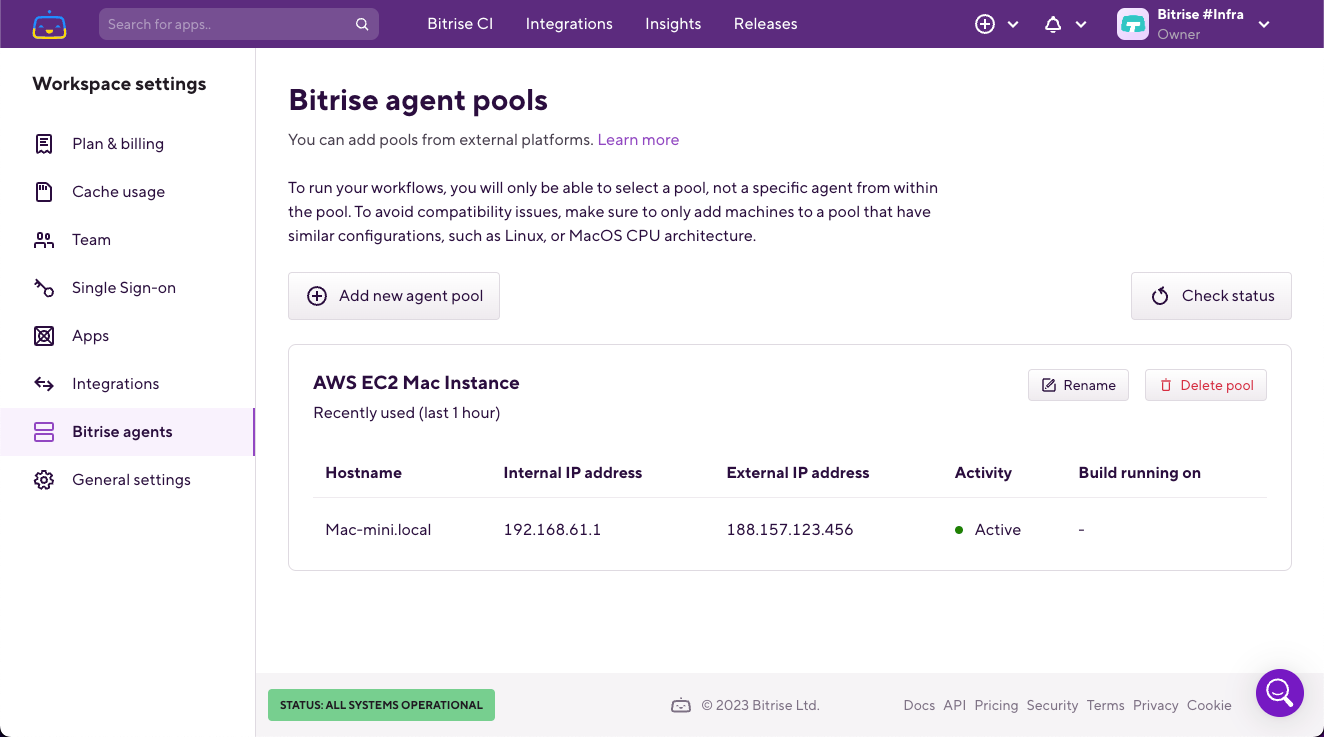
    Bitrise this week will tighten integration with its DevOps platform for building and deploying mobile applications and the application development services provided by Amazon Web Services (AWS) cloud.

    Announced at the AWS re:Invent 2023 conference, the goal is to provide easier access to automated building, testing and release management capabilities provided by AWS as part of an effort to increase overall efficiency.

    Bitrise CEO Barnabas Birmacher said those capabilities will streamline workflows for a Bitrise Mobile DevOps platform that has been specifically designed for building and deploying mobile applications that typically need to be updated frequently.

    Based on a continuous integration/continuous delivery (CI/CD) platform developed by Bitrise that can be deployed in an AWS cloud computing environment, the integrations will make it simpler to build and run mobile applications at scale, noted Birmacher.

    The goal is to reduce the total cost of building mobile applications while at the same time improving developer productivity for mobile applications that have to be thoroughly tested before being made accessible via an application store, he added.

    It’s not clear how many organizations will prefer to have a dedicated CI/CD platform for building and deploying mobile applications versus using the same CI/CD platform they might already be relying on to build and deploy other applications. Bitrise claims to have more than 6,000 customers, including Reddit, WISE, Equinox and Philips Hue.

    As the percentage of mobile applications that make up an organization’s portfolio continues to increase, the pace at which those applications need to be updated lends itself better to a CI/CD platform optimized for those types of applications, said Birmacher.
    In fact, a recent survey conducted by Bitrise found 62% of respondents have been adversely impacted by manual processes that slowed the rate at which mobile applications were deployed and updated. The survey also found (44%) of respondents reported their release approval process is mostly or entirely manual, with only 9% having fully automated application releases.

    The survey also found that nearly two-thirds of organizations (66%) have deployed applications that can’t be opened in two seconds or less, which is widely considered the accepted level of performance required for mobile applications. In addition, three-quarters of organizations (75%) required more than two days to address bug fixes.

    Many mobile apps have become increasingly mission-critical thanks to digital business transformation initiatives. Consequently, the amount of focus on them within most organizations is high; any issues that arise are likely to be noticed at the highest echelons of an organization. That level of attention can easily put pressure on DevOps teams, mainly because the general expectation among end users is that mobile applications will be regularly updated with new functionality. However, if release processes are largely manual, regularly improving the user experience can become problematic.

    Each IT organization will need to decide for itself how best to go about building and deploying mobile applications, but the one thing that is certain is adjustments to DevOps workflows will need to be made as a lot more of these applications are continuously built, deployed and updated.

  • AWS Makes Economic Case for Graviton Processors

    AWS Makes Economic Case for Graviton Processors

    Amazon Web Services (AWS) is making available in preview a C7gn instance on the Amazon Elastic Compute Cloud (Amazon EC2) based on AWS Graviton processors. The C7gn instances provide up to 200 Gbps network bandwidth and as much as 50% higher packet-processing performance compared to previous-generation C6gn instances.

    Announced at the AWS re:Invent 2022 conference, these instances are based on Arm processor architecture that AWS provides as an alternative to x86 processors.

    Rahul Kulkarni, director of product management for Amazon EC2, said interest in more efficient AWS Graviton processors has spiked sharply as the overall economic outlook softened. More IT teams than ever are being tasked with finding ways to reduce costs as the overall number of applications being deployed in the cloud continues to grow, he added.

    While it’s not clear how many applications are being developed to run natively on Arm processors, Kulkarni noted that the process of refactoring existing applications to run on Arm processors is not as intensive for most applications as it was when previously moving applications from one class of processors to another.

    Overall, AWS now offers more than 600 types virtual machine instances on its cloud platform, including a set of Inf2 instances, available in preview, based on custom AWS processors that are optimized for processing workloads that include machine learning algorithms that drive artificial intelligence (AI) models.

    Every AWS instance takes advantage of a set of AWS Nitro Cards that offload the overhead virtualization creates so IT organizations can take full advantage of compute resources without having to allocate any resources to run virtualization software, noted Kulkarni. That virtualization tax is instead absorbed by AWS to reduce total cloud costs for the customer, he added.

    In addition, more customers are taking advantage of tools such as AWS Cost Optimizer and AWS Karpenter for Kubernetes clusters that employ machine learning algorithms to identify opportunities to reduce the cost of cloud infrastructure by, for example, shifting workloads to different classes of services.

    There are, of course, multiple strategies for containing cloud costs that range from committing to consuming a specified amount of compute resources annually at discounted rates to relying more on spot instances that are available for limited amounts of time. Less effective is moving workloads from one cloud provider to another simply because the total cost migrating workloads can be substantial depending on the number of proprietary application programming interfaces (APIs) that have been invoked.

    Regardless of approach, the days when developers were allowed to invoke cloud resources at will appear to have come to an end. Enterprise IT organizations are a lot more conscious of the total cost of IT in the cloud era. As a result, many of them are adopting financial operations (FinOps) best practices to maximize utilization of cloud infrastructure resources.

    It’s not clear how readily IT organizations will embrace AWS Graviton alongside other classes of Arm processors to achieve that goal, but as the economic outlook continues to remain uncertain, there is no doubt all options are now on the table.

  • Nobl9 Adds Free Tier to SaaS Platform for Managing SLOs

    Nobl9 Adds Free Tier to SaaS Platform for Managing SLOs

    Nobl9 this week announced it is making available a perpetual free tier of its software-as-a-service (SaaS) platform for managing service level objectives (SLOs).

    The free tier was announced at the AWS re:Invent 2022 conference and the company also revamped its pricing. Nobl9 Teams Edition (formerly Nobl9 Hydrogen) now includes 50 SLOs, up from 25, for $850/month. Nobl9 Enterprise Edition also has doubled the included SLOs from 75 to 150.

    Finally, Nobl9 also launched SLOcademy to help educate IT teams on how best to create and manage SLOs.

    The Nobl9 platform simplifies the creation and tracking of SLOs using metrics and observability data collected from more than 24 widely used DevOps tools including Prometheus as well as services provided by Datadog, New Relic, Dynatrace, Google, Amazon Web Services (AWS) and Splunk.

    Kit Merker, chief growth officer for Nobl9, said the company’s platform collects signals from logs, metrics and traces to define what normal should look like for any given service. The free tier of the platform has some limitations, but it does provide access to the full-featured platform to enable IT teams to get started managing SLOs.

    SLOs, of course, are not a new idea. They have been used as a metric to track the performance of IT services for decades. It’s not clear whether reliance on SLOs has waned over the years or if application environments simply became too complex to track meaningful metrics. However, as applications are increasingly viewed as services, it’s now only a matter of time before SLOs become more widely adopted across a modern application environment. The challenge, of course, is that defining an SLO is a lot easier than maintaining it—especially within today’s highly dynamic cloud-native application environments where services with lots of dependencies tend to come, change and go unexpectedly.

    Nobl9 is making a case for an SLO-as-code approach that makes it simpler to track service levels. A recent survey of more than 300 IT managers and executives conducted by Dimensional Research on behalf of Nobl9 found only 29% of respondents had no plans to implement SLOs. A full 94% of respondents that have or plan to implement SLOs intend to map them directly to business operations, with 91% reporting that they expect that effort to improve decision-making. More than 80% also said their organizations are planning to increase the use of SLOs, with 87% indicating SLOs should improve overall microservices performance.

    The challenge is that most organizations have limited visibility into their IT environments. The survey, for example, found less than half of respondents (46%) had visibility into all their IT environments. Only 45% and 35% claim to have visibility into containers and microservices, respectively. More than three-quarters (78%) said hybrid clouds make observability more difficult. Ironically, 45% of companies reported they already employed 11 or more observability and monitoring tools. On the plus side, 31% have hired site reliability engineers (SREs) while nearly half (46%) planned to create that role.

    It may be a while before most IT teams are organized around the concept of applications as services but as the management of IT continues to evolve it’s now just a matter of time before that approach becomes more the rule than the exception.

  • Logz.io Unveils Managed Open 360 Observability Platform

    Logz.io Unveils Managed Open 360 Observability Platform

    At the AWS re:Invent 2022 conference, Logz.io launched an Open 360 platform that combines multiple open source technologies to provide observability across both existing monolithic and emerging cloud-native application environments.

    Existing Logz.io offerings included in the Open 360 platform are Logz.io Kubernetes 360, a managed observability platform based on open source tools such as OpenSearch analytics software, Prometheus monitoring tools and Jaeger distributed tracing agents.

    In addition, Open 360 includes Logz.io Telemetry Collector agent software, Logz.io Data Optimization Hub dashboard, Logz.io LogMetrics Index for converting log data into metrics and the Logz.io Trace Sampling Wizard tool for configuring open source OpenTelemetry Collector agent software.

    Logz.io CEO Tomer Levy said rather than requiring organizations to combine a set of disjointed open software tools to create an observability platform, instances of open source tools have been curated by Logz.io. The goal is to streamline the number of tools and platforms that DevOps teams will need to observe multiple classes of applications, he noted.

    It’s still early days as far as the adoption of observability platforms is concerned, but it’s apparent that as application environments become more complex the monitoring tools DevOps teams rely on today will need to evolve. Observability platforms, in general, promise to unify logs, metrics and traces in a way that makes it simpler to launch queries to identify the root cause of an issue rather than simply tracking a set of pre-defined metrics.

    The rate at which DevOps teams will embrace observability will naturally vary, but the choice many DevOps teams are trying to navigate is how much to rely on proprietary observability platforms rather than using open source software to construct their own. Logz.io is making a case for finding a middle ground between those two extremes by relying on a managed service based on open source tools.

    Observability has always been a core DevOps tenet, but achieving and maintaining it is challenging. Most DevOps teams today aspire to maintain some level of continuous monitoring. However, as it becomes easier and less costly to instrument applications, interest is rising in observability platforms that simplify the investigation of anomalies indicative of an issue that could disrupt a distributed application environment.

    More challenging still, DevOps teams are also now managing a much wider range of application types as cloud-native applications based on microservices deployed on Kubernetes clusters are deployed alongside legacy monolithic applications running in the cloud and on-premises IT environments. The Logz.io approach enables DevOps teams to manage those applications at a lower total cost, noted Levy.

    Regardless of the approach to observability, the increasing complexity of application environments has become a major challenge for organizations that are increasingly sensitive to costs. Many of them can’t afford to hire additional DevOps engineers. Instead, the focus is on increasing the productivity of existing DevOps teams using a new generation of observability platforms that should cost less to acquire and deploy than to expand existing teams of DevOps engineers. That may not necessarily eliminate the need to hire additional DevOps engineers, but it should ensure organizations are getting the most out of the DevOps teams they already have.

  • Sumo Logic Extends Observability Reach to AWS Lambda

    Sumo Logic Extends Observability Reach to AWS Lambda

    At the AWS re:Invent conference this week, Sumo Logic announced that in addition to collecting log data, metrics and traces, it now can collect telemetry data from the Lambda serverless computing service provided by Amazon Web Services (AWS).

    In addition to collecting telemetry data, Sumo Logic also revealed that the Sumo Logic Continuous Intelligence Platform hosted on the AWS cloud can now analyze how functions used on the AWS Lambda service perform during transactions.

    That data can then also be correlated against the performance of other AWS services that Sumo Logic tracks via integrations with the AWS CloudWatch and AWS CloudTrail monitoring services.

    George Gerchow, chief security officer for Sumo Logic, said the company is making extensive use of the OpenTelemetry agent software created under the auspices of the Cloud Native Computing Foundation (CNCF) to make it simpler to instrument IT environments. That data is not only being used to improve application performance but also to surface anomalies indicative of a security breach, he added.

    As part of this ongoing security effort, Sumo Logic this week also added Sumo Logic AWS Quick Start integrations for rapid access to security and compliance insights along with support for Amazon Inspector, a vulnerability management service provided by AWS.

    AWS this week named Sumo Logic as its independent software vendor (ISV) partner of the year. The two companies have a longstanding relationship that began with Sumo Logic’s decision more than 10 years ago to build a monitoring platform hosted on the AWS cloud.

    As IT monitoring tools continue to evolve into observability platforms, Gerchow said it’s becoming much easier to leverage machine learning algorithms and open source agent software to identify the root cause of an issue before it results in a major disruption.

    Most IT teams today are still relying on legacy monitoring tools that only tack a set of predefined metrics to identify when a specific platform or application is performing within expectations. The metrics tracked generally focus on, for example, resource utilization. In contrast, observability combines metrics, logs and traces—a specialized form of logging—to instrument applications in a way that makes it simpler to troubleshoot issues.

    Observability, of course, in one form or another, has always been a core tenet of DevOps best practices. Initially, DevOps teams focused on continuous monitoring as the most effective way to proactively manage application environments. However, it can still take days (and sometimes weeks) to discover the root cause of an issue. Observability platforms promise to make it easier to manage IT environments even as the overall complexity of those environments continues to increase.

    It’s not clear at what rate IT organizations will be transitioning to observability platforms. However, it generally takes only one major outage before IT organizations start looking for better tools to manage their IT environment. As those IT environments become more complex, the probability that there will be a significant disruption is now higher than it’s ever been. The challenge and the opportunity is to find a way to instrument applications more widely; the expectation being that an observability platform will be able to analyze telemetry data to reduce the number of issues that lead to service disruptions.

  • AWS Unfurls Bevy of Automation Tools to Streamline DevOps

    AWS Unfurls Bevy of Automation Tools to Streamline DevOps

    At the AWS re:Invent conference, Amazon Web Services (AWS) added a bevy of tools to its portfolio intended to accelerate the pace of application development while simultaneously simplifying DevOps processes.

    AWS development tools unveiled this week include AWS Amplify Studio, a visual development environment that allows developers to create web application user interfaces (UIs) with minimal coding.

    Ken Exner, head of product for developer tools at AWS, said as an extension of an existing AWS Amplify Studio tool, this latest addition allows developers to customize application UIs at a higher level of abstraction using a library of components while enabling them to drop down to a lower level of coding to customize their application further whenever required. After the UI is designed, AWS Amplify Studio automatically generates the associated JavaScript or TypeScript code for the developer.

    In general, AWS is committed to improving developer productivity by providing, for example, automated reasoning tools that automate processes without locking devs into a layer of abstraction that, ultimately, may create a wall that blocks them from meeting customization requirements, he said.

    Other developer tools launched by AWS this week include updates to Amazon CodeGuru Reviewer that adds a secrets detector that uses machine learning algorithms to identify hardcoded secrets that can be secured using AWS Secrets Manager; a revamped Amazon Inspector vulnerability management tool that provides automated assessment scans, automated resource discovery, support for container-based workloads, improved risk scoring, integration with Amazon EventBridge and AWS Security Hub and the removal of the stand-alone Amazon Inspector scanning agent.

    AWS also revealed it has eliminated the need to manually pull images from the Amazon Elastic Container Registry (ECR) repositories by adding automated synchronization capabilities that keep private and public registries consistent with each other.

    In terms of IT operations tools, AWS added a managed database service to its Amazon Relational Database Service portfolio that allows IT teams to customize the underlying database and operating system using an RDS Custom option, a new table class for Amazon DynamoDB designed to reduce storage costs for infrequently accessed data and a service for RDS, dubbed Amazon DevOps Guru, that extends existing machine learning capabilities to automatically detect and diagnose performance bottlenecks and operational database issues.

    Jeff Carter, vice president for relational databases at AWS, said that as databases are increasingly managed by DevOps teams rather than traditional database administrators (DBAs), the cloud service provider is moving to reduce friction by automating as many manual tasks as possible. That’s critical at a time when IT teams are deploying a much wider range of purpose-built databases that are optimized for different classes of applications, he added. The overall goal is to rely more on automation to reduce friction across the IT environment, said Carter.

    Overall, there are two classes of AWS customers: The first are development teams that are increasingly relying on managed services provided by AWS to automate a wide range of DevOps processes. The second tend to be enterprise IT organizations that prefer to manage cloud services themselves.

    Mitch Ashley, a principal for Techstrong Research, an arm of the parent company of devopsy.kinsta.cloud, noted that, in many cases, enterprise IT teams are managing DevOps workflows that span multiple clouds. As such, they tend to prefer tools and platforms that can be applied to both multiple clouds and on-premises IT environments. The more those organizations rely on managed services provided by a cloud service provider the more difficult it becomes to consistently manage DevOps workflows across multiple IT environments.

    It’s too early to say just how much IT organizations will rely on managed services going forward. However, at a time when more organizations are using more IT platforms than ever, it’s clear the DevOps management challenge increases with each new platform introduced into the IT environment.

  • AWS re:Invent Roundup: Private 5G | Graviton3 ARM Chips | DevOps Guru++

    AWS re:Invent Roundup: Private 5G | Graviton3 ARM Chips | DevOps Guru++

    Welcome to The Long View—where we peruse the news of the week and strip it to the essentials. Let’s work out what really matters.

    This week: Three things that caught my eye from Amazon Web Services’ re:Invent 2021 conference: Private 5G, Graviton3 chips, and something called DevOps Guru for RDS (yes, really).

    Private NRaaS vs. Wi-Fi

    First up this week: AWS Private 5G is a new turnkey service, offering local private cellular data infrastructure, for places where Wi-Fi just doesn’t cut it. Despite the name, it offers a 4G/LTE fallback to 5G/NR. Because it’s AWS, the hardware is free—you just pay for usage.

    Analysis: Combine with an Outpost for a sharper edge

    Wi-Fi is unreliable and low powered. 5G over the 3.5 GHz “citizens’ band” seems like a great alternative (just don’t tell the lunatic fringe of the anti-5G brigade).

    And, of course, AWS makes it easy to buy—Amazon ships you all the private radio gubbins for “free” and just bills you based on capacity and usage. It’s automatically configured and remotely maintained. You just take your internet connection and plug it in.

    Aisha Malik: Amazon launches preview of new AWS Private 5G managed service

    “AWS Private 5G” … is a new service that aims to make it easy to deploy and manage your own private network. … AWS CEO Adam Selipsky said that with AWS Private 5G, you can set up and scale a private mobile network in days instead of months.
    …
    There are no upfront fees or per-device costs: … Customers pay only for the network capacity and throughput they request. [It] scales capacity on-demand.
    …
    AWS Private 5G is available in preview in the United States.


    And this is better than Wi-Fi how, exactly? Ballu counts the ways:

    Industrial area coverage: Where you need 50 Wi-Fi radio units, you can provide service with 3–4 p4G/p5G radios.
    …
    Hazardous areas: Where you can’t provide the networking at all the corners or areas, one p5G radio blast area (esp with beam technology) can.
    …
    Packet loss: Less packet loss compared to Wi-Fi (believe me, it’s a big deal in the Industrial world)
    …
    Compatibility: What’s a negative for 5G modems (not many devices are available), is positive to some extent. Once investment is made with 5G modems, the devices can be on the road too.


    Unsurprisingly, Brian Roemmele feels vindicated:

    Precisely as I wrote about in 2017 to great ridicule from an analyst at a famous VC firm: Amazon is becoming a phone company.
    …
    From the Sidewalk Network to the Kuiper satellite system to local 5G. The network is no longer just “dumb pipes.”


    Graviton3: AWS ARM SoC is PDQ

    Graviton3 is the latest version of Amazon’s ARM server chip. It looks like it’s based on a 5nm process implementing the latest ARMv9 ISA. AWS is making the usual claims about it being much faster than the previous generation, but it also has new security features.

    Analysis: Cool chips

    AWS is deadly serious about low-power, high-performance compute. Amazon is just one licensee that would be distressed to have Nvidia owning Arm.

    As I said last week—and the week before that—ARM chips are an increasing fixture in the datacenter, especially ones that value “performance per Watt.” Other IaaS providers might bleat about how they’re reducing the energy used to cool their data centers, but surely it’s a better plan to start with less waste heat.

    Maria Deutscher: AWS debuts new compute-intensive and AI instances powered by custom chips

    AWS’ new Amazon EC2 C7g instances target compute-intensive workloads such as analytics tools and scientific modeling software. The C7g series is based on the AWS Graviton3 chip, the third iteration of the cloud giant’s internally-designed processor.
    …
    Companies that plan to use C7g instances for machine learning workloads can expect an up to threefold performance jump in AI performance. The speed jump is partly the result of the processor’s support for bfloat16, a specialized data format [that] enables applications to process floating point numbers faster and using less memory than FP32, the data format historically used for the task.
    …
    For cryptographic tasks, Graviton3 delivers as much as double the performance of the Graviton2. … The chip introduces a feature called pointer authentication to reduce the risk of cyberattacks.


    Tim Anderson has been sifting through the re:Invent announcements:

    Top of the list perhaps is Graviton3, the next generation of AWS’s homemade [ARM] server processors. These chips will be used in new C7g instances previewed offering DDR5 memory (50 percent more bandwidth than DDR4) and up to 25 per cent better compute performance compared to instances powered by Graviton2.
    …
    Adam Selipsky gave his first Re:Invent keynote as AWS CEO. [He] said Graviton uses “up to 60 per cent less energy.” … Graviton matters because it is among those leading a charge to get more [ARM] microprocessors into data center and cloud infrastructure, and because if it’s more energy and cost efficient to operate, it’s critical to Amazon’s bottom line, sorry, today’s environmental concerns.


    And is that pointer-authentication feature useful? Yes, very, says spijdar:

    Very useful. … If the performance is good, this is a nice extra layer that makes return-oriented programming more difficult. Combined with NX bits, it really raises the difficulty in developing/using many types of exploits (it’s not impossible to bypass … but there’s no perfect security).


    DevOps Guru Adds RDS Support

    DevOps Guru for RDS is the latest upgrade for AWS’s oddly-named smart monitoring features.

    Analysis: Silly name; useful tool

    Laplace and Gauss were right: Your DevOps team aren’t all rockstars. “Average” ops staff are in the majority. So extending AWS’s monitoring automation to your database instances should be a positive step.

    But that branding: Can anyone take it seriously?

    Stephanie Condon: AWS brings more automation to database management

    The new Amazon DevOps Guru for RDS automatically can find and fix database issues … helping developers using Aurora detect, diagnose and resolve database performance issues. [It] can help remediate a range of issues, such as over-utilization of host resources, database bottlenecks, or misbehavior of SQL queries.
    …
    Last year, AWS introduced DevOps Guru, a service that uses machine learning to automatically detect and alert customers of application issues. … Amazon DevOps Guru for RDS builds on that
    …
    Users can view [issues] in the DevOps Guru console or via notifications from Amazon EventBridge or Amazon Simple Notification Service (SNS).


    Sounds interesting, says u/random_dent:

    I thought the DevOps Guru for RDS sounded interesting. You need to enable performance metrics first, which have their own charges, but it still looks not too expensive, plus three months free-tier, so we may try it out.

    We’ve had some odd issues with RDS performance that are too inconsistent to lock down. It would be interesting to see if this could give us some insight.


    But that name! Here’s Thomas LaRock—@SQLRockstar:

    I’m old enough to remember when DevOps Guru for RDS was just called “database performance monitoring.”


    And @shmick is young enough to say it like this:

    such a cringe name


    The Moral of the Story: Misfortune tests the sincerity of friends


    You have been reading The Long View by Richi Jennings. You can contact him at @RiCHi or tlv@richi.uk.

    Image: Andrew Svk (via Unsplash)

  • Fugue Marries Compliance-as-Code Tool to AWS Well-Architected Framework

    Fugue Marries Compliance-as-Code Tool to AWS Well-Architected Framework

    Fugue has infused the best practices defined by Amazon Web Services (AWS) within its software-as-a-service (SaaS) offering for provisioning infrastructure using its infrastructure-as-code (IaC) platform.

    Fugue CEO Josh Stella said that IT teams can now evaluate templates for provisioning AWS infrastructure that were created using AWS CloudFormation or Terraform tools to ensure they comply with the AWS Well-Architected Framework.

    The AWS Well-Architected Framework spans five pillars that AWS has defined for designing and operating reliable, secure, efficient and cost-effective systems in the cloud. AWS has defined a set of best practices for each pillar and rewards organizations for following those by making available additional cloud credits. The goal is to improve overall cloud security by providing guidance that ultimately reduces the number of misconfigurations so that cybercriminals can’t discover and exploit them.

    The Fugue platform complements that effort because it is based on Open Policy Agent (OPA), a general-purpose engine for managing compliance-as-code that is being advanced under the auspices of the Cloud Native Computing Foundation (CNCF). Fugue extended OPA by creating Regula, an open source tool that evaluates IaC files for potential security and compliance violations. Fugue then created a SaaS platform that makes extensive use of the AWS Lambda serverless computing platform to make it easier to enforce compliance policies.

    Those policies include turnkey coverage for specifications such as SOC 2, NIST 800-53, GDPR, PCI, HIPAA, ISO 27001, CSA CCM, CIS Controls, CIS Docker and CIS Foundations Benchmarks for AWS, Microsoft Azure, Google Cloud and Kubernetes.

    Stella said Fugue has now incorporated the technical aspects of the AWS Well-Architected Framework. However, it’s still up to each IT team to navigate the cultural aspects of the shared responsibility model of compliance and security that cloud service providers like AWS follow.

    Unfortunately, developers that employ IaC tools to provision cloud infrastructure often make some faulty assumptions about the level of security maintained by the cloud service provider. The result is often a raft of security and compliance issues that arise mainly because most developers don’t have a lot of domain knowledge expertise in either area.

    It’s not clear how many organizations have adopted the AWS Well-Architected Framework, but as various tools make it easier to implement these best practices defined by AWS the more secure and efficient cloud computing environments should become. In fact, in many cases, those tools are being embedded within a larger set of DevSecOps best practices that are being implemented across multiple clouds.

    Stella said he doubted there will ever be any standardization when it comes to security and compliance frameworks that could be applied to multiple clouds; however, it’s clear that cloud service providers are at least making available frameworks that borrow concepts from one another.

    Regardless of the approach, the overall state of cloud security and compliance will continue to improve as more guardrails are automatically implemented. The issue then becomes not only finding a way to ensure that cloud infrastructure is secure when deployed and also determining how much of the infrastructure being relied on today is less secure than it should be.

  • AWS BugBust Challenges Developers to Set World Record for Bug Busting at re:Invent 2021

    AWS BugBust Challenges Developers to Set World Record for Bug Busting at re:Invent 2021

    Software bugs are irksome, time-consuming and can be one of the most expensive software development costs for any company on an ongoing basis. Software Testing News cited a study that found the cost of poor software quality in the United States alone was estimated to be $2.8 trillion dollars. Let that sink in. $2.8 trillion dollars. And 18.22% of that cost was technical debt. Pair that with the fact that Watts Humphrey1 estimated in his book, A Discipline for Software Engineering, that, on average, software developers make 100 to 150 errors for every thousand lines of code.

    Suffice it to say that the costs of poor software quality are significant.

    Welcome to the First Annual AWS BugBust re:Invent Challenge

    AWS is making a commitment to help software teams around the world improve software quality with their global AWS BugBust Challenge. The first annual AWS BugBust re:Invent Challenge is right around the corner.

    The challenge, taking place from November 29, 2021 at 10 a.m. PST through December 2, 2021 at 2 p.m. PST, enlists Java and Python developers to collectively fix bugs and eliminate technical debt using Amazon CodeGuru. Within this time frame, registered participants across the globe—participating virtually—and those present onsite at the BugBust Hub at the AWS re:Invent Expo, can compete to fix as many bugs as possible to win prizes, glory and claim the title of the Ultimate AWS BugBuster. For each bug that you fix, you receive points based on the complexity of the bug. The more bugs you fix, the more points you will gain and the higher you will climb up the AWS BugBust Leaderboard. The live leaderboard will track each participant’s progress and showcase the number of bugs fixed and points received.

    Be a Part of Setting a Bug-Busting World Record

    At re:Invent, AWS also is looking to set a Guinness Book of World Records record for the largest code-fixing challenge ever. To date, there are no existing records for an event of this kind. Fix at least one bug to qualify to be part of setting the Guinness record. You can join onsite or online. Be part of the excitement of trying to set a world record while winning prizes and gaining recognition!

    Milestone Prizes

    While developers will go head-to-head to win the title of the Ultimate AWS BugBuster, they will also have the opportunity to win prizes for their milestone achievements. The Grand Prize will be $1,500 in cash. 

    There will be five key milestones that developers will be working towards:

    • First milestone—1 point—AWS BugBuster Fly Swatter
    • Second milestone—50 points—AWS BugBust branded sanitizer (BugSpray)
    • Third milestone—150 points—AWS BugBust glow-in-the-dark Bug Jar
    • Fourth milestone—300 points—AWS BugBust hoodie
    • Fifth milestone—500 points—AWS BugBust branded Echo Dot
    • Grand prize—$1,500 for the top BugBuster

    In addition to the milestone prizes, all developers who have contributed toward setting the record for the world’s largest code-fixing challenge will receive an exclusive AWS certificate. The bugs fixed at this live event will count toward the global total which the AWS BugBusting team will have front and center at the event.

    AWS BugBust Hub

    The BugBust Live Challenge will be hosted in the BugBust Hub. The Hub will provide a fun and relaxing environment for developers to fix bugs and ask questions of the AWS BugBust SWAT team as they get started on the BugBust Live Challenge. Not on-site at AWS re:Invent? No worries—developers can still participate and win prizes virtually, too!

    For more information and to pre-register for the AWS BugBust re:Invent Challenge, please visit the AWS BugBust website.


    1 Known as “the father of software quality,” Watts S. Humphrey is the author of numerous influential books on the software development process and software process improvement. Humphrey is a fellow of the Software Engineering Institute (SEI) at Carnegie Mellon University, where he founded the Software Process program and provided the vision and early leadership for the original capability maturity model (CMM). He also is the creator of the personal software process (PSP) and team software process (TSP). He was awarded the National Medal of Technology―the highest honor given by the president of the United States to America’s leading innovators.

  • AWS re:Invent – New Releases Drive Cloud Security Innovation

    AWS re:Invent – New Releases Drive Cloud Security Innovation

    The recent AWS re:Invent conference in Las Vegas saw the release of several new AWS services for security. Some of these announcements such as AWS Web Application Firewall and AWS Inspector seemed to take many in the security press and blogosphere by surprise.

    Cloud-native security companies like Evident.io however, weren’t surprised by these announcements. In fact, AWS has been actively partnering with their security ecosystem to create opportunities for partners to innovate on top of these new base services.

    Both incumbent and emerging partners need to remember that a platform is not a product, it is a constantly growing and evolving entity that will continue to adapt as the cloud ecosystem continues to change.

    If you want eternal stability, consider investing in a pet rock. If you want to be part of continuously improved technology ecosystems, then strap in because AWS is the rocket ship of platforms in this space.

    AWS, no matter what they innovate, will encroach on similar value positions of its ecosystem as a matter of existence. However, this is the best situation possible for customers of the platform.

    Customers win out because they receive constant technology innovation and improvement as part of their platform experience, which is something that was never present in the datacenter ecosystem.

    Let me paint some color to what these services mean for the ecosystem:

    AWS Web Application Firewall (WAF)

    AWS WAF enables customers to create filtering rules that whitelist or blacklist application calls coming inbound from the internet towards a customer’s deployed CloudFront CDN resources.

    For example, a customer could write a WAF Rule that filters requests to their web application based on source IP address matching or pattern-matches against the request string.

    If I was running an e-commerce store that only sold products to the US, I would ensure that my WAF rules contained blocking request patterns for IP Address ranges from China, Syria, Sudan, North Korea, and other embargoed countries (and huge sources of malicious traffic).

    While this appears to be a direct attack on some cloud security providers, it really creates a new market path and opportunity for them to deliver their WAF intelligence to the customer.

    Let’s be honest — there’s nothing differentiating about building a big x86 appliance and having it run the rules intelligence for your infrastructure.

    AWS has removed that barrier of virtualizing the appliance and created a direct path for these companies to deploy their core value proposition — curated and powerful rulesets that protect customers from historical, existing, and future attacks.

    Expect to see branded rulesets available through some kind of marketplace or other delivery mechanism here, as that is what customers need.

    AWS Inspector

    Inspector, in our eyes, was the most important announcement in recent AWS history. We’ve finally seen the true convergence of cloud-based security begin to emerge: Continuous API-centric security intelligence accessibility that is pervasively built into the platform’s diverse feature-set.

    With the advent of Inspector, security providers can directly interface to the hosts and applications to provide deep, thorough security visibility for customers without deploying additional third-party agents.

    Let’s face it, customers were already overburdened with agents before they ever got to their security stack, and the value delivered by security agents has been questionable at best in cloud environments.

    Expect security platforms to integrate singular-views of workload-wide security intelligence in order to provide customers a complete picture of their security posture, risk profile, and attack surface.

    Config Rules

    Config Rules was, perhaps, the least exciting of AWS announcements in the security space. Unfortunately for Config-based service interactions, the limitations of the service are still apparent a year after initial launch.

    Config Rules offers no exception, where interesting capabilities for customers to define custom rules that help them understand what changes impact security in their environment are hampered by limited service support, a cost model that is too unpredictable for small customers and of minimal security value beyond the “ping” that happens when rules fire.

    These challenges are compounded by the barrier to entry of writing well-structured and contemplated security rules by a broad audience of non-security experts, which delivers an almost false sense of protection.

    Contrasted with CloudTrail, which gives valuable audit information that makes sense at an operational level, Config Rules anticipates the customer will have strong security experience and operational knowledge to leverage the service.

    But some customers in every user base are satisfied with what we call “good enough” security in the industry, which defines a scope of offerings that barely make the cut to be called security technology.

    The platforms and vendors slinging “good enough” security tend to be at the international buffet, where you get a below-average pizza, a mediocre taco salad, and a poor hamburger.

    Nothing you get leaves you with a feeling of being satisfied, because not enough effort was put into the final product to actually change the way you think about the experience.

    But mature, focused products will always deliver a superior customer experience, and in security that should never be considered optional.

    A vendor who divides their attention between cost management, security, optimization, etc. will never provide the same quality or attention to protecting your infrastructure as a focused innovator in the space can offer.

    Users can expect a waiting period for service support for new AWS services, meaning that your security controls are dependent on Config’s roadmap.

    But security savvy customers, are not keen on waiting for security to grow up around them – they need it now, they need it on 100% of their cloud infrastructure, and they need it to be actionable.

    This is why many will continue to choose the leaders in each security layer over the basic security features tied into the platform itself.

    Expect Config Rules to grow over time – but if Config is any indicator, it will be a long time before Config Rules provides real value for customers on the platform.

    The real value here is that innovators in the security space will continue to fill the gaps left by services in the platform and innovate customer value atop the technology that does make the cut.

    Wrap-Up

    Well, that was a journey – and we only covered three services! AWS re:Invent 2015 was a whirlwind of sessions, 19k participants, and awesome discussions on every topic under the sun.

    It’s hard to believe we have to wait another year to see this massive gathering happen again, but that leaves a lot of time for innovation, new customer success stories, and to sort through the giant piles of swag that everyone picked up in that madhouse of an expo hall.


    Author: Tim Prendergast co-founded Evident.io to help others avoid the pain he endured when helping Adobe adopt the cloud at a massive level. After years of building, operating, and securing services in AWS, he set out to make security approachable and repeatable for companies of all sizes. Tim led technology teams at Adobe, Ingenuity, Ticketmaster, and McAfee.