Tag: Red Hat Enterprise Linux

  • OpenELA Commits to Building RHEL-Compatible Operating Systems

    OpenELA Commits to Building RHEL-Compatible Operating Systems

    CIQ, Oracle and SUSE are pooling their collective efforts to form the Open Enterprise Linux Association (OpenELA), a trade group committed to developing Linux distributions compatible with Red Hat Enterprise Linux (RHEL) by providing open and free Enterprise Linux (EL) source code starting later this year.

    EL is the base operating system that RHEL and SUSE Linux Enterprise, Oracle Enterprise Linux, Ubuntu from Canonical and Rocky Linux from CIQ are built upon.

    The effort is a direct response to a decision made by Red Hat to no longer make the source code for RHEL available to organizations that want to build RHEL-compatible platforms based on a Linux distribution. In place of RHEL, the code to enable downstream distributions of Linux that would be compatible with RHEL will be provided. The initial OpenELA will be on RHEL versions EL8, EL9 and possibly EL7.

    Wim Coekaerts, executive vice president of software development at Oracle, said there have already been instances where organizations migrated from one distribution of Linux to another. The goal of OpenELA is to reduce fragmentation that might occur with RHEL source code no longer available to the open source community.

    Alan Clark, a member of the SUSE office of the CTO, added that this approach will preserve the flexibility organizations have today as it is specifically applied to RHEL-compatible platforms.

    It may be a while before RHEL-compatible distributions of Linux based on EL are available, but the time and effort required to replace the operating system is much less than in prior years. It’s not clear to what degree IT organizations are concerned about the Red Hat decision, but if they are, they will need to decide to what level they will swap out operating systems versus deploying a different distribution of Linux for new application environments going forward.

    Conflicts involving various forks of projects continue to be an issue for the open source community. Mostly those forks are created because of differences in business models, but other factors play a role including the pace of innovation and, regrettably, personality conflicts among maintainers of open source software projects.

    Regardless of the root cause for creating multiple distributions of any given project, each variant adds complexity that DevOps teams need to navigate. Dependencies on specific versions of open source software can create issues when specific capabilities are not available on another platform that a DevOps team is using to deploy an application. As a result, some organizations prefer a proprietary platform such as Windows simply because they perceive navigating the compatibility issues they may encounter to be more challenging than they can handle.

    The trade-off is that open source software drives innovation faster as the pace at which contributions are made accelerates over time. It’s like most democratic processes—it’s a little messier than any other form of governance.

  • Forking RHEL! Oracle and SUSE Join the Fight ¦ Silverman Sues AI Firms

    Forking RHEL! Oracle and SUSE Join the Fight ¦ Silverman Sues AI Firms

    Welcome to The Long View—where we peruse the news of the week and strip it to the essentials. Let’s work out what really matters.

    This week: SUSE announces a Red Hat Enterprise Linux fork after Oracle said a similar thing, and Sarah Silverman says OpenAI and Meta have stolen her words. (more…)

  • IBM/Red Hat Sparks Anger at GPL ‘breach’ as RHEL Source Locked Up

    IBM/Red Hat Sparks Anger at GPL ‘breach’ as RHEL Source Locked Up

    Welcome to The Long View—where we peruse the news of the week and strip it to the essentials. Let’s work out what really matters.

    This week: Red Hat Enterprise Linux (RHEL) goes closed source. Well—no, not really; but IBM’s lawyers are accused of skating so close to the edge of legality that they risk violating the GNU Public License. (more…)

  • Red Hat Enhances Insights to Simplify RHEL Management

    Red Hat Enhances Insights to Simplify RHEL Management

    This week at its Red Hat Summit event, Red Hat introduced an expanded set of capabilities to Red Hat Insights that simplify management of Red Hat Enterprise Linux (RHEL).

    Managing Linux across the hybrid cloud is complex, and it’s made even more so because of current macroeconomic conditions and the challenge of finding and retaining highly skilled DevOps and IT professionals, said Gunnar Hellekson, vice president and general manager, Red Hat Enterprise Linux, Red Hat.

    The enhanced Insights capabilities add a layer of abstraction to help reduce enterprise Linux complexity across the hybrid cloud and make RHEL management easier by lowering skill level requirements for managing Linux server estates, the company said.

    Using a single UI, entry-level systems administrators and IT support teams can access Red Hat Insights’ predictive analytics to identify potential bugs, misconfigurations or security vulnerabilities and remediate them. Systems administrators of all skill levels can detect, assess and push fixes for potential problems without a deep understanding of Linux management systems like Red Hat Satellite Server and without having to interact with the command line, the company said.

    These enhancements help organizations maintain services and systems even in uncertain macroeconomic times when hiring is constrained. Red Hat research also claimed that these enhanced capabilities enabled IT organizations to find IT issues up to 90% faster and remediate them nearly 66% faster across the hybrid cloud.

    A Red Hat Insights image builder service also helps lower the skills level needed to manage Linux estates by enabling IT teams to build standardized, optimized operating system images, including the creation of their own ‘golden images’ that adhere to organization-specific needs for security and compliance. These images can be deployed across public clouds, hybrid clouds, data centers and the edge using the same console.

    As the economic downturn continues, organizations are looking to do more with less and identify ways to make the most of the resources, talent and skillsets they already have. Red Hat is making the case for adding a layer of abstraction to allow less-highly-skilled IT and DevOps team members to contribute to managing Linux estates across hybrid, multi-cloud and edge deployments.

    “The demands of managing Linux across the hybrid cloud are stretching the ability of resource-constrained IT departments to keep pace,” said Hellekson in a statement. “CIOs need to be able to extend existing skillsets and lower the skill barriers for overseeing Linux estates, which is exactly what the management capabilities of Red Hat Insights are designed to do.”

  • Red Hat Adds Service to Customize RHEL Images

    Red Hat Adds Service to Customize RHEL Images

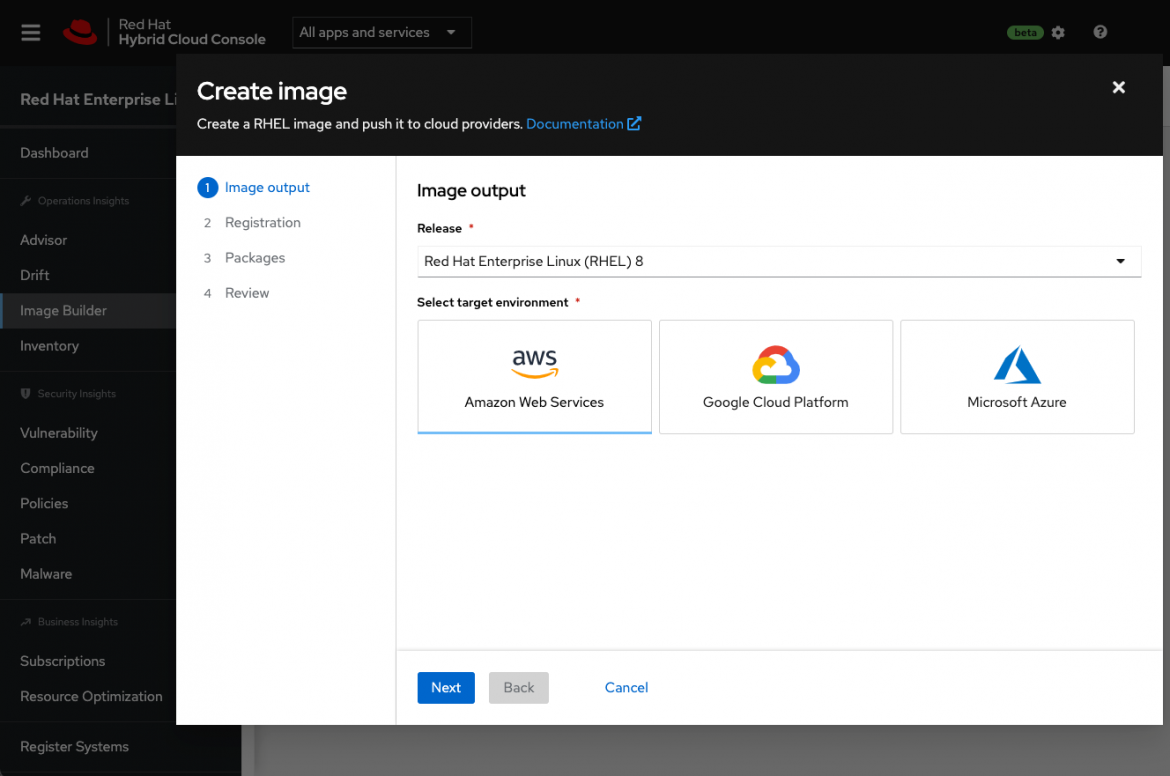
    Red Hat this week announced a public beta of an Image Builder service that streamlines the process of building customized instances of the Red Hat Enterprise Linux (RHEL) operating system.

    Scott Herold, director of product management for RHEL at Red Hat, said the Image Builder service enables an IT team to define a “gold” template for each target deployment environment that only contains the RHEL code required. Initially, Image Builder is configured to default to build a minimal, recommended RHEL server image for Amazon EC2, Microsoft Azure and Google Cloud Platform (GCP) cloud services.

    Future updates to the service will add support for VMware vSphere platforms as well as downloadable images and installation media for physical servers, customized filesystem layouts and versions 9.0, 8.5, 8.4 and 7.9 of RHEL. The service itself is accessed via the Red Hat Hybrid Cloud Console that is currently being made available in beta.

    Herold said building or installing operating systems is often a slow, tedious and error-prone process that needs to be manually performed in a slightly different way for each platform. Each physical server or edge computing platform requires different configurations and workflows. As a result, the chances mistakes will be made is high; Image Builder can greatly reduce the possibility of mistakes because there is no guesswork required, noted Herold.

    IT teams can also opt to include additional content from Red Hat in those builds to further streamline deployment processes, noted Herold. Those images can then be automatically registered with Red Hat to ensure future updates are received.

    The ability to customize those images also serves to reduce the overall size of the codebase that needs to be secured, added Herold. At a time when there is increased focus on software supply chains in the wake of a series of high-profile security breaches, many IT teams are revisiting their software deployment processes, he noted.

    Ultimately, Herold said Red Hat is moving toward providing IT teams with a more cloud-like experience regardless of where they deploy Red Hat’s curated open source software. The goal is to reduce as much friction as possible so that IT teams can more easily manage infrastructure at scale, he added.

    One way or another, the entiree software deployment process is becoming more automated. Much of the drudgery that has historically made it challenging to deploy and manage IT platforms at scale can be traced back to manual processes created when organizations ran a much smaller number of applications in on-premises IT environments. As IT teams increasingly deploy more applications in the cloud and at the network edge, it’s become more apparent that manual legacy processes won’t scale—especially when it’s already challenging to hire and retain IT personnel.

    It’s not clear how quickly IT teams will modernize software deployment processes using automated DevOps processes. Simple inertia is often a powerful force to overcome; however, most IT professionals can easily find something more compelling to do with their time that doesn’t involve using manually customizing operating system images.

  • Rocky Linux Emerges as a CentOS Replacement

    Rocky Linux Emerges as a CentOS Replacement

    Rocky Linux was created to offer the community an alternative following Red Hat’s recent decision to shift its focus away from CentOS—the open source version of Red Hat Enterprise Linux (RHEL). However, the Linux distro’s popularly can also be attributed to how its creator sought to offer a superior alternative based on lessons learned during CentOS’ development—and less as a perceived backlash to Red Hat’s controversial move, said Gregory Kurtzer, Rocky Linux’s creator, who is also founder and CEO of Ctrl IQ.

    “As one can probably imagine, there were a lot of lessons learned from the founding of CentOS—we did a lot of things correctly, but we made some mistakes, as well, that set into motion some of the difficulties the project went through,” said Kurtzer. “I was not—nor am I now—upset at Red Hat or anyone else. It’s important to understand that companies have a legal responsibility to do what they need to do. But I will say, this is why open source communities should not be controlled by a single company, especially if that company has a competing product to the open source project.”

    In addition to applying experience gained from the CentOS project to help “recreate the initial goals of CentOS in a new project,” Kurtzer said he was prompted to create Rocky Linux following Red Hat’s decision to end-of-life (EOL) CentOS. The move “affected my company, our customers, as well as the entire industry,” said Kurtzer.

    “To be blunt, my knowledge—in terms of doing it myself is severely dated. Luckily, after I made the announcement that I was considering recreating CentOS, thousands of people reached out to me wanting to be part of the project and contribute,” said Kurtzer. “From that, our development team and open source community was born.”

    Additionally, CentOS Stream offers value to the community by allowing “us and others” to take part in developing the upstream Enterprise Linux standard, said Kurtzer, who added that his team will continue to debug Rocky Linux so that solutions are properly integrated into the Enterprise Linux Standard.

    “The necessity was absolutely clear, so I founded Rocky Linux and the Rocky Enterprise Software Foundation (RESF),” Kurtzer explained. “Together with our contributors, sponsors and partners, we all have united for a common goal: to create an open source community that will provide us all with an enterprise operating system to stand the test of time, attrition and commercial agendas.”

    Interest in the development of a CentOS alternative was strong when Kurtzer first floated the idea of the project to the community. Since its release in June, the total number of ISO downloads is 56,000, according to Rocky Linux Tier0 mirror data.

    “We have zero visibility as to any other ISO downloads from any of our other mirrors, but if I were to guess, I’d say it would be about two to three times more, in total,” said Kurtzer. “When we all get a moment to breathe, it will be fun to see how many people are using Rocky Linux, and take in all the feedback the community has provided,” he said.

    With this team of developers,  Kurtzer said it took about seven months to build the general availability  (GA) release. “We didn’t just jump right into building the operating system because the goal was to create an infrastructure where many contributors and developers can take part without putting the security of the product at risk. Building that infrastructure took about four months,” Kurtzer said. “Once the infrastructure was completed, we spent about two months building the first-release beta candidate and then spent the following month ensuring that we did everything correctly.”


  • Red Hat Expands RHEL Subscription Program for Developers

    Red Hat Expands RHEL Subscription Program for Developers

    Red Hat is extending its developer program to make it simpler for both individual developers and small teams to access a free Red Hat Enterprise Linux (RHEL) operating system subscription.

    These programs are launched in the wake of Red Hat’s decision to no longer invest in an open source CentOS Linux distribution project. Many developers employ CentOS to build applications that are later deployed on RHEL in a production environment.

    Starting in February, an existing no-cost Individual Developer subscription for RHEL can be used in production for up to 16 systems in an on-premises environment or in the cloud. Previously, developers were limited to using the subscription on a single machine. Red Hat is also making it easier for teams of developers to join this program at no additional cost via an existing subscription their organization may already have.

    In place of CentOS, Red Hat is positioning the CentOS Stream as a hub through which development teams will gain access to a continuously updated Linux distribution that will become the next minor update to RHEL. The Fedora project, managed by Red Hat, will continue to exist as the vehicle through which the RHEL community experiments with major innovations.

    Brian Exelbierd, head of RHEL community projects, said these changes should ultimately prove to be a boon to DevOps teams, as they will better align the instances of applications being developed with existing instances of RHEL running in production environments. Historically, there was a significant amount of effort required on the part of DevOps teams to move an application developed on CentOS to RHEL, said Exelbierd.

    At least two other entities have rushed to fill the perceived CentOS gap. Gregory Kurtzer, one of the co-founders of CentOS, along with the support of more than 650 contributors, has launched Rocky Linux to make sure IT organizations have access to a fork of RHEL without a subscription. At the same time, CloudLinux is pledging to spend $1 million annually to create a distribution of Linux, dubbed Project Lenix, that is also based on a fork of RHEL. CloudLinux previously provided a hardened edition of CentOS that has been installed more than 200,000 times by 4,000-plus customers.

    Exelbierd said Red Hat is not trying to subvert those efforts, but it does have a vested interest in making it simpler for developers to build applications that eventually get deployed on production systems. Red Hat only generates revenue when organizations pay to subscribe to an instance of RHEL that gets deployed in a production environment.

    Regardless of what operating system developers employ, unless organizations decide to deploy CentOS in production environments, all paths eventually lead to RHEL. It will be interesting to see how far organizations will go in supporting a fork of RHEL that, in many cases, was employed simply because a developer didn’t want to pay for full subscription.

  • Red Hat Streamlines Operating System Update Cycle

    Red Hat Streamlines Operating System Update Cycle

    Red Hat is looking to make it easier for DevOps teams to absorb leading-edge innovations as they are slipstreamed into a new distribution of CentOS.

    CentOS is a distribution of Linux based on a fork of Red Hat Enterprise Linux (RHEL). The team that oversees CentOS operates independently of Red Hat. That team in collaboration with Red Hat is making available an additional distribution dubbed CentOS Stream, through which a continuous stream of content will be updated several times daily.

    Mike McGrath, senior director for Linux engineering at Red Hat, said those innovations eventually will find their way into RHEL, but until then developers who want to build applications using those features as they become available can use CentOS Stream.

    This latest distribution of Linux from Red Hat is intended to act as a bridge between Fedora, a distribution of Linux through which Red Hat makes available experimental technologies, and RHEL, he said.

    McGrath said developers have been asking for a more stable distribution of Linux that provides access to innovations that are likely to be incorporated in RHEL, which so many IT organizations today deploy in production environments. CentOS Stream will make it easier for developers to take advantage of those new capabilities a lot sooner than they can today, he noted.

    CentOS Stream will be maintained in parallel to CentOS, which means organizations that have decided to standardize on CentOS are not going to be impacted by updates to CentOS Stream.

    As more organizations subscribe to software, version numbers associated with any software platform are becoming less relevant. Many DevOps teams especially want to be able to take advantage of new capabilities within the context of a continuous integration process when and if they see fit, rather than waiting for a formal update of a piece of software to be released.

    It will be interesting to see how many IT organizations embrace CentOS Stream at a time when many of them are under increased pressure to build innovative applications faster. In many instances, those innovations are dependent on features and capabilities embedded in the operating system, so waiting for those capabilities to show up in a major RHEL upgrade isn’t especially helpful. Many developers want to be able to exploit those capabilities the minute they are certified to run on RHEL. In many cases, developers are gaining access to those features only a few short months ahead of time whenever a preview edition of the next version of RHEL is made available.

    Eventually, every software platform provider will need to come up with some similar approach to CentOS Stream to provide developers with early access to new capabilities. In many cases, developers already have access to next-generation features if they have a close relationship with the platform provider. However, the process for making new capabilities available to developers remains haphazard at best.

    — Mike Vizard

  • With RHEL 8, Red Hat Adds More Automation to IT Ops

    With RHEL 8, Red Hat Adds More Automation to IT Ops

    At the Red Hat Summit 2019 conference, Red Hat today announced the general availability of Red Hat Enterprise Linux (RHEL) 8, which includes among other things a Smart Management add-on designed to make it easier to manage RHEL 8 across hybrid cloud computing environments.

    In addition, RHEL 8 includes Application Streams, a set of utilities for updating languages, frameworks and developer tools without impacting the core resources, as well as updating RHEL 7 to RHEL 8 in place.

    RHEL 8 also adds Red Hat Enterprise Linux System Roles, which provides modules to automate complex tasks using the Ansible automation framework along with support for the Red Hat container toolkit and the general availability of the Red Hat Universal Base Image, a userspace image derived from RHEL that makes it easier to build Linux containers certified to run on RHEL.

    Red Hat also revealed that Red Hat Insights, a set of predictive analytics tools, will be included with the RHEL 8 subscription and that RHEL 8 supports both the OpenSSL 1.1.1 and TLS 1.3 cryptographic standards.

    Gunnar Hellekson, director for product management for Red Hat, said Red Hat is focusing on automating as many tasks as possible as part of an effort to make the life of IT operations teams simpler. As part of that effort, Hellekson said Red Hat is moving to lower the barrier to becoming a RHEL administrator by abstracting away many of the complexities historically associated with trying to manage Linux environments using a command line interface (CLI). Much of that focus will manifest themselves via ongoing enhancements to the Compose and Cockpit tools Red Hat provides for deploying and managing instances of RHEL, said Hellekson.

    Red Hat is making it clear it wants to make RHEL much more accessible to a larger number of IT administrators, especially those that historically have favored a more graphical approach to managing operating system environments. At the same time, however, Red Hat is infusing more automation into RHEL 8 as part of an effort to make it easier to manage deployments at scale. That latter capability is crucial for DevOps teams that, for example, need to be able to update a development environment without waiting for an IT operations team to reconfigure and reboot an operating system. Via add-ons to the core RHEL platform, Red Hat is now starting to expand those automation capabilities across both on-premises and public cloud computing environments.

    It’s unclear going forward how many instances of RHEL any one IT administrator might be able to manage on their own. Trying to determine that number might not even be worth the effort because advances in automation are now coming so rapidly that trying to determine that right number of IT administrators per environment is not possible to determine consistently. Instead, IT organizations should just assume that, thanks to automation enabled by machine learning algorithms and predictive analytics, the operating system environment is now flexible enough to scale up and down as needed.

    — Mike Vizard

  • Red Hat Injects DevOps Flexibility into RHEL 8

    Red Hat Injects DevOps Flexibility into RHEL 8

    With the beta release of the next version of Red Hat Enterprise Linux (RHEL), Red Hat is setting the stage for making it easier for DevOps teams to consume emerging operating system services without having to upgrade their entire operating system.

    The beta release of RHEL 8 adds an Application Streams capability designed to make it possible to leverage userspace more flexibly, as modules running in userspace now can be updated more quickly than the core operating system.

    Matt Micene, the technical product marketing manager for RHEL 8, said it’s also now possible for multiple versions of the same package—for example, an interpreted language or a database—to be made available via an application stream. That means different DevOps teams will be able to more easily work with different versions of various classes of technologies without having to wait for the next upgrade of the operating system, he said.

    As part of that focus on flexibility, Red Hat is also moving to make it easier for organizations that have embraced microservices based on containers to build applications. Open source tools such as Buildah for container building, Podman for running containers and Skopeo for sharing and finding containers are now fully supported in the operating system. Red Hat is also extending support for container networking using IPVLAN, which enables containers nested in virtual machines (VMs) to access networking hosts. There’s also a new TCP/IP stack with Bottleneck Bandwidth and Round-trip propagation time (BBR) congestion control. As organizations increasingly adopt containers, many of them are starting to make operating systems decisions based on which platform has the most containerized optimized services built in.

    Other capabilities being added include support for OpenSSL 1.1.1 and TLS 1.3 along with Systemwide Cryptographic Policies; a Stratis file management system for dealing with lots of volumes; a Composer tool for building custom images that can deployed on hybrid clouds; support for the Yum 4 packager; and a new web console for managing the RHEL environment that presents administrators the same user interface experience regardless of their experience.

    Micene said Red Hat is trying to strike a balance between stability and IT agility. There are plenty of organizations that still prefer to upgrade their operating systems at very well-defined intervals. But there are also an increasing number of organizations that want to be able to take advantage of the latest IT innovations without having to wait for an operating system upgrade. Many of those organizations increasingly view IT as being core to their ability to compete, he said.

    Over time most organizations will develop a more schizophrenic approach to IT. There will be some application workloads where stability trumps all other requirements. At the other end of the scale, innovation will be the most prized attribute. To one degree or another, every workload is going to fall along a spectrum between those two extremes. The challenge is defining the right mix of DevOps processes to serve the needs of every and any workloads regardless of its attributes.

    — Mike Vizard