Tag: product management

  • Atlassian Extends Scope of Jira Project Management Portfolio

    Atlassian Extends Scope of Jira Project Management Portfolio

    At the Atlassian Presents: Unleash event today, Atlassian announced it is adding a Jira Product Discovery application to its portfolio. Jira Product Discovery makes it easier for organizations to keep track of the ideas that drive software development initiatives.

    At the same time, Atlassian is making available Jira workflow and toolchain templates to make it simpler for software development teams to extend the scope and reach of the project management software they use to track those projects. Rather than each organization developing these templates, Atlassian is now providing them in a way that allows organizations to customize and extend them as they see fit.

    Finally, Atlassian also announced that an existing Jira Work Management tool will be made available for free through March 2024.

    Megan Cook, head of product for software teams at Atlassian, said these additions will make it easier for organizations to collaborate around software development projects that businesses increasingly depend on to drive revenue. The overall goal is to make it easier for multiple stakeholders of the projects to more easily collaborate with software developers that rely on Jira to manage those projects, she added.

    These latest offerings are part of an ongoing Atlassian effort to enable organizations to simplify collaboration and enable organizations to embrace value stream management (VSM) without having to acquire a dedicated platform. In some cases, organizations may decide to adopt a dedicated VSM platform, but a project management application should make it simpler for everyone in an organization to keep track of how software development projects are impacting the business, noted Cook.

    It’s not clear just how many businesses are aligning their internal processes around DevOps workflows, but as more of them realize how dependent they are on software, there is a clear need to collaborate more efficiently with software development teams. In fact, many organizations are now trying to adjust to the rapid rate at which software is being delivered thanks to the adoption of DevOps best practices. In some instances, updates to software are now being delivered faster than many businesses can absorb given the impact those changes have on digital processes.

    The irony is many business executives used to routinely complain about how long it took IT organizations to adjust as business conditions changed. Now, many businesses are rolling out additional digital capabilities via software updates that can be made multiple times a month.

    The rate at which organizations will collaborate across departments will naturally vary, but the days when each department was a fiefdom unto itself are coming to an end. There may even come a day when organizations will need to restructure as the walls that once separated various fiefdoms become more porous.

    One way or another, the way organizations are managed is evolving in the digital age. Organizations are employing software to pivot more frequently as business conditions evolve. Each new idea can not only be tracked but also quickly evaluated for feasibility given the level of software development resources required, noted Cook. The challenge and the opportunity is as much about changing the culture of an organization as it is about modernizing the processes used to build and deploy software.

  • The Strategic Product Backlog: Lead, Follow, Watch and Explore

    The Strategic Product Backlog: Lead, Follow, Watch and Explore

    The economic outlook for 2023 suggests many organizations will be leading through a period of resource scarcity as IT budgets are scrutinized and organizational priorities are re-evaluated. For the product manager, smaller budgets and fewer resources place even greater emphasis on ensuring alignment between enterprise priorities and the product backlog.

    Many tools are available to help product managers prioritize individual work items at a tactical level for DevOps teams. These models generally seek to quantify some combination of internal stakeholder value and level-of-effort required for developers and DevOps teams to complete. Higher-value lower-effort items rise to the top.

    Other strategic factors are just as important in the prioritization process, particularly for products living within a larger enterprise product portfolio and competing for scarce resources. For these, a product manager must understand why a given work item or capability should be given priority and how it should be pursued. This involves asking questions such as: On what basis should an item come into the product consideration set? How much should DevOps and developers seek to innovate in delivering a specific capability or feature? What is the product and the portfolio-level opportunity cost of pursuing a given piece of work?

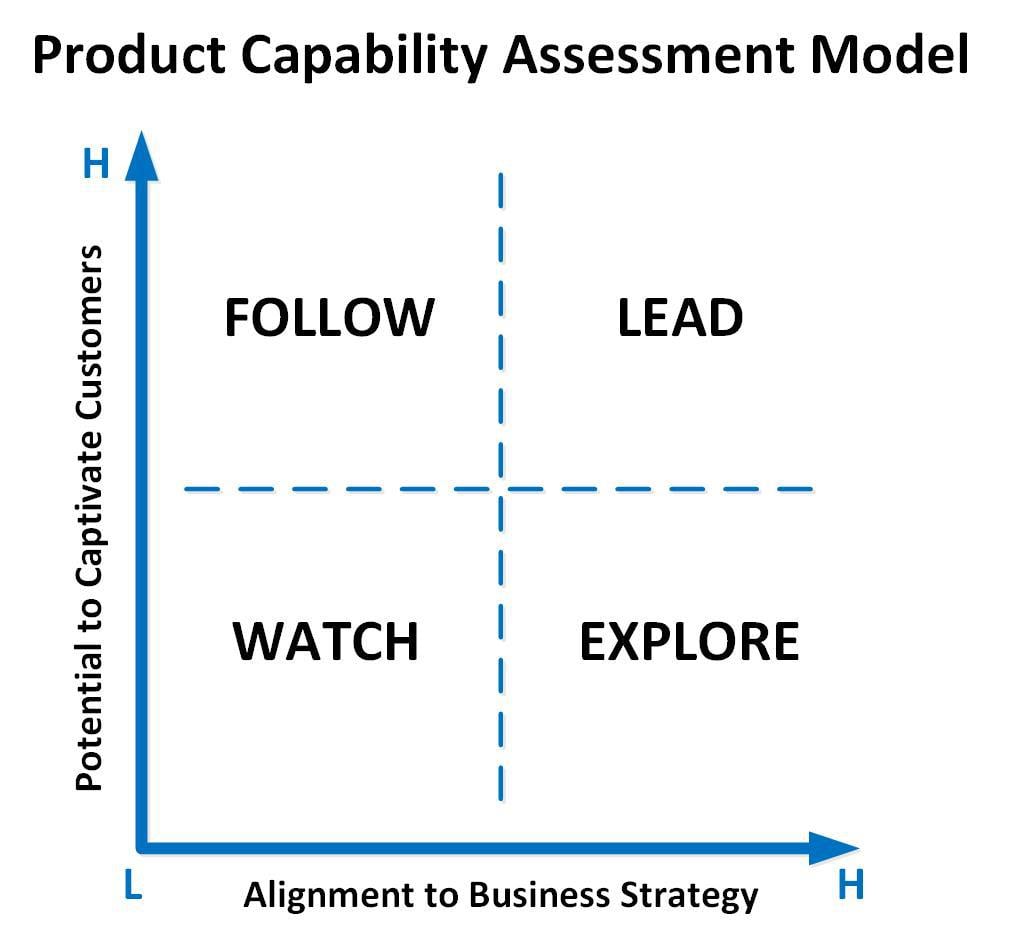
    A strategic model for backlog evaluation helps to set expectations with DevOps, developers and other internal stakeholders and ensure customer needs are front and center in prioritization decisions. It establishes a common language for collaboration. Two dimensions should emerge in evaluating capabilities at higher product and portfolio levels: Capability alignment to business-level strategy and the potential for a capability or feature to not just satisfy but captivate customers with a novel or compelling experience.

    The intersection of business strategy and customer experience factors can serve as a useful model for a product manager to think strategically about their backlog. The model helps to inform not only the question ‘Should we do this?’ but also ‘How should we proceed?’ and make things clearer for DevOps teams.

    Lead

    Items in this quadrant are the unicorns of the backlog and have the greatest potential to both strategically differentiate a product or enterprise and captivate customers. Product focus in this quadrant should be to invest in innovative, industry-leading approaches to satisfying customer needs in a manner that is consistent with business strategy and unique selling proposition. These items should receive the highest strategic priority on the product backlog.

    Follow

    Potential work items in this quadrant have a high potential to delight customers if handled well and irritate them if not. However, these elements are unlikely to be competitively differentiating given the current business strategy. Product focus in this quadrant should be to continually assess competitor treatment of these elements and adopt proven best-in-class experiences within the industry and adjacent industries. The product should focus moderate priority on competitive intelligence for elements in this quadrant and follow existing competitor approaches that enhance the customer experience.

    Watch

    Items in this quadrant are generally not problematic for customers. They are unlikely to differentiate the product or enterprise from competitors given the current business strategy and should be given low priority. The product should monitor proposed solutions in this quadrant to ensure no unnecessary customer effort is being introduced by other backlog items.

    Explore

    Product functionality in this quadrant is either not problematic for the customer experience or represents capabilities that are still emerging in the marketplace. These elements have a likelihood of developing into competitive levers, provided they can be developed in a manner that enhances the customer end-to-end journey. The product should place a high priority on product discovery for elements in this quadrant. It should explore capability innovation through design thinking or similar customer-centered ideation approaches.

    Mapping a product backlog to these four quadrants is as much art as science. It requires a deep understanding of business strategy, intended outcomes and customer needs. As with any strategic model, its value comes from the quality of discussions it produces and its role in surfacing implicit assumptions from the product’s stakeholder group, including DevOps teams and developers. Whatever model is used, having a mechanism to drive strategic product discussions is a critical tool in the product management toolbox and an important step to product management maturity.      

  • Building and Leading Product Teams in Uncertain Times

    Building and Leading Product Teams in Uncertain Times

    The world seems to be changing faster than ever, and there’s no reason to believe it will slow down anytime soon. The pandemic has compounded this sense of constant flux, with customer priorities shifting overnight. Against this backdrop, product teams need to constantly evolve their development work without losing focus or feeling they need to react to every small change in the market. 

    This requires team leads to throw out their old playbooks and develop a new strategy that allows them to deliver continuous innovation without creating chaos for their teams or losing sight of their north star. Road maps are shrinking from years to months, and are now being created with the understanding that they may become outdated or redundant at any time.

    Building and maintaining an organization that can not only survive but thrive in these conditions is a daunting task. It requires a structured, programmatic approach that also supports agility and adaptability. Those requirements may feel at odds, but they actually are not. Here are five tactics to help your product strategy evolve with the times. 

    Keep That “Day One” Mentality

    It’s important to keep the soul of your product top of mind. It helps to retain a “day one” mentality which means constantly reminding yourself why you started in the first place and what problem you set out to solve. That founding problem statement should serve as your guiding light, especially through times of rapid growth and change.

    Customer requests are, of course, a high priority and should always be thoughtfully considered. But ask yourself if the request is aligned with that day one problem you set out to solve. If it’s not, work with the customer to identify the underlying issue they’re really trying to solve for versus focusing on the symptom they’re experiencing. 

    Cultivate a Culture That Thrives on Change Without Succumbing to Chaos

    It takes a combination of strong organizational capability and the right culture to build a team that can thrive on ambiguity. Strong organizational capability is achieved through talent, architecture and execution skills. 

    Great product teams build an architecture that supports iteration and are able to execute toward their north star in small, rapid steps. Team leaders should build a culture that takes failure in stride and learns from it to improve each subsequent iteration in the product journey. 

    Change is inevitable, but chaos is avoidable. Leaders must create an environment that feels psychologically safe and supportive, so that team members feel confident in changing priorities and making rapid decisions. 

    Build an “Innovation Factory” or a System that Reduces the Potential for Chaos

    Innovation and agility require well-planned foundational resources. Following are the key steps that can help put these building blocks in place.

    • Think of velocity as a part of your product. Teams should be broken into small groups to autonomously drive the product forward, but in such a way that the overall experience feels seamless to end users.
    • Democratize the product concept phase by creating conditions for a large number of ideas. Everyone involved should be inspired to contribute, including employees, partners and customers.
    • Create a system for product development excellence. Fully automate your product development life cycle by approaching developer infrastructure as if it were a service, with clear service-level objectives within a CI/CD framework. Digitize each step in the product concept, development and deployment journey, with a focus on measurement, learning and iteration in every phase. Ask who and how many people are building versus approving at each stage and ruthlessly optimize and automate where possible. 

    Bring a Service Mindset to Everything you Do

    If you’re building a SaaS product, as many startups today are, you’re no longer delivering a product in the traditional sense. You’re delivering a service, and you’re responsible for the entire experience from start to finish. This means you’re in full control over when to release new features and how you measure user engagement. You can see where the friction points are, and where customers are delighted. We have a philosophy at my company of “less input, more output”—simplicity is the name of the game, where the output and value your service creates for customers is the only measure that matters. 

    The outcomes required may change as customer priorities evolve and new requirements flow in, but adapting quickly and effectively should just be a matter of (re)connecting well-built services within your platform to prioritize and address those changes. Leverage the cloud ecosystem in a way that allows you to safely bet on other players and partners who are moving as quickly as you are. Focus on making sure your foundation is strong; one that can provide a service at scale even as the outcomes customers want change over time. This allows you to stay laser-focused on the task at hand: Maximizing value for users. 

    Incorporate Users in the Product Development Cycle and Learn as you Go

    The cloud has transformed the way organizations build products and integrate feedback. The entire life cycle is digitized and measured. Product teams can move at a much higher velocity and in smaller increments, with the ability to make near-real-time adjustments along the way. But the greatest advantage a cloud environment offers is that we can now include users in the entire product life cycle, every step of the way. It gives us the ability to measure outcomes quickly and take action on the information that immediately benefits customers.

    It sounds counterintuitive, but product teams can prepare for the unknown. There’s no way to see what’s over the horizon, but with the right people, processes and tools in place, there’s no reason that uncertainty should derail you. There has never been a more exciting time to be an innovator or a builder. Meet the uncertainty ahead with open arms and a strategic eye.

  • Clubhouse Becomes Shortcut to Transform Software Project Management

    Clubhouse Becomes Shortcut to Transform Software Project Management

    Shortcut, formerly known as Clubhouse Software, today announced that its project management software for software development teams has been expanded to include additional workflow capabilities.

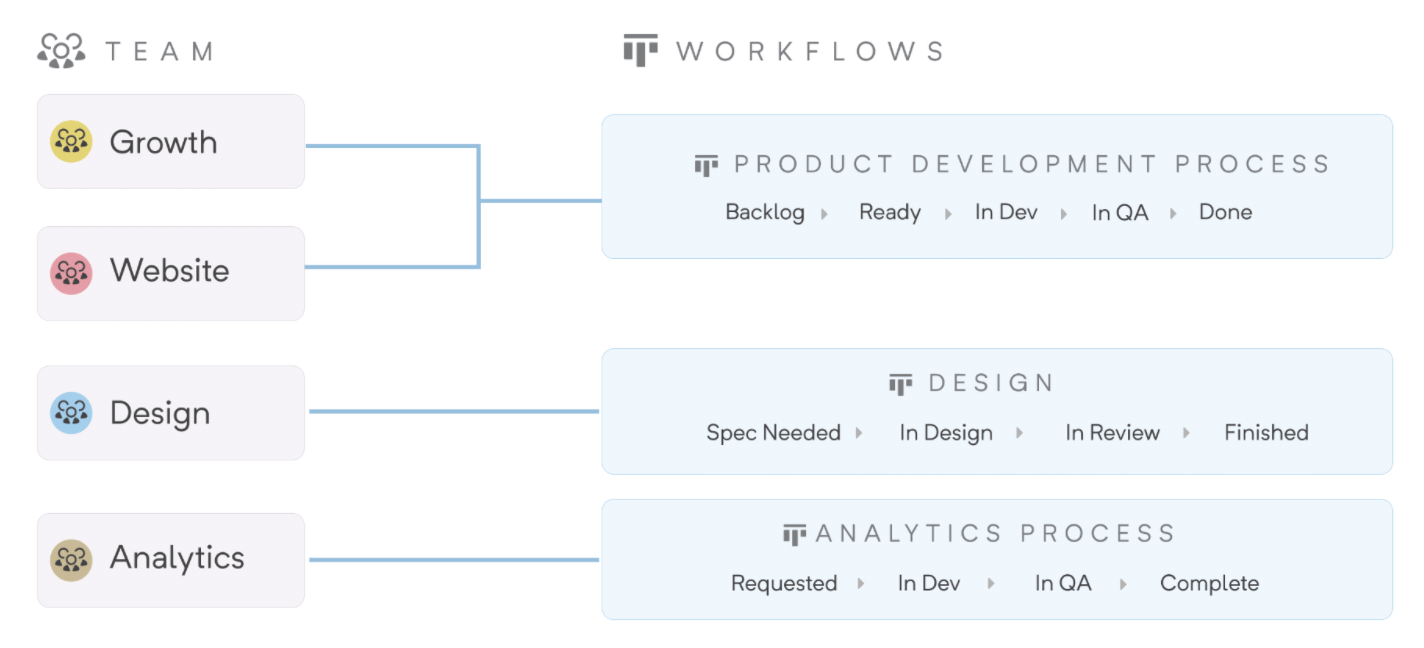
    CEO Kurt Schrader said team-to-workflow functionality is being added to the software-as-a-service (SaaS) platform and will make it easier to share workflows across software development teams in a more standardized way.

    Organizations can standardize workflows across multiple teams while still giving each team the ability to customize workflows for their own unique processes. As work gets created and assigned, it automatically moves into a workflow without having to manually update processes.

    Shortcut is designed to make it simpler for development teams to collaborate in a way that maintains transparency with other teams working on projects that are part of the same larger initiative, said Schrader. It allows product managers, engineers and designers to plan, track and measure their work without friction as the organization continues to grow in size, he added.

    For example, Shortcut will surface what teams need to focus on as priorities and timetables change within a specific project in addition to allowing users to define sprints using start and end dates, and the tool then sends reminders so the team can reserve time to focus on specific projects.

    Shortcut will also integrate with continuous integration/continuous delivery (CI/CD) platforms via application programming interfaces (APIs) to enable the development of custom workflows that include, for example, integration with real-time conversations occurring via the Slack collaboration service.

    Most of the project management software DevOps teams employ today is too complex and intimidating for the average business executive. Rather than forcing business users to learn how to master these applications, a case can be made for a more intuitive set of project management tools for both software development teams and the product managers they ultimately serve.

    As more organizations realize how dependent they are on software to drive business processes, many of them are reviewing the tools they currently rely on to manage software development. The goal is to not only reduce friction and enable more transparency across teams but also to provide stakeholders outside of the development team with more visibility into the status of any given project.

    At the same time, organizations are simultaneously launching more software development projects that have many dependencies. Many of those initiatives are based on microservices that are being built in isolation from one another before being aggregated to create an application. The dependencies between those microservices require organizations to make sure they are developed and deployed in a way that doesn’t leave one software development team waiting on another to finish a project before they can complete their work.

    Shortcut

    Schrader said that humans, as a species, are bad at organization. Project management applications should make it simpler for companies to understand how projects are not only organized but also all the dependencies that exist between them.

    Regardless of how software development projects are managed the need for greater visibility is obvious to all. Less clear is the best way to go about achieving that given all the communications channels available.

  • SREs: Stop Asking Your Product Managers for SLOs

    SREs: Stop Asking Your Product Managers for SLOs

    One of the fundamental premises of software reliability engineering is that you should base your reliability goals—i.e., your service level objectives (SLOs)—on the level of service that keeps your customers happy. The problem is, defining what makes your customers happy requires communication between software reliability engineers (SREs) and product managers (PMs) (aka business stakeholders), and that can be a challenge. Let’s just say that SREs and PMs have different goals and speak slightly different languages.

    It’s not that PMs fail to appreciate the value that SREs bring to the table. Today, in the era of software as a service, features such as security, reliability and data privacy (which used to be considered “non-functional requirements”) are respected as critical features of the service-product a SaaS company delivers. Modern application users and customers of software services care a lot about data privacy, cybersecurity and uptime; therefore, PMs care, too. In fact, it’s not uncommon to see these features touted prominently on a company’s website (I saw one today claiming “99.99% uptime for every customer!”) because the folks in marketing know that customers are making purchasing decisions based on whether the company can deliver reliability, speed, security and performance quality. So, yes, PMs do care.

    The difficulty lies in the negotiation between the PM and the SRE about the value of providing that level of service and the cost associated with it:

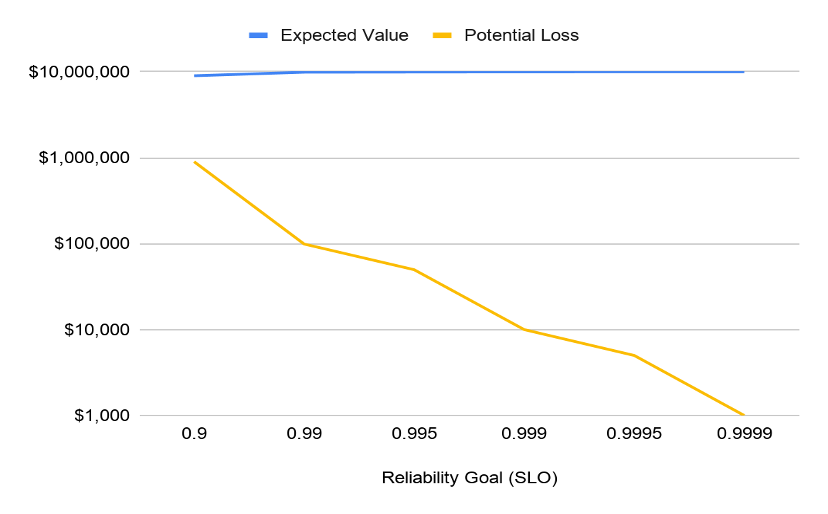
    The people and infrastructure costs associated with providing the next level of reliability increase geometrically for a host of reasons, but the expected value to a $10 million business of losing out on that one in 1,000 transactions versus one in 10,000 is only $1,000.

    But translating “customer happiness” into actual objectives derived from observable metrics is easier said than done, particularly for companies that are just getting started with SLOs. Let’s face it, all the talk about “nines” can be difficult to conceptualize. Fortunately, there’s an easy way for PMs and SREs to get on the same wavelength.

    Engineers, stop asking your PMs for SLOs!  Instead, convert user stories into reliability goals.

    User stories are a great way for PMs to express a customer’s experience and expectations to the engineering team. SREs can then translate the user stories into SLOs in a few simple steps.

    What is a User Story?

    User stories are narratives that describe how a particular type of user engages with the service. The first-person plotline might go like this: I am this type of person, and this is what I need and expect to be happy, and if I’m not happy, this is what it’s going to cost you.

    Note: In this user story, we’ve taken the liberty of including empathy for the reliability expectations of the user.

    Retail example: I’m a shopper on your online store on Black Friday, and I want to take advantage of your Black Friday sale. I want to log on, peruse your Black Friday deals, pick the products and features I prefer, and make my purchase in just a moment or two. If it takes too long to log on, or if I get hung up in the system, I’ll easily get frustrated and move on to other retailers. I don’t want to miss the deals!

    An SRE can take that user story, ask the PM a few questions to gather just a few more critical bits of information, then do some simple math to derive the SLO for your Black Friday.

    Ask Your PM These Questions

    To determine the reliability goals for a user story, you need to add three pieces of context:

    Step 1 – Identify the Top Critical User Transactions

    First, determine the relative priority or criticality of the transaction being successful. Not all transactions are created equally, so we need to understand what kind of transaction we’re talking about here. For example, browsing a catalog page (which could be refreshed if unsuccessful) is different from the shopper’s checkout experience.

    Retail example: We have several transactions in a retail business, including:

    1. Inventory catalog search.
    2. Order fulfillment.
    3. Payments processing.
    4. Price and discount.
    5. Checkout experience/shopping cart abandonment.

    For our example, let’s develop the SLO for payments processing, which is a throughput metric—the total number of transactions a retailer can handle in a given period of time.

    Step 2 – Estimate the Volume of Transactions at Various Times

    Now that we know the transaction we’re talking about (payment processing throughput), we can estimate the rough volume of transactions or user interactions that will occur in each of those categories, rounded to the closest order of magnitude (see Fermi Estimation). How much of your business happens during this time? Do you have a critical time of day? Do you have a critical season? Do you have a critical day(s) of the year?

    The same transaction at a different time may be more or less valuable. Think about an ad playing during the Superbowl or stock prices while the market is open. Or when your CEO is giving a critical customer presentation. Timing matters.

    Retail example: Our hypothetical retailer has critical periods in the holiday shopping season and a critical day called Black Friday. Typically, 4% of annual business happens during Black Friday weekend, and 16% of annual business happens during the remaining holiday season.

    Adobe Analytics estimates that sales for the full weekend (Thanksgiving through Cyber Monday) is 20% of total revenue for the full holiday season. According to the National Retail Federation, 2019 holiday sales were $730.2 billion, accounting for 20% of annual sales.

    Step 3 – Estimate the Business Value of Transactions in Each Circumstance

    Finally, we can now understand how the reliability of this transaction affects business outcomes. This could be the risk of lost revenue or perhaps a brand reputation metric such as reduced CSAT. Now you have a pretty clear picture of the business impact of unreliability.

    Retail example: If our imaginary retailer has revenue of $10 million, it would make $400,000 of that during Black Friday weekend, and $1.6 million during the rest of the holiday season. On Black Friday shopping carts are worth $100, $80 during the holiday season and $50 the rest of the time. There are 800 transactions per day on Black Friday, 625 per holiday season day and 488 any other day.

    Now that you have this input, you can start to calculate appropriate SLOs based on the value at risk and the cost to meet that reliability goal.
    If possible, you can estimate the cost to deliver each level of reliability. Consider not only the cloud computing and direct operational costs, but also the reliability investments in testing, performance, security, chaos engineering, release management, rollback, monitoring, on-call, automation, etc., that would be required to achieve the reliability level at each point. By plotting this cost (at least to the order of magnitude) you can find a break-even point where the value at risk and cost of reliability crossover. This is the business-justifiable SLO for these transactions.
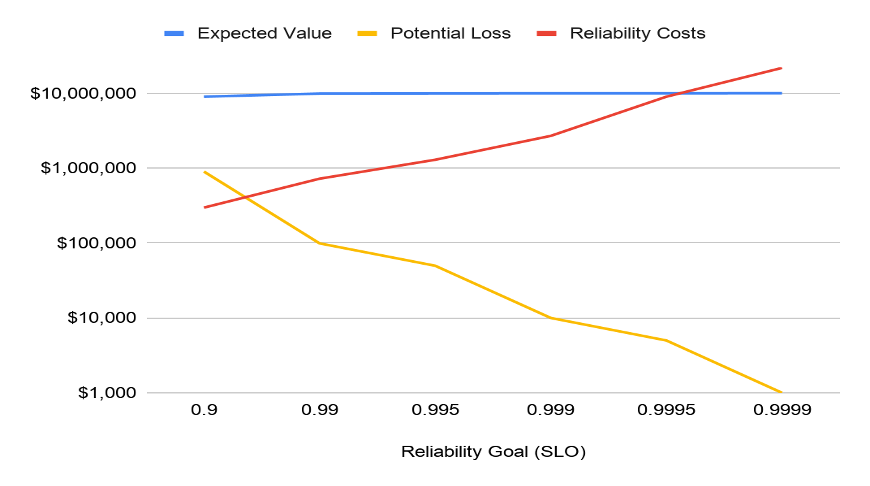
    Plot the value-at-risk as a function of value x volume x SLO. The value-at-risk will decline sharply as the reliability is increased; however, the cost to achieve this reliability also increases exponentially. It’s simply not worth investing more than that at-risk amount for any given user story, so the SLO determination is clear. Note that the SLO may not be achievable for the team currently, but you have a precise idea of what matters to the business and the break-even point of your reliability investments.

    Instead of asking PMs to “speak SRE,” span the communication gap by using the common language of user stories to build business-cogent SLOs.

  • Product vs. Project: Balancing Management Roles for Success

    Product vs. Project: Balancing Management Roles for Success

    Many businesses today rely on project management to ensure that all the activities that are required to help the business function are able to do so efficiently. The importance of project management is ingrained into many businesses, and doesn’t need to be justified—or does it? For software development companies, product management also needs to be considered just as much, if not more. To determine whether both or one is needed, and to what extent, business leaders need to first recognize the similarities and differences between the roles of the project manager versus the product manager, and what each can bring to the business.

    The key to understanding the differences starts with the descriptive writing mantra that everyone learned back in school: the 5 Ws (and 1 H), otherwise known as who, what, when, where, why and how. Though the who and where are generally self-explanatory, you can easily understand the difference between product management and project management by understanding which of the other four questions each job answers. Both positions fulfill critical roles in effective product delivery.

    Product Management: Getting Concrete Answers

    Product management answers the questions of “what” and “why.” These are important because, for every product you build, you need concrete answers to these questions.

    What

    The fundamental question that we’re asking here is, “What are we building?” Many enterprises have a product range that spans across dozens of different markets. Though this is great for the business and investors, it’s not an effective way for a team to work. When you ask a team to build or support a product, they need a clear vision of what that product will actually do. This is especially true for software products because it’s easy for them to lose their identity if they attempt to do too much.

    In a big enterprise, a “do everything” mentality can cost more over time. It’s likely that you have many software teams, and each one is building software that’s designed to suit a specific part of the market. When those teams implement software that duplicates some functionality already provided by your business, you’re wasting time and effort.

    This is where a good product manager is valuable. They help keep software teams focused on what they’re building and rein in the desire (by developers and executives alike) to grow the software outside the job it needs to do.

    Why

    The other major question that product managers answer is, “Why are we building this?” For developers, why is often more important than what. Work is almost always interconnected with the work of other teammates. When teams understand why they’re building something, it’s much easier to understand how those connections should work. It also gives developers information about which trade-offs they should make when implementing a feature, such as simplicity and usability versus speed.

    It’s the job of the product manager to understand and convey the why of the product. They do that by conversing with executives and project stakeholders to understand how this product fits into the overall business need.

    Project Management: The Thoughtful Side

    Project management, on the other hand, answers a different set of questions. A project manager’s job is focused on the how and when.

    How

    Large software projects are complex, with many interdependent and interlocking pieces. Efficient software project managers understand those interdependent requirements and plan for them. They organize the project’s tasks so that by the time someone is ready to work on one piece, its dependencies have already finished. Developer downtime is minimized and it enables those developers to focus only on the problems they need to solve for each task.

    Managing these kinds of interdependent requirements is the most valuable thing that project managers do for their software developers, though it can often be missed by executives, who are much more focused on the second project management question: when?

    When

    This is the visible project management question, “When is that project going to be done?” External stakeholders don’t care about how or why. They usually only care about what when the final product isn’t what they expected. But when is a question that’s top of mind for every single team leader who waits for a software project to be finished.

    This is also the most difficult question to answer. It’s almost impossible to reliably predict how long it will take to deliver a feature—not even a whole project, just one part of it. Something that seems simple at the outset turns out to be much more complicated. Alternatively, sometimes something you think might take two weeks instead takes only a day or two.

    The Balancing Act

    In most traditional cases, both product and project management are crucial for software delivery pipelines to run smoothly. However, many enterprises are now moving their deployment infrastructure toward a continuous delivery model, which adopts DevOps principles. For teams that practice continuous delivery, the question of when something is coming out can sometimes feel less important. Additionally, many software teams transition toward agile software principles, which makes the collective software team responsible for the question of how. Third-party planning tools can also make it easier for software teams to answer the how and when questions for themselves.

    For this reason, many teams are transitioning away from using dedicated project managers. Instead, they move much of that responsibility to the teams and focus their planning efforts on the product itself. However, the most successful projects answer all four questions effectively. When you don’t have a good answer to one or more of these questions, the project can end up stressful and frustrating.

    The people answering these questions might change over time, as it has changed already. The crucial point is to just ensure that you do have people who are dedicated to solving these questions and relaying this information to their teams. This is the smartest way to ensure projects stay on track and deliver the product that is expected and needed.

  • What Makes Product Managers Effective?

    What Makes Product Managers Effective?

    Product managers can specialize in all sorts of disciplines. Some are better at hardware development while others are better at staying on budget. However, there are a number of traits that are easily identifiable in great product managers regardless of specialty.

    Great product managers share great traits including confidence, compassion and curiosity. Here are the top traits of the top-performing product managers:

    Compassionate

    The personality of a product manager is just as important as their technical skills and professional abilities. They are leaders to product developers, collaborators with clients and liaisons to executives. As such, they must have high-quality soft skills. They must show empathy to the overworked developer and passion to the client, and send reassuring updates to the c-suite. All of this is impossible without an immense capacity for compassion.

    Data-Oriented Product Managers

    Product development isn’t just an emotional journey (even when emotions run high). The team relies on a data-oriented product manager to make informed decisions that lead to satisfactory outcomes.

    While the best must show compassion for others, they also must hold themselves to a precise standard. To excel, they have to rely on objective evidence rather than just their emotional experience and “gut feelings” to carve a successful product path.

    Curious

    The best product managers are endlessly curious people who want to know why certain products work or particular strategies fail. They research obsessively and are always in the know of the latest trends.

    Curious people generally make for good employees who are bound to get better and better over time. The best product managers are proud of their curiosity and use it as a point of reference. A curious product manager will identify problems before they even arise and establish a variety of management styles to see what works.

    Confident

    Confidence is an absolute necessity for a product manager to be considered the best. Confident product managers know their decisions are well-informed and will provide results in a positive way. They are confident people who provide a sense of security and assurance to every level of a development company.

    The confidence that exudes from the best product managers is what allows them to be so effective in their roles. A confident manager enables employees to focus on their jobs and not worry about the plan ahead. Confidence brings out the best in a development team.

    Experienced

    There’s no problem with hiring a talented product manager with only a few years of experience. In fact, it works out for many companies. However, one of the most common traits shared among the best is their tenure.

    The top product managers almost always have a wealth of personal experience to draw from. As professionals, they have spent their lives working on important products, tweaking their product management methodology and learning from past mistakes.

    Conclusion

    The best product managers know that it takes a certain individual to pursue product management. Chief among them is the passion for the skill. The best of them are passionate and skilled individuals who use their acumen to help companies realize their vision. The worst are those who do it for a paycheck or as a hobby.

    Top product managers are those who work their hardest to help a company realize its goal while creating a cohesive environment. They are people who want to know the answer; people who want to find solutions to all problems that arise in development; curious and confident people who use their personality traits to bring a vision to life.

    Elite product managers use data and experience to come up with interpersonal strategies and management plans. This allows them to establish a cohesive base of operations while the development process continues at a steady pace. The best product managers have soft and hard skills to get the job done. And, they have the experience to push forward with success.

    — Anthony Coggine

  • Training & Certification Implications

    Training & Certification Implications

    Changing culture does not happen by osmosis, it happens through incessant education. The DevOps continuum of services your organization originally intends to create and implement is a journey more than a concrete destination. It will evolve over time no matter what your original plans were, no matter what your vendor of choice tells you, and no matter what resistance you meet along the way. If anything, resistance within your organization will push your journey left or right from its originally intended path. The lack of features in your tooling, or the introduction of those same features over time, will impact the journey of DevOps your organization will embrace. Culture is fluid. DevOps is fluid. So managing the impact they will have on each other should warrant dedicated concentration, and resources, in the form of training and education.

    Audience Educational Considerations

    It is not just your practitioner base that will need perpetual education to use your DevOps services to maximum effect. It is also the business community that relies on DevOps information and the executive community that may have sponsored the journey into DevOps in the first place. Education for the non-practitioner is more than just a matter of managing expectations, although that is a big part of it; it is a matter of helping this community learn to watch “change” or innovation as it moves from idea to production. DevOps will make an extraordinary impact on the speed of innovation delivery, as well as the quality or reliability of delivery. Engaging your business community and training them so they see this, comprehends what it means to them, and keeps them informed of the improvements will be critical to the long-term success of your efforts.

    Consider how managing expectations will impact adoption of DevOps services from a business point of view. When you first start on your DevOps journey, usually only the build and deployment services are launched as the “core” of the service. As you do this, you will need a way to keep your business community (i.e., the audience of what you do), informed as to your progress, and what key features or functions remain on the drawing board. How you communicate this information will be key to managing the expectations of your audience.

    For example, your initial efforts at build and deploy may only include the application code as its target. But over time you may begin to deepen what can be automated down the stack—say databases or middleware—as your next target. Eventually you are automating server O/S or even network definitions. If this is the services plan your organization takes on, you need to outline the timeline for expansion to the business community—not just in bullet points on a chart or timeline graphic, but specific benefits they should expect to receive at each milestone (i.e., why they should care).

    As your actual journey of DevOps begins, you may find, as an example, that you never get to network definitions in your automation efforts for one reason or another. Why you’re not reaching this goal needs to be explained, as well as the impacts of this. What drives this conclusion should also be explained; it might be for a very good or legitimate reason. But altering the DevOps journey needs to be ingrained in the business culture. Taking small steps, minimizing risk, learning from mistakes, and moving on—all are key lean concepts, agile methods, and ultimately they ensure the success of your DevOps efforts. The need to communicate changes in your plans to the business community helps manage expectations, but beyond that, it teaches the business community that information will be flowing constantly—and will be important constantly, even if it is brief in each segment.

    Whether your organization plans to expand DevOps services by moving down the stack, or perhaps by adding more capabilities laterally, you will need the ability communicate direction as well as “how” to take advantage of the expansion of DevOps you offer. So for example, if you are expanding your DevOps service by moving down the stack from app to operating system (OS), you will need to show the business community how to watch changes at each level (app, middleware, OS) or, if you are expanding your services laterally, adding automated testing, then release orchestration, then monitoring integration, and finally production provisioning automation. You need a plan for communicating each success, as well as “how” the business community can take advantage of what is accomplished.

    This communication plan should manage expectations, inform of changes in strategy or direction, inform of success/failure/alteration, and teach the business user how to use what you have done. Your communications plan may be looking at new data that was not previously available, or tracking innovation change differently. But educating your business community base will not be a “one-time” event; it will be a perpetual activity. Therefore, how you create this process should be built for perpetual delivery, not just a one-and-done delivery.

    The frequency of offering it will depend on the specifics of your organization’s needs. But the frequency should always keep pace with the changes and successes of your DevOps services delivery. If that is weekly, then weekly, if that is monthly then monthly. What you do to communicate, and how, will depend partly on that frequency and the size of your audience. Keep in mind your tooling vendor is also constantly enhancing its toolset with new features. The frequency of delivery may also need to incorporate those impacts as well.

    Practitioner Educational Considerations

    Educating your practitioner community generally is focused on tooling proficiency. But that may be a limited view. The architecture of your DevOps services is arguably more important than the specifics of how you use the build tool. Consider how your DevOps practitioners intend to accomplish the ability to scale build automation, as an example. I could just train the practitioners on how to use the build tool and then turn them loose, automating builds armed with little more than a cursory understanding of my preferred build tool. And over time using this training method, I will have as many methods to construct build automation as I have engineers who touch my tools, namely “n” methods. Having that much diversity in “how” I construct build automation creates variability that, with a large portfolio of apps, does not scale and is difficult to sustain without constantly throwing labor at it.

    Conversely, my architectural approach to build automation established by the DevOps team instead might be that each kind of technology uses a master template, or framework, as its approach. This information has little to do with a specific build tool and everything to do with the  organization’s “strategy” for build construction. That information becomes much more important than specific tool usage, because it affects “how” engineers use the tool according to company standards and practices. Training and creating a communications plan for reaching every member of your practitioner community on these items becomes critical to longer term success. This includes hiring new talent, departmental transfers and contractor augmentation.

    The additional consideration here is how you want to manage your intellectual property. “How” your company constructs build automation may be a proprietary advantage for your firm. This is particularly true if your architecture team is top-notch and able to create structures in your tooling that less experienced practitioners would not have even considered. If you train outside contractors on your methods, you are in effect giving away some of the farm. Non-disclosure agreements may keep a contractor from purposely sharing your methods with a competitor, but it will not prevent the engineer from learning how to make a better mouse trap while working with you. The contractor leaves your employ, a much more well-educated engineer than when he or she started.

    Once overall strategy education has been planned for and imparted to your practitioner community (another perpetual delivery method required), most companies focus on tooling proficiency. DevOps is still a relatively new phenomenon. And as such, certifications that are common in the networking world, for example, do not exist in the DevOps world. Gaining proficiency from vendor tools should be provided by those vendors as part of the licensing purchase agreement. If the vendor is unable to provide it in a formal delivery method, beware: The toolset is probably a new acquisition or too new in the market. If you are using open source tooling, a fully in-house model for training must be created and managed on an ongoing basis.

    Impacts to the Bottom Line

    Changing culture on a wide scale will require a focus of resources for training and education across your company. Engineers typically do not make the best communicators—that might be a DNA thing—so you may want to pair training and communication resource employees with the DevOps team to deliver what will be needed in an ongoing basis. The main consideration here is to realize that because DevOps services constantly will be evolving, communication plans need to keep pace with their evolution. And yes, I realize, this is additional overhead costs that almost no DevOps delivery person believes he or she needs when the services are first launched.

    But like all things, an initial publication or announcement is not sufficient to keep track with something that changes on a highly frequent basis. Adoption either can be facilitated by a good communications plan or thwarted by the lack of one. If it takes your company 15 months longer to get fully onboarded to DevOps because of delays in the rate of adoption (based on poor or non-existent communication), you must consider the costs of that delay in contrast. If after onboarding to DevOps, your business audience is ill-informed about how to use the services to maximum effect, what will that inefficiency cost the company? If your practitioners are only exposed to tooling proficiency once and without architectural oversight, what will the cost of the variability they produce in their automation be to the company?

    Investing in training and constant communication may not raise revenue, but it will certainly avoid costs. The measure of how much cost it avoids is difficult to track. Most companies who make the investment understand intrinsically what the alternative would be, and choose not to go down that road. The only admonition I would offer is that I have seen clients make this decision late in the cycle, and every one of them did so because the pain motivated it. Your strategies for DevOps should be comprehensive in perspective, if you need help crafting or improving yours, contact me—I am looking at the moment.

    To continue the conversation, feel free to contact me.


  • Product Management’s Role in a  DevOps World

    Product Management’s Role in a DevOps World

    When we started Datical, we knew that in order to be successful we needed to practice what we were preaching: DevOps. As the VP of Products and product owner of Datical DB, our flagship Database Lifecycle Management tool, I recognize that Product Management is well positioned to facilitate DevOps adoption across the entire organization. It’s our job to ensure that the solutions we deliver to the market are aligned with our customers needs, valuable, and appropriately represented. To achieve this end, my team has embraced the Three Ways and established practices that map them.

    The First Way: Systems Thinking

    “Systems Thinking” in the product management group goes beyond application development and delivery. Our PM team must also consider how we improve, market, sell, and support our solutions to fully realize our company’s potential. To gain the deep understanding of all aspects of our Product Lifecycle, we’ve agreed upon the following guiding principles:

    • Every Sales Call is a Product Call – My team and I spend a lot of time shadowing calls in all stages of the sales cycle. By attending as many calls as we can we learn what first motivates our market to seek a solution in our space. We get insight into what features resonate most and what areas of our solution are uninteresting to them. We hear how our Sales team is positioning the product and we understand the challenges they face when presenting our solutions to interested parties.
    • We Are a Required Member of our Scrum Teams – The PM & Engineering organizations are highly engaged with one another. Product & Engineering management meet 2-3 times a week to discuss sprint progress, new development stories, and long term product roadmap. Product Managers attend daily development stand ups to answer questions and eliminate roadblocks in the current sprint based on the needs of internal and external customers. We balance technical debt, infrastructure requirements and feature development during sprint planning to ensure high-quality product releases and a reliable delivery chain.
    • We are Marketing’s Lyricist – Our deep understanding of our customers, our market, and our products allow us to arm our marketing group with the content and messaging they need to be heard over the chatter. We influence marketing plans with what we know is working in sales and what we know is coming out of engineering.
    • Everyone is Customer Support – We take reactive and proactive participation in customer support seriously. PM responds directly to customer support requests and we constantly reach out to customers we haven’t heard from to make sure they are getting value from the product and that their needs are being met.

    The Second Way: Amplifying Feedback Loops

    The Second Way, Amplifying Feedback Loops, is where the product group provides the greatest value to the company. By adhering to our guiding principles of Systems Thinking detailed above, the product group has a good handle on all aspects of our business. We know how we sell, we know what we need to do to increase our value, we know the engineering effort involved in delivering new features, we know where our customers are thriving and where they are struggling, and we know what we’re telling the market.

    The physical manifestation of the Second Way in the product group is our Product Roadmap. Too often, roadmaps become little more than flashy marketing tools that promise a lot, but often fail to deliver on the hype. We’ve found that customers respond more favorably to a smaller roadmap that is accurate than they do to a road map that is full of wild, cleverly named features whose delivery is uncertain at best.

    At Datical, we take what we’ve learned from participation in sales and support activities to prioritize our development efforts on real customer needs. We apply what we’ve learned from engineering about the effort involved to deliver on our customer prioritized feature list, balance those estimations with what’s necessary to maintain a smooth operating environment for development, and provide realistic delivery goals for product features. Once we have dates for new feature delivery, marketing can plan their strategies ahead of time and sales can speak with confidence and certainty when discussing our future with prospects and customers. When every person in your organization can speak confidently about your customers, your product, and your market, the deck is stacked in your favor.

    The Third Way: Embracing Experimentation

    Product Managers that know their customer’s problems are crucial to reaping the most reward from Embracing Experimentation. A great example of this is a feature we are releasing in our 3.0 version of Datical DB this Friday. We call it the Rules Engine, and it is the direct result of Datical’s culture of encouraging experimentation.

    Datical DB has a feature called Forecast that allows you to simulate your proposed database updates in memory without actually affecting the database instance. This takes the uncertainty out of the deployment process by identifying errors prior to execution. Customers really liked the feature, but there were always questions about the extent of Forecast’s capability. Typically they would ask about standards and best practices for their specific organization and whether we could modify the Forecast feature to accommodate their specific use cases. If we were to commit to modifying Forecast to suit everyone’s needs, it’s all we would have time to do. We recommended that the customers manually review the changes in those cases before promotion to downstream environments, something they were already doing with piece meal SQL scripts.

    While discussing the frequency and consistency of these feature requests with our VP of Engineering, we had an idea. What if customers didn’t have to rely on us to modify Forecast for their specific needs? If we could deliver on this, we would drastically reduce the time and money companies were spending on reviewing database change prior to approval. We decided to turn our best minds on the idea with a very sparse set of loosely defined requirements.

    Our first attempt failed. We reviewed the results of our research and prototype attempts, refined the story, and tried again. Our second attempt showed promise. We refined it further, built on what we learned, and had a viable solution in sight.

    We began talking to our customers about it. I actually heard a grown DBA giggle with excitement! He had DBAs on his team spending 70% of their time manually reviewing SQL scripts from development to make sure they were in compliance with their standards.

    After collecting customer feedback, we combined it with the results of our technical experimentation, and are very thrilled to be bringing this feature to market at last. By encouraging experimentation and not bowing to initial failures, we’re delivering a great differentiating feature to the market.


    About the Author

    High-Res-Peter-Pickerill-6571-150x150

    Pete Pickerill is Vice President of Products and Co-founder of Datical. Pete is a software industry veteran who has built his career in Austin’s technology sector. Prior to co-founding Datical, he was employee number one at Phurnace Software and helped lead the company to a high profile acquisition by BMC Software, Inc. In addition to managing a development team and product schedule at BMC, Pete worked directly with large financial services institutions to provide the features they needed to achieve greater efficiency and cost savings in their application deployment processes.