Tag: product development

  • Building and Leading Product Teams in Uncertain Times

    Building and Leading Product Teams in Uncertain Times

    The world seems to be changing faster than ever, and there’s no reason to believe it will slow down anytime soon. The pandemic has compounded this sense of constant flux, with customer priorities shifting overnight. Against this backdrop, product teams need to constantly evolve their development work without losing focus or feeling they need to react to every small change in the market. 

    This requires team leads to throw out their old playbooks and develop a new strategy that allows them to deliver continuous innovation without creating chaos for their teams or losing sight of their north star. Road maps are shrinking from years to months, and are now being created with the understanding that they may become outdated or redundant at any time.

    Building and maintaining an organization that can not only survive but thrive in these conditions is a daunting task. It requires a structured, programmatic approach that also supports agility and adaptability. Those requirements may feel at odds, but they actually are not. Here are five tactics to help your product strategy evolve with the times. 

    Keep That “Day One” Mentality

    It’s important to keep the soul of your product top of mind. It helps to retain a “day one” mentality which means constantly reminding yourself why you started in the first place and what problem you set out to solve. That founding problem statement should serve as your guiding light, especially through times of rapid growth and change.

    Customer requests are, of course, a high priority and should always be thoughtfully considered. But ask yourself if the request is aligned with that day one problem you set out to solve. If it’s not, work with the customer to identify the underlying issue they’re really trying to solve for versus focusing on the symptom they’re experiencing. 

    Cultivate a Culture That Thrives on Change Without Succumbing to Chaos

    It takes a combination of strong organizational capability and the right culture to build a team that can thrive on ambiguity. Strong organizational capability is achieved through talent, architecture and execution skills. 

    Great product teams build an architecture that supports iteration and are able to execute toward their north star in small, rapid steps. Team leaders should build a culture that takes failure in stride and learns from it to improve each subsequent iteration in the product journey. 

    Change is inevitable, but chaos is avoidable. Leaders must create an environment that feels psychologically safe and supportive, so that team members feel confident in changing priorities and making rapid decisions. 

    Build an “Innovation Factory” or a System that Reduces the Potential for Chaos

    Innovation and agility require well-planned foundational resources. Following are the key steps that can help put these building blocks in place.

    • Think of velocity as a part of your product. Teams should be broken into small groups to autonomously drive the product forward, but in such a way that the overall experience feels seamless to end users.
    • Democratize the product concept phase by creating conditions for a large number of ideas. Everyone involved should be inspired to contribute, including employees, partners and customers.
    • Create a system for product development excellence. Fully automate your product development life cycle by approaching developer infrastructure as if it were a service, with clear service-level objectives within a CI/CD framework. Digitize each step in the product concept, development and deployment journey, with a focus on measurement, learning and iteration in every phase. Ask who and how many people are building versus approving at each stage and ruthlessly optimize and automate where possible. 

    Bring a Service Mindset to Everything you Do

    If you’re building a SaaS product, as many startups today are, you’re no longer delivering a product in the traditional sense. You’re delivering a service, and you’re responsible for the entire experience from start to finish. This means you’re in full control over when to release new features and how you measure user engagement. You can see where the friction points are, and where customers are delighted. We have a philosophy at my company of “less input, more output”—simplicity is the name of the game, where the output and value your service creates for customers is the only measure that matters. 

    The outcomes required may change as customer priorities evolve and new requirements flow in, but adapting quickly and effectively should just be a matter of (re)connecting well-built services within your platform to prioritize and address those changes. Leverage the cloud ecosystem in a way that allows you to safely bet on other players and partners who are moving as quickly as you are. Focus on making sure your foundation is strong; one that can provide a service at scale even as the outcomes customers want change over time. This allows you to stay laser-focused on the task at hand: Maximizing value for users. 

    Incorporate Users in the Product Development Cycle and Learn as you Go

    The cloud has transformed the way organizations build products and integrate feedback. The entire life cycle is digitized and measured. Product teams can move at a much higher velocity and in smaller increments, with the ability to make near-real-time adjustments along the way. But the greatest advantage a cloud environment offers is that we can now include users in the entire product life cycle, every step of the way. It gives us the ability to measure outcomes quickly and take action on the information that immediately benefits customers.

    It sounds counterintuitive, but product teams can prepare for the unknown. There’s no way to see what’s over the horizon, but with the right people, processes and tools in place, there’s no reason that uncertainty should derail you. There has never been a more exciting time to be an innovator or a builder. Meet the uncertainty ahead with open arms and a strategic eye.

  • Building Trust Into Your Product by Design

    Building Trust Into Your Product by Design

    In today’s world, every tool, every solution and every technology has the potential to do both good and bad. Good, if used according to the way it was designed, but bad if it falls into the wrong hands, or is manipulated or abused. As the ‘Peter Parker’ principle says, “With great power comes great responsibility.”

    As the COVID-19 pandemic continues and consumers look to digital communications to maintain some sense of normalcy and connectedness during these desolate times, the onus is on us, industry leaders, to ensure that the products and services being developed to connect and communicate with disparate employees, customers, and partners aren’t weaponized by bad actors.

    The best way to do this? By building trust into your design.

    You Have to Define Trust to Know How to Build Trust

    According to Merriam-Webster, the dictionary definition of trust is “one in which confidence is placed.” But the reality is that in today’s world, there are many ways trust can be perceived.

    Think of the automotive industry, where trust can be tangibly seen in the growth and success of certain car brands over decades. There, trust can be seen as ‘brand loyalty,’ or customers who repeatedly purchase from the same brand because they trust the company and trust the product.

    Trust in technology is the same. It has to be engineered and cultivated, but at the end of the day trust in the product must be mirrored by consumer trust in the organization. The two go hand in hand.

    The best way to approach building and sustaining trust when developing new products boils down to three key things: integrity, third-party accountability and consistency. Integrity stems from delivering high grade products and solutions, in conjunction with demonstrating accountable, transparent communications at the organizational level. Third-party validation further underscores that integrity, and restates the quality of products and services being delivered from a third-party perspective. And finally, consistency; being able to deliver exemplary products and solutions on a continual, consistent basis – the most essential ingredient in maintaining and bolstering trust among customers.

    Transparent Communication is Key

    As we enter 2021, the threat landscape is fraught with bad actors looking to take advantage of the latest threat vectors and emerging technology. As our lives continue to transition from physical to digital, and as more personal information is stored online, companies have to prioritize proper and timely communication about cybersecurity incidents.

    This brings us back to organizational trust being foundational for trust in a product. If you’ve seen the Netflix documentary ‘The Social Dilemma’ you know that social media is an oft-cited example of technology being misused or manipulated by bad actors. But after Twitter suffered a social engineering attack in July, the platform issued a swift update to its users. They were open, prompt and transparent in their analysis of the event, and highlighted not only the updated safety precautions put in place in response to the breach, but also underscored their ongoing commitment to trust and transparency within the Twitter community.

    Incidents like these, though harmful in the short term, can be less detrimental if addressed and communicated in a timely, transparent manner. There’s a saying, ‘It’s not what happens to you, but how you react to it that matters.’ The same goes for proper breach disclosure within the tech industry as a whole.

    Trust has Never Been More Foundational to the Business of Building

    As we enter 2021 and the COVID-19 pandemic rages on, more companies than ever are finding themselves in the business of building. Healthcare providers are drumming up new ways to digitally engage with patients and providers outside the physical confines of a hospital. Financial services organizations are adding more immediate, personalized ways to engage with customers when, where and how they need it. Educators are creating new digital solutions to keep millions of children, learning from home for the foreseeable future, engaged. And retailers are rebuilding the in-store experience for customers entirely online.

    With so much building going on around us, it’s important to keep in mind that the building process today requires not only outlining what you’re trying to build and defining how you intend to use it, but also analyzing how it can potentially be abused, manipulated or rendered ineffective.

    Consistently running your products and solutions against the latest threat models is one way to ensure your products’ security posture is up to date with the latest attack vectors. Another idea is to incorporate ‘security champions’ into your product development process and teams, to act as mini consultants who evaluate potential cybersecurity vulnerabilities. Once you’ve incorporated methods like these, turning to a third party to assess and sign off on your product’s cybersecurity resiliency is a good way to validate your products’ security adherence and effectiveness in the face of ever-evolving threats.

    Trust and Development Should go Hand in Hand

    At its core, trust and development should go hand in hand. Developers don’t need to recreate the wheel every time – there are plenty of libraries available online to leverage and pull from. What’s most important is for developers to understand the libraries they’re using to build, and ensuring that proper security protocols are built in from the start.

    Trust can seem like a huge lift, or an unnecessary distraction on the way to an MVP, product launch or update. I assure you, this is not the case. No matter how big the effort may appear, investing in trust – and the various methods, ways and changes that harden your products and services against abuse – will pay dividends down the line. Customers will trust your product and your company, and will, therefore, be more likely to remain loyal. If nothing else, keep in mind that building trust takes time, effort and consistency, while losing trust can happen in the blink of an eye.

  • Future-Proof Your Product Development Life Cycle

    Future-Proof Your Product Development Life Cycle

    In product development, change is vital. In fact, some might say that product development is the embodiment of change. Continuous improvement keeps products from becoming stagnant, which, in turn, keeps companies afloat.

    While change is important, it’s not always helpful, especially when it involves the management of employee attrition and retention. Over the last year, many organizations have witnessed how an uncertain business environment can leave their workforce in chaos. Every year, thousands of experienced developers and engineers in the product development ecosystem leave their jobs, taking valuable tactics, insights and tools with them to their next role. Though these workers often pass on their expertise to those who take their place, without formal systems or standardized processes for gathering that information, much of the knowledge will be lost. The ultimate result is an increase in development costs and deployment delays.

    We’ve all heard the phrase, “You don’t know what you’ve got until it’s gone.” When it comes to an employee, that individual’s informal knowledge isn’t always easily captured by existing internal company processes. To retain and protect this knowledge, companies need technology that makes it easy to gather, store and access for future use.

    Enter future-proofing, the process of using digital tools to capture knowledge and make accessibility seamless for future employees at various stages of product development. Employing future-proofing strategies will help IT company leaders and decision makers ensure a continuum throughout the product development life cycle.

    Future-proofing is especially vital in this age of digital transformation, as it helps address common concerns that crop up about collaborative environments, team efficiencies and product integrations. Let’s take a look at what this entails.

    Future-Proofing in the Age of Digital Transformation

    The best-case scenario for adept future-proofing in the age of digital transformation is to have product development adapt alongside any systemic changes. Under these terms, software solutions that holistically capture both formal and informal knowledge are the secret to future-proofing the product development process. An effective digital solution will help you do this in three ways:

    • Comprehensively enables collaboration: A comprehensive solution will give users a single source of truth to track decisions, questions and problems. Unlike a shared Excel spreadsheet or Word document that can get overwritten, forgotten, corrupted or contains incomplete, fragmented information, future-proofing tools can effectively gather, store and then pass along knowledge.
    • Increases team efficiency: By working from a single source, teams can capture knowledge – often without even realizing it – through feedback and team communication. Additionally, a single source of information reduces design inconsistencies and discrepancies.
    • Seamlessly integrates digital tools: Because product development does not rely on a single digital system, solutions need to be integrated across different digital tools and throughout the product development life cycle. By integrating with tools that track development and with other information gathering and tracking solutions, knowledge is captured at multiple levels, streamlining future projects.

    Overall, fostering an environment that encourages teamwork is the best way to ensure knowledge sharing and preservation. However, when that is not possible, companies need to have a backup plan. By merging talent with technology, you can capture both formal and informal knowledge before an employee walks away, and, therefore, future-proofing your product development life cycle.

  • How Collaboration Can Optimize Product Development

    Strategic collaboration allows companies to build partnerships and seek solutions that are adaptable and specialized

    Systems engineers have faced complexity since the dawn of time. And while bringing complicated projects to market under old rules, methods and technologies was never a walk in the park, today’s highly competitive market presents new challenges to prove the old rules of product development are defunct. In fact, a recent report from Machina Research, now part of Gartner, estimates the number of connected machine-to-machine devices will increase to 27 billion by 2024, up from 5 billion in 2014. The sheer increase in machine devices alone provides a clear picture of the importance placed on systems engineers to stay the course when navigating product development’s complex nature.

    Within the constantly evolving modern product development system comes an increasingly intricate development process. Today’s system engineers are fighting to fit a square peg into a round hole by using old tactics to solve new challenges. This includes an accelerated rate of innovation, increasingly complex end user asks, tighter deadlines and ever-changing regulations. Alongside these challenges, Forrester Consulting found that product development is facing five main obstacles in keeping teams from true optimization:

    • The confusing and constantly changing nature of requirements and a lack of quick development for solutions.
    • Stakeholders providing conflicting priorities, assumptions and unclear objectives.
    • Difficulty collaborating across globally distributed teams.
    • Unnecessary handoffs and delayed decisions.
    • The increased need for collaboration across diverse roles.

    So what is the solution to these problems, you ask? One could argue strategic team collaboration is the best way to address both the challenges of the modern product development landscape and the obstacles systems engineers are facing. Let’s dig into that a bit deeper.

    Team Collaboration: An Enabler of Innovation

    Teams that are still operating with outdated strategies and systems find themselves unable to adapt and adjust quickly when the market changes. With rapid growth predicted to stay at a steady rate, strategic collaboration allows companies to build partnerships and seek solutions that are adaptable and specialized. This includes sharing data throughout your whole business, including distributed teams and partner organizations, which allows transparency to reach the entire supply chain. With the COVID-19 pandemic causing supply chain halts and the backup of product releases, it is now more important than ever to ensure communication throughout the entire development process.

    With the country leaning on a remote workforce more heavily this year, virtual meetings and emails are not sufficient enough as communication tools for a team that has to coordinate across departments, roles, companies and geographic boundaries. As a first step to meet these demands, system engineers should consider the following strategies:

    1. Ask your team the question, what does success look like? If each member has a different end goal, you will end up wasting valuable time. By defining what success looks like, you can align your teams on what you are building and clarify expectations upfront. This saves time and allows for better communication across teams.
    2. Support better decision-making through situational awareness. When you have communication upfront about a team’s end goal, they are far more likely to make decisions that work toward achieving that. Without situational awareness, employees are unable to comprehend the impact of their decisions or clearly define their roles and responsibilities. This makes it difficult to settle on the right choice when faced with a bump in the road.
    3. Ensure you’re up-to-date with your traceability practices. Especially for those who need to adhere to regulations, traceability analysis allows you to ensure your system holds up under regulatory demands. Further, it meets contractual terms before you encounter a problem.
    4. Create collaboration with a purpose. Ensure relevant data is accessible to everyone to whom it may be relevant, and keep them in the loop on decisions that happen outside the process as much as possible. When you keep your teams in the know, they are able to work collaboratively and with greater situational analysis.

    At the end of the day, your goal should be to empower your whole team through data sharing, transparency and a clear definition of success. When you are able to do this, your team will be better positioned to make decisions that benefit the project and work symbiotically across diverse roles.

    We may not be able to predict exactly where the product development industry is going, but know that there will be rapid innovation. It’s best to prepare your teams now; otherwise, it will be a bumpy ride.

  • Accelerating Software Delivery Doesn’t Mean Compromising on Quality

    Accelerating Software Delivery Doesn’t Mean Compromising on Quality

    Whenever we’re pushed for time and forced to rush, we know we’re entering an unspoken deal with the devil. Whether it’s cooking the family a last-minute dinner, ironing a shirt before a wedding or writing against a strict deadline, we’re acutely aware it’s highly unlikely the output will be a fair reflection of our best efforts.

    Seldom does “hurry” equal “success”; mistakes will inevitably happen–that’s all part of the age-old mission to maintain the equilibrium between speed and quality. But what happens if the work, such as enterprise software delivery, is perpetual by its very nature and the only goal is to deliver a continuously improving experience to discerning end-users? How can such a compromise exist in such a fast-paced environment?

    It’s a challenge, that’s for sure–especially for software delivery teams at traditional large organizations. Unlike tech giants and other digital natives that were conceived around the very idea of a business model driven by incredible digital experiences, mature enterprises–your banks, insurance companies, retailers and so on–are learning on the fly, and serve and support vast product portfolios from across the business.

    That doesn’t mean they can’t compete–far from it. They just need to rethink how product-related work flows across their value streams to better empower their talented test and quality assurance teams who, with the right information available in real-time, are able to ensure customers are regularly receiving high-quality products in a timely manner.

    Trust in Your Test and QA Teams

    In most instances, enterprises can dramatically enhance the quality and speed of their software delivery without heavily investing even more resources into their test/QA organizations. Their testing and QA teams can create order out of chaos, and are in a unique position to understand and assess the health of the product’s development and delivery to answer questions such as:

    • Are all the requirements fulfilled?
    • Are their implementations defect free?
    • Are the known defects tolerable if they’re deployed into production?

     In many organizations, it’s up to the testing team to declare whether a product is ready, or if they must stop-ship. To effectively handle this responsibility, the testing team must have access to the right information at all times. It was once hoped that test management tools could be the single source of truth (at least when it came to managing defects).

    Such a dream turned out to be dead in the water because all other specialists across the software delivery value stream use their own best-of-breed tools to create and manage their work (represented as artifacts such as requirements, features, epics, stories and so on).

    And because these specialized tools do not naturally integrate and automatically flow information, testers (and QA teams) end up on time-consuming scavenger hunts to find the most current information—which dramatically undermines their ability to quickly and accurately determine the health of any product. It’s a vicious cycle.

    There’s More to Product Development than Defects

    Each specialist in the software delivery process has their own point of view on the shared artifacts. Testers need access to requirements to create tests. But the business analysts, product managers and product owners that write the requirements do not use the test management system, preferring their own purpose-built tools for developing requirements and user stories.

    Similarly, project managers use PPM tools, while IT support uses ITSM tools. And so on for each discipline across the key stages of the value stream from ideate and create to release and operation. While each of these disciplines are linked together by their desire to create and deploy the highest quality product possible, their ability to work together is hampered by the fact that their tools do not work together. And when these teams don’t work well together, it’s end users and the business that suffer.

    Knowledge-Sharing Across the Value Stream

    Getting these tools to work together can be accomplished in several ways:

    1. A Manual Process: such as logging into another team’s tool, emailing a colleague for the information or consulting a spreadsheet.
    2. Batch Data Transfer: exporting defects and requirements from one system and bulk importing them into another. Of course, artifacts loaded this way have only static information; they are not continually updated with the most current status.
    3. Automated Integration Across Toolchain: If these systems are integrated and the information in them is continuously synchronized, everyone has access to the most up-to-date information in real-time. Practitioners can even collaborate with one another via this information, all while remaining in their tool of choice.

    The third way is the only way to obtain the end-to-end visibility and traceability that is required for the vital one source of truth into the health of your software products. Only then can you access a single collection of consolidated data to analyze and optimize the quality of the software delivery process.

    By connecting these tools and synchronizing all product-critical data across the value stream, the QA process is strengthened and streamlined. For instance, when a tester creates a defect in a QA tool, it’s automatically updated in the PPM tool and the Agile Planning tool. The same is true for user stories, requirements and test plans—a free-flowing, always up-to-date stream of information that makes or breaks the speed and quality of a product’s development.

    A Single Well-Oiled Machine for Quality Control 

    True value stream integration doesn’t just enhance alignment between testers, developers and business analysts, it empowers all specialists involved in planning, building and delivering a software product. Business analysts, product managers, product owners, developers, architects, testers, system administrators, project managers, scrum masters and help desk professionals are operating within a single unified system by sharing and collaborating on the same information.

    With the test management system synchronized to other systems, the testing team gains a centralized view on a product’s health.

    Testers

    • Have access to product information in their test management system.
    • Have access to the most up-to-date information, eliminating costly rework due to inaccurate information.
    • Can collaborate on artifacts by updating and augmenting them in their tool, knowing their updates will be automatically reflected in all other systems syncing that artifact.
    • Can better leverage the features in their tools when those features rely on artifacts created by other teams—such as automatically creating tests from requirements.

    Testing Teams and Managers

    •  Gain better visibility into their products by receiving reports that pull data from multiple systems, rather than having a siloed view of their product data.
    • Get more collaborative, efficient teams. Practitioners no longer use ineffective email threads to communicate, they collaborate on common artifacts in their tool of choice.
    • Achieve a strong return on investment—each practitioner can save 20 minutes each day by automating manual processes, which can add up to millions a year in productivity savings and avoiding wasting precious human intellect.

    Moreover, with a fully integrated value stream, the QA and testing teams can institute standardized processes and tools, without being undermined by the tools and processes of other organizations. The centralized test management system can become the single pane of glass into a product’s development, providing test managers and executives with the insight into the chaos, allowing them more control and better decision-making. And, crucially, ensuring products are not only delivered on time but that they’re also continuously delivering delightful end-user experiences. No more deals with the devil, just the benefits of knowing the devil in the details.

    — Jeff McCollum

  • Embracing the Product Development Cycle

    Embracing the Product Development Cycle

    Nowadays, a truly successful product calls for purposeful investment in the people that will ultimately use it in their specific environments.

    We all know technological development is hyperactive and unpredictable. Ultimately, we want to be able to create cutting-edge tech, deploy it wherever it’s needed and have it operated by skilled staff that understand all the nuances. We need to be able to move fast, adapt on the fly and do so with security mechanisms that fire on all cylinders–irrespective of environment.

    The best way ahead is to actively engender a more informed user base that can apply experience and context. There are big benefits to be had by doing this. With the right investment and infrastructure, the aim is for informed and confident end users to form symbiotic relationships with the vendor, helping to guide product and solution development on an ongoing basis. Operational challenges are not static, so the technology in place to meet them certainly shouldn’t be.

    Vendors need to embrace the mindset that a product’s lifecycle needn’t be clunky, disrupted by diversions or constrained by boundaries. It is all about continually engaging and listening to every contributor to a product’s existence: customers, partners, engineers, support staff–the whole ecosystem. Collaborate, innovate, feedback, improve and repeat. The future is a dynamic continuum of constant innovation and improvement.

    As part of F5’s transformation to a multi-cloud application services company, we had to train hundreds of engineers around the world with a new set of foundational skills in cloud, automation, orchestration and DevOps methodologies. Essentially, the process entails developing training content to test with a selection of key users. Areas of improvement are identified, and these are then built into the product. The cycle is repeated.

    It may sound simple but you’re not going to get the substantive, actionable feedback you need without instilling the right culture. For this, you need a lot of training and documentation. You need to guide the way with strategic credibility and maintain confidence. Above all, you need to be patient and listen.

    At F5, we’re constantly building out the mechanisms for how we train in conjunction with our development efforts. A big part of that is integrating adequate feedback loops—both on the training and products front. If a customer hits a wall, what did we learn? How can we contribute via open source? How do we leverage what we learned to make our products and people better?

    We’re not just building automation and orchestration solutions. We’re aligning to the methodology around DevOps and the software process. We’re designing as if it were a giant distributed software project that happens to run on and integrate with the F5 platform. All of this gives us the means to start a new conversation with customers, one that is entirely based on how to achieve successful outcomes. Sometimes we may assent to, for example, the introduction of a new feature. Sometimes, we’ll push back. We will always be agile, adaptable and collaborative. It is never anything less than an eye-opening journey. It needs to be. We have no interest in directionless wheel-spinning, nor do our customers.

    Another major benefit of our approach is it explicitly and effectively helps NetOps become a true partner of DevOps. This means projects are no longer bounced around in silos, bottlenecks are eliminated and the results speak for themselves. Going through this process and making these shifts have fundamentally changed F5’s ethos and identity. We had to change in order to fully engage with the bleeding edge, with the way container ecosystems are built, the way microservices are built or the way software is developed in the modern age.

    — Hitesh Patel

  • What Makes Product Managers Effective?

    What Makes Product Managers Effective?

    Product managers can specialize in all sorts of disciplines. Some are better at hardware development while others are better at staying on budget. However, there are a number of traits that are easily identifiable in great product managers regardless of specialty.

    Great product managers share great traits including confidence, compassion and curiosity. Here are the top traits of the top-performing product managers:

    Compassionate

    The personality of a product manager is just as important as their technical skills and professional abilities. They are leaders to product developers, collaborators with clients and liaisons to executives. As such, they must have high-quality soft skills. They must show empathy to the overworked developer and passion to the client, and send reassuring updates to the c-suite. All of this is impossible without an immense capacity for compassion.

    Data-Oriented Product Managers

    Product development isn’t just an emotional journey (even when emotions run high). The team relies on a data-oriented product manager to make informed decisions that lead to satisfactory outcomes.

    While the best must show compassion for others, they also must hold themselves to a precise standard. To excel, they have to rely on objective evidence rather than just their emotional experience and “gut feelings” to carve a successful product path.

    Curious

    The best product managers are endlessly curious people who want to know why certain products work or particular strategies fail. They research obsessively and are always in the know of the latest trends.

    Curious people generally make for good employees who are bound to get better and better over time. The best product managers are proud of their curiosity and use it as a point of reference. A curious product manager will identify problems before they even arise and establish a variety of management styles to see what works.

    Confident

    Confidence is an absolute necessity for a product manager to be considered the best. Confident product managers know their decisions are well-informed and will provide results in a positive way. They are confident people who provide a sense of security and assurance to every level of a development company.

    The confidence that exudes from the best product managers is what allows them to be so effective in their roles. A confident manager enables employees to focus on their jobs and not worry about the plan ahead. Confidence brings out the best in a development team.

    Experienced

    There’s no problem with hiring a talented product manager with only a few years of experience. In fact, it works out for many companies. However, one of the most common traits shared among the best is their tenure.

    The top product managers almost always have a wealth of personal experience to draw from. As professionals, they have spent their lives working on important products, tweaking their product management methodology and learning from past mistakes.

    Conclusion

    The best product managers know that it takes a certain individual to pursue product management. Chief among them is the passion for the skill. The best of them are passionate and skilled individuals who use their acumen to help companies realize their vision. The worst are those who do it for a paycheck or as a hobby.

    Top product managers are those who work their hardest to help a company realize its goal while creating a cohesive environment. They are people who want to know the answer; people who want to find solutions to all problems that arise in development; curious and confident people who use their personality traits to bring a vision to life.

    Elite product managers use data and experience to come up with interpersonal strategies and management plans. This allows them to establish a cohesive base of operations while the development process continues at a steady pace. The best product managers have soft and hard skills to get the job done. And, they have the experience to push forward with success.

    — Anthony Coggine

  • Is Your Digital Product Ready for International Prime Time?

    Is Your Digital Product Ready for International Prime Time?

    When a digital product is developed in and for a particular geography and market, the enterprise and developer/architect function is focused on getting it to market first. Once it matures and receives greater engagement, enterprise is then looking to continuously add and develop a stable product that is feature-rich, scalable and robust. So, when the opportunity to take the product global arises, the design and development of the product encounters a whole set of challenges that is not accounted for in the initial stages of development. This is when the localization-versus-internationalization challenges take root.

    We have compiled a few quick hacks that you can use as your checklist for a smoother transition.

    Let’s first define internationalization and localization. As per the World Wide Web Consortium (W3C), localization is defined as “the adaptation of a product, application or document content to meet the language, cultural and other requirements of a specific target market (a “locale”).” Internationalization is defined as “the design and development of a product, application or document content that enables easy localization for target audiences that vary in culture, region, or language.”

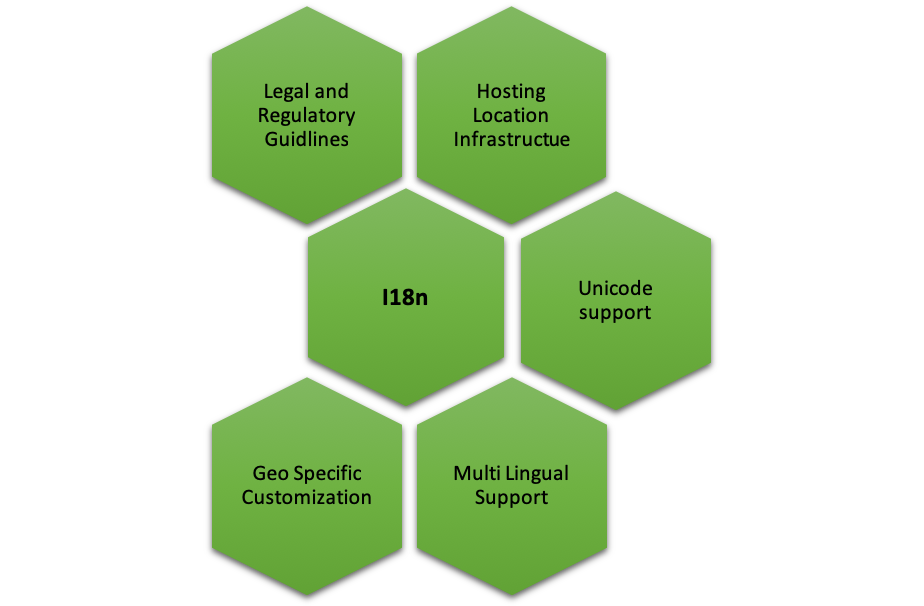
    So, what are the typical factors that teams of designers, architects and developers need to first establish, foreseeing internationalization?

    Legal and Regulatory Guidelines

    Different regions, geographies, countries and markets have different regulatory guidelines that can extend to several facets including organization practices, trademark requirements, currency repatriation, tax compliance, regulatory compliance, duties and corporate agreements and contracts, currency repatriation and so on. If you’re working on a product that you need to go-to-market in China for instance, then it is important to understand the legal and regulatory framework within which you can operate.

    Hosting Location, Global Distribution/Content Delivery Network Infrastructure

    Different geographies, different networks and different internet speeds are factors one must consider when taking your product global. How can a product be designed to ensure that it “loads” quickly for customers across regions? Should there be a central database or should it be distributed? Who, where and how will distribution of data be managed? These are critical questions to ensure there are no customer drop-offs.

    Unicode Support

    Today, Unicode allows support in most of the world’s writing systems. Enabling its proper usage that can support local, regional or even cultural context is critical. For instance, supporting special characters from different languages that are outside the ASCII boundaries (defines 128 characters in a typical English keyboard) is extremely important. Unicode defines 221 characters (characters from all recognized languages in the world), thus, UTF-8/16 encoding format should be supported when you’re planning to release your product in different geos. This is a crucial requirement for database, DB connection, build setup and server startup options—just to name a few.

    If you’re fond of hard coding text, think again. Creating text and media that is easily editable, gives you the flexibility to easily localize and adapt your product for different regions.

    Multi-Lingual Support

    English may be one of the most spoken languages in the world, but that doesn’t necessarily mean every region or market thinks, reads and speaks English. For instance, if you’re releasing a product in Japan, China or even India (with its plethora of scripts for different languages), multi-lingual support for your product is essential. Here are a few things to follow:

    • Maintain language-specific resource files for each support language (eg. en-us.properties, ar-sa.properties) with key value pairs—the key is used in the code to place the text, and value is the language specific translated text.
    • All text on the screen, messages and label text must be sourced from resource files, and there should be no referencing of text directly in the code.
    • Choose to keep the resource files at the back end/front end. Front end is recommended as it helps improve performance, and by avoiding calls to the back end and toggling, it moves fast.
    • UI framework should support translation features.

    Think about text expansion in different languages, in terms of number of characters and how it can affect the UI and UX of your product. The same holds good for languages that are written from left to right, as well as translations.

    Scalable Framework for Geo-Specific Customization

    Development framework must consider the UI/UX, branding, orientation and size of the product when going i18n. For instance, the color red could mean different things in different countries and cultures—in China it could mean endurance, in India it could mean purity, in Europe it could mean self-sacrifice or in South Africa it could mean grief and sorrow. Therefore, it is extremely crucial to understand different nuances of cultural significance while designing the UI for a great UX. A few other factors to keep in mind:

    • Tag-based framework for content picks up where the content is tagged to language/country, and gets picked for users having matching profiles, for the tag values. This way, you may have content for various languages, but a user in Spain gets to see only the Spanish content just by setting his language preference in your system.
    • Orientation and sizing adjustments—specific CSS to handle alignment/size specific customization.
    • Navigation (left to right), enable/disable certain options through CSS customization.
    • Localization-based content.
    • Language-based content.

    Developing a framework for rapid transition to international markets requires a thorough think-through from a product enablement perspective, keeping in mind operational efficiency without impacting product behavior. Using this checklist will help you save time, money and rework when you finally decide to go i18n.

    — Ruchi Vaidya Tomar