Tag: Postman

  • Postman Bets on Better API Documentation with Fern Acquisition

    Postman Bets on Better API Documentation with Fern Acquisition

    Postman CEO Abhinav Asthana explains how the acquisition of Fern will significantly improve the quality and consistency of documentation generated for application programming interfaces (APIs) and software development kits (SDKs), as well as the impact on developer experience and modern API-driven development.

    Fern, Asthana explains, has built momentum by helping companies generate higher-quality SDKs and developer portals—tools that make APIs easier to discover, learn and consume. By bringing Fern into Postman’s broader API platform (spanning design, collaboration, testing and monitoring), the goal is to improve the “last mile” of API programs: turning well-built APIs into well-adopted APIs.

    Asthana also argues that good documentation is becoming even more critical as developers begin relying on AI agents and automation to interact with services. Agents still depend on accurate metadata and clear descriptions to choose the right endpoints and use them correctly, and that context often comes from documentation. While AI can help generate drafts and drive consistency across large portfolios of APIs, Asthana stresses that humans remain essential in the loop—reviewing, validating and preventing hallucinations.

    API management varies by industry: fast-moving tech teams may prioritize speed, while regulated sectors demand stronger governance and lifecycle discipline. Regardless, he says discoverability and consistency are foundational. Better documentation doesn’t just help developers; it can prevent duplication, speed internal reuse, and make API-first strategies actually work in practice.

  • The DevOps Impact of API-First Development

    The DevOps Impact of API-First Development

    Balaji Raghavan, chief technology officer at Postman, breaks down key findings from the company’s 7th Annual State of the API Report — offering an inside look at how APIs are reshaping software development and DevOps practices worldwide.

    Raghavan notes that APIs have evolved from tactical integration tools into strategic enablers of digital transformation. According to the report, nearly every software organization now relies on APIs to connect distributed systems, streamline development, and accelerate product delivery. What’s changing, he explains, is the scale and complexity of API ecosystems — and how DevOps teams are adapting to manage them securely and efficiently.

    They highlight several trends emerging from the survey: the rise of API-first development, the growing importance of governance and lifecycle management, and the increasing use of AI to design, test, and monitor APIs. For DevOps teams, this means embedding API observability and automation directly into their pipelines to improve performance and reliability.

    Raghavan also discussed how teams are addressing the challenges of security, version control, and dependency sprawl as APIs become more interconnected across multi-cloud environments. He stressed that visibility and collaboration remain key — developers, platform engineers, and security teams must work from a shared source of truth to keep up with the pace of API-driven innovation.

    Ultimately, the report’s message is clear: APIs are no longer supporting players in the DevOps ecosystem — they’re the backbone of modern software delivery. The organizations that invest in automation, governance, and developer experience will be the ones that thrive as API complexity continues to grow.

  • Postman Adds AI Agent Mode to Design, Build and Deploy APIs

    Postman Adds AI Agent Mode to Design, Build and Deploy APIs

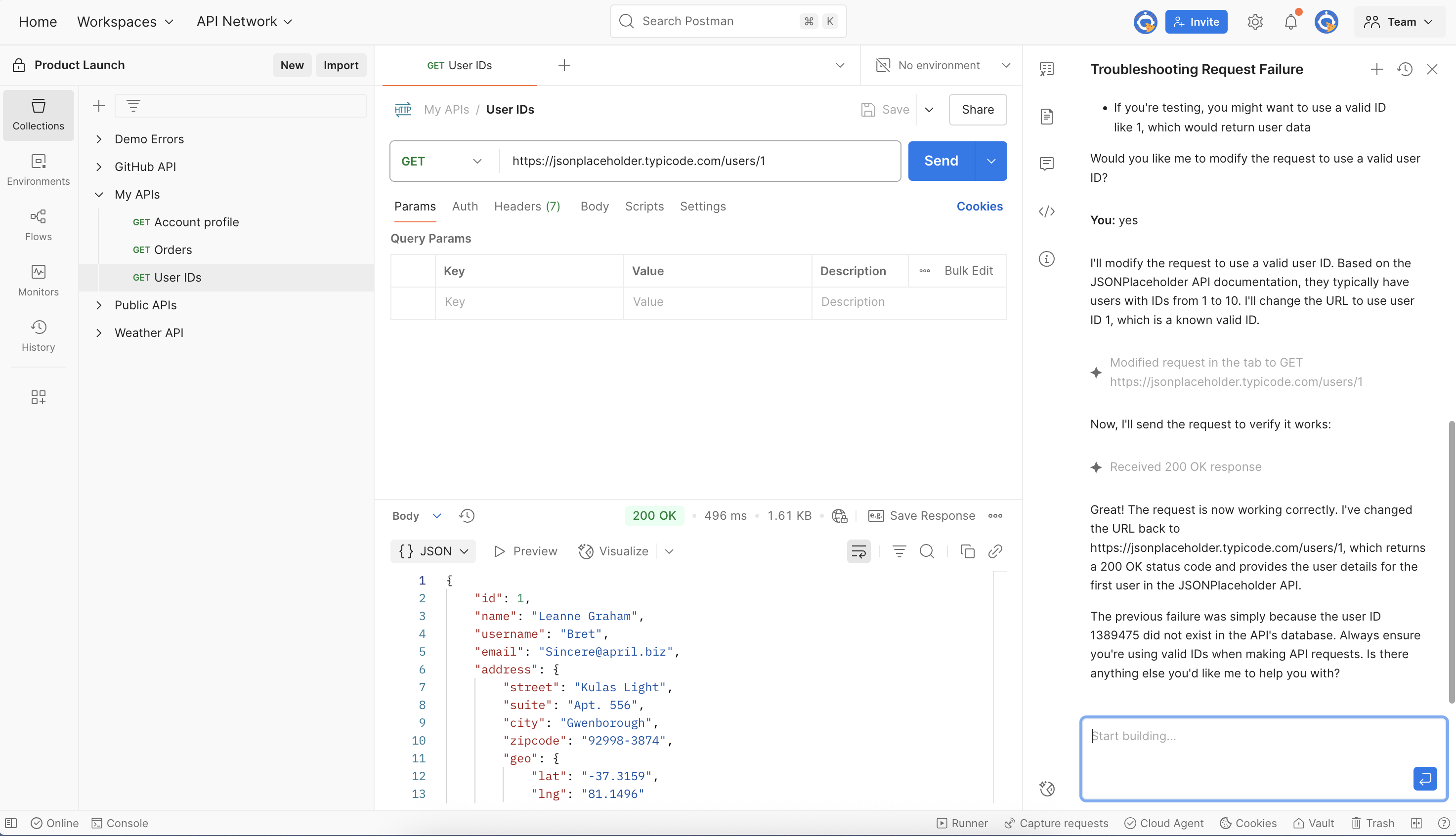
    Postman today revealed it has developed artificial intelligence (AI) agents for its platform for designing and building application programming interfaces (APIs).

    Announced at the POST/CON 2025 event, the Agent Mode enables developers to, via a natural language interface, automate entire multi-step workflows spanning the designing, testing, documenting and monitoring of a single API or a logical group of APIs, known as collections.

    Postman CEO Abhinav Asthana said unlike an AI copilot, Agent Mode natively executes tasks in a way that understands the actual intent of an API developer.

    The overall goal is to reduce the amount of time required to build and deploy an API from weeks to a few hours using a set of repeatable workflows created by an AI agent, he added.

    Additionally, developers will be able to integrate the Postman agent with other AI agents via a model context protocol (MCP) server that Postman added last month.

    Finally, Postman is also committing to make it possible for developers to alternatively employ AI agents they create to build, develop and test APIs. Postman Insights, now available in a more open beta, will then provide the tools required to track usage of any API created in real time, noted Asthana.

    It’s still early days so far as usage of AI tools to build APIs is concerned, but reliance on them within AI applications is already pervasive. Based on data collected from the Postman API Platform between May 2023 and April 2025, developers made more than 7 million API requests involving AI. The OpenAI platform accounted for 60% of that activity, but API traffic involving Meta Llama and Google Gemini grew by a factor of seven and five, respectively.

    In total, there are more than 40 million developers that make use of Postman tools to build APIs for 500,000 organizations. The Postman API Network is being used to expose more than 100,000 of those APIs to drive multiple application services. As AI agents make it simpler for both developers and now non-technical end users to build and deploy APIs, the volume of activity is only going to continue to exponentially increase, noted Asthana.

    Each organization will need to determine how extensively to rely on AI agents to build and deploy APIs, but it will, if necessary, be possible to rollback any tasks completed by an AI agent, said Asthana.

    The one thing that is certain is that API documentation should substantially improve. Most application developers don’t especially enjoy creating documentation, which can be a significant issue whenever a DevOps team needs to troubleshoot an application.

    Hopefully, an AI agent trained to develop APIs will lead to higher quality. APIs, in particular, have become the focal point for cybersecurity attacks because in addition to enabling the exfiltration of data they can also be a vehicle for corrupting business logic.

    In the meantime, however, IT leaders in the months ahead might want to revisit not just how APIs are created, but also managed, secured and updated in the age of AI.

  • Postman Acquires Akita Software to Gain API Observability

    Postman Acquires Akita Software to Gain API Observability

    Postman today announced it has acquired Akita Software to gain access to a platform for monitoring and observing application programming interfaces (APIs).

    The first integration of the respective products offered by both companies will arrive in beta this fall.

    Postman CEO Abhinav Asthana said the acquisition of Akita Software will make it much simpler for organizations to discover what APIs are being employed across an enterprise. A recent Postman survey found that 28% of developers are now deploying APIs at least once per week.

    The Akita Software platform will make it simpler for organizations to discover both rogue APIs that have been created by a shadow IT project and zombie APIs that have been inadvertently left exposed long after they are needed.

    Akita Software’s CEO Jean Yang said the integration with Postman’s API management platform will provide a rich source of data that can be used to add artificial intelligence (AI) capabilities to Akita’s API observability platform. For example, generative AI capabilities should make it simpler to create summaries in natural language that explain the calls an API is making to specific data sources.

    In addition, the combined company will be in a better position to enable organizations to better secure their APIs after deployment by surfacing anomalous behavior indicative of an API that is being used to exfiltrate data, she added.

    The merger with Postman will, in effect, enable the combined entity to provide a complete ecosystem for managing APIs, noted Yang.

    Most APIs are used primarily to interconnect internal-facing applications and systems, with a subset used to integrate partners. Only a relatively small percentage of APIs are externally facing in the sense that they expose data to the internet. Many organizations, however, fail to appreciate how quickly an internally facing API can become externally facing over the course of its life cycle. As such, IT teams need tools and platforms that can manage and secure APIs as they evolve.

    As APIs continue to play a crucial role in advancing business goals, there is a clear need for increased visibility as the types of APIs employed also continue to expand. Most APIs in use today are based on the REST format, but there are also APIs based on GraphQL, event-driven architecture and various messaging platforms. None of these newer APIs will supplant REST APIs any time soon. Rather, they are being applied to drive additional processes alongside REST APIs.

    In the longer term, it’s not clear how many APIs will be managed by the developers that created them versus a centralized DevOps team. However, the more APIs that are deployed in a production environment, the less feasible it becomes for developers to manage their life cycle. The challenge is making sure there is some type of structured workflow in place that, at the very least, makes everyone involved in the process aware that a new API has been created and deployed.

  • State of API Report Highlights Productization and Generative AI

    State of API Report Highlights Productization and Generative AI

    In today’s software landscape, an API-first strategy is increasingly popular. It’s the bedrock of how applications are built and connected. APIs help promote internal tech reusability, helping developers do more with less. Due to this increasing API reliance, maintaining quality control is increasingly important for internal and partner integrations and ensuring the reliability and security of these connections remains a top priority.

    Due to the rising API ubiquity, nearly half of the total development energy is spent working with APIs. And to continually improve these interfaces, taking a product mindset is proving helpful. In fact, 60% of API developers now view their APIs as products. Generative AI has also shown incredible promise and is now being used in tandem with traditional tools to increase API code quality.

    Postman recently released its fifth annual State of the API Report. The 2023 edition, which surveyed thousands of developers and API professionals, found subtle changes in tooling preferences and styles. It also sheds light on the ongoing API productization movement and API developers’ use of generative AI. Below, I’ll focus on these two key areas and review the report for its other key takeaways.

    API Productization is Hot

    The majority of API developers now view their API as a product, and this figure rises to 68% in large companies. A full 65% of respondents said their API generates revenue, too. This news is significant, as it demonstrates the industry is maturing its view of APIs. They are no longer offshoot developer toys but fully functional services contributing to overall business growth.

    But how much growth? Well, of those monetizing APIs, 43% now say APIs generate a quarter of company revenue. For some companies, APIs generated more than 75% of total revenue! There also appears to be a parallel between API revenue generation and large companies.

    Do you view your APIs as products? Most developers say "yes."
    Do you view your APIs as products? Most developers say yes.

    Other industry reports unearthed similar API productization potential. Rapid’s 2022 State of APIs report found that 42.6% of organizations are now monetizing APIs. And investment into API-first products remains strong even amidst a broader contracted tech investment climate. These findings come as social media giants like Reddit and Twitter attempt to monetize their APIs.

    That said, for 28% of companies, API revenue still equates to less than 10% of total revenue. APIs still don’t get the lion’s share, perhaps because they’re packaged with an existing platform or because of the many other indirect ways APIs might benefit the business. Furthermore, consumers are becoming more cost-conscious, as 60% cite pricing as a factor before integrating with an API. Still, the numbers are significant firsts for the burgeoning economy.

    Most API Developers are Using Generative AI

    Generative AI interfaces like ChatGPT and Bard have certainly taken the tech industry by storm due to their ability to generate code snippets, debug code and more. And for the first time, the State of the API Report spotlighted generative AI and its use within the API economy.

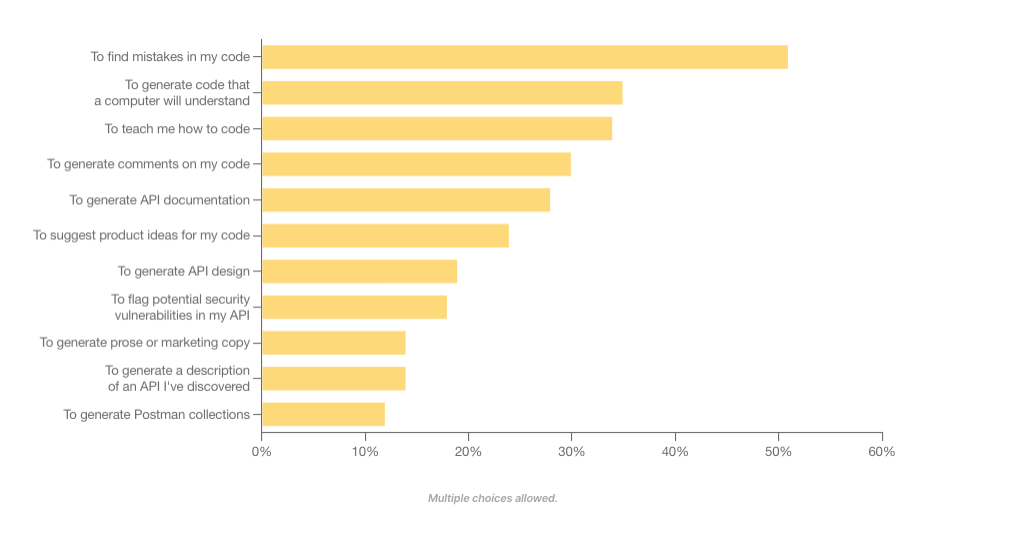
    Today, 60% of API professionals are using generative AI on the job. API engineers commonly use generative AI to find mistakes in code, generate machine-readable code and increase learnability around their programs. Some even use generative AI to suggest potential security flaws in their APIs.

    Compared with other app development endeavors, developers are by far most excited about building generative AI-powered applications in the year ahead. Yet, the efficiency gains are modest—many engineers forecast productivity improvements of 10% to 25%.

    How are API developers using generative AI in their work?
    How are API developers using generative AI in their work?

    Generative AI is set to accelerate many areas, including DevOps and API operations. Yet, contrary to some headlines, generative AI can’t automate all aspects of the software development life cycle. Rather, the technology is more likely to augment the API developer’s workflow than replace the need for seasoned professionals altogether.

    Other Key Takeaways

    Similar to last year’s report, integrating between internal applications, programs or systems remains a top concern for integrating an API or producing an API. The good news is that these integrations continue to increase in quality.

    The report found that deployment failures and times-to-recovery are improving on average. More than half (56%) of respondents said API security incidents occur less than once a year within their organization. This shouldn’t overshadow the significant impact API security breaches can have but signals that DevSecOps is beginning to respond to persistent API vulnerabilities.

    There are more API-first leaders than ever before. And API owners continue to evolve how their services are built and deployed. For example, REST is still by far the most common API style, used by 86% of developers. Webhooks made second place at 36%. However, GraphQL rose in usage, bumping SOAP into fourth position.

    SOAP slips on API architectural styles
    REST is still the dominant style, but GraphQL makes gains as SOAP slips.

    Other Quick API Factoids

    • More non-developers are becoming interested in APIs, as evidenced by 53% of survey takers being non-developers.
    • Most APIs are private—61% percent of businesses’ APIs are for internal use only.
    • After the technology group, business/IT services, financial services and health care are the most common sectors to adopt APIs.
    • Microservices is still the dominant architectural style of APIs, at 42%.
    • Performance, security and reliability are the top factors evaluated when integrating with a new API.
    • Improper authentication, authorization or access control is the most commonly cited API risk.
    • Common API tools include Postman, SwaggerHub, Datadog, SoapUI and Insomnia. Top gateway and API management platforms include AWS API Gateway, Azure API Management, Apigee and Kong.
    • JSON Schema is by far the most popular API specification.
    • The financial industry is a leader in API-first strategies—32% of respondents spend more than 20 hours a week working with APIs.
    • Most developers deploy APIs to production once a week to once a month.
    • When developers leave a company, their departure can cause outdated documentation, zombie APIs and a loss of institutional memory.

    API Obstacles Remain

    Looking to the future, investment in APIs is projected to climb. In fact, 92% of developers said their organization plans to invest the same or more time and resources into APIs in the coming year. Yet, some obstacles remain—a lack of documentation and poor service discoverability are still prominent roadblocks to API consumption. Furthermore, a lack of time and talent are major concerns that might stunt API development.

    The Postman State of API Report surveyed over 40,000 developers and API professionals, making it the largest study conducted on APIs to date. It should be noted that, given Postman’s specific focus in the market and its surveyed pool, figures may be skewed to represent increased API enthusiasm. For deeper insights, you can read the entire report here.

  • Postman Releases Tool for Building Apps Using APIs

    Postman Releases Tool for Building Apps Using APIs

    Postman today made generally available a visual tool infused with artificial intelligence (AI) that makes it simpler to build software by invoking application programming interfaces (APIs) found on its network.

    Shamasis Bhattacharya, chief software architect for Postman API, said Postman Flows makes it possible to use a low-code tool to build software using tens of thousands of APIs that can be found on the Postman API network.

    The goal is to reduce the amount of toil required to build applications of moderate to medium complexity in a way that doesn’t require developers to have deep programming expertise, he added.

    Instead, developers are presented with “blocks” that they can drag and drop to create an application and deploy the associated workflows. Postman Flows leverages AI to manipulate data returned by APIs using a natural language interface that reduces the level of technical acumen required to create those workflows.

    That approach provides developers with a reactive experience that is embedded within a visual tool, noted Bhattacharya.

    Many developers still have a natural bias toward writing code, but as demand for applications continues to increase, Postman Flows provides a means to significantly increase developer productivity, said Bhattacharya. There may still be instances where writing code is required, but as developers save more time using Postman Flows, many of them will switch over to a visual tool to build software faster by essentially gluing blocks together, he added.

    There’s naturally a lot of focus these days on developer productivity during uncertain economic times. More organizations than ever are dependent on software, but their ability to hire armies of developers is limited. Low-code tools have emerged to provide a means for accelerating application development, but Postman is now looking to apply that concept directly to the network of curated APIs that it provides to application developers.

    The one thing that is certain is that as the pace at which applications are being built increases, the number of them running in production environments will steadily increase. DevOps teams will find themselves maintaining a wide range of applications that were constructed using both procedural code and low-code platforms.

    In the meantime, IT organizations may want to start evaluating which types of applications lend themselves to being built by development teams that may not require as much experience writing actual code. Much of the application development backlog organizations are struggling with today could be reduced using tools that automate a wide range of development tasks. That should free up developers with more advanced skills to work on more complex applications. That approach might also reduce developer turnover as much of the fatigue associated with building more routine applications is reduced.

    Regardless of how applications are built, there will be a need to manage them in production environments. DevOps teams may soon be able to focus more of their time and expertise on optimizing application performance in production environments versus continuing to shepherd massive amounts of code through continuous integration/continuous delivery (CI/CD) pipelines.

  • The API Economy: Increasing Potential to Monetize Public APIs

    The API Economy: Increasing Potential to Monetize Public APIs

    API-first strategies are becoming more commonplace throughout today’s digital strata. APIs connect microservices architectures, power new digital transformations and help development teams avoid reinventing the wheel for common functions. And although most are built to connect internal components, studies indicate a movement toward more externalization and monetization of public APIs.

    Over three-fourths of developers now view participating in the API economy as a priority for their organization or plan to prioritize it soon, found Rapid’s newly released 2022 State of APIs report. The survey, which surveyed hundreds of professional developers, also uncovered a modest increase in companies seeking to generate direct revenue from APIs.

    Below, we’ll review some intriguing statistics from the Rapid report and consider the major takeaways technology professionals should consider in the year ahead.

    API Reliance Increases

    Reliance on APIs is rising across the board. Over 62.6% of developers reported relying on them more in 2022 than in 2021. Internal APIs help avoid development duplication and third-party APIs can quickly integrate standard functionality related to payments, messaging, geolocation, data sharing and many more areas. For example, ChatGPT has demonstrated the power of standard APIs to deliver advanced AI/ML to the masses in a programmatic way.

    As a result of this interest, the majority of organizations now consider participating in the API economy as a top priority. And as an organization grows larger, its reliance on APIs is likely to increase. A full 40% of the largest companies surveyed reported having more than 250 internal APIs. Nowhere is this more prevalent than in financial services. This finding makes sense, given how APIs can automate payments and underpin the open banking movement.

    In terms of who is using APIs, it’s most commonly full-stack or backend developers, the report found. One intriguing factoid is just how much of this work is now dominating developers’ time. Impressively, 65.5% of developers reported spending ten hours or more working with APIs in their job; 14.5% of them said that work takes up all of their time.

    In terms of design styles, various standards are used throughout the web development sphere. Yet REST is still king—69.3% of engineers used REST in production. REST is followed by webhooks, WebSockets, AsyncAPI, serverless and FaaS, SOAP, GraphQL, Kafka and gRPC, in descending order of popularity. Across the board, these statistics showed a steady increase from last year.

    Of note is that most APIs are built for internal purposes. These often wrap a database or provide open access to an internal microservice. Private use cases are by far the most common approach; according to the report, 75.1% of respondents worked on internal APIs. These findings aligned with other industry reports, such as the Postman State of the API Report, which found that, in 2022, 58% of API initiatives were private.

    Third-party APIs (53.9%) and partner-facing services (48.9%) trailed behind internal APIs in popularity. Interestingly, while internal use cases have remained steady, both partner and public-facing strategies have increased since last year. While the growth was a modest 5% for most sectors, partner-facing APIs in some industries grew by nearly 10%.

    Spotlight on Monetization

    Many still view APIs as operational glue for internal data or connecting partner services. Yet, the possibility of monetization through self-service developer portals shouldn’t be overlooked—countless API-first startups are actively gaining traction and funding. And monetizing this power is seen as a holy grail to some unicorn-chasing VC funds.

    Most APIs are purely for in-house internal integrations and are typically not externalized to the outside world for profit. However, this is slowly changing. In fact, 42.6% of organizations are now monetizing APIs, representing an increase of about 5% from 2021.

    As one may have guessed, financial services are leaders in monetizing their external APIs. The telecommunications industry is also noticeably active in monetization, too. Furthermore, with size comes increased monetization potential—about half of the companies with a large footprint of ten or more internal or external APIs also monetized them.

    API Economy in 2023

    Looking to the future, most anticipate more reliance on APIs across sectors — 69.2% expect to rely on APIs even more in 2023. Yet, organizations will have to grapple with particular hurdles in this newfound landscape. For example, a cloud skills gap might bar some groups from realizing the benefits of an API strategy. Other concerns include ungoverned sprawl, authorization concerns, shadow APIs and escalating attacks on public-facing endpoints. Also, some organizations are still determining how to best secure and scale their use of new styles, like GraphQL.

    A standards-based approach that applies platform-wide governance will likely be necessary to maintain an efficient yet stable API footprint. To meet these high quality standards, testing is nearly universally applied—92.7% of those surveyed test their APIs or plan to do so. The most common tests ranged from functional testing to integration testing, acceptance testing and performance testing.

    The Rapid 2022 State of APIs report received 850 responses from over 100 countries. For more insights, readers can view the complete results here.

  • Postman Survey: Increased Usage of APIs Results in More Security Incidents

    Postman Survey: Increased Usage of APIs Results in More Security Incidents

    A survey of more than 37,000 developers and application programming interface (API) professionals published this week by Postman, a provider of a platform for developing and managing APIs, suggests that as more APIs are deployed, more organizations are seeing a rise in cybersecurity incidents.

    The survey finds more than half of respondents (51%) reporting that more than half of their organizations’ development effort is spent on APIs. About 20% also noted they are responding to API security incidents or breaches at least once a month at their organization. Overall, more than half (52%) said API security incidents occur less than once a year.

    Kin Lane, chief evangelist for Postman, said that while a lot of the concerns over API security could be classified as “theater” being put forth by providers of API security platforms, it’s clear there is a need for a zero-trust approach to building, deploying and maintaining APIs.

    The bulk of APIs are used primarily to interconnect internal-facing applications and systems, with a subset then used to integrate partners. Only a comparatively small percentage of APIs are externally facing. However, Lane noted many organizations fail to appreciate how quickly an internally facing API can become externally facing over the course of its lifecycle. As such, IT teams need the tools and platforms required to manage and secure APIs as they evolve, he noted.

    In fact, nearly three quarters of respondents (72%) said being able to build APIs remotely is very important to them. That would suggest best DevSecOp practices will need to be extended to API development teams that are often working from home.

    Despite those concerns, however, a full 89% said Investments in APIs will increase or stay the same over the next 12 months to drive, for example, digital business transformation initiatives. However, the survey also suggests most organizations are still coming to terms with API development and deployment. Only 8% of respondents identified themselves as API-first leaders, which Postman identifies as an elite group that produces APIs faster, deploys more often, has fewer failures and recovers sooner when failures occur.

    Lane said the survey makes it clear that while APIs are playing a crucial role in advancing business goals, there is a need for increased visibility as more APIs are deployed across the enterprise. That’s especially critical as more types of APIs employed also continue to expand. Most APIs in use today are based on the REST format, but there are also now APIs based on GraphQL, event-driven architecture and various messaging platforms. None of these newer APIs are going to supplant REST APIs any time soon. Rather, they are being applied to drive additional processes alongside REST APIs, noted Lane.

    It’s not clear how many organizations are adopting a design-first approach to building APIs before they write application code, but as more APIs are deployed, the way IT is managed is rapidly changing. Application services are essentially becoming more disposable so long as the API used to expose them to other applications remains stable. In fact, it’s now only a matter of time before most organizations fully appreciate the degree to which their entire IT strategy now revolves around their APIs.

  • 22 Engineering Leaders Weigh in on APIs

    22 Engineering Leaders Weigh in on APIs

    Every business today is a digital business … and if it’s not, it will be soon.

    A recent survey by Deloitte found that digitally mature companies are better able to navigate rapid change and, as a result, perform much better financially.  Nearly two-thirds of survey respondents asserted that organizations that don’t digitize in the next five years will be “doomed.”

    Application programming interfaces (APIs) are the cornerstone of these digital transformation efforts. APIs aren’t just technical conduits that let applications communicate with each other. In a software-driven world, they allow developers to build services more quickly, enable innovation, open up new markets and drive competitive advantage.

    A new State of the API report from Postman, which surveyed 28,000 developers and other tech pros, offers a vivid snapshot of APIs’ central role in modern organizations. It showed that API-fueled innovation has helped companies respond to the pandemic; that the global API ecosystem is growing; that developers are spending more time than ever with APIs and that almost everyone believes investment of time and resources into APIs will increase or stay the same in their organizations for the next 12 months.

    To learn more about APIs’ status in the enterprise, I’ve spent part of 2021 interviewing 22 engineering leaders from various companies for my podcast, Breaking Changes. I wanted to dive deeper into how and why these leaders view APIs as critical to business strategy and hear what lessons they’d share with others.

    Here, in 20 bite-sized chunks, are the recurring themes:

    Business. The greatest value generated from API operations is rarely directly from any single API, but around the partner enablement APIs make possible. Over and over, companies see that building an API ecosystem helps extend their business’s reach and deepens the connection with partners and customers.

    Strategy. Without proper planning, an organization will always be stuck in reactive mode when it comes to the applications that API operations are powering. It’s much better to have a comprehensive API strategy.

    Third-party relationships. Reliance on third-party systems—the vast supply chain of partners and vendors that organizations share data with via cloud-based technology—is exponentially increasing, pushing organizations to develop a more formal and external API strategy.

    Resources. The resources surrounding API operations need to speak to developers, support them and help make their lives easier as they work with a company’s APIs.

    Governance. It’s important to be cautious in automating governance at the pipeline level before developing relationships across teams and a centralized API governance approach is vital, too. API governance is the practice of applying common rules and security policies for APIs. 

    Management. The management of APIs is a continuous journey and not a destination, requiring a significant amount of planning and attention to reach desired objectives.

    Global. We are all increasingly reaching a global audience with APIs, and every organization’s message and resources need to reflect the increasingly diverse audience.

    Multi-Protocol. The future of APIs is multi-protocol, requiring a diverse toolbox of API protocols and patterns to properly grow ecosystems over the next decade.

    Enablement. Companies need to be enabling their API development teams, not governing them; making sure they have what they need to do APIs well while also failing safely.

    Regulations. API regulations are here and are pushing mainstream enterprises to become technology companies, requiring that they have an API strategy for the future.

    Mobile. The world reached a milestone in 2019: There are now more cellphones than people. APIs are how digital resources are made available on these devices in both leading and emerging markets.

    Opinionated. Informed and opinionated approaches to the API life cycle will make a bigger impact than any single technology used in the infrastructure stack.

    Intelligence. There is a massive opportunity in deriving intelligence in aggregate across the millions of API requests we make each day across core business applications.

    Quality. Organizations should prioritize not just testing APIs but testing the API tests themselves. This ensures a level of quality and reliability across all APIs, regardless of the team working with them.

    Education. Ensuring that teams have the proper ongoing training and education around the API life cycle must be a top-line priority across API operations.

    Authentication. The authentication layer of the API infrastructure holds a wealth of intelligence. Having humans study this dimension is critical for security.

    Data. Challenges and opportunities at the API data layer are massive, and machine learning is giving teams an exoskeleton to support failing and iterating faster during development.

    Privacy. Ensuring that privacy is a basic building block of the API life cycle helps developers focus on what they do best, resulting in higher-quality applications that also respect privacy.

    Observability. API analytics have matured in the last few years; becoming much more about observability across the API infrastructure and helping organizations see and respond to what matters.

    Open Source. Open-source technology is an essential part of growing and supporting an API ecosystem, providing both the technical and human nutrients needed to be healthy.

    By keeping these 20 points in mind, organizations can maximize APIs’ role as an extremely powerful mechanism for leveraging data and application functionality for business success. APIs will underpin digital transformation for many years to come, so it’s important to cover all the bases.