Tag: platform engineering

  • Does Platform Engineering Make DevOps & DevSecOps Irrelevant?

    Does Platform Engineering Make DevOps & DevSecOps Irrelevant?

    For those of us old enough to remember, the DevOps movement came onto the scene somewhere around 2007/2008. Its proponents railed against the traditional software model at the time, which called for the developers who wrote the code to be organizationally and functionally separate from those who deployed and supported the code. The reasoning behind the movement is that these siloed teams, concerned only with their own objectives, resulted in botched releases, significant delays, poor communication and, ultimately, unhappy customers. It took a few years to gain traction, but when Gartner got on board with the concept in 2011, adoption soared, and Agile development practices like automated build and test and continuous integration and delivery became the new norm.

    Security and Compliance Join the Mix

    Agile, DevOps and its promise of continuous integration and continuous delivery … well, delivered. Development and operations teams were finally on the same page, each able to see a current phase’s end goal, providing the flexibility to make changes and improvements along the way, speeding the delivery of quality software. Unfortunately, in these early years of DevOps success, security and compliance generally remained siloed. That silo resulted in security being an afterthought—stuck near the end of the application development life cycle. Consequently, security took the blame for release-delaying bottlenecks.

    The year 2014 was notable for an exponential increase in security breaches compared to the year before. According to an article in Security Week, 2014 marked the year that, for the first time, one billion records were compromised in more than 1,500 notable data breaches, an increase of 80% from 2013. Home Depot, JP Morgan Chase and eBay were among the many exposed to attackers. Given these and other high-profile breaches, it was time to re-evaluate development processes and give security and compliance a seat at the table.

    With research by Microsoft and others showing that 80% of security breaches were related to configuration errors, the concept of DevSecOps, putting security front and center in the Agile development process, ensures that assets are configured correctly in the first place, providing continuous compliance by running constant scans to identify configuration drift.

    This approach can be extended beyond the data center to any cloud to any edge, where even applications can be managed and checked against compliance and security standards. You can even extend a single DevSecOps compliance framework to cloud native assets including Kubernetes and public cloud services. 

    Today, it is safe to say that the term “DevOps” is likely losing its relevance, but “DevSecOps” is alive and well, as long as the organization embraces the cultural, people and process changes necessary for success. Tools and technology are essential to DevSecOps, as is adopting a culture that security is everyone’s responsibility. That culture requires instigating a security-first mindset among teams as well as implementing essential automated security testing tools.

    What About Platform Engineering?

    Platform engineering has recently captured interest and is now generating considerable buzz due to its focus on building and operating self-service internal developer platforms (IDPs) for software delivery and life cycle management. The platform is supported by layered services or tools, created and maintained by a dedicated product team, designed to support the needs of software developers by essentially stitching together components to create a frictionless developer experience.

    As Gartner says, “Platform engineering is an emerging technology approach that can accelerate the delivery of applications and the pace at which they produce business value.” In fact, Gartner expects “[t]hat by 2026, 80% of software engineering organizations will establish platform teams as internal providers of reusable services, components and tools for application delivery. Platform engineering will ultimately solve the central problem of cooperation between software developers and operators.”

    In that context, platform engineering certainly builds upon the Agile concepts of DevOps and DevSecOps. Looking deeper at DevOps/DevSecOps and platform engineering shows that they both share many characteristics, while they can also be combined in a way that provides greater benefits to organizations that think about them in tandem. It is easy to see the integral link between platform engineering and DevSecOps and the broader infrastructure management landscape. For example,

    • Developer Experience and Productivity – DevSecOps extends experience and productivity support beyond the developer to IT Ops, security and compliance.
    • Automation – Automating infrastructure configuration as well as compliance tasks using a policy-as-code approach is the lynchpin of DevSecOps. Platform engineering provides the opportunity to extend automation to the other parts of the development lifecycle.
    • Self-service – This is another common concept where platform engineering can build off of the automation and services-oriented approach that DevSecOps uses to not only enable developer self-service for code/test/deploy, but also to enable developers to be more proactive and effective in the security/compliance realm.
    • Accelerate Value – Accelerating value is the focus of any tech enabler, from platforms to tools and processes.

    From an Agile development approach supported by DevOps/DevSecOps and extending now to platform engineering, the end game is all about speeding delivery of high-impact applications with continuous updates that are highly resilient, reliable and secure. Given the synergies and the pressure on organizations to rapidly deliver applications while combatting cyberthreats, any platform engineering effort should ensure that DevOps/DevSecOps plays a central role.

    While the term DevOps and, to some extent, DevSecOps, sound a bit dated and irrelevant and could maybe use a new moniker, the evolving role they are certain to play as platform engineering gains a foothold are not to be underestimated. 

  • Product Mindset Key to Platform Engineering Success

    Product Mindset Key to Platform Engineering Success

    Platform engineering has taken the world by storm, and for good reason. Good platforms reduce TicketOps, standardize config setups, and cut lead time and time to market. Despite the discipline’s new popularity, there remain some questions about what sets platform engineering apart from DevOps. The answer to those questions lies in the platform as a product approach–the heart of every successful platform engineering effort.

    What is Platform Engineering?

    According to Luca Galante, platform engineering is “the discipline of designing and building toolchains and workflows that enable self-service capabilities for software engineering organizations in the cloud-native era.” Platform engineers build an internal developer platform, which “consists of many different tech and tools, glued together in a way that lowers the cognitive load on developers without abstracting away context and underlying technologies.”

    What is the Platform as a Product Approach?

    A product approach requires user research, a defined mission, leveraging lighthouse teams, getting regular feedback, iterating and marketing your platform for internal buy-in. Together, these product management best practices will ensure your platform enables true developer self-service and finds the right level of abstraction.

    “Build it, and they will come” is not a viable strategy for ensuring developers will adopt your platform. Similarly, forcing developers to use a platform is likely to fail. Mandated usage creates resentment, reduces trust and results in shadow ops. To avoid your platform’s untimely demise, you have to treat your platform like a product and sell it to your customers: Your developers.

    This article provides a high-level overview of what a product mindset looks like in practice and why each component contributes to the success of your platform.

    Do Your Research

    Unless you gain a comprehensive understanding of developers’ pain points and what they’re already doing to mitigate those issues, you won’t build a platform people actually want to use. Hashicorp’s Michael Galloway shared this example of a user survey he conducted with his team while at Doma. The idea is to ask questions about the full software delivery process, from the planning stages of the interviewee’s work to debugging and testing. This way, the platform team can prioritize creating features to solve developers’ most frustrating problems.

    Oftentimes, platform teams will find that teams have conflicting wants and perspectives on what the platform should be. A platform product manager will help translate disparate responses into an actionable and successful plan. Successful platform teams also research open source and commercial tools and integrate pre-built solutions into their platform where beneficial. They study blueprints, like the internal developer platform reference architectures developed by McKinsey, as a starting point.

    Define Your Mission

    Your mission statement gives your platform team a clear identity and priorities. It’s also a starting point for understanding and communicating your impact on the business to relevant stakeholders. Good mission statements are emotional and inspiring, simple but meaningful, match the longevity of the organization and are informed by user research.

    Leveraging Lighthouse Teams

    When starting their platform engineering journey, many organizations don’t know what to build first. The confusion arises from having two important yet conflicting priorities. On the one hand, your platform team doesn’t want to bite off more than it can chew by building too many features at once. On the other hand, platforms that are thin enough to cover the entire enterprise often fail to provide enough value to individual teams.

    The way to strike the right balance is by leveraging lighthouse teams. A lighthouse team is the first group of people you’ll choose to build your organization’s platform for, so spend a lot of time with them to get it right. Cultivate ambassadors and evangelists and give them time to get the rest of the team (and the organization!) on board with your platform. Once you’ve built a platform that provides real value to your lighthouse team, repeat this process with more teams across the organization.

    The lighthouse team approach is valuable because it helps platform teams avoid boiling the ocean while also ensuring your platform provides real value every step of the way.

    Stay in the Loop

    Initial user research is not enough to sustain a successful platform engineering effort. Platform teams should solicit regular feedback from developers and use it to iterate the platform.

    Market Internally to Get Buy-In

    Conversations about platform engineering often focus on developers, but developers are not your platform’s only stakeholder group. Your platform team will also need buy-in from managers, SysAdmins, DevOps engineers and the C-suite.

    In his PlatformCon 2023 talk “How to communicate the business value of platform engineering,” Gartner’s Manjunath Bhat shared Gartner’s Enterprise Value Equation as a foundation for platform teams to understand and communicate the value of their Internal Developer Platform to different stakeholder groups.

    The process includes assessing stakeholder priorities and concerns, identifying and defining value enablers, building a value map to map value enables to stakeholder impact, supporting the value story through outcome metrics, and communicating the “why” and realized value to the organization.

    Sounds Great. What’s the Catch?

    Applying a platform as a product approach can be difficult in practice. For example, many organizations struggle to afford the internal developer platform the same considerations as they would an external product. When working with internal developers, it’s easy for platform teams to make assumptions about what those users know, want and need. However, platform engineering requires avoiding these assumptions and always seeking user perspectives.

    Another common pitfall organizations encounter is mandating platform adoption. Making the platform mandatory closes off the critical feedback loops platform teams need to gauge the success of their platform and make continuous improvements.

    Conclusion

    The platform as a product approach is what sets platform engineering apart from DevOps. It’s deceptively simple but important if you want to build an internal developer platform people actually want to use.

  • How Platform Engineering Bridges the IT and DevOps Divide

    How Platform Engineering Bridges the IT and DevOps Divide

    Ballooning lead and process time, with an opaque corollary relationship to fixed and marginal cost, is a significant and complex burden for any enterprise. And multi-cloud complexity and inefficient organizational and technical processes are some of the most wasteful areas companies face–so much so that Synergy Research reports organizations are cutting back on their cloud spend as tech budgets continue to fall under intense scrutiny, resulting in a Q1 2023 cloud spending growth rate of 19% compared to 32% just last year. With cloud cost containment a top priority, Forrester advised tech leaders to demonstrate to CFOs how they will stay on budget and demonstrate ROI at the board level. A key area where companies can eliminate expensive waste and increase time to value is the relationship and workflow between IT and developers, which, while being the DevOps charter for nearly 15 years, has gotten less attention among the viable cost-containment strategies for enterprises in 2023. Revisiting the latest iteration of this DevOps charter through the implementation of platform engineering strategies can help enterprises create a faster, leaner and more scalable dynamic. Let us examine why it’s now time for enterprises to consider platform engineering as a potent way to not only increase efficiency but also to bridge the divide between DevOps and IT.

    The Old Way: Forcing DevOps to Dance to the ITSM Tune

    In traditional enterprise organizations, IT typically dictates a top-down ITSM practice that limits the tools an organization can use for development and deployment; in many cases, it inhibits CI/CD and other core capabilities and practices of DevOps. This awkward attempt to accommodate modern DevOps practice through an aging ITSM paradigm has led to a suboptimal software delivery performance and poor developer experience (DX).

    McKinsey, highlighting the criticality of DX, found developers at a leading SaaS provider spent 20% to 30% of their time integrating different services such as firewall changes, DNS and security access to deliver code through its CI/CD pipeline. That’s a lot of time spent on low-value, repetitive tasks, ensuring a painful journey for a disappointing result. If the DX pain is high enough, developers often go around IT and create resources on their own, leading to shadow IT, adding new cost burdens and growing security exposures. Every minute and engineer count: Five minutes saved per day among 500 developers saves a week’s development time.

    Surely, there is a better way.

    Platform Engineering: Collaboration Through Composition

    Platforming engineering and “platform as a product” have been key to the PaaS ecosystem for years but are now gaining fresh traction in the industry. In Puppet’s State of DevOps Report, 51% of respondents said they had already adopted platform engineering and 93% said it was a step in the right direction. Gartner predicted 80% of software engineering organizations will have platform teams by 2026.

    The concept can be defined in several ways. Gartner reported platform engineering is “an emerging trend intended to modernize enterprise software delivery… designed to support the needs of software developers and others by providing common, reusable tools and capabilities, and interfacing to complex infrastructure.” PlatformEngineering.org’s recent blog post defines it as the discipline of designing and building toolchains and workflows for self-service capabilities in software engineering organizations during the cloud-native era.

    Regardless of definition, platform engineering is the latest iteration of IT centralization, though now attempting to retain all the benefits of distributed team empowerment through “composition” rather than converged control. As modernization continues, we experience the ebb and flow of composition and decomposition, both organizationally and technically. Microservices, Kubernetes, and GitOps patterns pushed the rational limits of decomposition and significantly raised the level of technical complexity in the enterprise. The natural counter pressure is a new cycle of composition that aims to simplify that complexity through platform engineering practices. Teams now look for these toolchains and workflows to be centralized in internal developer platforms (aka IDPs), exposing the development, deployment and maintenance of the entire life cycle of modern, cloud-native applications.

    IDPs can facilitate the flow, speed and innovation DevOps teams are demanding without sacrificing stability, security and control. They enable developers to configure their toolchain while meeting all controls through approved blueprints or “golden paths,” reducing lead and process time. Developers can focus on delivering business value instead of infrastructure tasks.

    Bringing IT and DevOps Back Into Alignment Saves Time, Money and Sanity

    Platform engineering creates a collaborative framework that connects IT and DevOps teams, so they can focus on outcomes rather than methods. Developers can use an IDP to follow conventions that speed up development and prevent anti-pattern creep. Guardrailing choices through golden paths reduce cognitive load and simplify execution context for security teams. The result? Developers can focus on what they were hired for and want to do–creating innovative, transformative applications and differentiated value. Security can sleep well knowing bespoke behavior isn’t opening new attack surface areas.

    On the Day 2 operations side, IDPs enable SRE and support teams to have a fleet-wide view and work effectively with developers to streamline the management of production needs across all applications, clouds and tech stacks.

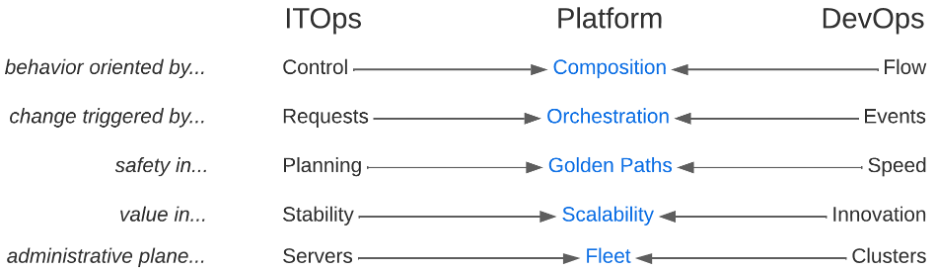
    The reframing of composition breaks the false dichotomies between IT and DevOps practices. You don’t have to choose between control and flow, change isn’t triggered by serial requests or async events, safety isn’t found in planning or speed, value isn’t found in stability or innovation and administrative plane primitives aren’t servers or clusters. Platform engineering practices allow you to prioritize composition, orchestration, golden paths, holistic scalability and fleet management to get teams out of entrenched myopia and embrace systems thinking that gets your business delivering strategic gain instead of tactical win/loss tallies.

    Finally, platform engineering positively impacts software delivery and operational performance metrics by streamlining development processes and reducing manual efforts. The bottom line is faster time to market while ensuring more consistency, less human error and improved software quality. This maximizes productivity, minimizes downtime and optimizes resource utilization, leading to cost advantages and increased efficiency for enterprises.

  • How Platform Engineering Protects Profit, People and our Planet

    How Platform Engineering Protects Profit, People and our Planet

    Platform engineering is emerging as a way of evolving DevOps, with 94% of respondents to the recent State of DevOps report agreeing that the practice helps their organization to reap the benefits of DevOps. The business arguments for platform engineering are clear: In that same report, respondents stated that platform engineering improves efficiency (59%), speeds up delivery time (58%) and improves workflow and process standards (57%).

    But in addition to the huge benefits organizations are now realizing in terms of business value, platform engineering is also pretty crucial for a business’s long-term viability. And by that, I mean that platform engineering can be inherently sustainable.

    How Can Platform Engineering Be Sustainable?

    First, it’s important to note that ‘sustainability’ here doesn’t just mean ‘green.’ Rather, sustainability means that an organization is able to meet the needs of the present without compromising the ability of future generations to meet their needs, too. These are needs that come in three different varieties: People, planet and profits.

    This means that to be truly sustainable, platform engineering needs to deliver lasting and stable returns on things like return on investment year-over-year, improved awareness of and reduction in an organization’s carbon footprint and better governance and optimization through monitoring and analytics.

    Any approach which supports business growth while simultaneously empowering employees and being kind to the planet is the dream for pretty much every organization. But how exactly can departments and wider organizations unlock all of these benefits? The answer is: There’s no magic bullet.

    Sustainable platform engineering is about treating your platform as an iterative cycle: It isn’t the actual creation of the tool that matters, as much as it is the maintenance, upkeep and usability of the platform as your business moves forward. This, naturally, will take time, effort and money—all of which, it’s safe to say in the current climate, are in short supply. But it is crucial that businesses act strategically, looking for areas for improvement and paths that will all add up to a more sustainable business in the long term.

    The Three Paths to Success

    These paths can be divided into three main areas of focus, and the first is GitOps or infrastructure-as-code (IaC).

    A tweak that every organization should start making is using Git as a single source of truth for deployments, enabling developers to work faster by empowering them to use their own code without hands-on involvement from ops teams. This could be combined with optimized infrastructure, moving toward IaC to enable faster and more efficient deployments.

    These principles form the foundation of sustainable platform engineering as they protect profits, allowing the business to keep moving forward and investing in the other areas crucial for a sustainable operation. Combining IaC with GitOps ensures speed and simplicity while maintaining a high-quality end product.

    Creating an optimized infrastructure is important, but just as important is empowering employees to feel good about the work that they are doing. That’s why implementing a self-service tool alongside an optimized UX is the second area of focus. This removes the pressure on those in the tech department to be infrastructure experts while erasing the need for endless tickets to be raised for issues.

    By freeing up DevOps engineers and platform experts to spend more time doing what organizations need them to do, businesses can keep innovating to maintain an edge over their competitors. Self-service capabilities combined with an accessible UX are a useful combination for a much-improved developer experience (DevX).

    Finally, it’s important to keep in mind that self-service isn’t just going to benefit end-users; it also has major upsides for improved governance, as well as keeping control of cloud spending and carbon footprint impact. Optimizing and iterating your platform engineering tool means that a business can keep up with the fast pace of the global tech market while also continuing to implement the latest tweaks and upgrades. It all adds up and builds on the organization’s platform engineering solution.

    Reaping the Rewards of Sustainability

    If an organization follows the above three paths, it is well on its way to a more sustainable business powered by platform engineering. By focusing on targeted, achievable projects to build a solid foundation, organizations can achieve big benefits for people, the planet and profit.

    From an economic perspective, sustainable platform engineering ensures legacy infrastructure is modernized, silos are broken down and production is accelerated, all ensuring the business doesn’t risk lagging behind competitors. A stable and secure return on investment is key to sustainability in the medium to long term, and sustainable platform engineering ensures a business is able to weather future challenges and keep a healthy profit margin.

    As we all know, underpinning any great business is the people who work there. Techs get stressed by having to interact with infrastructure they know nothing about, DevOps and specialists get stressed when those techs desperately raise tickets in an attempt to get help, and platform engineers get stressed when the weight of providing a solution to these problems rests squarely on their shoulders. Implementing a UX-strong self-service portal relieves the pressure, allowing employees to focus on delivering real value to the business through innovation. A better DevX ultimately leads to better business outcomes.

    And, of course, it’s ultimately no good having a successful business if the planet we all share continues to suffer from the effects of the climate emergency. Just like a business that hemorrhages money is unsustainable, so is a planet that wastes its finite resources. By getting control of cloud usage and controlling cloud climate impact, businesses will not only be empowering their people and improving their bottom line, but they will also be making a tangible difference to our shared environment, supporting our planet as it recovers from years of climate neglect.

    Platform engineering offers lots of tangible benefits for businesses, but sustainable platform engineering can be even better, not just for a business, but employees and our shared environment. It might just be time to upgrade DevOps and start thinking about building a sustainable organization that supports profit, people and the planet.


  • How Can DevOps Evolve? Platform Engineering

    How Can DevOps Evolve? Platform Engineering

    Kaylee Van De Voorde co-authored this article.

    Has your team adopted a DevOps mindset? Are your engineers using tools like Docker containers, Kubernetes and Terraform? Over the last decade, many engineering teams that adopted DevOps culture and pivoted to cloud-native applications that required rapid scaling may face a new set of problems. 

    DevOps

    DevOps practices have brought operations and software engineering teams together throughout the entire development life cycle, from initial concept through the engineering process to production support. This collaboration paved the way for iterative development: Improving velocity, providing rapid feedback and consequently improving application quality by uncovering bugs and environment requirements earlier without user impact. DevOps automation created a more “blameless” culture that improved trust, collaboration and innovation, which boosted team morale and increased engagement. 

    That said, DevOps teams have encountered many obstacles, including fears of job obsolescence and steep learning curves for every member. Teams that learned how to implement DevOps practices on their projects may have moved more slowly at first while learning how to work together in new ways and adopting new tools.

    What is Platform Engineering?

    So, what is platform engineering? Platform engineering bridges the existing gaps between software, hardware and infrastructure that come with adopting DevOps practices: Automated horizontal scaling, service discovery and cost optimization. Platform engineering makes it even easier and simpler for engineers produce high quality applications quickly by standardizing CI/CD deployments, ensuring that infrastructure is auditable and monitored, automating deployment methods and processes, providing accurate documentation and incorporating FinOps.

    Platform engineering teams can make these improvements available to their teams by creating tools such as an internal developer platform (IDP) that includes APIs that expose internal tools and features within the platform. 

    The Next Evolution

    Evolution does not mean starting from nothing.

    The core tenets of DevOps practices still hold their value; aligning software engineering and operations teams to better create applications that embody business and user functionality and run smoothly within an incorporated infrastructure, automation, security and dedicated site reliability engineering (SRE). Many DevOps teams may already be moving toward an overarching platform engineering culture and simply need to refine their standards. Distinct application teams may already be building similar features to provide platform functionality; a strong indication that a platform engineering team would be beneficial.

    Choosing to create a dedicated platform engineering team has tradeoffs: Building a platform engineering team pulls resources from building applications and new features that the business needs, but application teams could experience an increase in productivity if a separate platform engineering team is created. A dedicated platform engineering team can also provide clear, unified direction and nuanced goals for application teams; this is incredibly important when creating standards and internal tools.

    A platform engineering team is just one way that to advance and improve engineering culture. DevOps teams that may not require platform engineering can continue their growth by refining their existing practices and patterns in their everyday work. 

  • Survey Sees Value But Limited Understanding of Platform Engineering

    Survey Sees Value But Limited Understanding of Platform Engineering

    Platform engineering is emerging as method for managing DevOps at scale, but a survey suggested that many organizations are still not clear on the concept.

    A survey of 100 DevOps engineers, platform engineers, developers, site reliability engineers and IT managers conducted by Civo, a cloud service provider, found 85% of respondents work for organizations that have partially or fully embraced a DevOps culture, with nearly two-thirds (65%) identifying platform engineering as the next evolution of DevOps. Nearly, a third (30%) of respondents work for organizations that are already currently evaluating whether they should adopt platform engineering.

    Overall, the survey found 50% of the respondents at organizations that have adopted platform engineering reported improved standardization, with 43% also seeing faster product delivery.

    However, only 41% of the respondents in DevOps roles that were familiar with platform engineering said they had a moderate to high level of familiarity with the concept.

    Saiyam Pathak, director of technical evangelism at Civo, said the survey makes it clear that, in terms of understanding how platform engineering best practices should be implemented, there is need for more clarity. Many organizations initially adopted DevOps to spur innovation, so any approach to centralization shouldn’t come at the expense of developer productivity, he noted.

    Historically, DevOps adoption of DevOps workflows in most organizations has been driven from the bottom up. As a result, it’s fairly common for multiple application development teams within an organization to have adopted multiple DevOps platforms to manage workflows. Advocates for platform engineering are making a case for eliminating many of those redundant platforms in favor of, for example, a single continuous integration/continuous delivery (CI/CD) platform that serves as a corporate standard.

    At the core of those efforts is the assumption that centralization will reduce costs by eliminating redundancy. At a time when more organizations than ever are sensitive to the cost of IT, there is always going to be a natural tendency to rationalize platforms. Challenges arise, however, when centralization results in a loss of flexibility. Many of the teams adopt DevOps because they want to be able to add and replace tools as they see fit. If there is a corporate standard that narrows their tool options, those teams may start to look for ways to do an end-run around the corporate standard.

    The philosophical IT battle between advocates for centralization and proponents of decentralization has been around since the first PCs showed up in enterprise IT environments. As always, organizations need to strike a balance between both extremes, said Pathak.

    It’s not clear how much platform engineering might accelerate the pace at which applications are built and deployed, but the total cost of DevOps should decline as various tools and platforms are consolidated. The challenge, of course, is that centralizing DevOps workflows is likely to disrupt the application development workflows on platforms that may about to be rationalized.

    Regardless of what platforms become the corporate standard, the one thing that is certain is the cultural challenges associated with successfully making that transition will loom large within most organizations.

  • How IT Services Can Embrace Platform Engineering

    How IT Services Can Embrace Platform Engineering

    We are all familiar with DevOps as a newer approach to software development. The concept is designed to enable developers and IT operations teams to work together. Platform engineering, on the other hand, is a more mature, older approach that has become new again.

    Platform engineering, at its core, is the concept of productizing your internal development platforms to make it easier for developers to work. It is an emerging technology approach that can help accelerate the delivery of applications and the pace at which they produce business value. More recently, companies have grown their complex software architectures which have created silos for the teams that manage these various architectures. There may be multiple teams with various specialized skill sets and a single DevOps engineer who takes care of the continuous integration (CI) jobs to deploy and release to production.

    Now let’s imagine that you have 10 squads that focus on building and maintaining different applications. Now all of these teams are building and operating 10 different platforms to run their applications, which creates inefficiency across the teams and reinforces silos. In this scenario, teams may spend half of their time building and maintaining the platforms instead of delivering business value. This creates a large cognitive load on developers.

    This model becomes very hard to scale. Even though you have these squads managing their own infrastructure and platforms, you may find gaps because there is no centralized standard. So how do platform engineering concepts help with these complex landscapes and boost efficiency?

    The Consulting Mindset

    Platform engineers take all of the tools used to run an application across your various teams and standardize their usage. This enables self-service capabilities for your engineering organizations. Platform engineering can help centralize how you are deploying and running your applications across a complex software landscape. This includes not only the standardization of tools being used but also documentation and processes.

    Establishing platform teams requires a consulting mindset and thinking about what resources, services and components can be centralized to better serve the rest of the organization. Some may refer to this as the center of excellence (COE) model, or simply IT for IT. This boosts efficiency and cuts down the time to delivery by providing a central set of tools and platforms for your engineering organization. Many may see platform engineering as a cost center, but the ROI is higher-quality releases, a standardized way of developing and delivering software and shorter delivery times.

    Applying This Concept to IT Services Firms

    In my consulting days, I worked for firms that focused on delivery for the Salesforce platform. We often had complex projects that we needed to deliver for large enterprise customers who had multiple applications integrating into their CRM. Each project team often had a different way of delivering and developing based on the customer’s needs. This created specialized skill sets, but we had no standard way of developing and delivering. Investing in a platform engineering team to support the delivery organization can add immense benefits for large consulting firms, enabling them to standardize the tools and platforms being used to run and deliver applications at scale.

    Having a centralized place for your developers to go for process, documentation and tools to help them build and run applications can increase the speed at which they deliver. The efficiencies gained in having a smoother self-service flow for your developers and cutting down the delivery time are worth the investment. It brings significant long-term value that the customer will experience long after the engagement is completed, which can greatly impact future considerations for your firm.

    IT services firms should find ways to align and centralize their technologies with platform engineering concepts. You may not be able to exactly build out an internal developer platform, but adopting some of the core concepts will help you be more efficient as an organization. For example, if you are an IT services firm specializing in delivering applications on the Salesforce platform, look for extensible DevOps platforms that can support your development organizations.

    Also, look for ways to enable a self-service workflow to make it easier for your developers to work and scale. This may include investing in a platform engineering function to support the rest of the delivery organization. By establishing platform engineering concepts, you will be able to cut down the delivery time and create consistency in how you deliver and deploy applications for your customers.

  • Cycloid Adds Templates to Simplify GitOps Workflows

    Cycloid Adds Templates to Simplify GitOps Workflows

    Cycloid today added a Bootstrap Stacks capability that provides DevOps teams with the ability to build Git templates or use ones created by the company to define cloud computing environments.

    The capability is accessed via a portal added to the Cycloid platform for automating software delivery. It also makes it simpler for DevOps teams to reuse templates that are compatible with Terraform or Kubernetes environments as needed.

    In the months ahead, Cycloid plans to release Headers, a metadata tool that automatically populates project parameters in display pages and a project management tool to provide a unified view for each development environment, including continuous integration/continuous delivery (CI/CD) pipelines, documentation, automation, logs, cloud costs and carbon emissions.

    Cycloid founder Benjamin Brial said the templates provide a layer of abstraction that makes it simpler to implement GitOps workflows. As a best practice, GitOps enables DevOps teams to unify the management of code to provision IT infrastructure and software delivery. However, providing access to a Git repository alone is insufficient, said Brial. DevOps teams need access to a set of templates that automate the process and eliminate what is otherwise a complex set of tasks, he noted.

    Easily discovered templates also eliminate organizations’ tendency to create redundant automations simply because a development team was unable to find an existing framework that another team already created, added Brial.

    That approach also enables DevOps teams to more easily embrace platform engineering principles to centralize the management of DevOps using a Bootstrap Service catalog embedded within the Cycloid platform, said Brial. That capability makes it possible to enforce GitOps policies in a way the developers will have to respect because the automation frameworks are readily available, he added.

    It’s not clear whether organizations are embracing platform engineering. Historically, adoption of DevOps workflows in most organizations has tended to flow from the bottom up. As a result, it’s fairly common for multiple application development teams within an organization to have adopted multiple DevOps platforms to manage workflows. Advocates for platform engineering are making a case for eliminating many of those redundant platforms in favor of a corporate standard.

    At the core of any approach is the assumption that centralization will reduce costs by eliminating redundancy. Issues can arise, however, when centralization results in loss of flexibility. Many of the teams that adopt DevOps want to be able to add and replace tools as they see fit. If there is a corporate standard that narrows their tool options, it’s just a matter of time before those teams start to look for ways around the corporate standard.

    Each organization will need to strike a balance between flexibility and the need to bring some order to DevOps workflows. In the meantime, however, the pace at which multiple software development initiatives are being launched is likely to force a platform engineering conversation that, in many cases, many organizations have postponed longer than anyone cares to admit.

  • Quali Adds Governance and Cloud Cost Control Tools to Automation Platform

    Quali Adds Governance and Cloud Cost Control Tools to Automation Platform

    Quali today revealed it added governance and cloud cost management tools to its Torque platform for automating IT infrastructure management.

    David Williams, senior vice president for market strategy at Quali, said the added governance tools will make it possible to enforce security, compliance and consumption policies as IT environments are launched using the automation blueprints that Torque enables IT teams to create.

    At the same time, IT teams can now also define consumption policies based on cloud runtime or regions employed within a cloud computing environment. In addition to taking advantage of dashboards to visualize consumption of cloud resources, IT teams can also use Torque to identify cloud waste including detached, inactive and overprovisioned instances. They can pause, right-size or tear down environments to reduce costs and eliminate the possibility of a billing surprise at the end of the month, noted Williams.

    Torque also enables IT teams to detect drift and then update live cloud environments to remediate any that fall out of scope, he added.

    Quali has been making a case for an environment-as-a-service approach to managing IT. That approach is based on a set of triggers for controlling infrastructure via a software-as-a-service (SaaS) platform that can be invoked either via an application programming interface (API) or a graphical user interface (GUI).

    In addition to providing a set of infrastructure provisioning guardrails that prevent mistakes from being made, Torque makes it possible to automatically deploy complete application environments on top of infrastructure provisioned as code using blueprints rather than relying on low-level Terraform scripts. The goal is to increase developer productivity by enabling IT teams to create self-service portals that developers can use to spin up environments.

    That approach is becoming more appealing as many organizations begin to adopt platform engineering as a method to centralize the management of DevOps workflows, noted Williams. In fact, as part of that effort, many organizations are starting to unify the management of cloud and on-premises IT environments, he added.

    While many developers routinely provision IT infrastructure using tools such as Terraform, many of them lack the cybersecurity expertise required to ensure cloud computing environments are configured properly. Developers also tend not to remember to de-provision cloud resources when no longer needed; over time, those factors contribute to unnecessarily increased cloud costs.

    Ultimately, the goal is to find ways to centrally manage IT environments to reduce costs and improve cybersecurity without inhibiting the pace at which developers are building innovative applications, said Williams.

    At the same time, as application environments become more complex, it is becoming even more challenging to provision and manage IT environments at a time when many organizations are reluctant to hire additional IT staff, he noted.

    One way or another, IT environments will become more automated. The issue is determining how best to organize the IT teams managing those environments as tasks that once required a lot of manual effort are increasingly automated.

  • Survey Finds Cloud Management Strategies Shifting

    Survey Finds Cloud Management Strategies Shifting

    Even though organizations continue to consume cloud resources inefficiently, they continue to increase the amount of money allocated. These were among the findings of a global survey of 1,000 technology practitioners and decision-makers conducted by Forrester Consulting on behalf of HashiCorp.

    The survey found a full 94% of respondents reported that their organization struggled with cloud waste. Top factors contributing to avoidable cloud spending included overprovisioning resources (50%), idle or underused resources (50%) and a lack of needed skills (43%). Nevertheless, more than half of respondents (56%) said they boosted their cloud spending in the last year compared to 22% which reduced it.

    At the same time, however, 92% of respondents said they are moving toward adopting, standardizing or scaling platform teams as part of an effort to centralize the management of cloud services, but only 39% are scaling the use of platform teams throughout the organization. The survey also found, however, that organizations are addressing skills shortages by adopting a common operating model/shared automated workflows (58%), reskilling/upskilling (56%) and working with partners (43%).

    The survey also found many organizations are also committed to multi-cloud computing, with nearly three-quarters (73%) reporting this strategy is helping them reach their business goals. Another 19% said they expected this strategy to help them achieve their business goals in the next year.

    The most-cited reasons for adopting a multi-cloud strategy were reliability (51%), cost reduction (48%), security and governance (45%), digital transformation (45%) and scalability (45%). Only 10% had no choice but to go multi-cloud due to acquisitions or other issues.

    Security (88%), availability (84%) and scalability (84%) were identified most often as being important/very important multi-cloud success factors, followed closely by regulatory/compliance requirements (82%), staffing and skill levels (82%), budget (80%), visibility into cloud infrastructure (78%), automated tooling (77%) and platform teams (75%).

    The top cloud initiatives were data protection (77%), followed by secrets management and access control (both at 75%), the survey finds. The top security concerns were password/credentials/secrets leakage (50%) followed by data theft (49%), phishing (46%) and ransomware (42%).

    Overall, respondents said the biggest benefits of having a multi-cloud computing strategy were a stronger security posture (74%) and helping attract, motivate and retain skilled staffers (68%).

    Chris Van Wesep, senior director of product marketing for HashiCorp, said it’s clear organizations are purposely using multiple clouds to reduce costs by pitting one cloud service provider against another. The challenge organizations face when using that approach is they need to define a consistent set of development processes that can be used across multiple clouds to keep total costs under control.

    Organizations that embrace multi-cloud computing are also more likely to implement security best practices because of their need to consistently manage multiple cloud computing environments, he added.

    Of course, there is always going to be a great disparity between high- and low-performing organizations. The survey found that about 25% of survey respondents are high performing, with an equal number falling at the other end of the spectrum. The rest fall somewhere in between those two ends of the spectrum. The issue is that the gulf between the high and low ends of that spectrum appears to be widening as more organizations fail to muster the level of skills and expertise needed to succeed in the cloud era.