Tag: pagerduty

  • PagerDuty Previews Generative AI Copilot for ITSM

    PagerDuty Previews Generative AI Copilot for ITSM

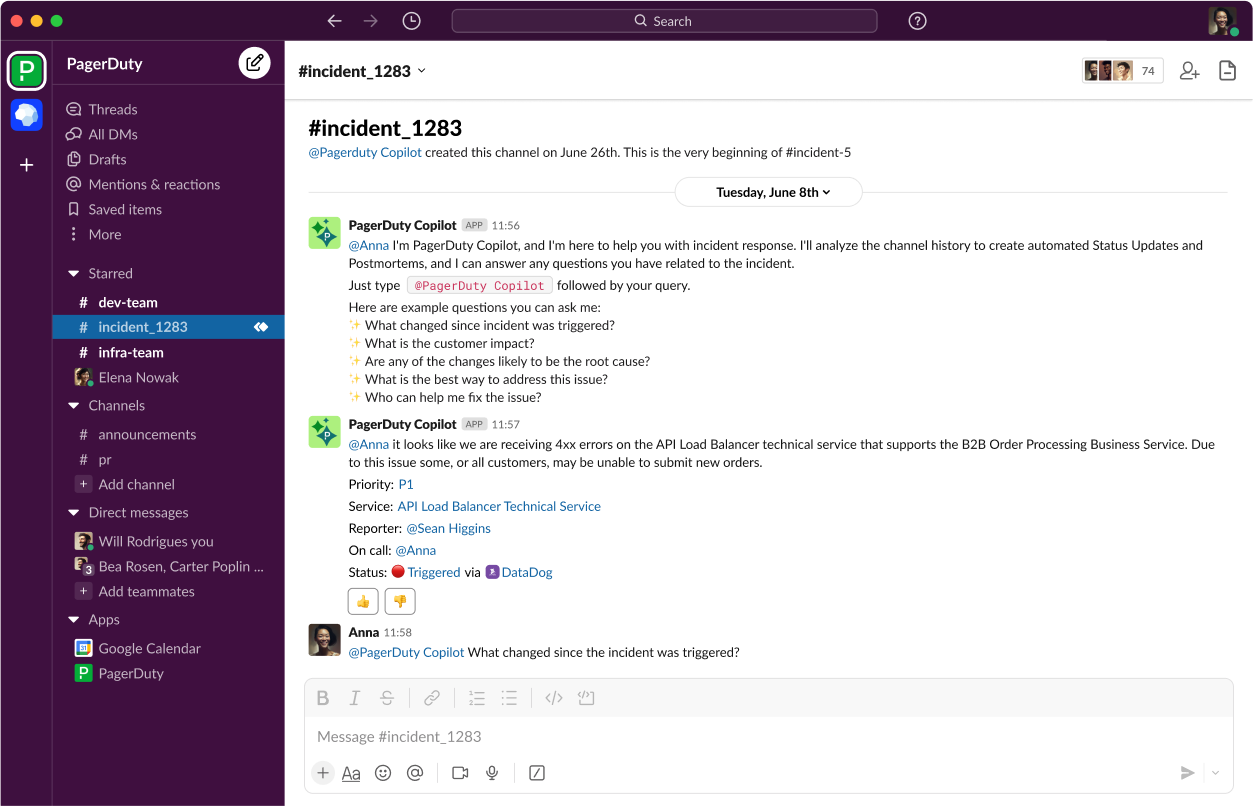
    Under an early access program, PagerDuty, Inc. is making available a tool that brings generative artificial intelligence (AI) capabilities to its IT service management (ITSM) platform.

    Jonathan Rende, senior vice president of products for PagerDuty, said PagerDuty Copilot for the PagerDuty Operations Cloud extends previous investments in machine learning algorithms the company has made as part of an ongoing effort to apply AI to ITSM.

    Designed to be invoked via Slack, PagerDuty Copilot makes use of multiple large language models (LLMs) to automate tasks ranging from providing summarization of IT incidents to creating code to automate workflows. PagerDuty plans to transparently swap LLMs in and out of its platforms as AI advances continue to be rapidly made, noted Rende.

    PagerDuty Copilot provides a level of abstraction for invoking AI models along with appropriate guardrails that make it simpler to manage IT operations without IT teams needing to have AI expertise, said Rende.

    The overall goal is to boost the productivity of IT operations teams by eliminating much of the drudgery and toil that conspires to make working in IT tedious, noted Rende. AI technologies are not likely to replace the need for IT personnel as much as they will enable IT teams to focus on tasks that add more value to the business, he added.

    It’s now only a matter of time before generative AI capabilities are pervasively applied across both ITSM and DevOps workflows. Less clear is the impact those capabilities will have on the best practices currently relied on to manage those workflows as more tasks are automated. Ultimately, however, AI should make it easier for more organizations to embrace those best practices as the level of skill and expertise required to manage IT at scale is reduced.

    In addition, the whole concept of issuing tickets to manage tasks tracked by a central system of record may need to evolve simply because AI has automated requests for service. There will naturally need to be some system of record for tracking requests. Still, ultimately that process will be managed via copilots rather than by a ticket created by an end user that is then tracked via an ITSM platform.

    Savvy IT teams, in the meantime, are already moving to determine which tasks and workflows will be automated in anticipation of AI becoming more widely embedded in ITSM and DevOps platforms. Roles and responsibilities within IT teams will inevitably evolve as AI increasingly automates mainly mundane tasks, such as creating reports that many IT professionals would rather not spend time writing.

    The biggest IT management platform challenge in the future might not necessarily be adjusting to AI as much as it will be orchestrating requests that are likely to be generated by multiple types of copilots that have been embedded into almost every application.

    One way or another, AI is about to transform how IT operations are managed. As disruptive as those advances will be, AI, more importantly, will also enable organizations to manage IT at levels of scale that were previously unimaginable.

  • PagerDuty Signals Commitment to Adding Generative AI Capabilities

    PagerDuty Signals Commitment to Adding Generative AI Capabilities

    PagerDuty has signaled its intention to add generative artificial intelligence (AI) capabilities to its cloud platform for managing IT operations via integrations with large language model (LLM) providers that it will disclose at a future date.

    These capabilities will make it possible to invoke natural language via PagerDuty Operations Cloud to automatically generate status updates, create drafts of incident postmortem reports and even co-author workflows in any programming language to automate remediation of an issue.

    Damon Edwards, senior director of product for PagerDuty, said as AI continues to evolve, the goal will be to minimize the need for human involvement as much as possible. That doesn’t mean there won’t be a need for humans to be involved, but it does mean that many rote tasks associated with managing an IT incident can be automated, he added.

    For example, the reports that are run to determine the root cause every time there is an incident can be automated, noted Edwards. In addition, summarizations of status reports or postmortems after incidents were resolved can be made readily available to any member of an IT team on demand, he added.

    Those capabilities will also make it easier to onboard new members to an incident management team as required, said Edwards. Today, it’s difficult to add new members to a team after an incident has unfolded because it takes time to bring them up to speed, he noted.

    In addition, generative AI also makes it easier to capture a lot of the tribal knowledge within an IT organization that would otherwise disappear when staff either leave the company or shift roles, said Edwards.

    The generative AI additions to the PagerDuty platform extend an artificial intelligence for IT operations (AIOps) capability that PagerDuty made available this spring. The PagerDuty AIOps platform leverages the data model embedded in its incident management software to reduce the amount of time required for an AI platform to learn how an IT environment operates and begin surfacing valid recommendations to optimize workflows.

    It’s not clear at what pace AI will be adopted within enterprise IT organizations, but it is rapidly becoming pervasive. Each DevOps team will need to decide the degree to which they can rely on AI to manage IT processes, but as IT processes become more complex, there is a clear need for AI to navigate all the dependencies that exist in an IT environment. As more routine tasks are automated, however, there will also inevitably be a realignment of roles and responsibilities within an IT organization. The overall goal is not so much to eliminate IT staff as much as it is to enable them to manage IT environments at a much higher level of scale.

    In the meantime, DevOps teams need to plan for not only what is possible using generative AI today but also tomorrow. After all, there’s not a lot of point in training someone to take on a new task if that task is automated a few months from now.

  • PagerDuty Bets on AIOps and Automation to Simplify IT Management

    PagerDuty Bets on AIOps and Automation to Simplify IT Management

    PagerDuty this week made generally available an artificial intelligence for IT operations (AIOps) platform that leverages the data model embedded in its incident management software to reduce the amount of time required for an AI platform to learn how an IT environment operates.

    Jonathan Rende, senior vice president and general manager for PagerDuty, said that approach enables the PagerDuty AIOps platform to begin surfacing valid recommendations sooner than other AIOps platforms. Other platforms first need to be integrated into IT environments by an expensive team of consultants and integrators, he added. The PagerDuty approach makes the benefits of AIOps immediately available to both IT operations teams and application development teams alike, he said.

    The arrival of PagerDuty AIOps comes on the heels of the launch of PagerDuty Process Automation, a platform for orchestrating automation across multiple platforms that is integrated within PagerDuty Operations Cloud. That capability makes it possible for organizations to centralize the management of islands of automation that have emerged across the enterprise without having to replace any framework that has already been deployed, said Rende. There are also more than 700 integrations between PagerDuty AIOps and the PagerDuty Operations Cloud platform.

    Like other platforms, PagerDuty AIOps relies on machine learning algorithms and an AI model created by PagerDuty to correlate events so that the platform can put them in context. Incident response recommendations are then made, which an IT team can accept and automatically implement or reject. The platform then uses those inputs to surface more accurate recommendations over time, said Rende.

    The platform will also automatically group apply defined rules coupled with its machine learning capabilities to aggregate alerts. That capability reduces the overall alert noise that might otherwise be generated, noted Rende.

    Organizations are looking to invest in AI and automation more heavily at a time when many of them are reducing the overall size of their IT staff, said Rende. The challenge with AI, however, is that it can take six months or more for a rival AIOps platform to learn enough about an IT environment to begin making recommendations. The PagerDuty approach takes advantage of the data within the PagerDuty incident management platform to train an AI model more quickly, in a way that reduces the time to generate valid recommendations to a matter of days, noted Rende.

    PagerDuty has been building that AI model for the last four and a half years with that specific goal in mind, he added.

    It’s not clear how quickly organizations are embracing AIOps, but as IT environments continue to evolve, many once-manual tasks are being automated. There is a natural fear of the impact those advances might have on specific roles within an IT organization, but as IT environments get more complex, there will always be a need for IT personnel that can focus on higher-order tasks, said Rende.

    Overall, the rate of IT staff turnover should also decline as much of the toil that contributes to burnout is also eliminated.

    It may be a while yet before AI becomes pervasively applied to manage IT, but the proverbial genie is not going back into the bottle. The challenge is determining precisely where the line between the man-machine interface with IT environments is today versus where it might be tomorrow.

  • The Now and Next of Automation

    The Now and Next of Automation

    Today’s never-ending flood of data has many of us drowning in noise. And while humans are still essential for thoughtful analysis and driving action, it’s no longer possible for a human to parse gigabytes of data alone.

    How do you begin to filter out the noise and then understand what to do with it? How can you get to the root cause of an issue so you can act on and resolve it? Most of all, how can you do all of this while being more productive and driving more innovation instead of constantly putting out fires?

    Automation is the obvious answer. For many organizations, automation isn’t just about efficiency – it’s about survival. Automation can make organizations more agile, resilient, and capable.

    Where you sit within an organization or team, however, often dictates how automation can help with your specific goals or alleviate your immediate pain points. Mandi Walls, a DevOps advocate with PagerDuty, offers some advice on how even less experienced teams can use automation to perform simple tasks, solve problems and improve the work environment.

    We hear a lot these days about A.I. and machine learning, or tools like Chat GPT which to some is a harbinger of robots finally replacing humans. Putting the hyperbole aside, where do you see automation today? Is it still a “nice to have” for engineering teams or a “must-have” to do their jobs effectively?

    Automation is definitely a “must-have.” Manual processes are risky; they can inadvertently introduce too many errors, especially in complex environments. The scope and complexity of modern technical ecosystems is just too vast for teams to effectively cope with using only manual methods.

    This is especially true for teams that develop and manage customer-facing services. Having a successful product leads to more customers, which requires more capacity and creates more complexity. To deliver the kind of performance customers expect, teams need to be fast and efficient. That’s where automation comes in.

    What are some specific types of automation that engineers and IT pros should be aware of?

    Some automation has become more or less ubiquitous, such as tools that enable configuring and building large numbers of systems with little human intervention. Other processes might feel less like “big-A” automation–for example, continuous integration/continuous delivery (CI/CD) pipelines are automation.

    Humans also aren’t manually building many software packages anymore. The use of automation in the software testing process has greatly expanded in the last several years, changing the jobs of QA engineers significantly.

    Is self-service automation – aka true autonomy that doesn’t require human intervention – the ideal end state for a digitally mature organization? When is the best time to jump in?

    Organizations that wait for a perfect opportunity to automate their processes risk wasting a lot of time and resources in the interim. Teams can look at any of the tasks that they regularly perform and assess them as candidates for automation.

    Tasks can be assessed in a number of different ways, but for teams just starting out with automation, seeking tasks that are low complexity and low impact is a strong starting point. Even if we look just within the realm of tasks that might be utilized during incident response, teams might have any number of tasks related to information gathering, log preservation, system diagnostics, and other telemetry that responders run for every incident. There’s no reason to require humans to run those well-understood tasks!

    As teams get more comfortable with creating and using automation, they can seek out more complex tasks to automate. And it’s entirely possible that there will be tasks that teams aren’t able to automate fully! Those tasks might be too complex, require a lot of human input or interaction or have too many edge cases for the team to create automation for.

    Are the principles of automation the same in simple versus more complex environments like Kubernetes?

    The principles are essentially the same, but the constraints and tools may be different. In some environments, a simple shell script might be enough to accomplish our goals. In other environments, we might need to make use of APIs or vendor SDKs to do what we want.

    On that topic, is self-service automation in cloud environments the preferred path?

    Actually, self-service is sort of how the cloud really got going! Development teams armed with nothing more than a credit card got the environments they needed without going through lengthy procurement processes.

    Now that cloud is a critical part of many workloads, organizations are putting more rigorous guidelines in place. The cloud platforms are also much more complex, with more service offerings than in the early days, which makes automation more important than ever. Automation helps organizations ensure that their cloud environments meet their security and compliance requirements, helps manage spend and still provides enough flexibility for all teams to get work done. And with self-service automation, developers can request an environment in the cloud to develop their service and have that service meet all the organization’s standards without having to keep up with all the details themselves.

    What about toil? Can that be fully eliminated through automation, or is some toil still necessary?

    I’m not sure I’d say toil is necessary, as much as it tends to be inevitable. There will likely always be some boring, repetitive tasks that are too unpredictable or unstable to automate well.

    That said, teams certainly don’t need more toil; having too much repetitive work tends to lead to less job satisfaction and higher attrition rates, so teams should be looking to minimize as much toil as possible where they can.

    Is there one myth or misconception, either about automation overall or self-service automation in particular, that you’d like to clear up? What’s the reality?

    First of all, don’t worry. You won’t be able to replace your team with a set of shell scripts! Seriously though, automation isn’t about “doing more with less.” It’s about doing more with the same. Automation is an approach to help teams cope with the day-to-day running of complex environments and will need to be managed as part of those environments. Managers need to make sure they are allotting time for the creation and maintenance of automation in the same way they would for other tools and applications.

    Interested in learning more about PagerDuty? Stop by Booth S49 at KubeCon to speak with an expert or see a demo!

  • PagerDuty Allies with JFrog to Modernize IT Incident Management

    PagerDuty Allies with JFrog to Modernize IT Incident Management

    PagerDuty has integrated its IT incident management platform with the continuous integration/continuous delivery (CI/CD) platform from JFrog as part of an effort to streamline troubleshooting of application environments.

    Steve Gross, senior director of strategic business development at PagerDuty, said the overall goal is to make it easier for IT operations teams and developers to collaboratively discover the root cause of issues by, for example, being able to identify builds within a JFrog pipeline that might be having a negative impact on a production environment.

    At the same time, IT teams employing PagerDuty can now also receive notification from JFrog Xray, a tool that discovers both vulnerabilities in open source software and license compliance issues.

    Organizations of all sizes are attempting to minimize the impact of an IT incident by providing deeper insights into how applications were constructed. The goal is to reduce the amount of time IT teams currently spend looking for the root cause of a problem.

    PagerDuty JFrog

    Ideally, IT teams would discover those issue before they impact end users. The challenge they face is it can take weeks to discover the root cause of an issue that takes a developer a few hours, at most, to fix. Armed with insights from the CI/CD platform, Gross said it becomes easier for IT operations teams to proactively pinpoint the source of an issue in a way that provides the developer with enough insight to act.

    That is critical because, more often than not, it’s the last build of application that was deployed in a production environment that is usually the source of an issue, especially when that IT environment was operating normally before that build was promoted into a production environment.

    The data collected by PagerDuty from various DevOps platforms is fed into the PagerDuty tools via a Change Events application programming interface (API). Over time PagerDuty will also be able to apply machine learning algorithms and other forms of artificial intelligence (AI) to identify issues long before they reach a meaningful level of disruption, noted Gross.

    In general, there’s a movement to modernize IT incident management in a way that aligns with DevOps best practices as part of an effort to identify issues before an application is actually deployed. The hope is that those efforts will reduce the number of “war room” meetings that need to be convened to determine the root cause of a performance or security issue after an application has been deployed.

    It may be a while before IT incident management processes are modernized to that level. However, as IT environments become more complex—in part because of the number of microservices-based applications with multiple dependencies that are now being deployed—it’s apparent existing approaches to IT incident management don’t allow IT teams to respond fast enough to an issue. In fact, that’s more challenging than ever now that many of the members of an IT team are working from home more often.

    The pressure to modernize IT incident management increases in almost direct proportion to IT teams’ stress levels. The challenge now is to modernize those processes before the members of an IT team are too burned out to appreciate the effort.

  • PagerDuty and JFrog Announce Integrations for DevOps and Security Lifecycle

    New integrations provide customers with faster incident resolution, improving uptime, enhancing customer experience and driving revenue generation.

    San Francisco, CA, June 8, 2021 — PagerDuty, Inc. (NYSE:PD), a global leader in digital operations management, today announced new integrations with JFrog (NASDAQ: FROG), the liquid software company. The integrations with JFrog Xray and JFrog Pipelines – both part of the JFrog DevOps Platform – allow customers to observe their entire software delivery lifecycle, understanding any changes, and identifying security issues throughout the process. This end-to-end DevOps solution includes DevSecOps, DevOps Observability and Software Development Lifecycle (SDLC) Monitoring for on-prem hybrid and Multi-Cloud deployments.

    “Traditionally, information security was a bottleneck in software delivery,” said Timm Hoyt, global vice president of partners & alliances at PagerDuty. “This new integration will not only help remove this bottleneck but help organizations thrive when resolving incidents. We’re proud to partner with JFrog and provide a solution that helps teams manage urgent, mission critical work that is essential to keeping digital services always on.”

    With the JFrog Xray-PagerDuty integration, DevSecOps teams can receive PagerDuty notifications for open source security vulnerabilities and license compliance violations detected by Xray’s continuous scanning of packages and container images to quickly fix the issues. PagerDuty can then turn any security or license policy alert into an incident report. This is useful to proactively manage security and compliance across the software development and release lifecycle, customize notifications, and receive a continuously updated list of impacted components and their associated dependencies.

    With JFrog Pipelines and PagerDuty, users can simplify and streamline how to identify faulty builds that impact production environments. IT operators can quickly detect incidents, determine root causes, roll back builds and shrink resolution time. This helps IT operators and developers become more productive, determine what has changed within their environment, and makes them better able to prevent outages and increase the uptime, stability and reliability of business-critical applications and digital services.

    “We are excited to partner with PagerDuty. The integration of our leading solutions — the end-to-end, universal DevOps Platform from JFrog, and PagerDuty’s digital operations management capabilities — enable DevOps teams with powerful observability and incident management throughout the DevOps lifecycle,” said Steve Chin, Vice President of Developer Relations, JFrog.

    To learn more about the integration of JFrog and PagerDuty products, register for PagerDuty Summit from June 22-25, 2021 and tune in for the session “The Power of AIOps” by Mitra Goswami.

    About PagerDuty, Inc. 

    PagerDuty, Inc. (NYSE:PD) is a leader in digital operations management. In an always-on world, organizations of all sizes trust PagerDuty to help them deliver a perfect digital experience to their customers, every time. Teams use PagerDuty to identify issues and opportunities in real time and bring together the right people to fix problems faster and prevent them in the future. Notable customers include GE, Cisco, Genentech, Electronic Arts, Cox Automotive, Netflix, Shopify, Zoom, DoorDash, Lululemon and more. To learn more and try PagerDuty for free, visit www.pagerduty.com. Follow our blog and connect with us on Twitter, LinkedIn, YouTube and Facebook.

    About JFrog

    JFrog (NASDAQ: FROG) is on a “Liquid Software” mission to enable the flow of software updates seamlessly and securely from the developer’s keystrokes to production. JFrog’s end-to-end, Universal, Hybrid DevOps Platform provides the tools and visibility required by modern software development organizations to fully embrace the power of DevOps. JFrog’s Platform is available as open-source, self-managed, and SaaS services (with free tier) on AWS, Microsoft Azure, and Google Cloud. JFrog is trusted by millions of developers and thousands of customers, including the majority of the Fortune 100 companies that depend on JFrog solutions to manage their DevOps pipelines. Learn more at jfrog.com.

  • PagerDuty Hires Timm Hoyt VP of Global Partners and Alliances to Bolster Its Partner-First Sales Strategy

    Global tech veteran to head up partnership sales program that will drive growth and create new opportunities for PagerDuty and its partners

    San Francisco, CA, May 18, 2021 – PagerDuty, Inc. (NYSE:PD), a global leader in digital operations management, has hired industry veteran Timm Hoyt to lead its global partner and alliances organization. As vice president of partnerships, Hoyt will work directly with PagerDuty’s product and sales team to increase partnership-driven revenue.

    Hoyt comes to PagerDuty with a background in building go-to-market engines for a broad spectrum of global public and private tech companies, including organizations focused on data center infrastructure and SaaS. He joins the team from Druva where he was global vice president of partner sales. In this role he overhauled the company’s sales motion to become partner-first, increasing Druva’s partner revenue from 9% to over 80% – and becoming the company’s best way to win new customers.

    “PagerDuty sits at the center of the digital ecosystem and partnerships are critical as they allow our customers to integrate our platform with their entire digital operations, improving overall performance and working effectively across teams, no matter their preferred working tool,” said Dave Justice, chief revenue officer at PagerDuty. “Close to 14,000 organizations, including more than 60% of the Fortune 100, rely on PagerDuty’s ability to manage urgent, mission-critical work that is essential to keeping digital services always on. Moving to a partner-first model for growth will help us to continue to expand how we deliver value to customers – helping them increase revenue, lower costs and mitigate risks.”

    Hoyt brings extensive experience with driving success in global markets, including with sales, marketing and building partner organizations. He has worked for several years in EMEA, as well as Japan, South Korea and North America and Latin America. As part of his responsibilities, Hoyt will oversee partnership relations for five key pillars, including channel partners, cloud providers, ecosystem alliances, managed service providers and system integrators.

    “As companies move rapidly to digital first, PagerDuty is essential for helping businesses handle any urgent mission critical need right away,” said Hoyt. “I couldn’t be more excited to join PagerDuty to lead its partner organization and continue to empower and incentivize the partners in our ecosystem.”

    PagerDuty’s partner program brings a rich mix of solution, industry vertical and geographic expertise, including the likes of Buildkite, Gitlab, Jenkins and JFrog, to those looking to automate digital operations management. With more than 500 integrations, PagerDuty serves the unique and complex needs across DevOps, ITOps, CloudOps, AIOps, Customer Service, Security Operations, and Industrial Ops. Hoyt’s appointment follows other company milestones like the acquisition of Rundeck which enhances PagerDuty’s automation capabilities and the expansion of the partner program last summer for system integrators and managed service providers.

    For more information about PagerDuty and its partnership program, visit the website.

    About PagerDuty, Inc.

    PagerDuty, Inc. (NYSE:PD) is a leader in digital operations management. In an always-on world, organizations of all sizes trust PagerDuty to help them deliver a perfect digital experience to their customers, every time. Teams use PagerDuty to identify issues and opportunities in real time and bring together the right people to fix problems faster and prevent them in the future. Notable customers include GE, Cisco, Genentech, Electronic Arts, Cox Automotive, Netflix, Shopify, Zoom, DoorDash, Lululemon and more. To learn more and try PagerDuty for free, visit www.pagerduty.com. Follow our blog and connect with us on Twitter, LinkedIn, YouTube and Facebook.

  • PagerDuty to Offer European Data Hosting

    PagerDuty responds to European customer growth with regional data solution


    SAN FRANCISCO – March 17, 2021 – PagerDuty, Inc. (NYSE:PD), a global leader in digital operations management, today announced plans to offer customers a new European hosting option for data assets, including customer-generated data, based on Amazon Web Services (AWS).

    PagerDuty helps companies manage time sensitive mission critical work and keep digital services always on. It enables teams who build and run digital systems to detect, diagnose and resolve issues fast – using machine learning to pinpoint problems and automate action. Customers include over 60% of the Fortune 100 and the likes of Vodafone, SAP, The Telegraph Group, GE, Cisco and Zoom.

    “SAP is dedicated to maintaining an always-on cloud infrastructure for our customers. PagerDuty’s innovative and agile approach to incident management has helped make this possible by reducing response and resolution times for our Cloud operations teams,” said Elamurian Rajagopal, head of service desk and network operations center at SAP. “We are excited by this new data center option as it adds yet another layer of regional support to PagerDuty’s service offering.”

    European customers using PagerDuty’s European data hosting will be able to achieve the same high levels of reliability they have come to expect of PagerDuty’s leading enterprise class platform and reduce any potential data latency issues.

    “PagerDuty has significantly improved the way we manage our SRE/Support & Operations activities,” said Lucian Craciun, head of technology at The Telegraph. “With aspects of the service now being offered directly from a European location, we are pleased to see continued investment in making this critical service more resilient, robust and performant.”

    PagerDuty’s regional data hosting option enables its growing European customer base, including those in highly regulated markets such as financial services, public sector, and healthcare, as well as Managed Service Providers, to meet the growing demand for PagerDuty’s solutions across the region.

    Sean Scott, chief product officer at PagerDuty comments, “We take data protection very seriously and work with all our customers in the EU and throughout the world to address their needs and concerns while also complying with local policy such as a GDPR. PagerDuty has set the bar consistently high when it comes to service reliability, redundancy and availability with service level agreements, no maintenance windows and three nines availability. This will be no different for EU users who can continue to deliver their customers a perfect experience every time.”

    PagerDuty handles the critical work of keeping digital services running perfectly, in a time when digital is the forefront of how companies serve their customers.

    “In today’s world, the need for resilient cloud-based geographic capacity is of great importance,” said Roy Illsley, chief analyst cloud and data center at Omdia. “PagerDuty’s European data center expansion plan will enable it to meet these needs and deliver a better customer experience. Omdia has seen an increase in demand for cloud-based services as organizations recognize that to meet the new velocity of business change its technology must be both agile and flexible.”

    PagerDuty expects regional services to be available to new customers from the second half of 2021 onwards.

    About PagerDuty, Inc.

    PagerDuty, Inc. (NYSE:PD) is a leader in digital operations management. In an always-on world, organizations of all sizes trust PagerDuty to help them deliver a perfect digital experience to their customers, every time. Teams use PagerDuty to identify issues and opportunities in real time and bring together the right people to fix problems faster and prevent them in the future. Notable customers include GE, Cisco, Genentech, Electronic Arts, Cox Automotive, Netflix, Shopify, Zoom, DoorDash, Lululemon and more. To learn more and try PagerDuty for free, visit www.pagerduty.com. Follow our blog and connect with us on Twitter, LinkedIn, YouTube and Facebook.

    __