The Open Policy Agent (OPA) was accepted for incubation by the Cloud Native Computing Foundation. In this DevOps Chat we spoke with one of the founders of the project, Torin Sandall, about OPA and why the CNCF is the right place for OPA. We also discuss the company he works for, Styra, which works with OPA.
As usual, the streaming audio is immediately below, followed by the transcript of our conversation. Enjoy!
Transcript
Alan Shimel: Hey, everyone. This is Alan Shimel, MediaOps, the people behind devopsy.kinsta.cloud, Container Journal, Security Boulevard and DevOps Chat, and you’re listening to another DevOps Chat.
I’m really happy to have as a guest for this DevOps Chat, Torin Sandall, and Torin is actually one of the co-founders of the Open Policy Agent (OPA) open source project, which recently came under the guidance management of Cloud Native Computing.
So, let’s welcome Torin. Torin, you there?
Torin Sandall: Hey, Alan. Yeah, great to talk to you.
Shimel: Great to have you here, and a pleasure to have you joining us on this podcast. Torin, let’s first start off with, maybe there are people out here who don’t know what OPA is—what Open Policy Agent is, right? There’s some great, if you go to—actually, if you go to CNCF.io, there’s a blog article all about it and I’ll put it in our show notes. But for those who are following along or listening to this in their car or what have you, talk to us—what’s Open Policy Agent?
Sandall: Yeah, that’s a great question, and it’s a good way to get started.
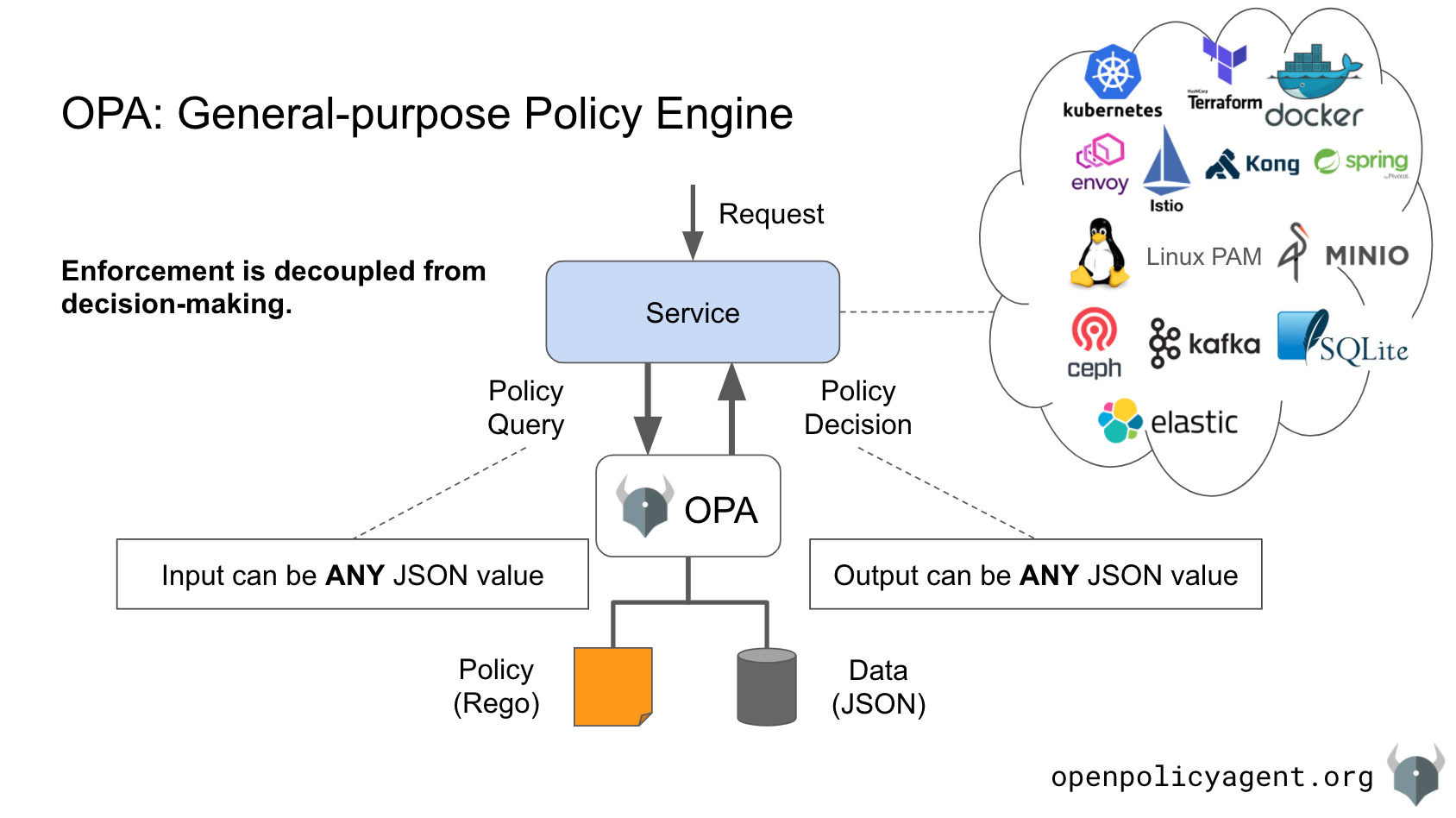
So, Open Policy Agent is a domain agnostic policy engine, okay? So, it’s general purpose, meaning that you can kind of take it and use it to enforce all kinds of policies and governance regimes across a wide range of technology.
So, for example, if you want to say that, you know, all of your containers have to be sourced from an internal image registry, you can express that kind of a policy with OPA, or the Open Policy Agent. If you want to do something like say that certain users can only see certain pieces of data served by a micro service, you can also do that with the Open Policy Agent. And if you want to restrict who can SSH into a server or run a pseudo command on a server, you can also do that with the Open Policy Agent.
So, the idea is that we give people this engine that allows them to unify policy control across various pieces of their stack.
Shimel: Excellent. And you know what’s interesting? I was talking to someone the other day and we were talking about, you know, how does Kubernetes fit into this whole Cloud Native thing? Because Cloud Native and the CNCF is bigger than just Kubernetes. And they gave me a really good analogy. They said, “Think of it as like, you know, a fleet of warships or, you know, a U.S. Navy fleet and maybe Kubernetes is the aircraft carrier. But there’s more to the Navy than the aircraft carrier. There’s more to a fleet than an aircraft carrier. There’s battleships and cruisers and destroyers and subs and frigates and amphibious landing ships,” and you know, I’m not a Navy expert. [Laughter] But there’s all these different elements that make up the fleet—and it’s a huge fleet.
And so, you know, when I look at OPA, you know, Open Policy Agent—and we’re gonna talk about joining Cloud Native Computing Foundation—it’s a necessary ship in the fleet, right? That really makes it easier and more practical to use a lot of the tools that are not only in the fleet, but a lot of the commercial tools that kind of exist on the periphery as well. Fair?
Sandall: Absolutely, yeah. The CNCF is a collection of projects that provide a lot of value within the overall ecosystem, and there are a few things that kind of bind them together, and those are kind of high level principles. So, you know, they’re all open source, they are all, you know, they’re oriented around containers. They’re oriented around very dynamic systems that you need to manage at scale.
And so, one of the interesting things about a lot of the projects within the CNCF is that they are kind of building blocks. You can think of them as libraries or building blocks for the overall system, right? And so, you know, they integrate together, you can plug them into other systems and so on. And so, that’s how we kind of look at OPA. That’s how we think about OPA, is as a building block or as a library for enabling rich, fine grain control across a variety of parts of your environment.
Shimel: Absolutely.
Sandall: And, yeah, and so, policy is particularly important when you start to talk about adoption of technology within large organizations, right? As Kubernetes has matured and enterprises have really started to run with it and deploy real production workloads on top of it, they’ve recognized the need for not just simple best practice kind of security measures, but much more sophisticated and rich and fine grained rules and constraints that need to be enforced in a system in order to keep everybody safe. And so, that’s where OPA fits into Kubernetes.
Shimel: Yeah, absolutely. You know what? I realized, and I apologize, I really didn’t do a good job of letting you introduce yourself to our audience on top of [Cross talk].
Sandall: [Laughter] That’s okay.
Shimel: So, Torin, I apologize. In addition to you being one of the co-founders of the project, why don’t you share a little bit about what you do in your day job and the rest of your life?
Sandall: For sure, yeah. So, I think what’s relevant here is that I’m the co-founder of the Open Policy Agent project. I’m also a software engineer at a startup called Styra. We’re the makers of the Open Policy Agent. We founded the project about three years ago—a little over three years ago, actually, and yeah, so we’re kind of like the stewards of the project today. That said, we’re starting to see a lot more people from the community kind of come in and start contributing to Open Policy Agent and related kind of projects in the ecosystem.
So, that’s sort of what I do. My focus is kind of on Open Policy Agent, but I’m super interested in the overall Cloud Native ecosystem and security and policy and all that kinda stuff.
Shimel: So, you know, and I should also mention—I did a terrible job laying this one out, Torin, I apologize. We should also mention that the big news coming out—I guess it was this week, or maybe late last week—was that OPA, Open Policy Agent, has now become or come under the auspices of Cloud Native Computing Foundation (CNCF).
Sandall: That’s right, yeah. So, we actually, we joined the CNCF as a sandbox to your project last year, in 2018. OPA was added into the CNCF sandbox. So, the CNCF has multiple tiers, and right now there’s sandbox, incubation and graduated.
And so, this year, basically, they do a review of projects, you know, every year, and they check in on how the projects are doing and how they’re growing and how their communities are evolving. And that’s just useful, right? To kind of maintain, kind of, you know, good hygiene within the ecosystem. But this time around, we felt that—everybody kinda felt that OPA was growing quite a bit and it kind of deserved to move up to the next level incubation within the CNCF.
And so, the move from sandbox to incubation is really a reflection of the progress that we’ve made over the last year in terms of both production users as well as proof of concepts and integrations, and new external contributors joining the project.
Shimel: Got it. And, you know, I will just mention that, you know, CNCF has really done an amazing job of shepherding these projects, from sandbox into incubation, and then from incubation into graduation. I forgot the number, if it was five or six projects they’ve graduated now.
Sandall: Yeah, I think there’s about five graduated projects today. You know, Kubernetes is one of them, it’s kind of one of the flagship projects, and there are others. And so, yeah, so, they’re really doing a good job of curating a very important set of building blocks, like I said, that are gonna help organizations get to cloud native.
Shimel: So, let me ask you a question—and I think this is something our audience would really enjoy. How did you, as a co-founder of the OPA project, right, what was your sort of motivation for, you know, bringing it under the CNCF?
Sandall: So, yeah, that’s a great question. What we found was that after, you know, the project had been around for over a year, or rather over almost two years, I guess. And what we found with talking to users and potential users was that they wanted to see OPA as part of a kind of vendor neutral organization, right? So, Styra, the company that I work for, had kind of built OPA, and it’s been open source since day one, but people really like to see these kinds of projects, these kinds of core infrastructure components a little bit decoupled from, like say, any particular organization.
Shimel: Mm-hmm.
Sandall: And so—
Shimel: Well, not decoupled from any particular organization. Decoupled from any one particular vendor.
Sandall: One vendor—yeah, sorry. One vendor.
Shimel: There’s not a single vendor.
Sandall: Yes. And so, you know, we looked around and we looked at the CNCF and we really liked what they were doing and we figured that that was the right place for OPA to be.
So, you know, the CNCF basically provides us with this kind of vendor-neutral home for the project, and it allows us to kinda create a rallying point around policy in the cloud native ecosystem. So, that was the main, high level motivation for joining CNCF.
Shimel: Got it. And it makes perfect sense. I mean, I’ve gotta tell you, you know, I don’t know if you’re familiar, but recently, the CNCF launched—not the CNCF, excuse me—the Linux Foundation, right, which is kinda the parent of the CNCF, right?—
Sandall: Right, yes. Yes.
Shimel: —launched another foundation called the CD Foundation, Continuous Delivery.
Sandall: Yes, yes.
Shimel: And CloudBees, the folks at CloudBees and the Jenkins project was given under to the CD Foundation. Jenkins had Jenkins X, Netflix put in Spinnaker and Google put in—I forget its name now, with a T.
Sandall: Tekton?
Shimel: Tekton. They put, you know, put Tekton into the thing. And I had a good chance to interview some of the CloudBees folks with this, and I asked them the same kinda question I just asked you. You know, and it was a very similar answer, that not only do end users perhaps shy away from a single vendor supported project, but it’s very hard for a project to break out of that mold and get other vendors or talent at other vendors to contribute, because they think they’re doing it for the benefit of one of their competitors.
So, by putting it under a neutral party like this, you know, not only is it more palatable to your end users and to the community as a whole, but it’s especially more attractive to that segment of the community that are made up of vendors. And whether you hate vendors and you think they’re all commercial slime who sold out to the man or not, the fact of the matter is, those are the people who have the resources to put into these projects and to move the needle and to keep that ball moving forward and push the rope up the hill and all of that. So, can’t live with ‘em, can’t live without ‘em, and this is a great kinda middle ground.
Sandall: That’s a good point, and I think that, you know, what we’re starting to see are more and more security vendors getting interested in OPA or Open Policy Agent. I like to call it OPA. It’s hard to call it O-P-A when you’ve got that OPA word that you can use, but anyway—
Shimel: Yeah, yeah, yeah. [Laughter]
Sandall: [Laughter] But yeah, so, we’re seeing more and more security vendors get interested in OPA and, you know, that is gonna be instrumental in the long run to achieving the goal of unifying policy control across a number of different systems, right? There’s never gonna be one vendor that rules everything and there’s always gonna be an amalgamation of different technologies. And so, you know, the best that we can do, I think, is provide this building block that can be embedded all over the place and that has, like, the fundamental kind of groundwork that enables unification. So, very exciting times.
Shimel: Absolutely. So, I’m gonna ask you now to put on your entrepreneur’s hat, right? As a co-founder of your company as well, and let’s look at it Torin from that point of view. How is this helping—and I’m not familiar with your company, so I’m gonna apologize in advance. Say the name for us, again?
Sandall: Sorry, the name of the company is Styra.
Shimel: How do you spell that?
Sandall: S-T-Y-R-A.
Shimel: Got it. So, how does this help Styra?
Sandall: That’s a great question. So, yeah, when the founders—I’m not a founder of Styra, I’m an employee at Styra.
Shimel: Oh, I’m sorry. Okay.
Sandall: But anyway, when the founders of Styra started the company, one of the things that they observed was that, in order to unify enforcement of policies across a wide range of technology, there would need to be kind of like a language based approach applied to the problem domain.
And so, that’s one of the things that the Open Policy Agent provides—it gives people this high level declarative language that they can use to codify policies. And so, that was kind of recognized as something that would be needed, and what you quickly kind of—the conclusion you quickly arrive to is that, this was in 2016, 2015, and even more so today, it’s true, but what you quickly arrive at is the realization that that kind of a technology needs to be open source, right? It’s unlikely that organizations are going to want to adopt a proprietary, closed source language. It’s just not going to happen.
And so, right from the very beginning of the company, it was recognized that an important part of the technology was going to be open source. And so, that’s how the kind of project sort of got started.
Shimel: Got it. Got it, got it, got it. You know, I don’t wanna put you on the spot, but a little Styra background—Styra’s venture backed or bootstrapped, or?
Sandall: Yeah, we’re venture-backed, and we recently did a bit of a launch at the RSA Conference a few weeks ago.
Shimel: Really?
Sandall: And so, that was very exciting, yeah. And so, you know, you can think of Styra as a control plane for policies. So, OPA kind of acts as the data plane, right? It’s this thing that you can embed into applications, you can embed it into Kubernetes, you can put it all over the place. But, what you need is also the ability to kind of manage those OPAs that are running all over the place.
And this is what we see within the OPA community—the people that are using OPA building it into their systems. Companies like Netflix that have built an internal security platform around OPA, what they’ve ended up doing is creating a centralized management plane for policy and for security.
And so, that’s what we’re doing at Styra is, we’re helping people kind of think about distributed enforcement of policy and centralized management of policy.
Shimel: Got it.
Sandall: So, we’re focusing today on Kubernetes and you can check out the website, we’ve got a bunch of information on there, but yeah, that’s the high level.
Shimel: Excellent stuff. As a matter of fact, just looking at the website, I didn’t realize this but Styra is Bill Mann’s company.
Sandall: That’s correct, yeah, he’s the CEO.
Shimel: So—just to show you how old I am. I’ve known Bill Mann a really, really long time, like, I remember the day he joined CA.
Sandall: Bill knows a lot of folks, yeah. [Laughter]
Shimel: Yeah, he gets around. Bill’s been around, and so have I.
Sandall: Yeah.
Shimel: I don’t know if that’s a good or a bad thing, you know? But hey, we’re still kickin’. So, tell Bill I said hello, he’ll get a chuckle out of it.
Sandall: Yeah. I will do that, yeah. And we’ve got a great founding team. They are some of the folks that did Nicira, which is one of the very, you know, basically, the first SDN kind of company, right? They [Cross talk]—
Shimel: Yep, I remember that one as well.
Sandall: Yeah. So, we’ve got a deep background within the security and policy space, and we’re kinda taking that and really bringing it into the cloud native ecosystem.
Shimel: Very cool. You know, I don’t wanna make this about Styra because we really wanted to concentrate on OPA and CNCF, but maybe we’ll still, maybe we’ll schedule something, a second one, and we’ll talk—we’ll dive more into Styra.
Sandall: Yeah, that would be great.
Shimel: You guys are gonna be at KubeCon in Madrid—or I mean, in Barcelona?
Sandall: We are gonna be in KubeCon, yes, in Barcelona in May. There are going to be a bunch of talks about Open Policy Agent. There’s gonna be, I think there’s at least three or four sessions that are happening. There’s also a little thing called Cloud Native Rejects the weekend before. [Laughter] These are the talks—like, the BSides Talks, basically for—
Shimel: Yes. Well, that’s how Security BSides started.
Sandall: Yeah, exactly. And so, there’s gonna be a session there with OPA content in it. So, yeah, it’s gonna be a great event.
Shimel: Excellent.
Sandall: And, of course, we’re gonna have a Styra booth at the event, so.
Shimel: So, we will have a, you know, Digital Anarchist is our video platform, and we’ll have a Digital Anarchist set there where we’ll be doing videos. So, be sure—we’ll talk offline, but we’ll get you guys in for a video. We’ll follow up more on that.
Sandall: Perfect! Yeah, looking forward to it.
Shimel: So, is there a timeline for graduation from incubation at CNCF, or that’s kinda open?
Sandall: It’s open. So, you know, they do a yearly review of the project, and it’s kind of up to, you know, the community and CNCF and everybody to kind of decide when that’s right. And so—yeah, so right now, one of the main criteria for graduation is around external contribution. And so, you know, over the next year, we’ll see how external contribution around OPA evolves and if it’s in the right place, then we’ll go ahead with that.
But we’re really happy right now just with the move to incubation because it brings more visibility to the project, it lends more credibility to the project—you know, in addition to all the people that are using it in production, having it more prominently represented within the CNCF is great. So, we’re really happy with where we are today.
Shimel: Fantastic, man. Hey, Torin, I had promised you we’ll do this in 15 minutes, and that was 25 minutes ago.
Sandall: [Laughter]
Shimel: So, I apologize for running over, but I thought we had a good conversation here.
Sandall: Yeah, yeah. Thanks a lot, Alan. Yeah, I appreciate the time to talk about OPA and Styra and I look forward to—
Shimel: Oh, it was really my pleasure. I’d like to—we’ll continue this at maybe KubeCon in May. But before we sign off—so, Styra is Styra.com, S-T-Y-R-A.com. The OPA project, right, is—
Sandall: Yep.
Shimel: —OpenPolicyAgent.org?
Sandall: That’s correct, yep.
Shimel: And, of course, you can find more information on it at the CNCF.io site, right?—
Sandall: Absolutely, yeah, and it’s on GitHub and we also have a blog if you go to blog.OpenPolicyAgent.org, you can find out more there. So, yeah, check it out, and—yeah.
Shimel: [Cross talk] It’s all good. Hey, Torin Sandall, co-founder of the OPA, Open Policy Agent project, which is now being incubated by Cloud Native Computing Foundation, as well as an employee at Styra—for my friend Bill Mann.
Sandall: [Laughter]
Shimel: So, good to have you on there. Say hello to Bill for me. Best of luck with OPA.
Sandall: Will do.
Shimel: And look forward to seeing you in May at KubeCon.
Sandall: Looking forward to it. Talk to you later. Bye.
Shimel: Alright Torin, thanks. Hey, this is Alan Shimel for devopsy.kinsta.cloud, Container Journal and Security Boulevard. You’ve just listened to another DevOps Chat.
— Alan Shimel