Tag: oneAPI

  • Intel Expands Scope of oneAPI Initiative

    Intel Expands Scope of oneAPI Initiative

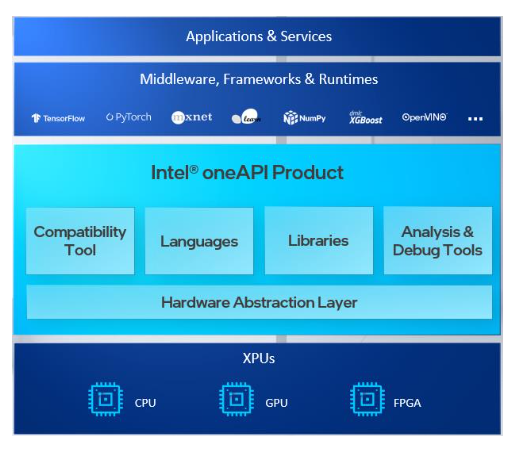
    Intel has expanded its effort to drive adoption of a set of open compilers, libraries, analysis and porting tools and frameworks for artificial intelligence (AI) applications, collectively made available via a oneAPI initiative, to include support for its latest generation of processors.

    The oneAPI initiative was launched more than three years ago to create a set of multi-architecture tools for building applications that could be deployed on any CPUs, graphical processor units (GPUs) and field programmable gate arrays (FPGAs). Processors that now support oneAPI include forthcoming 4th Gen Intel Xeon Scalable processors, Intel Xeon CPU Max Series and Intel Data Center GPUs.

    James Reinders, chief evangelist of Intel Software Products, said there is now a clear need for open tools and frameworks that provide equal access to multiple classes of processors. As part of that effort, the latest 2023 version of oneAPI, for example, adds support for plug-ins for Nvidia and AMD GPUs developed by Codeplay, a unit of Intel, to simplify writing SYCL code in a way that makes code portable across additional processor architectures.

    There is also a CUDA-to-SYCL code migration capability that supports more than 100 CUDA application programming interfaces (APIs) using the Intel DPC++ Compatibility Tool based on an open source SYCLomatic project. Intel is also providing tools to identify imbalances at scale using Intel VTune Profiler, and an Intel Advisor tool now provides automated roofline analysis for Intel Data Center GPU Max Series to identify root causes of memory, cache or compute bottlenecks along with insights for optimizing data transfer costs involving CPU-to-GPU offloading.

    As IT continues to evolve, it will become more routine for developers to invoke heterogeneous classes of processors within the same application, but it’s been challenging to convince providers of other types of processors to support the oneAPI initiative, noted Reinders. Processor providers have historically relied on compilers and libraries to lock developers into specific classes of processors.

    However, it’s becoming more common for developers to build applications that invoke multiple types of processors. The Intel oneAPI initiative is intended to simplify access to heterogeneous processors, also known as XPUs. That’s critical, because the pace of processor innovation has accelerated to the point where developers need to be able to invoke additional capabilities without waiting for specific compilers and libraries to be updated by multiple providers. Once oneAPI is more widely adopted, it then becomes possible to significantly lower the cost of application development and deployment, noted Reinders.

    It’s not clear whether the oneAPI initiative will become more widely adopted, either under the auspices of Intel or by some type of industry consortium that provides a neutral venue for building a common set of compilers and libraries. The one thing that is certain is that DevOps teams are vested in trying to standardize compilers and libraries across as many platforms as possible. The challenge, of course, is making sure developers only invoke compilers and libraries that can span multiple classes of processors versus ones that may have been optimized for a specific type of processor architecture.


  • Intel Expands Scope of OneAPI Toolkit Initiative

    Intel Expands Scope of OneAPI Toolkit Initiative

    Intel has made available a 2022 edition of its oneAPI toolkit through which it makes processor extensions accessible to DevOps teams.

    James Reinders, chief evangelist for Intel software products, said the goal is to make it simpler for DevOps teams to expose extensions to any company’s processors in the runtimes developers use.

    At its core, the oneAPI toolkit is a collection of APIs that Intel created for x86, graphics processing units (GPUs), application-specific integrated chips (ASICs), field programmable gate arrays (FPGAs) and other classes of processors.

    Reinders noted that developers have never had as much ready access to so many different processor classes before. The challenge organizations face, however, is making it simpler for developers to take advantage of those capabilities in a way that doesn’t require them to write low-level code, he added.

    The oneAPI 2022 toolkit adds additional capabilities including the world’s first unified compiler implementing C++, SYCL and Fortran, data-parallel Python for CPUs and GPUs, advanced accelerator performance modeling and tuning and performance acceleration for artificial intelligence (AI) and ray tracing visualization workloads. Collectively, Intel said it has made 900 new and enhanced features available via the oneAPI toolkit in the last year, including deeper Microsoft Visual Studio Code integration, support for Microsoft Visual Studio 2022 and Microsoft WSL2 for Linux development on Windows.

    As IT continues to evolve it will become more routine for developers to invoke heterogeneous classes of processors within the same application, said Reinders. Those capabilities will drive an explosion of software development innovation through the rest of the decade and beyond, he added.

    Intel is especially focused on making it easier for developers to invoke inference engines that take advantage of processor extensions to run AI workloads, Reinders said. Going forward, most applications will take advantage of machine learning algorithms that run inference engines optimized by Intel via extensions to its processors. As those workloads are constructed, integrating AI models within DevOps workflows will become the next major challenge, noted Reinders.

    It’s too early to say how simplified access to heterogeneous processors, also known as XPUs, might change the application development landscape. The one thing that is clear is IT organizations now have more options than ever. The issue now is finding a way to invoke all those capabilities in a way that doesn’t overwhelm developers. DevOps teams will play a key role in deciding which processors and associated extensions to make available to their development teams.

    In the meantime, the battle for processor dominance will only intensify in the months ahead. DevOps teams will need to decide how comfortable they are using processors manufactured by a single company like Intel or whether they want to employ a mix of processors provided by multiple vendors. Regardless of what they decide, it appears APIs will play a critical role in making it easier to benefit from advances in processor technologies.

  • Intel Readies Gold oneAPI Toolkit

    Intel Readies Gold oneAPI Toolkit

    Intel this week said a gold image of its oneAPI for unifying infrastructure as code will be available starting next month.

    Jeff McVeigh, vice president of data center XPU products and solutions Intel, said the goal is to provide a standard application programming interface (API) for accessing the compute capabilities of any processor regardless of what company may have manufactured it.

    The availability of oneAPI coincides with the launch of a series of dedicated graphical processor units (GPUs) from Intel that are intended to supplant the dominance of NVIDIA.

    McVeigh said Intel is encouraging cloud service providers and builders of systems deployed on-premises to embrace oneAPI as a way to standardize the way any CPU, GPU, field-programmable gate arrays (FPGAs) or any other class of processor is incorporated within an environment rather than continuing to relying on programming models such as CUDA from NVIDIA that are designed for only one class of processor.

    The average developer may never interact directly with a low-level oneAPI, but McVeigh said a standard set of APIs at the processor level should ultimately serve to reduce the total cost of IT as developers invoke multiple classes of processors with their applications.

    Intel, of course, also sees oneAPI as an opportunity to usurp NVIDIA as the dominant providers of GPUs that are now widely employed in the cloud to train machine learning models. While Intel CPUs are still employed most to run the inference engine that enables those models to be deployed in a production environment, NVIDIA is now seeking to leverage its success in the cloud to provide either GPUs that can be used to run inference engines or processors from Arm. NVIDIA is in the process of acquiring Arm, a provider of processors that are widely employed in embedded system and edge computing environments.

    Microsoft and the open source contributors that oversees the development of the TensorFlow framework for building artificial intelligence (AI) applications have thus far endorsed oneAPI. In addition, the University of Illinois Beckman Institute for Advanced Science and Technology this week announced it is creating a oneAPI center of excellence (CoE) that will extend the oneAPI programming model to nanoscale molecular dynamics (NAMD) environments that employ code to simulate large biomolecular systems.

    Previously, the University of Stockholm (SeRC) has committed to adding support for oneAPI to GROMACS, open source software for building simulations of biomolecules, while Heidelberg University is working on adding support for oneAPI to GPUs from other vendors. Intel is also making available software based on oneAPI that is compatible with CUDA, added McVeigh.

    Finally, Intel also announced this week that the Intel Implicit SPMD Program Compiler (ISPC) will run on top of oneAPI Level Zero, which provides low-level, direct-to-metal interface. Written in X, ISPC is used to accelerate Intel OSPRay ray tracing engine on Intel CPUs. Support for ISPC on Intel GPUs is forthcoming.

    It may a little while before DevOps teams see the benefits of oneAPI; however, as it becomes easier to mix and match processors as they best see fit, chances are it’s because the overhead on the back end has been substantially reduced using a common API.