Tag: observability platform

  • Lightstep Delivers Next Generation Observability Platform

    Lightstep Delivers Next Generation Observability Platform

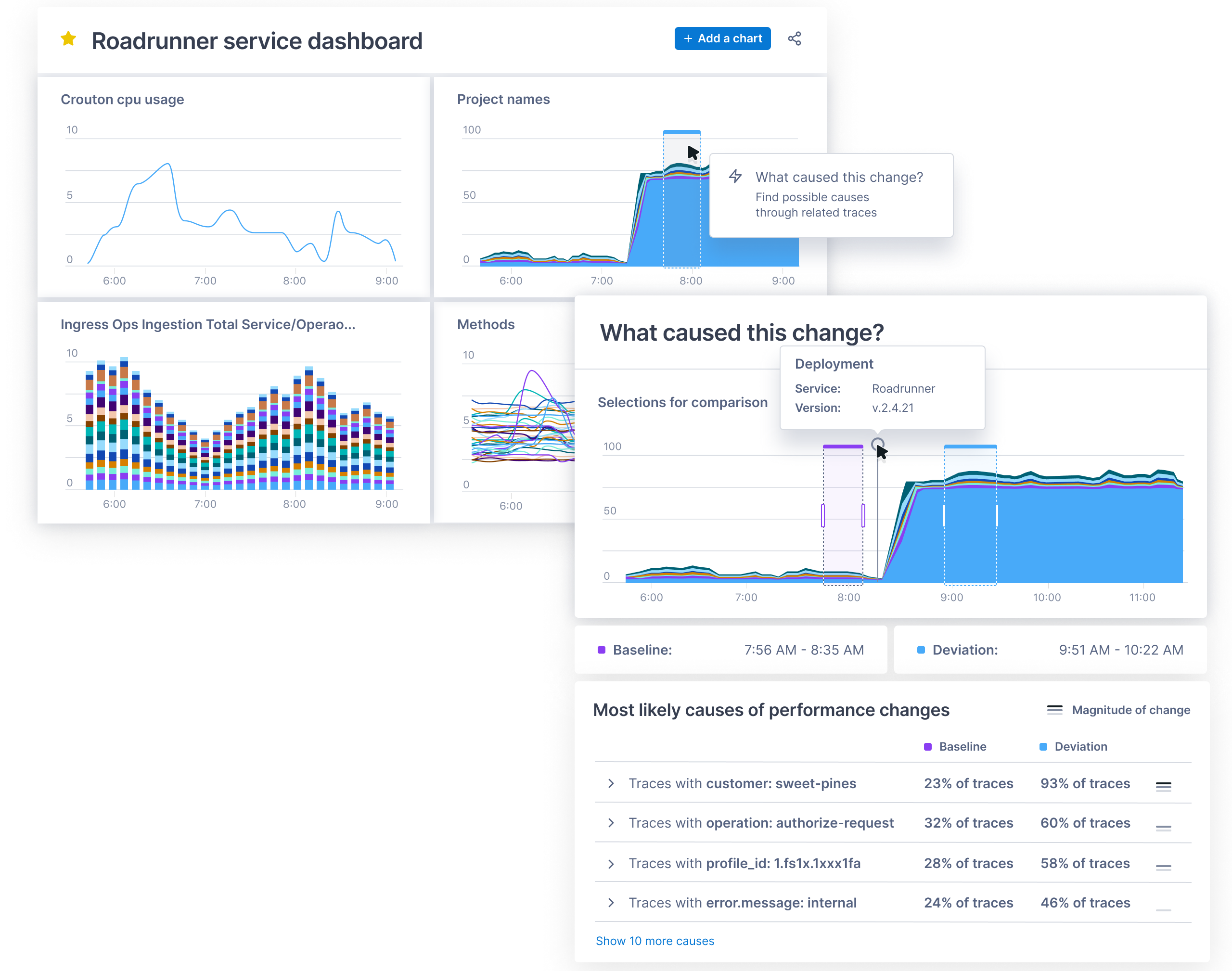
    Lightstep this week announced general availability of a Change Intelligence observability platform based on a time-series database that is capable of processing a trillion events each day.

    Ben Sigelman, Lightstep’s CEO, said as IT environments become more complex, thanks to the rise of microservices and cloud-native computing platforms, existing monitoring and observability tools will not be able to keep pace with the rate of change in what have become highly dynamic IT environments.

    While AIOps promises to address that complexity by employing machine learning algorithms to analyze IT environments and surface recommendations, Sigelman said there will always be the need for observability platforms that enable IT teams to discover the root cause of an issue in a way that surfaces the insights needed to fix the problem in real-time.

    The Lightstep database was built by the same team that created Monarch, the globally-distributed in-memory time series database system that Google employs to monitor its applications and systems. Lightstep’s database makes it possible to collect metrics, in the form of distributed traces, at a level of scale that allows IT teams to analyze events across a distributed IT environment made up of both monolithic and microservices-based applications, said Sigelman.

    Lightstep is the latest entrant in an already crowded field of observability platforms, all seeking to consolidate the wide range of monitoring tools IT teams have used for decades.

    The challenge IT teams face is that each of those monitoring tools is focused on a narrow range of platforms. IT teams often lack context when an issue arises, and wind up trying to correlate reports from multiple monitoring tools in the hopes of discovering the root cause of an issue. Observability platform providers are making the case for a single platform that correlates application and infrastructure events in a way that makes it easier for IT to fix issues faster.

    Observability, of course, has been a core tenet of DevOps for years. The tools for achieving that goal, however, have been cumbersome to implement and maintain using legacy application performance management (APM) platforms. Most of those platform providers, have rolled out what are positioned as next-generation observability platforms. Now, IT organizations will need to decide if they want to maintain investments in existing platforms versus moving to one of the raft of upstarts looking to dethrone APM incumbents.

    The startups are counting on a massive expansion in demand for observability platforms. IT organizations have tended to limit their usage of APM platforms to mission-critical applications due to cost and the challenges associated with maintaining the agent software needed to collect metrics from each application. Modern observability platforms have automated much of the metrics collection process, while open source software promises to make metrics collection more affordable..

    The challenge, of course, is that many organizations are already struggling to manage complex IT environments, and can’t necessarily wait for that open source software to mature.

  • Lightstep Unveils New Observability Platform to Replace Conventional Monitoring Solutions

    Built on top of rich distributed tracing data, metrics, and logs, the platform provides a unified view of telemetry data making it the quickest way to know what’s changed in system and service health


    SAN FRANCISCO, April 2, 2020 — Lightstep, the leading provider of observability software for organizations adopting microservices and serverless, today announced the release of its best-in-class observability solution to help developers better understand the health of systems and services. This includes integrating new metrics capabilities into their platform, enabling developers to have a one-stop shop for all their observability needs. New analysis features provide developers with the fastest and most effective way to investigate errors, understand service health issues, and predict the impact of new deployments.   


    As companies’ reliance on performant and reliable software increases, developers are facing the brunt of the burden. Every second of downtime can be detrimental to an organization’s bottom line, and the need for developers to adopt tools that can mitigate these lapses is greater than ever. 


    The next evolution of Lightstep’s distributed tracing tool is an observability platform that  provides automatic and rich analysis. Lightstep’s powerful capabilities help developers develop, deploy, and debug new service releases, regardless of the deployment methodology used (for example, canaries, blue/green deploys). Developers will then be able to identify and resolve the cause of performance degradations faster than any other tool on the market. The error and latency analysis feature simplifies the investigation of a service’s errors and latency by quickly highlighting the source of the problem and how it propagates through the call stack. It also helps developers understand what may have caused the error with a list of data-driven hypotheses. 


    And with new capabilities around runtime metrics, the solution accurately correlates metrics with problems in service performance. By making runtime metrics accessible with zero additional configuration and providing side-by-side visibility of performance metrics, developers are able to quickly identify if problems in their runtime (e.g. increased garbage collection, CPU, or memory) are causing service degradations.


    “At our core, Lightstep is a company of developers, so we know first-hand the stress placed on DevOps teams to execute seamless deployments every time, and how it is only continuing to grow as tech stacks get more complex,” said Daniel Spoonhower, CTO, Lightstep. “With our new observability solution, developers can analyze errors in real time, at any point in the deployment, and have all the tools and data they need in one unified view – that integrate effortlessly into their existing workflows.”


    With current market offerings, data that developers need quick access to is fragmented across many tools, making it difficult to swiftly understand what has changed in the performance of their services. Lightstep’s platform gives users a single place to answer real observability problems in real-time. These new updates include: 


    • Minimize the guessing: see insights based on metrics, traces, and logs all in one place, and at the right time
    • Regression analysis: automatically see what is contributing the most to your errors, latency, and throughput
    • Deployment monitoring: automatically see how different versions of your service are performing, and quickly diagnose regressions
    • Seamless onboarding: guided onboarding across almost any language in order to enable immediate insights


    “The Service Health feature, with regression analysis built-in, is exactly how I, as a performance engineer, would approach a regression. Out of the box, we can pinpoint not only when and where a regression first occurred, but also what caused the regression. All we had to do was show Service Health to the service owner for them to understand performance, distilled into three simple charts on a single tab. Unbeatable,” said Ian Thompson, Senior Software Engineer, Skyscanner.


    About Lightstep

    Lightstep enables teams to detect and resolve regressions quickly, regardless of system scale or complexity. We integrate seamlessly into daily workflows, whether you are proactively optimizing performance or investigating a root cause so you can quickly get back to building features.

  • New Relic Gives COVID-19 Relief Agencies Free 90-day Access

    New Relic Gives COVID-19 Relief Agencies Free 90-day Access

    New Relic will provide free access to the entire New Relic One observability platform for 90 days to any organization engaged in COVID-19 pandemic relief efforts that have a specific benefit to the public.

    Erin Dieterich, director of corporate social responsibility at New Relic, said it’s apparent that the IT platforms of both nonprofits and private companies that are lending their services and expertise to mitigate the impact of the COVID-19 pandemic will be taxed in unexpected ways.

    To help IT teams rise to that challenge, New Relic will make it possible to identify both software and infrastructure issues that are having an adverse impact on applications, noted Dieterich. Those issues undoubtedly will be experienced by both non-profit organizations as well as private companies trying to leverage their existing IT environment to make additional digital services available. Examples of organizations beyond those providing humanitarian aid that are being invited to register to use New Relic One via NewRelic.org include public and private schools and other providers of education services.

    New Relic also has a crisis management team in place to make sure the New Relic One service is not disrupted as the company’s own employees work from home across multiple geographies.

    Many of the providers of COVID-19 relief services are likely to find their efforts stymied at some point by IT issues. As IT environments have become more intertwined in the age of the cloud, it’s become difficult to ascertain the root cause of any application performance issue. Platforms such as New Relic One provide access to a cloud service through which IT teams can more easily pinpoint where a specific issue is potentially creating a wave of downstream application issues that would not be obvious to the average IT administrator.

    Beyond the teams of employees New Relic already allocates to New Relic.org on a full-time basis, Dieterich said the company is tapping volunteers from its own base of employees. Many of those employees themselves are now working from home, much like most of the rest of the global workforce.

    It’s too early to say to when the COVID-19 pandemic might subside, so New Relic plans to re-evaluate this initiative three months from now. In the meantime, the company has also pledged to make available $100,000 to match employee contributions to COVID-19 relief efforts.

    In the days and months ahead relief agencies of all sizes are going to be put to the ultimate test. While most of the focus is now on health care, it’s clear the COVID-19 pandemic also represents a major economic disruption. IT expertise will be needed to augment relief efforts spanning everything from tracking coronavirus cases to making sure people who are out of work receive food assistance. IT expertise that enables relief agencies to access public and private funding as quickly as possible is likely to be among some of the most important tasks ahead, regardless of whether anyone realizes today or much less even appreciates it tomorrow.

    — Mike Vizard