Tag: no-code development

  • The No-Code Revolution: 5 Industries That Will Win Big

    The No-Code Revolution: 5 Industries That Will Win Big

    The year 2020 tested the mettle of countless businesses and industries, but those who were able to stay afloat had one thing in common: the ability to adapt to an increasingly digitized world by embracing future-facing technology.

    For companies already steeped in the tech world, these changes came more naturally, but not all industries were equally equipped to transform. For those caught on their back foot, the key was to apply existing technologies to old systems and analog problems.

    No-code platforms quickly shot to the fore of these innovative solutions, and their importance will long-outlive the pandemic that was the catalyst for their growth. At its core, the no-code revolution is leveling the development playing field and lowering the barrier to entry of digitization. Programmers and non-programmers alike can now create enterprise-grade application software through graphical user interfaces (GUIs) and configuration instead of traditional computer programming.

    It is increasingly clear that these tools will form the prevailing wind of innovation, filling the sails of digital transformation for years to come—some have already called it the most disruptive trend of 2021. Yet many industries are only just beginning to realize the possibilities that no-code truly holds. Here are five of the industries that are benefiting most from the no-code revolution, and tips for how companies in each sector can continue to successfully implement no-code tools.

    1. Retail
    For years, online shopping was a convenience for many consumers. In 2020, it became a necessity.

    After a decade spent struggling to keep up with the rise of online conglomerates, the fate of retail industries was already questionable when the COVID-19 pandemic hit. Indeed, many of the businesses that first began to fail in the earliest days of the pandemic were retail giants who relied too heavily on their brick-and-mortar appeal. For brands that bit the dust, the “why” is no big secret: they failed to adopt new digital technologies and lost the loyalty of couch-bound customers.

    With no-code tools, the transition from “customer-friendly storefront” to “customer-friendly front end” is becoming quicker and easier than ever before. By allowing retailers to develop brand-tailored digital storefronts and progressive web apps that are as easy to design as they are to use, these tools will undoubtedly be one of the keys to success as the retail industry fights through the pandemic and looks toward a sustainable future.

    2. Insurance
    As with many legacy industries, insurance was long caught in the shadow of flashy innovators from the tech sector. But the push for transformation in insurance came not a moment too soon—not only did the year leading up to the pandemic see insurance leaders set their sights on digital innovation, but it was no-code tools that played a crucial role in leading the charge toward change.

    By allowing traditionally slow-moving enterprises to operate with startup agility, no-code tools are giving legacy insurance leaders in previously sheltered markets the edge they need to compete with digital-first newcomers.Today’s consumers increasingly expect a seamless digital user experience with everything from social media to gaming to insurance. With no-code tools, these expectations can be met without the need for high-level programmers or IT professionals.

    As they look toward the future, insurers who implement no-code platforms will be able to spend more time focusing on the quality of their products and less time losing customers due to outdated tech, all while cutting costs and simplifying operations at every level of their organization.

    3. Banking, Fintech and Payments
    Banking, another industry rife with legacy enterprises, has faced many of the same hurdles as its insurance counterpart, and it is for many of the same reasons that no-code development tools have extensive potential in the ever-shifting landscape of banking and its adjacent sectors.

    Mobile banking applications have already changed the way that everyday people think about, track and interact with their money. In a digital era where remote functionality is as urgent as it is practical, no-code tools can provide financial enterprises of any size with the opportunity to build, maintain and update consumer-facing platforms that meet customer standards, offer cross-platform integration and uphold necessary private data security.

    4. Health Care
    The COVID-19 pandemic has been a powerful accelerant for a diverse array of health care technologies, fueling rapid growth in fields like telemedicine and remote patient monitoring. As health systems continue harnessing technology to become more efficient and to improve patient outcomes, no-code tools can provide innovative solutions to multiple problems through the entire process of healthcare and treatment.

    Calendaring and scheduling platforms that make it easier for patients to arrange appointments, and easier for providers to keep track of them, can be developed and curated without writing a single line of code. No-code platforms are also one of the simplest ways that health care practitioners can offer user-friendly virtual visits, saving time for patients and providers alike, and minimizing unnecessary trips to and from germ-filled waiting rooms. Additionally, the ability of no-code platforms to turn high-level back-end data functionality into a widely accessible tool will make it easier than ever for health care organizations to log patient data securely and swiftly, which can ultimately be leveraged to track illnesses and find treatments, fast.

    With the ease of no-code development, health care professionals can spend less time addressing technical difficulties and more time addressing their patients.

    5. Manufacturing
    Manufacturing leaders have already expressed a keen understanding of the need for no-code solutions.

    Manufacturing Execution Systems (MES) have long been tasked with coordinating, executing and tracking the processes at a given factory or plant, but the rigidity that makes MES so useful for IT components of the manufacturing process also makes it difficult to use for shop floor personnel.

    Compared to MES, no-code platforms are cheaper to customize, quicker to implement and easier to update in accordance with changing operational needs. As manufacturers are increasingly expected to produce new, customized products with increasing speed and frequency, the need for no-code solutions will go from being a tech trend to an industry necessity.

    Unlike many past disruptive trends, which have often been characterized by their uniqueness, the rise of no-code is making innovation easier and more accessible across the board. While the industries listed above—retail, insurance, banking, health care and manufacturing—are each particularly well-poised to benefit from the no-code revolution, these five sectors mark only the beginning of what is to come.

    The development capabilities of no-code platforms will only continue to grow in the coming years. So, too, will the reach of these innovative tools.
  • Internal Makes On-Premises Edition of No-Code Tool Available

    Internal Makes On-Premises Edition of No-Code Tool Available

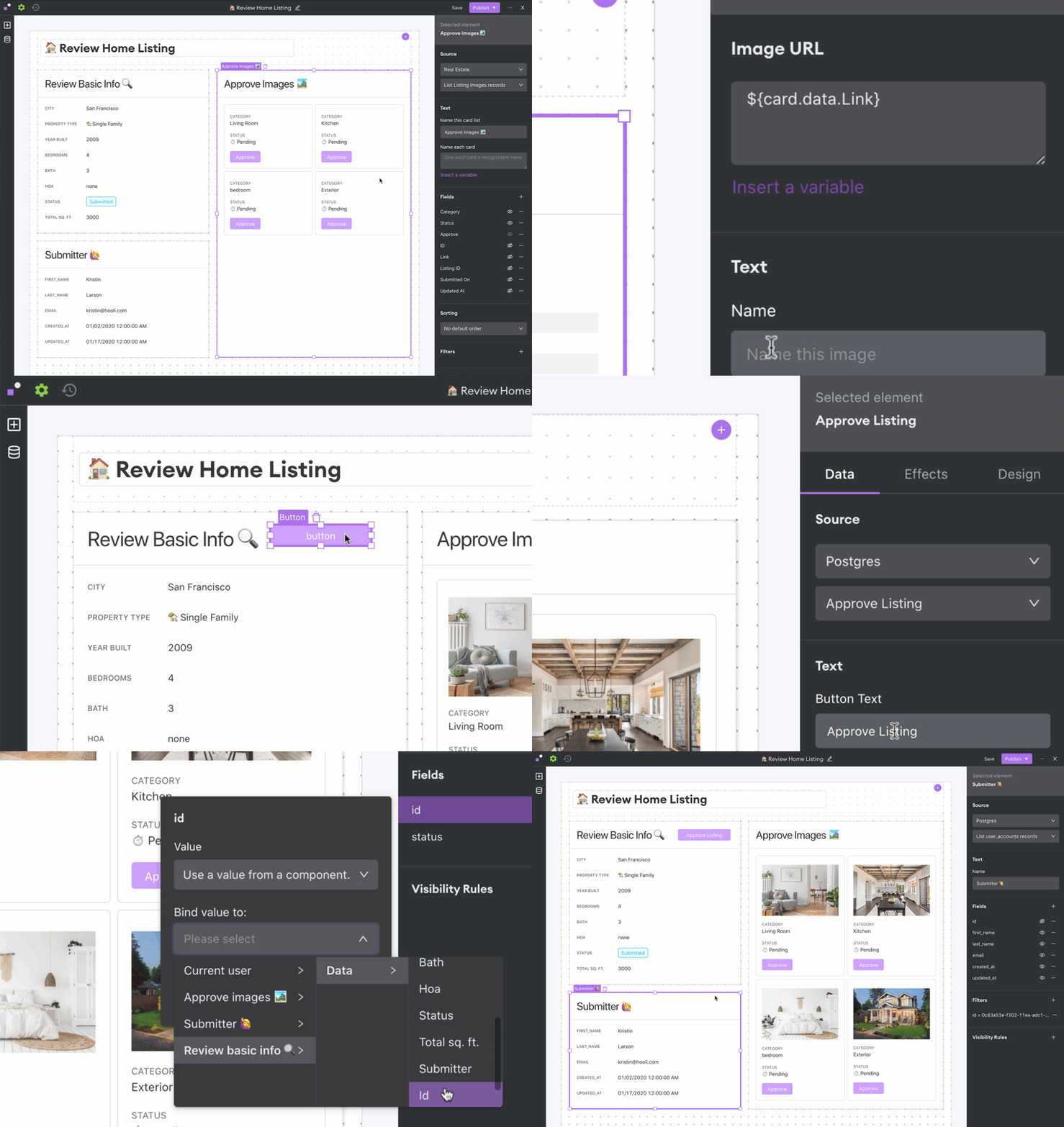
    Internal today launched an on-premises edition of its eponymous no-code development platform that promises to simplify application development backlog reduction for enterprise IT organizations.

    Arisa Amano, CEO of Internal, said many professional developers regularly find themselves building simple applications that, if given access to the right tools, could be built instead by end users. Internal was created to provide that capability either through a cloud service or, now, through an on-premises edition.

    The on-premises edition makes it simpler for developers to work with databases, application programming interfaces (APIs) and applications that reside behind a corporate firewall, Amano said.

    As organizations accelerate digital business transformation initiatives, professional developers are pressed to build and deploy more complex applications faster. Many lower-priority application development projects are sidelined simply because developers don’t have time to take them on. Internal, and other no-code and low-code application development tool providers, are making a strong case for enabling end users to build their own applications using graphical tools, or encouraging professional developers to use these tools to build less complex applications more quickly.

    A survey published by Internal finds 62% of respondents report their developers spend more than 25% of their time fulfilling requests to build internal tools. More than three-quarters of respondents (79%) said engineers use any extra time they can find to develop customer-facing features or other applications.

    Most of the projects filling application backlogs tend to involve workflows that span multiple applications running in a data center. The challenge organizations face is low-code and no-code tools that reside in the cloud can’t easily access that data. As such, Amano said there’s a clear need for a no-code tool that can be deployed in an on-premises IT environment.

    Of course, regardless of who builds the application, it still must be deployed. Challenges arise as developers build more applications, which must be concurrently deployed in production environments. The addition of no-code and low-code tools, and the applications created with those tools, will require organizations to rethink and refine their DevOps processes.

    Historically, professional developers have tended to view no-code and low-code tools as the application development equivalent of a black box preventing them from building reliable, robust applications that can scale. Many low-code and no-code applications that organizations build, however, are meant to used internally by a finite number of end users. At the same time, no-code and low-code tools become more robust with each major update.

    Whatever bias may exist, the current application development backlog in most organizations is only going to increase. Professional developers may prefer to write code at a lower level than a no-code or low-code tool allows; however, most business executives are more interested in application performance than in how it was constructed.

  • How No-Code Software Development Speeds Digital Transformation

    How No-Code Software Development Speeds Digital Transformation

    More organizations are democratizing software development through no-code solutions that empower anyone to write applications

    In today’s fast-paced and digital business world, organizations must revise their goals and processes to achieve digital transformation and remain a viable business.

    However, most transformation efforts fail. Recent McKinsey research shows that 70% of complex, large-scale change programs don’t reach their stated goals. For most organizations, the complexity of the technology environment and the inability to swiftly implement necessary changes are major roadblocks.

    No-code solutions allow organizations to stay agile and accelerate their strategy execution by empowering power users (or business users) and developers to rapidly develop applications. Such solutions also improve the ability of IT to respond to business demands, shorten time-to-market and accelerate digital transformation.

    What Is a No-Code Solution?

    A no-code solution mitigates the need for manual programming in application development. Instead of writing lines of code, users can develop applications through simple point-and-click on specific components that can be arranged into logical sequences to create functional and feature-rich applications.

    The inherent value no-code software development is it accelerates and democratizes the application development process. With such a solution, your power users can build applications to solve critical business problems and automate tasks to increase productivity.

    5 Benefits of No-Code Software Development Solutions

    • Reduce the load on IT: As mentioned before, no-code solutions allow business users to build applications without any coding knowledge. By enabling such a change, the solution reduces the burden on the understaffed IT department. Applications to solve business challenges and increase productivity can be built quickly without relying on IT. This in turn allows the IT department to dedicate more time to business-critical apps and projects.
    • Accelerate development time: No-code solutions enable business users to take application development into their own hands; they don’t have to wait for their requests to be answered by the IT department. Tasks that used to take months (even years) to complete can now be done in a few hours or days, depending on its complexity. That is the level of acceleration a no-code solution can provide to the application development life cycle.
    • Ensure more targeted outcomes: The point-and-click configuration of no-code solutions empowers the business users and developers to quickly build solutions to meet their exact requirements and specifications. Such applications then can be updated on the fly. These aspects are important to keep the business competitive and agile. While a no-code solution allows the development of applications for immediate impact, it can also prove to be cost-efficient in the long run.
    • Fight shadow IT: When the IT department is unable to act on the requests of business users, those users start seeking solutions on their own. With the rapid rise of SaaS, they can quickly find an application to meet their needs. However, adopting such applications can lead to security vulnerabilities. A no-code solution enables businesses to eliminate the problem of shadow IT by allowing the business (power) users to develop their solutions to meet specific business needs while enabling IT to centrally control the data and user accesses.
    • Enable experimentation without risks: Experimentation is an essential part of digital transformation. No-code solutions allow organizations to test their ideas on a small scale to eliminate the setbacks. It empowers business users to experiment with their ideas, iterate projects efficiently and create solutions that can transform organizations and keep them adaptable to changes in the industry.

    To meet the challenges of digital transformation and remain competitive in the marketplace, organizations need to create an environment that enables agility and flexibility of the internal workflows and customer-facing operations. When powered by a comprehensive no-code solution, organizations can create an infrastructure that allows them to transform and innovate faster, which generates new growth opportunities and provides a competitive advantage.

  • Citizen Developer Movement Gains Steam

    Citizen Developer Movement Gains Steam

    It’s been about a year since we covered how the rise of the consumerization of IT had extended beyond cloud services and devices to application development and the advent of the Citizen Developer from rarity to mainstream. The momentum of citizen developers in the enterprise has only increased in the past year. And the move is proving to provide much needed faster time to market for enterprise apps.

    According to the “QuickBase annual State of Citizen Development Report,” a survey completed this summer of 153 North American enterprises that develop and use custom business applications, the need to rapidly develop new apps is one of the leading reasons why non-developers in business roles are rolling up their sleeves and developing some of the apps their companies need.

    As readers of devopsy.kinsta.cloud are aware, app backlogs are a big concern. Reportedly, many organizations have app backlogs that range from weeks to months to years. Rather than wait for an IT department that is struggling to meet—or even catch up with—app demand (largely fueled by the thirst for mobile apps), they are turning to low-code and no-code development platforms that enable anyone to develop without understanding a formal language.

    How do enterprises support citizen development? They do it mostly by providing employees a place to build apps in cloud-based, low-code platforms. Some of the highlights from the QuickBase report include:

    • Developing a custom application using traditional development methods requires more than two months on average for 67 percent and more than six months for 31 percent of application builders.
    • Citizen development platforms are seen as capable of developing 26 different custom applications for a variety of top use cases including asset management, project management, IT help desk, inventory management, contact management, workforce management, service management, compliance management, contract management and facilities management.
    • Organizations consider the top benefit of no-code citizen development to be the ability to maintain and update applications faster than the more than two months required by 35 percent of traditional developers.

    The acceleration of app development and the fact that citizen developers help to move app ideas from the bottom up in an organization are why many IT leaders say citizen development is a catalyst of the innovation enterprises need. As Michael Beckley, CTO of Appian relayed to associate Tony Bradley in his story, “Citizen Developers Can Benefit an Organization“: “The best-designed products have always been built with the needs of the user from the outset. Who better than citizen developers to design software that enables organizations to transform customer experiences, launch compelling new products and manage risk efficiently? Citizen developers are motivated by the opportunity to create a new reality, not merely accepting the workplace as they found it.

    “Citizen developers are most successful when supported by IT,” Beckley continued. “One critical area where IT can help is in promoting reuse and modularity in the applications and business processes that citizen developers build.”

    That’s the key to success, going forward, in my view: The organizations that succeed with citizen development will be those that wholeheartedly embrace the movement and cultivate it, with IT’s help and guidance.

    In the QuickBase survey, among the broad population of app developers surveyed, the majority reported being able to deliver their apps in less than a month. Compare that to traditional IT developers alone, 67 percent of whom reported it takes more than two months to build an app and 31 percent reported more than six months. This is probably why 80 percent of respondents said that development speed was one of the top reasons for embracing citizen developers: The QuickBase survey found that 42 percent of their users are able to build apps at twice the speed of traditional development.

    With results like that, it’s just a matter of time before every large organization embraces citizen developers to clear app backlogs and innovate more rapidly.

    — George V. Hulme