Tag: Netflix

  • OpenAI Hires 1,000 Low Wage Coders to Retrain Copilot ¦ Netflix Blocks Password Sharing

    OpenAI Hires 1,000 Low Wage Coders to Retrain Copilot ¦ Netflix Blocks Password Sharing

    Welcome to The Long View—where we peruse the news of the week and strip it to the essentials. Let’s work out what really matters.

    This week: ChatGPT darling OpenAI wants people to write code in English, and the unintended consequences of blocking shared accounts. (more…)

  • Recession! DevOps Hiring Freeze | Data Centers Suck (Power) | Intel to ‘be’ Wi-Fi 7

    Recession! DevOps Hiring Freeze | Data Centers Suck (Power) | Intel to ‘be’ Wi-Fi 7

    Welcome to The Long View—where we peruse the news of the week and strip it to the essentials. Let’s work out what really matters.

    This week: Engineer jobs are being cut, cloud infrastructure is using too much energy, and Intel’s 802.11be silicon is alive. (more…)

  • Secure Software Summit: Applying Chaos Engineering to Software Security

    Secure Software Summit: Applying Chaos Engineering to Software Security

    Today’s software systems are, essentially, controlled chaos—and lightly controlled chaos, at that. This makes it exceptionally challenging to model the behavior of those systems. Our systems are quickly becoming larger and larger, with more and more moving parts. It is not uncommon for enterprises to have over 1,000 microservices and millions of containers running thousands of applications containing many thousands of open source libraries. 

    Why are things growing more complex? Because from microservices to CI/CD pipelines, from service meshes to blue/green deployments, all these new practices and new technologies help us make our applications and infrastructure more resilient and scalable. The downside is the ever-increasing complexity, which is actually accelerating. 

    In addition, software has officially taken over every layer of the networking and hardware stack (which sounds like an oxymoron, but it’s containers and virtualization turtles all the way down until you hit bare metal). Software is, by definition, easy to rewrite. Thus, the ease of changing software has further increased the number of changes we make to systems. Which adds still more complexity. In fact, software only ever increases in complexity; never decreases in complexity. Software is always trying to do more and encompass more. For that reason, even when you try to simplify software, you just move the complexity around rather than eliminating it. 

    Introducing Turbulence

    Here is how Netflix, the organization that pioneered chaos engineering, defines the practice: “Chaos engineering is the discipline of experimenting on a distributed system to build confidence in the system’s ability to withstand turbulent conditions.” Turbulence is the opposite of order, but it’s where all systems end up.

    In the beginning of a system’s life cycle, there is always an orderly plan for deployment and operations. You always have a clean diagram of your resources, code repositories, containers and always a nice 3D diagram of AWS instances you will deploy to and the network topology. 

    In reality, our systems are never this simple. After the system goes live, that is when we start learning about how it actually operates through unforeseen events like when marketing asks to refactor the pricing module or an outage to the payments API forces you to hardcode a token or a DNS outage—well, you know about DNS outages. In the span of a year or two, you go from 300 to 800 microservices and you have to add Kubernetes clusters and a container network interface (CNI) to properly secure the networking of those clusters. And so on and so on. The bottom line? Almost all production systems evolve into a state that we do not understand and cannot easily map back to our original systems diagram. 

    Chaos engineering is a mechanism for dealing with this growing level of complexity. The basic idea behind chaos engineering is asking the computer or application or network (or any other environmental element) a series of questions. Consider a legacy system like a mainframe. How did our legacy systems become so stable? They are well-documented. Engineers feel confident in how the system operates. The question is, was the system always that way? Is the system the same one that they originally designed? The answer is “No.” 

    Legacy systems actually went through a trial-by-fire; a constant parade of unforeseen surprises. These surprises were, effectively, questions. Through these surprises, engineers learned how the system would actually operate (or wouldn’t operate) in the face of chaotic and unforeseen events. This process created iterative feedback that helped the engineers learn how to make the system continuously more stable. 

    The point of chaos engineering is to generate this same type of feedback loop without the pain, stress and repercussions of unforeseen (and generally unwanted) events. Thus, chaos engineering is a proactive way of introducing adverse conditions to ensure that the system can still do what it’s supposed to do when unforeseen events transpire. Because everything today is software and change is constant, the questioning must also be constant. 

    For example, chances are that in the time since we originally designed any given system, it has changed a lot. This means some or all the mitigation and resilience we programmed in—retry logic, failovers, circuit breakers—are old news, designed for an older system. When triggers for those conditions actually occur, those mechanisms of resilience we designed may not perform as we had intended.  

    Chaos engineers proactively ask the question, “Under the conditions in which you are designed to perform, do you do what you are supposed to?” We introduce the conditions themselves in a controlled manner with a limited blast radius to put the system to the test and verify that our assumptions line up with the intended reality. The practice of chaos engineering is intended to be performed on live, running systems without the risk of taking down critical production assets or ambushing unsuspecting applications and their associated DevOps and development teams. This helps engineering teams reduce uncertainty by building confidence in their understanding of their systems by providing them with enhanced context. It turns out that, when engineers are presented with better context, it considerably improves their ability to make smarter, well-informed decisions where resilience is concerned. 

    Chaos Engineering for Cybersecurity

    Cybersecurity is a context-dependent discipline, dependent on how well you understand the systems you are protecting.  Software engineers are constantly changing the system. And they must have the flexibility to change it because their primary task is to constantly move towards business value. Yet to effectively apply cybersecurity practices, we must know what we are trying to secure. From that knowledge, we then can know what we most need to secure and how to do it on a given system in its most current state. 

    Before an engineer can understand how to build robust security measures that provide effective cybersecurity, the engineer must first understand the system. This reliance on the “system first” is a foundational driver for why our security systems and controls—even the immutable and ephemeral ones—experience considerable engineering drift over time. We are continuously burdened by the dependence on a stateful understanding of the system.  

    Without having some sort of testing or instrumentation feedback loop in our post-deployment world, we don’t know there is a problem with our security until there is an actual problem. Finding out that the room is on fire after the house has been burning for hours is too late. The result is the self-defeating series of reactive incident fire drills, war rooms and outages that we find ourselves in today. If we do not change this reactive crisis loop of chasing the tiger’s tail, it inevitably leaves us taking two steps back for every step we take forward with engineering teams. 

    When this drift goes undetected, we are left with our wounds exposed and attackers salivating at the meal to come.  Engineers always prefer to find evidence and sources of drift through some internal engineering failure or controlled test rather than experiencing a successful real-world attack. Over time, there is a constant drift between the system and security; engineers are constantly changing the system. As a result, there is frequently a lack of recalibration between systems and the security designed to protect them. The way to achieve this recalibration is through continuous testing or experimentation. 

    Testing is not chaos engineering. Testing is a verification and validation of something you know as either true or false. This could be vulnerability to a specific CVE or exposure to an attack pattern. In experimentation, you are trying to derive new information and explore the unknown unknowns. From this exploration, you seek to create a  better understanding of how a system reacts and then share that with the people who are designing the system.

    Live security incidents are not effective measures of detection because, by then, it is already too late in the life cycle to effectively address the problem. Worse, incidents cause stress, fear and irrational behaviors. People freak out. Not surprisingly, a security incident is not a good learning environment. Yet security incidents serve the same purpose: Asking questions about a system or systems and helping teams see how to improve them. Chaos engineering offers a better way to create these questions under conditions where it is easier to learn and observe system behaviors, providing clues to improving security. In other words, the purpose of security chaos engineering is to help us proactively understand our systems and where the security gaps are before an adversary has a chance to take advantage of them.

    There are multiple use cases for security chaos engineering including:

    • Incident response: Testing efficacy of run books, response plans, and determining whether data collection and alerting systems work as intended
    • Security control validation: Introducing conditions that should induce behavior from one or more controls and observing behavior
    • Security observability: Introducing unexpected attacks or breaches to see if your systems report and observe the incident accurately
    • Compliance monitoring: Applicable across all chaos engineering events by documenting that systems do what they say they are supposed to do

    A Practical Example

    A team I headed wrote an open source application, ChaoSlingr, designed to generate chaos engineering events for security experiments. The application consisted of three serverless functions to generate the experiment, apply it to infrastructure and then monitor the resulting impact on the system. 

    One example of how we used ChaoSlingr was an exercise where we induced an open port. Enterprises and engineers inadvertently open ports in firewalls all the time. Sometimes this is a result of misconfiguration. It may also be the result of a software upgrade after which the developer or AppSec engineer forgot to reset the port to the proper security settings. In theory, firewalls should automatically detect an unauthorized open port.

    For the experiment, we selected a set of resources that had opted-in to our experiments, selected a security group and opened the port. At the time we were relatively new to Amazon Web Services. We were surprised to find that the firewall only detected an unauthorized port opening 60% of the time. We discovered clear evidence of configuration and security tool drift. 

    We also noticed that a cloud-native configuration and management tool we had deployed was identifying and alerting the unauthorized port opening almost 100% of the time. We then realized that correlating and responding to incident events of an unauthorized port opening was complicated; it was hard to map the incident back to the log data describing how our systems responded to the event. We added a metadata pointer to each alert, allowing us to more easily correlate the information and save valuable time finding the affected security group and port. 

    In short, the exercise gave us excellent context on where our systems were drifting and failing to keep up, which of our systems were the most reliable and whether we could quickly and easily respond to these incidents by chasing down the right log files. 

    Security Chaos Engineering Programs Build Trust

    In any environment where we are managing complex systems, trust is critical. You must trust that your systems will handle unforeseen events gracefully and not cost your company money or reputational currency. You must trust that the people designing and building your systems are constantly trying to improve them.  You must trust that the security teams protecting your systems are up to the task. As systems grow more and more complex, the number of unknown unknowns multiplies. As humans, with our limited processing capacity, we cannot solve for unknown unknowns at scale, continuously. This is the task of security chaos engineering and the processes around it: To create a programmatic way to experiment against and find answers to unknown unknowns. Your systems, developers, customers and your CEO will thank you for it.


    About Secure Software Summit
    The Secure Software Summit brought together the world’s leading innovators, practitioners and academics of secure software development to share and teach the latest methods and breakthroughs on secure coding and deployment practices. If you are about developing, releasing and securing software, delivering new features fast and building things right from the start, click on the link below to get access to all of the sessions from this summit.

    https://go.shiftleft.io/secure-software-summit-2022-replay


  • What Chaos Engineering Is (and Isn’t)

    What Chaos Engineering Is (and Isn’t)

    The birth of chaos engineering happened somewhat accidentally in 2008 when Netflix moved from the data center to the cloud. The move didn’t go as planned.

    The thinking at the time was that the data center locked Netflix into an architecture of single points of failure, like large databases and vertically scaled components. Moving to the cloud would necessitate horizontally scaled components, which would decrease the single points of failure. But the move to horizontally scaled cloud deployment practices did not produce the boost to uptime of the streaming service that they expected.

    The specific methods for making a system robust enough to handle instances disappearing was not important. It might even be different depending on the context of the system. The important thing was that it had to be done, because the streaming service was facing availability deficits due to the high frequency of instance instability events. In a way, Netflix had simply multiplied the single-point-of-failure effect.

    Enter Chaos Monkey. Chaos Monkey gave the company a way to proactively test everyone’s resilience to a failure, and do it during business hours so that people could respond to any potential fallout when they had the resources to do so, rather than at 3 a.m. when pagers typically go off.

    Then, Dec. 24, 2012, happened. Amazon Web Services (AWS) suffered a rolling outage of elastic load balancers (ELBs). These components connect requests and route traffic to the compute instances where services are deployed. As the ELBs went down, additional requests couldn’t be served. Since Netflix’s control plane ran on AWS, customers were not able to choose videos and start streaming them.

    To ensure that all of these teams had their services up to the task, an activity was created to take a region offline. Well, AWS wouldn’t allow Netflix to take a region offline (something about having other customers in the region) so, instead, Netflix simulated the activity; labeled “Chaos Kong.”

    Fast-forward to about 2015. Netflix had Chaos Kong working on large-scale vanishing regions and had introduced Chaos Monkey, which worked on small-scale vanishing instances.

    In these early days of chaos engineering at Netflix, it was not obvious what the discipline actually was. There were some catch phrases tossed around about “pulling out wires,” or “breaking things,” or “testing in production,” paired with many misconceptions about how to make services reliable, and very few examples of actual tools to help support that work.

    To formalize the discipline, I was given the task of developing a charter and roadmap for a chaos engineering team at Netflix in early 2015. I built and managed that team for three years. My co-author of “Chaos Engineering: System Resiliency in Practice,” Nora Jones, joined the chaos engineering team early on as an engineer and technical leader. She was responsible for significant architectural decisions about the tools we built as well as overseeing implementation.

    To start, I sat down with my teams to formally define chaos engineering. We specifically wanted clarity on:

    • What is the definition of Chaos Engineering?
    • What is the point of it?
    • How do I know when I’m doing it?
    • How can I improve my practice of it?

    We researched resilience engineering and other disciplines in order to come up with a definition and a blueprint for how others could also participate in chaos engineering. After about a month of working on a manifesto of sorts, we produced the Principles of Chaos Engineering. The discipline was officially formalized:

    “Chaos Engineering is the discipline of experimenting on a distributed system in order to build confidence in the system’s capability to withstand turbulent conditions in production.”

    This definition established that it is a form of experimentation, which sits apart from testing. It also mentions “turbulent conditions in production” to highlight that this isn’t about creating chaos. Chaos engineering is about making the chaos inherent in the system visible. The point of doing chaos engineering is to build confidence.

    The principles go on to describe a basic template for experimentation, which borrows heavily from Karl Popper’s principle of falsifiability. In this regard, chaos engineering is modeled very much as a science rather than a technique.

    What Chaos Engineering Is

    The principles define the discipline so that we know when we are doing chaos engineering, how to do it and how to do it well. The more common definition for chaos engineering today is, “The facilitation of experiments to uncover systemic weaknesses.”

    The steps of Chaos Engineering experimentation are as follows:

    1. Start by defining “steady state” as some measurable output of a system that indicates normal behavior.
    2. Hypothesize that this steady state will continue in both the control group and the experimental group.
    3. Introduce variables that reflect real-world events like servers that crash, hard drives that malfunction, network connections that are severed, etc.
    4. Try to disprove the hypothesis by looking for a difference in steady state between the control group and the experimental group.

    By design, there is great latitude in how to implement these experiments.

    Experimentation Versus Testing

    Testing, strictly speaking, does not create new knowledge. Testing requires that the engineer writing the test knows specific properties about the system that they are looking for in advance. Complex systems are opaque to that type of analysis—humans are simply not capable of understanding all of the potential side effects from all of the potential interactions of parts in a complex system. This leads us to one of the key properties of a test.

    Tests make an assertion, based on existing knowledge, and then running the test collapses the valence of that assertion, usually into either true or false. Tests are statements about known properties of the system.

    Experimentation, on the other hand, creates new knowledge. Experiments propose a hypothesis, and as long as the hypothesis is not disproven, confidence grows in that hypothesis. If it is disproven, then we learn something new. This kicks off an inquiry to figure out why our hypothesis is wrong. In a complex system, the reason why something happens is often not obvious. Experimentation either builds confidence, or it teaches us new properties about our own system. It is an exploration of the unknown.

    No amount of testing in practice can equal the insight gained from experimentation, because testing requires a human to come up with the assertions ahead of time. Experimentation formally introduces a way to discover new properties. It is entirely possible to translate newly discovered properties of a system into tests after they are discovered. It also helps to encode new assumptions about a system into new hypotheses, which creates something like a “regression experiment” that explores system changes over time. Because chaos engineering was born from complex system problems, it is essential that the discipline favors experimentation over testing.

    Verification Versus Validation

    Using definitions of verification and validation inspired by operations management and logistical planning, we can say that chaos engineering is strongly biased toward the former.

    Verification

    Verification of a complex system is a process of analyzing output at a system boundary. A homeowner can verify the quality of the water (output) coming from a sink’s faucet (system boundary) by testing it for contaminants without knowing anything about how plumbing or municipal water service (system parts) functions.

    Validation

    Validation of a complex system is a process of analyzing the parts of the system and building mental models that reflect the interaction of those parts. A homeowner can validate the quality of water by inspecting all of the pipes and infrastructure (system parts) involved in capturing, cleaning, and delivering water (mental model of functional parts) to a residential area and, eventually, to the house in question.

    Both of these practices are potentially useful, and both build confidence in the output of the system. As software engineers, we often feel a compulsion to dive into code and validate that it reflects our mental model of how it should be working. Contrary to this predilection, chaos engineering strongly prefers verification over validation. chaos engineering cares whether something works, not how.

    Note that in the plumbing metaphor we could validate all of the components that go into supplying clean drinking water, and yet still end up with contaminated water for some reason we did not expect. In a complex system, there are always unpredictable interactions. But if we verify that the water is clean at the tap, then we do not necessarily have to care about how it got that way. In most business cases, the output of the system is much more important than whether or not the implementation matches our mental model. Chaos engineering cares more about the business case and output than about the implementation or mental model of interacting parts.

    What Chaos Engineering Is Not

    There are two concepts that are often confused with chaos engineering, namely breaking stuff in production and anti-fragility.

    Breaking Stuff

    Occasionally, in blog posts or conference presentations, we hear chaos engineering described as “breaking stuff in production.” While this might sound cool, it doesn’t appeal to enterprises running at scale and other complex system operators who can most benefit from the practice.

    A better characterization would be “fixing stuff in production.” Breaking stuff is easy; the difficulty lies in mitigating blast radius, thinking critically about safety, determining if something is worth fixing, deciding whether you should invest in experimenting on it—the list goes on.

    Breaking stuff could be done in countless ways, with little time invested. The larger question here is, how do we reason about things that are already broken when we don’t even know they are broken?

    “Fixing stuff in production” does a much better job of capturing the value of chaos engineering, since the point of the whole practice is to proactively improve availability and security of a complex system. Chaos engineering is the only major discipline in software that focuses solely on proactively improving safety in complex systems.

    Anti-Fragility

    People familiar with the concept of anti-fragility, introduced by Nassim Taleb, often assume that chaos engineering is essentially the software version of the same thing. Taleb argues that words like “hormesis” are insufficient to capture the ability of complex systems to adapt, and so he invented the word “anti-fragile” as a way to refer to systems that get stronger when exposed to random stress.

    An important, critical distinction between chaos engineering and anti-fragility is that chaos engineering educates human operators about the chaos already inherent in the system so that they can be a more resilient team. Anti-fragility, by contrast, adds chaos to a system in hopes that it will grow stronger in response rather than succumbing to it.

    As a framework, anti-fragility puts forth guidance at odds with the scholarship of resilience engineering, human factors and safety systems research. For example, anti-fragility proposes that the first step in improving a system’s robustness is to hunt for weaknesses and remove them. This proposal seems intuitive, but resilience engineering tells us that hunting for what goes right in safety is much more informative than investigating what goes wrong.

    The next step in anti-fragility is to add redundancy. This also seems intuitive, but adding redundancy can cause failure just as easily as it can mitigate against it, and the literature in resilience engineering is rife with examples where redundancy actually contributes to safety failures. Perhaps the most famous example is the 1986 Challenger disaster. The redundancy of O-rings was one of three reasons that NASA approved the continuation of launches, even though damage to the primary O-ring was well known internally for over fifty of the prior launch missions over the span of five years.

    There are numerous other examples of divergence between these two schools of thought. Resilience engineering is an ongoing area of research with decades of support, whereas anti-fragility is a theory that exists largely outside of academia and peer review. It is easy to imagine how the two concepts become conflated, since both deal with chaos and complex systems, but the spirit of anti-fragility does not share the empiricism and fundamental grounding of chaos engineering. For these reasons, we should consider them to be different pursuits.

    A combination of real-world experience applying the original four principled steps to experimenting on systems at scale, paired with additional thoughtful introspection, led the chaos engineering team at Netflix to push the practice further than experimentation. These insights became the “Advanced Principles,” which guide teams through the maturity of their chaos engineering programs and help set a gold standard toward which we can aspire—we’ll cover these in a follow-up post.

  • 3 Examples of AI at Work in DataOps

    3 Examples of AI at Work in DataOps

    Artificial intelligence (AI) is making all the difference between innovators and laggards in the global marketplace. Yet, implementing a state-of-the-art DataOps operation involves a long-term commitment to putting in place the right people, processes and tools that will deliver results.

    In this post, we look at three organizations that are doing cutting-edge work in the field of DataOps. We look at the specific strategies they use and the results they’ve seen as they navigate the uncharted waters of DataOps.

    Uber: End-to-End DataOps

    Uber is very vocal about the way it leverages AI across its apps and services globally. The company runs all its machine learning (ML) models on a platform called Michelangelo and use many other proprietary tools such as Manifold, Horovod and Piper to optimize and scale these operations.

    Michelangelo helps manage DataOps in a way similar to DevOps by encouraging iterative development of models and democratizing the access to data and tools across teams. On top of this platform, Uber uses other tools to help data teams.

    Uber ran its models in Tensorflow and realized model training was taking too long because of the large data sets it was dealing with. Taking a page from Facebook’s data team, the company realized the power of distributed training. This would enable Uber to run data operations in parallel on hundreds of distributed GPUs, rather than on a few GPUs. Yet, managing all this would be a challenge, which is why Uber built a tool called Horovod. Now under the auspices of The Linux Foundation’s Deep Learning community, Horovod supports additional frameworks such as PySpark, Petastorm and Apache MXNet. Additionally, using mixed precision training, Horovod is able to optimize the use of memory when running models, and in doing so, it enables running larger data models or running numerous mini-batches of data in parallel.

    Manifold is a visualization tool that helps to gauge the performance of various models against each other. Rather than use a simplistic, two-dimensional axis to plot performance data, Manifold groups large quantities of model performance data into subsets that avoid duplicating the important indicators of performance. This reduces noise and helps speed analysis of the data. The lesson: Look beyond the trees to view the entire forest when it comes to metrics.

    By adopting an end-to-end approach to DataOps and leveraging specialized tools at every step of the pipeline, Uber is pioneering the use of AI in its large-scale consumer applications.

    Netflix: Offline First, Then Online

    Content recommendation is key to the user experience in the Netflix app. Highly relevant content makes the experience personal and drives higher engagement. However, making this happen behind the scenes involves working with large quantities of data and overcoming obstacles every step of the way.

    Netflix uses Spark to power content personalization. While the company has existing models in production, it always is testing new models and hypotheses to improve on existing ones. However, every new model needs to be tested against an older model and should be proven to be better before being implemented. Netflix does this model testing offline rather than online in the live app. The company makes a copy of historical data and performs offline feature generation on this data. The features are stored in a Hive store in AWS S3, and subsequent feature generation and model training is done in Spark. Once a new model is ready, it is run in parallel with a live model and, if it performs better, it is deployed.

    Key to the success of this operation is the logging of historical facts from online to offline. This includes Netflix-specific facts such as video, user and computation facts. Once this historical data is stored, a data worker is able to run simulation tests against it using the newly developed models. These simulation tests are a great way to test models without breaking things and save time by failing fast. Once tested and compared with live models, Netflix goes on to establish different SLAs for different microservice apps that these models serve. All this effort results in a highly relevant recommendation engine and a very personalized experience for Netflix users.

    Airbnb: Tapping Into Related Data Stores

    Airbnb uses AI to improve the search rankings and relevance of its “AirBnB experiences” offering. The company started simply, only recording users’ daily searches, clicks and bookings. Soon, it created features on top of this raw data, including features such as experience duration, price of experience and user reviews, which would help build models. Airbnb used a ranking model to give weight to experiences that had a better conversion rate, better user reviews and a lower price than those with just a higher booking volume. This improved experience bookings by 13%.

    Going further, Airbnb tapped into the other user data it had—homes booked by Airbnb users—to further personalize the ranking of experiences. This is where things get interesting, as AirBnB is able to show experiences that are more likely to match a user’s interests. This is only possible by looking beyond a single data store and looking for relevant data that may exist elsewhere in the organization. This personalization further improved experience booking by 7.9%.

    Similar to Uber, Airbnb uses a combination of offline and online scoring for models. While the historical data is great to get started with and run basic simulation tests, online scoring unlocks additional features such as user location, search filters and login status that wouldn’t otherwise be available offline.

    Conclusion

    AI is changing everything, and DataOps is no exception. By helping companies to make sense of their data more quickly and with less reliance on human effort, AI drives faster, more consistent results.

    The good news for most of us is you don’t need to be a major tech company such as Uber, Netflix or Airbnb to take advantage of AI-driven DataOps. Tools such as Unravel are making AI-powered data insights practical for organizations everywhere, without requiring them to build bespoke DataOps solutions.

    This sponsored article was written on behalf of Unravel.

    — Twain Taylor

  • Using Netflix’s HubCommander to Automate GitHub Organizations

    Using Netflix’s HubCommander to Automate GitHub Organizations

    Netflix owes a great deal of its exponential growth to its phenomenal tech stack. Throttling its content through a single internal API, the company was able to deliver content agnostic of device type and quickly disrupt its contemporary competitors in the consumer entertainment industry.

    We’re intrigued, then, when Netflix exposes some of its internal architecture for others to use. HubCommander is just one recent addition to Netflix’s growing collection of open source tools. It’s a ChatOps tool for GitHub management.

    We’ve previously covered an open source approach to ChatOps, tracking how to bring free operational tools into the conversation for increased transparency and efficiency. In this article, we’ll resume this research by learning how Netflix has utilized HubCommander and delve into its open source iteration to see how others might leverage it to automate its GitHub organization.

    Problems

    Managing many GitHub repositories while working in a large organization can be frustrating; especially difficult is the task of managing permission levels between various user subsets. Not only are various user permission levels difficult to trace, but there is an intrinsic security problem to address as well, especially when working with external teams.

    “One of the biggest challenges with using GitHub organizations is user management.” — Netflix

    Project managers need to administer different organizations, and GitHub requires admin privileges to manage such repository settings; if onboarding thousands of employees, editing this manually could be an extremely tedious job.

    Benefits!

    At Netflix, HubCommander standardizes its user management approach, enabling automation for GitHub repo permissions across development teams.

    “Management of many users on GitHub can be a challenge without tooling. We needed to provide enhanced security capabilities while maintaining developer agility. As such, we created HubCommander to provide these capabilities in a method optimized for Netflix.”

    HubCommander thereby provides this missing link, granting admins the ability to quickly grant privileges. Easily to embeddable into chat, the HubCommander is made with ChatOps in mind. Therefore, privileged GitHub organization management tasks can be performed from the Slack channel, “without granting administrative or owner privileges to your GitHub organization members.”

    Using HubCommander

    To use HubCommander, first, you must have Python 3.5+, Slack, a GitHub organization, and a GitHub bot user with ownership level privileges.

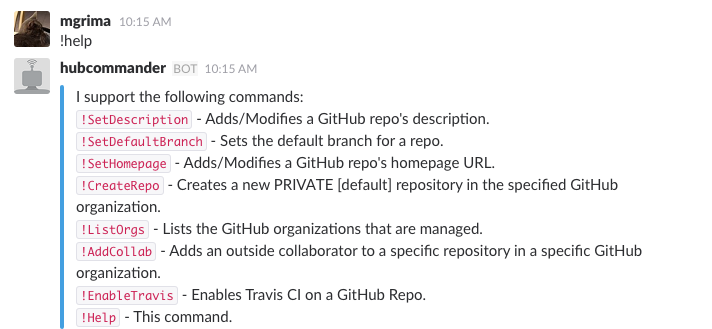
    Next, Slack channels with HubCommander installed can make the call !help to return a list of bot commands:

    Source: Netflix

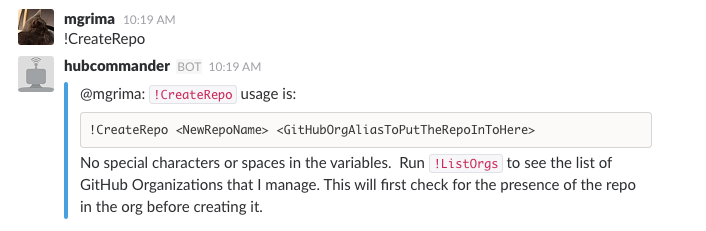
    To create a repo, for example, you can simply use the command !CreateRepo:

    Source: Netflix

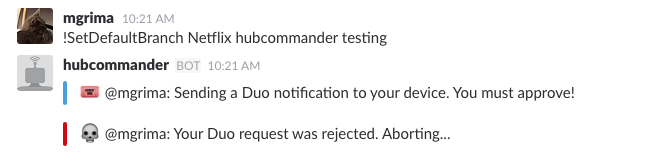
    Utilizing HubCommander also has security benefits as it reduces the number of GitHub API permissions granted per user—reducing attack vectors inherently increases security. Another point on security is HubCommander’s integration with Duo for additional authentication:

    Source: Netflix

    The total list of HubCommander features include:

    • Repository creation
    • Repository deletion
    • Repository description and website modification
    • Granting outside collaborators specific permissions to repositories
    • Repository default branch modification
    • Repository PR listing
    • Repository deploy Key listing/creation/deletion
    • Repository topics creation/deletion
    • Repository branch protection enabling/disabling
    • Enable Travis CI on a GitHub repo
    • Safeguard commands with 2FA via Duo

    Automating GitHub With ChatOps

    If your code resides in multiple Git repositories, like Netflix, having a method to configure permissions across all entities in a convenient way becomes a necessity. With a bot to perform operational tasks on GitHub repositories, Netflix is benefiting from automatic manipulation and a wider team access, adding to its agile goals:

    “The reduction in administrative overhead has significantly simplified our open source efforts.”

    Netflix operates with three development channels (a core Netflix OSS, Spinnmaker and a skunkworks project for new ideas). Thus, having a consistent permissions model across organizations can decrease friction. Also, since Netflix collaborates with third parties, such as contractors or other open source contributors, HubCommander also acts as an effective way to maintain security.

    Final Thoughts

    Netflix recognizes a growing popularity in the ChatOps approach and cites other benefits such as team transparency, a timestamp for each event and a self-service nature—all reasons for adopting a ChatOps strategy into its developer tooling.

    HubCommander appears like a good ChatOps tool for GitHub repository management. However, GitHub Actions (still in beta at the time of writing) is a new feature that will aid development workflows, offering automation for the GitHub operational duties themselves. This may spark alternative bots to be developed, especially in terms of workflows that respond to events.

    For now, with open source utilities such as HubCommander, certain GitHub duties can be quickened, stimulating a culture of more efficient management to decrease redundant tasks. While shorthand for GitHub repository management might not seem at first glance as a priority, it could scale down operational headaches tremendously.

    — Bill Doerrfeld

  • DOES San Francisco 2016: Adrian Cockroft On Retaining Talent

    DOES San Francisco 2016: Adrian Cockroft On Retaining Talent

    Another one of the over 50 video interviews we did at DevOps Enterprise Summit 2016 is our discussion with Adrian Cockroft. Adrian is was one of the last presenters at DOES this year, but that was a good enough reason to stick around until the end. Adrian’s presentation was on the challenges in retaining talent at high tech organizations.

    Before we dive into the talent conversation though, Adrian talks a bit about his own journey from Netflix where he pioneered so much of what we see in the DevOps market today. After Netflix, Adrian joined Battery Ventures, where he had the opportunity to go visit with numerous large organizations and find out what was working for them and what their challenges were. He was able to use that information to help guide Battery in which companies they should invest in to add to their portfolio. After several years at Battery, Adrian has recently left to join AWS where he will once again be directly involved as the VP of Cloud Architecture.

    But as I said earlier, Adrian’s presentation (truth be told he only had one slide or so, it was more of him speaking) was about the lack of enough qualified people to fill the ranks. This pressure results in successful companies having to “grow” their existing talent. But as Adrian points out the very act of letting this talent grow also leads them to move on. As they become more prominent in the field they are more likely to be recruited away. So how do you retain talent? Adrian tells us some of the things Netflix did to keep their engineers. Of course what Netflix did does not translate to many traditional organizations though.

    Obviously, monetary compensation helps an awful lot. But there are things beyond money (sometimes). Things like giving people titles like distinguished engineer for example.

    Adrian also brought up the example of Brent in the Phoenix project. How by giving him a different role, you not only remove the bottle neck, but also keep him happy in his new role.

    As usual, it was great listening and learning from Adrian. His reputation as one of the leading lights in the DevOps space is well earned and well deserved. Enjoy the conversation!

    devopstvsquareYou can see over 50 video interviews we did at DOES 2016 on our YouTube channel, DevOpsTV.

    — Alan Shimel

  • Does DevOps drive agility, or does agility result in DevOps?

    Does DevOps drive agility, or does agility result in DevOps?

    DevOps is a hot topic. Hell, I’m writing this on a site dedicated specifically to DevOps and you’re reading it, so it seems safe to assume we agree on the general premise that DevOps is an important trend for both business and IT. I question however, giving all of the credit for cost cutting, or for more agile and effective organizations to DevOps.

    A recent survey commissioned by CA Technologies titled DevOps: The Worst-Kept Secret to Winning in the Application Economy makes the claim that 88 percent of IT professionals surveyed have already implemented DevOps or plan to within the next five years. It also notes that companies that have already adopted DevOps have experienced 14 to 21 percent improvement in quality and performance of applications and/or faster time-to-market. Clearly DevOps is virtually ubiquitous, and companies that embrace DevOps are all but guaranteed to be more effective and efficient.

    Well, no. Not really. I’m a huge fan of DevOps, and I think there is a very good chance that organizations that adopt DevOps are likely to experience tangible, measurable benefits. However, one does not necessarily lead directly to the other and, in fact, it may be the other way around. Perhaps organizations that are doing the right things to yield improvements that result in more efficient and effective operations are also the organizations that are likely to embrace DevOps. I call this “Does DevOps drive agility, or does agility result in DevOps?”

    For starters, we still can’t even narrow down a concise explanation or definition of DevOps we can all agree on. So when we say that an organization’s success is the result of DevOps, what do we mean? Is it because the company broke down barriers between teams and enabled workers to collaborate together more efficiently? Is it because the company moved its infrastructure to the cloud and automated deployment of virtual servers and applications? Or is it because the company embraced specific tools or platforms like Chef, or Docker?

    There is an argument to be made that much of what comprises the strategic side of DevOps is just a natural, cyclical occurrence in business. There’s always some new management philosophy or business model du jour with a catchy buzzword, and right now it’s DevOps. Part of the reason that DevOps remains such an ethereal concept is that most of the organizations employing DevOps don’t realize they’re using DevOps, and they don’t call it that. Those organizations are just responding to the realities of competing today in the best way they can. That effort seems to lead invariably to embracing philosophies and strategies that have been collectively dubbed part of the DevOps culture.

    The organizations that started it all didn’t sit down and say “OK. We should start by adopting DevOps tools and strategies.” Companies like Netflix didn’t “embrace” DevOps—they created it from scratch, organically, and developed the tools and strategies that form the foundation of the DevOps movement. Everything that follows is an attempt to mimic the success of those organizations.

    If it’s a question of which came first, the chicken or the egg, it seems clear to me that DevOps is the outcome of a culture shift more than the engine or catalyst of the culture shift. To be fair, DevOps has matured, and is evolving into a culture all its own, and the tools and philosophies that make up DevOps are more clearly defined as time goes on. A company looking at it today can explore successful tools like Chef and Docker, and study examples of other organizations that have achieved success through DevOps principles.

    We still need to be careful, though, when breaking down statistics like those in the CA survey. Companies that are more agile, and deliver better quality products more quickly may also have adopted DevOps tools and strategies, but it doesn’t necessarily imply a direct cause and effect between the two. Perhaps as DevOps matures and the definition of the strategies and tools that comprise it becomes more consistent it will be easier to state clearly whether or not an organization has “adopted DevOps” and apply metrics that directly measure the effects of DevOps unique from the metrics the company would achieve anyway with or without DevOps.