Tag: NetDevOps

  • The Rise of NetDevOps and CI/CD Pipeline Solutions

    The Rise of NetDevOps and CI/CD Pipeline Solutions

    Over time, as organizations, networks and technologies have changed, the way enterprises think about managing networks has shifted as well. Enterprises are continuing to evolve their networking strategies, specifically with regard to how they expand their efforts to adopt infrastructure-as-code (IaC) practices. Looking ahead, the industry will continue to see the proliferation of solutions that help teams adopt a modern network operating model that delivers an agile, data-driven change management process. In most organizations, the software development team members and the networking team members have operated independently, with separate tools and processes. Developers would leverage pipelines to test and deploy code and then open a ticket for network changes such as VPNs or firewall changes. The network team would implement the changes, and end users could then use the application. The handoff between dev and network could be immediate or, more likely, it could take a few days–delaying the ability of the end users to access the new functionality. NetDevOps is focused on addressing this situation, which has become one of the market’s more critical infrastructure questions: How do you build an organization that can function smoothly across different skill sets, different technologies and different processes? Those same enterprises will be looking to leverage continuous integration/continuous delivery (CI/CD) practices from their software development best practices to help them overcome some of the challenges involved with implementing automation and orchestration into their networks.

    CI/CD Accelerates the Automation Process

    Let’s start with CI/CD. Adoption of network automation and orchestration will accelerate as network operators change the way they think about network updates and configuration management. According to Cisco’s recent white paper on how “Automation is driving network engineer skills transformation,” the reasons we’re seeing an increase in automation adoption is due to organizations relying on continuous connectivity, a greater need for the network to become more dynamic and the increased rate of changes both in the service supply side (applications) as well as in the service demand side (application consumers).

    However, some enterprises trying to build their own automation infrastructure struggle with resourcing, skill sets and maintenance effort struggles. To solve this, many of them are looking to incorporate the traditional DevOps practice of building and updating code with traditional continuous integration/continuous delivery (CI/CD) pipelines into their network automation and orchestration initiatives.

    Establishing a CI/CD pipeline is a workflow best practice for DevOps teams to follow. Today, organizations rely on CI/CD pipelines to help minimize bottlenecks in the software development and delivery process, while continuous integration optimizes building, integrating and testing code within a development environment.

    By integrating both CI/CD with network automation, teams will gain greater velocity and improve delivery. And by integrating network automation with an application CI/CD pipeline, they can reduce the time to perform network changes and enable secure access between the application and an in-house sales database.

    Why NetDevOps?

    NetDevOps brings the culture, technical methods, strategies and best practices of DevOps to networking.

    When DevOps principles are applied to network operations, organizations minimize operator interactions and optimize programmable network processes to configure, deploy and manage the environment, increasing efficiency and ensuring network availability, quality and reliability.

    NetDevOps takes those principles and applies them in a networking environment, offering tools to empower teams to collaborate and build an organization that can function across different skill sets and different processes — enabling everyone to participate in network orchestration.

    And it’s a movement that’s taking hold. According to Cisco’s Hybrid Cloud Trends report, 55% of those surveyed have created a cross-functional team with technical and business representation and 50% have a centralized CloudOps and NetOps function to help ensure their organization’s hybrid cloud strategy meets business objectives.

    Network Management Tools Will Continue to Evolve

    In today’s networking environment, where the expectation is to have an “always on” approach, teams are expected to build and release new applications at a faster pace than ever before. And every team has its own processes and methods for doing that which can create delays in the time it takes to execute the application. Incorporating network automation into the pipeline can empower teams to make application changes and deploy them to the network in seconds instead of the multiple days/weeks required for manual network changes. By integrating CI/CD pipelines and NetDevOps principles with network automation and orchestration, organizations can reduce the network change bottleneck even more.

    As we face the new year, we expect the way in which teams consume network automation and orchestration services as part of their software pipelines to become more sophisticated, with NetDevOps and CI/CD practices becoming a standard. And as more services become available, the adoption of IAC becomes easier. By abstracting and tweaking to abstract the traditional CI/CD pipeline, organizations of all sizes can accelerate the use of network automation and orchestration.

  • Languages and DevOps: Network

    Languages and DevOps: Network

    It is fun to discuss the changes in network operations over the last couple decades. We’ve come full circle, and, honestly, ended up in a better place. Network specialists were super command-line wizards who kept us going, with few GUIs in sight. Everyone thought the next iteration would be GUIs, so network operations could be accessible to more than a few command-line specialists. “Everyone” was mostly right; we did head in that direction. It was optional, and many network operations friends pointed out that you could still do more, faster with the command line. Before GUIs had the opportunity to catch up with command lines, though, automation came along. And then DevOps. And finally,* configuration-as-code. Pretty quickly, the ability to do everything through an individual product’s GUI was determined to be a weakness. Network operations personnel were dealing with more vendors to handle the networkification (it is too a word! I just made it up) of common development activities, like some aspects of security. And now, APIs and command lines rule the juncture of DevOps and networking.

    *Finally – so far, at least

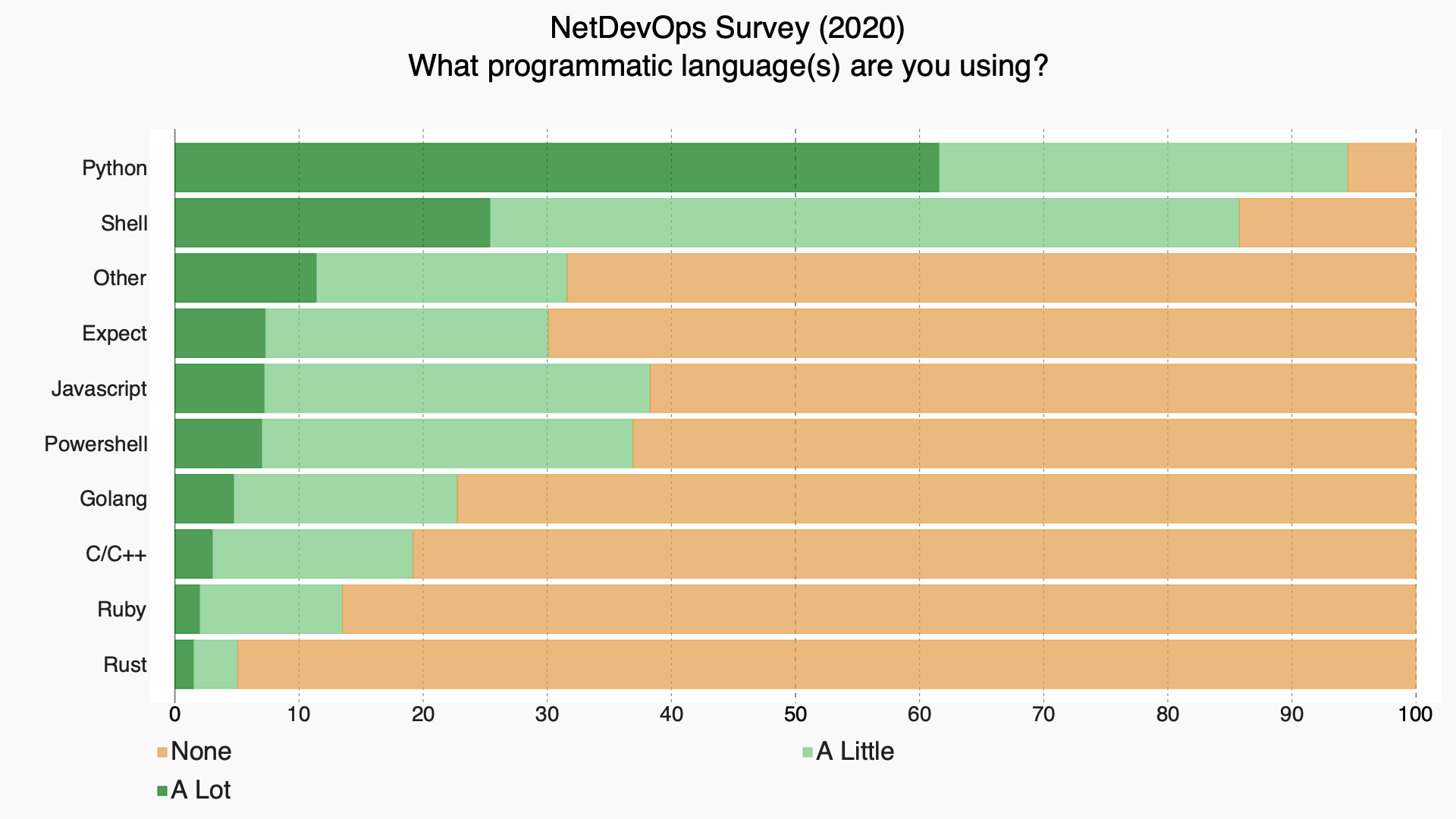
    And that shows in languages. Shell scripting and Python run this show, with little competition from any other language. We could get into a massive discussion about whether shell scripting is programming, but we won’t, because at least in networking, it most definitely is considered to be programming.

    One time, when we were tracking down a problem that involved all of IT, I was sitting with the serious network geeks and marveling at their ability to make everything they wanted happen from the command line in an instant, and their ability to parse command output. I’m no slouch when it comes to networking, but they easily put me to shame. I got to chatting with a few of them, and the consensus was that they loved computing but hated programming. Networking made sense to them. This explains why networking DevOps people are continuing to use Shell scripting and adopting Python at the same time.

    Python and Shell

    Shell is a given in networking. There are a lot of extant Shell scripts for doing all sorts of things, and the need to automate to keep up with Agile makes shell scripting a logical choice.

    Python enters the picture because it is “common ground.” It is intuitive enough for most networking people to do what they need to get done, and known or knowable to most developers. When it comes to usage, Python has overtaken Shell; (don’t take my word for it, check out the excellent work of the NetDevOps survey on GitHub, or just glance at the graphic below, created by them) in fact, Shell and Python command so much of the network development space that you are probably better off just making sure you’ve got those down, and focusing your free time on other issues like completely different networking commands, or even skills for data center versus cloud. The ROI would be better.

    But Wait, There’s More

    The key operational changes recently have been around GitOps and reporting back into the DevOps toolchain. People no longer want your appliance or application to have a pretty GUI, they want it to report in to the tools that provide automation and a larger-picture GUI. Many vendors are there already, but many are not yet. That creates a need for tools – products, open source projects, or internally developed – to do that integration while waiting for the vendors to catch up. These, again, are well-served by Python, though other languages that can handle APIs are viable, too.

    We’re headed for a world where systems detect anomalies and react to rectify them, but we’re not there yet – not on a strategic scale, at least. And we probably won’t be for some time, as automating massive network changes is a scary proposition and will take time to use these systems for detection, monitoring what they could have done, before organizations are willing to let them “just do it.”

    Carry On

    Meanwhile, NetDevOps is getting folded into DevOps proper, and in many organizations, using infrastructure-as-code or GitOps, is being deployed and managed like any other part of the life cycle. So we are moving along. For my network peeps, your job will continue to change, but it certainly won’t go away. You’re essential to smooth-running systems, and while the network may become even more virtual, it will still be networking. And under that virtual network will be … a physical network. So keep kicking it, and carving a path from users to apps, while protecting those apps and ensuring they have adequate resources. Oh, and if I spin up another instance at midnight, you’ll hop on and make sure it’s got traffic directed to it, right? RIGHT?!

  • Why DevOps Should Care About SDN

    Why DevOps Should Care About SDN

    Software-defined networking (SDN) and DevOps are not mutually exclusive. Actually, DevOps wants SDN, whether it knows it yet or not.

    Why?

    If software is going to eat the world, then SDN is going to eat networking.

    Networks are becoming more complex, and one way to manage them more effectively is through SDN. Also, organizations are demanding faster changes, yet networking changes traditionally have been a manual process.

    In a profession where network engineers typically work in seclusion and use significant manual processes, it can provide a set of tools to align with DevOps. This is why DevOps needs to care about it.

    Software-defined networking leads to infrastructure as code (IaC), which makes network automation possible.

    Software-Defined Networking and Infrastructure as Code

    SDN, in its simplest form, is controlling networking hardware with software. But there is more to it: Software-defined networking means networking switches and routers no longer need to be controlled with proprietary software. This creates an opening for innovation and is how we now have OpenFlow.

    This implies that networking now can culturally align itself with DevOps. The question will become whether it wants to. IaC is where networking will find its home with the DevOps team—it is like SDN for Ops.

    Why Does SDN Matter for DevOps?

    Software-defined networking will open communication and make automation possible—two ideas that are fundamental to an effective DevOps team.

    Open communication between networking can be easier when the mindset and tools are enabling a similar process. For DevOps, the current stack is providing tools to do exactly this. We see this with the Ansible and Red Hat DevOps networking partnership.

    What’s more, SDN enables network automation. Automation is an important goal for DevOps, which before SDN was not workable. Network automation can mean a better integration of DevOps and networking, as networking comprises many manual processes and, as such, is a bit isolationist. Aligning goals can provide better communication and collaboration.

    The Power of Network Automation

    SDN, IaC and DevOps networking are providing a set of tools and ideas that can push widespread adoption of network automation.

    Network automation is not a new topic, but implementation has been difficult. Technology had to catch up with demand: Before OpenFlow, networking infrastructure ran on proprietary software, which meant manual changes and configurations were commonplace and one-off scripts are the norm.

    With SDN and a technological environment conducive to network automation, we can begin to test different network automation strategies. Currently, however, organizations using automation only use it for segmenting their firewalls. We are in the early stages of what network automation can do.

    Just as DevOps is still finding ways to use automation in testing and development, networking is on its own discovery path to automation. The only difference is DevOps has a goal to automate and networking still views automation as a “nice to have.”

    Using NetDevOps to Bridge the Gap

    We have the conversation about SDN, IaC and network automation because networking does not have its functions accurately defined within the DevOps framework. That is why NetDevOps is a topic of discussion.

    The fact that SDN is still in its infancy stages and network automation is being discussed as “how to implement” shows there is a need for a cultural shift in networking that aligns with DevOps. This will help DevOps with communication and collaboration.

    DevOps wants automation and NetDevOps shares this goal. SDN is what makes this possible, and is exactly why DevOps should care.

  • 5 Reasons DevOps Needs NetDevOps

    5 Reasons DevOps Needs NetDevOps

    Networking’s role in DevOps is not accurately defined.

    Up to this point, networking has been integrated into DevOps through infrastructure as code (IaC), which has been around since the beginning of the DevOps movement. Although important, this does not quite encompass all of what networking needs within DevOps.

    A few of the current terms being used for networking in DevOps are:

    • Infrastructure as code (IaC)
    • DevOps networking
    • NetOps

    We have not agreed upon a universal, concrete philosophy to determine how to effectively bring networking into the DevOps conversation.

    This is why we need NetDevOps.

    NetDevOps is a construct of principles that aligns the networking team more closing with DevOps in your organization. It takes what traditionally are manual procedures in network infrastructure and applies the principles of automation and scalability.

    Why do you need yet another term or concept? This isn’t a new term; it just needs to be widely adopted.

    Therefore, here are five reasons you need NetDevOps.

    Networking + DevOps = NetDevOps

    DevOps needs networking and networking needs DevOps. The two may not admit this, but the open communication is essential. Networking’s biggest concern is network uptime, while DevOps’ ultimate goal is continuous delivery. The result is DevOps having a high interest in network availability to ensure updates can be delivered.

    Adopting a NetDevOps approach promotes networking to apply the same principles as DevOps. The goal of replicating and automating tasks—not automating for the sake of automation, but to take the processes that work effectively on one server and apply them to multiple servers.

    Remote Deployment for Cloud Adoption

    As cloud adoption increases, the need to deploy updates and changes remotely is essential. Cloud computing provides the necessary environment to implement the NetDevOps approach, which installing a hardware infrastructure allows for code deployment.

    In a cloud environment, such as AWS, infrastructure needed to implement this approach is available already. For example, AWS CloudFormation provides the necessary infrastructure for IaC.

    Infrastructure as Code

    IaC has been fundamental to the DevOps movement, and this is the foundation for NetDevOps: The ability to take network hardware and apply a set of code to the environment. The code allows you to automate an environment, which typically has needed to be updated manually.

    Automation is one of the core principles DevOps and NetDevOps share. Automation results in predictable network uptime, which provides an environment to better assist DevOps in achieving continuous delivery.

    Software-Defined Networks

    Software-defined networks (SDN) are a subset of the IaC discussion. It is the enterprise network version of cloud architecture. NetDevOps works in this environment through the use of white-box switches.

    Implementing white-box switches and installing Linux will create an SDN environment, which is conducive to NetDevOps. It is the necessary infrastructure for NetDevOps.

    Current Stack is Providing the Tools

    Once the above is implemented, a NetDevOps environment is ready to integrate with your current Ops stack. Ansible, Red Hat, Puppet and Chef already are providing the tools necessary to create a NetDevOps environment. Now you and your team need to implement it.

    NetDevOps is taking the traditional manual nature of networking and applying a set of DevOps principles. It is an environment of automation that brings networking full circle with DevOps.