Tag: mySQL

  • Best Practices for Configuring MySQL Replication

    Best Practices for Configuring MySQL Replication

    MySQL provides several replication configuration options. However, ensuring it is done correctly may take time and effort, with considerable choices. Replication is a crucial initial step to enhance availability in MySQL databases. A properly designed replication architecture can significantly impact the accessibility of your data and prevent potential management complications. This article will delve into best practices for replication, covering local and long-distance scenarios.

    Active and Passive Setups

    When using active/passive mode for replication in MySQL, one server acts as the source while others serve as read-only replicas. The replicas can handle read-only queries, but all writes must be directed to the source. This configuration distributes the load across all replicas. Still, in the default asynchronous replication mode, there might be a delay between when data is written to the source and when it’s available on the replica. Keep this in mind while designing your application.

    Alternatively, the active/active configuration allows multiple servers to handle both read and write operations. While it may seem beneficial to have two servers for write requests, each server still needs to process the query workload of the other, making write distribution less effective. Additionally, MySQL lacks native conflict resolution logic, so conflicts can quickly arise, making it challenging to determine the true source of data without significant data loss when a rebuild is necessary.

    I recommend using the active/passive configuration for replication and sharding if you require higher throughput from your database.

    Enable GTIDs

    Global transaction identifiers (GTIDs) are unique IDs attached to transactions in a replicated environment. By default, replicas track processed records in the binary log file of a source database. However, this method is fragile if the source crashes and logs need to be restored.

    With GTIDs enabled, each transaction receives a UUID-based ID, allowing replicas to determine if a transaction has been processed. The GTID is a UUID representing the source server, followed by an auto-incrementing ID (e.g., 14a54b2f-2ad0-43b6-b803-72b5d7151d3b:1). As transactions occur on the source, the UUID remains the same while the ID increases. When a replica processes a transaction, the GTID or GTID range (e.g., 14a54b2f-2ad0-43b6-b803-72b5d7151d3b:1-10) is stored in the gtid_executed table.

    This process significantly reduces the risk of data becoming unsynchronized due to unprocessed or excessively processed transactions.

    Replication Modes for Optimal Configuration

    MySQL offers two replication modes that behave differently and should be understood to ensure optimal configuration for your environment. By default, MySQL employs asynchronous replication, where transactions are sent to the source, read by replicas and processed independently without source validation.

    Alternatively, MySQL supports semi-synchronous replication, enabled as a plugin. In this mode, transactions are received by the source and processed by replicas, but the source waits for at least one replica to accept the transaction before responding. Semi-synchronous replication provides greater data consistency, though it introduces some overhead in response time.

    With semi-sync mode, there are additional options that can be adjusted. By default, the primary server waits 10 seconds for a replica with semi-sync mode enabled to acknowledge the transaction. If data consistency relies on semi-sync, consider increasing this timeout value to ensure guaranteed consistency.

    It’s important to note that these modes can be mixed and matched. For instance, you can configure one replica with semi-sync and another without, ensuring that one specific server always has an up-to-date copy of your database while other replicas catch up at their own pace. This approach aids disaster recovery by easily identifying the best candidate for recovery.

    Understanding the distinctions between these modes will help you make informed decisions that align with your business needs.

    Optimize Replica Instances With Separate Log Storage

    Replica instances in your environment rely on the binary logs of the source for accurate information, as mentioned earlier. These logs are stored on the same disk as the database by default. However, this setup can overwhelm busy databases due to high throughput, including database manipulation and reading binary logs for replication. To address this, storing the binary logs on a separate disk from the database is recommended.

    This approach offers performance benefits and cost savings in cloud environments where free volumes have strict IOPS limits.

    Monitor Replication and Metrics in Managed Clusters

    Monitoring is crucial for all infrastructure, including replication. With monitoring, it is possible to know if data is being replicated after configuration. SolarWinds database performance (formerly VividCortex) and Prometheus are popular solutions for monitoring replication and other metrics in managed clusters. Regardless of the chosen solution, it is essential to promptly notify the appropriate individuals when issues arise and address them before they escalate.

    Create a Failover Plan for Minimizing Disruptions

    Inevitable software or hardware failures necessitate failover planning to minimize potential disruptions. Utilizing replication offers resilience by ensuring multiple servers house your online data simultaneously. Therefore, your team must possess a well-prepared strategy should the primary data source fail. The following example outlines an unplanned failover process:

    ● Ensure the downed source remains offline to avoid unexpected replication issues.
    ● Identify and remove the read_only option from the chosen replica that will serve as the new data source. If using semi-sync, select the replica previously configured with the plugin and source.
    ● Update your application to direct queries to the newly promoted source.
    ● Modify the remaining replicas to start replicating from the new source.

    Optimize Cross-Region Replication

    Cloud providers typically provide services across multiple geographic regions comprising several data centers. These data centers, known as availability zones (AZs), are strategically located within the same region but far enough to withstand disasters. Replicating databases to different physical locations is recommended but requires careful consideration. Replication introduces additional latency due to the distance the data needs to travel. Fortunately, latency between AZs is generally low, with AWS claiming single-digit millisecond latency within the same region.

    In contrast, there is significant latency between regions. For example, at the time of writing, the latency between us-east-1 and us-west-1 was reported to be over 60ms by Cloudping.co. Replication across regions results in replication lag, which is the time difference between data being written to the source and being written to a replica. This lag is even more pronounced when replicating across longer distances.

    Asynchronous mode should be used for replication across regions to avoid unnecessary delays for applications making requests.

    A comprehensive understanding of replication configuration options is crucial. However, it is equally important to determine the optimal configuration for these options. This can significantly impact your MySQL cluster’s operational efficiency and data-serving capabilities.

  • Building Scalable Cloud Applications With MySQL

    Building Scalable Cloud Applications With MySQL

    Relational database systems such as MySQL have long been the go-to choice for handling large and complex data handling tasks. But, with the introduction of new technologies like NoSQL, many developers started to question whether traditional relational databases still have the upper hand. However, when building high-scalability cloud applications, relational databases like MySQL still have the edge over NoSQL. Here are five reasons MySQL remains superior to NoSQL in supporting developers of high-scale cloud applications.

    1. Enablement of Complex Queries

    Structured query language (SQL) is the most widely adopted language for relational databases, and MySQL is no different. SQL gives developers a powerful platform for creating complex queries and ad hoc reports, efficiently managing large datasets and creating tables and indexes for data optimization. By contrast, NoSQL usually offers only rudimentary query and data manipulation capabilities, often proving inefficient when handling complex data sets. Most data analysts are also familiar with SQL, so it’s a drop-in tool they can use to help gain insights.

    2. Scalability and Reliability

    MySQL is noted for its scalability when handling massive data loads and is particularly well suited to cloud-based applications that require consistently high performance. MySQL ensures that the consistency of data is maintained. MySQL is the go-to option for scalability and reliability for larger cloud applications. Companies such as Facebook, GitHub and WordPress have built billion-dollar businesses on MySQL, and it’s been tested and validated in some of the harshest and most demanding workloads of any database.

    3. High-Performance Replication at Scale

    MySQL replication offers a reliable solution for cloud applications that need to scale. Unlike other databases, MySQL’s replication capabilities provide effective data safety, making it a robust choice for applications that require high availability and durability. Additionally, MySQL enables seamless version upgrades without disrupting operations, ensuring the system always has the latest features and security patches. The read scaling feature of MySQL improves performance by distributing the read load across multiple instances, making it ideal for large-scale cloud applications. With a proven track record at scale, MySQL replication is the optimal choice for applications that want to grow and scale efficiently.

    4. High Availability and Durability

    MySQL provides enhanced high availability and durability, ensuring that critical data is always available even during maintenance and disaster recovery. This is because MySQL is fully ACID-compliant (atomicity, consistency, isolation, durability) and provides full support for transactions. Even when the system fails, the transaction can be rolled back and the data is not lost. With NoSQL databases, data is primarily written in memory and doesn’t provide the same degree of durability or consistency.

    5. Ease of Implementation and Debugging

    MySQL is easy to install, implement and debug compared to NoSQL. MySQL is supported by a large community of developers and database administrators who use it for a diverse range of applications. MySQL is also open-source and free to use, making it a great choice for businesses of all sizes. NoSQL systems require the installation of additional tools, libraries, and other components for implementation, making it more complex and time-consuming.

    MySQL provides many benefits for developers of high-scale cloud applications, ranging from its powerful SQL language for complex querying to its high availability and flexibility for managing multi-table joins. NoSQL remains a viable option in some cases, but developers who are building high-scale cloud applications are mainly sticking with MySQL due to its scalable and reliable nature, easy implementation and flexible query-handling capabilities. Choosing the right database engine is critical for any organization that relies heavily on large and data-heavy applications. MySQL continues to stand the test of time when it comes to ensuring performance and getting consistent results.

  • Quest Software Extends DevOps Reach to MySQL Databases

    Quest Software Extends DevOps Reach to MySQL Databases

    Thanks mainly to the rise of DevOps, the number of open-source database deployments in the enterprise has risen sharply in the last two years. The driving force behind those deployments has been developers that have shown a marked preference for downloading an open-source database instead of requesting access to a commercial database from a database administrator (DBA) working in an IT department. As more of those applications get deployed, however, either the developer or a DBA still needs to find a way to manage those open-source databases.

    To address that issue, Quest Software is now making available its Toad Edge tools for managing databases available for IT organizations that have deployed MySQL databases. Greg Davoll, executive director of product management and marketing, says Quest Software already supports open-source Postgres databases and will be adding support for other open-source databases.

    In a lot of instances Davoll says the same DBA that is being tasked with managing IBM DB2 or Oracle databases is being tasked to manage MySQL databases. Most of them are already familiar with Toad database tools that are already widely used by internal IT organizations. Davoll says Quest Software is well aware there are a variety of open-source tools available for managing open-source databases. But Davoli says most of those offerings are not nearly as rich in terms of features as Toad database management tools that have been continually enhanced now for the better part of a decade.

    For example, Toad Edge can be used to identify and manage schema differences and initiate changes in real time. Toad Edge can also be used to explore and edit JSON data as well as keeping all the scripts being employed to manage databases up to date.

    Davoll notes that Toad Edge has also been integrated with Jenkins Continuous Integration server to allow databases to better facilitate continuous integration/continuous deployment (CI/CD) processes.

    Most DBAs have come to terms with the fact they are being required to support multiple databases. They don’t always appreciate the extra work that involves. But as the number of applications deployed across the enterprise dramatically increases, the cost of employing commercial databases to support them all would be prohibitively expensive. Developers often download an open-source database on their own because they don’t want to spend time participating in an extended procurement process involving salespeople and purchasing managers.

    Developers don’t always appreciate what’s required to keep the databases their applications up and running. Many of them initially believed they would be able to eliminate the need for a DBA altogether. But developers soon discover how much time is required to do routine database maintenance. DBAs may not always get the respect they deserve. But as most developers have come to appreciate, it’s difficult to have a truly integrated DevOps process that doesn’t include at the very least someone willing to manage those tasks.

    — Mike Vizard

  • 8 Advantages of Using MySQL

    8 Advantages of Using MySQL

    MySQL is a free-to-use, open-source database that facilitates effective management of databases by connecting them to the software. It is a stable, reliable and powerful solution with advanced features including:

    1. Data Security

    MySQL is globally renowned for being the most secure and reliable database management system used in popular web applications including WordPress, Drupal, Joomla, Facebook and Twitter. The data security and support for transactional processing that accompany the recent version of MySQL can greatly benefit any business, especially if it is an eCommerce business that involves frequent money transfers.

    1. On-Demand Scalability

    MySQL offers unmatched scalability to facilitate the management of deeply embedded apps using a smaller footprint, even in massive warehouses that stack terabytes of data. On-demand flexibility is the star feature of MySQL. This open-source solution allows complete customization to eCommerce businesses with unique database server requirements.

    1. High Performance

    MySQL features a distinct storage-engine framework that facilitates system administrators to configure the MySQL database server for a flawless performance. Whether it is an eCommerce website that receives a million queries every single day or a high-speed transactional processing system, MySQL is designed to meet even the most demanding applications while ensuring optimum speed, full-text indexes and unique memory caches for enhanced performance.

    1. Round-the-Clock Uptime

    MySQL comes with the assurance of 24×7 uptime and offers a wide range of high-availability solutions, including specialized cluster servers and master/slave replication configurations.

    1. Comprehensive Transactional Support

    MySQL tops the list of robust transactional database engines available on the market. With features such as complete atomic, consistent, isolated, durable transaction support; multi-version transaction support; and unrestricted row-level locking, it is the go-to solution for full data integrity. It guarantees instant deadlock identification through server-enforced referential integrity.

    1. Complete Workflow Control

    With an average download and installation time of less than 30 minutes, MySQL means usability from day one. Whether your platform is Linux, Microsoft, Macintosh or UNIX, MySQL is a comprehensive solution with self-management features that automate everything from space expansion and configuration to data design and database administration.

    1. Reduced Total Cost of Ownership

    By migrating current database apps to MySQL, enterprises enjoy significant cost savings on new projects. The dependability and ease of management can save troubleshooting time that is otherwise wasted in fixing downtime issues and performance problems.

    1. The Flexibility of Open Source

    All the fears and worries that arise in an open-source solution can be brought to an end with MySQL’s round-the-clock support and enterprise indemnification. The secure processing and trusted software of MySQL combine to provide effective transactions for large-volume projects. It makes maintenance, debugging and upgrades fast and easy while enhancing the end-user experience.

    About the Author / Michelle McLean

    Michelle McLean is VP of Marketing at ScaleArc, responsible for overseeing all of the company’s marketing strategy and initiatives. She has more than 20 years of networking and market positioning experience. Prior to ScaleArc, she held director of product marketing positions at Silver Spring Networks, ConSentry Networks, Peribit Networks and Trapeze Networks, and prior to that, she was director of strategic marketing at Pluris. She previously served as program director at the research firm META Group, providing technology and strategy direction to global 2000 enterprise clients. Before that, she tracked technical developments, networking trends and vendor strategies as a journalist for two leading networking publications, LAN Times and LAN Magazine. Michelle earned her BA in English from the University of California at Berkeley. Connect with her on Twitter.

  • 4 n00b MySQL Mistakes Every Programmer Makes

    4 n00b MySQL Mistakes Every Programmer Makes

    Even experienced programmers can sometimes be thrown for an infinite loop–or other code failure–with these common MySQL mistakes.

    When a database application goes belly up, the cause often can be traced to sloppy coding. Every now and then, the reason for a misbehaving app is an idiosyncrasy in the platform itself. Here’s how to prevent your database from tripping over one of these common MySQL mistakes.

    Handling Numeric Value Overflows

    In an Aug. 11, 2014, article in the Database Journal, Rob Gravelle describes a “gotcha” (not a bug) in the way MySQL handles numeric value overflows. When a value supplied by an automated script or application is outside the range of a column data type, MySQL truncates the value to an entry within the acceptable range.

    Generally, a database system will respond to an invalid value by generating an error instructing the script to proceed or abort, or it will substitute the invalid error with its best guess as to which valid entry was intended. Of course, truncating or substituting the entered value is almost certainly going to introduce an error into the table. Gravelle explains how to override MySQL’s default handling of overflow conditions to ensure it generates an error, which is the standard response to invalid entries in most other databases.

    Misuse of Primary Keys

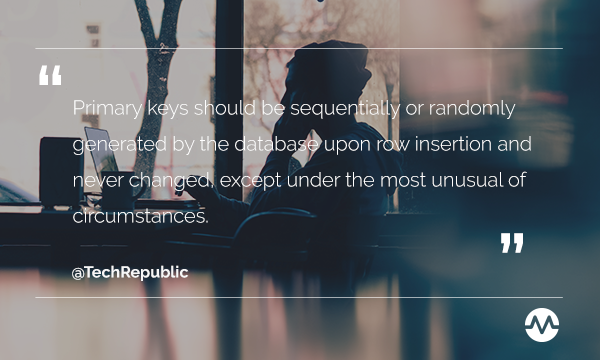
    According to Justin James on the Tech Republic site, the most common database programming no-no is the misuse of primary keys.

    MySQL-Mistakes

    James insists that primary keys should have nothing at all to do with the application data in a row. If they’re not system values managed by the system, you’re likely to encounter problems when you change the underlying data or migrate the data to another system.

    Using Stored Procedures as a Crutch

    Another frequent cause of program problems is overuse of stored procedures, which James describes as a “maintenance disaster.” There’s no easy way to determine which applications are using a particular stored procedure, so you end up writing a new one when you make a significant change to an app rather than adapting an existing stored procedure. Instead, James recommends that you use advanced object-relational mappers (ORMs).

    Not every developer is sold on ORMs, however. On his Experimental Thoughts blog, Jeff Davis explains why he shies away from ORMs. Because ORMs add more lines of code between the application and the data, they invite more semantic errors. Davis points out that debugging in SQL is simpler when you can query the database as if you were an application. The more lines of code between the application error and the database, the more difficult it is to find the glitch.

    Overuse of BIGINT

    One of the common database errors identified by Thomas Larock on the SQL Rockstar site is playing it safe by overusing the BIGINT data type. If you’re certain no value in a column will exceed 100,000, there’s no need to use the 8-byte BIGINT data type when the 4-byte INT data type will suffice. You may not think a mere 4 bytes is significant, but what if the table ends up with 2 million rows? Then your app is wasting 7.8MB of storage. Similarly, if you know you won’t need calendar dates before the year 1900 or after 2079, using SMALLDATETIME will make our app much more efficient.

    Misuse of GUIDs

    On the SQL Skills site, Kimberly Tripp highlights another common database design error: use of non-sequential globally unique identifiers, or GUIDs. In addition to creating fragmentation in the base table, non-sequential GUIDs are four times wider than an INT-based identity.

    Is your app’s failure to launch due to poor typing skills?

    Maybe the best way to start your hunt for a coding error is via a printout rather than with a debugger. That’s the advice of fpweb.net’s tutorial on troubleshooting SQL errors. The problem could be due to a missing single quote mark, or misuse of double quotes inside a string. If you get the “No value given for one or more required parameters” error message, make sure your column and table names are spelled correctly

    Likewise, if the error states “Data type mismatch in criteria expression,” you may have inserted letters or symbols in a column set for numeric values only (or vice versa). The FromDual site provides a complete list of MySQL error codes and messages, including explanations for many of the codes, possible sources for the errors, and instructions for correcting many of the errors.

    MySQL Error Codes

    The FromDual site explains how to find sources of information about MySQL error messages.

    MySQL error message

    For many of the MySQL error messages, the FromDual index provides an explanation, reasons for the error message’s appearance, and potential fixes.

    With a little work and a lot of sticky notes, these common MySQL mistakes are fairly easy fixes. There’s nothing worse than looking like a nOObie programmer and damaging the integrity of your application. So stay sharp, and take a second look at your MySQL queries.

  • Will MariaDB Soon Replace MySQL?

    Will MariaDB Soon Replace MySQL?

    MariaDB is a database growing in popularity. Its lead developer is Michael “Monty” Widenius, who was part of the team that created MySQL. When MySQL was acquired by Oracle, Widenius and some of the other original MySQL developers decided to launch MariaDB as a fork of MySQL and keep it as open source to mitigate any issues around Oracle’s ownership of MySQL.

    MySQL-vs-MariaDB

    In 2009, Sun Microsystems acquired MySQL. Sun’s subsequent acquisition by Oracle brought about a movement headed by Widenius to “save MySQL.” Widenius and many others in the open source community felt Oracle’s ownership might be a conflict of interest, since Oracle already had a competing closed source commercial database. They believed Oracle would be slow to further develop the MySQL database, given the potentially greater focus on the commercial Oracle database.

    In response to this, Widenius began working on MariaDB and helped form the MariaDB Foundation, which uses a community governance model. Because of the separation between the open source and commercial sides of the foundation, its governance generally is seen by the open source community as positive. This is in contrast to Oracle, which has both its commercial Oracle database and the open source MySQL both under the same governance. Often this is perceived as a conflict of interest, especially when it comes to keeping MySQL up to date.

    MariaDB vs. MySQL

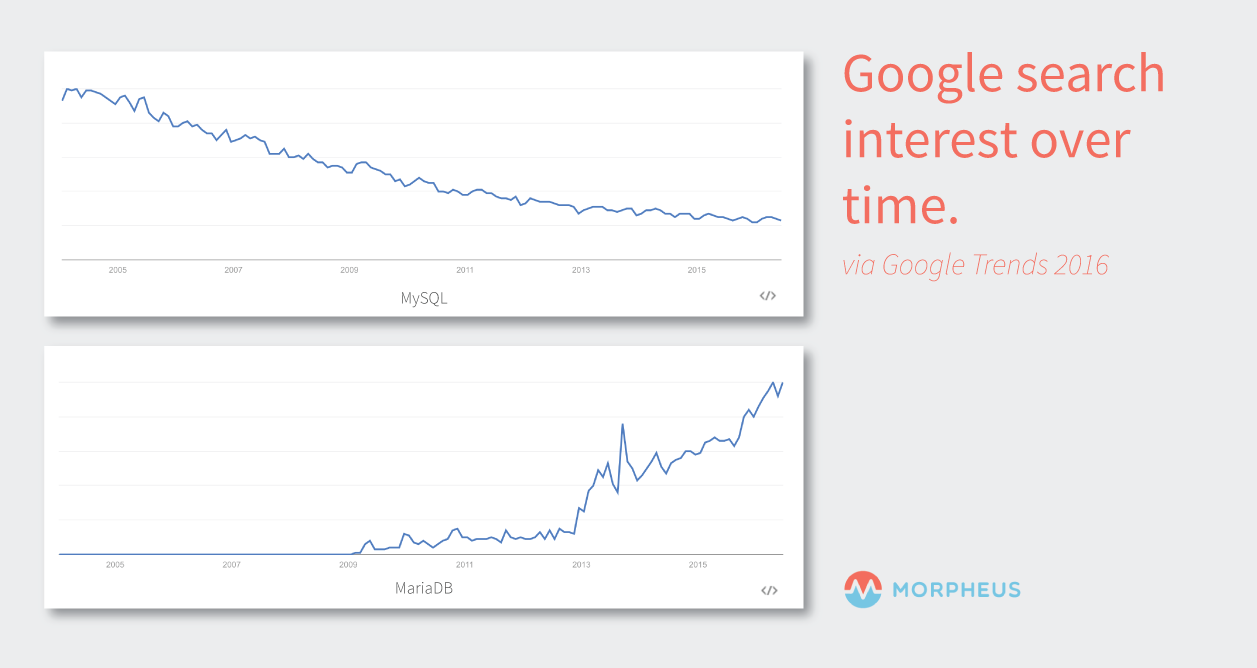
    While MariaDB isn’t yet replacing MySQL, it has brought about good competition between the two, which can be good for innovation. With its backing of Oracle, MySQL may reign supreme for at least the near future; however, technically speaking, MariaDB could replace MySQL if a company decides it wants to make the switch.

    The developers designed it as a drop-in replacement of MySQL. Since it was forked from MySQL, basically all of the structures MariaDB uses are the same. This means switching from MySQL almost surely won’t require a company to alter its application in any way, since the data and data structures won’t need to be adjusted.

    In fact, the command-line tools such as mysqladmin, mysqldump, the daemon and others all keep their original names, so MariaDB is very much a drop-in replacement for database administrators as well. Indeed, many organizations have already either switched to it or simply began using it on its own: It replaced MySQL as the default database in Fedora and Red Hat. It is also used by Booking.com, CraigsList and Wikipedia, among others.

    What Else Does MariaDB Offer?

    Community improvements to MariaDB have been made by notable organizations such as Facebook, Twitter and Google. For example, Google contributed data-at-rest encryption to release 10.1.3, which is quite helpful given the security issues that can arise quickly in this ever-changing environment. In addition, it offers performance improvements such as subquery optimization and faster joins. It also has added row-based replication.

    While MariaDB may not replace MySQL immediately, it is worth watching: It is gaining traction as a potentially serious contender in the marketplace.

  • Does MariaDB replace the “M” in LAMP

    Does MariaDB replace the “M” in LAMP

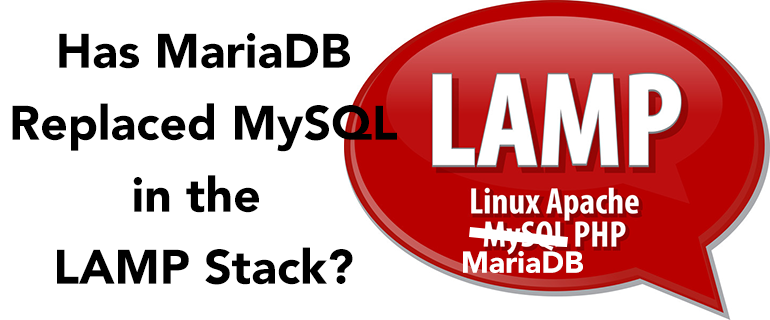
    If you were starting a new application tomorrow, which backend would you use? Chances are you said MySQL. However post Oracle acquisition MySQL has changed. After Oracle purchased the code they broke the hearts of many. And there is hope that MySQL has re-invented itself in the form of MariaDB

    (more…)

  • Tokutek Announces Reselling Partnership With SkySQL

    Leading MariaDB Distributor Adds TokuDB as Complementary Tool to Extend Database Performance and Scalability

    With TokuDB and the SkySQL MariaDB, database administrators and DevOps engineers can easily operate on continuously incoming data and incorporate analysis on large volumes of data.


    LEXINGTON, MA and LONDON, UNITED KINGDOM and HELSINKI, FINLAND–(Marketwired – Feb 12, 2014) – Tokutek, delivering database performance at scale, today announced that it has entered into a partnership with SkySQL™, a trusted provider of open source database technology, to resell its TokuDB® database storage engine. SkySQL will offer the TokuDB storage engine as a complement to its MariaDB® distribution to increase scalability and performance and to enable real-time management of transactional and analytical data.

    TokuDB enhances the SkySQL MariaDB distribution with its unique ability to handle high rates of incoming data, including updates, while maintaining query performance on large volumes of data. This occurs without requiring expensive hardware build-out and with no operational downtime. With TokuDB and the SkySQL MariaDB, database administrators and DevOps engineers can easily operate on continuously incoming data and incorporate analysis on large volumes of data. Businesses benefit from richer analysis, more up-to-date information, and access to detailed data.

    “Tokutek’s TokuDB storage engine gives the database administrators and DevOps engineers who support MariaDB applications a ready-made tool to improve their database performance and scalability,” said Tom Callway, Director Marketing, SkySQL. “The combination of high data ingestion, compression and Fractal Tree indexing in Tokutek’s TokuDB makes it a great complement to the SkySQL MariaDB for high-performance, real-time analytics.”

    Paybox, the leading provider of electronic payment solutions in Europe, is a current SkySQL MariaDB customer also using TokuDB to manage their database. According to Marc Thomas, chief technical officer at Paybox, “As we continue to grow, so do the demands on our databases. We’ve benefited from SkySQL’s deep knowledge of MariaDB and best-in-class support, and Tokutek’s unparalleled scalability and performance. The increased collaboration between SkySQL and Tokutek ensures that these two industry leading providers will become more tightly coupled on both the technology and the service level, which is a big plus for Paybox.”

    “SkySQL offers both a MariaDB distribution as well as the tools and services necessary to support it,” said John Partridge, CEO of Tokutek. “With our TokuDB storage engine available as a SkySQL download, SkySQL is giving its customers the ability to make MariaDB into a much more performant database.”

    TokuDB is the ideal choice for complex high-volume applications that require fast response time and that must simultaneously store and query large volumes of rapidly arriving data. These include social networking applications, real-time clickstream analysis, logfile analysis, ecommerce personalization, and high-speed webcrawling applications. TokuDB is fully compatible with MySQL and MariaDB.

    To learn more about the SkySQL MariaDB distribution with TokuDB v7.0:

    Download a free trial of the suite,
    Attend a Webinar overview of TokuDB v7.0,
    Read the Tokutek blog for more information on TokuDB.

    About Tokutek Inc.
    Tokutek is a performance database company that delivers Big Data capabilities to leading open source data management platforms. Its breakthrough technology lets customers build a new class of applications that handle unprecedented amounts of incoming data and scale with the data processing needs of tomorrow. Tokutek applies patented Fractal Tree™ indexing to increase MySQL performance and MongoDB performance, decrease database size, and minimize downtime. The company is headquartered in Lexington, MA, and has offices in New York, NY. For more information, visit Tokutek.com or follow us on Twitter@Tokutek.

    About SkySQL
    SkySQL is a trusted provider of open source database solutions for MySQL and MariaDB users on enterprise sites and in the cloud. SkySQL provides deployment and database management solutions to more than 400 client companies, including Canal+, ClubMed, Constant Contact, Deutsche Telekom, La Poste, Virgin Mobile, Western Digital, and XING. With more than 300 accumulated years of experience in the original MySQL solution, SkySQL has a wealth of core competencies in MySQL and counts on the support of the first MySQL creators, as well as those of MariaDB. The company has also developed database management solutions in the cloud, which are easy to use and offer improved productivity. For more information, go to www.skysql.com, and follow our twitter feed:http://www.twitter.com/skysql

    MySQL is a registered trademark of Oracle, and/or its affiliates.
    MariaDB and SkySQL are registered trademarks of SkySQL Corporation Ab. SkySQL and MariaDB are not affiliated with MySQL, or Oracle.
    Other names may be trademarks property of their respective owners