Tag: mobile app development

  • OutSystems Acquires Ionic to Further Automate App Development

    OutSystems Acquires Ionic to Further Automate App Development

    OutSystems this week revealed it has acquired Ionic, a provider of an open source framework that provides developers with a higher level of abstraction for building and deploying mobile and desktop applications.

    OutSystems CTO Patrick Jean said Ionic will accelerate the company’s ongoing efforts to extend the reach of its platform for building low-code applications without developers having to worry about, for example, the screen size of the device an application is deployed on it because the framework automatically right-sizes it. Ionic, in effect, will provide an extension to the platform that OutSystems already uses to automate the building and deployment of low-code applications, he added.

    In addition to its namesake user interface (UI) framework for building mobile applications that can run on multiple platforms, the Ionic portfolio also includes a tool for natively deploying web applications, dubbed Capacitor, and a toolchain for building web component-based design systems, dubbed Stencil. Collectively, these tools are used today by more than five million developers.
    OutSystems plans to extend the capabilities of these tools to make it simpler to deploy applications on both mobile devices and desktop systems, said Jean. The overall goal is to reduce the cognitive load that developers currently carry when they need to build and deploy applications that run on multiple platforms, he added.

    That capability will prove critical as more individuals beyond professional developers become involved in building, deploying and updating applications, noted Jean. In fact, many of those developers are likely to be business people that only develop applications on a part-time basis, he added.

    The percentage of applications being built using low-code tools has increased dramatically. Professional developers have embraced these tools and platforms alongside so-called citizen developers that are using them to build applications, as well. As the backlog of applications that needs to be built steadily increases, low-code platforms have played a crucial role in enabling developers to keep pace with the demand for new applications.

    Less clear is the impact these low-code applications are having on DevOps workflows. On one hand, there are clearly more applications that need to be deployed than ever. At the same time, many of the DevOps and data modeling processes that once required, for example, a dedicated continuous integration/continuous delivery (CI/CD) platform are being embedded in the platforms provided by the vendors that create low-code tools.

    Regardless of how low-code applications are deployed, the one thing that is certain is the pace of digital business transformation is being greatly accelerated by these tools and platforms. DevOps teams will soon need to put guardrails in place that enable developers with a wide range of experience and skillsets to securely deploy and update applications.

    On the plus side, DevOps teams should also expect it to become easier to automate the delivery of low-code applications at levels of unprecedented scale. In fact, the issue going forward may not be whether IT can keep up with the needs of the business but whether the business can keep pace with the rate of innovation now being enabled.

  • Future of DevOps: Trends to Watch

    Future of DevOps: Trends to Watch

    Technology is transforming every aspect of industry, and digitalization and automation have flourished in the past few years. DevOps has established itself as an indispensable software development methodology for successful digital transformation.

    According to a recent market survey, the DevOps market will exceed $20 billion by 2026, growing at a CAGR of 24.7% from 2019 to 2026. DevOps has facilitated rapid and dependable software development, delivery, improved quality and higher customer satisfaction.

    DevOps, too, is continuously evolving to meet the changing demands of the corporate environment. Let’s look at the future of DevOps and the trends you should expect to see.

    Serverless Computing

    DevOps teams will see a rise in the adoption of serverless architecture, mainly because of the massive capital and operational costs of server infrastructure. Numerous DevOps groups are working with modular components offering an overview of the pipeline. Moving these modular components to serverless architecture will empower groups to mitigate a few pieces of errands identified with pipeline architecture and focus on deployment and development of the product.

    Serverless computing streamlines overall DevOps operations, including the complete software life cycle, from development to deployment, testing and maintenance in one place. Also, serverless computing reduces the developer’s workload by taking care of server maintenance, such as cloud monitoring and system updates. Other prime USPs include flexibility, reliability, speed and cost-efficiency.

    Microservices Architecture

    Microservices architecture has been gaining popularity as an alternative to traditional monolithic architecture in the IT industry, and this trend is expected to continue. Microservices architecture is a pattern of organizing computer systems into segments that can scale on demand. A microservices architecture pattern is the next evolution of service-oriented architecture (SOA) that structures an application as a collection of coupled services. If one piece of the application fails, microservices make it easy to identify and contain the issue without disrupting the whole application.

    DevOps and microservices architecture enable decentralized teams to innovate rapidly, maintain control over their tech stack and standards, track performance metrics, supervise the development and release cycles and reduce overall consumption time by achieving shorter software release intervals.

    Low-Code/No-Code Applications and Platforms

    To keep up with the demand for new applications and features, many organizations have turned to low-code/no-code development to deploy applications swiftly. Adopting a low-code approach with DevOps is a game-changer. It enables developers to experience higher agility and gives the organization a competitive advantage in the fast-paced, demanding software market.

    Low-code applications allow non-technical ‘citizen developers’ to contribute to software development with the help of visual interface integration. In addition to end users, developers and DevOps engineers are set to play a crucial role in this trend, using low-code platforms and tools that offer drag-and-drop elements and other extensions. These low-code application development tools support every aspect of software development, including app ideation, analysis, software design, code development, quality assurance, deployment and documentation.

    DevSecOps

    Many large enterprises are integrating and automating security into DevOps processes. The transformation from DevOps to DevSecOps is expected to gain even more momentum in the future. According to a forecast, the DevOps market size is expected to reach $5.9 billion by 2023 at a CAGR of 31.2% during the forecast period.

    More companies will embed security controls earlier in the software development cycle to ensure application security. Tools and frameworks will simply integrate with CI/CD pipelines and testing tools will see a rise in 2022. DevSecOps empowers developers to consistently track, monitor and remediate security defects during the various stages of development while improving the speed of delivery and quality.

    Kubernetes and GitOps

    Kubernetes is an open source container orchestration platform emerging as an infrastructure trend on the operations side. Kubernetes will expand further into the software development space in 2022 and beyond. It will ease the task of starting a local Kubernetes cluster on a developer’s machine. Kubernetes security is expected to take center stage as well, through infrastructure-as-code (IaC) scanning.

    GitOps is a Kubernetes-related infrastructure trend that allows developers and IT operators to use Git to manage clusters and deliver efficient, secure applications without misconfigurations. It automates releasing incremental updates, and consistent delivery will enable developers to build, test and deploy software rapidly.

    AI and ML

    Artificial intelligence and machine learning have already transformed the way businesses operate nowadays. In 2022, it is anticipated that AI/ML will further streamline and accelerate every phase of the SDLC. It enables DevOps teams to enhance their performance through intelligent automation, improving feedback and managing alerts.

    Advanced analytical methods like predictive analytics are becoming increasingly important as the market evolves. AI can enable proactive investigation of the DevOps pipeline to identify problems and offer possible solutions. AI and ML integration also enable deep learning, data mining, statistics and modeling, becoming an integral part of your business’ workflow.

    Conclusion

    DevOps continues to evolve and pivot to drive significant IT transformations that directly bolster business goals and objectives. It will assist in enhancing the company’s ability to design, produce, launch and maintain high-quality software solutions. The above trends will help organizations move rapidly beyond automation, focusing on continuously improving outcomes. These trends are catalysts for creating a regular and dependable release pipeline and building better communication between development, IT and business teams.

  • Stopping Mobile Fraud With Automation and DevSecOps

    Stopping Mobile Fraud With Automation and DevSecOps

    Mobile fraud is a multibillion-dollar problem that’s only getting worse. One study showed that mobile click fraud alone rose 64% during the first few months of the COVID-19 pandemic. In fact, during the pandemic, about one in five mobile ad clicks were fraudulent. And that’s just one form of mobile fraud.

    Weaponized botnets, mobile malware, mobile Trojans and mobile cheat engines and dynamic instrumentation tool abuse—the methods that fraudsters use to defraud companies and consumers via mobile devices—are constantly expanding in number and scale. 

    Historically, organizations have fought against fraud through monitoring and data analysis. As transactions and data come in, analytics and AI work to discern legitimate events from fraudulent ones. These systems require training and a lot of data to become proficient at identifying fraud, and they can become very accurate. But fraudsters are always changing their tactics to evade these systems, and, as many of us have experienced, false positives are still a big problem. If you’ve travelled enough overseas, likely you’ve had your bank account or credit card frozen until you could call your financial institution to let them know that your purchases were genuine. 

    Another challenge with existing mobile fraud prevention solutions is that they are designed to protect networks and network resources first. As a result, while fraud is occurring and fraud prevention systems are learning, mobile end users are still being affected. Also, when a bad act is identified and a system enforces protections against fraud, these enforcement points typically block network traffic. That protects the network, but the consumer and their mobile app remain at risk. Once a fraudster compromises a mobile app, they may be able to attack through other vectors, even if one network is shut down. For instance, if a consumer unwittingly downloads and launches EventBot to their mobile device thinking it was a legitimate app, it may compromise multiple banking apps. If one bank shuts down its network after detecting fraud, EventBot may have other opportunities on the device.

    DevSecOps

    As this chart shows, once fraud takes place, damage to a brand, customers and the bottom line begins immediately. Even if it is detected and halted, the harm it has already caused can’t be undone. Mobile app publishers and developers need to stop mobile fraud where it starts, and that means implementing mobile fraud prevention inside the app within a DevSecOps framework. By blocking the technical methods used to carry out fraud via mobile apps, organizations can make massive inroads toward stopping fraud before it ever gets to the network level, preventing both customers and organizations from getting scammed.

    Why Traditional Security Approaches Don’t Work in Mobile Apps

    To achieve a multi-layered defense against fraud, a mobile app should include app shielding, anti-tampering, code obfuscation, data encryption (including strings, resources, preferences), jailbreak/rooting prevention and man-in-the-middle prevention (such as certificate pinning or certificate validation). Certainly, there are commercial SDKs and third-party libraries that can provide these functions, with some limitations. But these approaches typically still require extensive development work and introduce additional frameworks or programming language dependencies and incompatibilities. 

    They don’t solve the fundamental problem of implementing fraud prevention inside a mobile app—it’s too expensive and time-consuming.  The root of the problem rests in the way mobile apps are developed, released and updated in a modern agile organization. DevOps depends on processes that are dynamic, automated, agile, integrated, iterative and continuous. Mobile app security has traditionally been very different: Static with manual, line-by-line coding. This way of implementing manual security will never work in an agile delivery model.

    The promise of DevSecOps is built-in security, delivered as a fundamental part of a release process where security is designed into the process at each and every phase of the life cycle. The security model can be delivered and evolved atomically, iteratively and dynamically so that it adapts to fit the app.

    The future of fraud prevention lies in the mobile app, but to make this possible, the industry needs to apply AI and ML to automate fraud prevention and security implementation into mobile apps on time within an agile, fast-moving and iterative app life cycle and release process.

  • Redefining Continuous Security for DevSecOps

    Redefining Continuous Security for DevSecOps

    In the mobile app development world, security often takes a backseat to developing features and delivering the app. In fact, the 2021 Verizon Mobile Security Index found that 45% of organizations sacrificed mobile security in order to “get the job done.”

    It really shouldn’t come as a surprise. Certainly, it seems counterintuitive that mobile app development organizations would spend so much time and money to create an exceptional Android or iOS app and then fail to protect it against rooting, jailbreaking, reversing, hacking and other kinds of malicious manipulation. But the average mobile developer releases 12 apps each year; a frenetic pace that requires development to take place in parallel, without ceasing. Schedules and budgets are tight, and competition is fierce. Coding security into an app is both expensive and time-consuming, increasing the risk of a delayed release or budget overages.

    In many organizations, if security is implemented into a mobile app at all, the process takes place during penetration testing. That’s too late, and it’s extremely inefficient. Waiting to implement security after development and delivery are essentially finished will anger developers because now, they have to dive back into their code to make complex changes to work they thought was finished. The code is no longer fresh, so it’s going to take more time than it would have if security implementation had taken place during the development process itself.

    But integrating security into the development process is no simple task either. Imagine two friends are spinning a couple of jump ropes. Jumping in the middle without stepping or tripping on either of the ropes while they are moving is difficult. Each time a security feature is introduced into a mobile app’s software development life cycle (SDLC), the person building the security could step on the rope. Building security features takes time, and they are hard to build and maintain.

    Our Oversimplified Model of DevSecOps

    To solve this problem, DevSecOps was introduced to resolve this conflict and overcome the challenge of integrating security into the mobile SDLC. The idea is that organizations can develop features and incorporate security simultaneously. So far, much of the emphasis in DevSecOps has been focused on the processes development, security and operations that teams use to build, protect and release apps. People have done heroic work creating cultures of security and secure coding practices, which has moved the industry forward toward more secure mobile apps for everyone.

    Let’s take the jump rope analogy a bit further. One friend holding the ropes is the development and engineering team, while the other is the ops/release team. The ropes each represent an iOS and an Android app. In most organizations, the ropes are moving at blazing speeds, as apps are churned out one after the other. Meanwhile, on the sidelines, there’s the security team, whose job is to make sure the ropes meet security objectives, jumping in where needed, all without stopping the ropes from spinning.

    The trouble is that each group has different skills and objectives. Developers aren’t typically security engineers, and security teams don’t typically have developers. Neither group has the resources or skills to meet the needs of the other, and whenever they try, one of them trips on the rope.

    Mobile DevSecOps, Meet Continuous Security

    The only way to keep the current breakneck pace of app releases going while simultaneously providing security is to introduce as much automation as possible. AI systems can fuse security to an app more cost-effectively and consistently, complete with validation that the features required have been implemented. It’s different from code scanning, which occurs after the app is built and leaves remediation to the dev team. I’m proposing that the implementation of security itself be automated.

    The growing threats to mobile apps are too significant for development teams to ignore, but so are the market pressures that force such short delivery timescales. The only way out of this dilemma is extensive automation. Otherwise, the dev and sec teams will keep continuously tripping on each other’s ropes.

  • Higher Mobile App Stability Begets Higher User Ratings

    Higher Mobile App Stability Begets Higher User Ratings

    In the competitive mobile market, application stability is imperative. Downtime leads to poor user experiences, which stunts growth and revenue. Apps that have poor stability suffer the consequences. In fact, new studies show that just a 1% lower stability ranking can lead to nearly a one-star drop in App Store ratings.

    Bugsnag recently released its 2021 Application Stability Index (ASI) report, Characteristics of Leading Mobile Apps. The study took 260 top-performing mobile apps across industries and reviewed each’s stability and end-user satisfaction. The study found that apps with solid stability tend to rank much higher in the App Store and maintain increased user engagement. The report also demonstrated that developers are pivoting to weekly releases to quickly address bugs, progressing from the bi-weekly standard for software updates.

    Below, I’ll review the specific details of the ASI and the report and consider how stability varies throughout industries. Hopefully, the results here will help other software teams benchmark their app’s performance and release cadence against top-performers within their sector.

    Stability = User Satisfaction

    When measuring uptime and availability, five nines, or 99.999% uptime, is the golden target for most teams. This report measured stability as the percentage of apps sessions that were crash-free. The median across market-leading apps was 99.80%.

    What’s interesting is that apps with more nines in their stability score achieve markedly higher App Store ratings. Apps that scored less than 99.00% had a median rating of 4.15, whereas apps with 99.99% to 100% measured uptime had a median rating of 4.70. The distribution of ratings was extremely wide for low-performing apps, compared to higher average scores for higher stability.

    What do these results say? Users expect uninterrupted sessions. Frequently occurring stability issues can damage the consumer’s opinion of an app, leading to dissatisfaction and harsh reviews. The more stable an app is, the better chance it has to drive consumer success.

    Stability by Industry

    The study also exposed stability differences between industries. B2B SaaS apps ranked relatively high, at 99.85%. This is likely because B2B software must meet service-level agreements (SLAs). Such services have fewer (yet more high-paying) customers to support, the report speculated. Mobile apps directly tied to the exchange of money, such as e-commerce (99.86%), travel and hospitality (99.90%) and financial and banking (99.85%) also ranked consistently high in stability.

    Coming in second were mobile apps in the business-to-consumer (B2C) (99.82%), consumer goods (99.80%) and health and wellness (99.78%) categories. Though these areas require decent availability to remain viable, they may not need such stringent SLAs. In such scenarios, non-stop availability isn’t as directly tied to end revenue.

    Lastly, apps with the worst stability were found in the mobile games (99.71%) and media and entertainment (99.65%) categories. Mobile gaming had the worst ratings of all industries; mean stability equated to over a full day of outage per year. Increased downtime in both categories is perhaps due to more problems with frequent media updates. These areas also tend to have a lower average revenue per user (ARPU), which may affect how teams value ongoing support.

    Deployment Frequencies

    According to the report, highly stable mobile apps tend to release at least once per week, replacing the bi-weekly norm for updates. Nearly all industries are pushing at least four releases per month, aside from consumer goods and travel and hospitality, at 2.5 and 4 respectively. E-commerce takes the cake with a mean of seven releases per month.

    Nowadays, progressive delivery is made possible due to increased emphasis on CI/CD. Therefore, rapid deployment frequencies are the norm. Releasing new versions more quickly can help appease users with new features. It’s also helpful to quickly patch bugs and decrease mean time to recovery (MTTR) for major incidents.

    Users Love Stable Apps

    Throughout the pandemic, digital reliance soared—84% of consumers said applications were a lifeline to normality, found a recent AppDynamics report. In this climate, mobile applications are critical to delivering valuable interactions.

    Yet, user expectations have evolved. Now, it’s readily apparent that stability directly impacts consumer confidence. The ASI findings behoove engineers to edge closer to the five-nines goal. The more nines you have, the better off you are.

    “The results of our second ASI report highlight the need for better proactive error monitoring and stability management to help engineering teams build healthier apps that deliver superior customer experiences,” said James Smith, SVP of the Bugsnag Product Group at SmartBear.

    It’s good to reiterate that this study examined a handful of leading apps from each industry. So, these scores shouldn’t be construed as inclusive of the entire app marketplace, only as benchmarks for the top mobile app performers.

  • Applitools Extends Visual AI Testing to Native Mobile Apps

    Applitools Extends Visual AI Testing to Native Mobile Apps

    At its online Future of Testing: Mobile event, Applitools today previewed the ability to apply visual artificial intelligence (AI) to applications that run natively on a mobile computing platform.

    Accessed via a cloud service that is currently available for free on a limited basis, the Ultrafast Test Cloud for Native Mobile offering will extend the company’s visual AI tool for browser-based mobile applications to applications that run natively on Apple iOS or Google Android devices.

    Applitools CEO Gil Sever said that while most mobile enterprise applications today rely on browsers to make it simpler to build and deploy applications, in time, many more of these applications will be running natively on iOS or Google Android platforms, mainly because they provide a better user experience.

    That approach also eliminates the need to rely on cumbersome platform emulators to test applications because the Applitools AI tool can learn the nuances of each platform in a way that streamlines the application testing process.

    In fact, visual AI tools will not only make developers and testing teams more efficient, but they also will make it easier for end users to participate in the application testing process, Sever noted.

    The Applitools approach to AI testing also provides developers with more control based on the application’s use cases. Different settings can be applied to test, for example, a medical application that requires perfect alignment of pixels versus an e-commerce application that may not require as much fidelity. Developers can then resolve regression issues by employing root cause analytics.

    It’s not clear how broadly visual AI tools that use computer vision algorithms to automate testing will be employed. There is no doubt the current pace of application development is faster than most dedicated teams of testers can handle. As a result, more responsibility for application testing is being shifted left toward developers that, in the interest of time, might be more inclined to rely on AI and other forms of automation that can be accessed via a cloud service.

    The rise of AI testing tools might also go a long way toward ensuring more applications are thoroughly tested before being deployed in a production environment. One of the first steps in any application development schedule that gets compressed when a project falls behind schedule is testing. As more rote tests are automated, there should be more opportunities for dedicated testing teams to focus on improving the end user experience.

    It may be some time before most organizations are routinely employing AI to test applications. However, none of those organizations should expect AI to replace the need for humans to test applications alongside AI testing platforms that can see the actual application. After all, there’s a world of difference between seeing the changes that were made to an application and understanding why they actually needed to be made.

  • DevOps Chats: Mobile, Monoliths & Microservices, With LightStep

    DevOps Chats: Mobile, Monoliths & Microservices, With LightStep

    Daniel “Spoons” Spoonhower made a bit of a name for himself while he was at Google, as did his two co-founders of their latest company, LightStep. All three were there at the birth of the microservices wave that has swept through the software world.

    They left Google and started LightStep to help all developers build better, more scalable applications.

    With its new release, LightStep has pushed the bar higher. In this DevOps Chats podcast, Spoons tells us what they are doing and where he sees things moving.

    As usual, the streaming audio is immediately below, followed by the transcript of our conversation.

    Transcript

    Alan Shimel: Hey, everyone, it’s Alan Shimel for devopsy.kinsta.cloud and Container Journal. You’re listening to another DevOps Chats. I’ve got a great guest to talk with today, I hope you’re going to enjoy it. I’d like to introduce you to Daniel Spoonhower, better known as Spoons. Spoons, welcome to DevOps Chats.

    Daniel Spoonhower: Hi, great to be here.

    Shimel: So, Spoons, you are CTO and Co-founder of LightStep, and though some in our audience are probably familiar with LightStep, being that this is the first time we’ve had someone from LightStep on our podcast, I’m gonna ask you to kinda do some of the heavy lifting here and kinda—

    Spoonhower: Sure.

    Shimel: – tell our audience a little bit about LightStep and what you guys do.

    Spoonhower: Sure—sure, sure. So, LightStep provides simple observability for deep systems. We think observability is more than just metrics, logs, and traces, it’s really about being able to navigate from effect to cause. So, whether you’re pushing into deployment, you’re on call and you got paged or you’re just trying to improve performance, observability tools like LightStep should be able to give you the insights that you need to understand what’s happening in your services and across your system.

    Shimel: Excellent. And just by way of, again, giving the audience the background—Spoons, why don’t you tell them a little bit about your own personal journey? You are a Co-founder and CTO, but there was life before LightStep.

    Spoonhower: True, yeah. So, yeah, I’m Co-founder and CTO and LightStep, but we have three—all three of the Co-founders are technical, and so, we all have done technical things and we all have done a lot of non-technical things, too, which has been pretty fun for me just to learn about finance and about commercial real estate—who knows what.

    Shimel: Yeah.

    Spoonhower: But yeah, I’m an engineer by training. Before this, I was at Google for a while. I worked both on their internal infrastructure team, which was super interesting, as well as on the cloud platform. And I have various other experiences at big and small companies. I was at grad school for a while doing academic stuff, so—yeah, a lot of different things.

    Shimel: Excellent. Alright. So, before we—I know you guys have some new product announcements coming up, but you know, LightStep is, as I mentioned, new to our audience here on the podcast, but it’s been around five years, right? And I think you gave everyone kind of the—you know, the brief elevator pitch about it. But it really, you know, in an age where even just since I’m doing devopsy.kinsta.cloud, right, Spoon, we’ve seen APM turn into AIOps and companies go public in this space and everything, several. But yet, you know, the need to kinda monitor, manage, see what’s happening is still here and I don’t wanna say it’s getting easier or—you know?

    Spoonhower:  [Laughter]

    Shimel: Because I think it’s just, you know, natural. Things get more complex as we continue to build and so forth, and I guess that makes the monitoring easier, but when does it get simpler?

    Spoonhower: Well, yeah, so I think the situation has gotten a lot more complex. That might be because of things like microservices or serverless or things like that. I actually think a lot of complexity comes from the fact that we no longer run our whole applications. Like, we use DynamoDB, we use third party fraud detection service, right? There’s a lot of pieces of our software that are not even ours any more, so that adds a lot to the complexity.

    Shimel: Yeah.

    Spoonhower: I think the simplicity has to come from focusing more on the use cases. Like, what are you as a developer actually trying to get done? And then, I mean—I think this is where people kind of get into things like AIOps is, like, using software to sort of harness the data that we have to help you in that task. I think that can be a real-really nice as a developer, right, to not have to understand all of the depths of what’s going on underneath the hood.

    Shimel: Sure. I mean, I just find it somewhat ironic that, you know, we’re gonna break down silos, we’re gonna break up this monolith and go to microservices so that we can deal with smaller, more easily digestible threads, and then we’re gonna orchestrate all of this with a great tool like Kubernetes. And then I look at it, and I’m not the developer you are—I’m not claiming to be, or the technical person—but damn, it gets…it’s just the nature of the universe, at some level.

    But anyway, you guys are well aware of this. It’s acute. This is the world you play in. You’ve got some new product announcements. Let’s talk about ‘em.

    Spoonhower: Yeah. That’s right, yeah. So, I mean, the history of LightStep a little bit is that we started as a tracing tool, collecting data sort of—exactly to address the situation you’re talking about. You’ve broken your application into some pieces and you want to be able to understand the big picture, right, and put them back together.

    And what we’ve done actually is to continue to integrate additional data sources into that, so that we can provide sort of more user-centric things. So, what we’re rolling out right now is a couple different pieces. One is error analysis, so being able to understand, you know, you have a spike in errors in your service, harnessing that data, whether it’s traces or logs or metrics, to understand what the cause of those errors are. We have a detailed rollout analysis, so even if you’re in the middle of a rollout, so you’re saying you’re gonna canary or blue-green or something like that and you wanna understand what’s happening, we’ll do that analysis for you and do a side by side to tell you what’s different about the new release.

    And one thing that’s pretty exciting is that part of this is integrating metrics into the platform. Metrics are a tool that everyone has been using forever and ever and ever, but you know, there’s a lot of metrics out there, and part of what we think is important is that we’re able to focus on the right metrics, the metrics that are actually able to explain what’s happening right now.

    Shimel: Absolutely. So, this new release, April 2nd, is the key day?

    Spoonhower: Yeah.

    Shimel: So, people listening to this can go check it out right now at LightStep.com.

    Spoonhower: That’s right. We’ve got a free developer tier that you can try. We also have a really cool sandbox that’s sort of, it’s a sort of interactive playground where you can check out features and you can basically walk through one of these scenarios. So, say you’re doing a release, say you’re trying to debug an error or something like that. It’s not—you know, it’s not totally constrained, but will kind of show you along and give you a bit of a guide that you can still explore the rest of the product while you’re there, but really trying to help people kind of put two and two together and understand what’s happening.

    Shimel: Yeah, no, I love that, man. Because I gotta tell ya, we’ve been experimenting with something like that for a project we’re doing on devopsy.kinsta.cloud where, you know, we want to have web people do a little bit more hands-on playing with different vendors’ tools and so, we’re trying to give them a sandbox, right, where they can go in and do these things.

    Because, you know, we were talking off mic, right? Originally, this was gonna be an announcement around KubeCon which, unfortunately, you know, got pushed. And, you know, not getting into the whole politics and the whole thing around Coronavirus and all this stuff, but certainly, we need—we need more ways, we need more diverse ways of allowing people to see what kind of new products, what new technologies, how can they get it under their nails a little bit and really—

    Spoonhower: Yeah.

    Shimel: – kind of see if it’s for them?

    Spoonhower: Yeah, absolutely. I mean, I think people learn in lots of different ways, right? Some people wanna read, some people wanna watch a video. I personally really like doing this stuff. Like, until I’ve made it, coded it, whatever, I never remember it, so.

    Shimel: Absolutely. And you’re not alone. I do think specifically for technology vendors, having those kinda hands on that people can actually go in and we see it even on our webinars, man. If we do a webinar where the vendor’s doing a real live demo that people can follow along, we get insane numbers of people signing onto that, versus someone just talking, you know, and that doesn’t work.

    So, let’s talk a little bit about what was driving this, for you guys.

    Spoonhower: Yeah. I think, you know, we—so, I should say, when I say “we,” it’s me and one of the other Co-founders. Ben and I spent a while at Google, and Google—it’s a weird place, in a lot of ways, but there are some advantages. Like, there were ways in which being at Google is a little bit like seeing the future, and they weren’t called microservices at the time, but there were a lot of teams that built software that all had to stack together.

    And we saw, you know, sort of firsthand the problems that they had in terms of like, okay, I’ve broken this thing into pieces and now how do I understand that bigger picture? We saw a lot of arguments among those teams, like, you know—“Oh, no, it’s your fault,” “No, no, it’s your fault”—and needing some data to actually kinda resolve that.

    And so, I think, for us, you know, we saw the rest of the industry starting to adopt these things through different technology, maybe, but the same idea that you can have teams work independently and deploy independently yet still build a single application. And so, the motivation was really to try to help those folks to understand what’s happening and, you know, we see LightStep being used by individuals, but actually more and more by teams. We see it used in operational review so, you know, you’re doing a post mortem, you wanna show people what happened. LightStep is a great tool to help facilitate that conversation.

    And for us, this is really about being able to help those folks deliver software more confidently and then, you know, get back to building new features and doing all the fun stuff that they’re doing.

    Shimel: Yeah, yeah. I mean, wouldn’t it be great if we just, all we did was the fun stuff all the time? [Laughter] Some of us are lucky enough to do that, me included. But this thing, these are important things that need to get done and, you know, and LightStep is following that up.

    I wanted to return to the KubeCon thing if we can, for a second, Spoons. Not KubeCon itself, but rather the Kube community, right? And you know, look, Kubernetes itself comes out of Google, right? I’m not gonna say the Google people invented microservices, but certainly a lot of very foundational work was done there, right?

    When you are out and about or you see how this community has grown and the enthusiasm for things like LightStep, right—I mean, how does that, you know, kinda give you a warm fuzzy inside to say, hey, man, this is a whole—there’s this humongous community of people who kinda share our visions or our outlooks, and it’s a lot easier to sell to, and I don’t mean that you’re a salesperson, but it’s a lot easier to sell those solutions, right, than it is—you know, it’s not like pushing rope uphill.

    Spoonhower: Yeah, yeah. I mean, I think [Laughter]—yeah, I mean, Kubernetes is a result of a lot of mistakes that were made the first time around. [Laughter]

    Shimel: Yeah. [Cross talk]

    Spoonhower: So, I think a lot of people would admit that. No, but I think the community is really great. I think the thing that’s pretty exciting to me about it is really thinking about things like infrastructure as code, about, thinking about automation, about—and, you know, these things which we kind of think of historically as, you know, maybe more of a craft actually can be an engineering discipline, and I think that’s a lot of that community. It’s actually really great whenever I’ve been to KubeCon to see the range of folks there from, you know, sort of platform folks all the way up to people that are just building features and shipping code, that they’re also excited about those tools. That’s really, for me, makes a big difference, just to see that it’s not a niche thing so much, right, that it’s really a broad community that’s excited about it.

    Shimel: Oh, yeah, no, it’s broad. Me personally, I have 20 years in the security InfoSec space. I get excited when I see all the security people there about it, because I really feel like maybe this time we’ll do better, right? [Laughter]

    Spoonhower: [Laughter]

    Shimel: And we got out in front of this and where, you know, security is really kinda—it’s not the caboose on the engine, per se, it’s like, people care, and not just the security people care, the community cares.

    Spoonhower: Yeah, yeah.

    Shimel: And that’s important. So, you know, in today’s world, right, this isn’t this year’s release, this is just the April 2nd sort of new feature. So, what—and one builds on the next, right? So, what’s next here?

    Spoonhower: Yeah, so, I think we’re continuing to think about how we can do automated analysis. So, we have a future in the product already called correlations which, essentially, you know, you pick out some effect you think is important, you know? Errors went up, speed went down, whatever it is, and LightStep will find the things that correlate with that within sort of the set of requests that you’re looking at. So, we have a bunch more features related to that coming out later this year.

    So, this is kind of how I—I don’t know. When people say AIOps, I always gotta roll my eyes a little bit, but this is kinda how we think about, you know, bringing artificial intelligence to DevOps, right, is that it’s really through sort of putting the right clues in front of you, right? It’s not about providing 10,000 clues to solve a mystery, it’s about 5, right?

    Shimel: Right.

    Spoonhower: So, a bunch of stuff around that, and then—I mean, the other place that we’re thinking about is how do we get more proactive, right? How do we get in front of you and help you anticipate when these things are gonna be happening as well?

    Shimel: Absolutely. So, I suppose one day you’re gonna grow old and you’ll be on this side when—so, I’m no longer building products or founding companies that are building products, and I hear public lands come up with all these…and I don’t wanna say it’s just some marketing term, but—

    Spoonhower:[Laughter] You can definitely say that, that’s fine.

    Shimel: You know, I will tell you, the first time I heard AIOps, too, I said, “What?” You know? But, you know, I’ve been in technology long enough where—look, just don’t call me late for dinner, right? I don’t really care any more what you call it. And also on the media side of it versus on your side of it, I just report the news, you know, theoretically, right? We don’t—if you wanna call it, you know, if it quacks like a duck and it walks like a duck, it’s a duck.

    But in any event, I do hear you about that. And, you know, you wanna talk about an overhyped term? AI?

    Spoonhower: Yeah. I think in the world of—in DevOps, I think it’s actually, there’s some—

    Shimel: It’s overhyped, itself.

    Spoonhower: Yeah, there’s some [Cross talk] though, I think, because you know, if you’re talking about, like, I don’t know, ad placement or something like that, no one really cares about why, right? Like, you put the ad and someone clicks—nice job, right? Like, good job, robots.

    But like, you get paged and something’s like, “It’s that service over there, you should definitely roll it back.” And you’re like, “Yeah, but why?” Like, I’m not just gonna start rolling back things because robots tell me to.

    Shimel: Yeah, “I said so, that’s why.”

    Spoonhower: Right. [Laughter]

    Shimel: [Laughter] But I hear you, man, it’s out there. Well, listen, I told you, the time goes really quick here, and I think we’re about out, man. But Spoons, it was great having you on here. Good luck with this new release. I would say I look forward to seeing you at the next KubeCon. Let’s hope there is a next—

    Spoonhower: That’s right. I’ll see you somewhere, and if not, online.

    Shimel: Yeah. Otherwise, we’ll have you back here on the podcast, man.

    Spoonhower: Cool.

    Shimel: Alright? Hey, that was Daniel Spoonhower, Spoons, CTO and Co-founder at LightStep. He was just our guest on DevOps Chats. This is Alan Shimel for Container Journal, devopsy.kinsta.cloud, Security Boulevard. You’ve just listened to another DevOps Chats. Have a great day.

    — Alan Shimel

  • Citizen Developers Drive Productivity and Innovation

    Citizen Developers Drive Productivity and Innovation

    It was once written that “software is eating the world,” “APIs are eating the world” and “APIs are eating software.” In 2019, a more accurate statement might be, “APIs (or application programming interfaces) fuel the software that’s still eating the world.”

    In today’s world, there is an ever-constant demand for software, enterprise applications and mobile applications, and most company IT departments can’t keep up. Enter the citizen developer. Citizen developers are helping organizations close the demand gap and innovate more quickly. But who are they and what role do they fill within an organization? And how do they contribute to overall technology innovation within a company?

    Citizen Developers and the Need for Speed

    The ongoing need to develop software quickly and efficiently has given rise to a new type of developer. A citizen developer is a non-professional developer who builds new business applications using existing tools, development and runtime environments sanctioned by corporate IT. They also can access various online tutorials to learn and master their application-building skills.

    Today’s software development environment, powered by APIs, is ripe for the citizen developer. APIs, mobile application development kits and the cloud have created a no-code/low-code, building block-like approach to building software. Less code and a more simplistic software development path allow citizen developers to create much-needed apps quickly. This building-block approach cuts development time, translating to faster time-to-value.

    Speed is critical not only in the creation of new apps, but also in the end user experience of these apps. With the building-block model, citizen developers use best-of-breed technologies for each block—making the resulting UX optimal (and fast) for an internal user or customer end user. Internal users are able to use fast, effective search within employee directories, company intranets and project management solutions, for example.

    For end users, this need for speed addresses their ever-growing expectations. When someone searches for hotel deals in Phoenix, for example, they expect accurate, personalized and fast results. Even a one- or two-second delay can translate to lost opportunity and revenue.

    The Workplace

    In the digital workplace, citizen developers serve a key purpose. For starters, they know firsthand about the challenges employees face at work; they also know which applications or tools are critical to getting the job done. These non-IT developers (perhaps in a business or marketing role) help create apps for timesheet entry, productivity tracking, project workflow reporting and more. In one study, 76% of businesses stated that at least some of their apps were developed outside of their IT department—and 20% even stated that most of their applications were created outside of IT.

    Citizen developers often use low-code tools or visual tools with some degree of coding required. Low-code allows developers to design and develop software applications with minimal hand-coding, while low-code platforms enable users to build applications with modern user interfaces, integrations and data quickly without writing thousands of lines of complex code. Also, citizen developers may work alongside software developers and database experts to develop apps with custom coding to meet specific enterprise or company needs.

    Citizen Developers and IT: Working Together

    When citizen developers work alongside IT, two things happen. First, by creating simple apps on their own, they enable IT to focus on developing more complex applications. Second, when building more complicated or customized applications, IT can use citizen developers to derive valuable insight. This data helps with testing or tweaking business app prototypes. With low-code, citizen developers with some technical skill start with a prototype and then can iterate with the IT team during the developer phase and later integration of systems, custom coding and security processes. Also, developers, who are often asked to understand more of the business side of the organization, gain this insight working with workplace citizen developers. And the results are promising: 82% of citizen developers said they witnessed a reduction in inefficient tasks while 71% reported an increase in team productivity.

    In the past, IT spearheaded application development projects from beginning to end. Now, with citizen developers becoming an integral part of the workplace, IT’s role changes a bit. While no longer in full control, IT does give recommendations to the business department and selects development components and building blocks.

    Just the Beginning

    When it comes to search software, citizen developers have the potential to create personalized and customized experiences. While some types of front-end search are simple to create, developing a personalized and customized search experience is more complicated. This is where the current work lies and in doing so, we can build a new community of search-focused citizen developers.

    This is only the beginning, as there will always be a demand for developers (both traditionally trained and citizen developers). In the coming years, we will see more citizen developers as there literally aren’t enough engineering schools to train students to meet business demand. They are helping to democratize application and software development across the board—and we can expect to see businesses and consumers continue to benefit.

    — Julien Lemoine

  • How to Find and Hire Android Developers in 2018

    How to Find and Hire Android Developers in 2018

    A brilliant app idea demands no less a brilliant mobile development team. That means you have to take the time to search and recruit skilled Android developers and, correspondingly, overcome lots of challenges for this. Here are some tips to help you overcome the difficulties and mitigate possible problems in finding qualified Android developers.

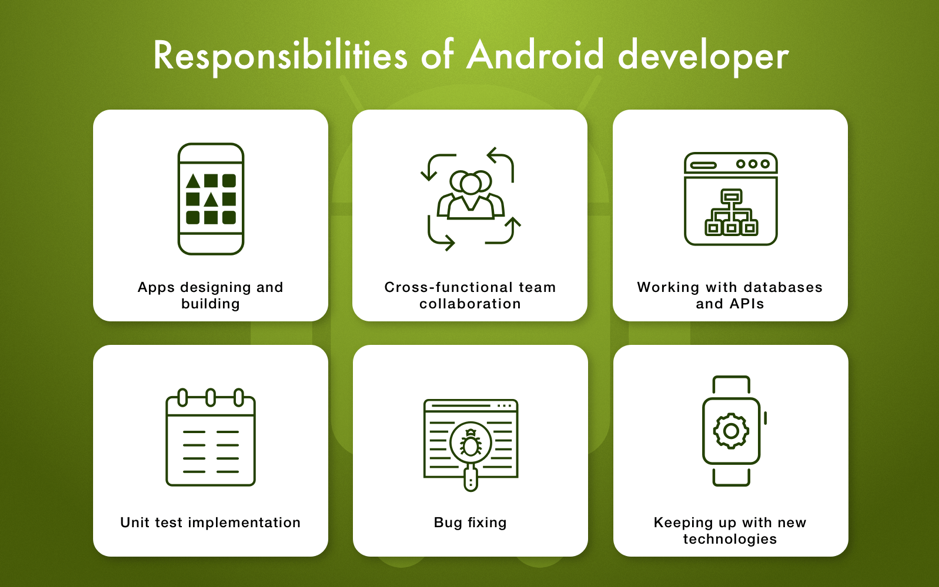
    Roles and Responsibilities of Android Developers

    It’s always a good idea to dive deeper into your employees’ responsibilities. So if you have no technical background, this section will be rather useful for you as it tells more about the skills of a proficient Android developer.

    It’s worth mentioning that the technical skills of Android and iOS developers differ due to the OS differences. A particular set of technologies is used for each OS and if you want to hire iOS developers, you should check the skills they need to have according to the latest market demands.

    Skill Level

    In the IT industry, developers are divided into levels specifying their proficiency. These levels are:

    • Entry level means a developer hasn’t had much experience in developing software products. Junior Android developers typically work on simple projects and they’re curated by more experienced colleagues.
    • Experienced developers work on complex projects and don’t have managerial responsibilities.
    • Senior developers typically have 5+ years of experience and often lead big projects as well as supervise the performance of technical tasks.

    Responsibilities

    Let’s consider Android developers responsibilities in more details.

    UI Engineering and Business Logic Development

    Developers have to re-create the app’s design as well as develop its functionality. Additionally, they should predict what bugs may occur and prevent their appearance.

    Collaborative Skills

    In most cases, developers don’t work on a project alone. They are surrounded by other specialists and need to effectively collaborate with them in order to achieve a common goal: a well-functioning end product.

    Databases and Third-Party APIs

    Android developers should be good enough at reading code written by other developers since they will have to work with external APIs and databases during their projects.

    Unit Testing

    Modular testing is a kind of industry standard. Android developers have to perform it to test a certain part of the app’s functionality and fix any bugs. Unit testing is a part of agile software development that’s designed to create high-quality apps fast.

    Bug Fixing

    Android developers should make everything possible to deliver a bug-free and stable-working product.

    Types of Android Developers

    There are several types of developers you can choose from. Which one to pick depends on your preferences and project.

    • Freelance developers. This type can be a good choice if you are on a limited budget and you want to save as much money as possible. However, bear in mind that, in fact, you have no control over freelancer’s work and all that remains is to rely on their responsibility.
    • In-house developers. These are the ones working on your project at your company’s office. It’s a good option in case you already have an office space and you want to manage the development on your own.
    • Outsourced team. The scheme is simple: You hire a software offshoring company, explain to them your requirements and they build a project for you from scratch.

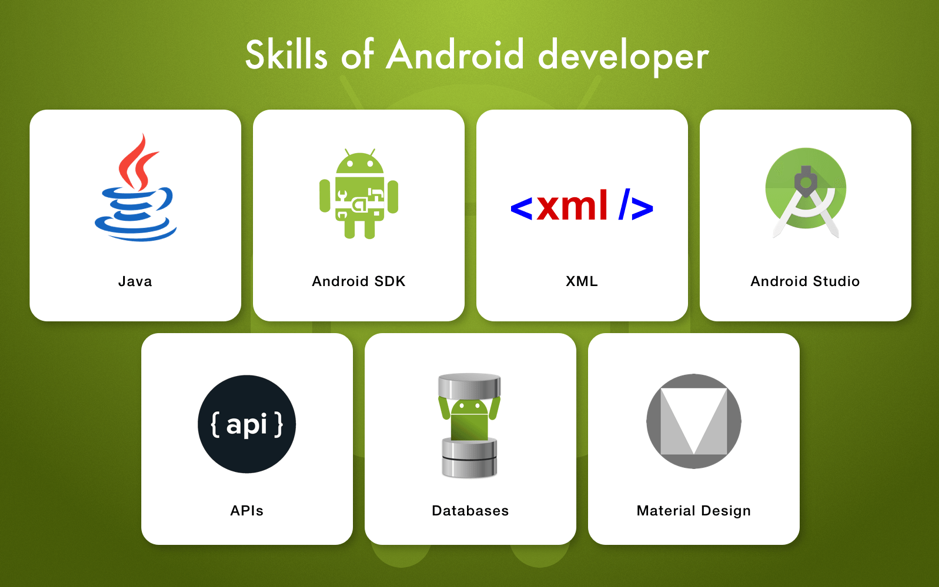
    Technical Skills of Android Developers

    Android developers must have a set of technical skills that actually make the app development possible. Underneath, we’ve listed basic technologies every Android developer should be able to work with.

    • Java: This is the official language for developing Android apps. This object-oriented language was created in 1995 and currently it’s the world’s most popular programming language. Every Android developer must have a decent knowledge of this language to build software.
    • Kotlin: This is the second official language for Android development and many programmers are switching to it for various reasons.
    • XML: Extensive Markup Language is broadly used for web development, but it is a necessary technology for Android development as well. In simple terms, XML is designed to provide the information exchange via the internet. So, if your app needs to be connected with the internet, developers have to use XML.
    • Android SDK. Android software development kit is a set of programs for various purposes. For instance, it has the integrated tools for debugging, code testing, checking the compatibility with different OS versions, etc.
    • Android Studio. It is an integrated development environment (IDE) developers use to write source code conveniently. This is possible due to a variety of built-in instruments (e.g. preview app for different OS versions).
    • APIs: The ability to work with third-party APIs and integrate them into software is another requirement for Android developers. For example, if you need in-app payments, developers can use Stripe API and adapt a ready-made code to the app’s needs instead of architecting the payment system from scratch.
    • Databases: Android developers should have skills of integrating cloud databases such as Firebase or local ones such as SQL for storing your app’s data.
    • Material Design. It is the Android design language and developers should be acknowledged with its guidelines to build the app’s user interface in the right way.

    Android Developer Rates

    The price for IT services is typically indicated for one working hour. The prices also heavily depend on a region.

    • North America: $150-170/h
    • Australia: $110/h
    • Western Europe: $70/h
    • Eastern Europe: $35-50/h

    Now you know what it takes to find a qualified Android developer!

    — Nataliia Kharchenko

  • Understanding the Mobile DevOps Process

    Understanding the Mobile DevOps Process

    In today’s current technology scenario, mobile app developers are always on the lookout for the latest IT innovations to stay on the competitive edge. To make the process of developing mobile apps more efficient, mobile service providers have adopted mobile DevOps.

    Mobile app development adopts the latest trends, technologies and tools for developing intuitive mobile application across different platforms as well as industry verticals. There are many mobile developers who are experts in the development of hybrid and native mobile applications across the platforms for end-to-end mobility, such as iOS, Android and Windows. Service providers aspire to achieve the business objective of the clients through leveraging people, processes and the latest technology.

    Why Mobile DevOps

    There are so many discussion and articles on mobile app development and how mobile DevOps practices could be integrated, adopted with existing processes and even how to use efficient resources that are beneficial for organizations. However, little has been said about why mobile DevOps could make a difference to companies that strive to enable their IT, development and operations to integrate with business goals.

    DevOps is vital for modern app development and delivery. However, leaders in the mobile application development and IT operations should address the unique collaboration, testing the release and analytics needs of mobile DevOps environments.

    Mobile DevOps for a Mobile Apps Developer

    The mobile DevOps discipline needs important business and technical decisions to be usable and to provide value for organizations. To get all critical pieces together and allow continuous mobile DevOps workflow, potential problems and bottlenecks should be identified. Nevertheless, mobile DevOps has its pros, as well.

    For a mobile developer to win the loyalty of mobile users, it must ship the right applications to the right customer at the right time. One has to continuously ship high-quality software and continuously listen and learn from users, providing them features before they know that they want them. Agile development methods are not enough; to win in mobile application, a developer needs mobile DevOps. It combines great automated tooling with a “continuous everything” culture.

    The Pros of Mobile DevOps

    Mobile DevOps has a number of advantage, including:

    • Shortens release time. DevOps, it’s been said, is about collaboration across teams, something that was not managed properly with the old waterfall practices. Actually, mobile DevOps is more than that. The simplified processes, when operations and development come together, could enable organizations share information between the teams and others and considerably shorten the time from the design-development phase to the actual release. Iterative cycle during development enable more frequent deployment of code, get new regressions tested, verified and released faster than regular phase-by-phase process. Mobile DevOps offer a faster path of fixing occurring problems with the product. Once enhancements and features implemented for each build are done, continuous integration with the right test setup provide a faster solution to problems.
    • Enables creation of better applications. More time spent on making new features, advantages and benefits for users simply are enabling the creation of better user experiences. User experience is the true differentiator today in the competition of the mobile apps popularity. Only those that enable delivery of experiences that users expect could remain in the competition. One of the most important things in doing DevOps is enabling instant feedback and reporting, transparent visibility to development and regression testing is paramount. This provides the mobile team an easy way of troubleshooting issues faster and fix, refactor and optimize user experience.
    • Saves time and make use of efficient resources. Faster features delivery, new build and updates are achieved when operation environments such as development, staging and production are stable and the operating environments work easily for development. This itself makes the whole mobile app development process more productive and helps maximize business advantages. One enabler of mobile DevOps is automation. Automation is available from source code management to testing and development tools and further to actual mobile app monitoring in production.
    • Provides multiple tools options. There are hundreds of thousands of tools that mobile applications are developed with daily. For any kind of feature, there should be a tool that could help build, test and deploy a certain part or feature of the app. Nonetheless, for good reason, some tools are used commonly by the mainstream. Most of the tools used and mobile DevOps processes that establish mobile DevOps core facilitate continuous integration, continuous release as well as continuous deployment. Part of the process is app release automation tools, which help up packaging and deploying app from development to production using automation. These tools help mobile DevOps flow to produce capabilities for implementing continuous delivery for even huge number of releases. Release management tools enable organizations to plan and to execute releases, offer a single collaboration portal for all stakeholders and provide traceability for a release and its components across all the build and delivery pipeline stages.
    • Could dodge inefficiencies and bottlenecks. The major idea behind Mobile DevOps is to make things transparent and efficient, boost internal communication and help in building better products or applications. When mobile DevOps practices, processes and tools are in line, several bottlenecks and inefficiencies could be avoided, such as:
      • Inconsistent development environments
      • Stability and maturity of workflow
      • Manual interventions
      • Lack of operational practices
      • ‘Old way’ and ‘new way’ integration
      • Competing/misaligned procedures and lack of ownership
      • Old-fashioned or manual testing process.

    Mobile DevOps is capable of transforming how an organization handles the development process for the better. It is no wonder  it has become the way of the future for mobile organizations. The DevOps approach principle puts emphasis on people and culture above tools and processes; thus, bringing business owners intimately to the design process can boost the success of the process. Organizations have to embrace a combination of collaboration and integration tools from both parties. Seamless interaction unlocks full benefits of the method and could ultimately contribute to overall business and operational success.

    About the Author / Drumit Shukla

    Dhrumit Shukla has been working as Business Development Manager in a software development company named TatvaSoft since 5 years. He is profoundly skilled and well experienced in providing software development services on various technologies ranging from Microsoft .NET to JAVA, Salesforce, BizTalk, SharePoint, PHP, Open Source, iOS, Android, Pentaho and more. Connect with him on LinkedIn.