
Microsoft, at its online Ignite 2020 conference, has launched a bevy of updates that collectively further adoption of best DevOps practices on the Microsoft cloud platform, including for the first time a preview of an ability to store artifacts created using low-code Power Apps tools on GitHub.
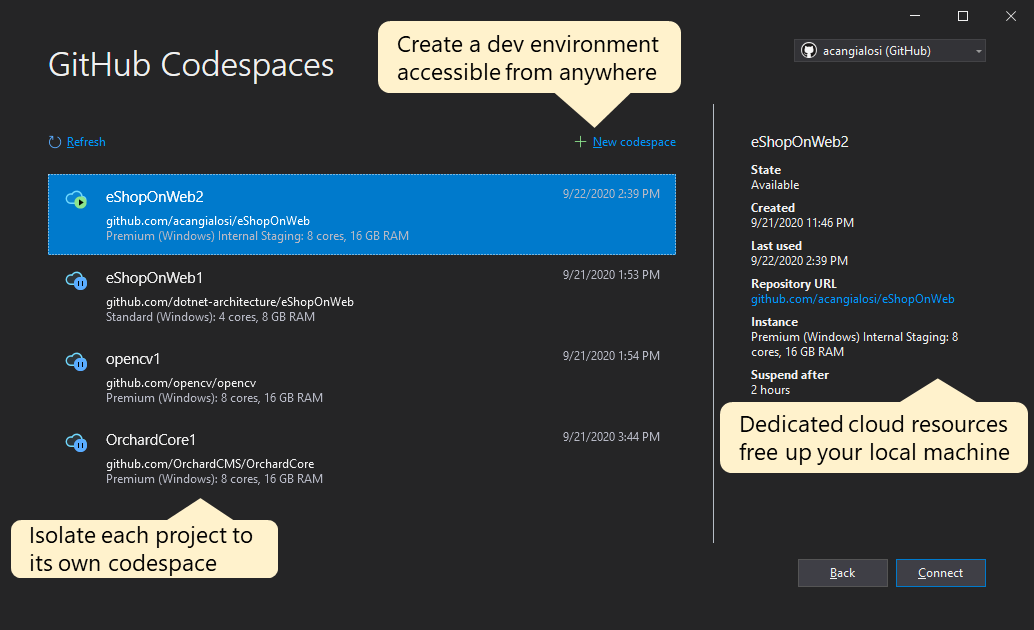
In addition, Microsoft announced a preview of an update to Visual Studio 2019 16.8 that will add support for GitHub Codespaces, a previously announced capability that automatically creates repositories on GitHub. GitHub Codespaces is currently available in beta and soon will be accessible directly from within Visual Studio.
Microsoft also revealed it has enhanced the Git tooling experience in Visual Studio to enable more asynchronous collaborations. A GitHub extension for Visual Studio Code enables developers to work with GitHub Issues and Pull Requests directly in the editor. Development teams that need to work in real-time alternatively can employ Visual Studio Live Share.
A publish experience in Visual Studio also now has the option to generate a GitHub Actions workflow for continuous integration/continuous delivery (CI/CD) environments in Azure resources using the deployment secrets configured in a GitHub repository. GitHub Actions for Azure can now also scan Azure resources for policy violations and vulnerabilities in container images and issues involving Azure Resource Management (ARM) templates.
Microsoft CEO Satya Nadella told conference attendees the velocity at which applications are developed and deployed has become even more critical as organizations embrace digital business transformation in the wake of the economic downturn brought on by the COVID-19 pandemic.
GitHub support for Power Apps is especially significant because it will make it easier for so-called citizen developers to collaborate with professionals developers as they jointly develop applications, he said.
Other notable updates to the Microsoft tools portfolio include a preview of an instance of the Azure Logic Apps workflow platform that can be deployed as a containerized runtime.
A .NET 5 Release Candidate is also now available, with general availability expected next month. This update adds support to smaller, faster single-file applications that use less memory when employed within microservices and containerized applications. It also includes significant performance improvements, support for Windows ARM64 and new releases of C# 9.0 and F# 5.0 languages.
Microsoft also announced several updates to App Service to make it easier and more cost-effective to migrate and modernize .NET web apps on the Azure cloud. A new Premium v3 (Pv3) App Service Plan can handle large-scale web apps, supporting more apps per instance and larger, memory-intensive apps with up to 32GB per instance. Microsoft is also making Windows Containers support in App Service generally available and will soon make Reserved Instance (RI) Pricing for App Service available to reduce costs.
Finally, Microsoft made several Kubernetes enhancements, including a preview of a start/stop cluster feature that will be added to Azure Kubernetes Service (AKS), and announced general availability of an Azure Policy add-on for AKS, which makes it possible to audit and enforce policies across Kubernetes clusters. Microsoft also made generally available Bridge to Kubernetes extensions for Visual Studio and Visual Studio Code that allow teams to develop against microservices within a running AKS cluster to enable debugging existing services without having to reconfigure or deploy a new cluster.
Nadella said keeping track of developer velocity and overall “tech intensity” within an organization is critical to success. It’s not yet clear how many organizations have put the metrics in place to measure either. However, it is clear that organizations that have yet to fully embrace best DevOps practices are already being left behind.