Tag: Mendix

  • Mendix Embraces DevOps for Next Era of Low-Code App Development

    Mendix Embraces DevOps for Next Era of Low-Code App Development

    Mendix, a subsidiary of Siemens, today updated its namesake low-code application development platform to add support for DevOps workflows and make it simpler for developers to compose applications and embed artificial intelligence (AI) capabilities.

    Sheryl Koenigsberg, vice president of product marketing for Mendix, said Mendix 10 makes it possible to use Git repositories for version control along with Mendix Pipelines, currently in beta. Mendix Pipelines is a continuous integration/continuous delivery (CI/CD) environment that will be embedded in the low-code platform. In addition, Mendix is adding support for Webhooks that can be used to integrate Mendix with existing CI/CD platforms.

    Mendix has also added a Solutions Kit, now generally available, to make it possible to customize applications in a way that ensures those changes will be preserved as application environments are upgraded.

    There is also now a Portfolio Manager tool to track projects and a connector for integration with the Jira project management software from Atlassian.

    Later this year, Mendix will also make generally available Adaptation Insights to provide insights into application extensions.

    In the future, developers will be able to leverage an extensibility framework to tailor the Mendix Studio Pro integrated development environment (IDE) by adding their own plugins, wizards, editors and third-party integrations. Later this year, Mendix 10 will also add, in beta, a version of its Studio Pro IDE for MacOS.

    The Mendix approach to composability is also being extended to incorporate AI. The company is adding Mendix Assist, a bot that generates validation logic for data entry. This module is the second AI capability that Mendix has developed after previously previewing Mendix Chat, a tool based on a large language model created using Mendix data that will be integrated into the Mendix integrated development environment (IDE) later this year. Mendix Assist will be incorporated into Mendix Chat.

    Mendix is also developing additional LLMs for creating applications and will as part of its commitment to composability plans to make it possible to integrate third-party AI services and LLMs into the Mendix Runtime to create “smart apps.” AI models will be converted to the Open Neural Network Exchange (ONNX) format, an open standard for machine learning models, to provide that capability.

    In addition, Mendix is adding support for event-driven architectures via Business Events and an Event Broker, to build more complex applications.

    Other capabilities being added to Mendix 10 include updated REST and database connectors, support for visual data filters, rich properties and design controls, a Start from Spreadsheet tool, end user survey tools, a PDF document generator and a revamped set of governance and risk assessment tools.

    Finally, Mendix is adding a Terraform module to make it simpler to deploy its low-code platform on the Amazon Elastic Kubernetes Service (Amazon EKS) in addition to providing a reference implementation for building private clouds to develop applications using the Mendix Cloud service.

    As AI-infused low-code applications are developed faster, it’s not clear to what degree organizations are prepared to embrace the inevitable disruption that will ensue. However, the one thing that is clear is that the DevOps workflows used to deploy these applications at scale will soon be put to the ultimate test.

  • Manufacturing Workers Eager to Digitally Upskill

    Manufacturing Workers Eager to Digitally Upskill

    Anyone who has worked in machining within the past 70 years knew that the future of machining was automation. In the 1940s, computer pioneer John T. Parsons and engineer Frank L. Stulen invented, via a contract with the U.S. Air Force, numerical control milling machines. The machines were designed to help the Air Force produce geometrically complex parts more economically and accurately.

    Those machines were the precursor to today’s computer numerical control (CNC) machining tools that use programming to automatically process some material, such as metal or wood, to specification. By the late 1980s, such machines were standard within tool and die, machine shops and manufacturing floors. Today, such digitization of manufacturing is accelerating.

    Workers, for the most part, embrace the change and would do more to meet the technical skills demands needed for their jobs – if only their employers supported them. That’s the primary finding from a survey, Digital Illiteracy in the Factory: Providing Workers with Low-Code Tools, commissioned by low-code platform provider Mendix.

    Interestingly, today, low-code development tools are finding a home in manufacturing. According to the survey, nearly 9 out of 10 said they want to learn low-code software development, while only 3% currently use low-code in their jobs. More than two-thirds (67%) say they want to create a software app that would solve work issues. According to this survey and a parallel survey conducted in Europe, U.S. workers are more willing to welcome and contribute to workplace digitalization than their counterparts in Germany (78% versus 61%) — a surprising result, given that German manufacturing workers enjoy a reputation as some of the most skilled in the world.

    “Incorporating digital applications is vital to the ongoing competitiveness of manufacturing in the U.S., and it is heartening to see such a large percentage of the manufacturing workforce ready to contribute to this effort,” Gardner Carrick, vice president of strategic initiatives at The Manufacturing Institute said in a statement. “Low-code applications provide our workforce with the tools to contribute to this digital transformation, and we should prioritize training in these skills.”

    The survey found that 87% of U.S. workers want to learn low-code development, and within those respondents, 88% of women who responded indicated being very interested in learning low-code, while 51% of men responded in kind. Perhaps not surprisingly, younger workers are more interested in learning low-code than those nearing retirement.

    That may be so, but U.S. manufacturing employers aren’t getting the memo. The survey found that U.S. manufacturers are giving their workers little help in developing their digital skills, and only 18% of workers are happy with their digital skills. “That only 18% are happy with their digital skills is just one sign that more training is required. At a time when the country’s manufacturing industry remains mired in a decades-long slump and when managers clamor for more useful software applications, news reports indicate that the nation’s workforce is ill-equipped to deal with writing code,” Mendix said in a statement.

    “The United States needs to move now to get their workers into the digital game,” said Derek Roos, Mendix CEO. “If the country wants ‘Made in the USA’ to mean something again, and if it wants to reduce unemployment and keep its economy vital and thriving, manufacturing and industry should provide low-code and other tools that help bridge the digital divide.”

    The survey was conducted from Jan. 29 through Feb. 11, among 250 full-time manufacturing workers in the U.S. and 250 within Germany. The survey’s objectives included learning workers’ attitudes and motivations, as well as obstacles that prevent them from acquiring low-code and other digital skills.

  • Mendix and Deloitte Canada Announce Strategic Alliance to Build Low-Code Digital Solutions for Enterprise Customers

    World’s leading professional services firm will create Canadian-based Centers of Excellence to train and certify 50 Mendix software developers

    BOSTON – OCTOBER 8, 2020 – Mendix, a Siemens business and global leader in low-code application development for the enterprise, today announced a strategic alliance with Deloitte Canada, a member firm of the world’s largest professional services firm, to utilize the Mendix low-code software development platform on behalf of enterprise customers seeking business transitions enabled by technology. To build capacity and expertise, Deloitte’s system engineering group has established centers of excellence (CoE) across the country to certify and deploy 50 Mendix rapid software developers to work on large-scale application development for customers in the financial services, insurance, logistics, public sector, and energy resource markets.

    “In order to thrive, companies we serve need to transform ongoing business operations, to increase efficiencies or to target new revenue streams,” says Anthony Chan, a partner and the national systems engineering leader at Deloitte Canada. “Deloitte is a champion when it comes to embracing the trend of using low-code to develop enterprise software for key business operations. The demand for IT services is rapidly increasing, and this strategic alliance helps us bridge the low-code talent gap and unlocks our ability to bring digital solutions quickly to market.”

    A paradigm shift for global system integrators

    One challenge facing legacy enterprises originally chartered in the 20th century is to engineer new ways to provide value and tailored services in the 21st century marketplace. Widespread adoption of next-generation technologies such as cloud-based software deployment, mobile access, microservices architecture, AI enablement, and chatbots has heightened expectations for frictionless user experiences across multiple channels by enterprise customers and workforce employees.

    Low-code has proven itself to be a platform that readily supports integration of these and other next-generation technologies, while at the same time facilitating tremendous cost efficiency throughout the application lifecycle. A recent Forrester: Total Economic Impact (TEI) Report highlighted the financial benefits for a hypothetical composite organization — an amalgam of four real-life enterprises using Mendix low-code for an average of almost six years — gained by building and deploying software with the Mendix low-code platform. Those benefits include an estimated $8.1 million in savings over three years for application delivery and an additional $3.3 million in profits from accelerating the time to market for new products and services.

    Future-proofing legacy enterprises with low-code deployment

    Nick Ford, chief technology evangelist at Mendix, added, “Our alliance, and Deloitte’s commitment as manifest in the new Centers of Excellence, will empower Deloitte to deliver all of the benefits of the Mendix low-code platform to its enterprise clients. A wider pool of developers, enhanced collaboration, accelerated time-to-impact, automation of routine IT maintenance and ‘plumbing’ chores, and greater efficiency throughout the entire application lifecycle combine to deliver real enterprise digital transformation.”

    The strategic collaboration between Deloitte Canada and Mendix builds on the successful alliance in other regions of the world, including the U.S. Recently, Deloitte participated in the Mendix World 2.0 conference that explored groundbreaking uses of Mendix’s low-code software development platform. On September 2, Peter Fever, managing director, Deloitte U.S., moderated an executive roundtable discussion with finance executives on “Banking’s Perpetual Digital Transformation.”

    Click here to access content free of charge from Mendix World, the world’s largest virtual low-code conference, featuring more than 60 sessions, including more than 20 by customers, and covering the gamut of low-code application development topics from strategy to practical, hands-on platform training.

    Learn more about the Mendix Platform and pricing and availability.

    Background

    In a pandemic-disrupted world, software is the new lifeblood of our daily lives and the connective tissue holding together the global economy. However, traditional software development takes far too long and very often fails to deliver the results business needs and users love. Even prior to COVID-19 there were simply not enough professional software developers in the world to build all the software currently required. The global pandemic has accelerated and exacerbated what was already a software and business crisis. Enter low-code software development. Low-code from Mendix is a powerful enterprise-grade visual development approach empowering citizen and professional developers to make cloud-native applications more than 10X faster for web and mobile using drag-and-drop components and model-driven logic – all through an intuitive graphical user interface.


    Connect with Mendix

    About Deloitte

    Deloitte provides audit and assurance, consulting, financial advisory, risk advisory, tax, and related services to public and private clients spanning multiple industries. Deloitte serves four out of five Fortune Global 500® companies through a globally connected network of member firms in more than 150 countries and territories bringing world-class capabilities, insights, and service to address clients’ most complex business challenges. Deloitte LLP, an Ontario limited liability partnership, is the Canadian member firm of Deloitte Touche Tohmatsu Limited. Deloitte refers to one or more of Deloitte Touche Tohmatsu Limited, a UK private company limited by guarantee, and its network of member firms, each of which is a legally separate and independent entity. Please see www.deloitte.com/about for a detailed description of the legal structure of Deloitte Touche Tohmatsu Limited and its member firms.

    Our global purpose is making an impact that matters. At Deloitte Canada, that translates into building a better future by accelerating and expanding access to knowledge. We believe we can achieve this Purpose by living our shared values to lead the way, serve with integrity, take care of each other, foster inclusion, and collaborate for measurable impact.

    To learn more about Deloitte’s approximately 312,000 professionals, over 12,000 of whom are part of the Canadian firm, please connect with us on LinkedIn, Twitter, Instagram, or Facebook.


    About Mendix


    Mendix, a Siemens business and the global leader in enterprise low-code, is fundamentally reinventing the way applications are built in the digital enterprise. With the Mendix platform, enterprises can ‘Make with More,’ by broadening an enterprise’s development capability to conquer the software development bottleneck; ‘Make it Smart,’ by making apps with rich native experiences that are intelligent, proactive, and contextual; and ‘Make at Scale,’ to modernize core systems and build large app portfolios to keep pace with business growth. The Mendix platform is built to promote intense collaboration between business and IT teams and dramatically accelerate application development cycles, while maintaining the highest standards of security, quality, and governance — in short, to help enterprises confidently leap into their digital futures. Mendix’s ‘Go Make It’ platform has been adopted by more than 4,000 leading companies around the world.

     

    …

  • Mendix Drives Economic Value for Large Companies Amid Software Developer Shortage, Strong Rise in Business Demand for Applications – New Report Finds

    Leading Research Firm Uses Real-Life Customer Experiences to Show That Low-Code is a Low-Risk, High-Advantage Proposition with Multimillion-Dollar Business Benefits

    BOSTON – August 13, 2020 – Mendix, a Siemens business and the global leader in low-code application development for the enterprise, today announced the availability of a commissioned study conducted by Forrester on behalf of Mendix that demonstrates the real-world value of the Mendix low-code platform. The Total Economic Impact (TEI) of The Mendix Low-Code Application Development Platform study created by Forrester in June 2020 shows that an enterprise’s investment in the Mendix platform yielded total quantified benefits of $20.52 million over three years. That included $8.1 million in application delivery savings, $6 million in operational efficiencies from applications developed using the Mendix low-code platform, $3.3 million from accelerated time to market for new products and services, and $3.1 million in incremental revenue from improved customer engagement.

    “The adoption of the Mendix platform widened the available talent pool of software developers, accelerated outcomes, fostered better business and IT collaboration, and automated tedious plumbing and infrastructure tasks required in traditional application development,” Forrester wrote. “As a result, firms experienced application delivery savings, operational efficiency, and business lift from the introduction of new products and improvements to customer engagement.”

    This report comes at a pivotal moment in which companies across all sectors are struggling with digital transformation. The historic shortage of developer talent is now colliding with the growing demand for software by major enterprises seeking to meet rapidly changing needs.

    Many companies are turning to low-code to bridge the gap and accelerate application creation. Low-code’s graphical interface and model-driven logic allow people who have no or limited coding experience to play an active role in developing applications. It also enables business and IT collaboration to ensure the applications deliver the tailored results businesses need. But IT leaders may not support low-code because they don’t realize that this technology is actually enterprise ready, and they may worry that it will reduce their power and prestige.

    “The TEI study illustrates that low-code is no flight of fancy technology,” said Derek Roos, co-founder and CEO of Mendix. “The Mendix low-code platform profoundly impacts the way organizations work. Companies have been using Mendix for years to drive significant business results – and other organizations can realize the benefits of low-code, too.”

    The TEI Study is Based on a Proven Framework and Experiences of Actual Customers

    Forrester, a leading global research advisory firm, reached these conclusions using its TEI framework and methodology, which has been employed in studies with thousands of leading companies over more than a decade. The multi-step TEI research consisted of these steps:

    • Speaking with Mendix stakeholders and Forrester subject matter experts to gather data about the Mendix platform
    • Interviewing four Mendix customers to obtain data on costs, benefits and risks involved with their deployments
    • Constructing a financial model representative of the interviews using the TEI methodology and risk-adjusted the financial model based on issues and concerns of the interviewed customers
    • Modeling the impact of the Mendix platform

    Mendix customers interviewed for the Forrester effort included two North American businesses – an insurance company and a real estate broker – which have been using the Mendix platform for 60 months and 102 months, respectively. The companies have 12,000 and 26,000 users of the applications created on the Mendix platform. The report also included two EMEA customers – a utility, with 48 months of Mendix platform experience and 26,000 application users, and an insurance company with 26 months of Mendix experience and 5,700 users on applications the client created with Mendix.

    Forrester used the data from the four customers to create a composite organization to illustrate the quantifiable benefits and cost savings that can be achieved with Mendix. The composite organization – a North America-based multinational B2B and B2C company with operations in Europe and Asia and 15,000 users of applications created with the Mendix low-code platform – was struggling to meet the software demands of its business units at a reasonable cost.

    The Research Shows That Mendix Delivers Significant Application Delivery Savings

    Like many businesses today, the composite organization had relied on traditional programming languages, frameworks, and legacy systems, and required manual data verification and integration prior to adopting Mendix. As a result, it suffered from error-laden and poor-quality data entry, high costs, and lengthy lead times. However, Mendix enabled the organization to increase development productivity, decrease personnel costs, and reduce application operations costs.

    This was possible due to a broad range of Mendix features and functionality. As Forrester noted, the Mendix visual modeling reduces reliance on traditional programming “speeding development by six to 10 times.” The Mendix low-code platform also enables technical and nontechnical developers to collaborate, which Forrester explained enlarges “the pool of talent able to participate in application development.” Forrester added that the “real-time involvement of business process domain experts” supported by Mendix is valuable in “reducing rework.”

    “The robust, complete Mendix platform enables organizations to solve problems by enabling blended teams to collaborate, driving efficiencies and doing more in less time,” said Roos. “Enterprises can bring their digital solutions to market faster, realizing an improved ROI at a faster pace, as well.”

    Addressing this point, the vice president of software development at the real estate broker interviewed for the TEI report explained his company’s experience, saying: “The ability to develop new products quickly with Mendix has changed our business. For example, most projects in our organization can take up to two years with traditional development. Now, we got our first iteration done within six months, and the second iteration done within four months. We can get so much out to our customers faster, and we get quick feedback from them. The speed-to-market has improved our relationship with our customers.”

    Businesses That Use Mendix Also Benefit from Greater Innovation and Profitability

    The Mendix low-code platform is also ideal for situations in which an individual or organization is not certain at the outset of a project just exactly what the application should look like. Traditional development makes experimentation incredibly expensive and slow. But Mendix enables developers to iterate quickly to deliver the right answers, experiences, and products faster. This accelerated time-to-market helps organizations grow their revenue and profits.

    Forrester said contributors to accelerated speed-to-market and incremental revenue include:

    • Testing and learning on new ideas, using speed-to-market benefits to lower the cost of failure, enabling the composite organization to “fail fast” and outpace competition with new products, services, and business models
    • A higher frequency of low-cost experiments with emerging technologies like conversational interfaces, AI, and IoT, leading to differentiated product and service experiences
    • Reduction of time and effort expended by skills development teams needed to achieve goals on time
    • Creating an innovation culture that attracts top talent and moving IT from a cost center to a revenue-driving enabler

    The insurance company’s development operations lead that Forrester interviewed for the TEI report commented: “Prior to our investment in Mendix, we outsourced some application development and experienced very long lead times. It was difficult to change our minds mid-project. It often took multiple years to build an application, and by that time, the business changed its focus, or the products changed, or the market changed, or all of the above changed. It was a very frustrating experience before Mendix.”

    Roos added, “Low-code is a paradigm shift. But with Mendix, it’s a low-risk change that yields real business results. We would like to thank Forrester, and our customers that participated in the TEI effort to tell their low-code success stories, for helping to illustrate the economic value of Mendix.”

    To read the full Forrester 2020 TEI study, download your copy here.

    To learn more about low-code, attend Mendix World: Version 2.0, the world’s largest virtual low-code conference ever. This event will kick off Sept. 1 and is free of charge for all attendees. Mendix World: Version 2.0 will feature more than 60 sessions, including more than 20 by customers, and cover the gamut of low-code application development topics from strategy to practical, hands-on platform training. For more information about Mendix World 2.0, and to register, click here.

    Background

    In a pandemic-disrupted world, software is the new lifeblood of our daily lives and the connective tissue holding together the global economy. However, traditional software development takes far too long and very often fails to deliver the results business needs and users love. Even prior to COVID-19 there were simply not enough professional software developers in the world to build all the software currently required. The global pandemic has accelerated and exacerbated what was already a software and business crisis. Enter low-code software development. Low-code from Mendix is a powerful enterprise-grade visual development approach empowering citizen and professional developers to make cloud-native applications more than 10x faster for web and mobile using drag-and-drop components and model-driven logic, all through an intuitive graphical user interface.

    Connect with Mendix

    About Mendix

    Mendix, a Siemens business and the global leader in enterprise low-code, is fundamentally reinventing the way applications are built in the digital enterprise. With the Mendix platform, enterprises can Make with More, by broadening an enterprise’s development capability to conquer the software development bottleneck; Make it Smart, by making apps with rich native experiences that are intelligent, proactive and contextual; and Make at Scale, to modernize core systems and build large app portfolios to keep pace with business growth. The Mendix platform is built to promote intense collaboration between business and IT teams and dramatically accelerate application development cycles, while maintaining the highest standards of security, quality and governance – in short, to help enterprises confidently leap into their digital futures. Mendix’s ‘Go Make It’ platform has been adopted by more than 4,000 leading companies around the world.

  • Mendix Injects More AI to Accelerate Low-Code Development

    Mendix Injects More AI to Accelerate Low-Code Development

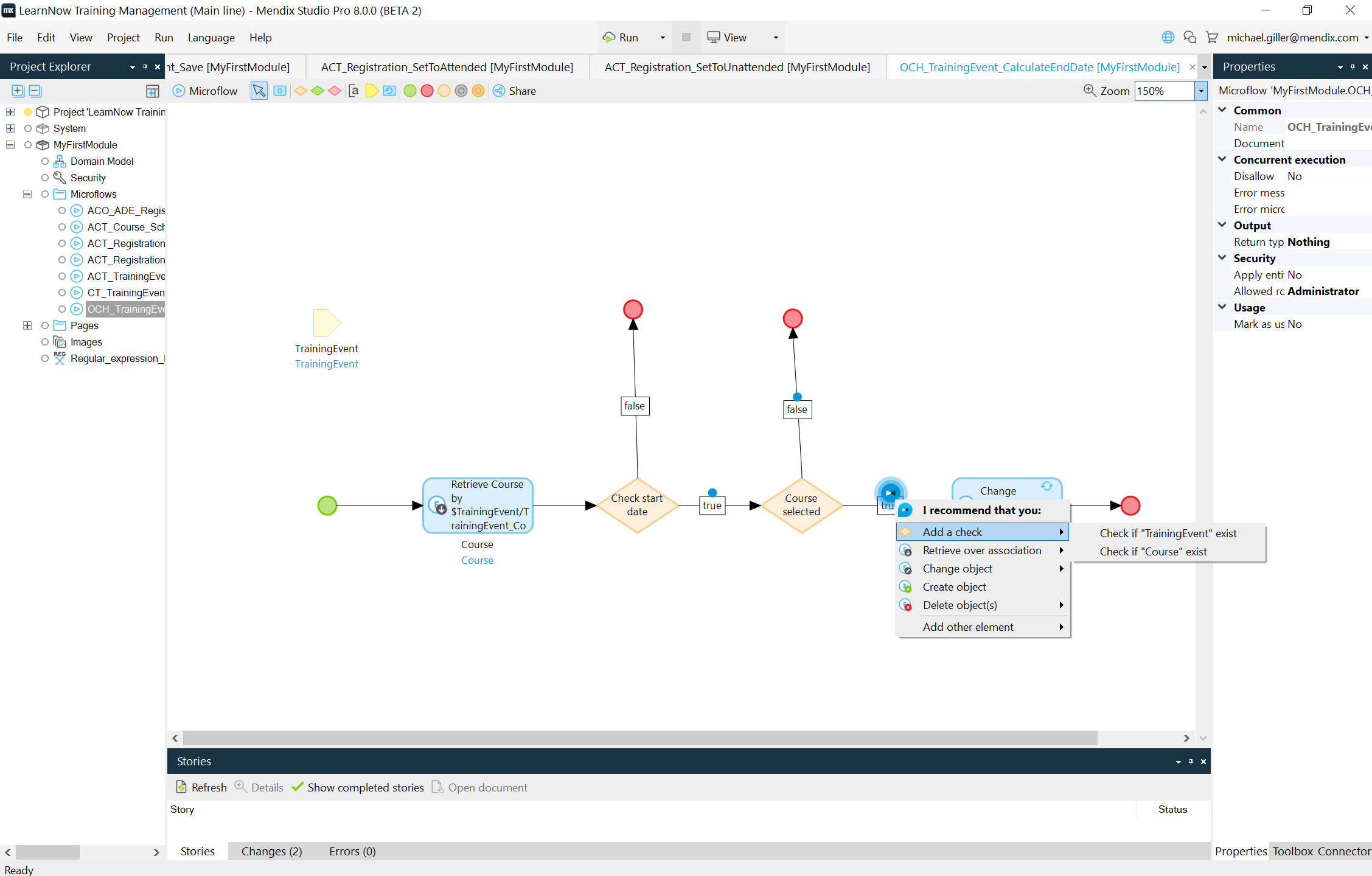
    The rate at which low-code applications are built and deployed will accelerate as developers begin to rely more on artificial intelligence (AI) to write code. The summer 2019 release of the Mendix low-code platform includes a revamped instance of Mendix Assist, which employs machine learning algorithms to make coding recommendations. Those algorithms have been trained using data drawn from 5 million application models employed across 15 industries over the last 10 years, and Mendix claims this version of Mendix Assist improves the accuracy rate of the recommendations being made to 95%.

    Sheryl Koenigsberg, director of product and solutions marketing for Mendix, said Mendix Assist will enable new developers to write better code faster, while experienced developers will be able to employ Mendix Assist to address routine issues that often get overlooked faster. Mendix Assist not only advises developers on what to do next but also generates recommended actions in previous logical steps based on whatever new code is introduced in the application.

    Mendix

    To make these capabilities more accessible, the summer release of Mendix adds Mendix Studio and Studio Pro, a set of integrated development environments designed to be accessible to both citizen and professional developers, to the low-code platform.

    In addition, Mendix is adding support for native mobile application development by adding support for React, a set of JavaScript libraries for building user interfaces for mobile applications, and including a native JavaScript editor. Those capabilities eliminate the need to rely on emulation software when building mobile computing applications, said Koenigsberg. Because the Mendix IDEs integrate low-code abstraction across iOS, Android, Java and Objective-C programming models, it also becomes easier for mobile developers to build reusable components. Mendix has also included more than 50 pre-built connectors to mobile device capabilities, such as camera, geolocation, biometric authentication and Bluetooth enablement, along with support for conversational chatbots and voice interfaces such as Alexa and Siri.

    Longer-term, Koenigsberg observed that it’s conceivable the AI capabilities being included in application development tools eventually will share insights with AI models being incorporated into continuous integration/continuous deployment (CI/CD) platforms. Proposed changes to an application could, for example, might be assessed from a performance perspective before any lines of code are written.

    In the meantime, the rate at which low-code applications will be moving through CI/CD platforms is about to increase substantially as developers augment their own skills by relying more on recommendations surfaced by AI engines. The quality of those applications should also improve as AI engines check, for example, to make sure all the appropriate compliance and cybersecurity controls are in place.

    It’s not likely AI engines will replace the need for developers anytime soon. However, it is apparent all the little things that routinely conspire to slow application development and delivery processes increasingly will be automated. That should make it easier for a larger number of organizations to embrace best DevOps processes. After all, the primary issue with DevOps adoption these days is not necessarily appreciating the value of the concept, but rather managing pipelines that still tend to get clogged every time an application fails to pass a gate because a developer forgot to do one thing or another.

    — Mike Vizard

  • Mendix’s Hyper Growth Continued in 2018 with 150% Year-Over-Year U.S. Revenue Increase; Siemens Acquisition Marks Largest-Ever Investment in Low-Code Category

    142 new customers signed with major multinationals and government enterprises

    • Siemens US$730 million acquisition in October cements Mendix as global leader in low-code for the enterprise and opens major new market opportunities; Mendix’s brand and exec leadership continue under Siemens ‘freedom to operate’ model
    • Top analyst firms continue to position Mendix as low-code ‘Vision Leader’; Mendix furthest to right for “completeness of vision” in prestigious Gartner Magic Quadrant — underscores company’s market and technology position as the leading low-code platform for the enterprise, with first-to-market AI capabilities in 2018


    BOSTON – FEBRUARY 14, 2019 – Mendix, a Siemens company and the global leader in low-code for the enterprise, completed a banner year in 2018 with 142 major new customers, industry accolades, and continued record-breaking revenue.

    The year capped off with the closing of Mendix’s acquisition by Siemens AG in Q4, marking the single largest investment ever in the low-code category. Mendix continues to lead the category it invented – low-code, cloud-native application development that facilitates unprecedented collaboration between business stakeholders and development teams, enabling the rapid creation of the right applications to improve operational efficiency and accelerate revenue growth.

    Record revenues, again; customer growth and retention post extraordinary gains

    Mendix maintained its fast-track growth trajectory in 2018, highlighted by US revenue growth of 150 percent. The company added 142 major new logos, including Verizon, Ingersoll Rand, Zurich Insurance, Innovapost (the IT arm of CanadaPost), BAM Infra (the Netherlands’ leading infrastructure engineering and construction company), North Carolina State University, and other major global enterprises, national institutions, and government entities. The number of customers signing up for US$1 million-plus ARR commitments doubled; Mendix renewed a remarkable 95 percent of its existing customers; and more than 50 percent of its customers expanded their engagements.

    “In 2018, our customers continued to achieve real, substantial and measurable business outcomes with unprecedented speed and efficiency,” said Derek Roos, Founder and CEO at Mendix. “By implementing the Mendix platform, our customers enable significant new revenue opportunities and operational efficiencies. We look forward to seeing what they make with Mendix in 2019.”

    Siemens closes acquisition of Mendix in Q4 2018

    Siemens AG finalized its acquisition of Mendix in October for US$730 million in cash, with additional investment in R&D and market expansion. Under Siemens’ “freedom to operate” model, Mendix will maintain its name, executive leadership structure, staff, offices, and culture as a segment in Siemens’ Digital Factory division. The Mendix platform will also be deployed across other Siemens divisions, and access to Siemens’ customer base is expected to accelerate Mendix’s growth, further scaling and strengthening its market leadership across industries and geographies.

    Gartner “Leader” for second straight year; Glassdoor “best cloud company to work for,” again; plus, a trio of innovation awards

    Mendix continues to enjoy “leader” status in evaluations of low-code offerings by the leading IT analysts, as well as industry recognition. These results and accolades include:

    Mendix is first to offer AI-assisted low-code development, headlining new platform enhancements

    • Mendix Assist was the industry’s first AI-assisted low-code development capability that provides real-time next-step suggestions and expert quality, performance, and maintenance recommendations with 90% accuracy. By the end of 2018, nearly half of all microflows built in the Web Modeler were using MxAssist.
    • Mendix Nanoflowstook the visual modeling of application logic Mendix is known for and extended it to run on mobile devices and web browsers. Because nanoflows execute on the client side they run offline and enable the development of engaging and blazingly fast mobile apps.
    • Mendix introduced a seamless developer experience on the SAP Cloud by implementing SAP ID integration single sign-on and identity propagation for SAP on-premises and cloud services users. Many additional SAP integrations in 2018 enable SAP customers to leverage their investment and build enterprise mobile and web apps 10x faster with Mendix.
    • Mendix tightened its integration with IBM cloud and Watson by enabling seamless developer onboarding with IBM ID integration, 1-click deployment on IBM Cloud, and integrated billing. IBM developers can now build innovative low-code apps faster that provide valuable native integration to IBM’s Watson AI, IoT, and Blockchain.

    Eric Erston promoted to Chief Revenue Officer

    To manage its continued hyper growth in the enterprise and deliver a completely integrated and positive value chain from sales to customer success Mendix promoted Eric Erston, formerly SVP of North America sales, to the new position of chief revenue officer. As CRO Erston has responsibility for global sales and services, and the creation of the CRO role underscores Mendix’s deep commitment to deliver the best customer experience in the industry throughout the entire relationship, from a customer’s first app to becoming an application factory building and deploying hundreds of apps every year on Mendix.

    New Boston headquarters, new offices in Frankfurt and Rotterdam

    Mendix added 224 new hires in 2018, a nearly 100 percent increase, and anticipates total head count to grow significantly in 2019. To support this growth,  Mendix moved and expanded its Boston headquarters to the city’s dynamic and growing Seaport neighborhood in November. The new headquarters is a fivefold increase in space to 30,000 square feet designed as a high-productivity, high-interaction “tech hub” environment and sets the stage for Mendix’s expansion in Boston, capitalizing on the exceptional tech-centric talent pool there. Mendix also opened a new office in Frankfurt, Germany, giving it a solid base for expansion in the DACH market, and proximity to Siemens.

    To accommodate its rapidly growing team in the Netherlands, Mendix moved into the award-winning De Rotterdam building, the largest building in the Netherlands, designed by world-famous architect Rem Koolhaas and his OMA studio. Mendix occupies the entire fifth floor of the building in Rotterdam’s rejuvenated old harbor district of Wilhelminapier.

    For more information about Mendix, please visit www.mendix.com.

  • Siemens Acquires Mendix to Advance Low-Code Platform Adoption

    Siemens Acquires Mendix to Advance Low-Code Platform Adoption

    Siemens this week moved to substantially accelerate its transition into becoming a software company by acquiring Mendix, a provider of low-code application development tools, for $730 million in cash.

    Mendix CEO Derek Roos said Mendix will operate as a business unit of Siemens, which has poured more than $10 billion over the last decade to software development as part of an ongoing digital transformation to a multibillion-dollar conglomerate.

    Siemens over the last year determined that Mendix was now a strategic component of that initiative, Roos said, as more applications are shifted to and developed in the cloud. Many Siemens employees already use Mendix tools to develop custom applications with limited to no programming skills. That capability is especially critical in line of business (LOB) organizations that are starting to deploy their internet of things (IoT) applications, he noted. Mendix also recently revealed it is starting to infuse its low-code application development platform with artificial intelligence (AI) capabilities.

    Roos said the $730 million investment Siemens is making to acquire Mendix is larger than all the venture capital investments made in rival companies delivering low-code platforms combined. As low-code tools have gained mainstream adoption, however, Mendix increasingly finds itself competing directly with larger rivals such as Microsoft and Salesforce, he noted.

    The Siemens decision to acquire Mendix comes at a time when archrival GE is throttling back on digital process transformation efforts. Roos said GE’s decision is unique to structural issues within GE versus being a decision that reflects loss of faith in digital process transformation driven by custom application development. Software is now the fastest growing segment of the Siemens conglomerate, he said.

    A recent survey conducted by Mendix in collaboration with ASUG, an end user association for organizations that have deployed software from SAP, finds 64 percent of respondents are experiencing increased demand for custom applications within their organizations. The primary problem is that same survey finds the average custom application development backlog is 24 months. Primary issues cited by survey respondents include high development costs (50 percent), difficulty integrating with existing systems (47 percent) and lack of skilled development resources (45 percent).

    Of course, as Siemens becomes a larger software force, some organizations will start will take into consideration how much they may compete with the company before selecting an application development platform. Mendix is betting that as application development expands well beyond internal IT organizations, its status as an independent business unit of Siemens will provide enough distance between Mendix and Siemens business units that a Mendix customer might compete against.

    In the meantime, organizations that are embracing low-code platforms are simultaneously increasing their investments in DevOps processes. As the number of applications being developed using low-code tools increases, there is a corresponding increase in application release management that requires them to modernize those processes. As Mendix plays the role in enabling applications that can be deployed from the cloud to the network edge, it’s now only a matter of time before the Mendix low-code platform becomes a more significant element of a larger set of DevOps processes driving digital process transformation projects as unprecedented levels of scale.

    — Mike Vizard