Welcome to The Long View—where we peruse the news of the week and strip it to the essentials. Let’s work out what really matters.
This week: Meta’s enforced hybrid work plan is failing badly, and Meta makes more layoffs. (more…)

Welcome to The Long View—where we peruse the news of the week and strip it to the essentials. Let’s work out what really matters.
This week: Meta’s enforced hybrid work plan is failing badly, and Meta makes more layoffs. (more…)

Welcome to The Long View—where we peruse the news of the week and strip it to the essentials. Let’s work out what really matters.
This week: Rethinking return-to-office mandates and a ridiculous, ancient Windows bug. (more…)

Welcome to The Long View—where we peruse the news of the week and strip it to the essentials. Let’s work out what really matters.
This week: Redmond SaaS keeps failing, RISC-V is RISEing, and Meta is enforcing hybrid work. (more…)

Welcome to The Long View—where we peruse the news of the week and strip it to the essentials. Let’s work out what really matters.
This week: The Passkeys authentication standard gets a huge boost, and IBM’s Arvind Krishna wants workers back in the office. (more…)

As we close out 2022, we at devopsy.kinsta.cloud wanted to highlight the most popular articles of the year. Following is the latest in our series of the Best of 2022.
I was watching Charlene O’Hanlon’s interview with the CRO of Rollbar, discussing the slow growth of “return to office” policies. High-tech, because we are more mobile, had more options than many people—the janitor, for example, must be physically at their job to do it. High-tech employees did not have that issue—or if they did before the pandemic, they certainly didn’t after a few months of lockdowns. And now our infrastructure allows us to work from anywhere.
One of the things that some companies are considering is requiring that all employees come back to the office. I rarely say things super bluntly, but this time, I need to be blunt.
Fight that tendency if it shows up at your organization. At this point in history, that way lies corporate doom. Okay, maybe not doom, exactly, but certainly bad things. Some people back in the office is fine, a choice about coming back to the office whenever your state/provincial/local government decides to allow it? Fine. A required return for everyone? No.
Of course, one cannot make such a blunt statement without an explanation. Do I think that remote work is somehow better for the company? No. Some people are more productive working from home, while others are distracted by the many non-work things around them that they want/need to do. So it is a mixed bag that requires monitoring. In all my years working from home and mentoring others just starting to do so, I’d say this split is closer to 50/50 than you might think. To paraphrase a sergeant from my army days, “Those who most want to are sometimes those who absolutely should not.” He was talking about living off-post, which is outside jurisdiction in much the same way that working from home is. And I’ve found some truth in that statement when applied to WFH. In fact, one interesting thing for me to watch were the success rates for companies that went 100% WFH. It’s gone better than I expected, probably because it was a broader swath of staff than just those who wanted to.
So why would it be better if I, who have worked from home for more than 20 years at a number of different companies, think it’s a mixed bag?
Hiring and retention.
We know that we’re short-staffed. We know that it is hard right now to find any flavor of IT peep, but it’s brutally hard in InfoSec and pretty tough in DevOps. A decent percentage of employees is going to want to keep working from home, and in the current environment, they can change jobs faster than you can say “retention bonus” if you give them a reason. I don’t have hard numbers, but let’s assume a hugely conservative 10% of IT staff preferred working from home. Can you afford to lose that number of your staff? Or even half that number, assuming some won’t leave? Probably not, considering the openings versus employee counts we’re currently seeing. More to the point, can you afford to never hear from that percentage of applicants because they don’t want to work somewhere that mandates their physical presence in the office? From talking to people, it seems money doesn’t resolve this issue. Working from home is a tangible benefit, and whatever a company offers, the next one might match with the WFH option.
There was a slow change going on in IT, where a significant percentage of staff were working at least part-time from home; the pandemic just sped that process up—shifted it left and iterated, so to speak, and now HR and management are going to have to deal with this reality head-on.
I’ve felt that some of the positions I’ve held at some of the organizations I’ve worked at/for were best performed on-site. But we have enough successful 100% virtual companies now to acknowledge this might be a corporate culture issue and not a “job fit” issue.
I don’t know how companies will handle it, but absolutism is not the way forward here, IMO. Charlene and Michael Davis had some thoughts on WFH and returning to the office you might want to listen to.
After all, you all are kicking it, and I know some of you don’t want to go back to the office. Can your org afford to lose you? Not if there is an easy way to avoid it.

Building a successful product team is difficult under the best of circumstances. Building one during a pandemic raises the level of difficulty by an order of magnitude. But it’s not impossible.
In early 2020, everything changed. For months now we’ve been scrambling, adapting to a new normal that none of us had the foresight to plan contingencies for. We’ve moved from a world of in-person collaboration to one that relies heavily on technology to keep the proverbial wheels turning.
The shift to an at-home workforce has brought with it the productivity you might expect when you strip away lengthy commutes and other inefficiencies. We’re left with an operation that’s run lean, on the back of technological solutions that push deliverables out the door in a matter of weeks, not months.
Now that digital transformation is no longer optional, a digital-first product team isn’t either. These digital natives were nice to have before, but in a world driven by Zoom meetings, Slack and Google Docs, they’re essential. Entire operations, quite literally, could fall apart without them. Without a doubt, a good product team starts with a good leader, and that leader these days needs a firm grasp on the tech challenges faced by their teams and the solutions that keep every part of the business moving in times of uncertainty.
But it’s not just technology. The DNA of the perfect product person starts with curiosity, an ability to poke and prod and find inefficiencies by asking the right questions and always seeking a better solution.
They should also have a growth mindset. An effective product person is always pushing the limits. It’s this ambition, this desire to keep moving forward regardless of the current situation, that often moves an entire team to keep up or risk getting left behind.
They aren’t followers. The ideal product person is willing to argue against a decision that the rest of the room agrees with. They stand their ground and explain their thinking in a way that’s productive and respectful. They might not be the typical extrovert, the person always willing to step up and lead, but when they speak up, their words have purpose. These types don’t follow orders blindly; they question them, looking not only at the task but also the desired outcome, in an effort to find a better way. “Because we’ve always done it that way” falls on deaf ears, as these types understand that what brings you success rarely keeps you on top without the ability to adapt and evolve.
It’s important to zoom out and remember that a great product team is about more than a group of individuals. When done right, it’s a collective that moves as one. Individual achievements become all but meaningless and the focus is always on the team.
This really boils down to culture. While a product leader chooses the shared beliefs, ideas, attitudes and knowledge that make up the team’s identity and work ethic, it is only the team that can internalize this collective consciousness and make the desired culture a reality. This is why one person can so easily make or break a team, so ensuring a good culture fit becomes the gel that holds the entire thing together.
For the most part, product teams need individuals that are team-oriented, individuals that care about propelling the team forward rather than just achieving individual goals. Understanding is everything, and an empathetic individual understands not only their own struggles but the challenges faced by those around them. The importance of these individuals cannot be overstated, not only for the culture of the team but that of the company as well.
Last, but not least, we look for people who make good decisions. This doesn’t mean they always make the correct decision. They are human, after all, but they are decisive in their decision-making and willing to take responsibility for decisions that go wrong. We don’t typically see the results of these decisions right away. Often, they play out several months, or even years, down the line. But we have to know that the person making these decisions is capable of weighing all the options, seeing all the angles and being decisive when called upon. This is particularly true at the senior level, the driving force of the team’s decision-making capabilities.
Culture starts from within, and though teams are of the utmost importance, they are composed of individuals. If we were to build a product team in 2020, in the midst of a pandemic, we could do worse than identifying these characteristics in each member. One individual could propel the team to new heights or serve as a speed bump on the road to success.

Pinpoint today added a User Dashboard to its namesake platform for managing software projects that makes it easier for remote developers to stay focused.
Company CEO Jeff Haynie said the User Dashboard provides developers with a personalized view of their work priorities and schedule for the day. It also provides a means to employ their Pinpoint Profile to highlight personal achievements and engage other engineers on the Pinpoint Platform.
The Pinpoint platform is designed mainly to identify software development bottlenecks that could delay a project. Most recently, the company added machine learning algorithms and advanced analytics to surface additional insights and recommendations.
This latest update extends the use of machine learning algorithms via a Recommended Content feed that curates content from blogs, podcasts and other media based on the observed interests of developers. Much like a built-in RSS feed, Recommended Content is an experiment to see whether the platform can save developer time by eliminating the need to scroll through less-relevant news, said Haynie.
In the wake of the COVID-19 pandemic, he said, many organizations are struggling even more to manage distributed or remote developers. It’s also now much easier for developers to become isolated from the rest of their team. The User Dashboard provides a way to engage developers through the same platform managers employ to track projects.
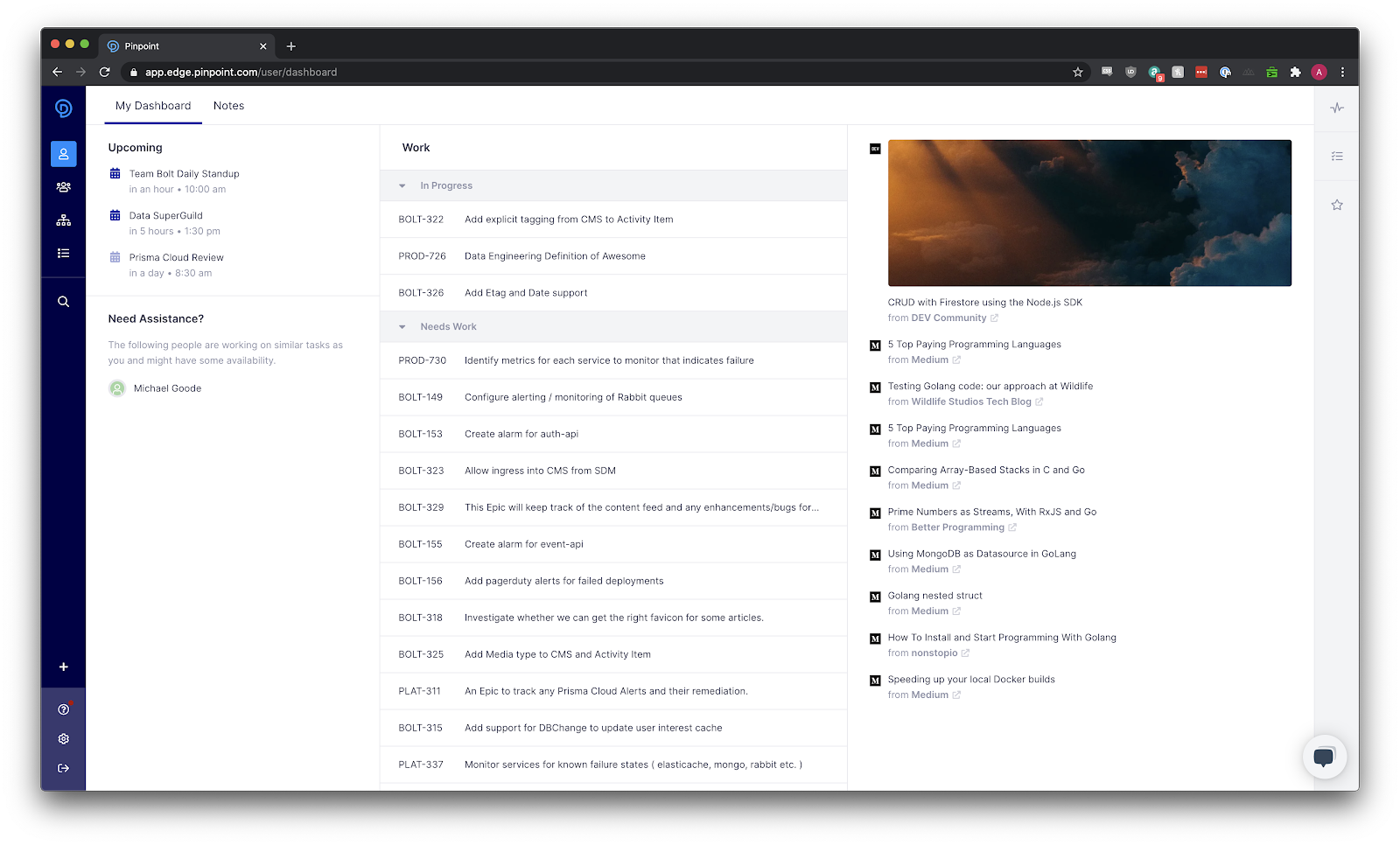
While there is no shortage of collaboration tools, Haynie noted they all tend to be tied to a specific DevOps platform. Pinpoint is designed to automate the process of collecting data from multiple tools, which the platform then analyzes to surface potential bottlenecks in the software development process. As software development projects become more complex, there is a need for a tool to visualize how hidden dependencies might upend delivery schedules, he said.
The User Dashboard now extends that framework out to individual developers, who can view how to prioritize their specific tasks in keeping with a larger set of goals, Haynie added.
Developers don’t typically have a lot of visibility into how their efforts ultimately impact the organization. In the absence of that information, it can become difficult to stay motivated, especially when working from home. Project leaders are now always going to be able to personally engage each developer every day, especially if members of the development team are located in different time zones.
The User Dashboard isn’t a substitute for personal interactions, but it does provide a means for developers to quickly learn at a glance what needs to be done next in a way that serves to minimize miscommunications. It’s not all that uncommon for developers to lose valuable time by being told to do one thing when they should have been focused on a different task.
Less clear is to what degree Pinpoint might be able to flatten management hierarchies within development teams. As a general rule, the fewer managers required the more an organization can allocate funds to hiring developers who, with the aid of the right platform, might one day manage themselves.
