Tag: low-code applications

  • Could No-Code Enable Everything Ops?

    Could No-Code Enable Everything Ops?

    It feels like DevOps principles are permeating every discipline, creating new buzzwords by the minute. DevSecOps. DatabaseOps. SalesOps. FinOps. MarketingOps. This “JargonOps” is clearly encouraged by marketing campaigns (and bloggers, wink, wink). Yet, the phrases do depict a real trend: all industries are getting an efficiency overhaul in the wake of increased automation.

    As I’ve covered before, low-code and no-code tools lower the barrier to entry to application development, enabling field experts to construct workflows as they see fit. For tech-savvy non-engineers, this could be a huge boon to transform copy-and-paste stopgaps into efficient workflow automations.

    I recently chatted with self-proclaimed “productivity geek” Sean Chou, CEO of Catalytic, to get his take on where this new era of automation is heading. From healthcare to logistics, advertising to supply chain management, every industry is likely to get an efficiency boost — and a lot of this digitization will be constructed using codeless environments.

    But first, how did we get here?

    From RPA to No-Code

    “The story of B2B software is largely about automation,” said Chou. If we consider classic examples of corporate applications, we see one common thread — B2B software has always sought to automate traditional office work.

    And so, it came to pass that computing and software devoured all these office tasks, from accounting to time-tracking, communications and many other areas. Though computer-based office work delivered huge efficiency boosts, these interfaces often introduced new hurdles; bad UI design, difficult navigation and a hundred open tabs, just to name a few.

    From there, robotic process automation (RPA) aimed to operationalize a growing number of tedious digital workflows across Excel spreadsheets, web apps and desktop apps. In Chou’s words, “RPA took the concepts of test automation software, and then pointed it toward production systems.”

    Though RPA’s process of recording screen interactions gathered much interest and attention (and funding), screen scraping is ultimately too fragile to be effective. It adds technical debt over legacy systems. It can be expensive to implement. Lastly, it’s not processes-centric and doesn’t implement reusable software-defined APIs.

    At that point, though, “Pandora’s box was open,” Chou said. Folks started to consider other ways to optimize, and reimagine how end users could automate workflows and stitch together interactions between disparate apps.

    Out of the ashes of RPA rose a new paradigm — low-code and no-code.

    No-Code Addresses Everything Ops

    With developer resources stretched thin and limited engineering talent available, it can be challenging to loop expert programmers into codifying traditionally non-IT processes.

    There’s not often enough developers to help with SalesOps, FinOps or any other Ops areas, explained Chou. “The only thing that can change the narrative is no-code technology that is effective.”

    Similar to how higher-level programming languages made low-level programming more accessible, Chou sees low-code and no-code unlocking accessibility for automation design by orders of magnitude.

    Four Examples of Everything Ops

    So, what are some examples of no-code use cases for automating operations? Chou outlined four specific categories that he believes will see much more citizen developer attention and action in the years to come:

    Customer Ops: “It’s really important to run customer operations as efficiently as possible,” Chou said. Especially in B2B interactions, people need to adopt various systems dictated by the customer. This can result in many ad-hoc implementations that beg for efficiency improvements.

    Financial Ops: Imagine the number of Excel spreadsheets that make up an account’s financial foundation. Consider the tedium of inputting data, generating reports or migrating calculations into other tools. There’s a ton to automate here. Providing no-code platforms to financial minds could have a “really transforming effect,” said Chou.

    People Ops: “The number of mini apps being developed for HR use cases is astounding,” Chou said. Think of all the digital tools HR must use: vacation requests, employee performance reviews, personnel databases – the list goes on. There’s a significant opportunity to clean up legacy applications within many HR departments to build a more coherent platform.

    SupplyChain Ops: Procurement and supply chain operations is another area where no-code could have an impact. Streamlining inter-company communications or engaging with potential customers are areas worthy of automation.

    No-Code? No Problem

    Across all these verticals, Chou notices three common patterns emerging.

    First, groups are using no-code to create standard operating procedures (SOP). SOPs could be used for onboarding or offboarding customers or ensuring compliance with a set of policies.

    Another everyday use is data pipelining — pulling information from many resources for analysis. A common use case is processing financial or customer data to generate a particular output. This is an area where embedded machine learning models could enrich the data.

    Lastly, a third common use case is creating workflow-powered surveys. These online forms could be used to measure employee engagement or to collect customer input. No-code workflows enable not only the collection of that data, but could allow for additional actions to be taken upon input.

    Implications and Governance

    Of course, giving non-developers the keys to the castle could have some downsides. Let’s face it — computer science is, well, a science. There’s a reason engineers are taught strict practices around version control, data governance and peer reviews. All of which must still be upheld when establishing a citizen development culture — especially at scale.

    When it comes to low-code and no-code, “governance is a huge thing,” said Chou. “Any company coming at this with no governance in mind can’t work beyond small teams.” Move beyond 10 or so citizen developers, and you’ll really need to establish some sort of shared framework or center of excellence.

    Making citizen development work in a large company requires IT visibility, data governance and a review process for new workflows, said Chou. IT will likely also want to verify that a new workflow doesn’t make permanent state changes. Otherwise, static apps that don’t touch core systems or affect persistent data stores are probably fine. “Having built-in governance is really key to making this successful,” Chou said.

    A Technology Leap

    No-code is giving more people the ability to produce unique workflows to increase their efficiency and do more with less. But with this movement comes worry. “With every technology leap, there’s always a wave of people concerned,” said Chou. Many naysayers are worried that automation will leave people out of work – “They’re coming for our office jobs!”

    Instead, Chou recommended we curb our expectations. Citizen developers are not going to build sophisticated iPhone apps any time soon. “If you think no-code is a panacea for all software, you’re coming at it all wrong,” he said. Instead, what they can actually can accomplish is far more practical.

    In reality, things are not as dire as some may make it seem. The new age of automation will likely open room for more jobs than it diminishes. “The net is always a plus,” said Chou.

  • Hybrid Low-Code: The Next Step in App Development

    Hybrid Low-Code: The Next Step in App Development

    The promise of low-code development has long been the ability to develop business-critical applications by humans with little programming experience. In fact, over the past year or two, the lines between low-code and no-code have become increasingly blurred. Low-code platforms have incorporated more and more functional no-code features to increase the efficiency of the developer even further. Some of these platforms have become so intuitive to use, the idea that anyone can create an app has evolved into the idea of citizen developers. But is low-code really the be-all and end-all when it comes to app development? Seems the answer to that is, “It depends.”

    It has become glaringly obvious that exclusively no-code platforms can’t create complex applications. But then again, these platforms were never really designed with that kind of functionality in mind. No-code can be a highly valuable, rapid prototyping tool as well as a decent tool for very small, very specific apps. These apps would be best suited for intradepartmental use or to extend the functionality of very specific SaaS tools. No-code is not going to power your business-critical applications, and a not-quite-a-developer is not going to lighten your IT load.

    But what about low-code? Can low-code be the bridge between citizen developers and the ever-growing list of backlogged apps? Maybe. Using citizen developers comes with a whole heap of issues that need to be addressed. While this topic can be the subject of an entire blog in its own right, I can quickly highlight the major issues to consider. How much of a citizen developer’s time should be dedicated to app development? Is using citizen developers going to create backlog issues in their primary departments? Who is going to train and support citizen developers? How is IT ensuring that citizen developer-created apps are secure, scalable and extendable? As great as citizen developers sound, they still are not a definitive solution.

    A realization has dawned in the low-code industry. Low-code can’t be and do everything, but it can be a useful development tool to speed up application development. However, most low-code platforms are in their own development silos, separated from other development tools with their own IDEs. Instead, one idea is to create a quick and easy-to-use user interface, drag and drop some app functionality, and then finish complex apps in a language the low-code platform can integrate with, such as Java, or via a Visual Studio plug-in. Even the biggest and best low-code vendors admit that just using low-code isn’t going to power your business.

    Low-code can’t be everything, but it can be a major part of everything. It just needs to look different from how most low-code platforms are designed. Using a hybrid low-code approach will allow organizations to truly use low-code from start to finish in the app development process. Rather than looking at low-code as a separate tool in the development process, a hybrid low-code approach brings low-code inside an IDE where traditional coding methods are still used.

    Is hybrid low-code the future of app development? I would say hybrid low-code is a next step in the evolution of app development. Low-code development tools shouldn’t be isolated in their own IDEs. It can be frustrating to leave a low-code IDE to finish the app in another IDE, and then have to connect the different elements into one cohesive app. As you can see, efficiency is reduced every time a developer leaves one IDE for another. Hybrid low-code views low-code as a tool inside a bigger development toolbox. It is there when convenient, but a developer isn’t forced to use just low-code. They can import already created assets from other languages, hand-code complex solutions, drag-and-drop when it makes sense, and create all the necessary components of a progressive web app with a click of a button.

    While there might be a profound realization that “traditional” low-code can’t do everything it originally promised, hybrid low-code could, instead, fulfill that promise.

  • The No-Code Revolution: 5 Industries That Will Win Big

    The No-Code Revolution: 5 Industries That Will Win Big

    The year 2020 tested the mettle of countless businesses and industries, but those who were able to stay afloat had one thing in common: the ability to adapt to an increasingly digitized world by embracing future-facing technology.

    For companies already steeped in the tech world, these changes came more naturally, but not all industries were equally equipped to transform. For those caught on their back foot, the key was to apply existing technologies to old systems and analog problems.

    No-code platforms quickly shot to the fore of these innovative solutions, and their importance will long-outlive the pandemic that was the catalyst for their growth. At its core, the no-code revolution is leveling the development playing field and lowering the barrier to entry of digitization. Programmers and non-programmers alike can now create enterprise-grade application software through graphical user interfaces (GUIs) and configuration instead of traditional computer programming.

    It is increasingly clear that these tools will form the prevailing wind of innovation, filling the sails of digital transformation for years to come—some have already called it the most disruptive trend of 2021. Yet many industries are only just beginning to realize the possibilities that no-code truly holds. Here are five of the industries that are benefiting most from the no-code revolution, and tips for how companies in each sector can continue to successfully implement no-code tools.

    1. Retail
    For years, online shopping was a convenience for many consumers. In 2020, it became a necessity.

    After a decade spent struggling to keep up with the rise of online conglomerates, the fate of retail industries was already questionable when the COVID-19 pandemic hit. Indeed, many of the businesses that first began to fail in the earliest days of the pandemic were retail giants who relied too heavily on their brick-and-mortar appeal. For brands that bit the dust, the “why” is no big secret: they failed to adopt new digital technologies and lost the loyalty of couch-bound customers.

    With no-code tools, the transition from “customer-friendly storefront” to “customer-friendly front end” is becoming quicker and easier than ever before. By allowing retailers to develop brand-tailored digital storefronts and progressive web apps that are as easy to design as they are to use, these tools will undoubtedly be one of the keys to success as the retail industry fights through the pandemic and looks toward a sustainable future.

    2. Insurance
    As with many legacy industries, insurance was long caught in the shadow of flashy innovators from the tech sector. But the push for transformation in insurance came not a moment too soon—not only did the year leading up to the pandemic see insurance leaders set their sights on digital innovation, but it was no-code tools that played a crucial role in leading the charge toward change.

    By allowing traditionally slow-moving enterprises to operate with startup agility, no-code tools are giving legacy insurance leaders in previously sheltered markets the edge they need to compete with digital-first newcomers.Today’s consumers increasingly expect a seamless digital user experience with everything from social media to gaming to insurance. With no-code tools, these expectations can be met without the need for high-level programmers or IT professionals.

    As they look toward the future, insurers who implement no-code platforms will be able to spend more time focusing on the quality of their products and less time losing customers due to outdated tech, all while cutting costs and simplifying operations at every level of their organization.

    3. Banking, Fintech and Payments
    Banking, another industry rife with legacy enterprises, has faced many of the same hurdles as its insurance counterpart, and it is for many of the same reasons that no-code development tools have extensive potential in the ever-shifting landscape of banking and its adjacent sectors.

    Mobile banking applications have already changed the way that everyday people think about, track and interact with their money. In a digital era where remote functionality is as urgent as it is practical, no-code tools can provide financial enterprises of any size with the opportunity to build, maintain and update consumer-facing platforms that meet customer standards, offer cross-platform integration and uphold necessary private data security.

    4. Health Care
    The COVID-19 pandemic has been a powerful accelerant for a diverse array of health care technologies, fueling rapid growth in fields like telemedicine and remote patient monitoring. As health systems continue harnessing technology to become more efficient and to improve patient outcomes, no-code tools can provide innovative solutions to multiple problems through the entire process of healthcare and treatment.

    Calendaring and scheduling platforms that make it easier for patients to arrange appointments, and easier for providers to keep track of them, can be developed and curated without writing a single line of code. No-code platforms are also one of the simplest ways that health care practitioners can offer user-friendly virtual visits, saving time for patients and providers alike, and minimizing unnecessary trips to and from germ-filled waiting rooms. Additionally, the ability of no-code platforms to turn high-level back-end data functionality into a widely accessible tool will make it easier than ever for health care organizations to log patient data securely and swiftly, which can ultimately be leveraged to track illnesses and find treatments, fast.

    With the ease of no-code development, health care professionals can spend less time addressing technical difficulties and more time addressing their patients.

    5. Manufacturing
    Manufacturing leaders have already expressed a keen understanding of the need for no-code solutions.

    Manufacturing Execution Systems (MES) have long been tasked with coordinating, executing and tracking the processes at a given factory or plant, but the rigidity that makes MES so useful for IT components of the manufacturing process also makes it difficult to use for shop floor personnel.

    Compared to MES, no-code platforms are cheaper to customize, quicker to implement and easier to update in accordance with changing operational needs. As manufacturers are increasingly expected to produce new, customized products with increasing speed and frequency, the need for no-code solutions will go from being a tech trend to an industry necessity.

    Unlike many past disruptive trends, which have often been characterized by their uniqueness, the rise of no-code is making innovation easier and more accessible across the board. While the industries listed above—retail, insurance, banking, health care and manufacturing—are each particularly well-poised to benefit from the no-code revolution, these five sectors mark only the beginning of what is to come.

    The development capabilities of no-code platforms will only continue to grow in the coming years. So, too, will the reach of these innovative tools.

  • Citizen Development Program: Selecting the Right Use Cases

    Citizen Development Program: Selecting the Right Use Cases

    The COVID-19 pandemic forced us into new ways of working that demanded a truly digital enterprise. Digital enterprises require we deliver applications for our everyday tasks and processes with unprecedented speed. Our traditional development resources – our professional developers – and traditional, professional code development environments simply cannot meet the demands from our lines of business.

    Citizen development

    The rapid adoption of low-code application platforms and the ability to use more readily available “low-code developers” partially closes the demand-supply gap by improving app delivery velocity for IT organizations. But velocity is only half the battle. Because our app development teams (pro and/or low code) can be so focused on the application itself, they may not fully understand the larger context around that application, the business processes they are attempting to digitize or how to connect with the process owners to gain that understanding. We become faster at app delivery, but not necessarily more agile. True business agility comes when we push app development to the edge; out into our lines of business and into the hands of “citizen developers.”

    citizen development

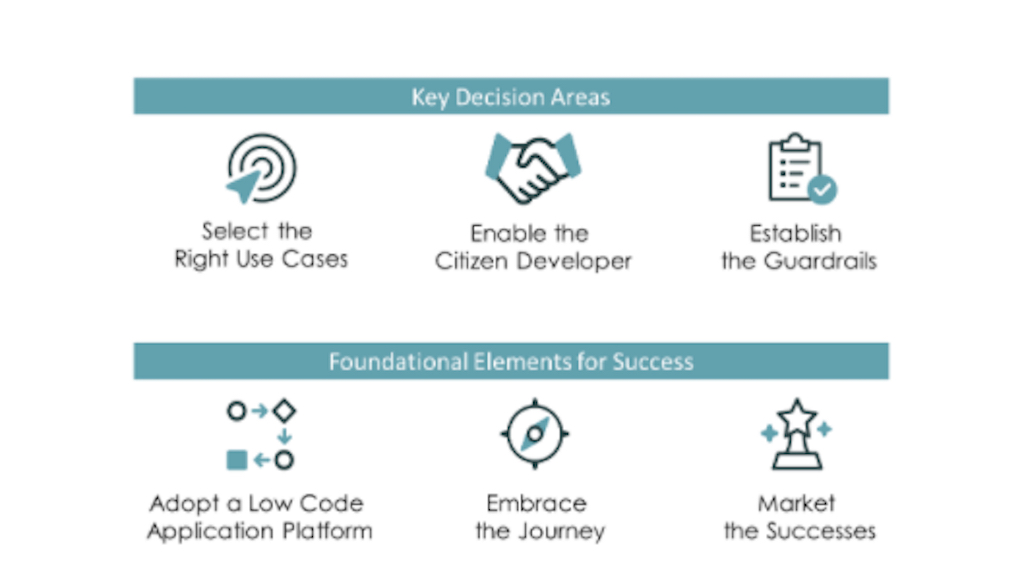
    Now let’s all take a deep breath, pause for a moment, and accept that citizen development is not the panacea for all our digitization needs – nor is it the beginning of application anarchy. A well-executed citizen development program can dramatically improve delivery velocity and business agility if organizations make good decisions in three key areas: 1) selecting the right use cases for citizen development; 2) enabling and empowering our citizen developers; and, 3) establishing citizen development guardrails that protect our organization.

    Before exploring the key decisions, it is important to note a few elements that are consistent across successful citizen development programs:

    • Adopting a Low-Code Application Platform (LCAP) – LCAPs benefit IT developers (both professional and low-code) but are critical to citizen developers. Teaching Java to your lines of business is what’s called a distributed development model – and that’s a whole different article.
    • Embracing the Journey – A citizen development program is a learning process for both the IT organization and the lines of business. Start focused, learn from the experience, adjust the approach and expand the reach.
    • Marketing Success – It is important to raise awareness of the program by telling the company about both the successes and the lessons learned – be candid and clear. People feel good about successful programs and rally around them.

    Selecting the Right Use Cases for Citizen Development

    We want to set up citizen developers, and the citizen developer program, for success, which means matching the business need to the citizen developer skillset.
    We need answer the following questions regarding line of business needs.

    • What business use cases are a good fit for our LCAP?
    • What technical requirements are a good fit for our LCAP? What technical requirements are not?
    • What types of applications in our enterprise are a good fit for citizen development?
    • Are there lines of business / departments that could benefit more than others from empowering citizen developers?
    • Are there specific risk, compliance, security and legal (RSCL) mandates that need to be addressed?
    • Are there other core enterprise systems that need to be considered for certain use cases?
    • Are there legacy technologies and/or is there technical debt that should be targeted?
    • What is the potential return on investment? How quickly can we start achieving that ROI?

    The answers to these questions are not binary. These questions, and others unique to each company, provide a filter to vet – and possibly score – use cases to determine suitability for a citizen development program.

    Just as important as selecting the right use cases is finding the right citizen developers. We need to answer the following questions about any potential citizen developers.

    • Will we have different categories of distributed / citizen developers? Are those categories based on skill level, organization and/or access?
    • Have we identified the aptitude and attitude characteristics of a good citizen developer?
    • How will we recruit and incentivize developers to join the program?
    • What is our value proposition to the citizen developer’s manager? Why would they support allocating some portion of their resource(s) building apps?

    In the early stages of a citizen development program, the most successful programs tend to prioritize the right developer over the right use case. A “high fit” developer delivering a “medium value” use case is a better bet than a “low fit” developer attempting a “high value” use case. Early wins matter.

    In part two of this series, we will explore enabling and empowering our citizen developers. We have now identified the right use cases and the right citizen developers, so let’s set them up for success.


    This post is the first of a three-part series offering real-world insights on delivering business value from citizen development initiatives.

  • Low Code: A Modern Approach to Software Development

    Low Code: A Modern Approach to Software Development

    Low-code development is not a new concept, but since the onset of the COVID-19 pandemic earlier this year, it has become increasingly popular. Low code helps businesses adapt to ever-changing environments quickly by allowing them to build, customize and deploy apps with little to no coding. It enables organizations to accelerate their innovation, automation and transformation efforts.

    “With low-code applications, business analysts, project managers, operations teams and other business users are empowered to implement solutions for themselves,” said Prodly CEO Max Rudman. “Consequently, technical developers have more time to focus on projects that require specialized skills. Because developers are now able to focus on tasks that really do require programming expertise, they become more productive, too.”

    On Nov. 19, the low-code community will come together for the first Low Code Today Virtual Summit to take a look at low code/no code in today’s new normal and highlight the impact of the rapid acceleration of low code use in the wake of COVID-19.

    Here’s a sneak peek of some of the discussions that will take place during the event by some of the distinguished speakers presenting at Low Code Today.

    Accelerate Digital Transformation With Low Code

    In this interview, ServiceNow CIO Chris Bedi shares the main benefits of low code and talks about the ServiceNow Citizen Developer Program. During his keynote presentation, Chris will share a CIO perspective on rolling out low-code applications at scale, best practices from rolling out ServiceNow Citizen Developer Program and suggested guardrails to ensure a successful and secure implementation.

    Empowering Citizen Developers With Low Code

    During this interview, Kianda Chief Operating Officer Derya Sousa explains how low code accelerates digital transformation and empowers citizen developers. Derya will be presenting at Low Code Today Virtual Summit along with Kianda CEO Osvaldo Sousa. During their session, Derya and Osvaldo will discuss how organizations use low-code/no-code platforms to build fully responsive, easy-to-deploy enterprise applications – all without the need for any coding.

    How Low Code Is Transforming Software Development

    Rackspace CTO Jeff DeVerter joined us to explain how low code is transforming software development and how Robotic Process Automation (RPA) complements low-code application platforms. During his keynote presentation, he will explain the newfound prominence of low code and outline how enterprises can best utilize the technology to accelerate the delivery of software and applications.

    Low Code Today features a full day of keynotes, panel discussions, Q&As, workshops and more from low-code pundits and pioneers. Attendees will get an intimate look at how organizations are embracing low-code technologies to advance their business while improving user experience.

    Some other speakers presenting at the virtual event include:

    • Matt Calkins, CEO at Appian (keynote speaker)
    • Jennifer Sable Lopez, Sr. Director, Community and Advocacy at OutSystems; Malcolm Ross, Deputy CTO at Appian; Marcus Torres, VP Product Management, Platform Business and Foundation at ServiceNow; Sephanie Louis, Global Head of Developer Community, Pega (keynote panel)
    • Lori Breitbarth, Sr. Principal IT Program Manager at MedTronic
    • Dan Stoll, Director of Technical Product Marketing and Sean Fiene, Senior Technical Enablement Manager at Nintex (joint discussion)
    • Mayur Shah, Senior Director Product Management at WaveMaker
    • Purnima Bihari, Technical Product Manager at Security Compass
    • Boris Crismancich, Head of Business Development at Katulu
    • Mitch Ashley, CEO at ASG and Parker Yates, CRO at MediaOps (joint discussion)

    The virtual environment features auditoriums with three tracks where attendees can watch the sessions by industry experts and an exhibit hall lined with booths showcasing the latest solutions from leading low-code companies. In the exhibit hall, attendees can download resources and interact with partner sponsors including ServiceNow, Appian, OutSystems, Prodly, Skuid, WaveMaker and DB Maestro.

    To check out the full agenda or to register for free, visit the Low Code Today website.

  • Empowering Citizen Developers With Low Code

    Empowering Citizen Developers With Low Code

    Adopting low-code/no-code technologies enables businesses to quickly build and deploy applications. Low code empowers non-technical teams to build custom applications for their business and customers, accelerating their digital transformation efforts.

    In this interview, Kianda Chief Operating Officer Derya Sousa explains how low code accelerates digital transformation and empowers citizen developers. 

    Derya is one of our outstanding speakers presenting at Low Code Today Virtual Summit, along with Kianda CEO Osvaldo Sousa. During their session, Derya and Osvaldo will discuss how organizations use low-code/no-code platforms to build fully responsive, easy-to-deploy enterprise applications – all without the need for any coding.

    To learn how low code empowers citizen developers and to hear about a real-life use case of how no-code solutions are accelerating digital innovation, attend Derya and Osvaldo’s session at Low Code Today Virtual Summit on Nov. 19. To check out the full agenda or to register for free, visit the Low Code Today website.

  • Low Code and Change Management with Max Rudman

    Low Code and Change Management with Max Rudman

    Many organizations trying to accelerate their digital transformation are turning to low-code technologies to respond quickly to the constant market changes. Low-code technologies facilitate application development by offering drag-and-drop components that require little to no hand-coding. Low code creates a seamless integration between cloud platforms, tools and utilities.

    As low-code applications increasingly become a shared responsibility between IT and business units, it’s incumbent upon IT to ensure changes are delivered consistently, reliably and without disrupting end users — no matter who makes the change.

    In this Q&A session, Prodly CEO Max Rudman answers a few questions about low-code applications and change management.

    Max is one of our distinguished speakers presenting at Low Code Today Virtual Summit. During his session, Max will discuss how to implement an agile change management process to low-code applications and accelerate time to value for low-code apps.

    How do low-code applications boost productivity?

    The simplest answer is: It’s just faster to configure and make changes to low-code applications. Low-code apps leverage declarative programming, meaning you assemble a solution by dragging and dropping predefined components together like Lego blocks instead of writing code line by line. Everyone knows how to use Legos, which brings us to the far greater productivity benefit of low-code apps — they expand the number of people on your development team.

    Low-code applications have given rise to the citizen developer — someone who deeply understands the business problem and how to design the desired solution but previously lacked the programming skills to make it a reality. With low-code applications, business analysts, project managers, operations teams and other business users are empowered to implement solutions for themselves. Consequently, technical developers have more time to focus on projects that require specialized skills. Because developers are now able to focus on tasks that really do require programming expertise, they become more productive, too. It’s a win-win for both IT and business.

    How does low code drive change management? How can you carry out an effective change management process?

    Low-code applications highlight the need for change management within an organization, especially as application configuration and maintenance becomes a shared responsibility between IT and lines of business. This should not be a free-for-all approach to application development where anyone can make changes to applications at any time. More and more businesses rely on low-code apps to manage critical and often complex business processes, like revenue and customer service. Changes must be made in a predictable way that mitigates the risk of errors, downtime and other disruption to users. At the end of the day, users don’t care if an application is built with code or clicks, but they do expect it to work reliably and securely for them to do their jobs. 

    Change management processes address these issues and foster greater collaboration between IT and the business. The low-code revolution has accelerated the pace of change, and it’s causing organizations to rethink their change management processes to accommodate non-technical developers to participate. It’s an opportunity and a responsibility of IT to establish the guardrails and guidelines to empower citizen developers to move fast without breaking things. 

    What can we expect from your session?

    We’ll be discussing the implications of low-code applications on existing change management practices and why that’s causing IT leaders to rethink the people, processes and tools for managing change. Attendees will get practical tips for change management strategies that decrease application time, accelerate time to value and mitigate risk. We’ll also dive into how to give CIOs and IT managers the visibility they expect into the change process.

    To learn more low-code adoption and change management, attend Max’s session at Low Code Today Virtual Summit on Nov. 19. To check out the full agenda or to register for free, visit the Low Code Today website.