Tag: Linux Foundation

  • LF Networking (LFN) Adds to Open Source Portfolio

    LF Networking (LFN) Adds to Open Source Portfolio

    At the online Open Networking & Edge Summit + Kubernetes on Edge Day event LF Networking (LFN), an arm of the Linux Foundation focused on networking, today added several projects that promise to make it simpler to programmatically manage networking services based on open source software.

    Walmart is contributing a L3AF project for managing network applications that make use of an extended Berkeley Packet Filter (eBPF) capability that allows applications to run in a sandbox at the microkernel level of an operating system. Intel and Aarna Networks, meanwhile, are donating the seed code from an EMCO project that provides a universal control plane to securely connect and deploy workloads across distributed computing environments that span everything from the edge to the cloud.

    Arpit Joshipura, general manager for networking, edge and internet of things (IoT) for the Linux Foundation, said the L3AF project adds a control plane for managing those applications to the LFN portfolio that addresses load balancing, rate limiting, traffic mirroring, flow exporter, packet manipulation, performance tuning and other management tasks. Earlier this year, the Linux Foundation set up a separate eBPF Foundation to further advance development and adoption of eBPF across multiple operating systems.

    At the same time, LFN also revealed today that Project Alvarium, a tool for measuring how well data is being delivered to devices that was originally created by Dell, and eKuiper, an existing open source lightweight IoT data analytics and streaming platform, are now part of the LF EDGE portfolio of projects.

    Finally, an open source mobile edge computing project, dubbed Edge Gallery, that was originally created by Huawei has been contributed to the Linux Foundation.

    Joshipura said the LFN continues to gain momentum as more vendors contribute core technologies that, ultimately, don’t provide them with enough differentiated value to continue to develop on their own. The LFN today also revealed that VMware and F5 Networks have joined the LF EDGE consortium as premier members, while mimik and Veena, Inc. have become general members of LFN and the Eclipse Foundation has become an associate member.

    The LFN also provides a mechanism that promotes adoption of those technologies more widely than any one vendor can achieve on its own. The total cost of delivering next-generation edge computing platforms based on wireless 5G networks will also be sharply reduced as LFN projects continue to mature, said Joshipura.

    In general, the rate at which various LFN projects are updated continues to accelerate, said Joshipura. The Akraino project for creating blueprints for edge computing platforms recently delivered its fifth update to address use cases involving smart cities, cloud-native multi-tenant environments and vehicular networks. An EdgeX Foundry project for IoT platforms, meanwhile, recently revamped its application programming interfaces (APIs) to make them more secure and enable more message-based communications. The Home Edge project will also soon issue a Drewberries update that will address code stabilization, scripting, APIs, data synchronization and security.

    It’s now only a matter of time before these LFN projects become more integrated with DevOps workflows as IT teams seek to give developers more programmatic control over network services. The issue now is deciding not so much whether to integrate network operations and DevOps teams but rather determining to what degree those teams will need to fold into each other.

  • Linux Foundation Public Health creates the Global COVID Certificate Network (GCCN)

    San Francisco, CA, June 8, 2021 — Linux Foundation Public Health (LFPH) today announces the launch of the Global COVID Certificate Network (GCCN) to facilitate the safe and free movement of individuals globally during the COVID pandemic. GCCN will establish a global trust registry network that enables interoperable and trustworthy exchanges of COVID certificates among countries for safe reopening and provide related technology and guidance for implementation. The effort is initially supported by Affinidi, AOKPass, Blockchain Labs, Evernym, IBM, Indicio.Tech, LACChain, Lumedic, Proof Market and ThoughtWorks, who have implemented COVID certificate or pass systems for governments and industries. LFPH will work with them to define and implement GCCN.

    With the go-live of the EU Digital COVID Certificate (previously called the Digital Green Certificate), the lack of a global trust architecture and ready-to-deploy tools to build compatible systems in other countries could not be more clear. LFPH is launching GCCN to address this gap, with an initial focus on safely reopening borders between EU and non-EU countries. It follows and operationalizes the Interoperability Blueprint (the “Blueprint”) of the Good Health Pass Collaborative (GHPC), an industry coalition that has defined principles and standards for COVID certificates. LFPH has co-led the process drafting the Blueprint, which was released on Monday for a period of public review.

    Eva Kaili, MEP and Chair of the STOA Panel of the European Parliament shared: “We are interested to learn about how LFPH is taking bold steps in creating the Global COVID Certificate Network in order to facilitate trust building and interoperability for safe borders reopening, since it still seems that there are many challenges and barriers to overcome, for example the need for a European eID agreement. The Science and Technology Options Assessment (STOA) Panel of the European Parliament (EP) is looking into the challenges that the pandemic has introduced, and also we explore potential technological solutions and their impact based on scientific data, credible sources of information and the respect of the European values. I look forward to the next steps of the LFPH that could provide us with more ideas and insights on strategies that enhance the use of a certificate in a safe way, and also to provide further technical options for the EU that could be adopted and could help and enable our system to work in a harmonised way. As soon as we achieve that, then we could immediately share the methodology to connect with the rest of the world and move to the new normal of our post COVID digital era, always in respect of the European charter for human rights and the regulation for privacy and personal data.”

    GCCN’s trust registry network will enable each country to publish a list of the authorized issuers of COVID certificates in that country that can be digitally verified by authorities in other countries. This will effectively bridge the gap between technical specifications (e.g. W3C Verifiable Credentials or SMART Health Card) and a complete trust architecture required for safe reopening. The use and impact of the network will be far-reaching as the world needs transitive trust more than ever.

    “The first wave of apps for proving one’s COVID status did not allow that proof to be shown beyond a single state or nation, did not avoid vendor lock-in, and did not distinguish between rich health data and simple passes. The Blueprint gives this industry a way to solve those issues while meeting a high bar for privacy and integrity, and GCCN turns those plans into action” said Brian Behlendorf, General Manager for Blockchain, Healthcare and Identity at the Linux Foundation.

    GCCN will support Global COVID Certificates (GCC) that apply to three use cases: vaccination, recovery from infection, and test results. These certificates can be held and shared in both paper and digital formats. Participating governments and industry alliances will specify the type(s) and format(s) of COVID certificates they issue and accept, allowing for flexibility but also harmonization. The GCC schema definitions and minimal datasets will follow the recommendations of the Blueprint, as well as GCCN’s technical and governance documents, implementation guide, and open source reference implementations, which will be developed in collaboration with supporting organizations and the broader LFPH community.

    The GCCN community will offer peer-based implementation and governance guidance to governments and industries as they start to implement COVID certificate systems. This includes how to build a country/jurisdiction-level trust registry and other related infrastructure, and how to leverage GCC to incorporate existing ecosystems into a national or jurisdiction-level infrastructure.

    LFPH and the supporting organizations have been pioneering the responsible, effective use of technology to address the global response to COVID since the earliest days of the pandemic. If your organization is actively working in this domain and wants to participate in the GCCN, please reach out to info@lfph.io.

    More information about GCCN and a complete list of supporting organizations is available on the LFPH blog.

    Additional Quotes

    “Uniting human trust and trustworthy data, Trust Registry Networks are critical first building blocks for establishing trust ecosystems. My team and I created the TrustCache open source project at ThoughtWorks to enable speedy, planetary-scale, and decentralized online/offline authorization checks across and within independent trust ecosystems. ThoughtWorks has a long history working with the travel and transport industries and open source. We are eager to help governments restore cross-border travel and serve the hard-hit airlines, cruise lines, and others by contributing to the Global COVID Certificate Network.”
    Ken Adler, Principal, Digital Trust, Identity & InfoSec, ThoughtWorks

    “Lumedic is honored to collaborate with LFPH and the Global COVID Certificate Network. In supporting Providence health system across seven west coast states in the U.S., we’ve established the first publicly available trust registry in healthcare. Lumedic Exchange facilitates widespread adoption of verifiable credentials for health and travel passes with our solution, Lumedic Connect. We look forward to supporting the return to global travel safely and efficiently.”
    Mike Nash, CEO, Lumedic Inc

    “For health passes to work globally, helping countries to restart economies and reopen borders, they need to be trusted globally. Through the Global COVID Certificate Network, Linux Foundation Public Health is working to address this challenge by bringing together a network of trusted and interoperable Trust Registries, so that the holder of a certificate can use it whenever they need and wherever they are. IBM is excited to collaborate with Linux Foundation Public Health on this important initiative at this critical time in our history.”
    Eric Piscini, VP, Emerging Business Networks, IBM Watson Health

    “LACChain, the Global Alliance for the Development of the blockchain ecosystem for Latin America and the Caribbean, has been working on the development of open-source tools for digital certificates and wallets based on international standards since 2019. The regional LACChain Network already in use by governments, multilaterals, corporations, banks, universities, start-ups, and others in Latin America and the Caribbean is ready to serve as a trust registry for the verification of COVID certificates in a privacy-preserving way. We have always been fully committed to enabling interoperability and compatibility between solutions and networks, and we are very excited to pursue such goals in this Global COVID Certificate Network.”
    Alejandro Pardo, Founder & Leader of the LACChain Global Alliance

    “Indicio’s success using Cardea, now a Linux Foundation Public Health project, to manage COVID testing for travelers was built on simplicity, clarity, and the predictability everyone needed to trust the technology behind verifiable health credentials. Decentralized identity offers governments and the public a more secure, privacy-preserving path to managing health and travel-data sharing. Verifiable digital credentials can tame the complexity of a vast range of data needs and requirements and manage their sharing and verification in an agile way. We see the Global COVID Certificate Network’s global trust registry as providing the simplicity, clarity, and predictability to make this happen on a global scale.”
    Heather Dahl, CEO, Indicio.tech

    “Evernym contributed extensively to the drafting of the Good Health Pass Interoperability Blueprint because our customers, such as the International Air Transport Association (IATA) and its Travel Pass initiative, need digital credentials that are interoperable and verifiable everywhere, just like a credit card or a passport works today. One of the most important recommendations in the Blueprint was for the establishment of a decentralized global trust registry network based on the open standards we have been advocating at the ToIP Foundation. We are excited that LFPH has stepped up to this task to work with governing authorities all over the world to operationalize the Global COVID Certificate Network. We look forward to helping implement the GCCN, integrating it with Evernym’s Verity and Connect.Me products, and helping our customers leverage this new tool for trust.”
    Drummond Reed, Chief Trust Officer, Evernym

    “We are humbled to help coordinate global decentralized trust networks and support the Global COVID Certificate Network. Proof Market introduced legislation in California (AB 2004) unanimously passing the Privacy Committee and the House, and passing the Senate — authorizing verifiable credentials for COVID-19 test results. The MedCreds platform, developed by Proof Market, and contributed to Linux Foundation Public Health, has been used to keep the film industry in California open during the COVID-19 pandemic, and aims to be available in Open Source as a reference implementation aligned with the Good Health Pass Interoperability Blueprint.”
    Tony Rose, CEO, Proof Market

    “As Blockchain Labs works closely with governments and international communities to support and lead safe reopening of society globally, it is clear that initiatives such as the Global COVID Certificate Network is important to ensure coordinated response from different entities. Together with the Linux Foundation, we will continue to work on enhancing the interoperability of Pass Infra with many adopted vaccination verification solutions, and assist everyone to recover from the pandemic safely.”
    Bryan Jin, Director of Global Operations, Blockchain Labs

    “AOKpass is committed to supporting important initiatives such as the Global COVID Certificate Network, which are critical to any truly global and coordinated response to the challenges created by the pandemic. We will continue to work closely with collaborative ecosystems like the Linux Foundation to ensure governments, enterprises and communities are equipped to more safely and efficiently engage in vital recovery efforts.”
    Darren Toh, CEO, AOKpass

    “As countries look to reopen borders safely, different digital health credentials standards are being developed to verify the authenticity of COVID-19 tests and vaccination reports, making it challenging for airlines and immigration authorities to interoperate with one another. As a solution, Affinidi has been working closely with a growing list of partners to leverage our universal verification solution, “Unifier”, which can verify multiple digital standards. We are committed to working with the Global COVID Certificate Network and all stakeholders to realise an open and secure global ecosystem that supports safe travel, one scan at a time.”
    Gina Chiang, Affinidi’s GM, Safe Travel initiatives 

    About Linux Foundation Public Health

    Linux Foundation Public Health (LFPH) hosts, supports, and nurtures open source technology for the benefit of worldwide Public Health initiatives. We identify promising technologies in order to grow them into sustainable projects supported by a diverse community of thousands of technologists, public health experts, academics, members, and volunteers across the globe. Over a dozen jurisdictions around the world rely on LFPH’s exposure notification and COVID credentials codebases to fight COVID-19 and safely reopen their communities.

    LFPH is part of the nonprofit Linux Foundation and hosts the COVID Credentials Initiative (CCI). For more information, please visit lfph.io.

    The Linux Foundation has registered trademarks and uses trademarks. For a list of trademarks of The Linux Foundation, please see its trademark usage page. Linux is a registered trademark of Linus Torvalds.

  • Linux Foundation Embraces Lightweight API Gateway

    Linux Foundation Embraces Lightweight API Gateway

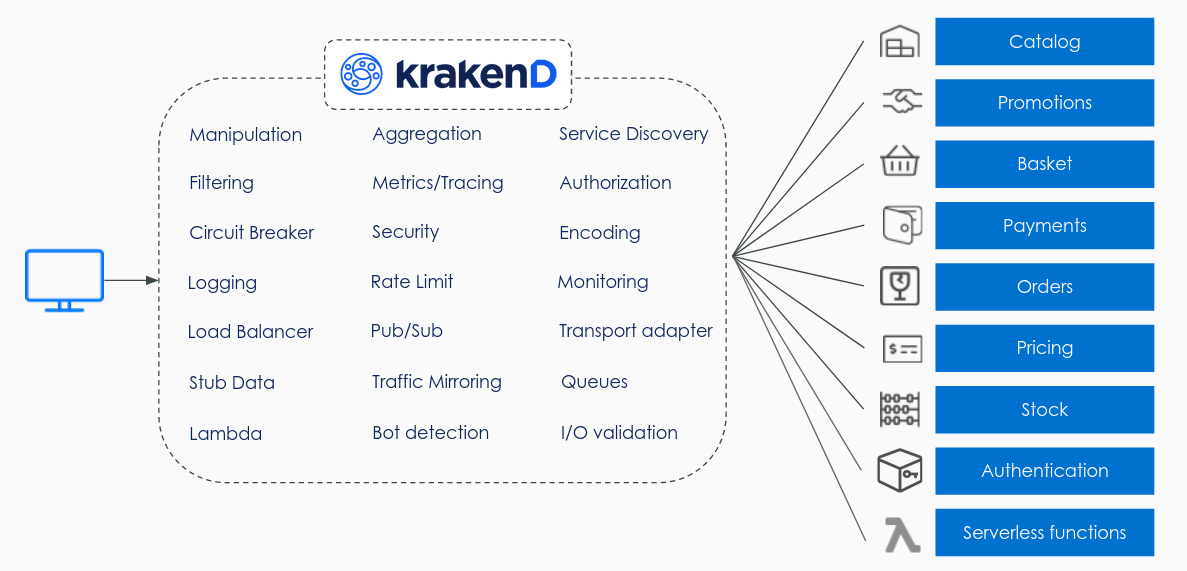
    The Linux Foundation announced today that an open source application programming interface (API) gateway known as KrakenD has become the latest project it will oversee.

    Rechristened the Lura Project, the lightweight stateless API gateway was originally developed by KrakenD, which plans to continue to offer an enterprise edition of the platform.

    KrakenD CEO Albert Lombarte said the API gateway it developed provides a more streamlined approach to managing APIs that doesn’t require an organization to install a separate proxy or database. All the reverse proxy capabilities most organizations require is already embedded within the API gateway. That approach also makes it easier for IT teams to decouple back-end server applications from client applications because now an API can be more easily updated without impacting client applications, Lombarte added.

    KrakenD Linux Foundation

    Organizations that already contribute to the ongoing development of the API gateway include 99P, Hepsiburada, Openroom, Postman and Stayforlong. The API gateway also is embedded in a variety of other platforms, said Lombarte; he noted that the number of servers running the gateway now exceeds more than one million per month.

    API gateways have been available in various forms for years, but with the rise of microservices the number of APIs organizations need to deploy and manage continues to rise steadily. Each microservice added to an environment adds yet another API. At a time when microservices-based applications are at the core of many digital business transformation initiatives, IT teams must employ a more flexible approach to managing the interactions between APIs.

    Thanks in part to the role they play in enabling digital business transformations, APIs are also being targeted more frequently by cybercriminals that have come to view them as an efficient way to exfiltrate data or inject malware into an application environment.

    It’s not clear what impact the Linux Foundation’s support might have on organizations’ selection of one API gateway versus another. In fact, many organizations are still trying to navigate when to employ an API gateway versus relying on proxy software to manage a handful of APIs versus a service mesh to manage thousands. The issue comes down to not just how many APIs there are, but also the overall weight of the platform being employed, said Lombarte. A service mesh typically requires more time and effort to deploy and manage, he noted.

    As the number of APIs in an IT environment continues to increase, there may come a day when organizations will have to revisit how APIs are created and maintained. All too often, APIs are still created as an afterthought once an application is created. They tend to be brittle and, as a consequence, still break often. A more holistic approach to managing APIs based on a set of DevOps best practices is required. The challenge is getting DevOps teams to prioritize APIs when there are so many other issues that require their attention. Nevertheless, it’s become apparent APIs are, in many cases, becoming too strategic to the business for their management to be left in the hands of a single development team.

  • Linux Foundation Launches Open Source Digital Infrastructure Project for Agriculture, Enables Global Collaboration Among Industry, Government and Academia

    AgStack Foundation will build and sustain the global data infrastructure for food and agriculture to help scale digital transformation and address climate change, rural engagement and food and water security
    SAN FRANCISCO, Calif., May 5, 2021 –  The Linux Foundation, the nonprofit organization enabling mass innovation through open source, today announced the launch of the AgStack Foundation, the open source digital infrastructure project for the world’s agriculture ecosystem. AgStack Foundation will improve global agriculture efficiency through the creation, maintenance and enhancement of free, reusable, open and specialized digital infrastructure for data and applications.
    Founding members and contributors include leaders from both the technology and agriculture industries, as well as across sectors and geographies. Members and partners include Agralogics, Call for Code, Centricity Global, Digital Green, Farm Foundation, farmOS, HPE, Mixing Bowl & Better Food Ventures, NIAB, OpenTeam, Our Sci, Produce Marketing Association, Purdue University / OATS & Agricultural Informatics Lab, and the University of California Agriculture and Natural Resources (UC-ANR).
    “The global Agriculture ecosystem desperately needs a digital makeover. There is too much loss of productivity and innovation due to the absence of re-usable tools and data. I’m excited to lead this community of leaders, contributors and members – from across sectors and countries – ro help build this common and re-usable resource – AgStack – that will help every stakeholder in global agriculture with FREE and open digital tools and data,” said Sumer Johal, Executive Director of AgStack.
    Thirty-three percent of all food produced is wasted, while nine percent of the people in the world are hungry or undernourished. These societal drivers are compounded with legacy technology systems that are too slow and inefficient and can’t work across the growing and more complex agricultural supply chain. AgStack will use collaboration and open source software to build the 21st century digital infrastructure that will be a catalyst for innovation on new applications, efficiencies and scale.

    AgStack consists of an open repository to create and publish models, free and easy access to public data, interoperable frameworks for cross-project use and topic-specific extensions and toolboxes. It will leverage existing technologies such as agriculture standards (AgGateway, UN-FAO, CAFA, USDA and NASA-AR); public data (Landsat, Sentinel, NOAA and Soilgrids; models (UC-ANR IPM), and open source projects like Hyperledger, Kubernetes, Open Horizon, Postgres, Django and more.

    “We’re pleased to provide the forum for AgStack to be built and to grow,” said Mike Dolan, general manager and senior vice president of projects at the Linux Foundation. “It’s clear that by using open source software to standardize the digital infrastructure for agriculture, that AgStack can reduce cost, accelerate integration and enable innovation. It’s amazing to see industries like agriculture use open source principles to innovate.”
    For more information about AgStack, please visit: http://www.agstack.org
    Member/Partner Statements
    Centricity Global
    “Interoperability means working together and open source has proven to be the most practical means of doing so. Centricity Global looks forward to bringing our teams, tools and applications to the AgStack community and to propelling projects that deliver meaningful value long-term,” said Drew Zabrocki, Centricity Global. “Now is the time to get things done.  The docking concept at AgStack is a novel way to bring people and technology together under a common, yet sovereign framework;  I see great potential for facilitating interoperability and data sovereignty in a way that delivers tangible value on the farm forward across the supply value chain.”

    Digital Green
    “The explosion of agri-tech innovations from large companies to startups to governments to non-profits represents a game changer for farmers in both the Global South and North.  At the same time, its critical that we build digital infrastructure that ensures that the impact of these changes enables the aspirations of those most marginalized and builds their resilience, particularly in the midst of climate change. We’re excited about joining hands with AgStack with videos produced by & for farmers and FarmStack, a secure data sharing protocol, that fosters community and trust and puts farmers back in the center of our food & agricultural system,” said Rikin Gandhi, Co-founder and Executive Director.
    farmOS
    “AgStack’s goal of creating a shared community infrastructure for agricultural datasets, models, frameworks, and tools fills a much-needed gap in the current agtech software landscape. Making these freely available to other software projects allows them to focus on their unique value and build upon the work of others. We in the farmOS community are eager to leverage these shared resources in the open source record keeping tools we are building together, said Michael Stenta, founder and lead developer, farmOS.
    HPE
    “The world’s food supply needs digital innovation that currently faces challenges of adoption due to the lack of a common, secure, community-maintained digital infrastructure. AgStack – A Linux Foundation’s Project, is creating this much needed open source digital infrastructure for accelerating innovation. We at Hewlett Packard Enterprise are excited about contributing actionable insights and learnings to solve data challenges that this initiative can provide and we’re committed to its success!” said Janice Zdankus, VP, Innovation for Social Impact, Office of the CTO, Hewlett Packard Enterprise
    Call for Code
    “Through Call for Code and IBM’s tech-for-good programs, we’ve seen amazing grassroots innovation created by developers who build solutions to address local farming issues that affect them personally,” said Daniel Krook, IBM CTO for Call for Code. “As thriving, sustainable open source projects hosted at the Linux Foundation, applications like Agrolly and Liquid Prep have access to a strong ecosystem of partners and will be able to accelerate their impact through a shared framework of open machine learning models, data sets, libraries, message formats, and APIs such as those provided by AgStack.”
    Farm Foundation
    “The advancements in digital agriculture over the past 10 years have led to more data than ever before—data that can be used to inform business decisions, improve supply and demand planning and increase efficiencies across stakeholders. However, the true potential of all that data won’t be fully realized without achieving interoperability via an open source environment. Interoperable data is more valuable data, and that will lead to benefits for farmers and others throughout the food and ag value chain,” said Martha King, Vice President of Programs and Projects, Farm Foundation.
    Mixing Bowl & Better Food Ventures
    “There are a lot of people talking about interoperability; it is encouraging to see people jump in to develop functional tools to make it happen. We share the AgStack vision and look forward to collaborating with the community to enable interoperability at scale,” said Rob Trice, Partner, The Mixing Bowl & Better Food Ventures.

    NIAB
    “Climate change is a global problem and agriculture needs to do its part to reduce greenhouse gas emissions during all stages of primary production. This requires digital innovation and a common, global, community-maintained digital infrastructure to create the efficient, resilient, biodiverse and low-emissions food production systems that the world needs. These systems must draw on the best that precision agriculture has to offer and aligned innovations in crop science, linked together through open data solutions. AgStack – A Linux Foundation Project, is creating this much needed open-source digital infrastructure for accelerating innovation. NIAB are excited to join this initiative and will work to develop a platform that brings together crop and data science at scale. As the UK’s fastest growing, independent crop research organisation NIAB provides crop science, agronomy and data science expertise across a broad range of arable and horticultural crops,” said Dr Richard Harrison, Director of NIAB Cambridge Crop Research.
    OpenTEAM
    “Agriculture is a shared human endeavor and global collaboration is necessary to translate our available knowledge into solutions that work on the ground necessary to adapt and mitigate climate change, improve livelihoods, and biodiversity as well as the produce of abundant food fiber and energy.  Agriculture is at the foundation of manufacture and commerce and AgStack represents a collaborative effort at a scale necessary to meet the urgency of the moment and unlock our shared innovative capacity through free, reusable, open digital infrastructure.  OpenTEAM is honored to join with the mission to equip producers with tools that both support data sovereignty for trusted transactions while also democratizing site specific agricultural knowledge regardless of scale, culture or geography,” said Dr. Dorn Cox, project lead and founder of Open Technology Ecosystem for Agricultural Management and research director for Wolfe’s Neck Center for Agriculture & the Environment.

    Our Sci
    “AgStack provides a framework for a scalable base of open source software, and the shared commitment to keep it alive and growing.  We’re excited to see it succeed!” said Greg Austic, owner, Our Sci.

    Produce Marketing Association
    “The digitization of data will have tremendous benefits for the Fresh Produce and Floral industry in the areas of traceability, quality management, quality prediction and other efficiencies through supply chain visibility. The key is challenges to adoption is interoperability and the development of a common, community-maintained digital infrastructure. I am confident that AgStack – A Linux Foundation’s Project, can create this much needed open-source digital infrastructure for accelerating innovation. We at Produce Marketing Association are excited about this initiative and we are committed to its success,” said Ed Treacy, VP of Supply Chain and Sustainability.

    Purdue University
    “We need fundamental technical infrastructure to enable open innovation in agriculture, including ontologies, models, and tools. Through the AgStack Project, the Linux Foundation will provide valuable cohesion and development capacity to support shared, community-maintained infrastructure. At the Agricultural Informatics Lab, we’re committed to enabling resilience food and agricultural systems through deliberate design and development of such infrastructure,” said Ankita Raturi, Assistant Professor, Agricultural Informatics Lab, Purdue University.

    “True interoperability requires a big community and we’re excited to see the tools that we’ve brought to the open-source ag community benefiting new audiences.  OATS Center at Purdue University looks forward to docking the Trellis Framework for supply chain, market access and regulatory compliance through AgStack for the benefit of all,” said Aaron Ault, Co-Founder OATS Center at Purdue University.
    UC Davis
    “Translating 100+ years of UC agricultural research into usable digital software and applications is a critical goal in the UC partnership with the AgStack open source community. We are excited about innovators globally using UC research and applying it to their local crops through novel digital technologies,” said Glenda Humiston, VP of Agriculture and Natural Resources, University of California.

    “Artificial Intelligence and Machine Learning are critical to food and agriculture transformation, and will require new computational models and massive data sets to create working technology solutions from seed to shelf. The AI Institute for Next Generation Food Systems is excited to partner with the AgStack open source community to make our work globally available to accelerate the transformation,” said  Ilias Tagkopoulos, Professor, Computer Science at UC Davis and Director, AI Institute of Next Generation Food Systems.

    About the Linux Foundation
    Founded in 2000, the Linux Foundation is supported by more than 1,000 members and is the world’s leading home for collaboration on open source software, open standards, open data, and open hardware. Linux Foundation’s projects are critical to the world’s infrastructure including Linux, Kubernetes, Node.js, and more.  The Linux Foundation’s methodology focuses on leveraging best practices and addressing the needs of contributors, users and solution providers to create sustainable models for open collaboration. For more information, please visit us at linuxfoundation.org.
    ###


    The Linux Foundation has registered trademarks and uses trademarks. For a list of trademarks of The Linux Foundation, please see our trademark usage page:  https://www.linuxfoundation.org/trademark-usage. Linux is a registered trademark of Linus Torvalds.


  • Armory Joins Continuous Delivery Foundation As Premier Member

    Armory provides enterprise version of Spinnaker, open source continuous delivery multi-cloud project housed under CD Foundation

    SAN FRANCISCO, April 13, 2021 – The Continuous Delivery Foundation (CDF), the open-source software foundation that seeks to improve the world’s capacity to deliver software with security and speed, today announced that Armory has joined the CDF as a premier member. Armory adds enterprise-grade proprietary features and support to the open-source Spinnaker project under the CDF.

    Spinnaker is a free and open-source multi-cloud continuous delivery software platform originally developed by Netflix and extended by Google. It is designed to work with Kubernetes, Google Cloud Platform, AWS, Microsoft Azure and Oracle Cloud. It has released hundreds of thousands of changes into production at Netflix and many other industry-leading companies like Adobe, Airbnb, Cisco, Grubhub, The Home Depot, JPMorgan Chase, Salesforce, Sony PlayStation, and Target.

    Armory joins CDF premier members CircleCI, Cloudbees, Fujitsu, Google, Huawei, IBM, jFrog, Netflix, and Salesforce in working together to make continuous delivery tools and processes as accessible and reliable as possible and  grow the overall ecosystem. Armory has been a General member since 2019.

    “We are moving up to Premier membership because the CD Foundation is the right governance model for continuous delivery software in general and Spinnaker specifically. This strong foundation directly benefits development teams by continuing to improve and strengthen the Spinnaker community. And with Armory providing needed enterprise-grade features and support, development teams can ship better software, faster,” said Daniel R. Odio, co-founder and CEO of Armory. “The CD Foundation is the exact right organization to help steer the course of development of Spinnaker, and we are enthusiastic about increasing our leadership role as part of the CDF.”

    Open source technologies such as Jenkins, JenkinsX, Spinnaker, Tekton, Screwdriver and Ortelius, which the CDF hosts, help development teams from companies of all sizes and industries improve their speed and productivity when creating cloud-native, legacy infrastructure, mobile, IoT, and bare metal applications.

    “Armory has been a part of CDF since the beginning, and this move to increase its participation in CDF is excellent for its customers, for CDF, and the broader continuous delivery software ecosystem,” said Tracy Miranda, Continuous Delivery Foundation Executive Director. “We know Armory well, and we’re thrilled to be working even more closely as we help enterprises worldwide accelerate the adoption of continuous delivery technologies and best practices as quickly and easily as possible.”

    Armory provides a collaborative software delivery platform with Spinnaker at its core. Amory’s enterprise-grade version of Spinnaker adds enterprise-grade features that make software delivery continuous, collaborative, scalable, and safe. Armory is a top contributor to the Spinnaker open source project.

    Spinnaker Summit

    The third annual Spinnaker Summit will be co-located with the CD Foundation’s cdCon (June 23-24, 2021). Registration for cdCon is free. Attendees need to add Spinnaker Summit registration as part of registering for cdCon.

    Options to Sponsor

    Spinnaker Summit and cdCon expect to host 3,000-plus virtual attendees, offer 45-plus sessions with 5 project-focused learning and collaboration tracks, plus engaging and inspiring keynotes on each day. The cdCon and Spinnaker Summit 2021 Sponsor Prospectus is available here (PDF).

    To find out more information and register today, see: https://events.linuxfoundation.org/spinnaker-summit/

    Additional CD Foundation Resources


    About the Continuous Delivery Foundation

    The Continuous Delivery Foundation (CDF) seeks to improve the world’s capacity to deliver software with security and speed. The CDF is a vendor-neutral organization that is establishing best practices of software delivery automation, propelling education and adoption of CD tools, and facilitating cross-pollination across emerging technologies. The CDF is home to many of the fastest-growing projects for CD, including Jenkins, Jenkins X, Tekton, and Spinnaker. The CDF is part of the Linux Foundation, a nonprofit organization. For more information about the CDF, please visit https://cd.foundation.

    About cdCon (June 23-24, 2021)

    Join Continuous Delivery leaders, industry icons, practitioners, and open source developers for a two-day virtual experience as we improve the world’s capacity to deliver software with security and speed. cdCon is the annual event by the Continuous Delivery Foundation that brings together technology teams, enterprise leadership and open source communities to drive the future of software delivery.

    This year’s sessions are designed for 3 different types of audiences:

    • Technology Teams: geared towards application developers, infra folks, DevOps engineers, security professionals, testers and any other practitioners involved with delivering software.

    • Enterprise Leadership: for senior leaders and decision-makers from organizations interested in measuring DevOps, scaling, transformation, security, FinOps, and developer productivity.

    • Open Source Communities: tailored for open-source core contributors and maintainers running and growing CDF projects and special interest groups, as well as folks looking to get involved with open source for the first time. This includes Jenkins, Spinnaker, Tekton, Jenkins X and other CDF communities.

    cdCon is a chance for our global community to come together to meet peers, share best practices and ideas, learn from each other and hear about the latest trends in software delivery.

    # # #


    The Linux Foundation has registered trademarks and uses trademarks. For a list of trademarks of The Linux Foundation, please see our trademark usage page: https://www.linuxfoundation.org/trademark-usage. Linux is a registered trademark of Linus Torvalds.
  • Linux Foundation Takes Control Of AsyncAPI Specification

    Linux Foundation Takes Control Of AsyncAPI Specification

    The Linux Foundation announced today that it now plays host to an AsyncAPI Initiative that has developed a specification and a suite of open source tools for asynchronous application programming interfaces (APIs) and event-driven architectures.

    Founding sponsors of the AsyncAPI Initiative include Ably Realtime, Apideck, Bump, IQVIA Technologies, Slack, Solace and TIBCO. Most recently, Postman, a provider of API management tools, committed to providing engineering resources to the project as well.

    AsyncAPI provides a language for describing the interface of event-driven systems, regardless of the underlying technology, and supports the full development cycle of event-driven architecture. That approach helps unify documentation automation and code generation, as well as managing, testing and monitoring asynchronous APIs.

    Chris Aniszczyk, CTO and vice president for developer relations at the Linux Foundation, said the Linux Foundation will work with the member organizations to facilitate a governing framework similar to the frameworks other open source projects have adopted under its auspices.

    In general, reliance on event-driven architectures is on the rise thanks, in part, to the rise of digital business process initiatives that require the processing and sharing of data across multiple platforms in near-real-time. The AsyncAPI Initiative makes it simpler for disparate event-driven platforms to be integrated. It’s unlikely multiple organizations involved in a digital business initiative are ever going to standardize on the same event-driven platform, so an AsyncAPI specification provides a critical linchpin.

    Usage of the AsyncAPI Initiative is already fairly widespread, with Adidas, PayPal, Salesforce, SAP and Slack all employing it in production environments. In fact, the Linux Foundation cited research that identified AsyncAPI as the fastest-growing specification being implemented by developers, after seeing adoption rates in production environments triple from 2019 to 2020.

    Event-driven IT architectures have, of course, been around for decades. However, as they have gained traction in the modern era of software development, the need for the equivalent of a REST API for asynchronous communications between platforms, based on different event-driven architectures, became apparent. The AsyncAPI doesn’t replace the need for other types of API specifications, but Aniszczyk noted that, over time, it will soon player a larger role, especially as cloud-native application environments become more distributed and the number of use cases that can’t be addressed using traditional batch-oriented techniques continues to rise.

    In the meantime, the number of providers of event-driven platforms based on proprietary architectures spans vendors ranging from Oracle and IBM to cloud service providers such as Amazon Web Services (AWS). At the same time, open source messaging platforms such as Apache Kafka are starting to have a significant impact on how IT teams build their own event-driven platforms.

    The level of enthusiasm for an API specification that makes all those platforms more interoperable than they would otherwise be is unclear. However, as modern IT platforms continue to evolve, more IT teams are becoming aware of the crucial role API specifications play in preventing them from becoming locked into one platform.

  • Linux Foundation Project Secures Software Supply Chains

    Linux Foundation Project Secures Software Supply Chains

    The Linux Foundation today embraced a sigstore project founded by Red Hat, Google and Purdue University to make it simpler for developers to employ cryptographic software, enabled by transparency log technologies, to secure software supply chains.

    Luke Hinds, security engineering lead in the office of the CTO at Red Hat, said he and Dan Lorenc, a staff software engineer for Google, led a small team creating a lightweight mechanism for signing software artifacts, such as release files, container images and binaries, in way that creates an immutable, tamper-proof log.

    Now, the goal is to take that project to the next level by contributing it to the Linux Foundation, at a time when the focus on software supply chain security has increased in the wake of a spate of high-profile breaches. As part of that effort, a free service, based on sigstore, will also be made available by the Linux Foundation to make the cryptographic software easily accessible to a wide range of developers.

    Hinds said one of the reasons that artifacts are not signed by developers is that the current processes employed are too cumbersome. The cryptographic software is designed to be integrated as an extension of existing workflows, Hinds noted.

    Because the log created is immutable, everyone participating in the software development process, including auditors, can now transparently track chain of custody for any software artifact, Hinds said. At its core, sigstore creates a set of short-lived ephemeral keys with a trust root based on an auditable public log.

    Existing approaches rely on digests stored on insecure systems that are susceptible to tampering. Cybercriminals can, for example, swap out digests if they can gain access to compromised credentials. Those types of targeted attacks can be thwarted using sigstore, because the log management system that underpins it is immutable, said Hinds.

    Of course, no system for securing software supply chains is going to be useful if developers won’t employ it. Key management, key compromise/revocation and the distribution of public keys and artifact digests are challenging to manage. Developers, then, need to determine which keys to trust in addition to learning how to sign them when different platforms are employed. Digests and public keys are also often distributed across vulnerable websites susceptible to hacks, or stored as a README file on a public git repository.

    As organizations embrace DevSecOps best practices, it’s only a matter of time before the entire software supply chain comes under greater scrutiny. Ultimately, the issue will come down to finding a way to secure those supply chains, either from the top down by deploying and maintaining a platform, or simply making it easier for developers to better secure artifacts from the bottom up.

    Regardless of approach, the signing of software artifacts should, one way or another, become more routine in the weeks and months ahead. The biggest challenge will be overcoming the simple inertia that currently exists among developers who routinely ignore the whole process.

  • Linux Foundation Announces Free sigstore Signing Service to Confirm Origin and Authenticity of Software

    Red Hat, Google and Purdue University lead efforts to ensure software maintainers, distributors and consumers have full confidence in their code, artifacts and tooling

    SAN FRANCISCO, Calif., March 9, 2021 –  The Linux Foundation, the nonprofit organization enabling mass innovation through open source, today announced the sigstore project. sigstore improves the security of the software supply chain by enabling the easy adoption of cryptographic software signing backed by transparency log technologies.

    sigstore will empower software developers to securely sign software artifacts such as release files, container images and binaries. Signing materials are then stored in a tamper-proof public log. The service will be free to use for all developers and software providers, with the sigstore code and operation tooling developed by the sigstore community. Founding members include Red Hat, Google and Purdue University.

    “sigstore enables all open source communities to sign their software and combines provenance, integrity and discoverability to create a transparent and auditable software supply chain,” said Luke Hinds, Security Engineering Lead, Red Hat office of the CTO. “By hosting this collaboration at the Linux Foundation, we can accelerate our work in sigstore and support the ongoing adoption and impact of open source software and development.”

    Understanding and confirming the origin and authenticity of software relies on an often disparate set of approaches and data formats. The solutions that do exist, often rely on digests that are stored on insecure systems that are susceptible to tampering and can lead to various attacks such as swapping out of digests or users falling prey to targeted attacks.

    “Securing a software deployment ought to start with making sure we’re running the software we think we are. Sigstore represents a great opportunity to bring more confidence and transparency to the open source software supply chain,” said Josh Aas, executive director, ISRG | Let’s Encrypt.

    Very few open source projects cryptographically sign software release artifacts. This is largely due to the challenges software maintainers face on key management, key compromise / revocation and the distribution of public keys and artifact digests. In turn, users are left to seek out which keys to trust and learn steps needed to validate signing. Further problems exist in how digests and public keys are distributed, often stored on websites susceptible to hacks or a README file situated on a public git repository. sigstore seeks to solve these issues by utilization of short lived ephemeral keys with a trust root leveraged from an open and auditable public transparency logs.

    “I am very excited about the prospects of a system like sigstore. The software ecosystem is in dire need of something like it to report the state of the supply chain. I envision that, with sigstore answering all the questions about software sources and ownership, we can start asking the questions regarding software destinations, consumers, compliance (legal and otherwise), to identify criminal networks and secure critical software infrastructure. This will set a new tone in the software supply chain security conversation,” said Santiago Torres-Arias, Assistant Professor of Electrical and Computer Engineering, University of Purdue / in-toto project founder.

    “sigstore is poised to advance the state of the art in open source development,” said Mike Dolan, senior vice president and general manager of Projects at the Linux Foundation. “We are happy to host and contribute to work that enables software maintainers and consumers alike to more easily manage their open source software and security.”

    “sigstore aims to make all releases of open source software verifiable, and easy for users to actually verify them. I’m hoping we can make this easy as exiting vim,” Dan Lorenc, Google Open Source Security Team. “Watching this take shape in the open has been fun. It’s great to see sigstore in a stable home.”

    For more information and to contribute, please visit: https://sigstore.dev

    About the Linux Foundation

    Founded in 2000, the Linux Foundation is supported by more than 1,000 members and is the world’s leading home for collaboration on open source software, open standards, open data, and open hardware. Linux Foundation’s projects are critical to the world’s infrastructure including Linux, Kubernetes, Node.js, and more.  The Linux Foundation’s methodology focuses on leveraging best practices and addressing the needs of contributors, users and solution providers to create sustainable models for open collaboration. For more information, please visit us at linuxfoundation.org.


    ###


    The Linux Foundation has registered trademarks and uses trademarks. For a list of trademarks of The Linux Foundation, please see our trademark usage page:  https://www.linuxfoundation.org/trademark-usage. Linux is a registered trademark of Linus Torvalds.

  • New Training Course Helps Gain Expertise with Jenkins CI/CD

    Course to help SREs, software developers, software architects and other DevOps professionals use Jenkins to improve their CI/CD practices

    SAN FRANCISCO, October 6, 2020 – The Linux Foundation, the nonprofit organization enabling mass innovation through open source, today announced the availability of a new training course, LFS267 – Jenkins Essentials.

    LFS267, developed in conjunction with the Continuous Delivery Foundation, is designed for DevOps engineers, Quality Assurance personnel, SREs as well as software developers and architects who want to gain expertise with Jenkins for their continuous integration (CI) and continuous delivery (CD) activities.

    Jenkins is an open source automation server that provides hundreds of plugins to support building, deploying and automating any project. Since its inception in 2004, Jenkins continues to be the most popular CI server in the world.

    In this course, students will learn how to set up Jenkins in a Kubernetes cluster, automate Jenkins installation using IaC concepts, set up a highly available Jenkins server, scale Jenkins infrastructure by leveraging static and dynamic build agents, automate various routine Jenkins tasks using CLI and RestAPI, secure Jenkins jobs by implementing fine-grained security controls, set up effective CI/CD feedback loops, set up complex multi-branch pipelines simulating real-life scenarios, and automate pull request workflow using GitOps principles. These skills will prepare you for SRE, DevOps, and release engineer roles.

    Before enrolling, students should have a basic understanding of Jenkins, Kubernetes and Docker. Those unfamiliar with these projects should first consider enrolling in free training courses from The Linux Foundation including Introduction to Jenkins, Introduction to Cloud Infrastructure Technologies, and Introduction to Kubernetes.

    The new course was developed by Himanshu Gautam and Deepika Gautam. Himanshu is an author, trainer, speaker, and problem solver with 20+ years of experience in software engineering. He is also an avid reader and a DevOps evangelist focused on creating elegant cloud-native architectures. He has also authored the CI/CD with Jenkins X (LFS268) course. Deepika is an author, speaker, trainer, and DevOps evangelist with almost two decades of experience in the software industry who specializes in implementing DevOps toolchains in multi cloud environments. She has also authored the Introduction to Jenkins (LFS167x) course. They together founded Aplima Inc., a CI/CD solution provider.

    The course is available to begin immediately. The $299 course fee provides unlimited access to the course for one year to all content and labs. Interested individuals may enroll here.

    About the Linux Foundation

    Founded in 2000, the Linux Foundation is supported by more than 1,000 members and is the world’s leading home for collaboration on open source software, open standards, open data, and open hardware. Linux Foundation’s projects are critical to the world’s infrastructure including Linux, Kubernetes, Node.js, and more. The Linux Foundation’s methodology focuses on leveraging best practices and addressing the needs of contributors, users and solution providers to create sustainable models for open collaboration. For more information, please visit us at linuxfoundation.org.

    About the CD Foundation

    The Continuous Delivery Foundation (CDF) seeks to improve the world’s capacity to deliver software with security and speed. The CDF is a vendor-neutral organization that is establishing best practices of software delivery automation, propelling education and adoption of CD tools, and facilitating cross-pollination across emerging technologies. The CDF is home to many of the fastest-growing projects for CD, including Jenkins, Jenkins X, Tekton, and Spinnaker. The CDF is part of the Linux Foundation, a nonprofit organization. For more information about the CDF, please visit https://cd.foundation.

    The Linux Foundation has registered trademarks and uses trademarks. For a list of trademarks of The Linux Foundation, please see its trademark usage page: www.linuxfoundation.org/trademark-usage. Linux is a registered trademark of Linus Torvalds.


    # # #

  • Linux Foundation Adds Entry-Level Certification

    Linux Foundation Adds Entry-Level Certification

    The Linux Foundation has announced the development of a new entry-level certification exam to complement their existing Linux Foundation Certified Sysadmin (LFCS) and Linux Foundation Certified Engineer (LFCE) exams. This new certification, the Linux Foundation Certified IT Associate (LFCA), targets people just moving into systems administration.

    The certification will focus on the test taker’s knowledge of the fundamentals of system administration. We are in a complex world with a lot of systems administration options, and the LFCA intends to touch a little bit on each of the areas a new admin might run into. The test is still in development, but the areas that The Linux Foundation intends to focus on include:

    • Linux Fundamentals
    • System Administration Fundamentals
    • Cloud Computing Fundamentals
    • Security Fundamentals
    • DevOps Fundamentals
    • Supporting Applications and Developers

    The categories will be complementary, with Linux Fundamentals including user and password management, for example, but security going more in-depth on that particular topic.

    In keeping with being accessible for people with entry-level knowledge of the above areas, this certification will be a single exam. That means a user need not wade through dozens of courses and exams to get started in their chosen area of specialty, and the other two certifications are available when the user is ready to move beyond the basics.

    Currently, The Linux Foundation has the following learning path for these exams:

        Introduction to Linux (LFS101) Training
        Essentials of Linux System Administration (LFS201) Training
        Linux Foundation Certified System Administrator (LFCS) Certification
        Linux Networking and Administration (LFS211) Training
        Linux Foundation Certified Engineer (LFCE) Certification
        Linux Security Fundamentals (LFS216) Training

    The LFCA is designed to fit between “Introduction to Linux” and “Essentials of Linux System Administration” to make a pairing of courses and certification exams to carry a system administrator through their career.

    In the midst of business closings and social distancing both increasing the amount of working from home that knowledge workers are involved in, on-site proctored examinations have suffered. This is unfortunate, as there is a spike in the number of people looking to improve their position through certification.

    Since its first exam, the Linux Foundation has offered online exams through a partnership with a proctoring organization. The approach is simple: Webcam, screen-sharing and chat are available to the proctor to monitor the test taker’s activities. Further, the entire session is recorded, so any misunderstandings can be reviewed. The fact that remote proctoring is standard for The Linux Foundation and the organization has been doing it for years hopefully means that proctoring is unobtrusive, and the test-taker can generally just take their test with minimum technical issues.

    The rush to remote proctored testing has created problems for some organizations; having had years to work it out should mean this is not a problem for The Linux Foundation in general and LFCA specifically.

    So if you have friends/coworkers interested in moving in this direction but are unable or unwilling to work through four years of university to get started, point them toward the LFCA. There are a lot of options, but the LFCA has less overhead than many of the other options and will help them settle on whether they are ready to pursue their dream.

    We’ll circle back and do a more in-depth look when the certification is released because there are two parts to a certification—who it benefits and what prospective employers think. We’ll be interested in seeing how this fits with employers’ needs, and to delve into sample questions when they are available.