Tag: LightStep

  • ServiceNow Acquires Era Software to Unify Observability

    ServiceNow Acquires Era Software to Unify Observability

    ServiceNow today announced it has agreed to acquire Era Software as part of an effort to add support for log data to the Lightstep observability platform the company acquired last year.

    Ben Sigelman, general manager for the Lightstep business unit at ServiceNow, said rather than reinventing the same log management capability that Era Software already has, it makes more sense to integrate that capability with the Lightstep platform that collects metrics and traces.

    The integration of those two platforms will then make it possible to unify observability rather than requiring DevOps teams to navigate two separate silos, he added.

    As observability continues to evolve and mature, the most immediate goal is to make it simpler to navigate the alert storm that inevitably ensues any time there is a disruption, said Sigelman. The alert storms generally occur after there has been a change made, but unraveling how exactly that change impacted an IT environment is challenging, he noted.

    An observability platform reduces the time and effort necessary to achieve that goal by surfacing a set of statistics that guide DevOps teams through that process, added Sigelman. The challenge, of course, has always been finding an efficient means of storing all the telemetry data that’s generated. In fact, as organizations start to deploy microservices-based cloud-native applications, many of them are starting to see the amount of telemetry data increase exponentially.

    Era Software uses an object storage system to index and analyze log data collected from cloud applications, Kubernetes and IT infrastructure platforms. The company has also made available in beta an Era Streams tool that reduces the volume of observability data collected without sacrificing fidelity by dynamically reconfiguring data pipelines in real-time.

    Once the acquisition is completed, log data analytics will then be shared with the IT service management (ITSM) tools that ServiceNow provides alongside the Lightstep observability platform. The goal is to make it easier to correlate those IT events with their potential impact on the business, said Sigelman.

    Era Software CEO Todd Persen said the long-term 10-year goal is to get to the point where issues are both automatically detected and remediated. In the meantime, the amount of context switching that IT teams encounter can be sharply reduced via a unified observability platform.

    There is, of course, no shortage of unified observability platforms these days. DevOps teams have also been relying on legacy monitoring tools that track specific metrics for years. The issue is that those legacy monitoring tools only track a narrow range of pre-determined metrics. As IT environments become more complex, the need to launch more open-ended queries to determine the root cause of IT disruption has become more pronounced.

    It may be some time before observability platforms are widely adopted, but the need for them is generally apparent to anyone managing a modern IT environment. Less clear is the degree to which observability platforms will remove the need for legacy monitoring tools; however, right now the focus should be on gaining as much visibility and transparency as possible into what are still opaque IT environments.

  • Lightstep Extending Beyond Observability with Lightstep Incident Response – Techstrong TV

    Lightstep Extending Beyond Observability with Lightstep Incident Response – Techstrong TV

    Ben Sigelman and RJ Jainendra discuss ServiceNow’s latest announcement that Lightstep is extending beyond observability and creating a differentiated portfolio for app development with the general availability of Lightstep Incident Response, helping make organizations’ digital products and services more reliable and resilient. The video is below followed by a transcript of the conversation.

    Alan Shimel: Hey, everyone. Welcome to Techstrong TV’s segment today. We’ve got some breaking news I wanna bring to you, and I’m really happy to be joined by two gentlemen who are gonna tell you the news. I’ve had the pleasure of having them on before.

    They’re two really bright guys from ServiceNow. Let me introduce you to Ben Sigelman and RJ Jainendra from ServiceNow. RJ, I think I left out an “N” somewhere in that second or third syllable, but we’ll let you correct it. I’m gonna ask you to go first, RJ. Introduce yourself to the audience.

    RJ Jainendra: Hey, Alan, good to see you again. And no, you got it right, RJ Jainendra. I’m a VP and GM at ServiceNow, unlocking product growth at the company. It’s great to be here.

    Alan Shimel: Excellent. It’s good to see you again. And of course, RJ, you’re general manager, but you’re the portfolio you are GM with includes observability. I believe it includes value stream as well, yeah?

    RJ Jainendra: So, ServiceNow does have offerings for value stream management, which brings together a number of different product lines. Our IT business management, which we recently rebranded as Service Portfolio Management, SPM, that’s one. The second is it also brings in elements from devops and ITSM offerings to provide a value stream management.

    But I’m here today to talk about Lightstep Incident Response. That’s the product line that we’ve been building out for a little while now, and ready to launch here today.

    Alan Shimel: Absolutely, so, we’re gonna talk about Lightstep. Gotta have Ben here. Ben, welcome. Why don’t you give people a little bit of – give the folks a little bit of your background?

    Ben Sigelman: Yeah, thanks, Alan, for having us. So, I’m Ben Sigelman. I was one of the cofounders at Lightstep and was the CEO up through last year, when we were acquired. ServiceNow wasn’t willing to let me remain the CEO of ServiceNow after the acquisition, so now I’m also a VP and GM, along with RJ. 

    Lightstep’s brand and certainly our products and many aspects of our culture have actually been intentionally retained as part of the acquisition, and the brand has actually been expanded to be a multi-product brand, which is what we’re talking about today.

    Most of my day-to-day is spent doing a combination of thinking about the product vision for observability specifically within Lightstep as well as the longer-term strategy within ServiceNow, and what we can do for our customers by unifying the world of ServiceNow with the world of high-volume customer-facing applications that Lightstep tends to play in.

    Alan Shimel: Absolutely. I think the ServiceNow team already has a pretty good guy in its CEO, but hey.

    Ben Sigelman: I actually, when I talked to Bill during the acquisition, I told him he had my condolences for being a CEO of a much larger company. I knew how stressful it was for Lightstep, so I can only imagine what it’s like for him. But he’s a fantastic guy.

    Alan Shimel: Absolutely. Yes, until you’ve been a CEO, and I don’t care whether it’s a really, really big company or a really small company, yeah, it’s a lot. Anyway, guys, let’s talk Lightstep, observability. Let’s talk about the expansion. Just to level-set things – you both referenced it – Lightstep was one of the leaders in this observability revolution or wave that we saw overtake the industry, let’s say, in the last three, four years, certainly, it really caught fire.

    Lightstep, Ben and your two cofounders, I believe, all came from Google, and really in many ways helped initiate the whole observability revolution there. Then leveraging open source and working with open source, open telemetry, et cetera, really built quite a community and following.

    ServiceNow, one of the most dynamic companies in our industry, recognized this and made Lightstep and observability an important part of the ServiceNow offering. But from what I’m hearing and reading between the lines is why stop there, right? There’s more.

    There’s more that the marriage of ServiceNow’s know-how market intelligence and skill set, and the Lightstep platform can do more, and today marks a significant expansion of that. So, you’re both GMs. Who wants to go first to talk about what this new expansion is?

    RJ Jainendra: So, I can talk a little bit about what the expansion is, and Ben can, I think talk through why it makes a ton of sense, what we’re doing. The thing that we see that’s happening in the market is just the amount of investment going into what’s been called digital transformation.

    It’s just increasing significantly, and I think by some accounts, IDC forecast, it’s gonna be something like north of $10 trillion cumulative by 2025. So what Marc Andreessen said a long time ago, I think it has come to pass, which is every company is a software company, and increasingly, with the adoption of cloud, organizations are prioritizing cloud operations and software development teams they build, and they run these millions of new customer-facing, revenue-generating applications and services.

    So from that perspective, the SREs and developers who really are responsible for keeping applications reliable and resilient, they really start impacting the business outcome. That’s where if you have incidents that occur, maybe it’s a bug or some sort of an outage or poor performance, it has a major impact on revenue, on customer loyalty, on the brand perception.

    That’s why you see the option in the market to introduce a new offering around incident response, which really leverages the power of the ServiceNow platform, but then it brings together the observability capabilities that Lightstep has into sort of a holistic offering that we can bring into market to help customers become more proactive and more effective in addressing issues. Ben, do you wanna add to that in terms of your perspective from an observability side?

    Ben Sigelman: Yeah, for sure. I think the way I’d explain it is observability, Alan, I would agree with you that it’s the wave, but it’s a very confusing, diffuse – it’s a body of water right now that can be hard to wrap your head around, and you frankly have a lot of what I would call legacy observability companies trying to take what they have and call it observability, because that’s easier than reforming it.

    So, it might be helpful to spend just one very quick, 30 second snippet talking about what observability actually is, architecturally. You have some layer at the bottom of integrations and data acquisition. You mentioned Open Telemetry earlier. The Lightstep Incident Response product that we’re announcing today also has an integration ecosystem built around it.

    But you have the acquisition of data, you have some kind of data platform where you store that, which I’m not gonna talk about in detail right now but I think is an interesting topic, slightly far afield. Then you have workflow been made with your full knowledge and workflow built on top of that, and that’s where the actual value is delivered.

    A lot of the conversation around observability today is that you have a silo for your metric system, a silo for your logging system. Maybe you tack on some kind of tracing or PM system, and then you integrate them in the browser.

    Then you also have this Incident Response thing over there. That’s some other vendor, and it does not make any sense. When we talked with our customers, the three things they are prioritizing are overall performance, velocity, and actually, most importantly, incident response and timed resolution.

    It’s the most important thing for observability. Then you have not just a separate tab, but a separate product to do incident management and incident response, which is not sensible from a workflow standpoint.

    So, for the brand, this is a very obvious and natural thing, to have incident response and observability integrated into a single experience, especially incident response where seconds matter, and a context switch like that is very expensive. So, anyway, that’s why this makes a ton of sense to us.

    It goes right at the heart of the MPTR problem, to have a single platform to manage the full lifecycle of incident management on the observability side and on the incident response side.

    Alan Shimel: Absolutely, and you know, Ben, to your point – well, first of all, I think you call them “legacy observability vendors.” Really, they’re APM, application performance management vendors who – 

    Ben Sigelman: Or infrastructure monitoring vendors, more to the point.

    Alan Shimel: Right, or infrastructure – 

    Ben Sigelman: It’s not the –

    Alan Shimel: You know, everyone loves a good name.

    Ben Sigelman: Right.

    Alan Shimel: A company I had started, we had come out with a product that Gartner would later name the category NAC, network access control. We had some stupid name for it before, but Gartner, you know, did that.

    All of a sudden, out of the woodwork, all these people who were doing totally different things started calling what they do NAC. A very similar thing happened with observability, right?

    Ben Sigelman: Yeah.

    Alan Shimel: Anyone who’s doing monitoring, all of a sudden it was observability. But I think, also to your point, was that observability got siloed into just observing. Almost by definition, observing, observability, is not actionable. It’s almost like observability is a passive word, where actionable is active word.

    Ben Sigelman: You’re exactly – that’s a very good point. If you go – I tend to be a little academic, but I think this is an interesting point. Observability really originates from control theory in the 1960s, and it was this smaller, kind of lesser cousin to controllability, which is kind of what you’re talking about.

    Controllability is really the thing that matters. If you can control a system, there are scientific ways of talking about that. Mathematical ways talking about that. To a certain extent, you can think of incident response as being the controllability side of what we’re talking about here.

    It’s like we’re making insights from observability actionable with the Incidence Response product, and that’s a really important part of actually closing the loop on the control theory of modern distributed systems. That’s a great insight that you’re making, Alan.

    Alan Shimel: Yep, thank you. Every once in a while, even a blind squirrel finds something, right? So, RJ, let’s talk about this. ServiceNow is not a trivial size company. To decide that – you didn’t really have an incident response solution in market prior to this, as far as I know. I’m not an expert on everything ServiceNow, but I’m not aware of it.

    To say okay, we are going to build this in as the logical next step in the Lightstep platform, just the inertia sometimes in an organization your size, it’s difficult. Let’s hear from your point of view what it took to make that happen, turn that ship.

    RJ Jainendra: Yeah, so, Alan, we actually do have capabilities in the ServiceNow platform through our IT Service Management and IT Operation Management products, around things like event technology around event correlation, being able to take large-scale number of events from the observability tools and bring them in and understand what those events mean.

    We also do have functionality in ITSM around notifying the right person. But really, the ServiceNow technology, we have great adoption with IT organizations and a large number of customers. But what we’re seeing really is as our customers are going through the digital transformation, they’re reorganizing, and the product teams that are out there are the ones that are sent to adopt these technologies on observability. 

    That’s why we felt that we wanted to bring an offering into market that could be adopted by teams. So, the entire experience for Lightstep Incident Response is as a modern SaaS application. If you’re a developer on the team – and what we’re finding right now is a lot of our initial customers are smaller companies.

    They’re early growth-stage companies that are post-revenue. They have customers, they wanna make sure that their systems are highly available for them. So, what we’re finding is that they can come online, they can sign up, and within a few seconds get access to the system, start using it, and if they see value, then they can swipe the credit card and they’re off to the races.

    So, very much a different motion, really suited to how teams out there in smaller companies are adopting technology. And of course, the startups of today are the ones that become the unique ones tomorrow, so that’s what we’re doing that’s a little bit different. But for ServiceNow customers, they need to have those capabilities within the ServiceNow platform.

    Alan Shimel: Excellent. So, guys, let’s talk – if you don’t mind, I gotta do a little meat-and-potatoes here. You guys announced this today. Is it available? When will it be available?

    RJ Jainendra: It is available today on Lightstep.com. So, we have had the product in the market for a little bit. We did a soft launch earlier last year. So, it’s been battle-tested, and we have a number of customers that have come online. They’re using it in production. So, it is available today, and it doesn’t take more than an email to sign up and get going.

    Alan Shimel: What’s the offering? How is it priced? If you’re an existing Lightstep or ServiceNow customer, how do you – firing off an email, yeah, but how do I – what’s this gonna set – you know, what’s involved here?

    RJ Jainendra: Yep, so, actually, it isn’t a whole lot more complicated than what I just said, which is just as you sign up for a lot of consumer-type services online, developers and SREs can get started with an email. We do have a couple of different tiers. So, we do have a free tier, where if you are just getting started and you may have just a couple of services that you’re monitoring and addressing issues for with Incident Management, that’s free.

    Now, if you’re gonna start scaling up and you have more than two, that’s when the pricing kicks in. We are taking an innovative approach in terms of pricing, which is it’s based on usage. So, we look at the number of active services that a team has, and then we charge by the number of active services, which is very different than some of the other solutions in the market, which charge by the number of developers that you have in the system.

    We really think that we wanna align to the value that our customers are trying to deliver, which at the end of the day, if you’re a developer or if you’re an SRE, your goal is to deliver these resilient, reliable services. So, we feel that aligning to the services – and no matter whether you wanna bring in your whole team or maybe you also wanna bring in sort of extended folks into the solution to be able to collaborate and figure out what the problem is.

    So, we don’t wanna let the number of seats become an impediment. We really would like to have our customers drive this notion of service ownership across the entire team, as opposed to being owned by a few key people, because there’s a lot of burnout that happens.

    So, there’s different models, but after a 30-day free trial, if customers see value and they have these active services, that’s when the billing kicks in. It’s all done by credit card, so it’s a fairly streamlined experience.

    Ben Sigelman: I will add that Lightstep observability experimented with seat-pricing several years ago and abandoned it, because it’s very important for us to deliver value to our customers, and there’s nothing quite as frustrating as hearing people say, oh, we really wanna be using this, but we don’t wanna add another seat license and blah, blah, blah.

    I think especially in large organizations, for incident response, it’s just immensely frustrating to be kind of wanting to use something, like, sporadically, maybe once every couple of months, and then being blocked out of the application because of concerns over seat licensing.

    So, with Lightstep Incident Response, there’s really no restriction on that. You can have a thousand-head engineering organization and put them into the product, and that doesn’t change your bill at all. The pricing is more correlated to the value that we believe we’re delivering, and the resiliency of the services themselves.

    Alan Shimel: Sure. So, I’ve gotta ask the question. I’m gonna ask it of you, Ben. This is a step of taking observability down the control, as you mentioned, the control path, for full control. What’s next?

    Ben Sigelman: That’s a good question. We’re gonna move into crypto. No, I’m just kidding, we’re not.

    RJ Jainendra: Join the crowd, yeah.

    Ben Sigelman: I’m not here to talk about specific products, but directionally for Lightstep as a brand, I think that we see there’s an entire ecosystem out there of – I think you can kind of extrapolate from where I was going with the workflows.

    I think where we – actually, Lightstep and ServiceNow are incredibly similar in our belief in workflows being paramount, and there are a number of other workflows where people have to do a major context switch when they’re involved with the work of making reliability and velocity happen for cloud-native applications and for customer-facing applications. That’s kind of a hint as to, I think, where we’re headed with future products. But this certainly isn’t the last one yeah.

    Alan Shimel: Great. Guys, we’re way past 15 minutes, but for people who wanna go get Lightstep and Lightstep observability up and running today, where do they go?

    RJ Jainendra: www.Lightstep.com.

    Alan Shimel: That’s what I was looking for, RJ. Hey, gentlemen – Ben, RJ – thanks so much for coming on and breaking this exciting news and offering, new offering from the Lightstep/ServiceNow team. Keep us posted, best of luck with it. It sounds like a winner. We hope to hear more soon.

    RJ Jainendra: Thanks, Alan.

    Ben Sigelman: Thank you, Alan.

    Alan Shimel: Thank you, guys. All right, go check it out, Lightstep.com, their new observability and incident response now as part of it, from ServiceNow. We’re gonna take a break. We’ll be right back.

  • ServiceNow Adds Lightstep Notebooks to Visualize Observability Data

    ServiceNow Adds Lightstep Notebooks to Visualize Observability Data

    ServiceNow today added a visualization tool to its Lightstep observability platform that will make it simpler for DevOps teams to correlate metrics, logs and traces.

    Ben Sigelman, general manager for Lightstep at ServiceNow, said Lightstep Notebooks will make it easier for DevOps teams to make sense of the massive amounts of data collected by the observability platform.

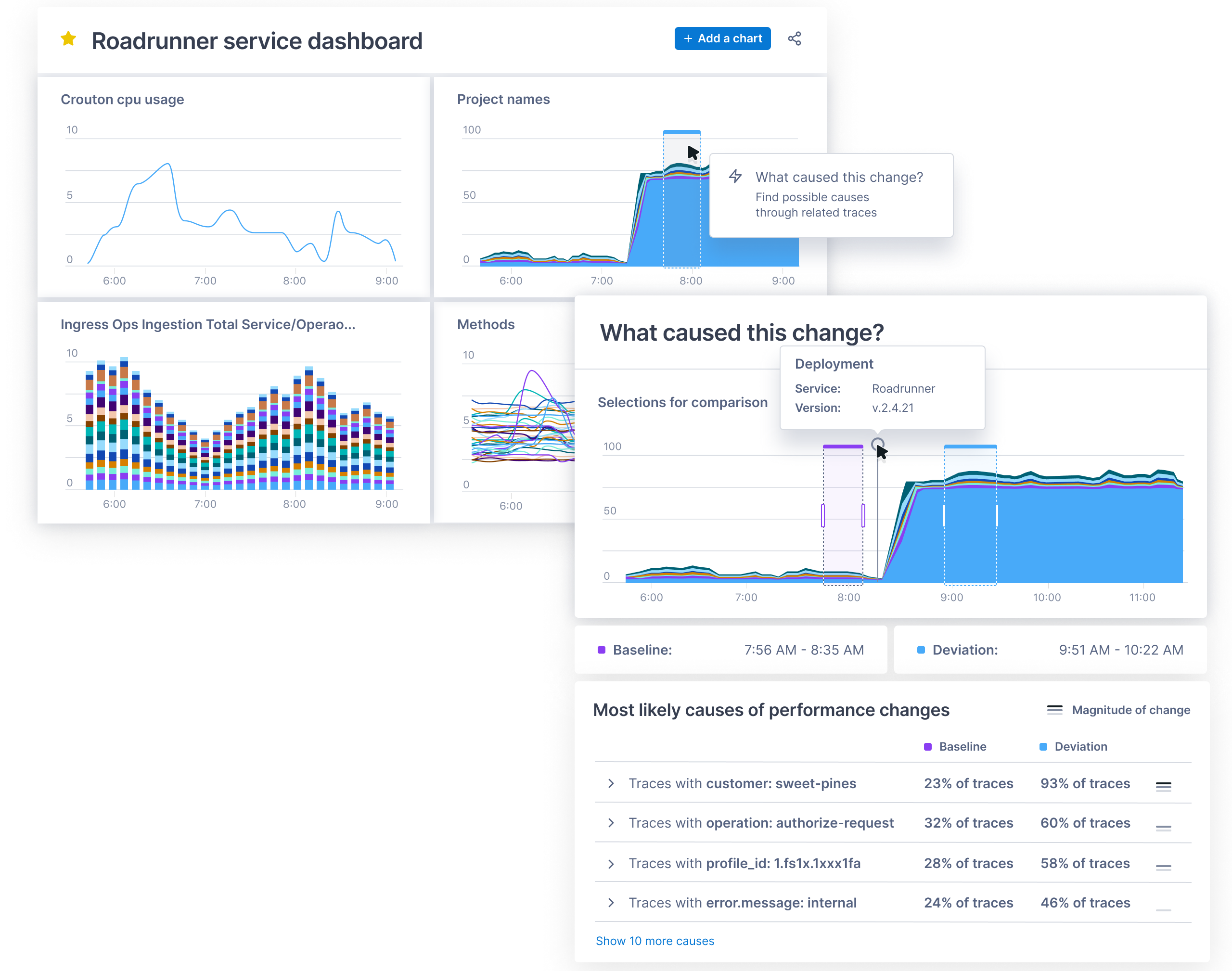
    Lightstep Notebooks is an extension of the Change Intelligence analysis engine that ServiceNow already makes available within an observability platform it acquired in 2021.

    Included with Lightstep Notebooks are a set of ad hoc charts that include access to heat maps and time-series data with trace exemplars using the database at the core of the Lightstep observability platform.

    An instantly generated investigative path also makes it simpler to identify the root cause of any issue, and each instance of Lightstep Notebooks can be shared with other members of the IT organization via an embedded link. Finally, 100% of trace data can be retained for up to three days.

    Sigelman said the ability to share Notebooks via embedded links will also help bridge the divide between DevOps and IT service management (ITSM) teams that often need to collaborate to resolve an IT issue.

    Naturally, the level of collaboration between those teams tends to vary widely by organization. However, as DevOps best practices are more widely embraced, the number of organizations that are trying to achieve that goal continues to steadily increase. Earlier this year, ServiceNow added an incident response offering to orchestrate on-call escalation, group alerts and provide analytics in further pursuit of that goal.

    Observability platforms aggregate the collection of logs, metrics and traces in a way that makes it possible for DevOps teams to query that data. The goal is to make it easier for DevOps teams to both identify the root cause of an IT issue and pinpoint any anomalies that might disrupt an application environment. The goal is to eliminate the need to convene a “war room” meeting that requires IT teams to suffer through the painstaking process of elimination to identify the root cause of an issue.

    Of course, before an IT environment can be observed, it needs to be instrumented. Thanks to advances in the form of open source agent software being advanced via the OpenTelemetry project managed under the auspices of the Cloud Native Computing Foundation (CNCF), it’s becoming less costly to instrument IT environments. That’s especially critical at a time when more DevOps teams are deploying microservices-based applications that are more complex to manage than legacy monolithic applications. While generally more resilient, the dependencies that exist between the microservices that make up an application can be difficult to identify without the aid of an observability platform.

    As a core DevOps tenet, the need for observability and instrumentation has always been apparent. The challenge has been finding the best way to achieve that at an acceptable cost, Fortunately, there is now no shortage of observability platforms. The only remaining issue is to determine which one best fits within the construct of the organization’s defined DevOps workflow.

  • ServiceNow Launches Incident Management Platform Infused with Observability

    ServiceNow Launches Incident Management Platform Infused with Observability

    ServiceNow added an incident management platform based on the Lightstep observability platform it acquired last year to its software-as-a-service (SaaS) portfolio.

    Ben Sigelman, general manager of Lightstep at ServiceNow, said Lightstep Incident Response gives DevOps teams access to observability tools that, via a self-service portal, enable them to determine the root cause of any incident much faster. It combines the ability to orchestrate on-call escalation, alert grouping, incident analysis and remediation with a set of collaboration and incident management tools.

    That approach will make the Lightstep observability platform much more accessible via a cloud service, noted Sigelman. The Lightstep observability platform itself is based on a time-series database capable of processing one trillion events each day.

    Lightstep Incident Response manages an organization’s on-call rotations by synchronizing schedules via a shared calendar, with specific tags that indicate who needs to be looped in based on the nature of the incident and the service that is impacted. Team members are invited to a dedicated channel based on prebuilt collaboration integrations for quick remediation. Over time they can create automated processes that self-triage and self-remediate problems as they reoccur. The platform also integrates with monitoring, observability and collaboration tools such as LogicMonitor, Postman, Slack, Sumo Logic and Zoom.

    Lightstep Incident Response is generally available now in both free and paid versions. Pricing is based on the use of active services being managed rather than by seat license.

    Lightstep Incident Response also natively integrates with the Now Platform that ServiceNow created for IT service management (ITSM). That integration will enable organizations to more easily meld ITSM and DevOps workflows, noted Sigelman.

    Observability platforms aggregate the collection of logs, metrics and traces in a way that makes it possible for DevOps teams to query that data. The goal is to make it easier for DevOps teams to identify anomalies that might disrupt an application environment. Those same tools, however, also allow DevOps teams to identify the root cause of an IT incident much faster. Today many organizations routinely convene “war rooms” that require IT teams to painstakingly identify the root cause of an issue by a process of elimination; this can take days—sometimes even weeks—to complete.

    With more applications becoming instrumented—thanks, in part, to the availability of open source agent software—Sigelman said observability platforms will play a critical role in helping to automate incident management processes. Prior to being acquired by ServiceNow, Lightstep team members played a role in the creation of both the OpenTracing and OpenTelemetry open source projects for collecting traces, metrics and logs. Today, OpenTelemetry is a sandbox-level project being managed under the auspices of the Cloud Native Computing Foundation (CNCF).

    With the deployment of more microservices-based applications, the percentage of applications that are instrumented will soon increase substantially. It’s not feasible to manage these highly distributed applications without some level of instrumentation. The issue now, of course, is determining to what degree to also instrument many of the monolithic applications that are already running in those same environments.

  • ServiceNow Acquires Lightstep to Gain Observability Platform

    ServiceNow Acquires Lightstep to Gain Observability Platform

    ServiceNow today announced it has acquired Lightstep as part of an effort to add an observability platform to its IT operations portfolio. Terms of the deal, expected to close this quarter, were not disclosed.

    The Change Intelligence observability platform from Lightstep is based on a time-series database that is capable of processing a trillion events each day. It was built by the same team that created Monarch, the globally distributed in-memory time series database system that Google employs to monitor its applications and systems. Lightstep team members also co-created both the OpenTracing and OpenTelemetry open source projects for collecting traces, metrics and logs.

    Pablo Stern, senior vice president and general manager for IT workflow products at ServiceNow, said ServiceNow will employ Lightstep to enable IT organizations to observe both monolithic and microservices-based applications as IT operations and DevOps teams continue to collaborate more closely with one another. The goal is to provide a single pane of glass through which IT teams can observe their entire IT environment via the Now platform that ServiceNow makes available via a software-as-service (SaaS) delivery model.

    That approach will enable DevOps teams to programmatically manage IT environments alongside IT administrators employing graphical tools, noted Stern.

    Lightstep CEO Ben Sigelman added that, in time, the number of users of that observability will only increase as more application stakeholders start to track software development projects that are at the heart of various digital business transformation initiatives.

    ServiceNow

    Thanks mainly to the rise of microservices that are now being deployed across highly distributed computing environments, it’s become more difficult to discover the root cause of an IT issue. Microservices-based applications have lots of dependencies that, while serving to make the overall application more resilient, conspire to make it difficult to determine which specific microservices might be adversely impacting the performance of an application.

    The time-series database that lies underneath the Change Intelligence observability platform makes it feasible to go beyond logs and metrics to process distributed traces that provide more insight into application behavior. Ultimately, the goal is to enable organizations to innovate faster with a higher degree of confidence in the IT environment, said Sigelman.

    As far as the march to observability in the enterprise is concerned, it’s still early days. While observability may be a core tenet of any DevOps practice, most IT organizations rely on myriad tools that surface data the teams then attempt to correlate. Whenever there is a major issue, those IT teams typically convene in a “war room” to compare reports generated by the various IT monitoring tools employed. Observability platforms that collect and process distributed traces used to instrument an application using a consistent set of specifications, frameworks and libraries. The OpenTracing and OpenTelemetry tools are significant because they provide an open source approach to instrumenting applications that reduces the total cost of observability. In comparison, many legacy application performance management (APM) platforms employ proprietary agents to instrument applications.

    Naturally, each IT organizations will be moving down the path toward an observability platform that provides greater application context. At this point, however, it’s not clear to what degree observability platforms will need to be installed before making the transition to microservices versus being a capability that only gets appreciated once the trouble with microservices finally becomes apparent.

  • ServiceNow to Acquire Lightstep, Combining Next-Generation Observability with the World’s Leading Enterprise Digital Workflow Platform

    Acquisition will help ServiceNow customers accelerate digital transformation with insight‑driven, action‑oriented workflows

    SANTA CLARA, Calif. — May 10, 2021 – ServiceNow (NYSE: NOW), the leading digital workflow company that makes work, work better for people, today announced it has signed an agreement to acquire next‑generation observability leader Lightstep.

    By acquiring Lightstep, ServiceNow will solidify and accelerate its position as the world’s leading enterprise platform for digital businesses. ServiceNow is already a recognized market leader in IT service management, IT operations management and digital workflows. With Lightstep, an emerging pioneer in next generation application monitoring and observability, ServiceNow will help DevOps engineers build, deploy, run and monitor state‑of‑the‑art, cloud‑native applications. Together, ServiceNow and Lightstep will extend the benefits of observability across the enterprise through digital workflows that convert real‑time insights into action across all the technologies, people, and processes that enable digital business.

    In a cloud and DevOps based world, the software that powers today’s enterprises is increasingly complex.  Yet, companies are expected to increase innovation and velocity without sacrificing reliability and performance. The combination of ServiceNow and Lightstep will deliver deep operational insights so enterprises can more effectively use modern technology stacks. Lightstep’s solution analyzes system‑wide metrics and tracing data in real time to understand the cause and effects of changes to application performance, reliability, and development velocity. The Now Platform coordinates the technical and team response, connecting insights with actions needed to drive digital transformation.  Customers will be able to more easily monitor and respond to critical signals and indicators of software health using Lightstep’s capabilities with ServiceNow’s IT workflow solutions’ ability to weave disparate elements into a seamless digital fabric. This gives business the confidence and clarity to drive faster innovation and better outcomes across the entire digital experience.

    “Companies are betting on going digital in order to thrive in the 21st century, but the transition is often challenging to navigate,” said Pablo Stern, SVP & GM, IT Workflow Products, ServiceNow. “With Lightstep, ServiceNow will transform how software solutions are delivered to customers. This will ultimately make it easier for customers to innovate quickly. Now they’ll be able to build and operate their software faster than ever before and take the new era of work head on with confidence.”

    Lightstep is the trusted observability solution for both born‑in‑the‑cloud companies like GitHub, Spotify and Twilio and fast‑growing enterprises whose businesses are increasingly reliant on software applications.  The Lightstep platform provides a unified approach to observability with system‑wide visibility and insights integrated across metrics, distributed traces, and logs. This helps organizations speed software development velocity without compromising quality and to drive faster innovation across the entire digital customer experience.

    “Today, observability primarily benefits the DevOps teams that build and operate mission‑critical apps,” said Ben Sigelman, CEO and co‑founder at Lightstep. “We’ve always believed that the value of observability should extend across the entire enterprise, providing greater clarity and confidence to every team involved in these modern, digital businesses. By joining ServiceNow, together we will realize that vision for our customers and help transform the world of work in the process – and we couldn’t be more excited about it.”

    San Francisco‑based Lightstep was co‑founded in 2015 by CEO Ben Sigelman, COO Ben Cronin, and Chief Architect Daniel Spoonhower. Key Lightstep team members helped define modern observability with their prior work on tracing and metrics monitoring at Google. Lightstep team members also co‑created both the OpenTracing and OpenTelemetry open‑source projects, leading the industry’s overall migration away from proprietary agents towards the portable, always‑on, and open standards‑based acquisition of traces, metrics, and logs.

    ServiceNow expects to complete the acquisition in Q2 2021. Financial terms of the deal were not disclosed.

    Use of Forward‑Looking Statements

    This press release contains “forward–looking statements” about the expectations, beliefs, plans, intentions and strategies relating to ServiceNow’s acquisition of Lightstep. Such forward–looking statements include statements regarding future product capabilities and offerings and expected benefits to ServiceNow. Forward‑looking statements are subject to known and unknown risks and uncertainties and are based on potentially inaccurate assumptions that could cause actual results to differ materially from those expected or implied by the forward‑looking statements. If any such risks or uncertainties materialize or if any of the assumptions prove incorrect, our results could differ materially from the results expressed or implied by the forward‑looking statements we make. We undertake no obligation, and do not intend, to update the forward‑looking statements. Factors that may cause actual results to differ materially from those in any forward‑looking statements include, without limitation, assimilating or integrating Lightstep’s technology into our platform; the inability to retain key employees of Lightstep after the transaction closes; unanticipated expenses related to Lightstep’s acquired technology; potential adverse tax consequences; disruption to our business and diversion of management attention and other resources; and potential unknown liabilities associated with Lightstep’s business. Further information on factors that could affect our financial and other results is included in the filings we make with the Securities and Exchange Commission from time to time.

    About ServiceNow

    ServiceNow (NYSE: NOW) is making the world of work, work better for people. Our cloud‑based platform and solutions deliver digital workflows that create great experiences and unlock productivity for employees and the enterprise. For more information, visit: www.servicenow.com.

    © 2021 ServiceNow, Inc. All rights reserved. ServiceNow, the ServiceNow logo, Now, and other ServiceNow marks are trademarks and/or registered trademarks of ServiceNow, Inc. in the United States and/or other countries. Other company names, product names, and logos may be trademarks of the respective companies with which they are associated.


  • Lightstep Delivers Next Generation Observability Platform

    Lightstep Delivers Next Generation Observability Platform

    Lightstep this week announced general availability of a Change Intelligence observability platform based on a time-series database that is capable of processing a trillion events each day.

    Ben Sigelman, Lightstep’s CEO, said as IT environments become more complex, thanks to the rise of microservices and cloud-native computing platforms, existing monitoring and observability tools will not be able to keep pace with the rate of change in what have become highly dynamic IT environments.

    While AIOps promises to address that complexity by employing machine learning algorithms to analyze IT environments and surface recommendations, Sigelman said there will always be the need for observability platforms that enable IT teams to discover the root cause of an issue in a way that surfaces the insights needed to fix the problem in real-time.

    The Lightstep database was built by the same team that created Monarch, the globally-distributed in-memory time series database system that Google employs to monitor its applications and systems. Lightstep’s database makes it possible to collect metrics, in the form of distributed traces, at a level of scale that allows IT teams to analyze events across a distributed IT environment made up of both monolithic and microservices-based applications, said Sigelman.

    Lightstep is the latest entrant in an already crowded field of observability platforms, all seeking to consolidate the wide range of monitoring tools IT teams have used for decades.

    The challenge IT teams face is that each of those monitoring tools is focused on a narrow range of platforms. IT teams often lack context when an issue arises, and wind up trying to correlate reports from multiple monitoring tools in the hopes of discovering the root cause of an issue. Observability platform providers are making the case for a single platform that correlates application and infrastructure events in a way that makes it easier for IT to fix issues faster.

    Observability, of course, has been a core tenet of DevOps for years. The tools for achieving that goal, however, have been cumbersome to implement and maintain using legacy application performance management (APM) platforms. Most of those platform providers, have rolled out what are positioned as next-generation observability platforms. Now, IT organizations will need to decide if they want to maintain investments in existing platforms versus moving to one of the raft of upstarts looking to dethrone APM incumbents.

    The startups are counting on a massive expansion in demand for observability platforms. IT organizations have tended to limit their usage of APM platforms to mission-critical applications due to cost and the challenges associated with maintaining the agent software needed to collect metrics from each application. Modern observability platforms have automated much of the metrics collection process, while open source software promises to make metrics collection more affordable..

    The challenge, of course, is that many organizations are already struggling to manage complex IT environments, and can’t necessarily wait for that open source software to mature.

  • Nobl9 and Lightstep Partner to Integrate Distributed Tracing Technology into SLO Management Platform

    Joint development effort to help engineers use real-time distributed data to design better SLOs and monitor software performance for better end-user experiences.
    BOSTON and SAN FRANCISCO, November 5, 2020 — Nobl9, a Boston-based software reliability platform startup, and Lightstep, the San Francisco-based observability company that has pioneered the cutting-edge practice of ‘distributed tracing,’ today announced an integration partnership in which the two companies will add support for the Lightstep core distributed tracing technology to Nobl9’s SLO platform. The effort enables organizations to establish service level objectives from performance data captured through distributed traces in the Lightstep platform.
    Distributed tracing, the technology at the heart of the Lightstep observability platform, is used to rapidly pinpoint the causes of failures and poor performance across the deeply complex dependencies among services, teams and workloads in modern production systems. SLOs—service level objectives—are strong, understandable goals that applications will run reliably and with adequate performance. What makes SLOs uniquely valuable and powerful is that they encode technical and business priorities in terms that are easy to understand, built by a collaborative team of application developers, product managers, IT operators and other business stakeholders. Using distributed tracing data as an input to the SLO process gives application developers and operators the ability to construct SLOs that reflect service dependencies and validate them with live telemetry from the application.
    Users of services—whether they are human or other services—have expectations about how reliable these services are, and those expectations vary by the types of services being requested, the time of day or year those services are being requested, and how reliable similar services are from competitors. Good SLOs are built on the economic value to the organization of successful service delivery. The Nobl9 platform, presently in private beta, democratizes the process of managing SLOs so that engineers can make objective reliability decisions based on data, not conjecture or organizational folklore. When SLOs are at risk, Lightstep provides explanations of what has changed to help engineers get things back on track.
    “In order for software to fulfill its promise as the only sustainable source of competitive differentiation, it has to be reliable,” said Marcin Kurc, CEO of Nobl9. “Site reliability engineering is the means by which reliable software is built and run, and SLOs are the foundation upon which SRE is built. That’s what we’re creating at Nobl9: a platform to help organizations create and manage SLOs that deliver positive reliability experience downstream, without over-provisioning or other capital-inefficient tactics that deliver negative ROI for the organization.”
    “Engineers in charge of delivering reliable software crave management systems that are elegant, flexible and save them time,” said Ben Sigelman, CEO and cofounder at Lightstep. “Engineers don’t want another maintenance headache, and they don’t want another framework or vendor that makes them bend over backwards. Lightstep and Nobl9 see the world the same way, and by integrating our systems, we’re giving our customers access to another, powerful value proposition for distributed tracing.”
    The integration will be made available to participants in the private beta program for the Nobl9 SLO platform.
    About Lightstep
    Lightstep’s mission is to deliver confidence at scale for those who develop, operate and rely on today’s powerful software applications. Its products leverage distributed tracing technology – initially developed by a Lightstep co-founder at Google – to offer best-of-breed observability to organizations adopting microservices or serverless at scale. Lightstep is backed by Redpoint, Sequoia, Altimeter Capital, Cowboy Ventures, and Harrison Metal and is headquartered in San Francisco, CA. For more information, visit lightstep.com or follow @LightstepHQ.
    About Nobl9
    Nobl9, the software reliability platform startup, is in the noble pursuit of reliable software. Founded by Marcin Kurc and Brian Singer, who joined Google via acquisition of Orbitera, Nobl9 helps software developers, DevOps practitioners, and reliability engineers deliver reliable features faster through software-defined Service Level Objectives that link monitoring and other logging and tracing data to user happiness and business KPIs. The company is backed by Battery Ventures, CRV, Bonfire and Resolute Ventures and is headquartered in Boston with a distributed team. More at nobl9.com.
    ###
  • Lightstep Announces New GitHub Action, Bringing Observability Data Directly to GitHub to Avoid Problematic Code Deploys

    • GitHub Actions is modernizing the developer workflow by automating tasks in the same place developers code and collaborate on pull requests
    • Lightstep will surface relevant Observability data within the existing GitHub workflow to ensure developers are shipping high-quality software

    cdCON — October 7, 2020 — Lightstep, the cutting-edge distributed tracing tool founded by former Google engineers, today announced their new GitHub Action called the Lightstep Pre-Deploy Check. By automatically bringing relevant Observability data directly into the development workflow on GitHub, software developers can ensure the quality and performance of their software, before it’s actually deployed.

    “This is a big shift left for how developers think about Observability,” said Daniel Spoonhower, Co-Founder and CTO of Lightstep. “DevOps is about acknowledging that it’s not good enough to ship code without worrying about how it performs in the real world. I very much believe in ‘you build it you own it’ — but I also believe that we need to make this easier by baking solutions into existing development workflows as much as possible, by automating as much as possible.”

    According to the State of Software Quality 2020 report produced by OverOps, two out of three developers spend at least a day per week troubleshooting issues in their code, and are frustrated by the unknowns that come with deploying new code into cloud-based, distributed architectures. Despite the 87M+ merged pull requests per GitHub’s annual Octoverse report, to date there has been zero visibility into the health status of a system within a pull request.

    “Automatically confirming production systems and services are healthy before deploying code that can impact them is a great step towards ensuring reliability, without compromising developer velocity,” said Chris Patterson, Product Manager for GitHub Actions at GitHub. “By bringing Observability data directly into the pull request process on GitHub, developers can avoid context switching, gain more ownership of how their code performs in production, and better support DevOps within their organization.”

    The Lightstep Pre-Deploy Check leverages publicly-available APIs from Lightstep to provide a deployment risk summary ahead of a code change going to a production environment. The information from the risk assessment is then automatically pulled directly into the GitHub pull request through a GitHub Action.

    Lightstep has also partnered with Rollbar and PagerDuty to bring even more information directly into GitHub. For example, if Lightstep completes a risk assessment and determines that the system is unhealthy, it can automatically take a snapshot of the production behavior in real-time and send it to PagerDuty, so the full details of the issue can be examined even if the developer was not there at the moment the issue started.

    “We see direct value to developer effectiveness with the Lightstep Pre-Deploy Check,” said Steve Gross, Sr. Director, Strategic Ecosystem Development at Pagerduty. “Now developers automatically have PagerDuty on-call details inside of a pull request, alongside system health details, at their fingertips in one screen.”

    About Lightstep

    Lightstep’s mission is to deliver confidence at scale for those who develop, operate and rely on today’s powerful software applications. Its products leverage distributed tracing technology – initially developed by a Lightstep co-founder at Google – to offer best-of-breed observability to organizations adopting microservices or serverless at scale. Lightstep is backed by Redpoint, Sequoia, Altimeter Capital, Cowboy Ventures, and Harrison Metal and is headquartered in San

    Francisco, CA. For more information, visit https://lightstep.com or follow @LightstepHQ

  • DevOps Chats: Mobile, Monoliths & Microservices, With LightStep

    DevOps Chats: Mobile, Monoliths & Microservices, With LightStep

    Daniel “Spoons” Spoonhower made a bit of a name for himself while he was at Google, as did his two co-founders of their latest company, LightStep. All three were there at the birth of the microservices wave that has swept through the software world.

    They left Google and started LightStep to help all developers build better, more scalable applications.

    With its new release, LightStep has pushed the bar higher. In this DevOps Chats podcast, Spoons tells us what they are doing and where he sees things moving.

    As usual, the streaming audio is immediately below, followed by the transcript of our conversation.

    Transcript

    Alan Shimel: Hey, everyone, it’s Alan Shimel for devopsy.kinsta.cloud and Container Journal. You’re listening to another DevOps Chats. I’ve got a great guest to talk with today, I hope you’re going to enjoy it. I’d like to introduce you to Daniel Spoonhower, better known as Spoons. Spoons, welcome to DevOps Chats.

    Daniel Spoonhower: Hi, great to be here.

    Shimel: So, Spoons, you are CTO and Co-founder of LightStep, and though some in our audience are probably familiar with LightStep, being that this is the first time we’ve had someone from LightStep on our podcast, I’m gonna ask you to kinda do some of the heavy lifting here and kinda—

    Spoonhower: Sure.

    Shimel: – tell our audience a little bit about LightStep and what you guys do.

    Spoonhower: Sure—sure, sure. So, LightStep provides simple observability for deep systems. We think observability is more than just metrics, logs, and traces, it’s really about being able to navigate from effect to cause. So, whether you’re pushing into deployment, you’re on call and you got paged or you’re just trying to improve performance, observability tools like LightStep should be able to give you the insights that you need to understand what’s happening in your services and across your system.

    Shimel: Excellent. And just by way of, again, giving the audience the background—Spoons, why don’t you tell them a little bit about your own personal journey? You are a Co-founder and CTO, but there was life before LightStep.

    Spoonhower: True, yeah. So, yeah, I’m Co-founder and CTO and LightStep, but we have three—all three of the Co-founders are technical, and so, we all have done technical things and we all have done a lot of non-technical things, too, which has been pretty fun for me just to learn about finance and about commercial real estate—who knows what.

    Shimel: Yeah.

    Spoonhower: But yeah, I’m an engineer by training. Before this, I was at Google for a while. I worked both on their internal infrastructure team, which was super interesting, as well as on the cloud platform. And I have various other experiences at big and small companies. I was at grad school for a while doing academic stuff, so—yeah, a lot of different things.

    Shimel: Excellent. Alright. So, before we—I know you guys have some new product announcements coming up, but you know, LightStep is, as I mentioned, new to our audience here on the podcast, but it’s been around five years, right? And I think you gave everyone kind of the—you know, the brief elevator pitch about it. But it really, you know, in an age where even just since I’m doing devopsy.kinsta.cloud, right, Spoon, we’ve seen APM turn into AIOps and companies go public in this space and everything, several. But yet, you know, the need to kinda monitor, manage, see what’s happening is still here and I don’t wanna say it’s getting easier or—you know?

    Spoonhower:  [Laughter]

    Shimel: Because I think it’s just, you know, natural. Things get more complex as we continue to build and so forth, and I guess that makes the monitoring easier, but when does it get simpler?

    Spoonhower: Well, yeah, so I think the situation has gotten a lot more complex. That might be because of things like microservices or serverless or things like that. I actually think a lot of complexity comes from the fact that we no longer run our whole applications. Like, we use DynamoDB, we use third party fraud detection service, right? There’s a lot of pieces of our software that are not even ours any more, so that adds a lot to the complexity.

    Shimel: Yeah.

    Spoonhower: I think the simplicity has to come from focusing more on the use cases. Like, what are you as a developer actually trying to get done? And then, I mean—I think this is where people kind of get into things like AIOps is, like, using software to sort of harness the data that we have to help you in that task. I think that can be a real-really nice as a developer, right, to not have to understand all of the depths of what’s going on underneath the hood.

    Shimel: Sure. I mean, I just find it somewhat ironic that, you know, we’re gonna break down silos, we’re gonna break up this monolith and go to microservices so that we can deal with smaller, more easily digestible threads, and then we’re gonna orchestrate all of this with a great tool like Kubernetes. And then I look at it, and I’m not the developer you are—I’m not claiming to be, or the technical person—but damn, it gets…it’s just the nature of the universe, at some level.

    But anyway, you guys are well aware of this. It’s acute. This is the world you play in. You’ve got some new product announcements. Let’s talk about ‘em.

    Spoonhower: Yeah. That’s right, yeah. So, I mean, the history of LightStep a little bit is that we started as a tracing tool, collecting data sort of—exactly to address the situation you’re talking about. You’ve broken your application into some pieces and you want to be able to understand the big picture, right, and put them back together.

    And what we’ve done actually is to continue to integrate additional data sources into that, so that we can provide sort of more user-centric things. So, what we’re rolling out right now is a couple different pieces. One is error analysis, so being able to understand, you know, you have a spike in errors in your service, harnessing that data, whether it’s traces or logs or metrics, to understand what the cause of those errors are. We have a detailed rollout analysis, so even if you’re in the middle of a rollout, so you’re saying you’re gonna canary or blue-green or something like that and you wanna understand what’s happening, we’ll do that analysis for you and do a side by side to tell you what’s different about the new release.

    And one thing that’s pretty exciting is that part of this is integrating metrics into the platform. Metrics are a tool that everyone has been using forever and ever and ever, but you know, there’s a lot of metrics out there, and part of what we think is important is that we’re able to focus on the right metrics, the metrics that are actually able to explain what’s happening right now.

    Shimel: Absolutely. So, this new release, April 2nd, is the key day?

    Spoonhower: Yeah.

    Shimel: So, people listening to this can go check it out right now at LightStep.com.

    Spoonhower: That’s right. We’ve got a free developer tier that you can try. We also have a really cool sandbox that’s sort of, it’s a sort of interactive playground where you can check out features and you can basically walk through one of these scenarios. So, say you’re doing a release, say you’re trying to debug an error or something like that. It’s not—you know, it’s not totally constrained, but will kind of show you along and give you a bit of a guide that you can still explore the rest of the product while you’re there, but really trying to help people kind of put two and two together and understand what’s happening.

    Shimel: Yeah, no, I love that, man. Because I gotta tell ya, we’ve been experimenting with something like that for a project we’re doing on devopsy.kinsta.cloud where, you know, we want to have web people do a little bit more hands-on playing with different vendors’ tools and so, we’re trying to give them a sandbox, right, where they can go in and do these things.

    Because, you know, we were talking off mic, right? Originally, this was gonna be an announcement around KubeCon which, unfortunately, you know, got pushed. And, you know, not getting into the whole politics and the whole thing around Coronavirus and all this stuff, but certainly, we need—we need more ways, we need more diverse ways of allowing people to see what kind of new products, what new technologies, how can they get it under their nails a little bit and really—

    Spoonhower: Yeah.

    Shimel: – kind of see if it’s for them?

    Spoonhower: Yeah, absolutely. I mean, I think people learn in lots of different ways, right? Some people wanna read, some people wanna watch a video. I personally really like doing this stuff. Like, until I’ve made it, coded it, whatever, I never remember it, so.

    Shimel: Absolutely. And you’re not alone. I do think specifically for technology vendors, having those kinda hands on that people can actually go in and we see it even on our webinars, man. If we do a webinar where the vendor’s doing a real live demo that people can follow along, we get insane numbers of people signing onto that, versus someone just talking, you know, and that doesn’t work.

    So, let’s talk a little bit about what was driving this, for you guys.

    Spoonhower: Yeah. I think, you know, we—so, I should say, when I say “we,” it’s me and one of the other Co-founders. Ben and I spent a while at Google, and Google—it’s a weird place, in a lot of ways, but there are some advantages. Like, there were ways in which being at Google is a little bit like seeing the future, and they weren’t called microservices at the time, but there were a lot of teams that built software that all had to stack together.

    And we saw, you know, sort of firsthand the problems that they had in terms of like, okay, I’ve broken this thing into pieces and now how do I understand that bigger picture? We saw a lot of arguments among those teams, like, you know—“Oh, no, it’s your fault,” “No, no, it’s your fault”—and needing some data to actually kinda resolve that.

    And so, I think, for us, you know, we saw the rest of the industry starting to adopt these things through different technology, maybe, but the same idea that you can have teams work independently and deploy independently yet still build a single application. And so, the motivation was really to try to help those folks to understand what’s happening and, you know, we see LightStep being used by individuals, but actually more and more by teams. We see it used in operational review so, you know, you’re doing a post mortem, you wanna show people what happened. LightStep is a great tool to help facilitate that conversation.

    And for us, this is really about being able to help those folks deliver software more confidently and then, you know, get back to building new features and doing all the fun stuff that they’re doing.

    Shimel: Yeah, yeah. I mean, wouldn’t it be great if we just, all we did was the fun stuff all the time? [Laughter] Some of us are lucky enough to do that, me included. But this thing, these are important things that need to get done and, you know, and LightStep is following that up.

    I wanted to return to the KubeCon thing if we can, for a second, Spoons. Not KubeCon itself, but rather the Kube community, right? And you know, look, Kubernetes itself comes out of Google, right? I’m not gonna say the Google people invented microservices, but certainly a lot of very foundational work was done there, right?

    When you are out and about or you see how this community has grown and the enthusiasm for things like LightStep, right—I mean, how does that, you know, kinda give you a warm fuzzy inside to say, hey, man, this is a whole—there’s this humongous community of people who kinda share our visions or our outlooks, and it’s a lot easier to sell to, and I don’t mean that you’re a salesperson, but it’s a lot easier to sell those solutions, right, than it is—you know, it’s not like pushing rope uphill.

    Spoonhower: Yeah, yeah. I mean, I think [Laughter]—yeah, I mean, Kubernetes is a result of a lot of mistakes that were made the first time around. [Laughter]

    Shimel: Yeah. [Cross talk]

    Spoonhower: So, I think a lot of people would admit that. No, but I think the community is really great. I think the thing that’s pretty exciting to me about it is really thinking about things like infrastructure as code, about, thinking about automation, about—and, you know, these things which we kind of think of historically as, you know, maybe more of a craft actually can be an engineering discipline, and I think that’s a lot of that community. It’s actually really great whenever I’ve been to KubeCon to see the range of folks there from, you know, sort of platform folks all the way up to people that are just building features and shipping code, that they’re also excited about those tools. That’s really, for me, makes a big difference, just to see that it’s not a niche thing so much, right, that it’s really a broad community that’s excited about it.

    Shimel: Oh, yeah, no, it’s broad. Me personally, I have 20 years in the security InfoSec space. I get excited when I see all the security people there about it, because I really feel like maybe this time we’ll do better, right? [Laughter]

    Spoonhower: [Laughter]

    Shimel: And we got out in front of this and where, you know, security is really kinda—it’s not the caboose on the engine, per se, it’s like, people care, and not just the security people care, the community cares.

    Spoonhower: Yeah, yeah.

    Shimel: And that’s important. So, you know, in today’s world, right, this isn’t this year’s release, this is just the April 2nd sort of new feature. So, what—and one builds on the next, right? So, what’s next here?

    Spoonhower: Yeah, so, I think we’re continuing to think about how we can do automated analysis. So, we have a future in the product already called correlations which, essentially, you know, you pick out some effect you think is important, you know? Errors went up, speed went down, whatever it is, and LightStep will find the things that correlate with that within sort of the set of requests that you’re looking at. So, we have a bunch more features related to that coming out later this year.

    So, this is kind of how I—I don’t know. When people say AIOps, I always gotta roll my eyes a little bit, but this is kinda how we think about, you know, bringing artificial intelligence to DevOps, right, is that it’s really through sort of putting the right clues in front of you, right? It’s not about providing 10,000 clues to solve a mystery, it’s about 5, right?

    Shimel: Right.

    Spoonhower: So, a bunch of stuff around that, and then—I mean, the other place that we’re thinking about is how do we get more proactive, right? How do we get in front of you and help you anticipate when these things are gonna be happening as well?

    Shimel: Absolutely. So, I suppose one day you’re gonna grow old and you’ll be on this side when—so, I’m no longer building products or founding companies that are building products, and I hear public lands come up with all these…and I don’t wanna say it’s just some marketing term, but—

    Spoonhower:[Laughter] You can definitely say that, that’s fine.

    Shimel: You know, I will tell you, the first time I heard AIOps, too, I said, “What?” You know? But, you know, I’ve been in technology long enough where—look, just don’t call me late for dinner, right? I don’t really care any more what you call it. And also on the media side of it versus on your side of it, I just report the news, you know, theoretically, right? We don’t—if you wanna call it, you know, if it quacks like a duck and it walks like a duck, it’s a duck.

    But in any event, I do hear you about that. And, you know, you wanna talk about an overhyped term? AI?

    Spoonhower: Yeah. I think in the world of—in DevOps, I think it’s actually, there’s some—

    Shimel: It’s overhyped, itself.

    Spoonhower: Yeah, there’s some [Cross talk] though, I think, because you know, if you’re talking about, like, I don’t know, ad placement or something like that, no one really cares about why, right? Like, you put the ad and someone clicks—nice job, right? Like, good job, robots.

    But like, you get paged and something’s like, “It’s that service over there, you should definitely roll it back.” And you’re like, “Yeah, but why?” Like, I’m not just gonna start rolling back things because robots tell me to.

    Shimel: Yeah, “I said so, that’s why.”

    Spoonhower: Right. [Laughter]

    Shimel: [Laughter] But I hear you, man, it’s out there. Well, listen, I told you, the time goes really quick here, and I think we’re about out, man. But Spoons, it was great having you on here. Good luck with this new release. I would say I look forward to seeing you at the next KubeCon. Let’s hope there is a next—

    Spoonhower: That’s right. I’ll see you somewhere, and if not, online.

    Shimel: Yeah. Otherwise, we’ll have you back here on the podcast, man.

    Spoonhower: Cool.

    Shimel: Alright? Hey, that was Daniel Spoonhower, Spoons, CTO and Co-founder at LightStep. He was just our guest on DevOps Chats. This is Alan Shimel for Container Journal, devopsy.kinsta.cloud, Security Boulevard. You’ve just listened to another DevOps Chats. Have a great day.

    — Alan Shimel