Tag: kubernetes

  • Operationalizing Cloud Native with Kubernetes Virtual Summit Speaker Spotlight: Tracy Ragan, Cornelia Davis, Ashley Ward and Rob Hirschfeld

    Operationalizing Cloud Native with Kubernetes Virtual Summit Speaker Spotlight: Tracy Ragan, Cornelia Davis, Ashley Ward and Rob Hirschfeld

    The Operationalizing Cloud Native with Kubernetes Virtual Summit will bring together Kubernetes and cloud-native community members for a unique learning experience focused on the tools and best practices you need in order to successfully secure and manage Kubernetes. Presented in a virtual reality environment, the event will take place on Oct. 1, at 10 a.m. EDT.

    Operationalizing Cloud Native with Kubernetes - speakers - Tracy Ragan - Cornelia Davis - Ashley Ward - Rob Hirschfeld

    At the The Operationalizing Cloud Native with Kubernetes Virtual Summit, Kubernetes technologists, DevOps and cloud-native experts will be educating the audience on cloud-native technologies and digital transformation with Kubernetes. Tracy Ragan of DeployHub, Cornelia Davis of Weaveworks, Ashley Ward of Palo Alto Networks and Rob Hirschfeld of RackN are a few of the outstanding speakers that will be sharing their knowledge and insights with the community at the Operationalizing Cloud Native with Kubernetes Virtual Summit.

    Recognized as a Women In Technology (WIT) Honoree for her work in DevOps, DeployHub Co-Founder and CEO Tracy Ragan is an expert in configuration management and pipeline life cycle practices with a hyper focus on microservices and cloud-native architectures. Tracy is a well-known DevOps evangelist and DevOps Institute Ambassador. She serves as board member of the CDF, where she is the elected General Member Representative, and she is also the creator of the Continuous Delivery Foundation Interactive Landscape. Prior to DeployHub, Tracy was co-founder and COO at OpenMake Software.

    During her talk, “Achieving Business Agility with Microservices,” Tracy will explain what application teams must do in order to achieve business agility. She will explore how microservices are truly the last mile of Agile practices and an essential component for the creation of a modern software architecture.

    One of our most distinguished speakers is Cornelia Davis, CTO at Weaveworks and author of “Cloud Native Patterns: Designing Change-Tolerant Software.” Cornelia is an industry veteran with almost 30 years of experience in image processing, scientific visualization, distributed systems, web app architectures and cloud-native platforms. She is responsible for Weaveworks’s technology strategy, inclusive of open source projects, commercial products and services offerings. Cornelia is driven by the desire to help enterprises transform their business through the leverage of cloud computing platforms.

    In her session, “The Business Benefits of GitOps,” Cornelia will cover key GitOps principles and practices and tie them to measurable IT outcomes, such as change failure rates and mean time to recovery. These IT metrics are intrinsically tied to digital transformation initiatives. She will also review research that has shown a correlation between these measures and where companies fall on the spectrum from high to low performers in terms of business outcomes.

    Ashley Ward, CTO for Prisma Cloud at Palo Alto Networks, is another of our brilliant speakers presenting at the virtual event. Ashley aids customers in the secure deployment and scaling of cloud native environments. He has over 15 years of experience in the operations and infrastructure architect space.

    During the session “Kubernetes Security – Defense in Depth,” Ashley covers the areas that need attention when securing the Kubernetes stack.

    “Kubernetes can seem complicated and even frightening when trying to secure it,” said Ashley. “I hope that people takeaway an understanding of why and how they can secure their Kubernetes clusters and resources.”

    He will also introduce the audience to the concept of a cloud-native application protection platform.

    Another DevOps and cloud-native expert joining as a speaker at this year’s virtual event is Rob Hirschfeld, founder and CEO at RackN. Rob has been creating software to automate infrastructure for over 20 years. He has been involved in numerous open source efforts including LF Edge (Board), CNCF (SIG Chair) and OpenStack (Board).

    Rob will show how EdgeLab.digital uses Digital Rebar to provide PXE boot, immutable O/S and API-driven automation control of RPis to build Kubernetes (k3s) and OpenFaaS.

    “This session is a ground-up demo of the entire process and background about why it’s important to have a proven reference architecture,” said Rob. “This is designed as a learning environment that can also scale to real edge and enterprise use.”

    Attendees will learn how this easy-to-duplicate-at-home demo creates a true desktop data center using the community edition of Digital Rebar to enable netboot for RPis and install CNCF sandbox project K3s. The same code learned in this demo session can run any COTS infrastructure and is currently running multinational banks in the EdgeLab.

    You can hear from these speakers and more than 30 other industry leaders at Operationalizing Cloud Native with Kubernetes Virtual Summit. To check out the agenda, the full lineup of speakers and to register (for free), visit the Operationalizing Cloud Native with Kubernetes Virtual Summit website.

  • Operationalizing Kubernetes Virtual Summit Speaker Spotlight: James Strachan, Liz Rice, Priyanka Sharma and Tim Hockin

    Operationalizing Kubernetes Virtual Summit Speaker Spotlight: James Strachan, Liz Rice, Priyanka Sharma and Tim Hockin

    The Operationalizing Kubernetes Virtual Summit will bring together Kubernetes and cloud-native community members for a unique learning experience focused on the tools and best practices you need in order to successfully secure and manage Kubernetes. Presented in a virtual reality environment, the event will take place on Oct. 1, at 10 a.m. EDT.


    Operationalizing Kubernetes Virtual Summit - keynote speakers - James Strachan, Liz Rice, Priyanka Sharma, Tim Hockin

    The Operationalizing Kubernetes Virtual Summit is a free, interactive virtual conference featuring a stellar lineup of Kubernetes and cloud-native experts, including keynote speakers James Strachan, Liz Rice, Priyanka Sharma and Tim Hockin.

    James Strachan, distinguished engineer at CloudBees, is one of the four brilliant keynote speakers presenting at the virtual event. James is co-founder of Jenkins X, an open source project that helps developers automate their CI/CD processes for cloud native applications. James is also the creator of the Apache Groovy programming language and the Apache Camel integration framework.

    In his keynote session “Using Jenkins, Jenkins X and Tekton with GitOps,” James will demonstrate how Jenkins, Jenkins X and Tekton can solve all of your cloud-native CI/CD requirements using a simple GitOps approach that is easy to set up, use and manage from Git.

    AWS Container Hero, Liz Rice, will also make an appearance at the virtual conference as keynote speaker. Liz is vice president of open source engineering at Aqua Security, where she works on container-related open source projects, and she’s also chair of the CNCF’s Technical Oversight Committee.

    The author of “Container Security: Fundamental Technology Concepts that Protect Containerized Applications” will review what you do and don’t need to worry about when running your cloud native applications during her session, “The State of Kubernetes Security.”

    Another CNCF member joining as keynote speaker is Priyanka Sharma, general manager at CNCF. Priyanka was previously the director of Cloud Native Alliances at GitLab, where she built the developer evangelism team that participates regularly in the cloud native community. Priyanka has contributed to several CNCF projects such as Jaeger and Vitess and was a founding team member of the OpenTracing standard.

    During her talk, “What 6.5 Million Developers Have in Common: Kubernetes,” Priyanka will share some interesting findings from research done by CNCF on the cloud-native ecosystem and will also discuss Kubernetes and cloud-native trends and best practices.

    Last but not least, Tim Hockin, principal software engineer at Google, will be interviewed for the keynote session “Operationalizing Kubernetes: Interview with Tim Hockin.” Tim works on the Google Kubernetes Engine (GKE) and is co-founder of the Kubernetes project. He has also worked on Google’s Borg and Omega projects as well as the Linux Kernel.

    As Kubernetes keeps gaining traction in mainstream IT environments, the next big challenge IT teams will face is operationalizing the platform at scale. But, is the Kubernetes ecosystem mature enough to operationalize at scale? Attend Tim’s keynote session to find out.

    Join this interactive, multi-track virtual conference and learn how thought leaders are embracing containers and microservices environments, leveraging cloud native technologies and enabling digital transformation with Kubernetes.

    You can hear from these keynote speakers and more than 30 other expert speakers at Operationalizing Kubernetes Virtual Summit. To check out the agenda, the full lineup of speakers and to register (for free), visit the Operationalizing Kubernetes Virtual Summit website.

  • 5 Myths About Software Development

    5 Myths About Software Development

    2020 has broken many rules about software development. Some perceived trends, however, remain myths

    Some trends come and go, some trends stick. I remember when Docker launched and it was barely mature enough to run unit tests, and now containers are a common way for modern orgs to deploy applications. We’ve seen the rise of microservices but also the return to the monolith. We’ve seen “observability” take off in popularity, while serverless remains a buzzword with limited (but fast-growing!) adoption. Machine learning and artificial intelligence are still click-worthy headlines, but how much actual ML is being used within our applications?

    The True State of Software Development

    Let’s look at five common myths about the current state of software development and evaluate why they’re not completely true:

    Digital Transformation Initiatives Will Be Hindered by the Pandemic

    We live in an online world where every business is already a software business (or rapidly becoming one). The impact of the pandemic further highlighted ISG’s research which stated that “2020 will still see the rapid scaling of digital initiatives across industries.” While some industries have been hit so hard that digital projects had no choice but to stop (e.g. the airline industry), in many circumstances this will be the catalyst to fully embrace digital transformation.

    The Waterfall Method Still Works

    Organizations that haven’t adopted more agile and iterative approaches to building software are operating at a significant disadvantage. I know there are many big companies that still believe in doing all of the strategic planning upfront (I know this because I talk to these companies), but the truth is that it leaves very little room for flexibility and improvement in real-time. In today’s world, the customers and the users are kings—it is no longer possible to build great products without their input. If you take anything away from this article, it’s that the waterfall methodology needs to be abandoned once and for all.

    Everyone Loves Kubernetes

    K8s is not a one-size-fits-all solution. The fact of the matter is that a large chunk of the enterprise still hasn’t fully embraced the cloud, let alone started containerizing their applications. So while we have to give credit where it’s due and acknowledge that K8s is the clear leader for orchestrating containers, we also have to acknowledge that the hype doesn’t quite match the adoption. It’s still a relatively young technology.

    According to a report from Datadog last year, 45% of their customers that run containers use Kubernetes. That number is growing and is certainly impressive, but when you realize that only a chunk of their customers run containers in the first place and they are a modern monitoring solution where we’d expect to see a higher percentage than a random sampling, it’s clear that K8s is far from mainstream.

    Everyone Is Doing Tracing

    The rise of the digital age has put monitoring and observability in the forefront. As we rely more and more on online services for internal and external interactions, we better make sure they are working properly. But at the same time, regardless of industry headlines and conference talks focusing on tracing, the truth is that the industry at large has yet to adopt it.

    For most organizations, there’s so much room for improvement in getting logging and metrics right, that there’s no need to opt for tracing (yet). After all, Google built most of its global platform relying on metrics. Unlike SREs, developers often find tracing alien and very cumbersome to deploy and wield. Instead, more and more companies are opting to empower their engineers to see what’s going on in remote environments through software understandability.

    AI Will Solve Our IT Problems

    We’ve been hearing about the promises of AI in IT for a long time now. One of the terms still actively promoted that I am very skeptical of is “AIOps.” What does that even mean, really? According to a recent report from OverOps, only a very small percentage of companies are even considering AIOps in their plans for the future.

    That said, I do believe in making better, data-driven decisions. So the more data we can collect, contextualize and understand, the better. We see how this helps companies identify anomalies, alert on issues and even project out into the future. But none of this, really, is artificial intelligence.

    Conclusion

    There’s often a gap between hype and actual adoption. That’s the role of good marketing. And ultimately, hype helps drive adoption. But as technical practitioners, we need to stay rooted in reality in software development and beyond. So while I am convinced agile has proven to be the best way to build and deploy software, and that most organizations would benefit from letting go of old-fashioned waterfall processes; on the other end, I haven’t been fully convinced of the benefits of tracing and AIOps for most companies.

  • Upcoming Event: Operationalizing Kubernetes Virtual Summit

    Upcoming Event: Operationalizing Kubernetes Virtual Summit

    As Kubernetes keeps gaining traction in mainstream IT environments, the next big challenge IT teams will face is operationalizing the platform at scale. On Oct. 1, at 10 a.m. EDT, leading Kubernetes and cloud native communities will come together at the Operationalizing Kubernetes Virtual Summit to explore the tools and best practices you need in order to secure and manage one of the most powerful, yet complex IT platforms in the world.

    Today, organizations are managing not just one or two Kubernetes clusters, but entire fleets as their infrastructures increasingly depend on Kubernetes for automating deployment, scaling and operations of applications. As such, operationalizing Kubernetes is paramount to a successful environment.

    The free, interactive virtual conference brings Kubernetes technologists, DevOps and cloud-native experts together to share their knowledge and insights with the community. Attendees will find out how organizations such as AWS, Microsoft, CloudBees and many others are embracing containers and microservices environments.

    Operationalizing Kubernetes Virtual Summit features an exceptional lineup of industry leaders, including:

    • (Keynote speaker) James Strachan, distinguished engineer at CloudBees
    • (Keynote speaker) Priyanka Sharma, general manager at CNCF
    • (Keynote speaker) Liz Rice, vice president of open source engineering at Aqua Security
    • Tracy Miranda, director of open source community at CloudBees
    • Michelle Noorali, senior software engineer at Microsoft
    • John Willis, senior director of the Global Transformation Office at Red Hat
    • Bob Reselman, analyst at Accelerated Strategies Group
    • Prashanto Kochavara, director of product at Trilio
    • Pankaj Gupta, senior director of product marketing at Citrix

    The virtual environment features a lobby, an expo hall lined with booths full of downloadable resources and an auditorium where attendees can watch the sessions by industry experts. Attendees will have the opportunity to interact, in real time, with speakers and sponsors, and will have the chance to participate in contests to win incredible prizes.

    Stay tuned for speaker announcements and more summit details. For more information and to register, visit the Operationalizing Kubernetes Virtual Summit.

  • IaC and Kubernetes: A Natural Pairing

    IaC and Kubernetes: A Natural Pairing

    Using IaC with Kubernetes helps standardize Kubernetes cluster configuration and manage add-ons

    Infrastructure as code (IaC) is the ability to provision and manage infrastructure using a configuration language. It offers repeatability, transparency and the application of modern software development practices to the management of infrastructure including networks, load balancers, virtual machines, Kubernetes clusters and monitoring.

    IaC helps to reduce error and configuration drift while allowing engineers to spend time on higher-value tasks. IaC defines what the end state of infrastructure should look like, instead of defining a process to be executed.

    So Why Aren’t All Companies Using IaC?

    There are three main reasons why companies may not yet be embracing IaC.

    Many industries and engineers have not fully embraced or adapted to the paradigm shift of infrastructure APIs and code

    A lot of us think about infrastructure as touchable, involving physical installation and cabling. It’s only relatively recently in enterprise IT years that the industry has adopted APIs that allow borrowing and configuring infrastructure on-demand without the physicality. Engineers are good at standing up infrastructure using a time-tested, battle-hardened process. Incremental learning and integrating IaC into processes and culture helps to digest an otherwise daunting and challenging project.

    Industries are hard at work adapting security controls and regulations to incorporate the opportunity of cloud and automation without compromising high standards for privacy, safety and security. Engineers using IaC to improve their own efficiency can help champion its use in wider circles. One such example of this success is the 18F office which helps improve how the government serves the public through technology.

    IaC may feel like a loss of security or control

    Increasing the awareness of how and why infrastructure is configured can invite questions or feedback that initially may feel uncomfortable to those who have made infrastructure decisions. The ease with which others can make changes to infrastructure may feel dangerous or devaluing to engineers who have always pushed those buttons.

    IaC provides an opportunity for improving single human points of failure and knowledge bottlenecks without jeopardizing necessary controls. Access to infrastructure code and IaC tools can still match organizational structure, culture and approval processes. Infrastructure engineers remain integral to its evolution and success, and they are more available to tackle next-level problem-solving.

    ‘We move too quickly to take the time to ramp up with IaC, and we’re fast at clicking in user interfaces’

    The repeatability achieved by IaC means artisanally created infrastructure does not need to be kept around because it may be needed next month and parallel infrastructure can be created for testing and destroyed tomorrow. Start using IaC for something small such as spinning up that occasional temporary VM, then create a limited-access service account that someone else can use along with your IaC when they need that VM. Your IaC efficiency will grow with your organization’s body of IaC knowledge and code.

    Kubernetes and IaC

    Using IaC with Kubernetes helps standardize Kubernetes cluster configuration and manage add-ons. Infrastructure now can be versioned and committed to a Git repository, and it can more easily be “stood up” elsewhere when the company needs to expand to new regions or clouds. IaC benefits are vast and include:

    • Reduced human error and increased predictability: Create new test environments without impacting production and make changes across multiple environments using code review processes. Focus and attention to detail are less impacted by repetitive manual work.
    • Consistency: The repeatability of IaC with Kubernetes allows for the rapid creation of consistent infrastructure. This frees up time to address other challenges.
    • Improved changed tracking and auditability: When infrastructure is represented in a versioned repository such as Git, commits to the Git repository can reflect who, when and why changes were made. The code provides a record of how environments were built and evolved.
    • Faster speed to recovery: The reliability of an application is impacted by the ability to pivot and the speed to redeploy. Infrastructure as code can help you know what the recovery process looks like and practice that process more often.

    Start Using IaC and Kubernetes

    As a company moves into the world of containers, cloud-native apps and Kubernetes, IaC will help teams improve application reliability and stability, streamline development and operations and support a better user experience.

    In a Kubernetes environment, reliability becomes much easier to achieve with IaC because teams are deploying standard configurations. DevOps teams can use IaC to embrace the ephemeral nature of containers and Kubernetes pods, as well as avoid single points of failure.

  • Cloud Foundry Foundation Updates CLI to Extend DevOps Processes

    Cloud Foundry Foundation Updates CLI to Extend DevOps Processes

    The Cloud Foundry Foundation (CFF) today released an update to its command-line interface (CLI) that will enable DevOps teams to build more granular and complex workflows spanning multiple processes across the open source platform-as-a-service (PaaS) environment.

    Announced at the Cloud Foundry North American Summit, version 7 of the Cloud Foundry CLI employs updates to the application programming interfaces (APIs) exposed via the Cloud Foundry PaaS to invoke package, droplet, build and process control resources while adding resources such as sidecars, manifests and deployments.

    The updates to the CLI and associated APIs will make it possible to enable rolling application deployments, run multiple processes within the same container and add metadata to objects.

    Chip Childers, executive director of the CFF, said most of the organizations that have adopted the Cloud Foundry PaaS are already fairly advanced when it comes to implementing best DevOps practices. The latest version of the CLI will make it possible to tighten DevOps feedback loops within the PaaS environment.

    In general, CFF is positioning the Cloud Foundry PaaS environment as a common framework for building and deploying applications on traditional virtual machines and Kubernetes clusters. The CFF has launched an incubation project, dubbed KubeCF, that enables a virtual instance of the Cloud Foundry runtime to be deployed on Kubernetes. At the same time, the CFF has made available Project Eirini, another incubation project that enables the Cloud Foundry scheduler to be replaced by Kubernetes, and Project Quarks, which allows the CF Application Runtime to be packaged using containers.

    The CFF has also launched Cloud Foundry for Kubernetes (cf-for-k8s), a more ambitious effort to replace the underpinnings of the PaaS environment with a Kubernetes foundation. That initiative should result in Cloud Foundry requiring much less IT infrastructure to be deployed. The CFF has also committed to embracing other cloud-native technologies such as the Istio service mesh.

    As part of that effort, the Bosh framework that the CFF created to automate the deployment of its PaaS will also eventually be replaced by a framework optimized for Kubernetes environments.

    Childers said it’s now clear Kubernetes will mature to the level required to support an enterprise-class application development environment. The opportunity now is for IT vendors such as VMware, SUSE and others to deliver an application development environment that makes developers more efficient than any other on cloud-native infrastructure, said Childers.

    For example, VMware today is making available a public beta of the VMware Tanzu application service for Kubernetes based on the cf-for-k8s project.

    Contributors to the CFF project are clearly trying to make up for lost time. Rival PaaS environments such as Red Hat OpenShift have long been integrated with Kubernetes. The CFF community, however, is betting more enterprise IT organizations will embrace Kubernetes once they discover various distributions of a PaaS environment they already rely on is available on that platform.

    Whatever the path chosen, the one thing that is clear is the Cloud Foundry PaaS is about to become a lot more accessible to organizations that, no matter how great the developer experience, previously balked at its overall size.

  • Cloud-Native Security and Performance: Two Sides of the Same Coin

    Cloud-Native Security and Performance: Two Sides of the Same Coin

    You’re running Kubernetes in a production environment, and you need to apply a patch — perhaps to a commercial application, an open source component or even a container image. How long should it take to implement that patch in production? Thirty days? One day? One hour?

    Remember, cloud-native environments are supposed to respond to change in real-time. Such a response isn’t simply scaling up or down as needed. It’s also essential to respond to security threats, and performance issues, as close to real-time as possible.

    Containers, and the microservices they support, are also ephemeral. They can live for five minutes or even less, and yet unpatched microservices are just as dangerous as more permanent code.

    Patching must also fit within your application lifecycle. Teams with a mature DevOps process typically release code weekly, daily or even hourly. Their ability to apply the patch and roll to production quickly, significantly reduces their security risk. Are your operators up to the task?

    Poor Security Management Becomes a Performance Problem

    The connections between security and performance go well beyond cloud-native environments. Denial-of-service (DoS) attacks obviously target a site’s performance, as do cryptojacking and to a lesser extent, ransomware attacks.

    In many cases, performance monitoring gives an organization its first indication that such an attack is underway. However, monitoring isn’t just for recognizing attacks in progress. It also plays an important role in the prevention of attacks as well — especially in cloud-native environments.

    To understand this point, think about how organizations have traditionally handled patch management, especially to software infrastructure: A vendor (or open source project) releases a patch. The enterprise applies the patch in a test environment that resembles production somewhat. After running a range of integration tests over the course of days or even weeks, the ops team may be ready to deploy the patch into production. 

    Another likely scenario: The ops team may collect several patches to different pieces of software, hoping to test and deploy them all at once. In the meantime, more time goes by, giving attackers even more opportunity for mischief.

    The reason that applying patches in an enterprise production environment takes so long is because IT leadership perceives that patch management is a high-risk activity. Patches may make a piece of software behave poorly or not at all — and the complex interdependencies among both applications and infrastructure components compound the risk of failure unpredictably.

    Cloud-Native Computing Changes the Equation

    Cloud-native computing extends cloud best practices such as scalability and resilience to the entire enterprise IT landscape, providing a new paradigm for computing across hybrid IT environments that leverage virtualization, containers and serverless computing as appropriate.

    At the center of the cloud-native movement is the open source container orchestration platform, Kubernetes. Kubernetes requires and reinforces a cloud-native architectural approach that decomposes applications into containerized microservices. 

    Deploying, managing and operating microservice-based workloads at scale becomes the central challenge for Kubernetes, and for cloud-native infrastructure in general.

    To manage patches, organizations must follow cloud-native principles. Monolithic, “test everything for weeks” approaches simply do not align with the dynamic, ephemeral nature of cloud-native software.

    Just as application developers use canary testing for features they are rolling out, canary testing infrastructure updates largely supplants testing in the full-blown test environment. 

    Testing patches (or updates) become an ongoing, largely automated process of trying new configurations in limited production environments, analyzing the resulting performance and rolling back changes if necessary.

    Operators can now test patches (or new releases) more quickly in production, in a way that ideally minimizes the impact on the applications that end-users interact with.

    How, then, should operators manage such canary environments? By monitoring the performance of the software under test.

    The Convergence of Security and Performance Monitoring

    Unpatched software is the leading source of vulnerabilities in the enterprise IT landscape, and managing patches in dynamic environments requires performance monitoring.

    Add patch management to other performance-related cyberthreats, such as denial of service, ransomware and cryptomining, and it’s clear that security and performance monitoring are two parts of a broad spectrum of IT operations management (ITOM) capabilities.

    In cloud-native infrastructure, ITOM doesn’t stop at monitoring. Instead, operators require observability tools that monitor logs, traces and metrics across the entire infrastructure, in addition to providing tools that operators can use to mitigate and prevent problems with the infrastructure.

    In other words, where monitoring is a passive, “watch the dashboard” activity, observability goes the extra mile, promoting an active, “understand and fix the problem” mentality.

    It doesn’t really matter if those problems are performance or security-related — in many cases, there’s no distinction. Today’s operators must work with tools that bring the two together into a full-fledged security, compliance and monitoring solution.

    The Intellyx Take

    Some analysts argue that IT infrastructure has followed a natural progression from on-premises servers to virtualization to cloud computing to containers. However, there is a fatal flaw in this argument.

    The first three environments in this sequence follow a clear pattern, as virtual machines work much the same as physical servers, be they on-premises or in the cloud. As a result, coding applications remained largely unchanged as enterprises worked their way along this progression to the cloud.

    Containers, however, are fundamentally different — especially once you place them into Kubernetes and the cloud-native context overall. With cloud-native computing, it’s essential to rethink the nature of the application from the ground up. Cloud-native computing is, in fact, an entirely new paradigm for enterprise IT.

    It’s no wonder, therefore, that core operational activities like security and performance monitoring have a new role in the cloud-native world. Indeed, security and performance are every bit as important as before, but today, we must deal with both at once in the context of a dynamic, ephemeral application landscape.

    Only within this context does it become clear what cloud-native vendors like Sysdig are offering. The world of IT infrastructure is changing, and with it the world of enterprise application development and deployment. Security and performance are as important as ever. Don’t let them fall through the cracks.

  • HashiCorp Extends Consul Service Mesh Reach

    HashiCorp Extends Consul Service Mesh Reach

    HashiCorp today made available an update to its Consul service mesh that makes it easier to integrate legacy and modern applications.

    Service meshes have emerged as a framework for documenting and controlling how application services interact with one another. Most of the adoption of service meshes thus far has involved applications built using microservices. With potentially hundreds or even thousands of microservices to manage, a service mesh framework becomes essential.

    HashiCorp Consul 1.8 extends the reach of the Consul service mesh by making available additional gateway and compliance features that make it easier to integrate any service into any mesh, in addition to adding support for audit Logging and single sign-on (SSO) capabilities.

    Amith Nair, vice president of product marketing for HashiCorp, said organizations that adopt Consul can apply a service mesh to both microservices and monolithic applications. That approach also eliminates the need to deploy a service mesh such as Istio, which only works when deployed in conjunction with a Kubernetes cluster.

    In general, Nair said Consul enables IT organizations to gain the benefits of a service mesh without being required to retire existing application services or manage them in isolation from modern cloud-native applications.

    Longer-term, Nair said HashiCorp expects an ecosystem to develop around Consul as technology partners extend the core capability of a service mesh to add, for example, application firewall services.

    It’s too early to say to what degree IT organizations will embrace service meshes as a technology. However, as IT environments become more complex many enterprise IT organizations are shifting toward managing services rather than individual applications. That approach enables IT organizations to align their IT strategy more easily with specific business outcomes.

    At a time when many organizations are also trying to accelerate a transition to digital business processes in the wake of the COVID-19 pandemic, most of those digital business processes are typically a collection of loosely coupled application services that could be managed via a service mesh.

    Nair said while it’s still early in terms of adoption, most enterprise IT organizations are now at least aware of what a service mesh does and why they might need to deploy one. The challenge, of course, will be getting IT organizations to prioritize the deployment of a service mesh when many IT budgets have become suddenly constrained. It’s also not clear who inside of those IT organizations will fund service mesh projects, which benefit a variety of application projects—application owners tend not to directly fund centralized IT management services, which leaves it up to IT leaders to fund. The challenge is, most IT budget dollars are already allocated.

    In the meantime, developers will continue to embrace everything from Kubernetes to serverless computing frameworks. However, the rate at which new applications are deployed generally far exceeds the rate at which applications are retired. As such, IT organizations should expect to find themselves managing a wide array of different types of application services for many years to come.

  • OpenStack Delivers Ussuri Update

    OpenStack Delivers Ussuri Update

    The OpenStack community today officially released Ussuri, an update to the cloud management framework that tightens integration between components including the ability to automatically provision bare-metal servers using the Ironic IT automation framework built for that purpose.

    In addition, the community has added IPv6 support to the Kuryr project for integrating OpenStack with container networking and support for the CRI-O image specification for Kubernetes clusters within the Zun container runtime project. As a result, IT teams can now employ Zun-created pods on Kubernetes clusters that can run Kata containers being developed under the auspices of the OpenStack Foundation.

    Jonathan Bryce, executive director of the OSF, said support for OpenStack remains strong with more than 1,000 developers from 188 different organizations making contributions to Ussuri. More than 24,000 code changes have been made to OpenStack in this release. According to 451 Research, the OpenStack ecosystem is on track to be valued at $7.7 billion by 2023.

    Most OpenStack deployments have been on top of virtual machines. However, as interest in bare-metal servers to run platforms such as Kubernetes has increased, so too has interest in employing OpenStack to automate the provisioning on that infrastructure.

    At the same time, the relationship between Kubernetes and OpenStack remains complex. Many organizations prefer to deploy Kubernetes on top of virtual machines to ensure isolation. Others view Kubernetes running on bare-metal servers as a way to eliminate the need for virtual machines altogether. It’s too early to say how that debate will play out but for now most instances of Kubernetes are deployed on virtual machines. The issue is whether to deploy Kubernetes on one of several open source virtual machines or employ commercial virtual machines from VMware that have been widely adopted in enterprise IT environments.

    The OSF is also trying to drive the development of Kata containers, which will enable IT teams to employ a container runtime on top of a lightweight virtual machine to achieve isolation between workloads. Bryce said IT teams should expect to see a significant upgrade to the Kata project that will, among other things, make the runtime easier to deploy.

    Investments in OpenStack over the last decade have been substantial, so it’s unlikely many organizations that have adopted it are going to abandon it anytime soon. However, in greenfield environments many organizations are considering rolling out next-generation cloud-native applications based solely on Kubernetes. The OpenStack community has already signaled its intent to foster as much interoperability as possible with Kubernetes, which is developed under the auspices of the Cloud Native Computing Foundation (CNCF).

    In the grand scheme of OpenStack history, it’s not likely Ussuri will be remembered as a major update. However, it does serve as a reminder of how active the OpenStack community remains, especially as telecommunications providers continue to rely on the cloud framework to automate the provisioning of both 4G and 5G networking services.

    In the meantime, enterprise IT teams that have embraced OpenStack as well should expect to be employing it to provision infrastructure to run both monolithic and microservices-based applications for years to come.

  • Decoding the Self-Healing Kubernetes

    Decoding the Self-Healing Kubernetes

    A business application that fails to operate 24/7 would be considered inefficient in the market. The idea is that applications run uninterrupted, irrespective of a technical glitch, feature update or a natural disaster. In today’s heterogeneous environment where infrastructure is intricately layered, a continuous workflow of application is possible via self-healing.   

    Kubernetes, which is a container orchestration tool, facilitates the smooth working of the application by abstracting machines physically. Moreover, the pods and containers in Kubernetes can self-heal.

    In the Avengers movie, Captain America asked Bruce Banner to get angry so he could transform into The Hulk. Bruce replied, “That’s my secret Captain. I’m always angry.” You must have understood the analogy here. Let’s simplify: Kubernetes will self-heal organically, whenever the system is affected. 

    Kubernetes’s self-healing property ensures that the clusters always function at the optimal state. Kubernetes can effectively self-detect two types of objects—podstatus and container status. Kubernetes’s orchestration capabilities can monitor and replace unhealthy containers as per the desired configuration. Likewise, Kubernetes can fix pods, which are the smallest units encompassing single or multiple containers. 

    The Three Container States Include

    1. Waiting: created but not running. A container, which is in a waiting stage, will still run operations such as pulling images or applying secrets, etc. To check the waiting pod status, use the following command:
      Checking waiting status
      Along with this state, a message and reason about the state are displayed to provide more information.
      Waiting before entering running stage
    2. Running Pods: containers that are running without issues. The following command is executed before the pod enters the running state:
      postStart
      Running pods will display the time of the entrance of the container.
      Time of entrance of the container
    3. Terminated Pods: a container that fails or completes its execution. The following command is executed before the pod is moved to terminated:
      prestop
      Terminated pods will display the time of the entrance of the container.
      Terminated pod - time of entrance

    Kubernetes’ Self-Healing Concepts – Pod’s Phase, Probes and Restart Policy

    The pod phase in Kubernetes offers insight into the pod’s placement. We can have: 

    • Pending Pods–created but not running.
    • Running Pods–runs all the containers.
    • Succeeded Pods–successfully completed container lifecycle.
    • Failed Pods–minimum one container failed and all containers terminated.
    • Unknown Pods.

    Kubernetes execute liveness and readiness probes for the pods to check if they function as per the desired state. The liveness probe will check a container for its running status. If a container fails the probe, Kubernetes will terminate it and create a new container in accordance with the restart policy. The readiness probe will check a container for its service request serving capabilities. If a container fails the probe, then Kubernetes will remove the IP address of the related pod. 

    Liveness probe example:

    Liveness probe example

    The probes include:

    • ExecAction–to execute commands in containers.
    • TCPSocketAction–to implement a TCP check w.r.t to the IP address of a container.
    • HTTPGetAction–to implement a HTTP Get check w.r.t to the IP address of a container.

    Each probe gives one of three results:

    • Success: The container passed the diagnostic.
    • Failure: The container failed the diagnostic.
    • Unknown: The diagnostic failed, so no action should be taken.

    Demo Description of Self-Healing Kubernetes

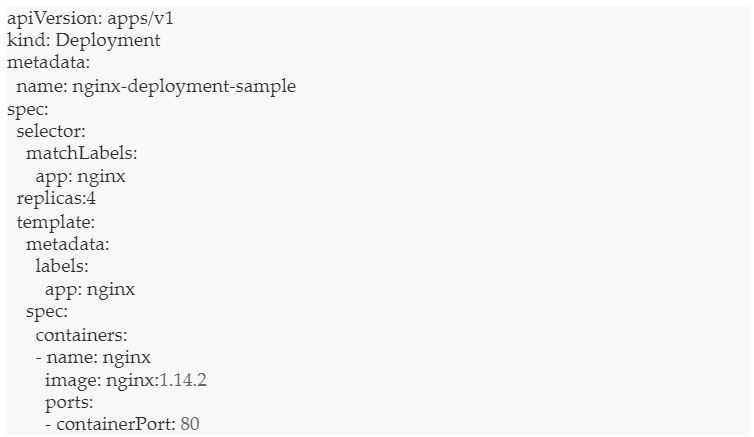
    We need to set the code replication to trigger the self-healing capability of Kubernetes. 

    Let’s see an example of the Nginx file:

    Nginx example

    In the above code, we see that the total number of pods across the cluster must be four.

    Next, let’s deploy the file.

    kubectl apply nginx-deployment-sample

    Let’s list the pods, using:

    kubectl get pods -1 app=nginx

    Here is the output:

    output_nginx-deployment-test

    As you see above, we have created four pods. 

    Now, let’s delete one of the pods.

    deleting a pod

    The pod is now deleted. We get the following output:

    pod deleted

    Let’s list the pods again.

    get pods

    We get the following output:

    Output: 4 pods

    We have four pods again, despite deleting one. Kubernetes has self-healed to create a new node and maintain the count to four.

    Conclusion

    Kubernetes can self-heal applications and containers, but what about healing itself when the nodes are down? For Kubernetes to continue self-healing, it needs a dedicated set of infrastructure, with access to self-healing nodes all the time. The infrastructure must be driven by automation and powered by predictive analytics to preempt and fix issues beforehand. The bottom line is that at any given point in time, the infrastructure nodes should maintain the required count for uninterrupted services.