Tag: KubeCon + CloudNativeCon EU 2022

  • Datadog Adds Support for OpenTelemetry Protocol

    Datadog Adds Support for OpenTelemetry Protocol

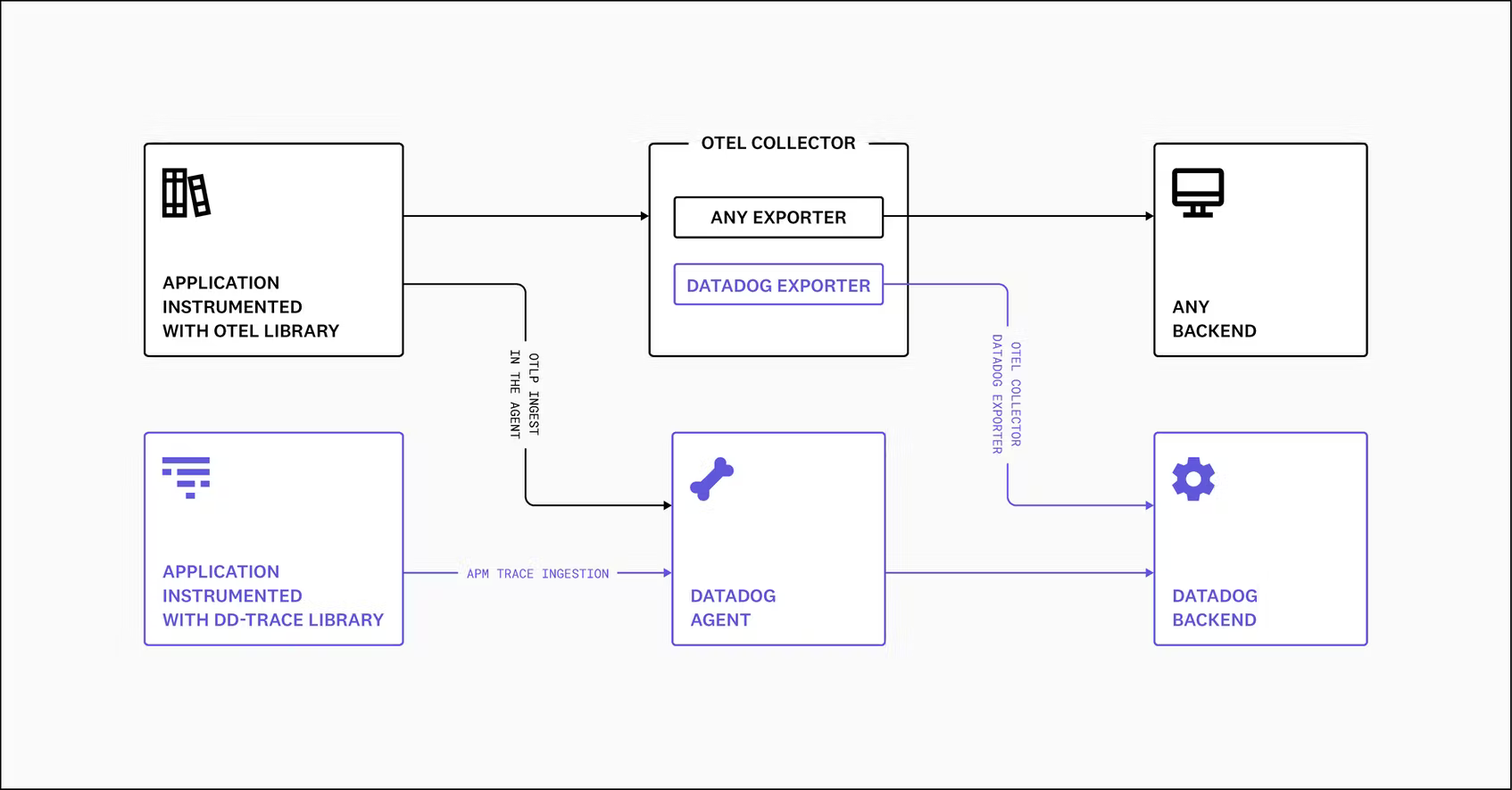
    At the KubeCon + CloudNativeCon Europe 2022 event, Datadog announced it made support for the OpenTelemetry Protocol (OTLP) generally available in the agent software it provides to instrument applications.

    Ilan Rabinovitch, senior vice president of product and community at Datadog, said that capability eliminates the need to install a separate OpenTelemetry collector to aggregate metrics, logs and traces from applications instrumented using the open source OpenTelemetry libraries being advanced under the auspices of the Cloud Native Computing Foundation (CNCF).

    The Datadog Agent can already collect application profiles, network data and infrastructure metrics via more than 500 integrations provided by Datadog. OpenTelemetry extends that capability with a set of application programming interfaces (APIs) and a wire protocol for instrumenting applications.

    Datadog is the latest in a series of providers of observability platforms that added support for the OpenTelemetry project that continues to gain momentum. The goal is to make it less costly to instrument applications using open source agent software that surfaces a consistent set of interfaces. Previously, each observability platform provider developed their own agent software that DevOps teams would need to install. Datadog is making a case for agent software that, in addition to collecting data from existing applications, is now compatible with the OLTP protocol created by contributors to the OpenTelemetry project.
    The issue that DevOps teams will need to come to terms with is that while OpenTelemetry agent software is free, many of them have already installed proprietary agent software to instrument applications. That agent software can often provide additional context that is not yet available in OpenTelemetry. History, however, shows that, in time, open source projects with larger numbers of contributors will outpace the ability of any single vendor to innovate.

    One way or another, DevOps teams will be instrumenting more applications as more microservices-based applications are deployed. The dependencies that exist between microservices make it too difficult to manage an application environment without additional instrumentation. The goal within many DevOps teams is to eventually replace the hodgepodge of monitoring tools that track a limited set of pre-defined metrics with an observability platform that not only aggregates metrics but enables DevOps teams to launch queries and surface IT issues before they become a major issue. In some instances, the rationalization of monitoring tools will help justify the acquisition of an observability platform.

    Observability, of course, is one of the core tenets of any set of DevOps best practices. Achieving it, however, has always been a challenge. Rabinovitch said an observability platform that regularly surfaces critical IT issues without requiring DevOps teams to launch queries to search for anomalies will eventually win the battle for observability supremacy.

    In the meantime, there is already no shortage of observability platforms. The challenge will be determining which one enables the highest level of instrumentation at the most reasonable cost.

  • Pull-Based Kubernetes Deployments Moving to GitLab Free Tier

    GitLab will include support for pull-based deployment in the platform’s Free tier in an upcoming release, which will provide users increased flexibility, security, scalability, and automation in cloud-native environments. With pull-based deployment, DevOps teams can use the GitLab agent for Kubernetes to automatically identify and enact application changes.

    “DevOps teams at all levels benefit from utilizing GitOps strategies such as pull-based deployment in their cloud-native environments. By offering this feature in GitLab’s Free tier, we can introduce more organizations to the power and utility of this secure and scalable functionality,” says Viktor Nagy, product manager of GitLab’s Configure Group.

    As an open-core company, GitLab is happy to contribute to the GitOps community and enable the adoption of best practices in the industry.

    What is pull-based deployment?

    Pull-based and push-based deployment are two main approaches to GitOps, an operational framework that takes DevOps best practices used for application development such as version control, collaboration, compliance, and CI/CD tooling, and applies them to infrastructure automation.

    GitOps enables operations teams to move as quickly as their application development counterparts by making use of automation and scalability, without sacrificing security.

    While push-based, or agentless, deployment relies on a CI/CD tool to push changes to the infrastructure environment, pull-based deployment uses an agent installed in a cluster to pull changes whenever there is a deviation from the desired configuration. In the pull-based approach, deployment targets are limited to Kubernetes and an agent must be installed in each Kubernetes cluster.

    “As long as the GitLab agent for Kubernetes on your infrastructure has the necessary access rights in your cluster, you can configure everything automatically, reducing the DevOps workload and the opportunity to introduce errors,” Nagy says.

    Pull-based deployment vs. push-based deployment

    Push-based deployment and pull-based deployment each have their pros and cons. Here is a list of the advantages and disadvantages of each GitOps practice:

    Push-based deployment pros:

    • Ease of use
    • Well-known as part of CI/CD
    • More flexible, as deployment targets can be on physical servers or virtual containers, not restricted to Kubernetes clusters

    Push-based deployment cons:

    • Requires organizations to open their firewall to a cluster and grant admin access to external CI/CD
    • Requires organizations to adjust their CI/CD pipelines when they introduce new environments

    Pull-based deployment pros:

    • Secure infrastructure – no need to open your firewall or grant admin access externally
    • Changes can be automatically detected and applied without human intervention easier scaling of identical clusters

    Pull-based deployment cons:

    • Agent needs to be installed in every cluster limited to Kubernetes only

    How pull-based deployment impacts the Free-tier experience

    Including support for pull-based deployments in GitLab’s Free tier provides a tremendous competitive advantage for smaller organizations, as they can now apply automation in a safe and scalable manner to their cloud-native infrastructure, including virtual containers and clusters. And, for organizations that are trying to get started quickly by minimizing the number of tools in their infrastructure ecosystem, this functionality is included in One DevOps Platform, not as a point solution.

    “DevOps teams don’t have to continuously write code for new infrastructure elements – they can write the code once, within a single DevOps platform, and have the agent automatically find it, pull it, and apply it, as well as configuration changes,” Nagy says.

    “Also, with the availability of pull-based deployment in this introductory tier, newcomers to GitLab will immediately be able to modernize application development and reduce the security risk associated with configuring such infrastructure.”

    This blog post contains information related to upcoming products, features, and functionality. It is important to note that the information presented is for informational purposes only. Please do not rely on this information for purchasing or planning purposes. As with all projects, the items mentioned in this blog post and linked pages are subject to change or delay. The development, release, and timing of any products, features, or functionality remain at the sole discretion of GitLab Inc.

  • Pure Storage Boosts Developer Productivity by Expanding the Portworx Portfolio and Making Kubernetes Adoption a Reality

    Portworx portfolio advancements provide more data services than ever before while giving DevOps teams greater control over their workstreams  

    Mountain View, CA, May 16, 2022 – Pure Storage® (NYSE: PSTG), the IT pioneer that delivers the world’s most advanced data storage technology and services, today announced a series of updates to its Portworx portfolio which include:

    • General availability of Portworx Data Services, the industry’s first Kubernetes Database-as-a-Service (DBaaS) Platform 
    • The next generation of the iconic Portworx Enterprise, the complete multi-cloud ready Kubernetes data management platform for running mission-critical applications in production. 

    General availability of Portworx Backup-as-a-Service on AWS, which also supports backup and restore of any Kubernetes services including Amazon EKS, Red Hat OpenShift, Google Kubernetes Engine, VMware Tanzu, and Microsoft Azure Kubernetes Service.

  • LitmusChaos Enhances Developer Experience for Cloud Native Reliability

    In cloud native computing, the applications are expected to be resilient, loosely coupled, scalable, manageable and observable. Because of containerization, there is a proliferation of microservices and they ship quickly. Microservices environments are more dynamic. In such an environment, making applications resilient means deploying the applications in a fault tolerant manner, but it also means building the application to sustain the faults happening on dependent (i.e., upstream/downstream) services and continuing to take appropriate action against the incidence of such a failure. Similarly, quality assurance teams should cover all the fault scenarios to be covered during the CI and CD process. Eventually, Ops teams must continue testing the service for resilience in production by practicing Chaos Engineering. Continuous verification can be and should be practiced at all stages of the product life cycle. 

    Chaos Engineering for Developers

    Cloud native developers follow Curly’s law while developing microservices. This enables modularization and faster shipping of applications, but also necessitates creating a set of well defined conditions in the code to handle various microservices faults, the API responses and the underlying platform such as Kubernetes. While Kubernetes plays a major role in enabling microservices architecture, it also brings certain assumptions that developers should be aware of. For example, the frequency with which pods are evicted or moved around nodes is several times greater then, say, VMs getting moved across in an ESX cluster. In a scaled environment, pod eviction can happen at any time (depending on the load conditions and other environmental factors), but the service should continue to work just fine. 

    A host of chaos tests can be performed during development to build resilience against Kubernetes faults and common cloud native infrastructure application faults. LitmusChaos, which is a cloud native application, provides all the capabilities to practice end-to-end Chaos Engineering. Its chaos experiments are declarative in nature and cloud native developers can add or execute chaos experiments in a cloud native way. The core of Litmus operates on the basis of Chaos CRDs, which makes the practice of chaos for cloud native developers very natural. 

    Chaos Engineering in CI

    Cloud native CI pipelines throw additional requirements for QA teams. They need to test the applications against various features of the cloud native platform functions such as Kubernetes. Kubernetes environments can present various faults such as pod, node and service level faults. In a chaos integrated CI pipeline, chaos experiments are designed to cover all fault scenarios of Kubernetes and other cloud native stack components, in addition to specific application faults

    Apart from being able to execute chaos experiments easily for various different scenarios, quality assurance teams can measure the performance of resilience metrics of the application from build to build. Litmus is such a tool, where resilience metrics are easily compared against the chaos runs against different versions of the system under test. 

    LitmusChaos workflows or scenarios

    Chaos experiments serve as the building units for Chaos Workflows, which string together multiple chaos experiments in any desired order and sequence to inject failure into more than one resource. This allows for the creation of complex, real-life failure scenarios involving several different aspects of the entire application as part of a single workflow, simply using the ChaosCenter web UI. Think of Chaos Experiments as Lego blocks encapsulating failure conditions for a specific target resource. These Lego blocks can be flexibly arranged in any desired order to shape the Chaos Workflow — a conglomeration of failure scenarios tailored to validate your specific SLO requirements. 

    Introducing chaos tests into developer CI pipelines

    LitmusChaos provides the ability to create workflows through chaos center and use them in different ways. For using the workflows in CI pipelines, the easiest way is to store the created chaos test in git. If you configure GitOps in Litmus, the workflows are automatically stored in Git and you can edit the test either directly on git or through the chaos center. Once the test (A YAML manifest) is in Git, you can invoke it in your CI pipeline by creating a kubernetes shell environment and executing

    “kubectl apply -f http://<github.com>/your-repo/your-file.yml” 

    The above commands does the magic of getting your chaos experiment, setting up the execution environment, executing the chaos test and uploading the results/metrics to chaos center.

    Basically, developers can construct their CI.yaml files by inserting “kubectl apply -f <chaostest.yaml> and observe the results in the chaos center. Chaos center provides analytics around historic workflow executions that help to know if the resilience of your application you are developing is increasing or intact assuming that you have provided good chaos coverage.

    Here is an example of how Litmus chaos tests are used on a CI platform, which in this case is Harness CI: https://dev.to/ksatchit/chaos-engineering-with-harness-cicd-pipelines-1dn0

    One can use the Litmus chaos tests in the same way on other CI platforms such as GitLab, CircleCI etc.

  • SlashData: Cloud Native Continues to Grow with More than 7 Million Developers Worldwide

    The global cloud native developer population has grown by 1 million in the last 12 months, according to the Q3 2021 State of Cloud Native Development Report developed for CNCF by SlashData. The company estimates that there are now 7.1 million cloud native developers worldwide. This represents an increase of 51% from our first report with SlashData in May 2020 when there were 4.7 million cloud native developers.

    The cloud native developer population includes 4.8 million developers using container orchestration tools and 4.2 million developers using serverless platforms. These are both up from 4.6 million and 4 million, respectively, since late last year.

    Kubernetes remains stable, but new trends emerge

    At the same time, the usage of Kubernetes has remained relatively stable, increasing by 2 percentage points over the last year. Some 61% of backend developers have used containers in the previous 12 months, with 30% using Kubernetes to orchestrate them. There are now an estimated 5.1 million Kubernetes users globally.

    As we saw in CNCF’s 2021 Cloud Native Survey, there are a few trends driving Kubernetes adoption. For one, larger organizations are more likely to be using Kubernetes. SlashData found that close to one in four developers working for very large enterprises (with more than 5,000 employees) use Kubernetes.

    Another trend from our Cloud Native Survey was the rise of managed services as Kubernetes goes “under the hood.” According to SlashData, the majority of container orchestration tools — including five of the top six most used — are managed Kubernetes solutions. Further, the proportion of developers choosing a single orchestration tool has decreased: 49% of developers who use orchestration tools used only one tool in Q1 2021. Six months later, this has decreased to 46%, with many reporting that they ​​use self-managed solutions in conjunction with vendor-managed services.

    Finally, Kubernetes developers are also more likely to be involved in emerging technologies like Blockchain, edge computing, and 5G.

    Is the consolidation of serverless coming?

    After seeing a slight decline in the last report, the use of serverless tools has increased by 5% from 4 to 4.2 million. However, the way developers engage with serverless products is changing, with developers using fewer serverless tools simultaneously. In Q1 2021, 23% of developers who used serverless used three or more tools. Six months later, this has decreased to 19%.

    Download the report to learn more about Kubernetes and cloud native trends!

    This is our fourth time working with SlashData to gain insights on cloud native development. 

    The report is based on the 21st edition of SlashData’s Developer Nation survey, which was fielded between June 2021 and August 2021 and reached more than 19,300+ developers globally. More than 3,900 survey participants answered questions relating to the development of backend services and the technologies they use.

  • Announcing the Refreshed Cloud Native Security Whitepaper

    The CNCF Security Technical Advisory Group (TAG) has just released a refreshed Cloud Native Security Whitepaper v2 to help educate the community about best practices for securing cloud native deployments. The whitepaper intends to provide organizations and their technical leadership with a clear understanding of cloud native security, its incorporation in lifecycle processes, and considerations for determining the applicability of standards such as NIST SSDF. The first version of the whitepaper was released on Nov 18, 2020. The paper has been translated into different languages and an audio release of version 1 can be found here.

    “In the past 18 months, the security industry and our group has evolved with attacks on supply chain and ransomware in the limelight. We received excellent feedback on improvements to the first version of the paper as part of a months-long retrospective process. Our group has also grown with multiple supplementary material like Secure Supply Chain Security Whitepaper, Cloud Native Security Map and Lexicon published since the first version of this paper. As a sign of the vibrant community, just like the first version, the people across the community brought their passion, skill sets and expertise to address end user feedback and growing pains in the Cloud Native Security space” said TAG Security Tech Lead Pushkar Joglekar. 

    While the large majority of the original paper, stands the test of time, this refreshed version demystifies security assurance and compliance by walking through specific use-cases of ransomware incident handling and how to secure financial institutions under EU regulations. Feedback from readers of the original paper is also addressed through inclusion of these new sections: 

    • Secure Defaults – Cloud Native 8: A high level guidance on implementing cloud native apps that are secure by default.
    • SSDF v1.1 mapping: Maps the NIST SSDF practices and tasks to Cloud Native Security Application Lifecycle
    • ATT&CK Threat matrix for Containers: Summary of how the threat matrix provides a structure towards applying guidance described in this paper
    • Guidance on how to share feedback: Instructions on how to share feedback on the paper is now part of the paper with a short summary on how feedback was collected and addressed after publication of the first version.  

    The CNCF Security TAG aims to facilitate a vendor neutral collaboration to discover and produce resources that enable secure access, policy control, and safety for operators, administrators, developers, and end-users across the cloud native ecosystem. If you are interested in participating in the Security TAG, check out the Charter for more information and please come say “Hi!” on #tag-security channel on CNCF Slack. 

    The whitepaper is available on GitHub.

  • Cloud Native Computing Foundation Welcomes Coinbase as Gold Member

    Innovator in the crypto economy affirms commitment to cloud native ecosystem

    Valencia, SPAIN, KubeCon + CloudNativeCon Europe – May 18, 2022 – The Cloud Native Computing Foundation® (CNCF®), which builds sustainable ecosystems for cloud native software, today announced that Coinbase has joined the foundation as a Gold member. 

    Coinbase provides a trusted and easy-to-use platform for accessing the broader crypto economy. 98 million+ verified users, 13,000 institutions, and 230,000 ecosystem partners in over 100 countries use Coinbase to easily and securely invest, spend, save, earn, and use crypto. The company’s mission is to increase economic freedom in the world through the crypto economy. To achieve this goal, it’s essential to develop common infrastructure that is transparent, safe, secure, and benefits all participants.

    “Coinbase’s infrastructure thrives on cloud native technology, and Kubernetes will continue to be of growing importance in our technology stack as the company evolves,” said Jordan Harband, Developer Relations Engineer at Coinbase. “We are investing heavily in cloud native technology to ensure the continued success and sustainability of cloud services for the developer ecosystem. We look forward to collaborating with CNCF to drive forward more initiatives, and to deliver and improve more tools for the community’s benefit.”

    Coinbase Cloud relies heavily on Kubernetes to provide a platform that enables the company to deploy and maintain blockchain infrastructure across multiple cloud providers. For this reason, Coinbase employs core contributors to Kubernetes, and Coinbase Cloud has made contributions to several CNCF projects including Kong, kOps, Kyverno, and Flux. 

    “Coinbase has been a trailblazer in the cryptocurrency economy,” said Priyanka Sharma, executive director of the Cloud Native Computing Foundation. “With their particular set of challenges in a nascent yet world-changing industry, we are very pleased that Coinbase has decided to join forces with the CNCF ecosystem and look forward to the unique insights they will bring.”

    Additional Resources

    About Cloud Native Computing Foundation

    Cloud native computing empowers organizations to build and run scalable applications with an open source software stack in public, private, and hybrid clouds. The Cloud Native Computing Foundation (CNCF) hosts critical components of the global technology infrastructure, including Kubernetes, Prometheus, and Envoy. CNCF brings together the industry’s top developers, end users, and vendors and runs the largest open source developer conferences in the world. Supported by more than 500 members, including the world’s largest cloud computing and software companies, as well as over 200 innovative startups, CNCF is part of the nonprofit Linux Foundation. For more information, please visit www.cncf.io.

    ###

    The Linux Foundation has registered trademarks and uses trademarks. For a list of trademarks of The Linux Foundation, please see our trademark usage page. Linux is a registered trademark of Linus Torvalds.

    Media Contact
    Jessie Adams-Shore
    The Linux Foundation
    PR@CNCF.io

  • Prometheus Associate Certification will Demonstrate Ability to Monitor Infrastructure

    New associate certification exam from CNCF and The Linux Foundation will test foundational knowledge and skills using Prometheus, the open source systems monitoring and alerting toolkit

    Valencia, SPAIN, KubeCon + CloudNativeCon Europe – May 18, 2022 – The Cloud Native Computing Foundation® (CNCF®), which builds sustainable ecosystems for cloud native software, and The Linux Foundation, the nonprofit organization enabling mass innovation through open source, today announced the new Prometheus Certified Associate (PCA) exam. The PCA is a pre-professional certification designed for engineers or application developers with special interests in observability and monitoring within the Prometheus ecosystem.

    The PCA is modeled after Kubernetes certifications such as KCNA, CKA, or CKAD and is intended for candidates who have passed these certifications or have completed Prometheus-specific training or Cloud Engineer bootcamps. The exam is now in Beta testing and will be generally available later in 2022. 

    According to CNCF’s 2021 Cloud Native Survey, the use of Prometheus in production has reached 65%, an increase of 43% year-over-year. Production users include organizations like Adidas, Slack, JPMorgan Chase, Verizon, and Uber. Prometheus was the second project to join CNCF in 2016 and the second project to graduate in 2018, following only Kubernetes. 

    “As cloud native stacks have grown and matured, observability has become crucial for visibility into application metrics, performance, alerting and insights,” said Chris Aniszczyk, CTO of CNCF. “Prometheus is a key element of this, enabling organizations to build a foundation of observability. The PCA exam will allow developers to demonstrate their proficiency in Prometheus ecosystem and cloud native observability concepts.”

    PCA will consist of a multiple-choice, online certification exam testing entry-level skills and knowledge around best practices for monitoring cloud native applications and infrastructure and the ability to improve application performance through observability data. Successful candidates will be able to recognize when something is wrong with an implementation, monitor and gain insight into performance, debug issues, and feed data into other systems, including QA, security, and automation. The existing “Monitoring Systems and Services with Prometheus” training course can be helpful for those new to Prometheus.

    “There is an ongoing talent shortage in the cloud space, and the only way to address it is to get more individuals trained and certified in these emerging technologies,” said Clyde Seepersad, SVP, and general manager of training & certification at The Linux Foundation. “We have seen tremendous interest in Prometheus training as adoption of this impactful technology has increased, which is a fantastic starting point. This new certification will allow individuals skilled in this technology to verify their abilities to employers, helping advance their careers while beginning to address this talent gap.”

    The exam is being developed in partnership with Certiverse. As demonstrated with The Linux Foundation Certified IT Associate (LFCA) and Kubernetes and Cloud Native Associate (KCNA) exams, the company’s online exam development platform brings high-quality certifications to market with the speed required to keep IT content current and relevant.

    More information about the exam and topics to be covered in it is available here. Those interested in enrolling in the Beta may do so for free here. Additional details on exam availability will be announced in the coming months. 

    About Cloud Native Computing Foundation

    Cloud native computing empowers organizations to build and run scalable applications with an open source software stack in public, private, and hybrid clouds. The Cloud Native Computing Foundation (CNCF) hosts critical components of the global technology infrastructure, including Kubernetes, Prometheus, and Envoy. CNCF brings together the industry’s top developers, end users, and vendors, and runs the largest open source developer conferences in the world. Supported by more than 500 members, including the world’s largest cloud computing and software companies, as well as over 200 innovative startups, CNCF is part of the nonprofit Linux Foundation. For more information, please visit www.cncf.io.

    About the Linux Foundation

    Founded in 2000, the Linux Foundation is supported by more than 1,000 members and is the world’s leading home for collaboration on open source software, open standards, open data, and open hardware. Linux Foundation’s projects are critical to the world’s infrastructure including Linux, Kubernetes, Node.js, and more. The Linux Foundation’s methodology focuses on leveraging best practices and addressing the needs of contributors, users and solution providers to create sustainable models for open collaboration. For more information, please visit us at linuxfoundation.org.

    The Linux Foundation has registered trademarks and uses trademarks. For a list of trademarks of The Linux Foundation, please see its trademark usage page: www.linuxfoundation.org/trademark-usage. Linux is a registered trademark of Linus Torvalds.

    # # #

    Media Contact:
    Katie Meinders
    The Linux Foundation
    PR@CNCF.io

  • CNCF Launches Cloud Native Network Function Certification Program

    New CNF Test Suite-based program will allow CSPs and telecom organizations to adopt Kubernetes and cloud native tools with confidence

    Valencia, SPAIN, KubeCon + CloudNativeCon Europe – May 18, 2022 – The Cloud Native Computing Foundation® (CNCF®), which builds sustainable ecosystems for cloud native software, today announced the Cloud Native Network Function (CNF) Certification Program. The CNF Certification Program will help Communication Service Providers (CSPs) and other telecommunications organizations identify which Network Equipment Providers (NEPs) follow cloud native best practices.

    CNFs are applications that implement or facilitate network functionality in a cloud native way. CSPs and other telecom organizations are migrating away from traditional Virtual Network Functions (VNFs) toward CNFs and Kubernetes-based infrastructures that provide service reliability while lowering capital and operating expenses and encouraging cross-cloud compatibility. The program will enable NEPs and CNF creators to demonstrate the adoption of cloud native best practices in their networking products. 

    “Moving to cloud native infrastructures has long been difficult for telecom providers who have transitioned to VNFs and found themselves with siloed resources and specialized solutions not built for the cloud,” said Priyanka Sharma, executive director of the Cloud Native Computing Foundation. “The CNF Certification program is designed to fill this gap by creating solutions optimized for cloud native environments. Some of the world’s largest telecom organizations, including Huawei, Nokia, T-Mobile, and Vodafone, already use Kubernetes and other cloud native technologies, and this program will make it easier for others to do the same.”   

    The CNF Certification Program runs on CNCF’s CNF Test Suite and supports any product that runs in a certified Kubernetes environment. The CNF Test Suite is an open source test suite for telcos to validate how well they are following cloud native principles and best practices, like immutable infrastructure and declarative APIs. It leverages 10 CNCF-hosted projects and several open source tools, including Fluentd, Helm, Jaeger, and Prometheus. Currently, the CNF Test Suite can run approximately 70 workload tests, which are segmented into seven different categories, including: 

    • Compatibility, Installability & Upgradability
    • Microservice
    • State
    • Reliability, Resilience & Availability
    • Observability & Diagnostics
    • Security
    • Configuration

    To get started, NEPs and CNF creators can self verify an application using the CNF Test Suite and submit results via pull request. Organizations that may not be ready to submit their results can still get started with the CNF Test Suite and use it to improve the “cloud-nativeness” in their products. CNFs that pass the CNF Certification will be considered ‘Certified,’ with more advanced levels to come as the program expands. 

    To learn more about the CNF Certification Program or get involved in CNCF’s Telco initiatives:

    • Read CNCF’s recent blog, ‘Testing cloud native best practices with the CNF Test Suite’ 
    • Join the conversation on Slack (#cnf-certification, #cnf-testsuite-dev)
    • Attend CNF Test Suite Contributor calls on Thursdays at 14:15 UTC
    • Join the CNF Working Group meetings on Mondays at 16:00 UTC 

    Supporting Quotes:

    “Building, deploying, and operating Telco workloads across distributed cloud environments is complex,” said Tom Kivlin, principal cloud architect at Vodafone. “It is important to adopt cloud native best practices as we evolve to achieve our goals for agility, automation, and optimization. The CNF Certification is a great tool with which we can measure and drive cloud native practices across our platforms and network functions. We look forward to working with our partners and the CNCF community to further develop and drive adoption of the CNF Certification Program.”

    “MATRIXX is excited to participate in the CNCF CNF Certification Program. We believe it will be instrumental in helping the telecom industry adopt cloud native technologies and best practices by harnessing the power of open source innovation and community collaboration,” said Marc Price, CTO, MATRIXX Software. “To realize the full potential of 5G, service providers are transitioning to CNFs, though telecom networking presents new and unique challenges that require a continued evolution in cloud native best practices. This program will help our advancements in cloud native solutions while ensuring customers can implement these tools with confidence.”

    “PANTHEON.tech is delighted to be part of CNCF’s initiative to show what cloud native computing should strive to be for telecom organizations,” said Miroslav Mikluš, CPO of PANTHEON.tech. “We’re excited to demonstrate our expertise in cloud native network functions by being one of the pioneering solutions to try the CNF Certification. Open source values and cloud native best practices are at the heart of what we do, and we are glad to be part of CNCF‘s effort to drive these forward.”

    Additional Resources

    About Cloud Native Computing Foundation

    Cloud native computing empowers organizations to build and run scalable applications with an open source software stack in public, private, and hybrid clouds. The Cloud Native Computing Foundation (CNCF) hosts critical components of the global technology infrastructure, including Kubernetes, Prometheus, and Envoy. CNCF brings together the industry’s top developers, end users, and vendors and runs the largest open source developer conferences in the world. Supported by more than 500 members, including the world’s largest cloud computing and software companies, as well as over 200 innovative startups, CNCF is part of the nonprofit Linux Foundation. For more information, please visit www.cncf.io.

    ###

    The Linux Foundation has registered trademarks and uses trademarks. For a list of trademarks of The Linux Foundation, please see our trademark usage page. Linux is a registered trademark of Linus Torvalds.

    Media Contact
    Katie Meinders
    The Linux Foundation
    PR@CNCF.io

  • Boeing Joins Cloud Native Computing Foundation as a Platinum Member

    Leading global aerospace company invests heavily in the cloud native ecosystem

    Valencia, SPAIN, KubeCon + CloudNativeCon Europe – May 18, 2022 – The Cloud Native Computing Foundation® (CNCF®), which builds sustainable ecosystems for cloud native software, today announced that The Boeing Company has joined the Foundation as a Platinum member. As part of its Platinum membership, the company will also have a representative on the CNCF Governing Board. 

    Boeing, one of the world’s largest global aerospace manufacturers, has over a century-long tradition of aerospace leadership and innovation. The company has built a huge software footprint and global community of thousands of software engineers who share a passion for computing, learning, and expanding technological boundaries. As Boeing invests in accelerating the digital revolution, it is looking for opportunities to foster and contribute as well as create new open source projects built on top of open source technologies.

    “At Boeing, we are working to leverage the flexibility and massive scalability of public cloud deployments to build extremely robust aerospace products and deliver software solutions with rapid iteration and innovation to our customers,” said Jinnah Hosein, Boeing’s Vice President of Software Engineering. “Boeing is pleased to join CNCF and be part of the ecosystem. I am looking forward to this partnership and together we’ll change the world with extremely robust software deployments.”

    Boeing is committed to increasing its involvement in open source projects, and recently started its first Open Source Program Office (OSPO). As a company that, from the sea floor to space, protects, connects, and explores our world, Boeing is dedicated to learning, knowledge sharing, and providing its global team members opportunities to grow and thrive. 

    “Boeing is an enduring global company that impacts the lives of people all over the world. The company has significant experience and resources that will hugely benefit the CNCF community,” said Priyanka Sharma, Executive Director of the Cloud Native Computing Foundation. “We look forward to collaborating with them and welcoming Ricardo Torres to the Governing Board.”

    Additional Resources

    About Cloud Native Computing Foundation

    Cloud native computing empowers organizations to build and run scalable applications with an open source software stack in public, private, and hybrid clouds. The Cloud Native Computing Foundation (CNCF) hosts critical components of the global technology infrastructure, including Kubernetes, Prometheus, and Envoy. CNCF brings together the industry’s top developers, end users, and vendors and runs the largest open source developer conferences in the world. Supported by more than 500 members, including the world’s largest cloud computing and software companies, as well as over 200 innovative startups, CNCF is part of the nonprofit Linux Foundation. For more information, please visit www.cncf.io.

    ###

    The Linux Foundation has registered trademarks and uses trademarks. For a list of trademarks of The Linux Foundation, please see our trademark usage page. Linux is a registered trademark of Linus Torvalds.

    Media Contact
    Jessie Adams-Shore
    The Linux Foundation
    PR@CNCF.io