Tag: John Willis

  • Techstrong Adds Two Industry Luminaries

    DevOps pioneer and author John Willis and cybersecurity leader Shira Rubinoff join the team at Techstrong Group

    Boca Raton, FL, June 21, 2023 — Techstrong, the power source for people and technology, that empowers people and technology, today announced the addition of two industry luminaries to its team.  Shira Rubinoff, a well known leader in the cybersecurity space, and a finalist for this year’s Cybersecurity Women of the Year award, joins Techstrong as chief cybersecurity officer. John Willis, renowned cloud and DevOps pioneer, multiple book author and speaker joins the team as distinguished analyst with a focus on DevOps, DevSecOps, governance engineering and AI.

    Willis and Rubinoff join existing Techstrong industry leaders such as Mike Rothman, Mike Vizard, Mitch Ashley and Alan Shimel, in Techstrong’s mission of not only reporting on the leading stories in technology, but also lending their considerable experience, expertise and analytical skills to keeping the Techstrong community empowered with what they need to stay in the know in today’s fast-changing technology landscape.

    “You can never have enough smart people. John and Shira are two of the smartest people I know. We are very fortunate to have them join the team here at Techstrong,” said Techstrong Group CEO and Founder Alan Shimel. “Especially in uncertain times such as the present, you want a wide variety of talent on the team. Given the chance we could not pass up adding their talents to our team to enhance our offerings not only to our audience, but to benefit our sponsor/customers as well. We are very excited by the possibilities they bring.”

    Rubinoff and Willis will be contributing to Techstrong TV, leading sites such as devopsy.kinsta.cloud, Security Boulevard, Cloud Native Now, DigitalCXO and Techstrong.ai, as well as advising end user organizations and technology vendors on go to market and technology adoption strategies.

    “I have been working with Alan and the Techstrong team informally for a number of years and am very comfortable expanding my presence here. I think the rise of generative AI, LLM and other new technologies is once again a watershed moment in the technology industry,” said John Willis. “That along with governance engineering are two areas where I am keen on adding my voice and views to discussion.”

    “I have built a very successful brand by delivering value to my sponsors and my audience in the cyber world. I am excited by the possibility of expanding that via the Techstrong Network, as well as exploring new technology developments,” said Shira Rubinoff. “Working as part of the Techstrong team with a group of peers is also something I am very much looking forward to.”

    In addition to the Techstrong team members mentioned above, other Techstrong contributors such as Bonnie Schneider, Jennifer Minella, Tracy Ragan, George Hulme, Mark Rasch and others will continue to produce compelling editorial content and provide valuable insights to educate, inform and inspire the Techstrong Group community.

    Both Rubinoff and Willis have already joined Techstrong Group, and their contributions can be found across various Techstrong Group channels, including articles, videos and podcasts.

    About Techstrong Group

    Techstrong Group is the power source for people and technology. Techstrong Group accelerates understanding of technologies that drive business. With a broad set of IT-related communities and offerings, Techstrong Group is the only media company serving the needs of IT leaders and practitioners with news, research, analysis, events, education, certifications and professional development. Our focus is digital transformation, DevOps, cybersecurity, cloud and cloud-native. Techstrong Group business units include: Techstrong Media, Techstrong Associations, Techstrong Research, Techstrong Learning and Techstrong Live!. For technology providers, Techstrong business units offer many ways to reach IT professionals and tell their stories.

    Techstrong Group is based in Boca Raton, Florida. For more information, visit us on the web and follow us on Twitter, LinkedIn, Facebook, Instagram.

    ###

    Techstrong Group
    Veronica Haggar
    veronica@techstronggroup.com


  • Free DevOps Training at DOI’s Global SKILup Day

    Free DevOps Training at DOI’s Global SKILup Day

    The DevOps Institute (DOI) is hosting a global training day called Global SKILup Day on Dec. 10, 2019. It’s a free virtual event and they have arranged for some of the brightest minds in the DevOps space to speak/train during the course of the day.

    Why global? They truly are planning on a follow-the-sun approach to training, with courses going on in each of the different regions throughout the day. In total, the event will run for 18 hours and span the globe–meaning where ever you are, free training is available to you.

    The SKIL (Skills, Knowledge, Ideas and Learning) part of this free training day is DOI’s training methodology for the next phase of DevOps. They have been conducting SKILup Days around the globe for a while now, and this appears to be a virtualized extension of that effort.

    “What type of training,” you ask? Well, here’s a list of topics broken down by DOI.

    No matter what your interest and/or needs are, there will be something that you can pick up at this training.

    As of this writing, there are 15 speakers to cover 18 hours in three regions, so while I am not party to their internal planning, this author would guess they are still filling out the engagements. Considering we’re nearly two months away, that’s not terribly surprising. What is surprising is the list of speakers contain a high percentage of recognized experts. That’s good for the training, because superstars who can’t present generally don’t have the name recognition these presenters do. And a huge chunk of effective of training is presentation.

    So go sign up! Grab a spot, set the systems to do long builds and learn something new. I like to go to these type of events simply because our little lab is set in its ways, and getting exposed to new methods/ideas keeps things from getting to stale. I won’t be taking up space at DOI though, as I’d rather leave it for all of you when space is limited.

    Since my current responsibility is for a testing lab, this is more important for those of you who are running public facing systems that represent your organization. If I were, the big one for me would be AIOps, because it kind of snuck up on me while working on continuous test and integrating new tools into the DevOps toolchain. In fact, my recent piqued interest in the topic came from looking at an integration and the tool was big on AIOps–though CI/CD Reference Architecture would be cool too. Attempts to standardize are interesting, because even though some parts have stabilized, we still very much live in the land of flux.

    Pick something you don’t think you care too much about along with things you do. You just might find a good reason to care, and it will help you continue to rock it.

    Disclaimer: I have contracted for DevOps Institute in the past (through Ingrained Technology), but I am not currently engaged by them. I shared this because it is free training, and who doesn’t want to know about that?

    — Don Macvittie

  • DevSecOps @RSAC, My 2 Favorite Presentations

    DevSecOps @RSAC, My 2 Favorite Presentations

    For the third year, devopsy.kinsta.cloud hosted a DevSecOps/Rugged DevOps event at RSA Conference. As with years before,  we smashed attendance records. We had just shy of 900 people stop in on Monday of RSA Week to hear from the 11 presentations we hosted. Taken in total, the presentations presented a wide range of DevSecOps issues. I wanted to draw your attention, though, to two of the presentations that I really enjoyed.

    First of my favorite presentations

    The first was from someone I had not met before who came to our attention via our call for speakers. Duane Schleen presented, “Implementing DevOps in a Regulated Environment: The Aetna Experience.” His presentation is below:

    Why did I love this presentation? Good question. First of all it is rare that we get such an open peak behind the kimono at the actual inner workings of an enterprise, especially in such a regulated industry as insurance.

    More than that though I am telling you that Duane Schleen or DJ as he is called is going to be a DevSecOps rock star. Can’t wait for him to write a few articles for us here at devopsy.kinsta.cloud. If you get a chance to see him speak at a conference near you, jump at it. Can you tell I am a fan?

    On top of this the look Schleen gives us into DevSecOps at Aetna shows that despite the naysayers, you can go faster, with higher quality and be more secure!

    The Second Presentation I loved

    The second presentation I wanted to bring to your attention was the opening keynote by John Willis. Most of you have probably seen John present before either live (if you are lucky) or on line. John is of course a co-author of the DevOps Handbook as well.

    John’s presentation is entitled, “Breaking Bad Equilibrium”.  It is about cooperation in DevOps, technical debt and uses some game theory to explain some of the John’s thoughts.

    My favorite part is when John uses some clips from the UK game show “Golden Ball” to discuss Nash Equilibrium (or prisoners dilemma )  and game theory. Both clips really grab you and make you think (as many of John’s presentations do). I will let his presentation speak for itself though.

    Beyond, these two excellent presentations, you can see the rest of the presentations from our DevSecOps event at RSA Conference this year on our DevOpsTV channel on YouTube. The link takes you to the playlist with all 11 presentations.

    This years DevSecOps event at RSAC was a smashing success with almost 900 people stoping in to hear some of the excellent presentations. It did this authors heart good to see this great mixing of the DevOps and security tribes coming together.

    — Alan Shimel

  • DevOps Chat: Gene Kim on The DevOps Handbook and DevOps Enterprise Summit

    DevOps Chat: Gene Kim on The DevOps Handbook and DevOps Enterprise Summit

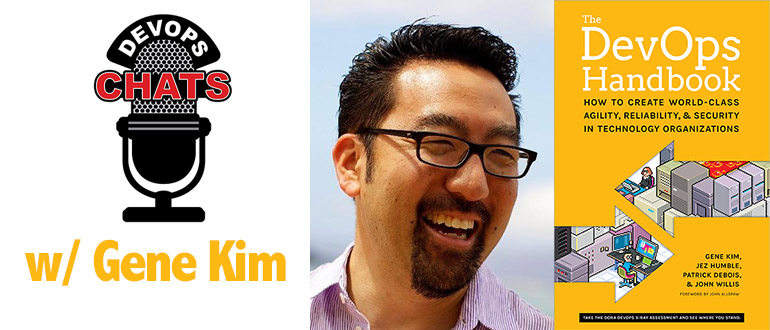
    Today was a red letter day in the DevOps world. Besides DevOps Connect: CD Summit’s being held in Atlanta and Berlin today. It was also the day of the highly anticipated release of the DevOps Handbook. The book was over five years in the making. It contains over forty case studies of real organizations and their DevOps journeys. I had a chance to chat with Gene Kim about the DevOps Handbook today. The audio of which is below.

    The authors of the book are some of the leading lights in the DevOps world: Gene Kim, acclaimed author of the Phoenix Project, Jez Humble, author of Continuous Delivery and Lean Enterprise, Patrick Debois, who coined the term DevOps and the one and only John Willis, @batchagalupe. All four put a lot of time in reviewing each case study and picking from the many different examples the best ones for the book.

    The case studies are organized into examples of each of the three ways that were espoused in the Phoenix Project. So while the DevOps Handbook is a very different style book than the Phoenix Project, which was a novel, it continues common themes. According to Gene, the DevOps Handbook is a prescriptive guide showing patterns that repeat themselves across multiple examples.

    The book itself is available on Amazon (link above), as well as other book sellers and from the IT Revolution site itself.

    Gene also talks a bit about the upcoming DevOps Enterprise Summit in San Fransisco this November. He gives us his top three reasons why he is really excited about this years event.

    Below is the streaming audio of our conversation. We wanted to publish this ASAP, so are putting it up before the written transcript of our conversation is complete. We will append it to this article when it is complete. In the meantime enjoy the conversation and let us know what you think of the book!

    If you read up to here, you deserve a special bonus. Here is a link for a download of 100+ pages from the DevOps Handbook to get you started. Enjoy!

    Alan Shimel:                Hi, everyone. Alan Shimel – devopsy.kinsta.cloud here for another DevOps Chat. This is a special edition DevOps Chat with none other than Gene Kim. Gene, welcome.

    Gene Kim:                   Hey, Alan. Always great to hang out with you. Thanks so much for having me on.

    Alan Shimel:                Thank you. Gene, you know a big day for Gene Kim, IT Revolution – John Willis, Jez Humble, Patrick Debois. The official release of the long and anticipated [laughter] or much anticipated book – The DevOps Handbook.

    Gene Kim:                   Yeah. Five and a half years in the making and hopefully people will stop making George R. R. Martin jokes to me. [Laughs]

    Alan Shimel:                Gotcha. Well, you know it’s funny. I’m here in Atlanta recording this at an event we were putting on and John Willis was the keynote and he said the same thing. He said, “Please, if you’re doing DevOps it shouldn’t take you five years to do the book, but it took us – but you’ll do your DevOps faster.” But you know what? Anything worthwhile is worth waiting for, Gene and certainly high, high expectations with this book 

    Gene Kim:                   You know, John and I have talked a lot in the last couple of weeks and one of the things we keep talking about is just how much we learned in the writing process. I mean it’s just a – even looking back I guess when I first met John six years ago and how much – we’re definitely kindred spirits and I’m also including Patrick Debois and Jez in this as well, but this conversation that John and I were having was as much as we thought we knew six years ago just even looking at how much we learned last three years is just amazing and I think we’re both kind of shaking our head at how much – almost the assumptions we had in our head to think that we could have been done by 2013, so I’m just so thrilled that so much that I’m learning made it into the book and I’m just so thrilled with the way the book turned out and I especially love the fact that it has 48 case studies and a lot of it came out of the DevOps Enterprise Summit in terms of how people are putting these principles and practices to work in large, complex organizations like Target, Nordstrom, Raytheon, Nationwide Insurance, Capital One and so forth, so I’m just thrilled to death.

    Alan Shimel:                Absolutely. And Gene, I don’t want to minimize 48 case studies and all that we’ve heard. It’s a tremendous body of work here, right? But what –

    Gene Kim:                   Yeah, yeah. Sorry.

    Alan Shimel:                No, no. I was going to say. It’s a tremendous body of work.

    Gene Kim:                   Yeah. So, [laughs] one of the things that we made as a bonus for people who pre-ordered the book was actually a lot of the dropped case studies – so in order to keep the book below 450 pages, we had to take out 20,000 words.

    Alan Shimel:                Uh-huh.

    Gene Kim:                   And so there was a lot of stuff that I actually was fighting tooth and nail to try to keep in the book, but eventually senior has prevailed and you know I definitely saw that you have to actually be able to carry the book

    [Laughter 

    Alan Shimel:                We might –


    [Crosstalk]


                                        We might see on late night TV sometime outtakes, bloopers and outtakes of The DevOps Handbook.

    Gene Kim:                   Yeah. Exactly. So we’ve actually made that available to some folks and – but then I think it really does represent what we thought were the most important parts and there’s a lot of stuff that we had to cut that I thought was also very useful and valuable. So it’s been an incredible journey putting this book together with my fellow colleagues.

    Alan Shimel:                Absolutely. So Gene, we may have some listeners out here who (a) haven’t read the book obviously. It’s just coming out today. But (b) maybe you’re not familiar in how this book really is a very different book than The Phoenix Project, right? I mean they’re totally different genres, right?

    Gene Kim:                   Yeah, yeah, yeah. That’s a good point. So, The Phoenix Project is of course a novel that was I think really intended win the hearts and minds of the technology community at large and really describe in vivid detail what does the DevOps problem look like? Which DevOps is really the solution for and one of the biggest comments that we got was, “Wow. I see this problem that I didn’t even know I had whether I’m dev, test, or operations or information security, but – and I totally want to replicate the outcomes that that amazing unicorn team did at the end of the book. How did they do that?

    And that’s what really The DevOps Handbook is designed to do is to be that non-fiction prescriptive guide to really inform those people going on the journey with hopefully – with what they need to know – certainly everything that we’ve learned in terms of what are the principles behind DevOps that allow organizations to have this fast flow of work from dev through tests through ops and the infosec, so we’re creating value to the customer while providing world class reliability security and stability whether we’re – regardless of where the value stream we’re in and so the book certainly expands upon the three ways that was first introduced in The Phoenix Project.

    The three ways being the principles of flow, feedback and continuous experimentation of learning, but we also talk more in the beginning about the principles from which you can derive all these patterns from and we have a big section around how to get started, how to organize those teams, what are the various adoption patterns whether – when dev is driven by ops, by chief architects or by developers. 

    Alan Shimel:                Uh-huh. It’s very interesting. I actually just had this conversation yesterday with a bunch of folks who are kind of – you know, there’s always doubters, Gene, right? So I had one guy telling me that DevOps will not truly succeed because it cannot succeed if led by developers. And I said, “Well, who said DevOps can’t be led by ops?” Right? Or –

    [Laughter]

                                        I mean we’re –

    Gene Kim:                   Exactly right. And those were the questions that we set out to answer by doing the DevOps Enterprise Summit, right? Is to really through experience reports really capture what those journeys look like – who it was led by, where they fit in the org charts.

    Alan Shimel:                Yep 

    Gene Kim:                   What the outcomes were and in some of the book we talk about the – where that source of energy can come from, what the outcomes and the transitions look like from those perspectives and what the implications are to how we design our organizations and I just love the fact that we’ve been actually now to document that in writing as opposed to buried in 50 videos.

    Alan Shimel:                Yes. Well, we – I don’t knock the videos. I do a lot of them. [Laughs]

    Gene Kim:                   No, I love the videos.

    Alan Shimel:                [Laughs] I’m only kidding. But Gene –

    Gene Kim:                   No, really. I love this book from The Danish Project. It actually came from Paul Muller, VP at HP.

    Alan Shimel:                Uh-huh.

    Gene Kim:                   And he said, “Messiah’s are great, but scripture is better.”

    Alan Shimel:                Uh-huh.

    Gene Kim:                   There’s still no better, more viral mechanism to spread knowledge than written word, so I love videos as much as you. And I depend upon them a lot in my own work, but in terms of the way that – ideas for the fastest – still through books.

    Alan Shimel:                Agreed. But you know what, Gene? An interesting – and I want to talk about the book, but just a quick aside – when we talk about the body of knowledge when we talk about the lessons that you’ve been able to glean from research, we would be bereft if we didn’t talk about the Puppet – the state of DevOps survey that you’ve done with Puppet Lab or Puppets – no longer Puppet Lab – with Puppet all these years.

    Gene Kim:                   Sure.

    Alan Shimel:                All of the DevOps Enterprise Summit transformation stories now going on into what? Our third year of that, right? The 48 case studies here in the book and frankly – I mean I know you. You’re out talking to people all year around, listening and anytime – your ears perk up when you hear someone talk about their story, so though these are 48 that make it and as you said some wound up on the cutting room floor, the body of knowledge of research that’s gone into where we are today is phenomenal. I mean it’s really some piece of work when you look back at it, no?    

    Gene Kim:                   Oh, yeah. Absolutely, man. I loved the way you framed it. I mean I think kind of the book that we wanted to write was one, we wanted to make sure it was grounded in sound principles, right? And so there we looked to – did the body of knowledge around lean and theory of constraints and plan operations and that goes back 50 years of knowledge – you know, go back 100 years and so that’s I would say the principles and then the primary research around the state of DevOps report. This is the work that I’ve done with Jez Humble, Dr. Nicole Forsgren and Puppet that spans 26,000 respondents over 4 years, so this I think helps us establish validity or confirm validity of these practices

    And then the third part is the experiential part of observation, right? The experience reports often told at conferences, including the DevOps Enterprise new Summit and I think maybe just to show a little bit of the method behind the madness. I mean so many of the talks at DevOps Enterprise are specifically – they were invited just because they were those experienced reports that we were looking for to help fill out The DevOps Handbook and that also attracted other likeminded thinkers, which has just been so great.

    Alan Shimel:                Yeah 

    Gene Kim:                   So, I think it really take all those approaches really to I think kind of the best – especially business books out there are those that kind of have that kind of quality to them.

    Alan Shimel:                Yeah. Gene, one other thing just on the book and then I want to turn over to devs for a moment and that is a lot of people thought we were going – it would be the DevOps Cookbook if you will where there would be a recipe of step-by-step, but that’s not really what the handbook is about, is it 

    Gene Kim:                   Yeah. In fact it will be – yeah. In The Phoenix Project there’s still – in the editions that are out there right now, they still have DevOps Cookbook in them and we renamed it to DevOps Handbook and I think the – I would say this book is definitely a prescriptive guide, but not necessarily saying that you have to do these things in sequential order, but it is still prescriptive in the fact that you have patterns, right? That we have each one of the three ways.

    There’s at least 100 plus pages on each principle on patterns that help fulfill flow, feedback and continuous experimentation learning, so by no means do you have to do them in order. You don’t have to do all of them, but I think what’s so great about patterns, it really does – anyone who has seen the transmission stories, whether they’re told that velocity, whether it’s Google, Amazon, Twitter or Facebook or at DevOps Enterprises, Target, Nordstrom, Nationwide Insurance, Capital One and Disney, right? You can’t help but observe the patterns, right? There is an emergent set of paths that these organizations take and so the goal is really to help to write a prescriptive path so that other organizations can achieve those same outcomes with hopefully less trial and error.

    Alan Shimel:                Sure. Sure. Gene, before we turn to devs, the book is generally available today. People can order it on Amazon. Can they order it directly from IT Revolution?

    Gene Kim:                   They can. In fact there’s a whole great – a bunch of great retailers that you can order the book from including Barnes and Noble, 800-CEO-Read, and you can buy it directly through IT Revolution and I think the reason why people would do that is right now it’s probably the cheapest way they can get the book internationally, but also there’s great retailers like Amazon UK, Book Seller. There’s a fabulous shop in the UK that actually sends books for free internationally and so that’s also a wonderful service 

    Alan Shimel:                Very cool. Very cool. All right Gene. We’re probably going to go over time. I’m sorry. I apologize, but let’s quickly talk – turn over and talk about the upcoming DevOps Enterprise Summit in San Francisco. It’s the third San Francisco summit – fourth DevOps Enterprise Summit if we count London, right? I’m excited. Of course I’ll be there. We’re going to do videos again and looking forward to hearing some perhaps new transformation stories and hearing – catch up some of the people we’ve heard from before, but give our audience a little – what are you looking forward to? What’s getting you jazzed about this event?

    Gene Kim:                   Oh, yeah. Yeah. I mean having coming off two years of DevOps Enterprise in the U.S. and we just did London a couple of months ago with DevOps Enterprise in London. I can still say this is going to be the best DevOps Enterprise yet. What excites me? I love all the conferences, [laughs] but I’m super excited for this one. Let me give you my top three

    One is we get to see a bunch of speakers that we’ve come to know and love and they’re coming back again and telling about their third year and so one of the neatest things that I just feel so honored and privileged is that we can chronicle the journey at Target, Nationwide Insurance, Capital One, Raytheon and their – CSG – all these organizations – we get to hear kind of – they’re going to summarize – here’s what your one and your two were like, which we’ve heard from before and then here’s the challenges that remain. Here’s changes and their responsibilities and here’s what they’re doing about it. And I just love that because yeah, I think most conferences you – I remember going to many conferences and you see the same person and sometimes they’re even giving the same talk and you’re like, “Why am I seeing the same person?” But in this case, right? It’s almost like a documentary, right? 

    Alan Shimel:                Yeah.

    Gene Kim:                   Where you got to see – follow them on their journey. So I think that’s pretty unusual in conferences and I hope everyone appreciates that as much as I do and I’m hoping that people will look forward to that. The second thing I’m really excited about is that we have more companies telling their journey that are – of which are very different than we’ve heard from before. Three come to mind for me. One is the adoption of DevOps inside of the Forge.mil program, so this is supporting the DoD across all of the armed services. And this involves classified systems.

    Alan Shimel:                Right.

    Gene Kim:                   And since this is a really neat story of like – a heroic story of how they were able to get DevOps outcome even though they never actually got to see the classified production systems.

    Alan Shimel:                [Laughs] It seems –

    Gene Kim:                   Astonishing 

    Alan Shimel:                Yeah. It’s kind of working in the dark.          

    Gene Kim:                   Yeah. I know. And still it doesn’t matter how much harder it is when you’re in the dark

    Alan Shimel:                Yep 

    Gene Kim:                   The other one is we have Susanna Brown and Benjamin Chan from American Airlines, so we’ve never had anyone from the aviation industry before, so this is – their area of responsibility include most of the non-ecommerce properties of flight operations, flight safety. All that stuff. I love that stuff. And we have the CTO from Hyatt speaking and so we’ve never had someone from the hospitality industry present before and so those are both keynote talks.

    Alan Shimel:                Fantastic.

    Gene Kim:                   I think that’s – yeah. The third think I’m looking forward to is we actually have two luminaries that I think almost anyone in the DevOps community holds in incredibly high esteem. One is John Allspaw from the famous Allspaw/Hammond presentation in 2009. He’s CTO at Etsy and John Willis, DevOps Handbook co-author. He’s going to be interviewing him about his journey now as a CTO of a publically traded company and one of the talks I’m also looking forward to is from Mark Imbriaco, so he is famous because he was the head of operations at 37 Signals 

    Alan Shimel:                Right.

    Gene Kim:                   So EMG’s Basecamp or Campfire, right? That’s him. Heroku, DigitalOcean, LivingSocial. Oh, he was the head of ops at GitHub for many years.

    Alan Shimel:                Yeah.

    Gene Kim:                   So in my mind these are some of the most storied, famous properties in our –

    Alan Shimel:                Well, no. He’s a great – he’s left a trail of success wherever he’s went with that stuff. It’s pretty interesting. One of the things you – you mentioned American Airlines – we had Dan Glass talk at our regular DevOps at RSA last year actually and they are – they’re doing the whole DevSecOps thing and I’m looking forward to that AA one. That ought to be good and AA I mean American Airlines. Yeah.

    Gene Kim:                   Absolutely.

    [Crosstalk]

    Alan Shimel:                Yeah. Good stuff there. And Gene, just – I think early bird pricing may have just ended maybe today or tomorrow. I don’t remember. I get your emails all the time on it, but people can still sign up, right?


    Gene Kim:                   Yes. Registration is still open and anyone who is interested in hearing about how large compass organizations are transforming and the amazing, heroic journey that they’re on. We would love to see you there.


    Alan Shimel:                Fantastic. And dates, Gene? Just maybe in case someone is wondering.


    Gene Kim:                   Yep. November 7th to 9th at the Union Square Hilton in San Francisco.


    Alan Shimel:                Absolutely. I will be there, so I encourage our listeners if possible to come by.


    Gene Kim:                   And get in line to be interviewed by the famous Alan Shimel, right?


    Alan Shimel:                Exactly. [Laughs] I will be doing video interviews there. So Gene, what are you doing with your free time?


    Gene Kim:                   [Laughs] Well, boy. You know, right now my planning horizon is about 15 minutes ahead of me. Everything – right now I’m spending a lot of time around the DevOps Enterprise Summit just getting ready. We have – I’m working with all the speakers in terms of making sure that those talks are as successful as they can be for both the prior community objectives as well as the attendees and we’re doing something new, which is – I think as adult learners we tend to learn less from theory and we learn more from experimental learning and that’s why we do – we share experience reports, but we’re actually – for that reason we’re kind of – we’re having facilitated discussion sessions.


    We’re calling them DevOps workshops around the top problem areas that have identified by the community, so that’s organizational design needing change, information security and compliance, minimal competency – essential competencies for our leadership and so those are small group sessions. Each one of them will have an assigned facilitator to really help maximize the learning within that group, so I’m super excited about that.


    So yeah, I guess the long and short, I’m working on helping make sure that DevOps Handbook, the people that are looking for it, that they know about it and that DevOps Enterprise is going to be successful and even more successful than prior years.


    Alan Shimel:                Fantastic. Well, Gene Kim. We’re way over time. I apologize, but it’s always a pleasure just catching up and just listening to everything you work on energizes me, so continued success with all of this, looking forward to the book. I think we’ll probably be doing something on devopsy.kinsta.cloud with maybe a free chapter or something you know, that –


    Gene Kim:                   Oh, yeah. Oh, I want to say – you’re right. Thank you so much. Yeah. So, we will make available the first 140 pages of The DevOps Handbook. So if that’s of interest, we’ll have instructions on how to get it, so if you are so –


    [Crosstalk]


    Alan Shimel:                I’m putting it together. Yep. I’ll try to include it in with this article and audio file for people who want it. I have the background already, Gene. I’ve been working with your team and we’re on it. I’ll do my best.   


    Gene Kim:                   Yeah. Great. So that is almost a third of the book if you take out the index and the footnotes and the endnotes, so if you think you’re interested, I think the best way to find out for sure is actually to download the excerpt and see it for yourself and hopefully it will be of value to you.    


    Alan Shimel:                Okay. Gene Kim, principle author of The DevOps Handbook.         


    Gene Kim:                   No, no. Just one of the co-authors.


    Alan Shimel:                Just one of many? Okay. One of the co-authors of – we might as well mention them all – Gene Kim, Jez Humble, Patrick Debois and the one and only John Willis. So great job, Gene. I’m looking forward to the DevOps Enterprise Summit in November in San Francisco and to everything else, I want to thank you for – well, number one for getting me into DevOps as you know, but number two, just for all the work you do and the research and the leg work and running around and cheerleading and you know what? You’re a good man, Gene Kim.


    [Laughter]


    Gene Kim:                   And Alan, it’s always so fun to be on the spinner with you as well.


    Alan Shimel:                All right, then. I will be in touch. Congratulations again on the book.


    Gene Kim:                   Thank you so much and see you in a couple of weeks in San Francisco.


    Alan Shimel:                Absolutely. Gene Kim, author of DevOps – one of the authors of DevOps Handbook, The Phoenix Project, the man behind DevOps Enterprise Summit. Thanks for being our guest today on DevOps Chat. This is Alan Shimel for devopsy.kinsta.cloud.

    — Alan Shimel

  • CD Summit/Jenkins Days with John Willis, KK & Mustafa Kapadia

    CD Summit/Jenkins Days with John Willis, KK & Mustafa Kapadia

    JohnWillis1Our fall lineup of DevOps Connect: CD Summit/Jenkins Days are coming on fast. We kick off this fall’s schedule of seven events in Atlanta on Oct. 4 and 6. The speakers and subjects are up on the site, but I wanted to highlight the three keynote speakers: Our three headliners for Atlanta are Mustafa Kapadia of IBM, Kohsuke Kawaguchi (KK), the founder of Jenkins and CTO of CloudBees and, finally, the one and only John Willis (@botchagalupe). Each one of these speakers would be a great listen by themselves, but getting all three in one morning should be great!

    But wait, there’s more. In addition to Mustafa, KK and John, we have a full day of kohsuke-kawaguchiDevOps learning in store. The afternoon features three separate tracks with four or five sessions per track. On track is solely on Jenkins, one is DevOps in general and one is on automation and interoperability. Some of the other speakers include Ben Bomhoff from Security First Insurance and Daryl Bower from Accenture. Check out the website to get more information.

    Mustafa KapadiaAll of the above speakers are on the second day of the event, Oct. 6. The first day, Oct. 5, features several great workshops on Jenkins, Blue Mix and a DevOps Foundation workshop by the DevOps Institute.

    You can check out the full line up of speakers, schedules and topics at the DevOps Connect website. The cost without workshops for the day conference is just $99 and includes lunch, refreshments and access. If you would like to attend the first day of workshops as well it is just another $99. If you are in the Atlanta area, this is a great day of DevOps!

    If you are not in Atlanta, be sure to check out http://www.devopsconnect.com for the full schedule for the fall. Other cities we are visiting include:

    • Amsterdam
    • Berlin
    • Denver
    • Austin
    • Seattle
    • Los Angeles

    If you are in any of these cities, please come spend a day or two with us. Also be sure to stay on the lookout for additional conferences we are planning including DevSecOps events at RSA and InfoSec World 2017.

    — Alan Shimel

  • Damon Edwards and John Willis @ DOES London 2016

    Damon Edwards and John Willis @ DOES London 2016

    It was a very busy DevOps Summer 2016. Now that it is almost over, we wanted to bring you some of the highlights. One highlight certainly was the DevOps Enterprise Summit (DOES) in London, where Gene Kim assembled a great lineup of speakers. Two of my favorites were Damon Edwards and John Willis, and I had a chance to sit down with both right after they finished presenting on the main stage of the event.

    This interview runs a little long (18 minutes or so) but features a really great discussion with John and Damon. They had just presented on better, faster & cheaper—the “iron triangle,” as Damon calls it. The presentation has grown out of John and Damon’s conversations over the years, many of them on the DevOps Café Podcast.

    To me, this iron triangle is the “cold fusion” of DevOps. It is really counterintuitive that by utilizing DevOps principles, you can achieve all three of these business goals. At the end of the day I agree with John and Damon that it is possible with DevOps.

    A special thanks to John, who literally had just stepped off an overnight flight to London and appeared that morning on little to no sleep.

    I am including first their actual presentation at DOES, courtesy of IT Revolution, and then my interview with them, where we dug a little deeper. I hope you enjoy listening and watching as much as I did speaking with these fellows.

    Here is the interview:

  • Puppet Labs Launches Annual State of DevOps Survey

    Puppet Labs Launches Annual State of DevOps Survey

    Puppet Labs has announced its 5th annual State of DevOps Survey. In the past five years, we’ve surveyed more than 20,000 technical professionals around the world, spanning all industries and companies of all sizes. We’ve captured a tremendous amount of data about how IT performance, culture, technical practices and organizational performance intersect.

    What sets our survey apart from the many other surveys out there is that it’s science-based. Yes, there is a science to creating surveys and analyzing data, and there’s also an art to translating all of that amazing data into something that’s useful to the industry at large.

    This year, we’ve partnered with DevOps Research and Assessment (DORA), founded by our friends Gene Kim, Jez Humble and Nicole Forsgren. If you’ve been following the DevOps conversation for a while, their names should be familiar. Together, our goal is to help advance the DevOps community and help technology organizations improve their practices through rigorous scientific research.

    Through our analysis, we’ve been able to quantify IT performance. We know that high-performing IT teams deploy code 30 times more frequently, with 60 times fewer failures, and they recover 168 times faster. We also know the factors that predict IT performance—technical practices such as continuous delivery, cultural norms and lean management—which in turn predict organizational performance.

    This year’s survey seeks to dive deeper into each of these areas, while also shedding light on new areas of research, including:

    • ROI of IT performance. What can you expect from your investment in DevOps? Our goal is to understand how throughput, stability and quality affect the bottom line.

    • Security and compliance. What role do security and compliance play in a DevOps environment? Some people see security as a roadblock to DevOps, but we want to investigate if it has to be that way.

    • Quality. So you’re deploying code faster than ever. What’s the quality of that code?

    • Containers. How do containers affect IT performance? Are they making IT’s job easier?

    • Lean management. Last year we found that lean management practices such as limiting work in process and creating and maintaining visual displays showing key quality and productivity metrics predict IT performance. This year’s survey looks at additional lean management practices to help us better understand what it really means for a technology organization to go lean.

    The survey seeks answers to questions we get all the time and we believe they reflect the broader concerns of the DevOps community. Your experience matters and we hope you’ll share it by taking the 2016 DevOps Survey. It should only take about 20 minutes, and when you complete the survey, you’ll be entered to win some great prizes (see the official rules), including :

    Please take the survey and share it with your friends and peers. Together, we can make IT better for everyone.

    About the Author/Alanna Brown

    unnamedAlanna Brown heads up DevOps research and go-to-marketing strategies at Puppet Labs. She also works closely with Puppet Labs product owners and engineers to develop a roadmap and support for Puppet on Windows.
  • John Willis on Kata Presentation at cdSummit SoCal

    John Willis on Kata Presentation at cdSummit SoCal

    I didn’t really have a chance to report much on the DevOps Connect: cdSummit SoCal we held late last year. The event featured a full day of some great DevOps, CD/CI sessions. It was co-produced with CloudBees and IBM, with SauceLabs, Sonatype, Sumo Logic and JFrog joining as sponsors. For me, the highlight of the day was John Willis on Kata. It was the headline presentation of the day.

    If you are lucky enough to have caught John’s presentation on this before, good for you. According to John, there really is not a good recording of him presenting this. Hearing that, we ran out and bought a video camera to capture what I think is one of John’s classic presentations and one that is very important to understanding DevOps.

    For those who don’t know, Kata is about how Toyota became a world power in auto manufacturing by following lean principles and other teachings of Deming. Sometimes called the patron saint of DevOps, Deming is certainly a hero to John and many others in the DevOps movement. But I think it is John’s unique style that really makes this presentation such a classic.

    So here is John “Batchagalupe” Willis on Kata from the DevOps Connect: cdSummit SoCal:

    Also, we are going to be producing a roadshow of cdSummit-Jenkins Days in conjunction with CloudBees and IBM. The full schedule will be on DevOpsConnect.com shortly, but the first event is slated for April 6 in Dallas.  Other cities include New York, Boston, Chicago, Los Angeles, Atlanta, Denver, Austin, London, Paris, Amsterdam, Berlin and Bangalore. Each will feature a day of workshops and a full day of multi-track sessions on Jenkins, CD and DevOps. If you are interested in speaking or sponsoring any of these, you can contact me at editor@devops.com.

    Hope you enjoy John’s presentation. We will be posting several other presentations from the cdSummit SoCal event in the next few days.

  • DevOps Connect: cdSummit SoCal

    DevOps Connect: cdSummit SoCal

    I know we have mentioned it before but we haven’t officially announced our DevOps Connect: cdSummit SoCal event on December 3rd in Los Angeles.  The event co-produced with CloudBees, the enterprise Jenkins company, IBM and devopsy.kinsta.cloud will take place from 9am to 6pm at:

    The Olympic Collection Banquet & Conference Center
    11301 W. Olympic Blvd., #204
    Los Angeles, CA 90064

    We have a great line up of speakers and sessions for this event and I wanted to share 4 of them with you today:

    JohnWillis11st Keynote/Headliner: John Willis, evangelist at Docker – That’s right, the one and only @botchagalupe will be kicking things off. If you have been lucky enough to catch John present before you know that he never disappoints.  Partly because his experience and knowledge give him superior insight into the issues and problems that IT teams face today, but also because he is so passionate about what he presents on.  John will be presenting:

    Kata

    Mike Rother in his book Toyota Kata implied there was an invisible side to why Toyota was so successful over the years.  As we we have explored the transitions from Lean to Agile and now to Devops we often fight the visible versus the invisible in accomplishing our goals.  This presentation will take a look at what Kata meant at Toyota, Alcola over the years and bring it full forward with companies line Netflix and Etsy.

    andypem2nd Keynote: Andy Pemberton, Sr. Director, Solution Architecture at CloudBees. I have seen Andy present several times now and he does a great job of showing how the technology we are using everyday in our lives is being pushed, pulled, stretched and shaped by DevOps, Continuous Delivery and Agile. Andy will be presenting:

    Orchestrating the Continuous Delivery Process

    Continuous delivery is an end-to-end process and orchestration is the engine that drives continuous delivery. Automating the continuous delivery pipeline starts with understanding the process and of the entire toolchain. It sounds daunting, but it can be approached in stages to keep up with the demands for application delivery speed.

    522972Boyd Hemphill, Director of Evangelism, StackEngine. Boyd is one of the great Austin DevOps folks. He runs the Austin DevOps Meet up Group, helps with Austin DevOps Days, Container Days and so much more. Like John Willis and Andy Pemberton, I have seen Boyd present a few times and he also just really brings a great talk. Boyd presented on “HomeOps, lessons he learned about DevOps while doing work at home.  It is funny, insightful and a really great presentation.

    HomeOps – Learning DevOps At Home

    DevOps is great. You can see the benefits. All the success stories have you champing at the bit to become your very own Unicorn. Oh, but you are smarter than that. You know that every one of those success stories comes with many, often hidden, trials and tribulations.

    HomeOps is the way I have become familiar with many of DevOps models such continuous delivery, lean thinking and cultural impact. Bringing these models to work with the ability to anticipate problems helped me save nearly $1.0m in costs while opening $1.8m in revenue.

    Come gain some of the missing insight to your continuous delivery journey.

    bobBob Reselman – Publisher and Managing Writer: The World in Which We Live. Bob is half of the ROELBOB team that has been creating some of the funny cartoons here on devopsy.kinsta.cloud. Bob also has many, many (did I say many?) years of tech experience under his belt which gives him the perspective he needs in his role at The World in Which We Live. Bob will be presenting:

    Making a Linux Container: My pain and agony in grueling detail

    Allow me to share an intimacy: I an experienced technology writer. Also, I am a container newbie. But, I understand that containers are an important step forward in computer virtualization. Knowing the stuff is a whole lot better than not knowing it.

    So I took the plunge and decided to get down and dirty by building a containerized microservice.

    I do have a method. I am a learn by doing guy. First I get the concepts down, then I get hands-on and write about it as I go. I assumed there must be a lot of Hello World type stuff out there to get me up to speed with the basics. Then, I could take things a bit further and build my microservice container on what I learned in the Hello Worlds.

    I mean, it can’t be that hard, right?

    Wrong!

    It turns out that making my first container was a journey into pain and agony. No human should have to go through such an ordeal. So I am going to share my story with you in grueling detail so that you don’t have to experience such torture… ever.


    We have another 5 or 6 sessions/speakers that we are finalizing right now and will announce next week.  However, there are still one or two slots open and if you are interested in presenting you can write me at editor@devops.com with contact info and we will contact you.

    Besides the great sessions and speakers, we will be featuring demos of Jenkins, CloudBees, IBM BlueMix and more. Also lunch, refreshments and more will be served.  There is plenty of free time built in for networking as well including caricatures by the ROELBOB team and more surprises in store. We will also be announcing additional sponsors in the coming days.

    So if you are in the Southern California area and into DevOps, CD, Jenkins, BlueMix or want to learn more, this is a can’t miss event. You can get more info here. You can register for the event (there is a $99 charge for the day) on Eventbrite.

    We hope to see you in Southern California on December 3rd.

  • Devops Days Silicon Valley, you don’t want to miss it

    Devops Days Silicon Valley, you don’t want to miss it

    DevOps Days have become a global phenomenon. These are unique, community-organized events that bring together development and operations practitioners for two days of scheduled presentations, open spaces (more about that later), and networking.

    How instrumental to the DevOps movement are DevOps Days? “DevOps” actually got its name from the discussions that happened at the first DevOps Days organized by Patrick Debois in 2009 in Ghent, Belgium.

    The 6th annual DevOps Days Silicon Valley is happening on November 6th and 7th at the world-famous Computer History Museum. Silicon Valley is the oldest of the US events and was originally the third DevOps Days ever. Starting as a low-key event hosted on the campus of Linked-in in 2010, DevOps Days Silicon Valley has grown into a major event.

    True to past reputation, this year’s speaker lineup blends industry favorites, like John Willis, with a unique mix of soon to be well-known speakers who have been selected by the community. The 2015 line-up includes:

    • State of the DevOps Union by John Willis
    • Anomaly Detection 101 by Elizabeth A. Nichols
    • Not Everybody is Kelsey Hightower by Gregory Poirier
    • Securing the Heart of Automated Infrastructure by Jamesha Fisher
    • Caching Versioned MetaData with Git by Kirsten Hunter
    • Flaming Poo and the Human Response by Jason Hand
    • DevOps Army of One – How to Survive When You’re the SPoF by Jonathan Disher
    • Single Point of Failure… Expert by Sasha Rosenbaum

    But that’s not all! Unlike most conferences where the scheduled speakers are the main event, at DevOps Days, facilitating the interaction between attendees is the main event. Both afternoons are dedicated to Open Space, where the agenda is dedicated to small-group participant-lead discussion and the discussion topics are chosen on the fly each day. This is the chance to dive into specific topics, ask for help, discuss what you’ve done, find like-minds, or just be a fly on the wall and take it all in.

    The DevOps Days experience is one that is unique among technology events — from the local community driven organizing (each one is totally run by local volunteer organizers) to the 50% of time dedicated to Open Space discussions. The whole point behind DevOps Days is to push those with fresh knowledge and insights, no matter how small, into direct contact with those who can benefit from or add to it.

    Of course there is a good bit of fun involved as well. Evening events, ignite talks, and the seemingly cult-like status of the locally designed t-shirts all add to the unique flavor of a DevOps Days event. Austin 2015 was famous for their dueling social themes of Star Wars (May 4th / “May the Force” day) and Cinco de Mayo (complete with large Mariachi band).

    If you are in the San Francisco Bay / Silicon Valley area, get your tickets for the November 6th and 7th DevOps Days Silicon Valley ($150) before they sellout. If you live elsewhere, be sure to keep an eye on the main DevOps Days site for upcoming events. You can also watch presentations from past events on the DevOps Days video site.

    About the Author/Damon Edwards

    41368124db43a27257c31df174a61357_400x400Damon Edwards is the co-founder and managing partner of the DTO Solutions, a DevOps and automation engineering consultancy whose clients include leading SaaS, e-commerce, gaming, and financial services companies. Damon Edwards is also the co-founder and vice president of SimplifyOps, a provider of support and services for the users of the Rundeck open source project. Damon has spent over 14 years working on both the technology and business ends of IT operations. Damon is also a frequent conference speaker and writer who focuses on DevOps and operations improvement topics. Damon is active in the international DevOps community, including co-organizing the DevOps Days conference series, co-hosting the DevOps Cafe podcast, and a co-author of the upcoming DevOps Cookbook from IT Revolution Press.