Tag: jfrog

  • PagerDuty Allies with JFrog to Modernize IT Incident Management

    PagerDuty Allies with JFrog to Modernize IT Incident Management

    PagerDuty has integrated its IT incident management platform with the continuous integration/continuous delivery (CI/CD) platform from JFrog as part of an effort to streamline troubleshooting of application environments.

    Steve Gross, senior director of strategic business development at PagerDuty, said the overall goal is to make it easier for IT operations teams and developers to collaboratively discover the root cause of issues by, for example, being able to identify builds within a JFrog pipeline that might be having a negative impact on a production environment.

    At the same time, IT teams employing PagerDuty can now also receive notification from JFrog Xray, a tool that discovers both vulnerabilities in open source software and license compliance issues.

    Organizations of all sizes are attempting to minimize the impact of an IT incident by providing deeper insights into how applications were constructed. The goal is to reduce the amount of time IT teams currently spend looking for the root cause of a problem.

    PagerDuty JFrog

    Ideally, IT teams would discover those issue before they impact end users. The challenge they face is it can take weeks to discover the root cause of an issue that takes a developer a few hours, at most, to fix. Armed with insights from the CI/CD platform, Gross said it becomes easier for IT operations teams to proactively pinpoint the source of an issue in a way that provides the developer with enough insight to act.

    That is critical because, more often than not, it’s the last build of application that was deployed in a production environment that is usually the source of an issue, especially when that IT environment was operating normally before that build was promoted into a production environment.

    The data collected by PagerDuty from various DevOps platforms is fed into the PagerDuty tools via a Change Events application programming interface (API). Over time PagerDuty will also be able to apply machine learning algorithms and other forms of artificial intelligence (AI) to identify issues long before they reach a meaningful level of disruption, noted Gross.

    In general, there’s a movement to modernize IT incident management in a way that aligns with DevOps best practices as part of an effort to identify issues before an application is actually deployed. The hope is that those efforts will reduce the number of “war room” meetings that need to be convened to determine the root cause of a performance or security issue after an application has been deployed.

    It may be a while before IT incident management processes are modernized to that level. However, as IT environments become more complex—in part because of the number of microservices-based applications with multiple dependencies that are now being deployed—it’s apparent existing approaches to IT incident management don’t allow IT teams to respond fast enough to an issue. In fact, that’s more challenging than ever now that many of the members of an IT team are working from home more often.

    The pressure to modernize IT incident management increases in almost direct proportion to IT teams’ stress levels. The challenge now is to modernize those processes before the members of an IT team are too burned out to appreciate the effort.

  • PagerDuty and JFrog Announce Integrations for DevOps and Security Lifecycle

    New integrations provide customers with faster incident resolution, improving uptime, enhancing customer experience and driving revenue generation.

    San Francisco, CA, June 8, 2021 — PagerDuty, Inc. (NYSE:PD), a global leader in digital operations management, today announced new integrations with JFrog (NASDAQ: FROG), the liquid software company. The integrations with JFrog Xray and JFrog Pipelines – both part of the JFrog DevOps Platform – allow customers to observe their entire software delivery lifecycle, understanding any changes, and identifying security issues throughout the process. This end-to-end DevOps solution includes DevSecOps, DevOps Observability and Software Development Lifecycle (SDLC) Monitoring for on-prem hybrid and Multi-Cloud deployments.

    “Traditionally, information security was a bottleneck in software delivery,” said Timm Hoyt, global vice president of partners & alliances at PagerDuty. “This new integration will not only help remove this bottleneck but help organizations thrive when resolving incidents. We’re proud to partner with JFrog and provide a solution that helps teams manage urgent, mission critical work that is essential to keeping digital services always on.”

    With the JFrog Xray-PagerDuty integration, DevSecOps teams can receive PagerDuty notifications for open source security vulnerabilities and license compliance violations detected by Xray’s continuous scanning of packages and container images to quickly fix the issues. PagerDuty can then turn any security or license policy alert into an incident report. This is useful to proactively manage security and compliance across the software development and release lifecycle, customize notifications, and receive a continuously updated list of impacted components and their associated dependencies.

    With JFrog Pipelines and PagerDuty, users can simplify and streamline how to identify faulty builds that impact production environments. IT operators can quickly detect incidents, determine root causes, roll back builds and shrink resolution time. This helps IT operators and developers become more productive, determine what has changed within their environment, and makes them better able to prevent outages and increase the uptime, stability and reliability of business-critical applications and digital services.

    “We are excited to partner with PagerDuty. The integration of our leading solutions — the end-to-end, universal DevOps Platform from JFrog, and PagerDuty’s digital operations management capabilities — enable DevOps teams with powerful observability and incident management throughout the DevOps lifecycle,” said Steve Chin, Vice President of Developer Relations, JFrog.

    To learn more about the integration of JFrog and PagerDuty products, register for PagerDuty Summit from June 22-25, 2021 and tune in for the session “The Power of AIOps” by Mitra Goswami.

    About PagerDuty, Inc. 

    PagerDuty, Inc. (NYSE:PD) is a leader in digital operations management. In an always-on world, organizations of all sizes trust PagerDuty to help them deliver a perfect digital experience to their customers, every time. Teams use PagerDuty to identify issues and opportunities in real time and bring together the right people to fix problems faster and prevent them in the future. Notable customers include GE, Cisco, Genentech, Electronic Arts, Cox Automotive, Netflix, Shopify, Zoom, DoorDash, Lululemon and more. To learn more and try PagerDuty for free, visit www.pagerduty.com. Follow our blog and connect with us on Twitter, LinkedIn, YouTube and Facebook.

    About JFrog

    JFrog (NASDAQ: FROG) is on a “Liquid Software” mission to enable the flow of software updates seamlessly and securely from the developer’s keystrokes to production. JFrog’s end-to-end, Universal, Hybrid DevOps Platform provides the tools and visibility required by modern software development organizations to fully embrace the power of DevOps. JFrog’s Platform is available as open-source, self-managed, and SaaS services (with free tier) on AWS, Microsoft Azure, and Google Cloud. JFrog is trusted by millions of developers and thousands of customers, including the majority of the Fortune 100 companies that depend on JFrog solutions to manage their DevOps pipelines. Learn more at jfrog.com.

  • Live from JFrog Swamp Up 2021 – The Top 4 DevOps Headlines of 2025

    Live from JFrog Swamp Up 2021 – The Top 4 DevOps Headlines of 2025

    We’re reporting live from swampUP. If you want to join this great session and many others you can still grab your free pass here.


  • Live From JFrog SwampUP 2021 – End-to-End DevOps for Containerized Applications with JFrog and Docker

    Live From JFrog SwampUP 2021 – End-to-End DevOps for Containerized Applications with JFrog and Docker

    We’re reporting live from swampUP. If you want to join this great session and many others you can still grab your free pass here.

  • Live From JFrog SwampUP 2021 – CodeCraft – BMW’s Driver of ‘Digital Car’ Software Development

    Live From JFrog SwampUP 2021 – CodeCraft – BMW’s Driver of ‘Digital Car’ Software Development

    We’re reporting live from swampUP. If you want to join this great session and many others you can still grab your free pass here.

  • Live From JFrog SwampUP 2021 – Going Serverless, with Artifactory and Containers on Cloud Run

    Live From JFrog SwampUP 2021 – Going Serverless, with Artifactory and Containers on Cloud Run

    We’re reporting live from swampUP. If you want to join this great session and many others you can still grab your free pass here.

  • Live From JFrog SwampUP 2021 – An Accelerated World Requires Accelerated Delivery

    Live From JFrog SwampUP 2021 – An Accelerated World Requires Accelerated Delivery

    We’re reporting live from swampUP. If you want to join this great session and many others you can still grab your free pass here.

  • Live From JFrog SwampUP 2021 – DevOps Beyond Digital Transformation Panel

    Live From JFrog SwampUP 2021 – DevOps Beyond Digital Transformation Panel

    We’re reporting live from swampUP. If you want to join this great session and many others you can still grab your free pass here.

  • JFrog Adds Private Distribution Network for App Binaries

    JFrog Adds Private Distribution Network for App Binaries

    At its online swampUP conference today, JFrog launched a Private Distribution Network (PDN) that makes it simpler and faster to distribute application binaries across an extended enterprise.

    Yoav Landman, JFrog CTO, said the PDN provides the equivalent of a content delivery network (CDN) designed specifically for distributing application binaries using a peer-to-peer network managed by JFrog. Each binary distributed is an immutable signed release that provides visibility and traceability to validate the source destination as well as the integrity of the binary, added Landman. That approach essentially applies concepts from a blockchain network to the distribution of application binaries, noted Landman.

    The PDN is based on patent-pending network optimization technology that employs caching, distribution nodes and lightweight accelerators that enable IT teams to distribute binaries through inbound-only firewalls or to environments that have limited connectivity, said Landman.

    Finally, the PDN also comes with tools to analyze binaries for open source security vulnerabilities and compliance with license policies in addition to role-based access controls (RBAC).

    Landman said the goal is to provide a way to distribute binaries via a single click all the way to edge computing platforms in a way that is tightly integrated with the continuous integration/continuous delivery (CI/CD) pipelines and software development life cycle (SDLC) processes a DevOps team already employs.

    Currently available via a private beta, PDN is scheduled to become available in the third quarter 2021 with pricing based on a per-use model that requires no upfront costs.

    JFrog

    For years now, JFrog has been making a case for applying DevOps best practices to the deployment of binaries rather than just managing source code. As enterprise IT environments become more distributed, the need to manage the deployment of binaries at scale becomes more acute. IT teams are not going to be able to dispatch software engineers to manually install binaries on every edge computing platform employed. The goal is to provide IT teams with complete transparency into software distribution in a way that makes it simple to address compliance requirements, said Landman.

    Most organizations already find deploying software to be a major challenge. CI processes are generally well understood as part of any application development process. CD has proven to be a more elusive goal, because each target platform on which software is destined to run tends to be unique, which makes automating the delivery process challenging. That issue is only going to be more difficult to address as organizations attempt to install software across hundreds, or even thousands, of edge computing platforms that might be based on a wide range of types of platforms. A PDN alleviates many of these issues by providing IT teams with a network to centrally manage the process, noted Landman.

    At this point it’s now only a matter of time before most organizations confront this next major DevOps challenge. As organizations look to process and analyze data at the edge to drive any number of digital processes in near real-time, the amount of software deployed outside of a cloud or traditional data center is about to explode. The challenge now, of course, is finding the most efficient way to secure delivery of all that code.

  • JFrog Tightens Integration with Cloud Edition of Jira

    JFrog Tightens Integration with Cloud Edition of Jira

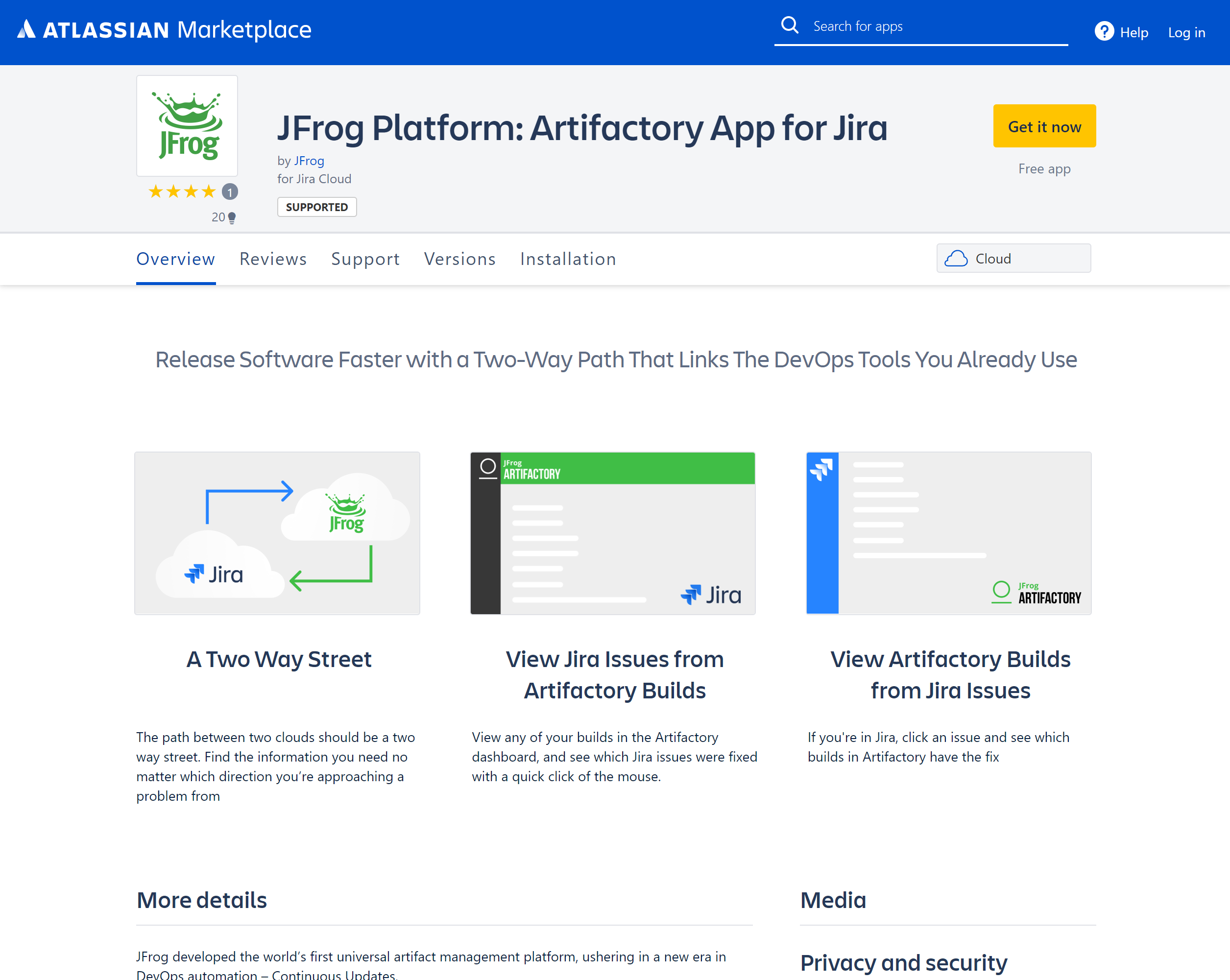
    JFrog this week announced that its DevOps platform, delivered as a software-as-a-service (SaaS), can now be integrated with the Jira project tracking and management application, delivered as a cloud service, from Atlassian.

    Casey O’Mara, vice president of worldwide business development for JFrog, said this bidirectional integration makes it possible to link a Jira issue, such as a bug fix, to the binary or build residing in the JFrog Artifactory repository that is part of the JFrog DevOps Platform.

    Available via an application that can be downloaded from the Atlassian Marketplace, this integration extends an existing alliance between the two companies, said O’Mara. There is, for example, already an integration between Atlassian Bitbucket Cloud for continuous integration and JFrog Artifactory repository.

    Creating a link with a Jira issue will make it easier to collaborate by, for example, making it easier to understand why a specific version of an artifact, such as a container image, was created, added O’Mara.

    Artifactory is already able to collect issue key messages from Git that logged alongside builds. The Artifactory dashboard for build information displays a link to each of the referenced Jira issues in the Issues tab. Now, users of Jira can link to the builds in Artifactory.

    Jira remains the dominant project tracking and management application for software development. As more organizations appreciate the degree to which they now depend on software, O’Mara noted the number of stakeholders in an organization using Jira is starting to increase, as application development schedules are tracked more closely. Atlassian is now making Jira more accessible as a cloud service to help foster that increased adoption, noted O’Mara.

    Atlassian is now making a case for transitioning its customer base to the cloud. In the third quarter of this year, it plans to discontinue new server license sales in addition to increasing prices for on-premises products. Ironically, the company reported preliminary results for its most recent third quarter that indicate revenues of between $566 million to $572 million. That’s $85 million more than originally forecasted, because demand for on-premises products has increased in anticipation of their unavailability later this year.

    In general, both Atlassian and JFrog are strong proponents of a best-of-breed approach to DevOps. JFrog, in its most recent quarter, reported $42.7 million in revenue, representing a 39% gain. Cloud revenue in that quarter grew 69% to $9.8 million, representing 23% of total revenue.

    It’s unclear at what rate organizations are shifting to the cloud. The number of workloads moving into the cloud has certainly accelerated in the wake of the economic downturn brought on by the COVID-19 pandemic. However, the bulk of data continues to reside in on-premises environments, and many organizations, because of performance, security and compliance concerns, don’t have any immediate plans to migrate all their applications to the cloud.

    Regardless of where DevOps platforms reside, there will always be a need to integrate them. It just may be easier to achieve that goal when all the tools that make up that workflow are running in the cloud.