Tag: Jenkins X

  • DevOps Chats: CloudBees Remains at Top of DevOps Market

    DevOps Chats: CloudBees Remains at Top of DevOps Market

    In this special DevOps Chats video edition, we speak with Sacha Labourey, CEO of CloudBees. From the very beginning of the DevOps movement, CloudBees has been one of the companies at the top of the DevOps market and, based on its latest business metrics, the company remains there.

    Being the enterprise Jenkins company helped CloudBees early on to be a leader at the top of the DevOps market. But with Jenkins and Jenkins X handed over to the Continuous Delivery Foundation (CDF), CloudBees can no longer count on its Jenkins connection to stay on top.

    Sacha, like any good CEO, did not allow CloudBees to rest on its laurels. An aggressive acquisition strategy including acquiring Electric Cloud, Rollout.io and others, has kept CloudBees on top. At the same time, Sacha has led the product and engineering teams as they roll out a new generation of DevOps products and services including the upcoming Software Delivery Management (SDM) and Software Delivery Automation (SDA).

    In this video, Labourey lays out what the past year has seen for CloudBees and what the coming year could bring. Of course, with Covid19 everyone is sailing into unchartered waters. But Sacha has the course in mind for CloudBees to follow.

    Have a listen to our conversation with Sacha to understand CloudBees’ plan to stay at the top of the DevOps market.

    [video src="https://videos.files.wordpress.com/TNgFIQ9x/2020-03-19-interview-with-sacha-labourey-1_hd.mp4" /]

    — Alan Shimel

  • Broadridge’s Annie Michelia on Why DevOps and the Cloud Go Hand-In-Hand

    Broadridge’s Annie Michelia on Why DevOps and the Cloud Go Hand-In-Hand

    Brian Dawson: Hello. Welcome to DevOps Radio, live at DevOps World | Jenkins World 2019. I have the pleasure of having a chance to interview Annie Michelia. She is a database architect at Broadridge, and really not just a database architect. As we talked and as I understand your bio, you actually have a wide range of skills and it appears that you do a lot there at Broadridge. Can you start by telling us a bit about what you do and about how you arrived there?

    Annie Michelia: Yes. By trade, I’m an Oracle DBA, to start with. So I’ve been working as a database administrator for most of my professional life. Right now in Broadridge, I work as an architect, in the sense, I work with on-premise database technologies as well as AWS cloud technologies. So I play a major role in cloud initiative projects for lift and shifts. So that’s when the DevOps kicked in.

    Brian: Okay. While you’re there, can you tell me a bit about DevOps at Broadridge? You mentioned DevOps kicked in. I’m curious to know where you guys are on your DevOps journey in terms of Broadridge, and why you guys are pursuing it?

    Annie: That’s a good question. So we in Broadridge have been using DevOps practices for more than five years now, successfully, to do all the application deployments, infrastructure deployments seamlessly. So the database was always standing in the backbench because of its complexity, not just complexity. Also, the thing is we handle mission-critical business data, which is persistent data, which we cannot touch and play around with.

    Brian: Your systems of record that need to be maintained can’t break, right.

    Annie: True. We are a financial solutions company. So for financial services, the criticality plays a very high role. So that’s why it has been staying aside. So when we started the initiatives for the cloud, the management decision was they said everything has to flow through automation, so no manual deploys, no manual installs. So we started this initiative just for the cloud piece, so for the database side.

    Brian: Okay.

    Annie: So what we thought is whatever we did manually in the past for databases needs to be automated, not just infrastructure, but also the ongoing deployments.

    Brian: The delivery and the deployment portion of it.

    Annie: Exactly. So all the schema changes, code changes and data changes, everything has to be in a no-touch environment. So that’s when we started practicing DevOps for database.

    Brian: So DevOps and cloud went hand-in-hand for Broadridge.

    Annie: Exactly, yeah.

    Brian: Okay. What drove the decision to go to the cloud? Do you know? Was it cost, speed?

    Annie: That’s one of the reasons, also the technology. So we evolved. We don’t want to be using the old technologies. The other reason could be cost, because of the licensing for the traditional enterprise DMS’s. So that’s why the organization has made a decision to do a lift and shift of most of the applications to cloud. So when we moved to the cloud, the decision was made that the environment should be zero-touch.

    Brian: Okay. I’m going to want to drill into, in a moment, lift and shift, which people have different opinions and it has different meanings, and also, some of the challenges of really integrating data and traditional relational databases into a CI pipeline. But before we do, I’d like to ask have you seen benefits of DevOps so far? Is Broadridge benefiting? Are customers benefiting? If so, how?

    Annie: When we thought of this automation for databases, it was really, really scary because we are dealing with critical data. So it was taking, actually, quite a time to understand and to convince the customers for the automation piece. But the whole point, if you look around the process itself, the manual process took a lot of time, but not just the time. The process, when you see it in manual, it actually involved multi-team participation. So not just the time, not just the human errors or something like that, it took multiple technical people from various teams to do a simple deployment process.

    Normally, the DBAs are doing – most of the time, the product – I’m sorry. Most of the time, the production support DBAs, who are hired to do production support, end up doing deployments all the time. We are a quite large company, so we have a lot of applications to support. So rather than doing the real production support work, the DBAs ended up doing deployments all day and weekends.

    Brian: And that’s at the cost of both the DBAs and potentially production support is now lacking, potentially, and not as responsive, right?

    Annie: True, yeah. When it comes to automation, one real big drawback is doing the manual setup of deployment. There is no traceability for what we deployed and where we deployed. Did we do it in a test environment? Was it successful? Are we ready to do it in production? Can we go forward? So there is no traceability, so that creates a big chaos.

    So when you break all this stuff into the DevOps automation, you have a version-controlled deployment. So there is a big traceability, and you know what you do in test, which can be promoted to production or not. So that’s the biggest advantage I see as a DBA over other constraints like time and other things.

    Brian: Right. You gain efficiencies.

    Annie: Efficiency, reliability.

    Brian: Visibility, traceability, which is huge. Now, I cannot claim by any means to be a database expert. I will share, I spent a bunch of years in the game industry as a software engineer/programming, and I didn’t quite get the importance of databases, the science behind it, the complexity. As I moved into the other phase of my career, more focused around enterprise development, and began to spend more time in traditional databases, I realized how complex it can be. Something I learned there is really in that space there are a lot of manual controls into place.

    Annie: True, yeah.

    Brian: A lot of responsibility put in the experts’ hands, because traceability was not really built into the database updates and migration process.

    Annie: That’s a little bit different. For a simple deployment, multiple teams are dependent on it and everybody ought to be on the spot for installation, validation, and then verification. So in this automation process, with a push of a button in Jenkins, that’s how we put it together. Any nontechnical person can run this. So there is not DB involvement. There is no one’s involvement, not a development involvement or a service delivery team’s involvement. Any nontechnical person can push a button from Jenkins, which can do all the magic.

    Brian: Okay.

    Annie: It retrieves the artifact from source control, extracts, makes a SQL connection, executes. Before execution, if there is a requirement for database backup, pre-deployment backup, advance into it, it takes the backup and runs the deployment, creates the log file, publishes the logs to all the interested parties.

    Brian: Awesome.

    Annie: Just the push of a button. So Jenkins does all the magic.

    Brian: I always love to hear Jenkins doing all of the magic.

    Annie: Yeah. That’s the only tool we are using for this automation.

    Brian: I’m going to want to dig into the hows of how you did this. Again, before we shift, I have a precursor question. Are you seeing customer or business benefit from this process? I think the internal benefit is immense. We talked about productivity, visibility, traceability. Is there error reduction? Is there reduction of failure rates that are bettering the service for the customer?

    Annie: Exactly. When we do the same thing manually, the errors may not be huge or quantifiable, but the impact of even one error is huge because we are in the financial industry.

    Brian: Yes, right. It could be millions, billions of dollar error, one error in data.

    Annie: Exactly. So we are fined with the _____, so we’ll be fined or penalized. The penalty is really huge for a single mistake in a year. So we completely eradicated the incidents. That’s a bigger achievement I could see.

    Brian: So the DevOps automation provided more reliability, safety, and security for your customers.

    Annie: Yes.

    Brian: I bet if we were to measure blood pressure, it probably also lowered blood pressure for the DBAs and team members.

    Annie: That is true, yeah.

    Brian: So let’s talk a bit about the technical implementation. Look, I’ll admit that oftentimes when we talk about DevOps and how to implement DevOps, there are some rough edges and some difficult areas that oftentimes the luminaries, evangelists, speakers tend to sort of gloss over. Security is one of those that isn’t fully integrated. Oftentimes, it’s difficult. Management of environments has improved considerably. But data is one that I think people still struggle with.

    Now, you guys chose to lift and shift. What I’ve seen a lot of greenfield teams do is sort of move directly to cloud technology, move directly to NoSQL databases, possibly do some level of ETL, but largely say, “We’re going to take our traditional data store and leave it behind because it’s so difficult.” You guys chose to lift and shift and bring along the data in the databases that you had invested in, correct?

    Annie: Correct.

    Brian: It sounds like it was challenging.

    Annie: It’s a challenge, but when you look at the organization’s perspective, the total infrastructure maintenance cost is completely removed or eradicated. So the technical people can spend more of their time on architecting things, rather than sitting and supporting things, the traditional work. So it’s just we are losing the job, but the nature of the job has been elevated.

    Brian: Right. You can focus on things that matter.

    Annie: Yeah.

    Brian: Can you share with me –? We talked a bit about some of the technical difficulties. Maybe you can take me on a journey. Tell me a bit about what the solution looks like at Broadridge, for integrating first your traditional relational databases into CI/CD. And what are the solutions? What challenge did you run into? How did you implement it? We’d love to understand some more of the details.

    Annie: Okay. We just use two tools to do this. One is for the source control, GitLab. So we just tell the developers to check in their code in GitLab. And when it’s ready for deployment and when it converts to an artifact, then the process can kick in. So a nontechnical person will run this build from Jenkins. So this is the whole point.

    The first and very – difficulty, I would say, is the understanding. The whole Jenkins is integrated with the other tools, like GitLab or Nexus or any other tool. So that was a challenging thing for me.

    We really need to understand how they can talk to each other, with what credentials. So that’s the starting point. So, luckily, our DevOps team has a very good standardized process. So they have created service accounts for each technology, for each build. So those cannot be shared. The password cannot be given to the individuals.

    So the service accounts can talk to the other tools, the other DevOps tools. It could be GitLab or Nexus or whatever. So that’s the first challenge from my side.

    Brian: And do you use credential management in Jenkins for this?

    Annie: Yeah. We have credentials created in Jenkins itself, which is highly encrypted. So Jenkins uses the credential file to talk to the other tools.

    Brian: Talk and execute the automation or orchestrate.

    Annie: Exactly. The same applies for the database credentials as well. In our setup, as I said before, when you click the button, the system downloads the artifact, makes SQL connections. It’s how it’s going to make the connection. So it needs credentials.

    So we instruct the developers to submit a configuration file for us, which just had the connection information, nothing more than that. So what is your target server name, target DB name? Which object do you want to backup or do you want to skip the backup? So it’s like a ten-line config file. They just need to say yes or no or they need to fill the right-hand side.

    So we just give them the template. So they are just going to fill the right-hand side of the config file. So there they give us all the connection information, but the credentials are managed by DBAs. So we create the user name and password in the credentials file to make the connections.

    Brian: Okay. And then they are submitting – to stay in the technical implementation level for a bit, the developers, one, I notice you’re shifting left. They’re empowered to deliver at a speed that they need to deliver versus filling out a ticket, having a phone call, crafting an email. You guys are empowered as the DBA or the database team to focus on higher order, higher level issues. So there’s a lot of benefit there.

    Now, I’m curious. Was it a shift for the developers? Are the developers directly submitting SQL or DDL?

    Annie: No. They’re not allowed to. The Jenkins setup is like we have non-prod and prod server setup. In non-prod, the developers can play around with it, like in a development environment. So they can submit a sample artifact, and they can just try to run the code – sorry – Jenkins job to understand how it works. That’s all they can do. Then when the artifact is ready to be promoted for the higher environments, they can’t touch anything. So there is a different promotion process we have on the DevOps team.

    Brian: Okay. I was curious about that. Right.

    Annie: The DevOps team actually has a process. They call it a promote artifact process. So even they can’t do anything about it. Once they say the code is tested in development, the process kicks in that promotes the artifact to a different source repository. So after that, they have no luxury to go and change the code. So that’s done. So when you test something in development, that is going to production. So that’s the word I use, traceability, right.

    Brian: Right, and it’s similar to retrieving application artifacts and the value of binary repositories, which is build once and promote.

    Annie: That’s it, yeah. I wouldn’t say it’s continuous delivery, but we are targeting that continuous delivery. What I understood is when you push a button for development, when it completes, it goes to QA prod. So that’s what continuous delivery, what I understood so far. So that is not actually in place, because that is actually handled, coordinated within teams, because there is a different change control process.

    Brian: Right. So there’s manual intervention. You’re automating, but your automation has to work with existing change control processes.

    Annie: Exactly, yeah.

    Brian: And in reality, when we’re dealing with data in a financial institution, those change control or change management processes are likely going to stay.

    Annie: Exactly.

    Brian: It’s not practical or not –

    Annie: Yeah. We have a governance team to approve the change for production. So that’s when there is an intervention. But even there is a manual … that’s like a release management flow. So that flows automatically. Then when it’s ready to go, the button can be pushed for prod. So CI in place, CD on the way.

    Brian: Right. CI in place, CD with manual gates is in place.

    Annie: Exactly. That’s the right word.

    Brian: People get on themselves. I speak to many organizations, “Well, we haven’t implementing continuous delivery.” I maintain that at the end of the day that there’s objectives for higher quality, optimization of effort, and increased velocity. If you can do that while still maintaining your manual checks, well, you’ve achieved your goal. It might not be pure continuous delivery. Maybe you guys will get there one day, but –

    Annie: Exactly. I don’t believe in this CI/CD.

    Brian: There’s a place for it at Broadridge today. But that’s where the DevOps comes in. I’m curious. Alignment is always a struggle, right. So this, yes, you still have governance in place. These changing systems, cloud, DevOps and automation must have changed the way you work and have had sort of some cultural implications.

    What did Broadridge do to get teams aligned, to get everybody sort of shifting into this new way of working?

    Annie: Right now in Broadridge, every week have center of practice conferences, where we educate people to understand the existing model. Then we tell them how to onboard themselves into this process. So we educate them.

    We have Confluence pages created for them. So we publish periodically. Then in every COP and COE meeting, which is conducted by the DevOps team, they invite us as a guest, as a speaker, to tell them how any team can get into this process. So every day we get customers. That’s how I would say it.

    So we have multiple application teams. After each and every meeting, we would get five to ten emails saying, “Hey, I want to jump into this process.” Even this morning I got an e-mail. I’m out of the office. I got an e-mail saying, “Hey, I want to jump into the process.” I said, “I’ll give you a demo by next week.” So that’s how it goes.

    So people are interested to come. Even though they know the criticality, but they love the process because it eradicates the manual time and errors completely. So that’s a big thing they look at.

    Brian: Would you say that marketing – so you’re getting people aligned by taking a service approach. I heard you use the words, “We’re getting customers every day.”

    Annie: Yeah, that’s what I feel. I belong to the shared services group from the technology solutions team. So we provide solutions to the teams. That’s our goal, so I see them as a customer.

    Brian: Okay. Like a business that’s customer-facing, it sounds like there’s education and awareness. There’s training and marketing.

    Annie: Yep. That’s what we do every week.

    Brian: Continual training and marketing has let to alignment and adoption. And how important was it that you show success? What I’m also gathering is as part of this, you’re positioning what the benefits are of adopting your service. Right?

    Annie: Mm-hmm.

    Brian: I guess I’d ask how important to the growth has it been that you guys transparently share your successes and possibly even some of your struggles and failures?

    Annie: Normally, after we present the first framework, we get a lot of suggestions from the application teams. So I took this very positively. They actually told me, “Hey, your interface could look like this, man. It could look prettier.” I agreed to it because I was only focusing on the logic of the implementation, not the interface look itself. But when it comes from the development teams, they are already well-versed in programming.

    So they tell me, “You could change this. You could modify this. You could put less parameters.” So I adopted those things. So it’s not just a one-way knowledge-share. It’s like a two-way understanding, yeah.

    Brian: Awesome. I’d say for our listeners as well as you, when I hear you talk about creating a baseline, communicating that and getting the feedback from the developers, it very much aligns with software delivery management messaging you’re going to hear at the keynote at CloudBees today, and this concept of not just automating, but continuously improving, so you can get stuff out there, get feedback, and make it better.

    Annie: Better, yeah.

    Brian: So yeah, look at SDM. I hear a bit of your experience being similar. I.e., it’s not just business to customer. It’s also internal critical systems, where you can bring these to bear.

    So can you tell me, in terms of security and compliance, and you’ve touched a bit upon this in terms of data, but the security and compliance, as you stated, is tantamount, is critical in financial institutions. How do you guys leverage DevOps to help ensure audit and compliance, and help ensure that you’re achieving your security and compliance goals at Broadridge?

    Annie: Basically, first and foremost, I would say the source control artifact. That is the first level in auditing and security. So if you want to go back and see, you have a service ticket with a version control artifact. So you know what was installed, on which date, on which server. That is so helpful for auditing purposes.

    Brian: Okay.

    Annie: So for the security purpose as well, since the credentials are managed locally in Jenkins as an encrypted file, it is very secure and it’s not –

    Brian: Centralized secure –

    Annie: A centralized place, so that it’s not being shared with multiple teams or multiple people. Normally, DBAs hold the credentials, but now, no one is holding any credentials. So once it’s created, it’s stored. That’s it. It works very well.

    Brian: Awesome. Thank you. Now I’m curious. I’m going to ask a couple of sort of fun questions, but questions we also like to help inform our audience about who our guests are. So one of those is who is your favorite DevOps superhero and why?

    Annie: I would pick someone from my company. I’m sorry. I’m being selfish. Daniel Ritchie I would say.

    Brian: Daniel Ritchie.

    Annie: Yeah. He’s the man who introduced DevOps to me. Because when I had an interest, I approached him. Everyone in my company said Daniel is the go-to guy. So I approached him. He spent quite a few hours with me, explained about the DevOps CI/CD process. That actually impressed me to do this framework. So I would say he’s my hero.

    Brian: So let’s dig into – Daniel or Danny?

    Annie: Daniel Ritchie.

    Brian: Daniel Ritchie. Thank you, Daniel, and hello, Daniel. So what’s Daniel’s role at Broadridge?

    Annie: He’s a DevOps architect at Broadridge, and he has been wonders for the past five or six years.

    Brian: Awesome. I also noticed this loop here of there’s curiosity. There’s someone that has some experience and expertise. They service the curiosity with that. So it’s sharing and training. People marketed Daniel to you, to be able to go find him. Then now, you’re doing the same, to spread the word within your company.

    Annie: Yeah, true.

    Brian: So yeah, it’s awesome and I love how it underscores that at the end of the day, while there may be top-down components to DevOps improvements, at the end of the day, DevOps is really about sharing, collaboration, and community. I think what you’ve shared with us has demonstrated that.

    Annie: Thank you.

    Brian: So to shift, I like to ask guests to share what we call a dev-oops moment. And that’s not D-E-V-O-P-S, but rather D-E-V-O-O-O-P-S. That’s a moment where either dangerously, precariously or humorously something went wrong and you learned from it. Do you have a dev-oops moment that you can share with us?

    Annie: Yeah. When I was initially developing the framework, I didn’t know how to mask the password in Python script, because I’m not a developer. So when I ran the build, I saw the password displayed on the console output. It was like, “Oops.” I was like –

    Brian: And now you’re like, “How do I get rid of it? Where are the logs?”

    Annie: Then I went back to the CloudBees, how to wrap the password. Then I found the syntax, came back and had –

    [Crosstalk]

    Brian: Shhh. Nobody tell anybody.

    Annie: Yeah. So that was an embarrassing moment for me, but that was just with me, so I just canceled the build.

    Brian: That’s good to know. I’ll tell you. I have had something similar happen. I don’t think it was in a critical environment, but I didn’t catch it right away. So that meant that I’m SSH into servers, combing through logs, trying to figure out everywhere where this unmasked password would have leaked.

    So thank you for sharing that. That’s why those DevOps moments are important. And in that, you said you were able to go to CloudBees and they explained it.

    Annie: Yeah.

    Brian: Do you happen to recall how you masked it?

    Annie: I saw some blocks, block spots, and those guys were really good. So I just posted a question and I got an answer instantly. Yeah, within like a few minutes I got an answer, with syntax, so I could wrap like this. They gave some examples.

    Brian: Then on interpretation and complexity it’ll obfuscate it.

    Annie: I just used it for my thing and then I went back and learned.

    Brian: Also a lesson about testing locally first, right, before it went into the pipeline.

    Annie: Exactly.

    Brian: Awesome. Do you have any final thoughts that you’d like to share with us, in addition to the experience and knowledge you’ve already provided, any final words for the listeners?

    Annie: No. I’m so glad that I’m here to share my experience about the framework we have. I’m so happy to be here.

    Brian: Awesome. I’m going to poke and prod you a little more. Now that you’re at DevOps World/Jenkins World, was this your first one or have you –?

    Annie: Yeah, very first one.

    Brian: Okay. What are you looking forward to getting out of it?

    Annie: I would like to know about the things which I do not know so far, because my level of DevOps is very limited. So I would like to know how I can improvise my framework with the available sources. So I looked into the topics and they were so interesting.

    Brian:Awesome, great. I’m pretty convinced that in terms of better understanding CI/CD, DevOps and what you can do in particular to do it, to apply it within and enterprise, you will learn more here. I’d love to hear from you, if I see you again later in the show. I’d love to hear from you how your experience has been and what you’ve learned.

    Annie: Thank you so much.

    Brian: All right. Thank you, Annie.

  • Jenkins X Continues To Experience Strong Demand, Speeding Development Of Cloud Native Applications

    CloudBees introduces first GUI for Jenkins X as downloads, contributors and corporate support to the open source project grow


    KUBECON SAN DIEGO, CA. AND SAN JOSE, CA. – November 20, 2019 – CloudBees, the enterprise DevOps leader powering the continuous economy, today introduced a graphical user interface (GUI) for Jenkins X at KubeCon San Diego. CloudBees’ announcement comes at a time when the Jenkins X open source project and CloudBees’ support for the project are both gaining momentum at a rapid rate, with contributors and supporting companies hitting all-time highs.


    In less than two years, approximately 885 developers have contributed code to the Jenkins X project and there are 176 contributing companies (Source: Continuous Delivery Foundation DevStats, October 2019).

    Jenkins X offers automated CI/CD for cloud native applications on Kubernetes. Using Jenkins X, developers can leverage Kubernetes to build and deploy cloud native applications quickly and easily without having to learn the intricacies of Kubernetes and its ecosystem. The Jenkins X project, initiated by CloudBees and other contributors in February 2018, is now part of the Continuous Delivery Foundation.

    “As a software developer in charge of migrating monoliths to microservices deployed to Kubernetes, Jenkins X has helped me and my teams to be efficient in managing complex projects that require 100+ source code repositories to be deployed to different Kubernetes clusters,” said Mauricio Salatino, principal software developer for a workflow and decision automation platform company and an instructor at Learnk8s. “This was a task that initially looked impossible for a team of just four people, but we did it easily with Jenkins X.”

    Jenkins X continues to be enhanced at a rapid pace. CloudBees’ introduction of a new GUI in its CloudBees Jenkins X Distribution gives developers more flexibility and a richer user experience. The existing command line interface (CLI) loved by many developers is still available and continues to be enhanced, but now users have a choice to use the CLI or the new graphical environment, depending on which better suits their workflow. The CloudBees Jenkins X Distribution is a free offering from CloudBees.

    “Our goal is to make Jenkins X the most friction-free environment for developers looking to use Kubernetes in an opinionated, automated way,” said Mo Plassnig, vice president of cloud, CloudBees. “Offering a richer, more intuitive GUI is just the start. Contributors throughout CloudBees and the Continuous Delivery Foundation ecosystem are hard at work creating more improvements – everything from log handling to environment promotions to onboarding of workflows.”

    “The numbers show that our vision for Jenkins X was right on target,” said James Strachan, a distinguished engineer at CloudBees and one of the founders of Jenkins X. “As more organizations embrace DevOps, the need for a CI/CD solution that leverages the power of Kubernetes with the rich capabilities and straight-forward convenience of Jenkins X has continued to grow.”

    Additional Resources

    Download Jenkins X


    About CloudBees
    CloudBees is powering the continuous economy by offering the world’s first end-to-end continuous software delivery management system (SDM). For millions of developers and product teams driving innovation for businesses large or small, SDM builds on continuous integration (CI) and continuous delivery (CD) to enable all functions and teams within and around the software delivery organization to best work together to amplify value creation.

    CloudBees is the CI, CD and application release orchestration (ARO) powerhouse, built on the commercial success of its products as well as its open source leadership. CloudBees is the largest contributor to Jenkins and Jenkins X, and a founding member of the Continuous Delivery Foundation (CDF). From startups with full-stack developers practicing NoOps to large Fortune 100 companies, CloudBees enables all software-driven organizations to intelligently deploy the right capabilities at the right time.

    Over 3,500 of the world’s best-known brands and over 50% of the Fortune 500, invest in CloudBees because of its ability to work across any cloud, in any development environment and to balance corporate governance and control with developer flexibility and freedom. CloudBees is home to the world’s leading DevOps experts, helping thousands of companies harness the power of “continuous everything” and putting them on the fastest path from great idea, to great software, to great business value.

    Backed by Matrix Partners, Lightspeed Venture Partners, Verizon Ventures, Delta-v Capital, Golub Capital and Unusual Ventures, CloudBees was founded in 2010 by former JBoss CTO Sacha Labourey and an elite team of continuous integration, continuous delivery and DevOps professionals. Follow CloudBees on Twitter, Facebook and LinkedIn.


  • Simplified Telephony Solutions

    Simplified Telephony Solutions

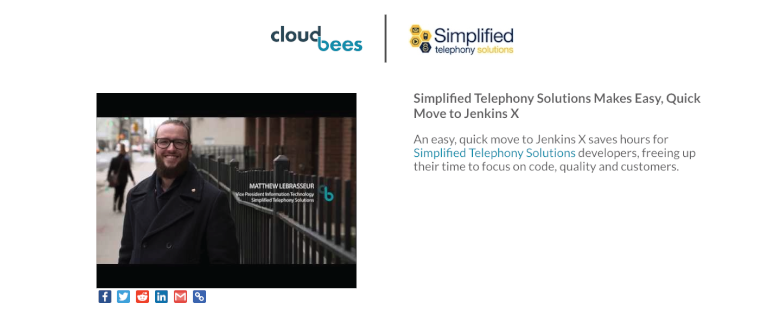
    Simplified Telephony Solutions Makes Easy, Quick Move to Jenkins X

    An easy, quick move to Jenkins X saves hours for Simplified Telephony Solutions developers, freeing up their time to focus on code, quality and customers.

     My favorite thing about Jenkins X is it really is a one size fits all solution. From day one, it just worked. Now we have more time to focus on what’s important – our code, our software and our customers. 
    Matthew Lebrasseur
    Vice President of Information Technology

    [su_youtube url=”https://www.youtube.com/watch?v=EUPq3WQ1Y98&feature=youtu.be”]

  • What to Expect from DevOps World | Jenkins World 2019

    What to Expect from DevOps World | Jenkins World 2019

    The clock is ticking. DevOps World | Jenkins World, the world’s biggest annual gathering of Jenkins users and DevOps practitioners, is just around the corner, scheduled for August 12-15 in San Francisco. The agenda is set. The DevOps Community is rolling out the red carpet. Are you coming?

    You’ll be among the largest gathering of DevOps superheroes. We’re also pulling out all the stops, offering more speaker sessions, a bigger expo set-up and a themed superhero after-party for conference-goers to let loose at, following a full day of activities.

    Located in the heart of Silicon Valley, the city of San Francisco itself is a world-class conference draw. We’re looking forward to sharing a few days with a record 2,000 attendees in just a few short weeks.

    This year’s theme is “Transform and Deliver,” and the conference will deliver on a number of fronts. It will entertain, educate and maybe even surprise attendees with the wide array of offerings planned for the four-day time frame. It also will focus on the concept of delivering software–highlighting the value digital transformation has in delivering software more efficiently, more quickly and with higher quality.

    Whether you are already prepping for the show or still considering a trip, here are a few of the things on tap for this year’s event.

    Sessions and Speakers

    At DevOps World | Jenkins World 2019, you’ll find plenty of opportunities to learn and engage at every turn. This year’s San Francisco event will feature more than 100 sessions covering a wide range of DevOps-, software delivery- and Jenkins-related topics. In San Francisco, sessions will be conducted by practitioners from organizations such as: Adobe, CloudBees, Eli Lilly, Fugue, Google, IBM, Latam Airlines, Liberty Mutual, Microsoft, Salesforce, SAP Labs and The Hartford.

    Let’s talk specifics. This year, attendees can learn about everything from cloud native and Kubernetes to pipeline development and management, CI/CD, release management, data and reporting, DevOps and security/compliance. Highlights include From Zero to DevOps Superhero: The Container Edition, with Jessica Dean of Microsoft; Continuous Delivery Directly to the Car, with Rafal Kowalski of Grape Up; 10 Attributes of the DevSecOps Elite with Derek Weeks of Sonatype and Hasan Yasar of Carnegie Mellon Software Engineering Institute.

    The conference will feature a series of keynote addresses, as well. Speakers will include CloudBees CEO Sacha Labourey, Jenkins Founder Kohsuke Kawaguchi, CloudBees VP of Marketing Shawn Ahmed, CloudBees VP of Product Management Ben Williams, CloudBees CMO Andre Pino, Google Cloud Developer Advocate Dave Stanke, Redmonk Co-founder James Governor, CloudBees Director of Open Source Community Tracy Miranda, Cloud Native Computing Foundation CTO/COO Chris Aniszczyk, Jenkins X Co-creator James Strachan, Netflix Director of Delivery Engineering Andy Glover and Google Cloud Platform Engineering Manager Tara Hernandez.

    Training, Workshops and Jenkins Certifications

    If the training and workshops–held on the conference’s first two days–help provide the skills needed to help your organization transform to DevOps, the final two days (August 12-13) offer up a wide variety of sessions from experts that will enable you to deliver success.

    Training topics will include Continuous Delivery with Jenkins X, DevSecOps Engineering Certification, DevOps Leader Certification, Jenkins Admin Fundamentals, CloudBees Core Fundamentals and Continuous Delivery with Jenkins on Google Kubernetes Engine. All trainings and workshops are available to add onto the full conference sessions pass for an additional cost.

    Attendees registering for the conference will receive a free Jenkins certification exam voucher ($150 value) for the Certified Jenkins Engineer (CJE) or Certified CloudBees Jenkins Platform Engineer (CCJPE) exams. You can choose to sign up for an on-site exam at DevOps World Jenkins World (first come, first served) or use it at a later date. There are also several half-days, one- and two-day courses that can be added during the event registration process to help attendees prepare for certification.

    Networking and Expo

    Beyond the official sessions, there will be ample time to network with colleagues and check out the latest and greatest from industry vendors on the expo floor. Exhibitors include DevOps World’s showcase sponsor Google, premium sponsors Sonatype and VMware, and other sponsors such as GitKraken, Gradle, Honeycomb, Incredibuild, Mattermost, Instana, OverOps, Scalyr and Zebrium.

    Awards

    The DevOps World | Jenkins World 2019 Awards recognize the achievements of DevOps innovators and Jenkins practitioners around the globe, with two categories of awards announced during the conference: The Jenkins Community Awards, celebrating individual Jenkins community contributors, and the CloudBees Innovation Awards, honoring companies that demonstrate quantifiable business value from DevOps, CI and CD using CloudBees solutions.

    Jenkins awards include honors such as Jenkins Security MVP, Most Valuable Jenkins Advocate and Most Innovative Jenkins X Implementation. CloudBees Innovation Awards include the DevOps Automation Excellence Award, the DevOps Scalability Achievement Award and DevOps Rising Star Award.

    After-Party

    Everyone who attends DevOps World | Jenkins World is a DevOps superhero. On the Wednesday night of the conference, grab your capes and masks to celebrate with the industry. Join us for our superhero-themed party!

    Are you ready for this year’s show?

    Learn more about DevOps World | Jenkins World. Then register and use code DWJW20 to get a 20% discount off your registration.

    — Martha Samper

  • Announcing the CloudBees Jenkins X Distribution

    Announcing the CloudBees Jenkins X Distribution

    Today we are announcing the first release of the CloudBees Jenkins X Distribution. It’s a battle-tested, preconfigured ready-to-go package for Jenkins X that you can count on today. We’ll vouch for it with support and documentation, and evolve it at a predictable and well-tested cadence.

    That’s a big deal for us and for the Jenkins X community, and we’ll talk here about what it is, what it means, and how it impacts future Jenkins X open source development. Don’t worry, though – it’s all good news.

    What is CloudBees Jenkins X Distribution?

    Jenkins X is growing and evolving, rapidly. Every day it gets more stable, works better and does even more cool new stuff. The OSS community emerging around Jenkins X continues to grow and we want to see that accelerate even more. Open-source standards are good for the industry, and we believe next-gen CI/CD should be as community-driven and as open as Jenkins has been for the last 15 years.

    All that said – some organizations need to rely on something today. They need to know if and when the bits will change and what the change is. They need to know that what worked today will still work next month, where to get help and information and who to count on when they’re picking a tool to power their business.

    We’re creating the CloudBees Jenkins X Distribution to give teams who want to use Jenkins X but can’t go all-in on keeping up with the fast-paced open-source project. We feel this enables teams to use Jenkins X to solve their critical daily needs without limiting community innovation and participation.

    What’s in it, what’s not and where can I get it?

    The CloudBees Jenkins X Distribution doesn’t do everything Jenkins X does – it takes the most mature and critical bits, tests and documents them and then gives you a package of a ready-for-primetime slice of the wider OSS project.

    The distribution will roll in new features on a monthly basis – always tested and documented – and you’ll be able to see what’s coming and choose when to adopt it. We’ll never let any breaking changes get through unexpectedly.

    For example, the first release of CloudBees Jenkins X Distribution supports Google Kubernetes Engine (GKE) and preview environments, but not Amazon’s Elastic Kubernetes Service (EKS) or DevPods. These features will come – as will lots of other cool stuff! We will always be upfront so that you know exactly what will run well and what isn’t ready yet.

    The OSS project is there with more experimental features (and welcome arms) if you need one of those features sooner. You can find the full list of what the CloudBees Jenkins X Distribution supports to today, and download it, right here.

    If your team is adopting Jenkins X and wants the comfort of world-class support, CloudBees will stand by the distribution. You can buy paid support plans for the distribution to make sure your team has someone to call and help you out any time you need.

    How does this relate to the OSS world?

    CloudBees is an open-source company, and we want to see open-source standards continue to define how teams work. The CloudBees Jenkins X Distribution is not an attempt to pull oxygen away from the Jenkins X project – it’s the opposite. We know people need a level of trust to invest in new tool choices, and we want to bring that level of maturity to Jenkins X so more people can find it, love it and participate in it.

    The more people using CloudBees Jenkins X Distribution, the more Jenkins X workloads are running in companies all over the world. As a community, Jenkins X can learn from these companies to drive the OSS project, to validate strategic directions, and to get advice and support from the most mature adopters.

    This is a bet on JX and the OSS world for CloudBees, and we’re excited to make it.

    Additional resources

  • DevOps World | Jenkins World 2019 Training is Best in Class

    DevOps World | Jenkins World 2019 Training is Best in Class

    Do you work on Jenkins pipelines? Are you responsible for implementing CloudBees tools in your development environment? Do you manage a DevOps team? Is your organization ramping up DevSecOps capabilities?

    If you answered yes to any of these questions, you should be attending the training sessions coming up at DevOps World | Jenkins World, a premier global event for Jenkins users and DevOps practitioners. The event is devoting two full days to educating attendees on the finer points of these topics listed above. The conference itself is taking place Aug. 12-15 in San Francisco’s Moscone Center and the training is scheduled for Monday and Tuesday (August 12 and 13).

    Conference attendees will have plenty to do throughout the week. The final two days will feature an agenda packed with keynotes, industry-focused thought leader sessions, an awards ceremony and, if that’s not enough, an after-party with a superhero theme. In-between sessions, there will be time to walk the expo floor, to get a glimpse of the latest and greatest technologies in the space and do some networking with some of the other 2,000 enthusiasts attending the conference.

    Training will be front and center early in the conference. Professionals with varying levels of experience—those just getting started and those with a substantial background in their subjects—can take advantage of trainings targeted just for them. They can sharpen their skills, gain new perspectives and walk away with certifications that will help them advance in their careers.

    Anybody who’s been in the business for a while will confirm: Well-trained teams are a big asset in DevOps. The field is expanding rapidly and changing every year, and DevOps practitioners need to devote themselves to continuous learning to keep pace with modern software development. At DevOps World | Jenkins World, they can learn about best practices ranging from authorization to security, build management and interfacing with cloud services.

    While training sessions are available to purchase at a nominal cost, attendees can receive a free Jenkins certification exam voucher—a $150 value—for the Certified Jenkins Engineer (CJE) and Certified CloudBees Jenkins Platform Engineer (CCJPE) exams. Attendees can choose to sign up for an onsite exam at the conference or use it at a later date.

    For a full rundown of the conference’s training offerings, check out the Training and Certification page.

    Now, let’s take a quick glimpse at what’s being offered.

    Jenkins Training

    Jenkins, the world’s leading open source automation server, is celebrating its 15th anniversary this year. A lot has changed during that time. A community has grown around the technology resource, adding new tools, new plugins and new best practices year after year.

    While the community dedicates itself to sharing information and educating its members, the DevOps World | Jenkins World conference provides the perfect setting to get the targeted training members to get the most out of Jenkins in their work environments.

    DevOps World | Jenkins World has four separate certification courses designed to build attendees’ Jenkins skills. There are introductory and intermediate courses that will position them to become more proficient in specific areas important to their own career development. Attendees can learn about Jenkins pipeline fundamentals—everything from the structure of a declarative pipeline to the use of features to finish the pipeline. They can also take advantage of an intermediate session with lectures about shared libraries and Docker agents and follow-up lab exercises. Jenkins Admin courses get learners started on the Jenkins dashboard and configuration practices and then branches out to cover more advanced concepts such as scaling Jenkins, managing different functions and more advanced uses of Docker and Kubernetes.

    There’s a second track that covers concepts connected to continuous delivery with Jenkins X. The Jenkins X project, introduced by CloudBees, provides a resource to educate community members on cloud-native processes. This course explores ways to take advantage of Jenkins X, showing attendees how to create a fully operational continuous delivery pipeline using containers, Kubernetes, Jenkins X and many other tools.

    CloudBees Training

    If you work with CloudBees technologies in a DevOps environment, the CloudBees Core Fundamentals course is a great place to advance your skills. Attendees need to take Jenkins Admin Fundamentals and Intermediate classes to really leverage the concepts covered here. They’ll learn how to optimize the CloudBees Core product suite to successfully scale CD and DevOps in their organizations. They’ll also learn about key proprietary features in CloudBees Core to enhance the capabilities of Jenkins, including enhancements for authorization and security that provide the control and administration needed to master key aspects of the pipeline.

    DevOps Training

    This course is more advanced—a certification for DevOps leaders of all kinds. To take the course, you don’t have to be an official leader of a DevOps team. Teams need leaders of all kinds. Whatever your position on the team—be it tactical of strategic, as a designer, implementer or motivator—you can play a leadership role. This course will teach the finer points of managing people and situations in a DevOps environment. It will build leadership skills—showing how to align and collaborate to break down silos and evolve the organization. It will present real-life scenarios and case studies to prepare team members to thrive in a fast-paced DevOps and Agile environment. Completion of this certification positions learners to complete the DevOps Leader exam successfully.

    DevSecOps Training

    It took a while for organizations to start integrating security into DevOps environments. Security was once considered an afterthought in—or even a hindrance to—DevOps processes. But now, DevSecOps is taking hold, and organizations need to build the skill levels to make the discipline successful.

    This course offers attendees the training they need to gain a DevSecOps Engineering Certification. It outlines DevSecOps as a concept, reviews key best practices DevOps teams need to adhere to and explains how DevOps security practices differ from other security approaches. The course will teach practical steps on how to integrate security programs into DevOps practices and highlight how professionals can use data and security science as the primary means of protecting the organization and customer. Completion of the course positions attendees to successfully pass the DevSecOps Engineering Certification exam, which is offered on the last day of class.

    Learn more about the training and workshops available. Then register with code DWJW20 and get 20% off your registration.

    — Jason Farmer

  • 6 Reasons to Convince Your Manager to Send You to DevOps World |Jenkins World

    6 Reasons to Convince Your Manager to Send You to DevOps World |Jenkins World

    This year’s DevOps World | Jenkins World will take place Aug. 12-15 in San Francisco, at the Moscone Center.

    Now, chances are you don’t need any real convincing to attend this event. DevOps World | Jenkins World is, after all, the premier annual conference for DevOps- and Jenkins-related content. You’ve experienced it yourself, or heard others talking about past years’ events—how the conference is packed, year after year, with sessions given by experts, multiple keynotes from industry leaders, hands-on training, plenty of time for networking, a themed after-party and all kinds of other cool things to take advantage of. This year, the event is going to be bigger than ever.

    But, maybe you need a little help convincing your manager to authorize your trip. If so, we’re here to help. We’ve pulled together a list of selling points you can bring to your manager to show the incredible value a trip to DevOps World-Jenkins World can generate.

    You Can Turn Yourself into a DevOps Leader

    As we all know, DevOps is more than a technology, more than a process; it’s a culture that needs to be nurtured and fed. It needs DevOps leaders to advance that culture. Sending you to DevOps World-Jenkins World can turn you into a DevOps leader.

    You can start by taking a DevOps Leader course that will equip you with the skills and knowledge you need to successfully complete the DevOps Leader certification exam. But it goes beyond one specific course. There are other courses focused on DevSecOps, Continuous Delivery with Jenkins X and best practices connected with the use of CloudBees Core. There are sessions addressing topics ranging from DevOps culture to DevOps theory versus practice. Immersing yourself in all the DevOps content here will raise your knowledge level to new heights.

    You’ll Sharpen Your Automation Skills

    If your organization is using Jenkins, your manager knows how important is the role technology resources play in automating key aspects of the software delivery process. Management is constantly pushing teams to brush up on Jenkins and related DevOps tools—how they work, how to get the most out of them, how to fix problems, etc. Any resource that will help advance the collective knowledge of the group will be welcomed with open arms.

    DevOps World | Jenkins World offers a treasure trove of educational sessions that will help you advance your CI/CD knowledge and Jenkins expertise. Training includes intro and intermediate sessions on Jenkins administration and Jenkins Pipeline. The courses build on each other and propel learners toward the expertise needed to pass the Certified Jenkins Engineer exam. You’ll be bringing back knowledge you can apply to your organization on day one.

    There are also sessions on automated release orchestration and on a number of the DevOps tools and technologies widely used throughout the industry.

    You’ll Hear From the Masters

    It’s one thing to watch a video or read a book by one of the industry’s giants. It’s quite another to see the expert live and maybe even have a conversation with them during the show. DevOps World | Jenkins World offers this kind of access. Jenkins founder Kohsuke Kawaguchi (KK), CloudBees CEO Sacha Labourey and Redmonk analyst James Governor are some of the speakers who are sure to enlighten and entertain. Bring home stories of how KK challenged the crowd to think differently or what Redmonk’s Governor really thought of a commonly held DevOps practice.

    You’ll Gain a New, Broader Perspective

    With more than 100 sessions to choose from, it goes without saying that you can learn a lot of new things. Beyond the basic workshops and presentations, you can take in talks about everything ranging from DevOps in the public sector to machine learning in “continuous everything” environments. Want to hear the 10 attributes of the DevOps elite? How the auto industry is embracing continuous delivery? How Verizon followed a high-availability model using Jenkins? It’s all here. And you can bring the knowledge back to your organization, sharing it in one-on-one meetings, in presentations or in general thoughts about initiatives for next year.

    You’ll Build Your Network

    What happens when you put 2,000 or so DevOps enthusiasts in one place? They’re going to do the same thing sports fans and car fanatics do: talk loudly and animatedly about the topic they love. DevOps World | Jenkins World attendees will share stories about epic fails and debate a long list of best practices.

    Know what else they’re going to do? Exchange Twitter handles or vCards. This can be hugely valuable, not just to you but to your organization. Imagine your manager, needing help, asking you if you know anybody who knows this technology, understands this issue or has access to some hard-to-find resource. You tell your manager you can help; you met someone at the show who knows all about this. You picked up dozens of Twitter followers now engaged with you or your company and would love to help.

    You’ll Be Giving Back to Your Organization

    Building on the last item: Your manager wants this trip to be valuable—for you, for her and for the organization. You want the same thing. It’s your job to highlight how you plan to use your time wisely at the show to directly benefit your company.

    Get creative. Talk about frustrations, pain points, staffing needs, business opportunities—you name it, you can solve it. DevOps World | Jenkins World has the content and the structure to be a resource for your organization. Detail your expenses, and stress how this is a work trip designed to enhance the organization’s overall knowledge base.

    When you have successfully made your case and received approval to attend, register with this code: DWJW20 and get a 20% discount off your registration.

    — Heidi Gilmore

  • eBook – Building Cloud Native Apps Painlessly – The Prescriptive Guide to Kubernetes and Jenkins X

    eBook – Building Cloud Native Apps Painlessly – The Prescriptive Guide to Kubernetes and Jenkins X

    This new book explains how our industry has reached the cloud native era, which impacts how software applications are developed, tested, deployed and managed. Inside, you’ll read about how the future of modern application development can benefit from the powerful combination of Jenkins X and Kubernetes, providing developers a seamless way to automate their continuous integration (CI) and continuous delivery (CD) process.

    Written by well-known DevOps leaders including Robert Davies, Brian Dawson, James Rawlings and James Strachan, this definitive guide will help you understand:

    • The technical and business benefits of Jenkins X.
    • How developers can use Jenkins X to build cloud native apps.
    • The steps for getting started with Jenkins X.

    [su_button url=”https://www.cloudbees.com/resource/ebook/building-cloud-native-apps-painlessly” target=”blank” background=”#ef2d3f”]Download Now[/su_button]

  • eBook – CI/CD for Cloud Native Applications on Kubernetes

    eBook – CI/CD for Cloud Native Applications on Kubernetes

    CI-CD-for-Cloud-Native-Applications

    Teams often spend days manually setting up Jenkins, pipelines and implementing continuous integration/continuous delivery (CI/CD) effectively. Jenkins X comes with all the automation you need to be able to focus on your application code and tests.

    In this whitepaper, explore the business value Jenkins X brings to organizations who undertake the journey of continuous everything.

    • Automatic software releases with semantic versions, the creation of artifacts, Docker images and Helm charts
    • Automatic promotion of versioned artifacts across your environments via GitOps
    • Preview environments created on each pull request

    [su_button url=”https://www.cloudbees.com/resource/whitepaper/cicd-cloud-native-applications-kubernetes” target=”blank” background=”#ef2d3f”]Download Now[/su_button]