Tag: java

  • Organizations Prioritizing Java Application Modernization

    Organizations Prioritizing Java Application Modernization

    A survey found that modernizing existing Java applications is a higher priority than other projects for 87% of respondents, with more than 80% of these applications expected to be re-engineered over the next five years. The survey polled 450 IT professionals working in organizations in the U.S. and United Kingdom that have more than 500 employees.

    Conducted by the market research firm Vanson Bourne on behalf of Diffblue, a provider of a generative artificial intelligence (AI) platform for refactoring applications and generating unit tests, the survey also found enterprises plan to invest nearly half (45%) of their software development resources on modernization of existing applications versus developing new ones. A full 90% of respondents expected to rely on automation to accomplish those tasks, the survey found.

    Specifically, survey respondents reported they planned to rely on automation to improve security (50%), increase development velocity (45%) and improve developer experience (42%). Well over half of respondents (58%) said they had already been working on these projects for more than 12 months.

    If organizations don’t modernize Java applications, more than half of respondents (51%) said too much time would be spent on unproductive coding, while 50% said development velocity would be adversely affected. The biggest obstacles cited are choosing the right technical approach (45%) and securing budget (42%).

    More than half of organizations (59%) have created a dedicated modernization budget to support their efforts. Nealy half (48%) said funds are being provided by business teams for projects, while 49% said general operating budgets have increased.

    Diffblue CEO Matthew Lodge said it’s clear there is a huge commitment to application modernization. The reality is the majority of work IT teams do involves applications that have already been deployed. The challenge they face is that the effort required to modernize these applications is still far too dependent on manual processes, he added.

    Overall, the survey found 96% of respondents considered Java applications extremely or very important to their organizations. On average, 65% reported additional Java applications are still being developed. Only 4% said they planned to migrate away from Java as part of a modernization effort.

    Over half of the respondents expected to use Java 11 (53%) or Java 17 (56%) in their applications, compared to 19% using Java 8. More than a quarter (27%) expected to use a forthcoming Java 21 release. A full 100% expected to use the Spring framework to build these applications, with more than half (54%) planning to upgrade to the latest version that supports Java 17. A full 97% said unit testing is an “extremely” or “very important” element of their application modernization effort.

    After experiencing something akin to a mid-life crisis, Java has itself been modernized with the release of Java 17, noted Lodge. The Java community is now adopting many concepts that may have been pioneered in other programming languages, he added.

    Regardless of whether organizations are modernizing existing Java applications or writing new ones, the one thing that appears certain is the venerable programming language isn’t about to disappear any time soon.

  • Securing Open Source Components in a World of Mixed Committer Motivations

    Securing Open Source Components in a World of Mixed Committer Motivations

    Our world runs on software that contains open source components. This places an increased burden on developers, as the primary consumers and deployers of those components, to use code that is fully up-to-date and secure. The vast majority of open source committers with write access to project repositories remain focused on maintaining and making positive improvements to that code, while also helping to benefit the open source community as a whole. However, the sheer complexity of many open source projects has opened the door to different, more insidious and concerted types of attacks which could cause widespread and serious harm.

    Developers Have to Move Fast and Reuse Gives Them That Speed

    One complicating factor is the prevalence of reuse of third-party open source elements across the majority of open source projects through two main types of dependencies. With direct dependencies, an open source component links straight to a third-party code library, while transitive dependencies occur when a component calls out to a library that is, in turn, communicating with another dependency.

    Dependencies enable developers, under ever-increasing corporate pressure to deliver new software rapidly, to move faster by building on top of existing work by their peers. The downside is that those dependency foundations are vulnerable to attack, with some libraries perhaps under the aegis of a single committer for whom the code collection may be a side project and perhaps not attended to on a regular basis.

    Sonatype research and that of other organizations tells us that developers working with a Java application may be dealing with a staggering 1,500 dependency changes every year, with the average Java application containing 148 dependencies and the average Java project being updated 10 times annually. While the number of open source projects isn’t ballooning, the amount of versions of those projects is skyrocketing. The majority of vulnerabilities today impacting open source projects result from transitive dependencies, the more complex type of dependency.

    In an area where multiple projects may exist effectively solving the same issues, developers need to be aware of which projects are being actively maintained versus those that are either poorly nurtured or no longer in operation. On the other hand, successful open source projects may have tens or hundreds of committers with write repository access, which address a whole different set of issues, including reaching agreement on what a vulnerability consists of and how to fix or patch it.

    Amid a Community for Good, Bad Actors and Incidents of Self-Sabotage Emerge

    The reasons why individuals choose to commit to open source software are wide-ranging; a strong desire to give back to the community to a passionate and, perhaps very single-minded, hobby to an integral and paid part of a developer’s role and responsibilities at work. A few years ago, the concept of a malicious open source committer was an abstract theory. The thought back then was that perhaps a handful of ‘bad apples’ might exist within a community of millions of developers. However, since 2019, researchers’ tools and those of other organizations have identified over 100,000 malicious, suspicious or proof-of-concept packages, pointing to a much higher degree of behavior by cybercriminals.

    Bad actors are deliberately taking advantage of the complexity of open source software to knowingly introduce exploitable vulnerabilities. These attacks are growing in sophistication particularly in relation to malicious code injections into the source code of an open source library. These attacks can often appear as harmless code changes and remain hidden before delivering a malware payload. There is the recent example of a crypto heist that stole over $3 million in cryptocurrency which leveraged compromised access to a private GitHub repository.

    Protestware, where a code maintainer chooses to self-sabotage their open source project often to draw attention to a cause, whether geopolitical or specific to that individual, has become an issue over the past year. In this case, although the stated goal is not malicious hacking, real harm, in terms of major disruption, to developers using that code can occur.

    To counter both the impact of bad actors and of self-sabotage on open source components, developers need to take advantage of release integrity features to help protect themselves and their organizations from harm. They must be able to have full visibility and control over the software they build and the open source components that they are sourcing as part of that development work. At the same time, governments around the world, including in the U.S., are weighing into issues related to the security of software supply chains, so increased regulations and penalties should also factor into how developers and their organizations behave moving forward.

    We’re only one step away from the next potential Log4j attack, and every developer and organization needs to up their game and be ready to move fast on vulnerability identification and remediation. The gathering and sharing of data is what will help to increase everyone’s safety.

  • AWS re:Invent — Top 4 Things We Learned This Week

    AWS re:Invent — Top 4 Things We Learned This Week

    Welcome to The Long View—where we peruse the news of the week and strip it to the essentials. Let’s work out what really matters.

    This week, four things that caught my eye from Amazon Web Services’ re:Invent 2022 conference: SnapStart turbocharges Lambda, Graviton3E ARM HPC SoC, AWS continues hiring, and AWS’s origin story. (more…)

  • VMware Brings Java 17 Support to Spring Boot Framework

    VMware Brings Java 17 Support to Spring Boot Framework

    VMware this week made a Spring Boot 3.0 update for building microservices-based Java applications that is based on the latest long-term support release for the Java Standard Edition (SE) platform.

    Michael Minella, senior director of software engineering at VMware, said the latest edition of the framework supports Java 17. The hope is that adding this support will encourage organizations to move from Java 8 to the latest long-term release of the platform without requiring multiple upgrades to other previously released editions of Java SE.

    In addition, Spring Boot 3.0 now also natively supports a high-performance Java development kit (JDK) known as GraalVM along with version 6.0 of the Spring framework for building Java applications using OpenJDK, an open source version of Java SE that VMware made available earlier this month.

    VMware added support for Micrometer and Micrometer Tracing to improve the observability of Spring applications that will increasingly include multiple microservices dependencies.

    Finally, VMware also added support for Jakarta Enterprise Edition (EE) 10, an open source extension of Java SE that is being advanced under the auspices of the Eclipse Foundation.

    Minella said support for Java 17 coupled with GraalVM provides a stable foundation for building Java applications that are significantly faster than applications that rely on Java 8—still the most widely used edition of the platform. DevOps teams should begin to adopt a new standard for building and deploying the Java applications that still dominate enterprise IT environments, Minella said.

    There is, of course, no shortage of programming languages being used to build enterprise applications. After three decades, however, Java continues to dominate, in large part because of the sheer number of developers that have Java programming skills.

    It’s less clear how quickly legacy Java applications will be updated to run on Java 17 and the GraalVM. Now that Java 17 is supported in Spring Boot—the most widely used framework for building Java applications—the pace of adoption for the latest long-term release of the Java SE platform should accelerate in 2023.

    In addition, Minella noted the latest edition of the Spring framework will put organizations in a better position to take advantage of forthcoming advances such as Project Loom, an OpenJDK effort to replace threads with a lighter-weight concurrency model based on fibers that are managed via the Java runtime rather than the underlying operating system.

    Collectively, these and other technologies will make it less expensive to run Java applications that are significantly faster than previous generations of applications, he added.

    Most DevOps teams will find themselves managing a mix of Java applications—constructed using multiple variants of the core Java SE platform—for many years to come. However, it’s probable most new Java applications will be based on Java 17. In addition, there will be efforts to modernize legacy applications based on previous iterations of Java SE. As a result, most DevOps teams working in enterprise IT environments should expect to see an increase in the overall number of Java-based projects using microservices moving through their pipelines in the months ahead.

  • Eclipse Foundation Opens Marketplace for OpenJDK Binaries

    Eclipse Foundation Opens Marketplace for OpenJDK Binaries

    The Eclipse Foundation this week opened an Adoptium Marketplace through which DevOps teams can access Java binaries based on the OpenJDK specification. OpenJDK was created based on the Java standard edition (SE) of the programming language and virtual machine.

    Mike Milinkovich, executive director of the Eclipse Foundation, said the goal is to make it easier for IT teams to access open source binaries via a vendor-neutral marketplace that complies with the Java SE Technology Compatibility Kit (TCK) that was created to make sure runtimes based on OpenJDK conform to the original Java specification.

    The marketplace has been set up in collaboration with the Adoptium Working Group that was set up by the Eclipse Foundation to govern OpenJDK, an open source implementation of the Java SE originally created at Sun Microsystems and later acquired by Oracle.

    Members of The Adoptium Working Group include Alibaba Cloud, Azul, Huawei, IBM, iJUG, Karakun AG, Microsoft, New Relic and Red Hat. That group created an Eclipse AQAvit project to test binaries for compliance with the Java SE TCK specification.

    OpenJDK is a reference implementation used by multiple vendors to create their own binaries, which are only guaranteed to be compatible with the standard until the next update arrives; updates are released approximately every six months. The Eclipse Adoptium project will make it simpler for developer teams to identify which binaries are compatible with specific implementations of OpenJDK. Ultimately, the goal is to encourage developers to build applications using frameworks that make use of new OpenJDK features as they are added to the platform versus continuing to rely on older binaries.

    Java remains the dominant language for developers working in enterprise IT organizations. Over the last few years, however, OpenJDK has gained traction as organizations adopted an open source implementation of the specification that enabled providers of application development frameworks to reduce licensing costs.

    It’s not clear at what rate enterprise IT organizations are replacing proprietary editions of Java with OpenJDK. However, during an economic downturn, more organizations tend to rely on open source software. Many organizations are also now looking to build microservices-based applications using Java frameworks based on OpenJDK runtimes.

    It’s obviously taken quite a bit of time for the OpenJDK community to put together a vendor-neutral marketplace. In the meantime, a wide range of other programming languages gained traction in the enterprise. There is still a lot of dependency on Java for building backend applications and services, but it’s more common than ever to see frontends that access those backend applications and services being built using, for example, a framework based on JavaScript.

    Java, of course, isn’t going away any time soon. The sheer number of enterprise developers that rely on it to build applications will ensure its continued longevity. The important thing to note, however, is that as more open source platforms are employed, the pace at which the overall community will innovate should continue to accelerate.

  • vFunction Tool Uses AI to Help Convert Monolithic Java Apps

    vFunction Tool Uses AI to Help Convert Monolithic Java Apps

    vFunction today added the ability to employ artificial intelligence (AI) to automatically assess the level of effort required to convert a monolithic Java application into a set of microservices.

    Bob Quillin, chief ecosystem officer for vFunction, said the goal is to make it simpler for IT teams to more effectively employ the company’s vFunction Application Transformation Engine by using a vFunction Assessment Hub that assesses the level of technical debt involved.

    Legacy monolithic Java applications tend to have a lot of technical debt and dependencies that make them a challenge to convert into microservices, he noted. Most simpler Java applications have either already been converted or are in process, Quillin added.

    The vFunction Assessment Hub enables IT teams to better predict the outcome of refactoring a Java application to better prioritize which Java application should be converted first based on, for example, the level of scalability that can be achieved, said Quillin. Current assessment approaches involve a lot of manual effort and which typically requires organizations to hire external contractors to perform, he added.

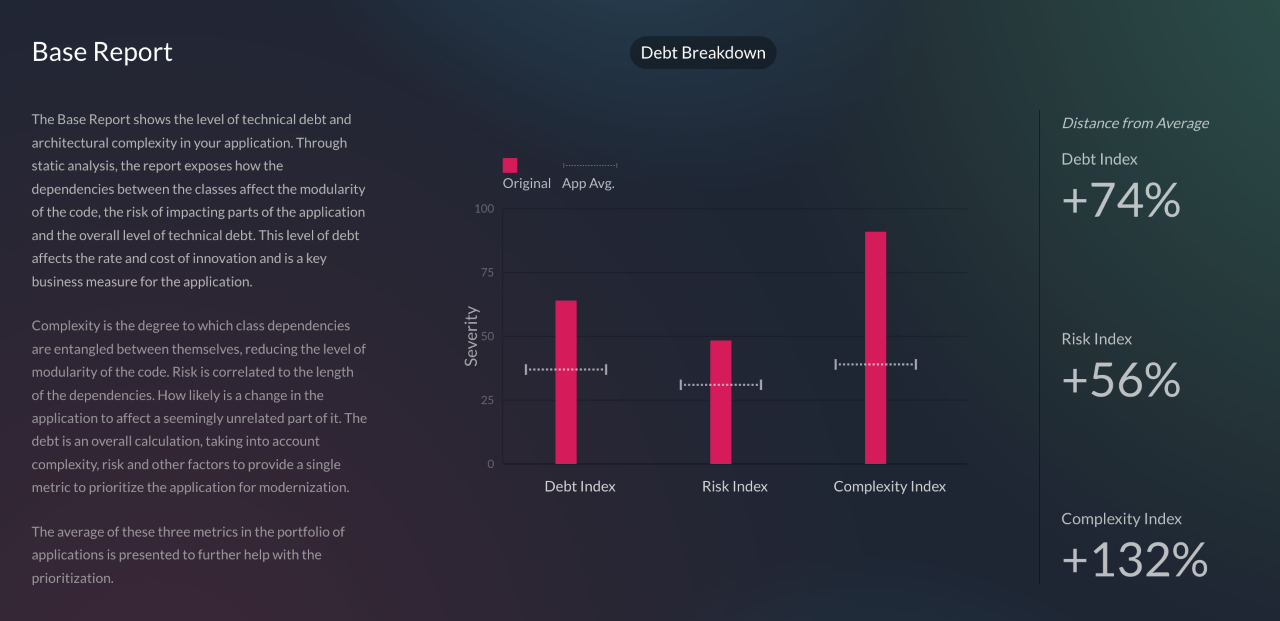
    An AI-based approach reduces the total cost of creating a business case and constructing a roadmap for modernizing existing Java applications, said Quillin. The vFunction Assessment Hub measures application complexity based on code modularity and dependency entanglements and then assesses the level of risk changes might have on the stability of the application based on the depth and length of the dependency chains. It then surfaces benchmarks for debt, risk and complexity in addition to identifying aging frameworks that could create security risks and licensing issues.

    Thus far most organizations have been content to lift and shift Java applications into the cloud without modernizing them. The application simply now runs on infrastructure that is managed by an external cloud service provider. That approach does little to improve the scalability of a monolithic Java application, noted Quillin. The goal should be to convert that Java application into a set of microservices that run natively in the cloud, he added.

    The vFunction Assessment Hub is already being used within a Java Refactoring Service for the Azure cloud provided by Microsoft that is based on agent software to analyze code and the vFunction Application Transformation Engine.

    In general, organizations are embracing microservices to build applications that are both more scable and resilient. In the event a microservice becomes unavailable, requests for services are rerouted to another microservice to make sure the application degrades gracefully, rather than simply crashing altogether. The challenge, of course, is that the dependencies that can exist between hundreds of microservices can be more challenging to manage over time than those of the monolithic application being replaced.

    It’s not likely that microservices-based applications will entirely replace monolithic applications any time soon, but the bulk of new applications are being built on top of a microservices-based framework. As such, many DevOps teams are now managing a broad mix of monolithic and microservices-based applications across IT environments that become increasingly more complex to manage with each passing day.

  • Fixing Spring4Shell Starts With Software Supply Chain Management

    Fixing Spring4Shell Starts With Software Supply Chain Management

    Spring4Shell is the latest call to action for radically improved software supply chain integrity. While Spring4Shell investigations continue, one conclusion is indisputable: We must holistically rethink the way we continuously inventory and manage the complex landscape of interrelated software and its sources.

    Whether or not Spring4Shell surpasses the breadth of impact of Log4j, there’s still massive potential for severe consequences to software and API security across the open source infrastructure, frameworks and application software stacks.

    That’s because, as we saw with Log4j, this attack could impact most enterprise Java applications globally. It seems the root cause is a vulnerability in the widely used, free, community-developed, open source programming framework Spring Core.

    The Spring framework is the foundation for most enterprise Java applications—as many as 74%, according to some data. Specifically, Spring serves as the foundation for enterprise Java apps so that teams can focus on application-level business logic without being locked into specific deployment environments.

    Spring Core’s ubiquity introduces significant potential for widespread impact due to its use across enterprise software, cloud services, third-party software and service products as well as internally managed software. This is another call-to-action to improve the way we approach software supply chain security and supply chain management. Thankfully, there’s already a place to start.

    Every infrastructure and software team can begin addressing this vulnerability by leveraging resources from The Linux Foundation’s Software Bill Of Materials (SBOM) project. The 2021 initiative included an SBOM readiness survey, a Generating Software Bill Of Materials training course and an SBOM generator tool based on the SPDX standard (ISO/IEC 5962:2021).

    The Linux Foundation’s SBOM contributions provided all of us a head start to begin addressing issues with software supply chain management. With widespread adoption, SBOM equips software projects and users to assess and address Spring4Shell as well as any other as-yet-unknown vulnerabilities and prepare us for what is undoubtedly a season of high-impact infrastructure software vulnerabilities.

    For more Spring4Shell resources, please visit: https://www.contrastsecurity.com/security-influencers/new-spring4shell-vulnerability-confirmed-what-it-is-and-how-to-be-prepared

  • Best of 2021 – Transform Legacy Java Apps to Microservices

    Best of 2021 – Transform Legacy Java Apps to Microservices

    As we close out 2021, we at devopsy.kinsta.cloud wanted to highlight the most popular articles of the year. Following is the sixteenth in our series of the Best of 2021.

    Velocity is one of the major tenets of DevOps, and anything that maintains or improves velocity benefits the overall process. Yet, there are still many speed bumps in the DevOps process that threaten to derail progress and slow DevOps processes to a crawl. One of the biggest speed bumps arises when transforming legacy monolithic applications into something more cloud-friendly—namely, microservices.

    Microservices are clearly the future of applications developed for the cloud; research giant IDC predicts that 90% of all new apps deployed by 2022 will feature microservices architectures. IDC also notes the primary benefits of microservices are the improvements to developers’ ability to design, debug, update and leverage third-party code. Although DevOps tends to be about developing internal code, the benefits offered by a microservices architecture remain much the same.

    Microservices: Getting There

    Moving toward a microservices architecture can be straightforward or complex, depending on the path an organization is taking and where they begin. For example, if the goal is to transform legacy applications into microservices, the process can be complex and tedious. Transformation of legacy applications often means manually disassembling legacy code and breaking it up into standalone code elements that will run as microservices. That greatly complicates things for the DevOps pipeline, where fast iteration of existing code is the norm, not the exception.

    However, there are tools coming to market that can ease the process. One such tool is vFunction, which recently came out of stealth with the mission to transform monolithic Java apps into microservices. 

    microservices

    vFunction has an interesting approach to that process. The vFunction platform is deployed locally, where the vFunction Java virtual machine (JVM) agent examines legacy applications and gathers data which is then collected on the vFunction server. From there, software architects can further investigate the collected information about the legacy applications, and start designing a microservices architecture to modernize the codebase. “Once developers are satisfied with the design, vFunction generates a service specification file, which contains all the information required to create the microservice,” said vFunction CEO and co-founder Moti Rafalin. “That file is used by our automation engine, which scans the original code and copies the relevant artifacts to create the new service.”

    Rafalin said that vFunction leverages supervised learning techniques, graph theory and clustering algorithms to identify dead code and code anomalies that could prevent a clean breakdown, or “decomposition,” of the legacy application. Ultimately, vFunction has the potential to automate many of the manual steps that DevOps engineers used to perform to break monolithic applications into microservices. According to Rafalin, vFunction makes the process as much as 15 times faster and can achieve somewhere between 80% to 95% automation. Currently, vFunction is focused solely on Java, which it deems the biggest opportunity today. However, the company has plans to support applications written in other languages in the future.

    Beyond newcomer vFunction, there are other ways to deal with moving legacy Java applications into the cloud. One example is Anthos, which is a managed application platform that extends Google Cloud services into DevOps environments. Another is IBM’s Mono2Micro, which is an AI-based, semi-automated toolset to assist with refactoring monolithic Java applications. 

    For those looking to build microservices-based applications from scratch, numerous tools exist. Most interesting are the development environments that use rapid application development (RAD) techniques and leverage low-code models. There are dozens of RAD platforms available; prime examples being WaveMaker , OutSystems and AgilePoint.

    In most cases, those moving legacy applications to a microservices model will usually select numerous tools, based on the particular use case. For some, it may be easier to rewrite smaller legacy applications; for others, refactoring may be the only way to capture the intellectual property in legacy applications. Either way, carefully selecting the appropriate tools goes a long way towards maintaining velocity in the DevOps realm. Maintaining that velocity proves critical for building cloud-friendly applications on budget and on time. 

    “Unless one modernizes those monolithic applications to be cloud-native, they end up requiring very large machines and often end up paying more to the cloud providers,” Rafalin said. “Organizations now understand that, if they want the true benefits of the cloud, they need to modernize these apps. And this starts with adopting an architecture that includes microservices, APIs, and modern design principles.”

    The lesson is to choose wisely, and select toolsets that support scale as well as growth, and that can support the requirements of microservices.

  • Log4j Puts Effective IT Operations at Center Stage

    Log4j Puts Effective IT Operations at Center Stage

    News of the Apache Log4j vulnerability exploit is striking fear into the hearts of both software makers and users. Log4j is the most popular Java logging service used today, with over 400,000 GitHub downloads and has been embedded in most internet services and products from companies all over the world, including Apple, Amazon, Cloudflare, Steam, Tesla, Twitter and Baidu, just to name a few.

    Exploiting this vulnerability is simple and allows threat actors to control Java-based web servers and launch remote code execution (RCE) attacks. New variations of the original exploit are being introduced rapidly—over 60 in less than 24 hours. The attack surface grows by the minute. Good credential management and advanced authentication will not help as this exploit is pre-authentication, which means an attacker doesn’t need to authenticate to your web applications to attack. Your web server is vulnerable.

    The good news is your organization likely has a team of seasoned IT operations pros that can help protect against the worst of Log4j’s devastation.

    How IT Operations Can Protect Against Log4j Vulnerabilities

    Step One: Find Log4j Wherever it Exists

    You need to investigate every internet-facing application, website and system that you own or use. This includes self-hosted installations of vendor products and cloud-based services. Focus on systems that are internet-facing that contain sensitive data. Once you’ve completed assessing your hosted apps and vendor systems, move on to endpoint applications. Java-based apps like WebEx, Minecraft, Citrix and many more.

    Step Two: Patch, Patch, Patch

    Patch in the same order as above: Internet-facing applications, websites and systems. If no patch is yet available for your apps and systems, uninstall.

    The pandemic has forced many endpoints into workers’ home environments, which creates extra challenges for patching those endpoints and keeping them compliant. Operations teams can’t rely on work-from-home folks to patch their own systems, even if they’re given clear instructions. Many of them will just ignore those directions, so you need to adopt systems that enforce continuous compliance.

    Step Three: IT Operations is Essential

    Communicate with your senior leaders. They should be in the know about this one! Senior leadership needs to position their IT operations teams among their most vital employees. Don’t think this is going to go away any time soon—we’re just starting to get a glimpse of what is being tried out there in the wild. Buckle up.