Tag: it

  • 3 Quick Fixes for Event-Driven Architecture (EDA) Complexity

    3 Quick Fixes for Event-Driven Architecture (EDA) Complexity

    Event-driven architecture (EDA) and the adoption of event streaming throughout enterprises are increasingly becoming essential architectural requirements for businesses across almost every industry. However, the more companies use it, the greater the complexity becomes. Event portals can play a pivotal role in not only gaining comprehensive insights into the intricate and expanding event-streaming ecosystem but also facilitating the auditing, management and governance of events.

    According to a recent IDC Infobrief, 93% of companies employing EDA across various applications reported that EDA either met or exceeded their expectations. Moreover, 82% of IT leaders intend to apply EDA to two to three new use cases within the next 24 months.

    Nonetheless, the number of event streaming use cases results in a surge of data volumes. This, in turn, entails the adoption of more brokers, projects and products for event streaming. For instance, an organization might use open source Kafka for one specific use case while turning to brokers like Confluent for another and Amazon MSK for yet another distinct purpose.

    While the real-time processing of data is certainly a positive development, numerous experienced EDA adopters have yet to maximize its potential. Frequently, the situation involves a one-to-one exchange, where a stream is consumed only once, or organizations, having advanced through various stages of maturity with multiple streaming use cases, find themselves entangled in a complex network of brokers, clusters, topics and overlapping schemas.

    Let’s explore three typical challenges that organizations encounter as they progress toward event-driven maturity.

    Success Needs Visibility – Make Sure Your Event Portal Can Provide It

    Application decoupling is great for runtime, but this lack of visibility on both the publish and subscribe side can cause issues when making changes to existing applications. Application producers don’t know who the consumers are and consumers don’t know who the publishers are.

    An event portal offers a single window into an event-steaming ecosystem. It provides a native discovery agent to scan, for instance, a Kafka cluster and its schema registry to produce a visual representation of every topic and its schema(s) across multiple versions–and, importantly, who its consumers are.

    If an organization were to decompose its monolithic applications into event-driven microservices that communicate with each other via, say, Apache Kafka, one of the biggest challenges is to understand and manage the infrastructure and information flows.

    Specifically, how to see the microservices affected by a given change before deploying a new feature or function to ensure it won’t bring that system down – even for as few as five seconds.

    By using an event portal, organizations can automatically scan their system and visualize a complete map of endpoints and event streams instead of manually diagraming event streams between microservices.

    Using Data at Its Best – in Real-Time

    Let’s extrapolate the poor visibility issue from one application across the entire enterprise.

    For instance, if you’ve been using Kafka for several years, especially with many departmental or specific application-type use cases, your Kafka cluster now is a treasure trove of real-time data. But data is most valuable at the moment it’s produced – as per Forrester: “Data is, without a doubt, valuable. But when stored in vaults and locked down, it is not.” Real-time data is the most valuable data that exists. But siloed event streaming data means other departments, decision-makers, customers and partners don’t know about it – therefore, it’s not getting shared or reused to its full potential.

    Typically, developers don’t have anywhere to go to find this data treasure trove. Some have resorted to building Confluence or Wiki pages that try to document that this data exists, using SharePoint or Word documents. Noble intentions, but without real-time data mining and updates, this information quickly gets stale and out of date.

    Again, this is where an event portal makes a difference, providing a perpetually up-to-date catalog of data detailing all topics, event streams, schemas and pub/sub interfaces for each application, along with owners and points of contact, as well as changes for each of the managed EDA entities. This helps expedite development by letting developers easily share, discover and re-use any existing Kafka or event streaming asset, both inside and outside the organization.

    For a real-world example of this in action, look at the Federal Aviation Administration and its SWIM (system-wide information management) infrastructure that distributes real-time information to FAA systems across the United States.

    Through secure gateways, external partners of the FAA can tap into the flow of events. Airlines and other industry partners that need the SWIM data get it in real-time, without perpetually requesting updates. Whether it’s the availability of gates at an airport, the position data of planes in the sky, or the weather for a region – external partners have the latest information without needing to ask.

    Don’t Forget to Govern Event Streams!

    The decentralized and dynamic nature of event-driven systems introduces unique security challenges. One of the common trade-offs with event streaming is that it does include access control rules, but developers can err on the side of being too permissive to ensure agility. If streams are not visible, properly cataloged, and data updated regularly, this presents problems with data security, governance and compliance.

    Using an event portal designed to give organizations visibility and control over their event streaming can turn security from reactive – to proactive. Users can organize systems into application domains, create and import payload schema definitions in a variety of formats, including AsyncAPI, define event interactions between applications and microservices, and create events and associated topic addresses using topic structure-proven practices. With the right visibility, administrators can ensure security, governance and compliance with internal policies and government regulations.

    EDA to the Rescue!

    A single, multi-broker event gateway technology offers a solution for organizations to uncover, regulate and oversee the life cycle of their real-time event streams throughout the enterprise. Its significance will continue to grow as more organizations adopt EDA as a fundamental platform.

  • How Event-Driven Architectures Drive Real-Time Operations

    How Event-Driven Architectures Drive Real-Time Operations

    People, events, the human brain—in fact, the whole world operate in real-time, but businesses have struggled to keep up. With the help of event-driven architecture (EDA) and the Open API economy, businesses can now do the same. The power of an event-driven world means that, after years of geopolitical events affecting how businesses operate, many businesses are starting to uncover real value by truly being able to operate in real-time.

    Whether it be retail and manufacturing or energy and resources and financial services, locating and responding to vital issues within a company’s supply chains or product lines in real-time, is key to success.

    Amazon’s CTO, Dr. Werner Vogels, said that “the world is event driven” in his keynote speech at AWS re:Invent in December 2022. Now, new IDC research unveils that nine out of 10 of the world’s largest companies will deploy real-time intelligence driven by event-streaming technologies by 2025.

    But What’s the Secret Behind Such Success?

    A recent IDC Infobrief, sponsored by Solace, surveyed over 300 enterprise IT professionals in North America, Asia and Europe, all of whom work for large companies implementing or considering EDA. The results are quite telling–an overwhelming 93% of respondents at companies that have deployed EDA across multiple use cases said EDA has either met or exceeded their expectations. In addition to technical advantages from EDA, most businesses also see clear business benefits: A full 23% of respondents reported increasing productivity; 22% said better customer acquisition and 18% saw revenues increase as a result of EDA efforts.

    1. Get Support From the Top to Ensure Alignment Throughout

    Expanding the footprint of EDA across the enterprise is a journey, and every journey starts by assembling those that are critical to its overall success. Business sponsorship and engaging key stakeholders is vital, especially in the early days of EDA adoption – 56% of respondents in the early EDA stages cited this as a priority when ROI and business benefits may not be immediately clear.

    The impact of well-aligned C-suite, operational and technical teams is reflective of business-level digital maturity, too. As 35% of respondents at an advanced stage of EDA rollout felt C-level support was critical, it comes as no surprise that respondents with higher levels of EDA maturity also have higher levels of overall digital maturity, including digital strategy and change management support.

    2. Tackle Complexities Head-On With the Backing of IT

    As EDA becomes more pervasive across an organization, demands on IT become more sophisticated, requiring a deepening of EDA skills in the IT organization, notably with DevOps teams, developers and architects. More than one-third (36.1%) of respondents cited the lack of skills to execute EDA as a hurdle to adoption. Approaches to logging, governance and oversight (30.7%) can also become increasingly challenging and must be thought through carefully.

    This is where EDA providers themselves need to step up and provide adequate training and a certification path for architects DevOps and developers looking to gain the fundamental knowledge and skills to design and implement event-driven systems. This should include technical details such as understanding various design patterns for EDA, microservices choreography versus orchestration, the saga pattern and RESTful microservices. Education should also clearly define and demonstrate key concepts and tools for EDA success, such as event portal, topic hierarchy best practices and event mesh.

    3. The Benchmark for Success Chops and Changes: Businesses Need to Go With the Flow

    The right measures of EDA success in the early days of adoption are not the same measures as EDA adoption grows over time.

    Fewer EDA-mature organizations cited “cost reduction” (23%) and “number of projects completed” (31%) as top measures of success. In the medium term, after two or three use cases, most organizations saw “operational stability” along with “number of projects” to measure success. Further, after broad adoption, “increased revenue” (43%), “operational stability” (32%) and “amount of resiliency” (30%) become more important measures.

    This changing set of measures is reflective of the maturity curve of EDA adoption across multiple applications within a business’s ecosystem. A business is truly operating in real-time when deploying EDA across key customer-facing, employee-facing and supplier-facing organizations. This is where revenue is being generated in high volumes, organization-wide – hence stability and resilience become key to ensuring things continue to run smoothly on what can often be a global scale.

    4. Keep Everyone in the Loop

    It is essential to take the company with you along the entire journey. The research showed the bumps in the roadmap. In the early stages of EDA maturity, lack of understanding of EDA benefits and inconsistent buy-in are the most frequently cited organizational challenges (38%). As organizations progress to a centralized EDA status, cost concerns (42%) and finding the right use cases (36%) can hamper success. More advanced stages of EDA also cite a lack of understanding of EDA benefits (45%), and cost concerns (39%) but change resistance (38%) becomes a major hurdle.

    Continuous focus on change management and communicating business benefits is vital. The core group of invested stakeholders who began the journey must band together to demonstrate the value of EDA clearly and consistently to other areas of the business on a regular basis.

    5. Recognize the Benefits That Partners Bring to the Table

    To accelerate business and technical benefits and reduce the impact of challenges, survey respondents cited “finding a supportive partner to assist with the implementation of EDA” (37.7%) as a critical consideration. Partnerships and product integrations with the providers of preferred business software and SaaS services can make it easy to event-enable an organization. Given the amount of new technical skills and learning previously cited, this can provide peace of mind for organizations taking their first steps on the journey to EDA.

    EDA isn’t just a change in IT architecture, it’s a mindset that applies to modern business leadership organization-wide. To keep the momentum during the journey, respondents also noted the use of a robust change management plan that “ensures coordinated middle management support” (35.1%), as they are typically accountable for getting work delivered and reporting across the organization.

    EDA Becomes the Norm

    The InfoBrief results speak for themselves – EDA is quickly becoming the “normal” process for businesses looking to operate in real-time. As more and more companies recognize the business benefits at stake, understanding these five requirements will be a necessity for successful EDA deployment.

  • Survey Surfaces Major Observability Challenges

    Survey Surfaces Major Observability Challenges

    A recent survey found the biggest obstacles to observability were the pace of technology change, IT blind spots and the complexity of modern applications. The survey polled 300 IT professionals to identify the biggest challenges they faced in achieving observability. The accelerating pace of technology change (72%) topped the list, followed by IT blind spots and the growing complexity of modern applications (58% each), and lack of funding (52%).

    The survey, conducted by SolarWinds, also found the typical enterprise suffered nine brownouts or outages every month, each of which lasted around twelve hours. The full cost of outages and brownouts averaged $13.7M annually for these enterprises, according to the SolarWinds report.

    Jeff Stewart, field CTO and vice president, global solutions engineering at SolarWinds, said the survey makes it clear that a lack of observability is having a material impact on businesses. Organizations are now moving beyond monitoring predefined metrics to embrace observability platforms that make it simpler to investigate the root cause of issues that adversely impact businesses; these businesses are more dependent on IT than ever, he added.

    In fact, the primary reason organizations are investing in observability is to improve their customer experience (96%), enable faster innovation (71%), reduce time spent solving (71%) and detecting (60%) issues and improve operational efficiency (55%), the survey found.

    While it’s still early days as far as achieving observability is concerned, a lot of progress is starting to be made as organizations realize that complex IT environments require a different management approach. IT teams can no longer afford to navigate multiple monitoring tools in what often turns out to be a vain effort to prevent brownouts and downtime, noted Stewart.

    In addition, many IT teams are becoming increasingly aware that the telemetry data collected via an observability platform provides the foundation for infusing IT operations with artificial intelligence (AI) capabilities, he added. The ultimate Holy Grail is to one day achieve autonomous operations, noted Stewart.

    There is, of course, no shortage of observability platforms, but Stewart contends that providers of monitoring tools such as SolarWinds are in the best position to help IT teams make the observability transition. Rather than ripping and replacing a monitoring platform, a more seamless transition that results in less disruption is preferable, he noted.

    Regardless of approach, observability platforms that enable IT teams to launch queries across complex distributed computing environments are becoming a necessity. Distributed computing environments often have more dependencies than IT teams can manually track. It’s only a matter of time before the most talented DevOps professionals start to migrate to organizations that provide them with the management tools and platforms required to succeed. Otherwise, the stress of managing a complex IT environment will only result in higher rates of burnout among DevOps professionals.

    It may be a while before observability platforms are pervasively employed across IT environments, but as it becomes clear that brownouts and downtimes result in a decline in revenue, business leaders will understand what’s required to maximize profits. In many cases, the answer will be an observability platform that surfaces the insights needed to proactively manage modern IT environments.

  • SmartBear to Acquire Stoplight to Advance API Governance

    SmartBear to Acquire Stoplight to Advance API Governance

    SmartBear announced today it plans to acquire Stoplight, a provider of tools for editing and governing application programming interfaces (APIs).

    Sean Butler, vice president of product management for SmartBear, said the deal, once finalized, will add a set of complementary tools and open source software that extends the core API catalog platform that SmartBear provides to manage APIs. The open source software provided by Stoplight includes Prism, an HTTP mock server that emulates API behavior; Spectral, an API style guide enforcer and linter; and Elements, an API Documentation tool.

    The governance capabilities are especially critical as organizations begin to deploy hundreds, even thousands, of APIs that are used to integrate the microservices that are at the core of modern cloud-native applications, noted Butler.

    As those applications are deployed, the management of APIs is naturally becoming more challenging. Organizations, for example, might have a different set of rules for APIs that are externally facing than they do for internal APIs. However, it’s not uncommon for internal APIs to be made externally facing without updating them when a new use case is discovered.

    SmartBear is advocating a “design first” approach to the building of APIs that ultimately serves to make them simpler to manage, said Butler. In fact, good governance provides the foundation upon which API security can be achieved and maintained at a time when the number of cyberattacks seeking to exfiltrate data via API endpoints is starting to increase, noted Butler.

    Unfortunately, too many developers are still prone to building and deploying rogue APIs, many of which turn into zombie APIs that developers forget to remove long after the function they were designed to enable is no longer required.

    It’s not clear how many organizations are adopting a design-first approach to building APIs before they write application code, but as more APIs are deployed, the way IT is managed is rapidly changing. Application services are essentially becoming more disposable, so long as the APIs used to expose them to other applications remain stable. In fact, it’s now only a matter of time before most organizations fully appreciate the degree to which their entire IT strategy now revolves around their APIs.

    The challenge is that it’s not always clear who within an IT organization is responsible for API management. Although an API is created by a developer, that developer eventually moves on to other projects. Therefore, responsibility for managing and updating APIs often winds up shifting to DevOps teams that were not part of the API development process.

    One way or another, the management of APIs will need to improve once legislation that holds organizations more accountable for how data is managed becomes law. The issue that many organizations will soon discover as they move to address those requirements is: A general lack of visibility into both the number of APIs they have and, just as importantly, how they are being employed.

    Hopefully, advances in artificial intelligence (AI) will one day soon make it simpler to manage APIs. In the meantime, however, a modicum of governance applied today should go a long way to preventing a problem that otherwise is all but inevitable.

  • How Platform Engineering Bridges the IT and DevOps Divide

    How Platform Engineering Bridges the IT and DevOps Divide

    Ballooning lead and process time, with an opaque corollary relationship to fixed and marginal cost, is a significant and complex burden for any enterprise. And multi-cloud complexity and inefficient organizational and technical processes are some of the most wasteful areas companies face–so much so that Synergy Research reports organizations are cutting back on their cloud spend as tech budgets continue to fall under intense scrutiny, resulting in a Q1 2023 cloud spending growth rate of 19% compared to 32% just last year. With cloud cost containment a top priority, Forrester advised tech leaders to demonstrate to CFOs how they will stay on budget and demonstrate ROI at the board level. A key area where companies can eliminate expensive waste and increase time to value is the relationship and workflow between IT and developers, which, while being the DevOps charter for nearly 15 years, has gotten less attention among the viable cost-containment strategies for enterprises in 2023. Revisiting the latest iteration of this DevOps charter through the implementation of platform engineering strategies can help enterprises create a faster, leaner and more scalable dynamic. Let us examine why it’s now time for enterprises to consider platform engineering as a potent way to not only increase efficiency but also to bridge the divide between DevOps and IT.

    The Old Way: Forcing DevOps to Dance to the ITSM Tune

    In traditional enterprise organizations, IT typically dictates a top-down ITSM practice that limits the tools an organization can use for development and deployment; in many cases, it inhibits CI/CD and other core capabilities and practices of DevOps. This awkward attempt to accommodate modern DevOps practice through an aging ITSM paradigm has led to a suboptimal software delivery performance and poor developer experience (DX).

    McKinsey, highlighting the criticality of DX, found developers at a leading SaaS provider spent 20% to 30% of their time integrating different services such as firewall changes, DNS and security access to deliver code through its CI/CD pipeline. That’s a lot of time spent on low-value, repetitive tasks, ensuring a painful journey for a disappointing result. If the DX pain is high enough, developers often go around IT and create resources on their own, leading to shadow IT, adding new cost burdens and growing security exposures. Every minute and engineer count: Five minutes saved per day among 500 developers saves a week’s development time.

    Surely, there is a better way.

    Platform Engineering: Collaboration Through Composition

    Platforming engineering and “platform as a product” have been key to the PaaS ecosystem for years but are now gaining fresh traction in the industry. In Puppet’s State of DevOps Report, 51% of respondents said they had already adopted platform engineering and 93% said it was a step in the right direction. Gartner predicted 80% of software engineering organizations will have platform teams by 2026.

    The concept can be defined in several ways. Gartner reported platform engineering is “an emerging trend intended to modernize enterprise software delivery… designed to support the needs of software developers and others by providing common, reusable tools and capabilities, and interfacing to complex infrastructure.” PlatformEngineering.org’s recent blog post defines it as the discipline of designing and building toolchains and workflows for self-service capabilities in software engineering organizations during the cloud-native era.

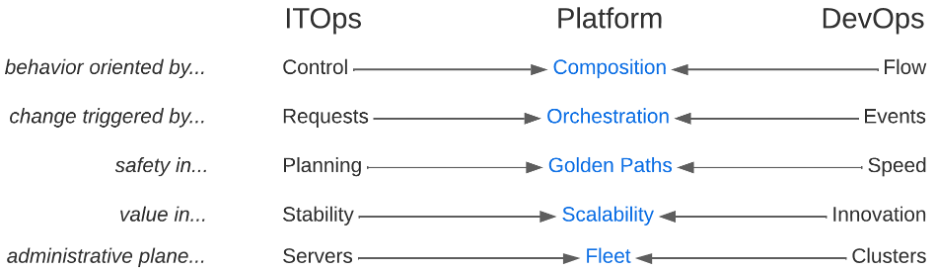
    Regardless of definition, platform engineering is the latest iteration of IT centralization, though now attempting to retain all the benefits of distributed team empowerment through “composition” rather than converged control. As modernization continues, we experience the ebb and flow of composition and decomposition, both organizationally and technically. Microservices, Kubernetes, and GitOps patterns pushed the rational limits of decomposition and significantly raised the level of technical complexity in the enterprise. The natural counter pressure is a new cycle of composition that aims to simplify that complexity through platform engineering practices. Teams now look for these toolchains and workflows to be centralized in internal developer platforms (aka IDPs), exposing the development, deployment and maintenance of the entire life cycle of modern, cloud-native applications.

    IDPs can facilitate the flow, speed and innovation DevOps teams are demanding without sacrificing stability, security and control. They enable developers to configure their toolchain while meeting all controls through approved blueprints or “golden paths,” reducing lead and process time. Developers can focus on delivering business value instead of infrastructure tasks.

    Bringing IT and DevOps Back Into Alignment Saves Time, Money and Sanity

    Platform engineering creates a collaborative framework that connects IT and DevOps teams, so they can focus on outcomes rather than methods. Developers can use an IDP to follow conventions that speed up development and prevent anti-pattern creep. Guardrailing choices through golden paths reduce cognitive load and simplify execution context for security teams. The result? Developers can focus on what they were hired for and want to do–creating innovative, transformative applications and differentiated value. Security can sleep well knowing bespoke behavior isn’t opening new attack surface areas.

    On the Day 2 operations side, IDPs enable SRE and support teams to have a fleet-wide view and work effectively with developers to streamline the management of production needs across all applications, clouds and tech stacks.

    The reframing of composition breaks the false dichotomies between IT and DevOps practices. You don’t have to choose between control and flow, change isn’t triggered by serial requests or async events, safety isn’t found in planning or speed, value isn’t found in stability or innovation and administrative plane primitives aren’t servers or clusters. Platform engineering practices allow you to prioritize composition, orchestration, golden paths, holistic scalability and fleet management to get teams out of entrenched myopia and embrace systems thinking that gets your business delivering strategic gain instead of tactical win/loss tallies.

    Finally, platform engineering positively impacts software delivery and operational performance metrics by streamlining development processes and reducing manual efforts. The bottom line is faster time to market while ensuring more consistency, less human error and improved software quality. This maximizes productivity, minimizes downtime and optimizes resource utilization, leading to cost advantages and increased efficiency for enterprises.

  • Revolutionizing DevOps With Low-Code/No-Code Platforms

    Revolutionizing DevOps With Low-Code/No-Code Platforms

    The DevOps industry is growing at an incredible pace, with its worth exceeding $8 billion in 2022. Analysts predict that the market will experience a five-fold increase and reach almost $40 billion by the end of the decade. But with this growth, there is a significant issue within the DevOps chain that continues to escalate: A widening talent gap. The U.S. Department of Labor predicted that by 2030, the global deficit of development engineers will exceed 85 million. Additionally, the demand for DevOps professionals is expected to increase by over 20% annually throughout the rest of the decade. These conflicting trends present significant challenges for software and application companies. While there is a substantial opportunity to generate revenue by creating new and better applications, the shortage of skilled personnel to develop these products is a significant roadblock. Integrating low-code and no-code tools into the DevOps process could be a viable solution to address the talent gap. These tools offer various benefits and efficiencies, including streamlining the work of existing DevOps professionals and enabling organizations to expand their teams beyond traditional personnel sources. Leveraging these tools could give companies in the DevOps industry a competitive advantage.

    Challenges of Traditional DevOps

    Traditional DevOps practices pose significant challenges for companies that hinder productivity and overall success. The first significant issue is the talent shortage. According to a report by the Manpower Group, 75% of employers consider finding tech talent their primary concern. As the demand for experienced DevOps professionals continues to grow, it is becoming increasingly difficult for companies to find the right personnel.

    Another significant challenge in traditional DevOps practices is the high learning curve. The prediction by Gartner that 75% of DevOps initiatives would fail to meet expectations by 2023 highlights the severity of the learning curve and the challenges associated with adopting DevOps practices without proper training and experience.

    To avoid delays, increased costs, and suboptimal productivity, companies should explore innovative solutions such as low-code and no-code platforms. This would enable citizen developers to contribute to the development process and streamline infrastructure management processes, enabling greater efficiency and scalability in their DevOps practices.

    How Low-Code/No-Code Revolutionize DevOps

    Low-code/no-code platforms are gaining widespread recognition for their potential to drive app development across organizations, as Gartner predicts that by 2024, 80% of apps will be developed by non-IT professionals. The adoption of these productivity tools can bring significant benefits to the DevOps landscape, particularly in the following ways.

    Reducing Workloads and Stress
    By using low-code and no-code software, organizations can distribute basic app-building and basic development tasks across the organization, freeing up skilled developers’ time and reducing their workload and stress. This significantly improves the workplace experience and enables developers to focus their time on delivering more complex, high-quality solutions.

    Accelerating Innovation With Low-Code/No-Code Platforms
    Low-code/no-code platforms can accelerate innovation by enabling developers to quickly spin up proofs-of-concept for more complex software development tasks that require coding expertise. Ideas and solutions can be tested before investing time and resources in full-scale development.

    Creating New Roles and Opportunities
    No-code platforms can create new roles and opportunities within the enterprise, such as no-code projects focused on optimizing processes and building solutions. Citizen developers without coding experience can pursue new career paths and opportunities to contribute to their companies’ success. One example is applying no-code technology to digitize paper forms across organizations. Employees without coding experience can create mobile apps that speed data collection, improve data accuracy and allow for instant digital data sharing and analysis.

    Giving Developers a More Strategic Role
    With tactical software development carried out within business units, developers can spend more of their time focused on cutting-edge technologies like mixed reality, quantum computing, and AI. This can give them a more strategic role in the enterprise and enable them to focus on the “next big thing.”

    Considerations and Challenges

    While low-code/no-code platforms have the potential to offer numerous benefits to DevOps teams, it’s important to be aware of challenges that have arisen when pairing the two successfully, and how to avoid them.

    Poorly-Designed or Insecure Applications
    With non-IT professionals developing applications, there is a higher risk of introducing vulnerabilities that could compromise the security of the application and the organization. Additionally, the lack of oversight and governance could lead to poor coding practices and technical debt. For instance, the use of new-generation iPaaS platforms by citizen integrators has made it difficult for security leaders to have full visibility into the organization’s valuable assets. Attackers are aware of this and have already taken advantage of improperly secured app-to-app connections in recent supply chain attacks, such as those experienced by Microsoft and GitHub.

    Companies need to make sure IT staff carefully check how low-code and no-code technologies are adopted and how apps are reviewed in order to reduce vulnerabilities.

    Limited Customization and Scalability
    While low-code/no-code platforms can help speed up application development by up to ten times, their limitations can create hurdles when building large, complex applications. These platforms can be useful for basic application development, but they may not be suitable for complex or highly-customized applications. For example, if your app requires robust offline capability that handles conflict resolution and on-device offline storage, you’re better off selecting a low-code platform like Alpha Anywhere than a drag-and-drop app builder like Appypie, which is a fit for less complex apps.

    Complex Integrations With Legacy Systems
    As organizations try to integrate low-code and no-code applications with legacy systems or other third-party applications, technical challenges can arise. For example, if an organization wants to integrate a low-code application with an existing ERP system, it may face challenges in terms of data mapping and synchronization. Some low-code and no-code applications are built to export data and share it well, but when it comes to integrating event triggers, business logic, or workflows, these software solutions hit limits. Buyers need to consider their requirements carefully before making a purchase.

    To address the potential challenges of low-code/no-code platforms, organizations must establish governance policies and procedures to ensure adherence to security and quality standards. This includes implementing proper access controls with zero-trust security, data privacy measures and vulnerability management processes. Organizations should work with their low-code/no-code platform providers to ensure seamless integration with other systems and scalability to support evolving needs. Along with this, regular assessments and audits of applications developed using low-code/no-code platforms can also help identify and address security risks before they turn into significant issues.

    Conclusion

    The integration of low-code/no-code platforms into DevOps practices represents a promising solution to address current challenges in the industry. By leveraging these platforms, organizations can expand their teams beyond traditional personnel sources and create a more inclusive environment for non-IT professionals to contribute to the development process. The rise of no-code is a win-win for everyone, and as early adopters seize this opportunity, they can gain a significant competitive advantage in the market. The future of DevOps is exciting, and the potential of low-code/no-code development is limitless, unlocking the innovation potential of all employees and empowering them to make a difference in their organizations.