Tag: IT services

  • Observability: The Central Watchtower Your All-Seeing IT Needs

    Observability: The Central Watchtower Your All-Seeing IT Needs

    If there’s something you need to keep secure, it’s natural to want to keep it sealed away under lock and key. However, even keeping something in a vault, far from prying eyes and ill intent, may not be enough to offer peace of mind. After all, how can you have the peace of mind of knowing it’s safe if you don’t regularly check to ensure it hasn’t bolted, been burgled or broken down?

    Now, multiply the volume and value of things being monitored tenfold — and you get a sense of the daily inefficiencies and anxieties IT professionals battle.

    Instead of jewels, these teams safeguard, manage and maintain something far more valuable: The data that underpins everything from business transactions to system performance to threat detection to service delivery and beyond. To make matters more complicated, today’s digital ecosystems are more complicated, distributed and disparate than ever before.

    Databases are critical to managing a successful IT department — and it’s time to discard the widespread industry’s perception of them as an unknowable black box. To be sure, databases represent the most difficult component of the IT ecosystems to observe, tune, manage and scale. But the database isn’t a Magic 8 ball in terms of its internal processes; We no longer have to shake the mystery toy and accept one of the six answers it’s designed to spit out.

    The fact of the matter is that database specialists and IT teams need a clear view of database performance telemetry if they want any hope of maintaining the health, stability and scalability of their services.

    Observability Tools

    This is where observability tools can play a transformative role. Taking its cues from the all-seeing panopticon watchtower, observability eliminates the dark corners of the database dungeon by providing a comprehensive view across the full cloud-native, on-premises and hybrid technology stacks.

    The word panopticon derives from the Greek word panoptes, or “all-seeing.” The panopticon model features a central, lighted guard tower at the center of a circular room — allowing 360-degree lines of sight that allow the guards to observe every surrounding cell from a single, centralized vantage point.

    English philosopher Jeremy Bentham had no way of foreseeing the challenges of today’s database professionals when he first conceived of the panopticon in the 1700s. The concept would lay the blueprint for a prison system designed around one core concept: Enabling the minimum number of guards to effectively monitor the maximum number of inmates. Bentham’s system also works as a strategy for ensuring the health and performance of your organization’s critical databases.

    The panopticon was designed so that every cell could be monitored from one central point — ensuring not only better and more straightforward security but preserving resources in saved time, manpower and effort expended. Think of your ITOps, database, DataOps and DevOps teams as the wardens of your IT performance. Traditional monitoring can be likened to patrolling a traditional prison: Rows of cells facing out into a hallway that is patrolled on a schedule or used to spot and address misbehavior as it’s noticed.

    How can they be sure they’re focusing their efforts in the right place? Or trust that Cell Block A won’t stage a breakout while they’re breaking up an argument in Cell Block B?

    In short: They can’t. Odds are, the team is either running from outage to outage in an everlasting firefighting mode or relying on random spot checks for something as vital as the health of our IT systems.

    Observability, as opposed to monitoring, puts teams into that central panopticon watchtower, allowing them to not just see everything, but to see it within the context of the bigger picture. This comprehensive visibility and always-on observation enable IT teams to identify critical issues as they occur, even those caused by complex dependencies between the database, operating system, storage subsystem and network.

    Database Performance Issues

    Furthermore, database performance issues are a starting gun for costly bottlenecks or serious outages that can handcuff your company’s ability to compete or grow. Without complete and precise database monitoring and observability, IT operations struggle to accurately determine an application’s root cause of performance issues. This increases the risk of downtime, data loss and poor customer experiences.

    Discovering the root cause of performance issues is quite literally a system-critical undertaking, whether you’re simply running your enterprise, scaling your operations or deploying new code. Observability also offers teams the rare opportunity to get ahead of performance issues since you can see performance anomalies in advance of a service disruption rather than relying on real-time remediation.

    With traditional methods, DevOps and IT teams must manually analyze the data presented to them, correlate it to the problem, and locate the error before they can finally begin addressing it. In contrast, observability collects data to provide information on what’s not performing as expected and why. This allows teams to take a proactive approach to solving downtime and bottlenecks and proactively preventing them.

    In the software world, that translates directly to more time spent where it matters: Developing new business value within your applications and infrastructures, fueling innovation and exceeding customer expectations.

    Given how complicated the modern database has — and continues to — become, arming your enterprise with the right observability solutions can provide a boost to efficiency and performance and pardon your teams from a sentence to time-consuming, mundane and error-prone work.

  • How IT Services Can Embrace Platform Engineering

    How IT Services Can Embrace Platform Engineering

    We are all familiar with DevOps as a newer approach to software development. The concept is designed to enable developers and IT operations teams to work together. Platform engineering, on the other hand, is a more mature, older approach that has become new again.

    Platform engineering, at its core, is the concept of productizing your internal development platforms to make it easier for developers to work. It is an emerging technology approach that can help accelerate the delivery of applications and the pace at which they produce business value. More recently, companies have grown their complex software architectures which have created silos for the teams that manage these various architectures. There may be multiple teams with various specialized skill sets and a single DevOps engineer who takes care of the continuous integration (CI) jobs to deploy and release to production.

    Now let’s imagine that you have 10 squads that focus on building and maintaining different applications. Now all of these teams are building and operating 10 different platforms to run their applications, which creates inefficiency across the teams and reinforces silos. In this scenario, teams may spend half of their time building and maintaining the platforms instead of delivering business value. This creates a large cognitive load on developers.

    This model becomes very hard to scale. Even though you have these squads managing their own infrastructure and platforms, you may find gaps because there is no centralized standard. So how do platform engineering concepts help with these complex landscapes and boost efficiency?

    The Consulting Mindset

    Platform engineers take all of the tools used to run an application across your various teams and standardize their usage. This enables self-service capabilities for your engineering organizations. Platform engineering can help centralize how you are deploying and running your applications across a complex software landscape. This includes not only the standardization of tools being used but also documentation and processes.

    Establishing platform teams requires a consulting mindset and thinking about what resources, services and components can be centralized to better serve the rest of the organization. Some may refer to this as the center of excellence (COE) model, or simply IT for IT. This boosts efficiency and cuts down the time to delivery by providing a central set of tools and platforms for your engineering organization. Many may see platform engineering as a cost center, but the ROI is higher-quality releases, a standardized way of developing and delivering software and shorter delivery times.

    Applying This Concept to IT Services Firms

    In my consulting days, I worked for firms that focused on delivery for the Salesforce platform. We often had complex projects that we needed to deliver for large enterprise customers who had multiple applications integrating into their CRM. Each project team often had a different way of delivering and developing based on the customer’s needs. This created specialized skill sets, but we had no standard way of developing and delivering. Investing in a platform engineering team to support the delivery organization can add immense benefits for large consulting firms, enabling them to standardize the tools and platforms being used to run and deliver applications at scale.

    Having a centralized place for your developers to go for process, documentation and tools to help them build and run applications can increase the speed at which they deliver. The efficiencies gained in having a smoother self-service flow for your developers and cutting down the delivery time are worth the investment. It brings significant long-term value that the customer will experience long after the engagement is completed, which can greatly impact future considerations for your firm.

    IT services firms should find ways to align and centralize their technologies with platform engineering concepts. You may not be able to exactly build out an internal developer platform, but adopting some of the core concepts will help you be more efficient as an organization. For example, if you are an IT services firm specializing in delivering applications on the Salesforce platform, look for extensible DevOps platforms that can support your development organizations.

    Also, look for ways to enable a self-service workflow to make it easier for your developers to work and scale. This may include investing in a platform engineering function to support the rest of the delivery organization. By establishing platform engineering concepts, you will be able to cut down the delivery time and create consistency in how you deliver and deploy applications for your customers.

  • Cloudflare Adds Digital Experience Monitoring to CDN Portfolio

    Cloudflare Adds Digital Experience Monitoring to CDN Portfolio

    At an online CIO Week event, Cloudflare today added a digital experience monitoring capability to a portfolio of services layered on top of its core content delivery network (CDN).

    Corey Mahan, director of product management for Cloudflare, said the Cloudflare Digital Experience Monitoring service extends a Cloudflare Zero Trust platform based on agent software dubbed Cloudflare WARP. The solutions delivers a wide range of software-as-a-service (SaaS) offerings spanning everything from data loss prevention (DLP) to email security.

    He added that the overall goal is to reduce the total cost of IT by delivering SaaS application services more efficiently using a single agent rather than having to deploy multiple agents for each service.

    The Cloudflare Digital Experience Monitoring service, available as a private beta, will enable IT teams to leverage the Cloudflare CDN to measure and analyze controlled data flows to public or private resources by emulating traffic flows using synthetic data. Via integration with the Cloudflare Zero Trust platform, IT teams can also access real-time data visualizations highlighting anomalies in connectivity or performance that might, for example, be indicative of a security breach, noted Mahan.

    While there’s no doubt IT organizations are looking to streamline the number of IT vendors they need to manage, it’s not clear what the center of gravity will be for achieving that goal. Cloudflare is making a case for using the same global CDN that many organizations already rely on for networking services.

    The Cloudflare Digital Experience Monitoring service leverages the company’s CDN to make it simpler to understand, for example, why users in one geography experience sub-optimal application experiences compared to another, said Mahan. That’s especially critical when more organizations than ever have employees working from home across multiple geographies, he added.

    In the longer term, more networking and security functions will be consumed as a service. The challenge then becomes integrating those services into the DevOps workflows that are employed to deploy applications across a highly distributed computing environment. In many cases, what might initially appear to be an application performance issue winds up being a network connectivity problem that is more easily solved.

    One way or another, the management of IT services in the months and years ahead will continue to converge. Organizations of all sizes will need to determine whether it makes economic sense to acquire platforms they need to manage versus consuming a service that is managed on their behalf. Most of the time, a service will be easier to consume and free up resources that can be applied to other IT functions, such as application development.

    Of course, organizations will also need to take care to avoid locking themselves into a specific services provider. Ultimately, however, the question is whether managing a specific IT function provides enough differentiated value to be worth the time and effort when there is so much more to do.

  • Atlassian Launches ITSM Platform

    Atlassian Launches ITSM Platform

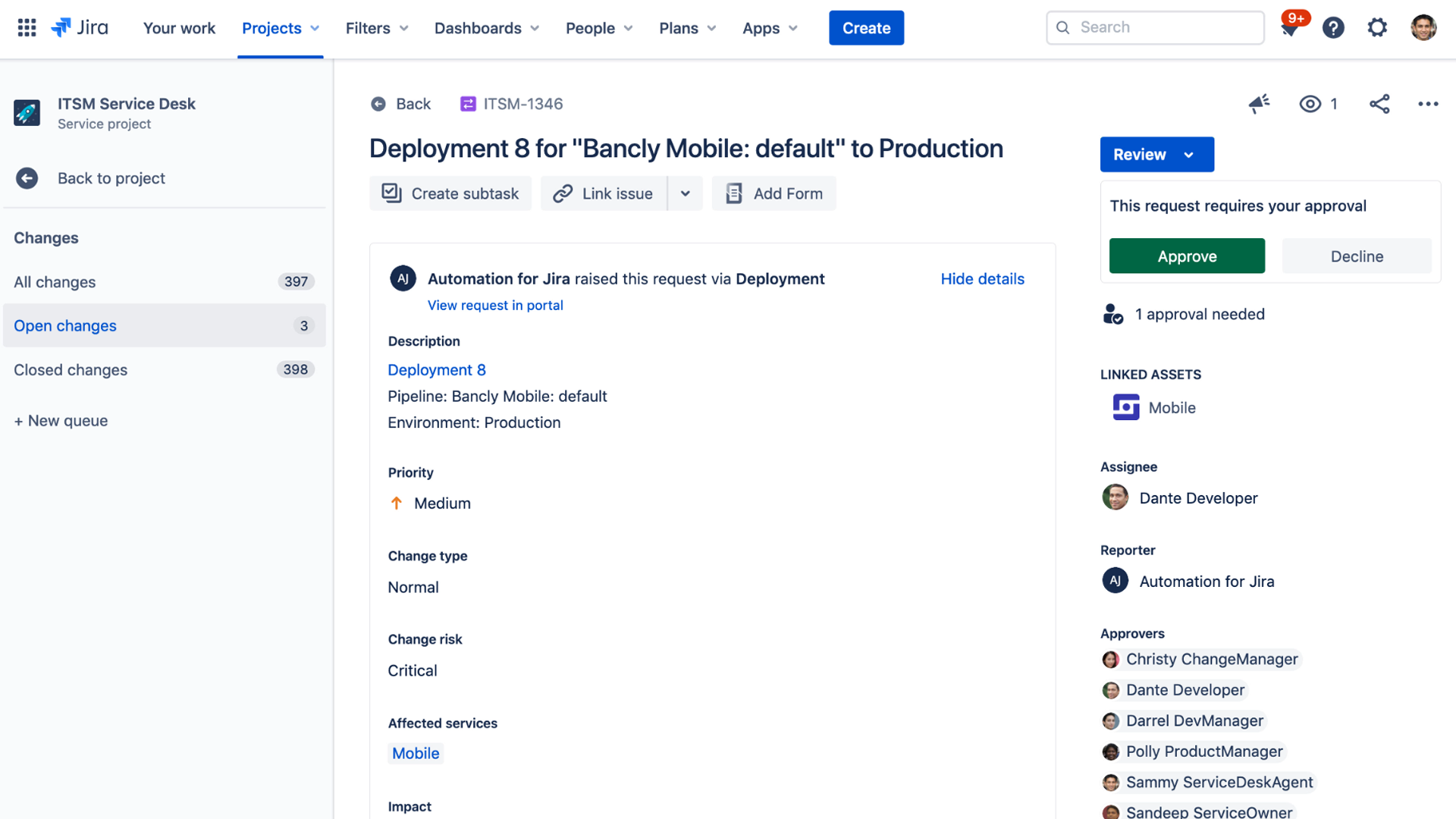
    Atlassian today extended its footprint in IT service management (ITSM) with the launch of Jira Service Management, a cloud-based platform designed to bridge the divide between DevOps and ticket-based approaches to managing IT.

    Edwin Wong, head of product for IT at Atlassian, said Jira Service Management builds on Opsgenie, an IT incident management platform. The goal is to provide an ITSM platform to better manage IT at a higher velocity by enabling developers to address IT support processes more easily, he said.

    Going forward, Jira Service Management will add asset and configuration management and conversational ticketing capabilities that Atlassian gained via the recent acquisitions of Mindville Insight and Halp, he added.

    Jira Service Management currently provides support for on-call scheduling, alerting, incident swarming from Opsgenie along with deeper integration with Jira Software for project management, the Bitbucket repository and Confluence collaboration software.

    IT team cans also leverage capabilities such as bulk ticket actions along with machine learning algorithms to intelligently categorize similar tickets, noted Wong.

    Jira Service Management replaces the Jira Service Desk platform that many development teams already use to manage incidents. The goal now is to provide a platform that makes it easier for developers and IT administrators to collaborate more easily to resolve issues, he said. There are currently more than 25,000 organizations that employ Jira Service Desk, which Wong said provides the base of customers from which Atlassian intends to drive convergence of DevOps and ITSM workflows.

    Most legacy ITSM platforms were designed for IT administrators. However, as IT continues to evolve developers are assuming responsibility for applications end-to-end. That transition requires a different approach to ITSM that provides deeper integration with DevOps tools that enable developers to resolve issues without requiring IT organizations to convene a “war room” meeting for each incident, said Wong.

    The launch of Jira Service Management comes at a time when more organizations are starting to transition ITSM to the cloud. With most IT staff working from home either full- or part-time to help combat the spread of the COVID-19 pandemic, organizations need ITSM platforms that are easily accessible from anywhere.

    Each IT organization will need to decide to what degree they need to converge DevOps and ITSM workflows. The goal should be to enable developers to resolve issues efficiently when required. There is still a need for ticket-based approaches to managing IT that are based on the ITIL framework. However, organizations are discovering that ITIL-based frameworks don’t enable the level of agility required to quickly resolve incidents involving custom application software.

    Regardless of the path forward, ITSM is entering a new phase as organizations start to appreciate how dependent they are on software. The days are coming to an end when end users log into an ITSM platform to create a job ticket that is addressed by an IT administrator who would contact a developer if necessary. What’s required is a more proactive approach that immediately alerts developers whenever there is an issue. The challenge is enabling that level of support in a way that creates the least amount of friction possible.

  • Dell Launches Project Apex to Deliver IT as a Service

    Dell Launches Project Apex to Deliver IT as a Service

    Dell Technologies today launched Project Apex, an initiative that promises to significantly expand its ambition to deliver IT as a service from the edge to the public cloud.

    Announced at the online Dell Technologies World 2020 conference, this initiative builds on the Dell Technologies Cloud Platform through which Dell manages IT infrastructure as service on behalf of customers.

    Sam Grocott, senior vice president of product marketing at Dell Technologies, said via a single pane of glass organizations will be able to deploy and manage application workloads running on IT infrastructure provided by Dell as well as public cloud service providers using the Dell Technologies Cloud Console, which is currently available as a public preview.

    In the first half of next year, Dell plans to roll out Dell Technologies Storage as a Service (STaaS) for on-premises IT environments, which also can be managed via the Dell Technologies Cloud Console.

    In addition, Dell is reducing the entry-level cost of its existing hybrid cloud offering built on top of Dell Technologies Cloud Platform to $47 per instance per month with a subscription, in addition to making the service available in the UK, France and Germany.

    Dell is also making a pre-approved Flex On-Demand pricing option that charges organizations on a usage basis for IT infrastructure, and has expanded its managed data protection services to include multiple public clouds.

    It’s not clear whether organizations will prefer to rely on Dell to manage their IT versus continuing to manage it themselves or rely on a third-party IT services provider. In theory, organizations will be able to invest more in application development that would eventually consume more IT infrastructure than is consumed today. However, it’s not clear internal IT organizations are prepared to cede control over IT infrastructure and applications to a single IT vendor, especially if they employ IT technologies provided by a broad spectrum of vendors.

    In the wake of the economic downturn brought on by the COVID-19 pandemic, however, Grocott noted the number of organizations that prefer to treat IT as an operational expense has increased substantially. In addition, with more employees working from home organizations are looking for a more flexible approach to IT that is a challenge for them to achieve relying on legacy systems. To facilitate that transition, Dell is expanding the refurbishment and recycling services it makes available to customers.

    In effect, Dell is enabling a cloud operating model to be applied to all of IT regardless of where applications or IT infrastructure is deployed.

    Of course, Dell is not the only IT platform provider with such ambitions. Not only are longtime rivals in the data center expanding the scope of the managed services they provide, but every major provider of a cloud service has also expanded the reach of their offerings to include on-premises and edge computing platforms. It may be a while before this titanic struggle for control over IT plays out, but the one thing that is for certain is the way IT is consumed is changing utterly.

  • HashiCorp Adds Business Tier to Managed Terraform Service

    HashiCorp Adds Business Tier to Managed Terraform Service

    HashiCorp today announced it has added a Business tier to the HashiCorp Terraform Cloud that expands the managed service in a way that provides advanced security, compliance and governance capabilities along with the ability to execute multiple runs concurrently and take advantage of more flexible service level agreement (SLA) options.

    Meghan Liese, director of product marketing for HashiCorp, said this new tier addresses the requirements for enterprise IT organizations that are looking for a way to enable teams of developers to more securely provision IT infrastructure using open source Terraform tools.

    For example, the Business tier of the service provides integration with single sign-on tools provided by Okta, while auditing of logs is provided via integration with tools from Splunk. This tier also provides access to private networks with fixed IP addresses as well as self-hosted agents to interact with other management planes if required.

    HashiCorp reported that since launching a managed service last year for IT organizations that don’t want to provision the servers, it is now adding more than 5,000 new users per month, with 500,000 runs to provisioning infrastructure executed monthly.

    The other two existing levels of services provided by HashiCorp are free instances aimed at individual developers and a Team and Governance services that can be employed to create teams that manage and govern reusable instances of configurations.

    Liese said HashiCorp launched the Business tier in part to respond to the needs of enterprise IT organizations looking to automate the provisioning of IT infrastructure at scale. While there is a lot of free-rein usage of open source Terraform tools, Liese said enterprise IT organizations need to ensure security and meet compliance requirements.

    Those same enterprise IT teams also tend to provision IT infrastructure concurrently, which, Liese noted, means waiting for one configuration to be completed before another is launched isn’t practical.

    Terraform has gained a lot of traction among individual developers who have shown a tendency to prefer open source tools to provision IT infrastructure. That momentum has enabled HashiCorp to provide IT organizations with both commercial support for instances of Terraform they deploy and manage as well as via a service through which instances of Terraform are managed and updated by HashiCorp.

    Regardless of the path chosen, the number of IT teams provisioning IT infrastructure as code has increased substantially. Less clear is to what degree that provisioning is being done by developers versus IT operations staff who have mastered Terraform. At a time when many organizations are unable to add more IT personnel, the need to automate the provisioning of IT infrastructure has never been more acute.

    Of course, there are still more than a few IT teams who prefer to rely on IT administrators to provision IT infrastructure using legacy tools. However, as the pressure to become more agile continues to steadily increase, it’s now only a matter of time before the manual workflows constructed using those tools are rendered obsolete.

  • Fastly Facilitates Observability at the Edge

    Fastly Facilitates Observability at the Edge

    Fastly this week announced it is adding the ability to collect tracing, customizable logging data and both real-time and historical metrics from a serverless computing framework designed to be deployed on edge computing platforms.

    Company CTO Tyler McMullen said the goal is to make it easier for IT to bring observability within the context of a DevOps to an edge computing platform.

    The Compute@Edge serverless compute platform enables IT teams to employ functions to execute code on an edge computing platform versus having to install virtual machines or containers. Those edge computing platforms are connected to a content delivery network (CDN) managed by Fastly.

    McMullen said that approach provides a way to deploy microsecond applications at the edge while still attaining observability in keeping with best DevOps practices. Otherwise, edge computing platforms become yet another black box that provides IT teams with no visibility.

    DevOps teams can send real-time logs to 27 and counting supported endpoints. Default log fields are automatically exposed to better determine the root cause of any issue. DevOps teams can also capture custom event details.

    Metrics such as CPU and RAM utilization can also be surfaced either in real-time or on a historical basis. The Compute@Edge service also honors request tracing parameters by maintaining them when they enter and leave the Fastly platform. Developers can tag individual end user requests with unique identifiers that can be shared with third-party platforms such as Datadog.

    Currently available in beta, Compute@Edge makes it easier for IT teams to employ a serverless computing framework to drive event-driven applications at the edge, McMullen said. Latency issues that arise when applications attempt to access cloud services are pushing more organizations to deploy real-time applications at the network edge. Functions running on a local serverless computing platform enable IT teams to achieve that goal in a way that consumes the smallest amount of IT infrastructure possible, he added.

    With the rise of 5G networking services, it’s now only a matter of time before the number of platforms on which a DevOps team needs to deploy code expands significantly. Most DevOps teams are already challenged by all the unique platforms to which need to deliver code. Edge computing could potentially exacerbate those issues because each edge computing platform tends to have unique attributes. A common serverless computing framework running on each of those edge computing platforms could help streamline continuous delivery.

    Of course, it’s too early to say what impact the downturn on the economy will have on edge computing projects. In theory, at least, organizations are gearing up to deploy these applications in anticipation of wireless 5G connectivity services being widely available and affordable. Chances are high, however, with more organizations not willing to send people to install applications on those endpoints manually, reliance on DevOps processes and CDNs to automate application delivery at the edge will become a requirement.

  • ServiceNow Acquires Sweagle to Advance DevOps Agenda

    ServiceNow Acquires Sweagle to Advance DevOps Agenda

    ServiceNow has acquired Sweagle, a provider of a repository for collecting configuration data that makes it easier to manage IT environments at scale.

    RJ Jainendra, vice president and general manager of DevOps and IT business management at ServiceNow, said Sweagle advances the DevOps initiative his company launched last year by providing a way for IT teams to more easily share configurations created by a variety of tools within a single repository. Those configurations can then be vetted to make sure DevOps teams are not reusing configuration that might be propagating a cybersecurity vulnerability, he said.

    Sweagle is essentially a modern implementation of a configuration management database (CMDB). It will be revamped to have the same look and feel of a ServiceNow application once the deal formally closes in the early part of the third quarter, Jainendra added.

    ServiceNow also plans to integrate Sweagle with its Service Graph, which enables teams to visually track metrics across a service spanning multiple platforms.

    Jainendra said as IT teams deploy applications it’s not uncommon for them to track more than 50,000 data configurations. Sweagle provides an opportunity to bring some order to what historically is a set of IT processes that are becoming more complex as organizations embrace microservices based on containers and serverless computing frameworks.

    Sweagle complements a DevOps initiative ServiceNow launched late last year through which the company is providing increased visibility into DevOps processes to IT service desk staff. ServiceNow DevOps collects metrics from various DevOps platforms that can be analyzed alongside the metrics ServiceNow surfaces using an ITIL-based framework accessed via a software-as-a-service (SaaS) platform.

    Ultimately, ServiceNow doesn’t anticipate DevOps replacing ITIL as much as it sees both approaches creating a need for IT teams to strike a balance across disparate styles of managing IT, each of which places different levels of emphasis on agility and stability, Jainendra noted.

    Naturally, each IT organization will need to determine how best to balance those conflicting goals. In many cases, organizations will decide to manage applications very differently from the underlying IT infrastructure on which they are deployed.

    Regardless of approach, IT organizations have never been under more pressure. In the wake of the COVID-19 pandemic more applications are moving into the cloud to achieve flexibility and resiliency. At the same time, more application code is being pushed out to the network edge. As IT becomes complicated, many organizations are mixing and matching best ITIL and DevOps practices as they best see fit.

    As is the case with any philosophy, there are proponents of DevOps and ITIL frameworks that are not given to compromise. However, most IT organizations tend to gravitate to the middle ground. In the wake of the current economic downturn, it’s probable there will be an even larger inclination toward compromise. After all, the rate at which applications are moving into the cloud is accelerating. However, most of those applications are now being accessed by devices that are more distributed than ever now that more people are working from home.

  • HashiCorp Unfurls Cloud Platform for Managed Services

    HashiCorp today at its online HashiConf Digital event launched HashiCorp Cloud Platform (HCP), through which it intends to make all of its software available as a fully managed service.

    At the same time, HashiCorp announced a public beta of an update to HashiCorp Terraform, a curated instance of an open source tool for configuring IT infrastructure that adds additional workflow capabilities.

    Finally, an update to Nomad, a cluster manager and scheduler for containerized application environments, adds support for multiple clusters as well as the Container Network Interface (CNI) specification defined by the Cloud Native Computing Foundation (CNCF).

    Rob Genova, director of product marketing for cloud services at HashiCorp, said although the company previously made some of its offering available as a managed service, HCP will serve as a foundation on which HashiCorp will manage updates to its software on behalf of end customers.

    The first managed service on HCP, now available in private beta, is an instance of the Consul service mesh deployed on Amazon Web Services (AWS), which will be followed by an instance of Vault, secrets management software developed HashiCorp, that will also be deployed on AWS.

    At the core of HCP is a HashiCorp Virtual Network (HVN), which offers a common abstraction across cloud providers around an isolated single-tenant network. Each HVN can have multiple services deployed within it. In the future, HashiCorp is promising HVN will enable peering across cloud providers and cross-provider clustering of its software. Support for additional cloud services will be added based on customer demand, added Genova.

    HCP will be offered on a pay-as-you-go pricing model to minimize upfront costs, which Genova said should make Consul and other HCP services more accessible to smaller teams and organizations. Costs will increase only when workloads scale. Both development and production pricing options will be made available, he said.

    HashiCorp already provides access to hosted instances of Consul and Terraform, which it will continue to offer alongside HCP, Genova added.

    Genova said it’s become apparent more organizations would prefer to have HashiCorp manage Consul, Vault, Terraform and Nomad on their behalf. At a time when many organizations have limited IT resources, Genova said many organizations want to devote the bulk of their limited internal resources to building and deploying applications rather than the infrastructure required to maintain them.

    It’s not clear how many organizations will opt to rely more on managed services in the wake of the economic downturn brought on by the COVID-19 pandemic. At a time when many organizations are either reducing or freezing headcount, all options are being considered. Many internal IT teams may occasionally employ a managed service to extend their own capabilities. In other cases, developers may bypass an IT operations team altogether.

    In the wake of the pandemic, Genova noted more organizations simply want to deploy resources in the cloud to ensure availability while gaining increased flexibility.

    Regardless of the path chosen, the days when IT teams felt more compelled to do everything themselves are, for better or worse, changing utterly.