Tag: intelligence

  • How Can DevOps Teams Use Customer Intelligence Data?

    How Can DevOps Teams Use Customer Intelligence Data?

    Customer intelligence involves collecting and analyzing data about customers’ behaviors, preferences and needs. It helps businesses understand their customers better and tailor their products and services to meet customer demands. The data is gathered from various sources, such as customer feedback, web analytics, social media, purchase history and software usage metrics. The insights drawn from customer intelligence can be used to inform business strategy, product development and marketing efforts.

    The goal of customer intelligence is to create a detailed understanding of the customer’s needs, preferences and habits. This information can be used to predict future behavior, improve customer service and drive sales. For instance, if a software company knows that a particular customer segment mainly accesses their software on mobile devices, the organization can improve their mobile support or create dedicated mobile applications for that customer segment.

    How Can DevOps Teams Use Customer Intelligence Data?

    There are several ways that a DevOps team can leverage the data gathered from customer intelligence.

    Prioritizing Feature Development Based on Customer Feedback

    When developing new features, it’s useful to analyze customer feedback to understand what features customers find most valuable and prioritize those for development. For instance, if feedback suggests that customers want a more intuitive user interface, the team can prioritize UI improvements.

    By focusing on the features that customers find most valuable, DevOps teams can improve the usability and functionality of their products. This can lead to higher customer satisfaction and loyalty and, ultimately, increased sales. Additionally, prioritizing feature development based on customer feedback can help DevOps teams avoid wasting time and resources on features that customers don’t value.

    Tailoring UX and UI Design Based on Customer Preferences and Behaviors

    By analyzing data on how customers interact with their products, teams can identify pain points and areas for improvement. For example, if data shows that customers are having difficulty navigating the website, the team can redesign the navigation to make it more user-friendly. 

    Alternatively, if customers abandon their shopping carts at a certain point in the checkout process, the team can investigate and make necessary improvements.

    Using Customer Data to Drive Personalization and Customization Features

    Personalization is about tailoring the customer experience to the individual user, while customization is about giving customers the ability to tailor the product or service to their specific needs.

    For instance, by analyzing data on a customer’s browsing and purchase history, a team could develop a feature that recommends products based on the customer’s past behavior. Or, if a customer frequently purchases a certain type of product, the team could create a feature that allows the customer to customize that product to their liking.

    Leveraging Predictive Analytics to Forecast Future Customer Needs and Trends

    Predictive analytics involves using historical data to predict future events. In the context of DevOps, this could mean using customer data to forecast future customer needs and trends.

    For example, if data shows a growing interest in eco-friendly products, the team could anticipate this trend and start developing more eco-friendly products. Predictive analytics can also help teams identify potential issues before they become problems, allowing them to address those issues and improve the customer experience proactively.

    Best Practices for Effectively Using Customer Intelligence in DevOps

    Here are some best practices that DevOps teams can use to make the most of their customer intelligence data.

    Integrate Customer Feedback Early and Often

    Customer feedback from surveys, social media, and customer service interactions provides invaluable insights into what customers need, their pain points, and their preferences.

    By integrating this feedback into the DevOps process, teams can better understand customer needs and develop products or services that address those needs effectively. Early integration of customer feedback allows teams to pivot and make changes more swiftly, thus saving time and resources.

    It’s also important to obtain feedback regularly. Customers’ tastes and preferences evolve continuously, and their feedback reflects those changes. Feeding frequent customer intelligence into the development process ensures the DevOps team’s work stays aligned with the shifting customer landscape.

    Leverage Analytics Tools

    Analytics tools can help DevOps teams sift through large volumes of customer data and extract actionable insights. These insights can then be used to inform decision-making and drive innovation.

    Some tools excel at data visualization, helping teams understand complex datasets through graphs and charts. Other tools excel at predictive analytics, helping teams forecast future trends based on historical data.

    Choosing the right analytics tool depends on the specific needs of the DevOps team and the nature of the customer intelligence data they have at their disposal. The key is to leverage its capabilities fully to extract the most value from the customer intelligence data.

    Ensure Data Quality and Relevance

    Not all data is created equal, and if it is poor quality or irrelevant, it can lead to misguided decisions and wasted resources.

    Data quality refers to the accuracy, completeness, consistency, and reliability of the data. DevOps teams should implement robust data quality checks to ensure that the customer intelligence data they’re using is of high quality.

    Data relevance, on the other hand, refers to the data’s applicability to the task at hand. Not all customer intelligence data is relevant to every DevOps project. Teams need to carefully select the data that is most relevant to their specific project and ignore the rest.

    Balance Quantitative with Qualitative Data

    While quantitative data provides hard numbers and concrete facts, qualitative data offers deeper insights into customer attitudes, perceptions and behaviors.

    Quantitative data can help DevOps teams identify trends, measure performance, and track progress over time. However, it often fails to explain why certain trends are occurring or why performance is changing. 

    It also can help DevOps teams understand the reasons behind the numbers. It can provide insights into why customers behave the way they do and what they truly think and feel about a product or service. Balancing quantitative with qualitative data gives DevOps teams a more holistic view of the customer landscape, enabling them to make more informed decisions.

    Cross-Functional Collaboration

    Customer intelligence data is valuable for all teams across the organization, not just DevOps. By collaborating with other teams, such as marketing, sales and customer service, the DevOps team can gain additional insights and perspectives. 

    Cross-functional collaboration also fosters a culture of data-driven decision-making across the organization. When all teams use customer intelligence to inform their work, the organization as a whole becomes more customer-centric, agile and innovative.

    Conclusion

    Successfully using customer intelligence data in software development allows teams to remain responsive to customer needs and increase the value of their products. DevOps teams need to integrate customer feedback early and often, leverage analytics tools, ensure data quality and relevance, balance quantitative with qualitative data,and foster cross-functional collaboration. By following these best practices, DevOps teams can use customer intelligence data to drive innovation and create products and services that truly resonate with customers.

    Image source: Josh Sortino via Unsplash  

  • LinearB Raises $16M for Software Delivery Intelligence

    LinearB Raises $16M for Software Delivery Intelligence

    LinearB announced today it has raised an additional $16 million in funding to advance adoption of a software delivery intelligence platform.

    Ori Keren, LinearB CEO, said rather than relying on antiquated processes that require software development teams to track progress by reentering data into a project management application, it’s now possible to automatically collect all the relevant data required from the tools and platforms being employed to build software.

    The LinearB platform correlates DevOps pipeline data gathered from code, Git, projects and releases to provide visibility and context to every member of the development team. LinearB employs machine learning algorithms to construct and correlate that data, in real-time, to provide accurate insights into project status. That’s critical, because it empowers every individual on that team to make informed decisions about which tasks to prioritize without waiting for an explicit directive, Keren said.

    LinearB will, in part, use the funding to build integrations with a wider range of DevOps platforms and tools, Keren added.

    Software delivery intelligence differs from value stream management (VSM) platforms; though they provide similar insights, those surfaced by LinearB are aimed at developers rather than C-level executives trying to optimize deployment of limited resources across multiple teams, said Keren. In many ways, the data collected by LinearB could be employed to better inform a VSM platform, Keren added.

    LinearB, in contrast, makes it easier to identify which teams and projects need additional help in near-real-time using metrics surfaced in a dashboard that track, for example, cycle times. The goal is to provide insights that make it easier to predict and eliminate project delays, remediate high-risk code before it is included in a production environment, eliminate bottlenecks and make certain the focus of the DevOps team remains on tasks of the highest priority.

    More than 1,500 software development teams are already using LinearB as an alternative to traditional project management applications. Most of those customers are building commercial applications, so the goal now is to extend the reach of LinearB into the enterprise, said Keren.

    LinearB, of course, doesn’t eliminate the need for project managers. However, it does eliminate the need for project managers to nag developers to update a project management application. Given the rate at which application development projects are now updated, much of the data in a project management application is outdated shortly after it is entered.

    There’s a lot of pressure on application development teams these days. Many projects have been accelerated as part of an effort to more rapidly embrace digital business transformation in the wake of the economic downturn brought on by the COVID-19 pandemic. The challenge for many developers is they, too, are working from home to help combat the spread of the virus. That often results in interactions with managers over video conferencing calls that lack context. Having access to a software development intelligence platform should enable everyone with a vested interest in application deployment speed to make more informed decisions faster.

  • 3 Steps to Turn a Data Deluge Into Actionable Intelligence

    3 Steps to Turn a Data Deluge Into Actionable Intelligence

    Digital transformation is creating even more data for organizations to manage effectively. Here’s how to find the intelligence needle in the data haystack

    Data and analytics transform how companies across all industries identify and act on opportunities to gain a competitive advantage. But many organizations are discovering that ever-growing volumes of the former make the latter increasingly difficult. They struggle to turn raw data into a strategic asset that informs decision-making and accelerates growth. Overcoming that struggle requires conceiving and implementing an effective data transformation initiative. Fortunately, there are three steps to implementing sustainable initiatives that any company can follow, no matter its maturity or size.

    But before taking the first step, it is vital to secure the commitment at the board and management levels that the initiatives will be a companywide priority. That is critical to ensuring the allocation of adequate resources and budget dollars at the outset. Failure to secure senior leadership’s enthusiastic support will impede progress if not completely derail the entire project.

    You might not think that would be a difficult sell. But research firm KPMG found that the opposite is true when it examined the fundamental role data analytics will play in the financial services sector over the next 10 years:

    “(Many CEOs are) responding incrementally and, at best, tactically with better front-end digital services for customers or process improvements in the back-office. But they’re not addressing the more fundamental issue – that their very business model will need to change. And fast.”

    If you encounter resistance, here’s the crux of your argument: Your company is a data company. It doesn’t matter if you sell software, cars, clothing, food or any other product or service; the ever-growing volumes of data you’re collecting inform all business decisions. Or at least, they should.

    Curt Hopkins, editor in chief for Hewlett Packard Labs, summed up this point perfectly: “Data has become the new gold that backs the value of companies, though it is a gold that companies must locate, mine and refine before spending. Business has shifted from making things to knowing things, so realizing usable data is the order of the day if a company wants to remain profitable.”

    Step 1: What Data Do You Have?

    Once you have secured the full support of management, you’re ready to take the first step to launch a data transformation initiative: gain an understanding of precisely what you have and where it “lives.”

    Take the time to conduct a thorough exploration of all your raw data sources and where those volumes are stored—likely some combination of individual users’ laptops and other devices, on-premises systems and in the cloud (public, private or hybrid).

    Next, determine who has access to your data and how. If you decide to work with an analytics services provider, do you have the necessary extraction processes in place to deliver raw data to your partner? If not, you will need to build that pipeline or move the data into a cloud-based analytics database.

    Step 2: What Do You Want to Accomplish?

    Once you know what you have and where it is across your organization, the next step is to formulate your initiatives based on your objectives. Classifying all datasets under two broad categories—internal use or external use (i.e. commercialization)—will help narrow down the relevant data for a specific campaign.

    Embed responsibilities for secure data handling and usage across all parts of the organization—don’t put them only on the technology teams’ collective shoulders. Assume you will need to organize, transform and enrich data to realize its full value. Remove any barriers to sharing data under NDA and considering a nuanced build-versus-buy approach. Finally, ensure the initiatives map to management by objectives (MBO) to maintain a focus on using data to help the company achieve its business goals. At this point, you’ll need to answer the build-or-buy question to determine if you have these transformation capabilities internally or need to find them externally.

    Step 3: How Will You Track Progress and Evaluate Outcomes?

    After executing the data initiative, you should regularly measure its outcomes. Hold your teams accountable by setting time-based goals and tracking progress versus plans. Anticipate the need to iterate because harnessing data is a fluid process. Create and maintain a dictionary to keep employees and teams aligned as they progress on their tasks and projects.

    One additional and no less critical consideration is to ensure you strike a balance between gaining the ability to use data assets with protecting them from security threats, both cyber and physical. According to  “The Cost of Insider Threats Global Report 2020” by IBM and the Ponemon Institute, the average cost to recover from a breach is between $3 million and $4 million, and that does not account for the loss of customer trust and brand loyalty. Protecting customer and employee personally identifiable information (PII) and all other sensitive data types and complying with all data rights agreements is paramount.

    Fifteen years ago, British mathematician Clive Humby famously proclaimed, “data is the new oil,” and the analogy holds up today. Like the raw crude that comes out of the ground, raw data only represents potential value. Just as oil has to be refined into fuel to become useful, data must be analyzed and refined to become functional.

    By understanding your supply of raw data, formulating your initiatives and executing and measuring those initiatives, you will be better able to identify opportunities and make more informed decisions that give your organization a competitive advantage.

  • Intelligent DevOps for New Age Digital Systems

    Intelligent DevOps for New Age Digital Systems

    Transforming DevOps by leveraging the power of analytics and autonomics

    In a previous blog, I have written about how Quality Assurance is getting transformed to Quality Intelligence using the power of big data analytics and autonomics.

    In this blog, we will discuss how DevOps solutions of the future can become more intelligent by taking advantage of these same emerging digital technologies such as autonomics and analytics.

    Technologies such as predictive analytics, autonomic computing (autonomics), artificial intelligence and robotic process automation (RPA) are already driving unprecedented levels of automation in many other businesses. Combined, these three technologies are driving the next generation of automation—what is commonly referred to as “intelligent automation.”

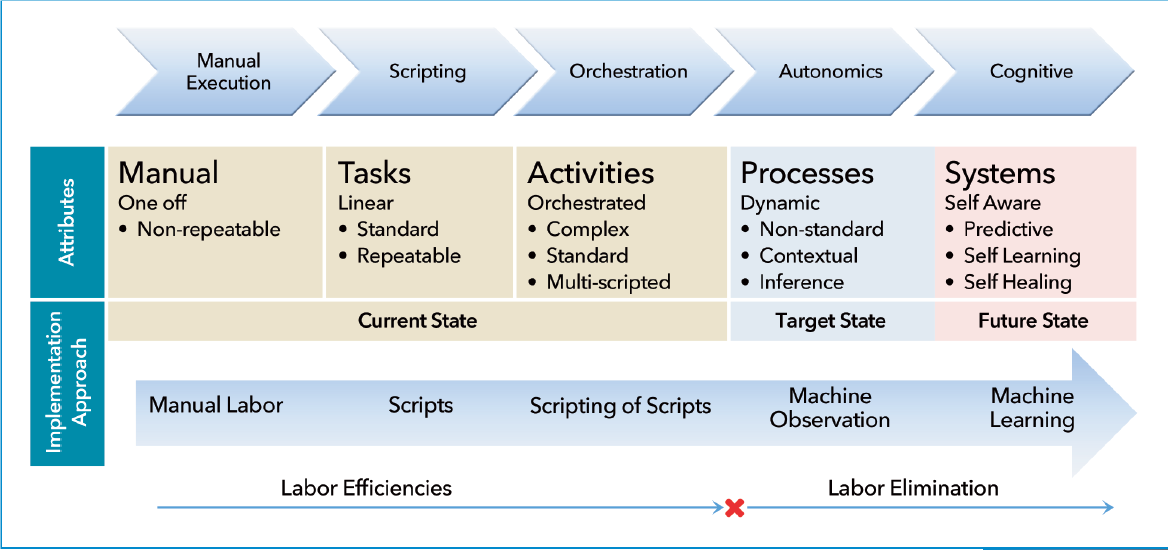
    Intelligent automation goes beyond basic automation and orchestration of manual tasks to incorporate adaptive self-learning—leading to fully autonomous systems. The figure below (courtesy IRPA) illustrates the evolution of automation as it moves toward full autonomy. The Google car (and other similar solutions) is a great example an intelligent automation system, capable of learning from its environment and adapting behavior accordingly.

    Automation in Traditional DevOps

    Digital systems are driven by new age technologies such as social, mobile, big data, analytics, cloud, internet of things (IoT), artificial intelligence, augmented and virtual reality, genomics, etc.  These technologies introduce significant change and complexity to how modern systems are built and deployed. Businesses that leverage these technologies to transform themselves into cognitive enterprises demand new and intelligent approaches to the underlying processes and techniques to support them. Such processes and techniques need to be more than agile; they need to adaptive and capable of reacting dynamically to frequently changing circumstances.

    Let’s look at some examples of current DevOps techniques and how they will need to evolve to support dynamic digital systems. Automation within traditional DevOps solutions is generally limited to scripting and orchestration as shown above.  Automation adoption levels vary, due to various reasons ranging from complexity to skills and organizational challenges. Maintenance of such scripts is itself sometimes a bottleneck, as applications and environments change rapidly, the scripts need to be updated manually and often become obsolete. New age agile digital businesses, by contrast, demand automation that is able to adapt dynamically and self-heal on demand.

    Further, classic DevOps automation techniques are typically driven by static predefined rules. For example, the criteria for promotion of an application build through different stages of the pipeline is often statically defined. This is a limitation for new age systems where the criteria needs to be dynamic and may vary depending on multiple circumstances. The automation system needs to able to look at past data, keep learning from current data and make adaptive intelligent predictions about the right course of action.

    DevOps for internet of things (IoT) systems is very different than that for traditional software systems. The target environment for production deployment in consumer IoT is geographically dispersed, typically not configuration controlled, may have unreliable network connectivity and may even be fragile. Further, IoT systems generate huge amounts of data that necessitate robust data mining and self-learning (adaptive) techniques not provided by traditional lifecycle automation tools.

    Similarly, customer experience (CX) is a key new metric for digital systems that transcends traditional DevOps metrics such as release velocity and quality. CX data is unstructured, fuzzy, voluminous and volatile. CX-driven DevOps (or CX-Ops) is an emerging discipline that requires big data analytics and cognitive approaches (such as natural language processing or NLP) to decode meaningful insight from such data.

    Hence, as digital enterprises evolve and businesses demand greater agility and flexibility, the DevOps function to support such systems will need to transform as well.

    Next-Generation Intelligent Automation Landscape

    Before we jump into what intelligent DevOps would look like, let’s first look at the different types of automation systems being adopted in the industry in general. The following types of automation are described as part of the “intelligent automation continuum”:

    • “Systems that Do”: These are basic automation systems that replicate human keystroke actions and static (pre-defined) rules-based activities. They also take advantage of descriptive analytics that reflect past trends and patterns. Examples of such systems include speech and image recognition.
    • “Systems that Think”: These use algorithms and intelligence to find meaning in data, handle judgment-oriented tasks using diagnostic analytics and make recommendations based on patterns. Examples of such systems include natural language processing and recommendation engines (such as email spam filters).
    • “Systems that Learn”: These understand context, interpret and dynamically adapt based on circumstances; they typically leverage predictive and prescriptive analytics to solve problems independently. Examples of such systems include self-driving cars and neural networks.

    A Peek at Intelligent DevOps

    So, what would transformed intelligent DevOps look like? Intelligent DevOps automation would take advantage of cognitive and autonomics systems to enable smarter adaptive lifecycle automation based on analytics. In my previous blog, I discussed how QA can take advantage of big data analytics. Intelligent DevOps, to a large extent, depends on such capability.

    Based on the above model, let’s look at the different types of DevOps automation we can create:

    DevOps Systems that Do: This includes traditional DevOps automation systems (e.g. for continuous integration and testing, continuous deployment), as well as pipeline lifecycle automation that are based on static rules (e.g. traditional release management automation)

    DevOps Systems that Think: This includes advanced automation systems such as:

    • Automated automation systems, for example, generation of automated test cases from manual tests (or test models) using NLP, generation of virtual services based on request-response data logs
    • Self-healing automation, for example virtual services (or test scripts) that can auto-update based on change in application endpoints (or behavior)
    • Monitoring of IoT systems, for example “smart homes,” which require continuous use of diagnostic analytics to mine huge volumes of data to understand failure modes and prescribe recovery techniques
    • Automated verification of system requirements based on customer experience analytics
    • Automated generation of test scenarios based on analytics on production logs

    DevOps Systems that Learn: This includes sophisticated test automation systems such as:

    • Adaptive continuous delivery pipeline—Learning systems that analyze past data to manage the pipeline based on dynamic rules. For example, correlate code quality and defect detection and slippage patterns to dynamically decide what tests to be run and what gates to be enforced (vs enforcement of statically defined gates) for different teams and products for promoting application builds
    • DevOps process optimization based on insight across the life cycle. For example, correlation of production log data with past code change data to determine the level of failure risk in different application modules. See more on this in the section below.

    We embody the evolution to intelligent DevOps in CA’s maturity model (shown below), which also aligns with the RPA maturity model described above. Beyond the continuous maturity level, Intelligent DevOps is the driving force behind continuous optimization and improvement.

    Cross-Life Cycle DevOps Intelligence

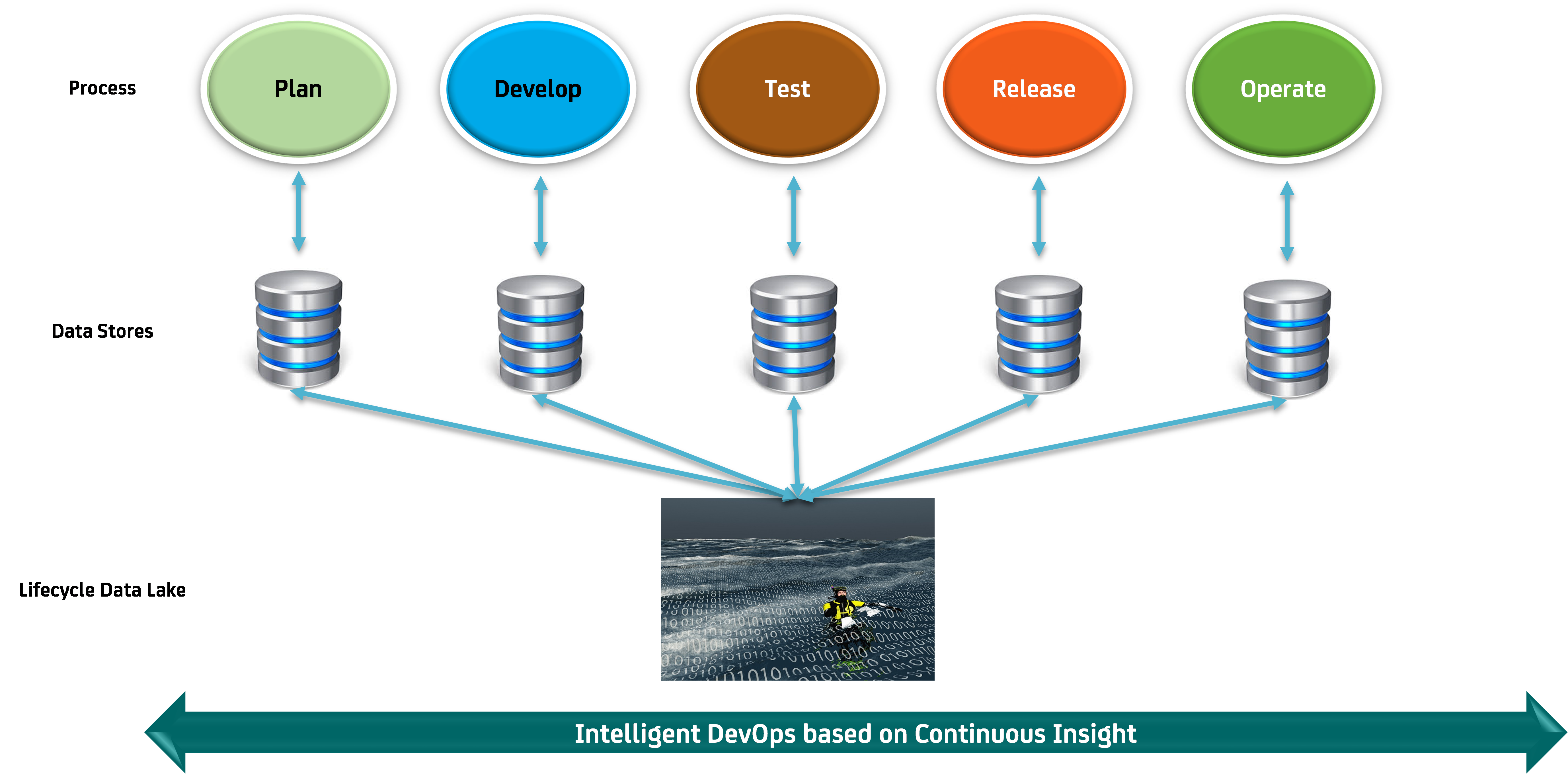
    Intelligent DevOps enables us to perform process optimization based on analytics from data correlated across the system life cycle, from planning through operation. Each process area generates a great amount of data that is typically analyzed within the process (and sometimes organizational) silo.

    While such analytics is useful in itself, correlation of data across these process areas (see figure below) may be used to provide a wide variety of intelligent lifecycle insight (and process improvement possibilities), such as:

    • Correlating configuration data analytics with code change and defect analytics helps us pro-actively identify failure modes related to code and infrastructure changes.
    • CX analytics (from the Operations process) can be used to validate requirements in the plan and define processes
    • Production log analytics may be correlated to test log data to identify missing test cases

    In the spirit of the “Continuous Everything” philosophy in DevOps, we envision a new solution stream around “Continuous Insight” where analytical insights are generated and acted upon continuously (and autonomously) as processes execute.  We will discuss more on the subject of Continuous Insight in a future blog.

    In conclusion, we believe that intelligent approaches described above will be infused into every aspect of DevOps going forward and revolutionize the way DevOps is performed. Stay tuned my friends, and may all our DevOps be intelligent!

    — Shamim Ahmed