Tag: IBM Cloud

  • IBM Adds Fully Managed VMware Service to Cloud Portfolio

    IBM Adds Fully Managed VMware Service to Cloud Portfolio

    At the VMware Explore 2022 Europe conference, IBM this week announced an IBM Cloud for VMware-as-a-Service offering that integrates instances of VMware Cloud with the infrastructure-as-a-service (IaaS) platform managed by IBM in the cloud.

    Rohit Badlaney, vice president of product management and strategy for IBM Cloud, said now that VMware Cloud can be consumed as a subscription service, it’s now possible for IBM to integrate it with its cloud platform to create a fully managed service. Previously, IT organizations would have had to separately license VMware Cloud and deploy it on IBM Cloud themselves, he noted.

    In general, Badlaney said IBM is focused on working with organizations in highly regulated industries that need to run complex workloads in the cloud. IBM is not interested in competing against other cloud service providers to run workloads on commodity infrastructure, he added.

    The majority of applications that run in the cloud today consume a narrow range of memory and storage resources. The IBM cloud is clearly more focused on providing higher-margin services to complement the cloud infrastructure it makes available via its data centers. Less clear is to what degree monolithic applications running in on-premises IT environments are being lifted and shifted to the cloud. While there is clearly a segment of organizations that no longer want to operate their own data centers, the bulk of applications continue to run in on-premises IT environments. The reasons for this include everything from performance requirements and security concerns to regulatory compliance issues.

    However, since most on-premises applications run on VMware virtual machines, much of the focus on cloud migration has revolved around platforms that would not require IT teams to refactor applications to run on a different virtual machine platform. IBM is also betting that, given the current state of the global economy, more organizations will soon be opting to not manage their own data centers. Cloud platforms managed by a third party would enable those organizations to focus more of their own internal IT efforts on application development and deployment.

    Each organization will need to determine for itself whether to treat IT as an operating versus a capital expense, depending on which approach makes the most economic sense. Organizations that have embraced DevOps workflows would need to align the way they build and deploy applications to a managed service.

    In theory, of course, a managed cloud computing service makes IT teams more agile and efficient. Less IT infrastructure winds up being overprovisioned by developers that can programmatically spin up resources on demand. Of course, there are a lot of IT stacks other than VMware Cloud that can be deployed in the cloud. IBM, for example, makes available the Red Hat OpenShift platform to run cloud-native applications on Kubernetes clusters. IBM has not yet committed to offering the VMware Tanzu platform for running those types of applications.

    Not every application is going to wind up running in the cloud, but what is certain is that application environments are becoming more complex to manage in the next era of cloud computing.

  • IBM ‘is Ageist and Sexist’ | IBM Mainframe-aaS | IBM Vaccine Mandate

    IBM ‘is Ageist and Sexist’ | IBM Mainframe-aaS | IBM Vaccine Mandate

    Think! Welcome to Big Blue Week here at The Long View—where we peruse the news of the week and strip it to the essentials. Let’s work out what really matters.

    This week: IBM’s employment practices scrutinized, IBM z/OSaaS breaks cover, and IBM encourages staff back to the office.

    1. ‘Dinobabies’ and ‘Dated Maternal’ Workforce Woes

    First up this week: IBM’s defense in an employment age discrimination lawsuit looks to be shredded. Internal emails “appear to show high-level discussion about paring the ranks of older employees.”

    Analysis: Not a good look

    According to one of the plaintiff’s lawyers, unnamed “top IBM executives were explicitly plotting with one another to oust older workers … to make room for millennial employees.” On the face of it, they seemed to be doing the polar opposite of the Age Discrimination in Employment Act.

    Noam Scheiber: Making ‘Dinobabies’ Extinct: IBM’s Push for a Younger Work Force

    Top IBM executives were directly involved in discussions about the need to reduce the portion of older employees … sometimes disparaging them with terms of art like “dinobabies.” … Documents made public by a Federal District Court … show executives discussing plans to phase out older employees.
    …
    The newly unsealed documents, which quote from internal company emails … show top IBM executives specifically emphasizing the need to thin the ranks of older workers and hire more younger ones. [One] email refers to IBM’s “dated maternal workforce,” an apparent allusion to older women, and says: “This is what must change. They really don’t understand social or engagement.”
    …
    Adam Pratt, an IBM spokesman, [claimed,] “IBM never engaged in systemic age discrimination.” [He] said that some of the language in the emails “is not consistent with the respect IBM has for its employees” and “does not reflect company practices or policies.”


    Yikes, ageism and sexism? Experienced staff are valuable, says MrBanana:

    I did some time at IBM [and] remember being invited to a meeting with a new group, headed by a new “thinker,” who had something to present to myself and a colleague. We walked past the foosball table to the meeting room. Naturally the room had no chairs, and was covered in multi-coloured Post-it Notes. Once they had gone through their mood boards and the non-linear presentation of this new idea, I turned to the other old geezer in the room. “Didn’t we look at something like this 8 years ago?”

    “Yeah, we worked out that compute power just to run the UI for one session wouldn’t be available for a couple of decades.” The children were somewhat disappointed, and (fortunately) we were never asked back to their romper room.


    But experience can be both a blessing and a curse, learned aahortwwy:

    I experienced both sides of this in five years at a company in hypergrowth. … I learned so much at that job: … In year 1, I was determined to accomplish X and ignored the skeptical comments of some colleagues who’d been at the company longer than me. I failed and wasted some time. In years 4 and 5, new colleagues were determined to accomplish X and ignored my skeptical comments.


    2. IBM Wazi as-a-Service Confusion

    “Mainframe” is not a dirty word. It’s secure, vertically scalable, and it put the VM in VMware. Now, what IBM Wazi did for on-prem LPARs, Wazi aaS promises to extend to hosting z/OS instances.

    Analysis: Mainframe-as-a-service reinvented

    Mainframes and cloud-native DevOps need not be incompatible. To modernize legacy apps using hybrid cloud instances for dev/test—and even prod—can be a big productivity boost. But isn’t it weird that IBM spun out its mainframe-as-a-service zCloud offering only a few months ago?

    Mike Vizard: IBM Shifts Mainframe App Testing to the Cloud

    While many workloads over the years have been migrated off mainframes or simply retired, the applications that run on z/OS today are still among the most mission-critical that organizations run. … IBM this week revealed it has added the ability to set up testing environments on the IBM Cloud for z/OS mainframe applications.
    …
    IBM plans to make IBM Wazi as-a-Service (Wazi aaS) for z/OS generally available in the second half of this year, [which] will enable DevOps teams to self-provision an instance of a z/OS virtual server on a secure private space running on IBM Cloud. … At the same time, it will become easier to modernize mainframe applications by making them more accessible to other applications via a set of secure APIs … using a cloud-native set of DevOps tools that run in a Kubernetes environment.
    …
    Modernizing mainframe applications is a less complicated endeavor than migrating them. The challenge is that building, deploying, maintaining and securing all the APIs required to do so represents a significant amount of effort.


    OK, boomer, why are we talking about 1960s mainframes on devopsy.kinsta.cloud? Here’s ArchieBunker:

    Mainframes are different beasts altogether, almost alien when you compare them to PC hardware. You have binaries written for the S/360 system in the 1960s? Good news you can still run them natively without a recompile.

    You think virtualization and containers are a hot topic? IBM was running multiple OS instances inside a VM in the 1970s. … The engineering is incredible.


    But z/OSaaS? It’s déjà vu time for Beleagured Greybeard:

    “Cloud Managed Services for z” AKA “zCloud” has been around for over 10 years. … IBM offloaded it with the Kyndryl spin, so its odd that they now want to re-invent it.
    …
    If it’s a strategic platform, why didn’t they hold onto it instead of spinning it off to Kyndryl? Sounds like yet more daft leadership decisions.


    3. IBM’s Return to Work Plan has Vaccine Mandate

    IBM wants to “keep employees safe” as they return to office work after being fully remote. In practice, this means a vaccine mandate.

    Analysis: IBM Digital Health Pass is divisive to vocal minority

    Although there are exemptions on medical or religious grounds, IBM has promised to place dissenters on unpaid leave. As you might expect, the policy has a few employees up in arms.

    Cassie Werber: How Salesforce, IBM, and HSBC are approaching return to work

    When the pandemic hit, and IBM moved 95% of its workforce to fully remote, it was pleasantly surprised to discover no drop in productivity. … Still, they planned to return to offices.
    …
    The company saw this as a way to keep employees safe. … One example … is its development of the IBM Digital Health Pass as an alternative to vaccine cards or paper vaccine certificates, which they use to make sure all the staff that come into their offices are vaccinated.
    …
    Arvind Krishna, IBM’s CEO, meanwhile came up with what he called the IBM Work From Home Pledge. [It] included commitments to flexibility, kindness, sensitivity to family, setting boundaries, and acknowledged video fatigue. It concluded with a commitment to “be connected.”


    Tricky to “be connected” if you’re not allowed back in the building. Anne D’Innocenzio, Heather Hollingsworth, Tali Arbel, Mae Anderson, Ken Sweet, Matt O’Brien and Dee-Ann Durbin:

    IBM software engineer Justin Albano said his company recently notified employees that it would be revoking badge access to workers who aren’t vaccinated or haven’t proved that they are. “We’re not able to enter an IBM office at this time,” said Albano.
    …
    He said some workers have successfully sought religious exemptions but “my thought process was I shouldn’t have to explain to my company my faith” to get out of a policy that’s “immoral in its foundation.”


    What’s the alternative? With a perspective, it’s Chris Haney:

    Or, get the vaccine. Protect yourself and the people around you. You people really are detached from reality.


    The Moral of the Story: Those who know do not speak; those who speak do not know.


    You have been reading The Long View by Richi Jennings. You can contact him at @RiCHi or tlv@richi.uk.

    Image: Marcin Wichary—cc:by; leveled and cropped (ask your parents)

  • IBM Unifies Cloud Services to Simplify App Dev

    IBM Unifies Cloud Services to Simplify App Dev

    IBM announced today that an IBM Cloud Code Engine service that unifies the cloud platforms on which applications are built and deployed is now generally available.

    Built on top of a serverless computing platform, IBM Cloud Code Engine is a managed service that unifies access to a platform-as-a-service (PaaS) environment, a container-as-a-service (CaaS) environment and batch workloads, that run on traditional virtual machines, to a single platform.

    At the core of that managed service is an instance of Kubernetes running Knative middleware for invoking an open source serverless computing framework, the Istio service mesh and Tekton pipelines for building DevOps workflows.

    Jason McGee, CTO and vice president for IBM Cloud Platform, said the goal is to eliminate the artificial constructs that developers are forced to navigate in the cloud today that can each trace their lineage to a different era of software development. The IBM Cloud Code Engine unifies the developer experience in a way that makes it simpler to build and deploy applications on the type of cloud service that best makes sense for a specific application workload, McGee said. Developers no longer need to configure code for a specific type of infrastructure; they can simply describe how they want source code or a container image to behave, and IBM Cloud Code Engine automates deployments accordingly.

    The serverless computing framework that IBM Cloud Code Engine is built on also makes it possible for IBM to only charge organizations when code is actually running, versus requiring them to commit to a specific amount of infrastructure to run a set of virtual machines, McGee added. Charges are based on the memory and vCPU consumed and incoming HTTP calls. That approach will, over time, substantially reduce the total cost of cloud computing, said McGee.

    It should also accelerate the rate at which applications are migrating to the cloud, added McGee. Today roughly 20% of application workloads run in the cloud. Getting the next 40% of workloads shifted into the cloud will require providing a simplified application developer experience, noted McGee.

    The challenge organizations are wrestling with today is that they are deploying a mix of monolithic and microservices-based applications in the cloud that, to varying degrees, rely on batch-oriented and real-time platforms. IBM Cloud Code Engine represents an effort to provide a layer of abstraction over a wide range of cloud services that they can flexibly invoke via an event-driven platform, as required.

    The DevOps implications of IBM Cloud Code Engine are potentially profound. DevOps teams today spend an inordinate amount of time provisioning cloud infrastructure on behalf of developers. IBM is now making a case for a platform that automates that process in few seconds. In effect, control over cloud infrastructure will shift even further left to application developers. DevOps teams, in theory, will spend more of their time optimizing cloud environments after an application has been deployed.

    It’s not clear to what degree platforms such as IBM Cloud Code Engine might force cloud service providers to consolidate distinct cloud services they provide to developers today based on the type of application being built. However, it’s already apparent that the writing on the wall heralding that consolidation have now been indelibly inscribed.

  • Accelerate Your Digital Transformation with IBM

    Accelerate Your Digital Transformation with IBM

    DevOps practices, processes and solutions help businesses accelerate their digital transformation by improving the speed and quality of software development. DevOps tools enable teams to do their job more efficiently by embracing automation, increasing agility and building speed, versatility and security into the framework.

    At the IBM DevOps Virtual Summit, attendees will learn how to keep their applications running smoothly with automation and data-driven solutions that can reduce mean time to resolution and explore IBM solutions to help innovate hybrid environments, disrupt cloud native development and transform existing mainframe infrastructures. The free virtual event will take place on Oct. 29 from 10 a.m. to 2 p.m. ET.

    IBM leaders will discuss the benefits of DevSecOps, how to increase business value, SRE best practices and how IBM Cloud software and services can help organizations succeed on their DevOps journey.

    The virtual event will feature four educational sessions from leading DevOps technologists:

    • “Application Modernization Enabling Hybrid Cloud with IBM Z,” by Rosalind Radcliffe, distinguished engineer and chief architect for DevOps at IBM.
    • “The Modern DevOps Manifesto,” by Andrea Crawford, distinguished engineer at IBM.
    • “DevSecOps in a Hybrid Multicloud World,” by Sunil Joshi, executive architect at IBM.
    • “Common Tooling Approaches from Kubernetes to the Mainframe,” by Eric Minick, program director at IBM.

    For more information about the virtual summit or to register, please visit the IBM DevOps Virtual Summit website.

  • IBM Cloud Expands Database Ecosystem with New Partners

    IBM to make DataStax Enterprise, EDB, and MongoDB Enterprise Server generally available.

    With open source technology pervasive across the IT industry coupled with the ever-increasing need to optimize your application workloads with fit-for-purpose database technologies, it has been part of IBM’s longstanding cloud database strategy to provide our clients with a variety of the most popular open source databases.

    Over the past decade, not only has IBM participated in and promoted the open source database market evolution (and this year we are celebrating the 50th anniversary of IBM first proposing the SQL Relational Model), we’ve also recognized how many of the vendors behind these technologies have come to formulate and evolve their business models in light of these trends in the database market.

    IBM Cloud Databases’ two-front strategy

    At the center of this dynamic between the open source communities and the vendors backing those communities are our clients, and our drive to provide our clients with the best database technologies they want to use. It is with our clients as a priority that we are continually balancing our contributions to the open source communities with our support to the vendors backing these projects to formulate our two-front strategy.

    On one front, IBMers are actively participating across thousands of open source repositories across many technologies. Aptly, we have also just announced the next generation of our Cloudant DBaaS based on Apache CouchDB: Cloudant on Transaction Engine.

    On the other front, we are very excited to announce three new collaborations that enable IBM to enrich the database capabilities available on our cloud with the latest innovations, enterprise capabilities, and authentic technology from the vendors themselves.

    New partners

    Over the next few months, we will be making the following generally available:

    • DataStax Enterprise: Built on Apache Cassandra, extends operational reliability and improves performance for workloads. Provides foundation for further capabilities around graph and search.
    • EDB: Enhanced PostgreSQL with additional enterprise management tooling and security, support for Oracle compatibility, multi-master replication, and schema migration and compatibility analysis.
    • MongoDB Enterprise Server: Robust operational tooling, automatic field-level encryption, comprehensive auditing and advanced analytics.

    While ISV collaborations are plentiful across the various cloud providers these days, we’ve focused on a more deeply integrated experience in how these databases will be made available on the IBM public cloud, specifically in the following ways:

    • Natively run on the IBM public cloud, and managed only by IBMers
    • Backline expertise provided by the vendor, without providing access to customer databases or otherwise compromising data confidentiality
    • Provisioned directly from our catalog with availability across all six Multi-Zone Regions plus numerous Single-Zone Regions
    • Default high availability across Multi-Zone Regions, backed by IBM Cloud’s 99.99% SLA
    • Automatic backups to Cross Regional Object Storage with on-demand restore
    • Default integration into Key Protect, Log Analysis with LogDNA, Activity Tracker with LogDNA, and Cloud Monitoring with Sysdig
    • Seamless scale, independent allocation of compute and storage, and optional auto-scaling configurations
    • On IBM paper and supported through the IBM portal

    Please check back in the coming weeks for availability of these offerings.

    If you’re interested in learning more about how we built and run these offerings, alongside many of our other Database-as-a-Service offerings, I invite you to check out “Building Cloud-Scale DBaaS with Kubernetes Operators.”

  • IBM Boosts Security and Productivity with Red Hat OpenShift 4.3 on IBM Cloud

    As more businesses journey to the cloud, they need ways to easily deploy and manage their critical workloads securely across public clouds, private clouds, and on-premises environments. This is particularly crucial when faced with the ongoing demands to support remote workforces.

    The IBM public cloud has been rebuilt on a foundation of open source innovation, security leadership, and enterprise-grade infrastructure, which makes it easier for clients to rapidly develop new applications and reducesthe complexity in managing teams and technologies. And this is why our public cloud has become the preferred destination for businesses to run their most complex workloads.

    Today we’re taking this a step further by announcing enhancements to Red Hat OpenShift on IBM Cloudwith the availability of OpenShift 4.3 – and we’re the first major cloud provider to offer this. The effort is jointly engineered and supported by IBM and Red Hat.

    Most notably for our clients, we’ve added unique security and productivity features designed to help eliminate substantial time spent on ongoing maintenance like updating, scaling, securing and provisioning. We’re delivering the resiliency needed to handle unexpected surges in use, as well as protection against attacks that lead to breaches or outages and potential productivity losses. Now development teams can focus more on what matters – accelerating cloud native application development so they can drive new, competitive capabilities.

    With this fully cloud managed offering, the master for your clusters is protected by IBM Cloud’s unique architecture, configuration and tools. Below are the technical benefits designed to help save time, reduce outages, and boost security.

    ·        Protect your Master with Automated Recovery
    We’re automating recovery so you don’t lose time with customer support and other tasks that you might have otherwise had to do yourself (like strategy, staffing, storage.)
    By continuously backing up etcd, we’re minimizing the threat of data loss in the unlikely case of a complete master outage. Masters are by default highly available, and you can further protect your master from a single data center failure by adding multizone clusters. So, if one data center goes down there is no impact to availability because IBM Cloud runs an active-active-active master.
    ·        Full Admin Access with Built-in Protection
    Only Red Hat OpenShift on IBM Cloud provides cluster-admin access without the risk of an admin being able to take down the master.  Master nodes for Red Hat OpenShift on IBM Cloud are physically network-isolated from the worker nodes. Therefore the master nodes are not accessible from any of the worker nodes within the cluster (network diagram).

    With this new functionality, you’re no longer faced with recovery as the only viable solution to an outage, and your access is not limited either, as you might experience with other offerings. This means better access to controls and easier cluster management.

    ·        Increase Productivity by Autoscaling the Master
    Red Hat OpenShift on IBM Cloud provides autoscaling masters with an industry-leading  99.99% SLA in multi-zone regions. This means your workloads can expand quickly, while you don’t worry about capacity. You can also autoscale your workersto meet your app’s capacity needs.
    For example, in the heat of delivering a big feature, admins might overlook manually scaling the master, and without this new functionality, you’d have no SLA and your admins would be faced with scaling the master components as your grow – leading to a big loss in productivity.
    ·        Automate Worker Management and Provisioning Based on Workload Needs
    Red Hat OpenShift on IBM Cloud provides total control over worker node provisioning and flexibility with worker pools, so you no longer worry about over- and under-provisioning your apps. IBM automates the worker management and provisioning to help ensure you’re matching workloads with the proper resources.
    Other vendors may limit your ability to provision more node types and flavors, so you can’t easily automate how and when users get resources. Now you can easily mix node types and flavors to realistically match workloads that require a mix of data, compute, and services.
    ·        Managed Security with Red Hat OpenShift on IBM Cloud
    When your CISO, NetOps admin, or DevSecOps admin comes to your door, you know that you’ve got another security and certification mountain to climb.
    The master and its components (compute, networking, and storage) are continuously monitored by IBM Site Reliability Engineers (SREs). They apply the latest security standards in order to detect and remediate malicious activities, and work to help ensure reliability and availability of Red Hat OpenShift on IBM Cloud. Plus they follow relevant cybersecurity practices from the Kubernetes master benchmark that is published by the Center of Internet Security (CIS). Review IBM’s responsibilities for security.
    No other cloud vendor helps you as much as IBM with OpenShift security and compliance, which includes chores for PCI, HIPAA, ISO27K, SOC1, and SOC2 Type 2.
    These benefits were born from common enterprise use cases we’ve solved for our customers: security, resiliency, and productivity. In Red Hat OpenShift on IBM Cloud, we’ve leveraged the experience we’ve gained from running Kubernetes for years — now with 20,000+ clusters in production.

    Additionally, with OpenShift 4.3, users can access the following new capabilitiesas-a-service:
    ·        Operators: Focus on app development with automated updates and health checks of your tools deployed into OpenShift
    ·        Knative: Serverless app development for event-based workloads
    ·        Service Mesh: Microservices management for distributed componentized applications
    ·        Increased security: Built-in authentication, auditing and secrets management

    The IBM Developer Advocacy Program also shared their perspective on the advancements made to Red Hat OpenShift on IBM Cloud. You can view the blog here.

    Additionally, to support today’s announcement and reinforce IBM’s continued commitment to driving open source innovation, IBM Research unveiled two container-based open-source projects that will enable confidentiality of code and data. You can read more about Encrypted Container Images and Trusted Service Identity here.

    Get started today:
    ·        If you have questions or comments, engage our team via Slack. You can register hereand join the discussion in the #openshift channel on https://ibm-cloud-success.slack.com.
    ·        Learn more about Red Hat OpenShift on IBM Cloud
    ·        Check out a free cluster for a quick test driveor do a tutorialon Red Hat OpenShift 4.3 on IBM Cloud

  • Sysdig Extends Cloud Monitoring Alliance With IBM

    Sysdig Extends Cloud Monitoring Alliance With IBM

    Sysdig and IBM announced they have extended their alliance to make Sysdig monitoring tools more broadly available across IBM public cloud services.

    IBM first adopted the Sysdig platform to enable DevOps teams to monitor workloads running on a subset of the IBM Cloud in June 2018. Now the company will extend those managed instances of the Sysdig monitoring platform running on its own public cloud to include additional cloud services such as IBM Watson, Event Streams, Cloud Databases, Cloud Object Storage and Cloud Foundry.

    Janet Matsuda, chief marketing officer for Sysdig, said monitoring capabilities as especially critical as the number of microservices-based applications running on public clouds continues to increase. IBM also makes use of the open source Prometheus monitoring platform to monitor many of those applications. Sysdig last month announced compatibility with Prometheus as a data source.

    In the wake of the COVID-19 pandemic, it’s probable that more monolithic applications will also be moving into the cloud as part of organizations’ business continuity strategies. Applications that run in the cloud are easier to manage remotely. Regardless of whether applications are monolithic or based on microservices, it’s clear IT teams will be “flying blind” unless they have access to monitoring tools, Matsuda noted.

    Over time, many of the monolithic applications being moved into the cloud will be transformed into a more flexible set of microservices that are easier to update. As that transition occurs, the need to observe the myriad microservices running on a public cloud becomes an even bigger challenge for IT teams.

    Of course, some IT teams will prefer to employ their own monitoring tools versus relying on a managed service, especially if they are trying to centralize the management of IT across multiple public clouds and on-premises IT environments. However, for now, at least, the bulk of IT teams are still employing various public clouds in isolation from one another.

    Longer-term, the relationship between Prometheus and commercial monitoring platforms is still being defined. Many application developers are relying on Prometheus to observe applications during the development process. Many IT teams, however, are already making extensive use of commercial monitoring platforms to identify and correlate issues in production environments. Sysdig is betting most of those organizations will continue to rely on those tools because they are easier to set up and navigate. In addition, each instance of a Kubernetes cluster currently requires its own instance of Prometheus.

    On the plus side, the amount of time and effort being applied to instrumentation and observability as part of any set of best DevOps practices continues to increase sharply. Furthermore, the need to combine security and operational IT metrics and analytics to advance DevSecOps adoption is also going to push IT organizations toward more robust monitoring platforms. Arguably, the real challenge is no longer finding a way to instrument applications as much as it will be turning all the data being collected into actionable intelligence that can be relied on to automate the management of IT at an unprecedented scale.

    — Mike Vizard

  • IBM Cloud Annotations Tool eases the process of AI data labeling

    A new automated labeling tool in the open source Cloud Annotations project makes it easier for developers to label data without having to manually draw…

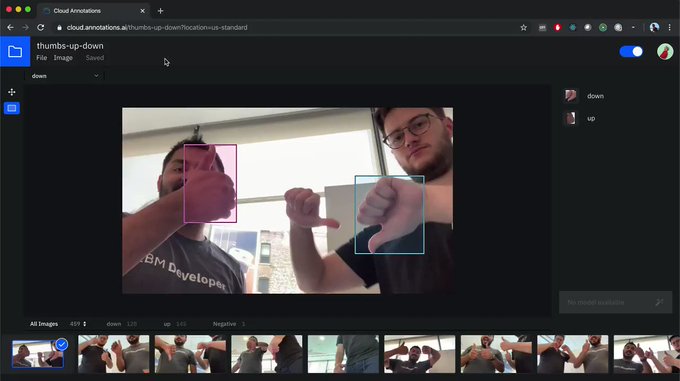
    Faced with the daunting task of hand labeling thousands of images, developers are looking for an easier way to train their object detection models. Currently, it takes 200-500 samples of hand-labeled images for a model to detect one specific object. Autolabeling images speeds the process and gives developers back valuable time to work on other innovative projects.

    A new automated labeling tool in the open source Cloud Annotations project makes it easier for developers to label data without having to manually draw labels on an entire dataset of images. The new feature takes advantage of AI to assist in the labeling process.

    You can access the tool now when using the Cloud Annotations GUI. You simply have to select the “Auto label” button and it will autolabel the images you’re uploading.

    Cloud Annotations is a fast, easy, and collaborative open source image annotation tool. Backed by IBM Cloud Object Storage, Cloud Annotations enables you to store as much data as you need, access the data from anywhere and share across multiple collaborators in real-time.

    Cloud Annotations enables multiple people to collaborate in real-time, access the data from anywhere, as well as store and back up the data through IBM public cloud.

    How it works

    To take advantage of the new tool:

    1. A user uploads and labels a subset of photos via the Cloud Annotations GUI.
    2. The user then trains a model following these instructions.
    3. The tool uses that model to label more photos. Simply select “Auto label” in the GUI and the tool will take over the task of labeling photos.
    4. User reviews new labels.

    See it in action

    The following video shows you how the autolabeling function works.Cloud Annotations now has auto labeling. It’s an early beta, but you can now upload a model to your project and let it do the labeling for you!

    Embedded video

    Get started

    The Cloud Annotation auto labeling feature is currently live on GitHub, available for anyone to use and take advantage of as a massive time saver. Start using the tool and let us know what you think!

  • Aegean Airlines, BNP Paribas, Elaw Tecnologia SA and Home Trust Select IBM Cloud for Mission-Critical Workloads

    New capabilities make IBM’s public cloud the most open and secure platform for enterprises to run their core business

    ARMONK, N.Y., Oct. 22, 2019 /PRNewswire/ — IBM (NYSE: IBM) today announced that clients in highly regulated industries, including Aegean Airlines, BNP Paribas, Elaw Tecnologia SA and Home Trust, are selecting IBM Cloud as their preferred destination for mission-critical workloads.

    IBM also announced new capabilities that make its public cloud the industry’s most secure and open cloud for business, including:

    • The industry’s only commercially available state-of-art cryptographic technology for the cloud called “Keep Your Own Key.”1 This gives enterprises the ability to retain control of their own encryption keys — and the hardware security modules that protect them — so customers are the only ones who can control access to their data.
    • Increased bandwidth for its next-gen virtual servers on the cloud up to 80 Gbps, making the IBM public cloud hyperscale-ready. Designed so enterprises can access IBM public cloud services and scale their networks quicker than ever before, all within a controlled, secured environment that is suited for sensitive workloads.
    • An expansion of IBM’s global cloud data center footprint with new multizone regions (MZR) planned for Toronto, Canada and Osaka, Japan by the end of 2020, building on the recently announced MZR in Sao Paulo, Brazil. These regions will help clients quickly deploy mission-critical workloads and applications across hybrid cloud environments, and gain access to a consistent set of IBM public cloud services – from enterprise-grade infrastructure to AI services.
    • The same IBM Power Systems technology behind the world’s smartest supercomputers, Summit and Sierra, is expected to be available for select geographies by the end of 2019 in the IBM Cloud giving organizations a new, powerful option to begin developing and training their AI applications. IBM’s support of Red Hat OpenShift on IBM Power Systems reinforces our commitment to clients to provide a flexible, secure and open, hybrid multicloud platform for their workloads.
    • New features to be made available for IBM Security Advisor to detect security misconfigurations so companies can better assess their security postures and take corrective actions.

    IBM reported last week that its cloud business generated more than $20 billion dollars in revenue over the last 12 months. Today’s news complements IBM’s existing cloud offerings for private and on-premises environments – including those from recently-acquired Red Hat – enabling the company to provide comprehensive, open multicloud hybrid solutions.

    “Open architectures, based on Kubernetes and containers, are driving the next wave of cloud-based innovation. That’s why IBM has just completed a two-year journey to enhance its public cloud on a foundation of open source software,” said Arvind Krishna, Senior Vice President, Cloud and Cognitive Software, IBM. “Today, we are going a step further by unveiling new capabilities for the IBM public cloud, designed to provide clients with the highest available level of security, leading data protection and enterprise-grade infrastructure to run Red Hat OpenShift.”

    Aegean Airlines has adopted IBM Cloud to transform its internal business processes and further enhance its customer experience.

    “IBM is the strategic provider that will support our determination and willingness to innovate and achieve excellence at both organizational and business process level,” said AEGEAN Group’s Chief Information Office, Aristeidis Kamvysis. “By utilizing IBM Cloud, we’re able to infuse IBM Watson into our applications in order to gain better business insights, while improving business operations in a reliable, scalable, and agile environment.”

    With the consumer experience a top priority, banks like BNP Paribas must deal with the rapidly changing needs of customers, while also managing evolving security and regulatory guidelines, and a variety of complex data and workloads.

    BNP Paribas is leveraging the IBM Cloud and adopting a hybrid cloud strategy to overcome these challenges and support its development and innovation within the ever-increasing need for security and compliance. This includes a BNP Paribas dedicated cloud based on IBM public cloud technology that offers the best of both worlds: the security of a private cloud, with the breadth of catalog and economics of a public cloud. Due to launch in mid 2020, it will provide access to the full range of IBM Cloud IaaS and PaaS services, including IBM’s Watson AI services, and will run in a Multizone Region dedicated to BNP Paribas in the Paris area to provide high availability and resilience. BNP Paribas will migrate its IT and applications to this dedicated cloud, complementing it with the IBM public cloud in the US, Asia and Europe. Together, BNP Paribas and IBM look to define and establish the cloud platform to help meet the regulatory and security controls facing BNP Paribas’ critical banking workloads.

    “With the increasing regulation restrictions in the financial services industry, institutions have been historically challenged to use cloud, and public clouds in particular. By working with IBM, we are able to provide the innovation and agility that public clouds can offer, combined with the security necessary to remain compliant,” said Bernard Gavgani, BNP Paribas Group Chief Information Officer. “This approach enables us to innovate faster, provide a better customer experience, enter into new business models and tap into new technologies, such as AI.”

    Together with IBM, Elaw Tecnologia SA, a company that specializes in the development of corporate solutions for legal management, created a new cognitive solution that automates cumbersome and high-volume legal tasks, hosted on IBM Cloud.

    “The strict labor laws in Brazil result in a vast number of labor lawsuits. To streamline legal processes, we worked with IBM to develop a AI-enabled legal process management solution to improve efficiency and productivity for our lawyers,” said Guilherme Bordon, Chief Executive Officer, Elaw. “The solution is hosted on IBM Cloud to enable Elaw to access IBM Watson APIs, automate processes and provide a secured platform for confidential information.”

    Home Trust, a federally regulated trust company based in Canada, recently migrated its IT infrastructure to IBM’s public cloud to transform its operations, while still maintaining end-to-end visibility and management over its platforms and applications. By migrating to the cloud, Home Trust now has access to flexible and scalable computing services, as well as access to higher value technologies, including AI, to digitally transform its offerings.

    “For many financial institutions, upgrading core systems can disrupt underlying business operations and impact efficiency,” said Victor DiRisio, Chief Information Officer at Home Trust. “By choosing IBM Cloud, we are able to modernize our IT environment while realizing the economic benefits of cloud computing. It ensures that new solutions are immediately useable, rapidly deployable and can ultimately offer a superior customer experience.”

    For more information on today’s news, visit https://www.ibm.com/cloud/blog/announcing-new-public-cloud-capabilities

    About IBM Cloud
    With over $20B in annual cloud revenue, IBM has built a leading enterprise hybrid cloud business. This includes a comprehensive range of as-a-service offerings, software, hardware and professional services that enable IBM to advise, move, build and manage cloud solutions across public, private and on-premises environments. Through its global network of more than 60 cloud data centers across 19 countries and 18 availability zones across 6 regions, IBM public cloud helps enterprises in all industries to meet security, resiliency, performance, and global deployment requirements. Built on an open source, multitenant environment, clients have secured access to an enterprise-grade IaaS and a leading PaaS that provides them with the latest developer capabilities and ready-to-go innovation engines. This includes more than 190 cloud-native APIs, such as AI, blockchain, IoT, serverless and quantum computing, and consistent function all the way to the edge.

    For more information, visit https://www.ibm.com/cloud/public

    Statements regarding IBM’s future direction and intent are subject to change or withdrawal without notice, and represent goals and objectives only.

    1 Encryption keys and cryptographic operations are protected with highest level certified HSM –  with Hyper Protect Cryto services: FIPS 140-2 Level 4.


  • IBM Extends Cloud Reach to Include Integration

    IBM Extends Cloud Reach to Include Integration

    At the IBM Think 2019 conference this week, IBM unfurled an IBM Cloud Integration Platform that pulls together a range of tools in a single development platform that the company promises will reduce the amount of time it takes to deploy applications by making it easier to reuse integration code.

    Hillery Hunter, vice president and CTO for IBM Cloud Infrastructure, said by bringing all of its primary integration tools into a single cloud platform, IBM is effectively making an integration platform-as-a-service (iPaaS) environment available for the first time.

    IBM this week also formally rolled out IBM Services for Multicloud Management, a portal through which multiple clouds can be managed using software-as-a-service (SaaS) applications developed by ServiceNow, along with a set of IBM Services for Cloud Strategy and Design through which IBM will advise clients on how to architect the right holistic cloud strategy. The premise of both those services is that organizations soon will be rightsizing workloads to run on whatever cloud or on-premises IT platform that best suits them. The portal developed with ServiceNow provides access to dashboards and analytics designed to enable IT organizations to analyze cloud spend and manage workloads deployed on any platform, including Amazon Web Services (AWS) and Microsoft Azure.

    IBM is also extending the cloud services it provides to include the IBM Cloud Hyper Protect Crypto Service, which makes use of IBM LinuxONE mainframes to provide encryption key management built on the only FIPS 140-2 level 4-based technology.

    Hunter said IBM’s approach assumes organizations have already bought into best DevOps practices and API management to provide the means through which multiple clouds will be managed. The challenge many of those organizations are now wrestling with is implementing processes that determine where a workload not only should be developed and deployed but also moved as its characteristics evolve. To provide that analytics, IBM is employing machine learning algorithms running on distributed instances of Kubernetes to continuously track changes and updates to cloud platforms, said Hunter.

    IBM previously outlined a strategy under which it is trying to meld DevOps and ITIL-based processes to make it easier to manage workloads running on any cloud or on-premises IT environment. While the growth of cloud computing continues at an exponential rate, IBM executives this week took pains to remind conference attendees that 80 percent of enterprise-class workloads still run in on on-premises IT environment. In fact, IBM’s rationalization for spending $34 billion to acquire Red Hat is based on that fact. However, while many workloads will continue to run on-premises, IBM is clearly making a case for centralizing the management of all those platforms on IBM Cloud.

    It most likely will take the better part of the next decade to determine where different types of applications may wind up running. Predictions concerning the percentage of application workloads that will run in the cloud continues to be one of the most hotly debated topics in the IT industry. Whatever the outcome, however, it’s 100 percent certain more than one cloud platform will be involved.

    — Mike Vizard