Tag: Honeycomb

  • AI Raises the Stakes for Observability Engineering

    AI Raises the Stakes for Observability Engineering

    AI-assisted development has quietly changed which part of the software lifecycle is hardest. Writing code is no longer the bottleneck. Understanding what the resulting system is actually doing in production is. When agents and assistants can generate whole services in an afternoon, the ability to validate change, investigate incidents and reduce risk becomes the constraint that actually decides how fast a team can ship — and that puts observability engineering squarely at the center of the conversation.

    Alan Shimel talks with Liz Fong-Jones, Technical Fellow at Honeycomb, about what that shift looks like from the ground. Fong-Jones draws a sharp line between telemetry and observability that most teams still blur. Telemetry is the raw material: logs, metrics, traces describing what is happening inside a system. Observability is the broader property of being able to combine that data with human knowledge and process to actually understand the system and make better decisions. Her framing is that observability is a living quality of software — like testability or accessibility — and a team is never done with it.

    They get into how AI reshapes the observability loop itself. Fong-Jones sees real leverage in agent-assisted workflows that generate instrumentation code, sift through mountains of telemetry and help engineers move through investigations faster. The point is not that AI removes human judgment from the loop. It changes where humans spend their time, pulling them off toil and toward the interpretation and decision-making that only a person can do. The second edition of the O’Reilly book Fong-Jones co-authored reflects that shift — the field has moved past arguing whether observability differs from monitoring and into how it supports AI-driven software delivery.

    The bigger arc is that cloud native has become the default substrate for modern software, containers and Kubernetes are now assumed rather than debated, and OpenTelemetry sits underneath the whole picture as the standard everyone builds on. In that world, observability engineering is not a nice-to-have added on top of production. It is the thing that lets teams move faster with AI while keeping the risk of moving faster inside acceptable bounds — and the organizations that treat it as a first-class engineering discipline are the ones that get to keep shipping when everyone else is chasing incidents.

  • AI-Driven Observability: Fast, Context-Rich MCP Servers

    AI-Driven Observability: Fast, Context-Rich MCP Servers

    Christine Yen—developer-turned-CEO—explains why Honeycomb built an MCP server and why every observability vendor may follow. MCP, short for Model Context Protocol, acts like a concierge for AI agents: It makes a product’s API, telemetry schema and helper tools easily discoverable so large-language models can ask precise questions instead of guessing. Yen sees it as table stakes for letting bots troubleshoot production just as humans do.

    Speed is the first requirement. Engineers won’t wait minutes for an LLM to fetch a log slice or distribution graph. Honeycomb’s mantra—fast is a feature—now pays off when an agent fires off dozens of sub-queries during root-cause analysis. Yen jokes that no one wants to brew coffee while a model thinks, so the platform’s near-instant queries translate directly into snappier conversational answers.

    Depth of data is the second pillar. Because customers pipe richly labeled events (“checkout_latency_ms”, “user_tier”) instead of fixed dashboards, even off-the-shelf models can map plain-English prompts to meaningful fields. Yen argues this beats the “narrow metric lists” many teams still rely on; a model that understands business context can pinpoint anomalies without endless prompt engineering.

    Yen admits she no longer remembers every field in Honeycomb’s own dog-food cluster—but the MCP server does. She expects newcomers to treat agents as default copilots, while power users toggle between raw queries and natural language. The challenge for vendors, she says, is balancing both paths without forcing engineers into one camp.

    Yen’s closing advice: start experimenting now, map where your context lives and demand that every tool expose it through open protocols. The future observability stack won’t just collect data; it will serve it—fast and in the right context—to whatever human or agent asks first.

  • Honeycomb Taps ChatGPT to Simplify Observability

    Honeycomb Taps ChatGPT to Simplify Observability

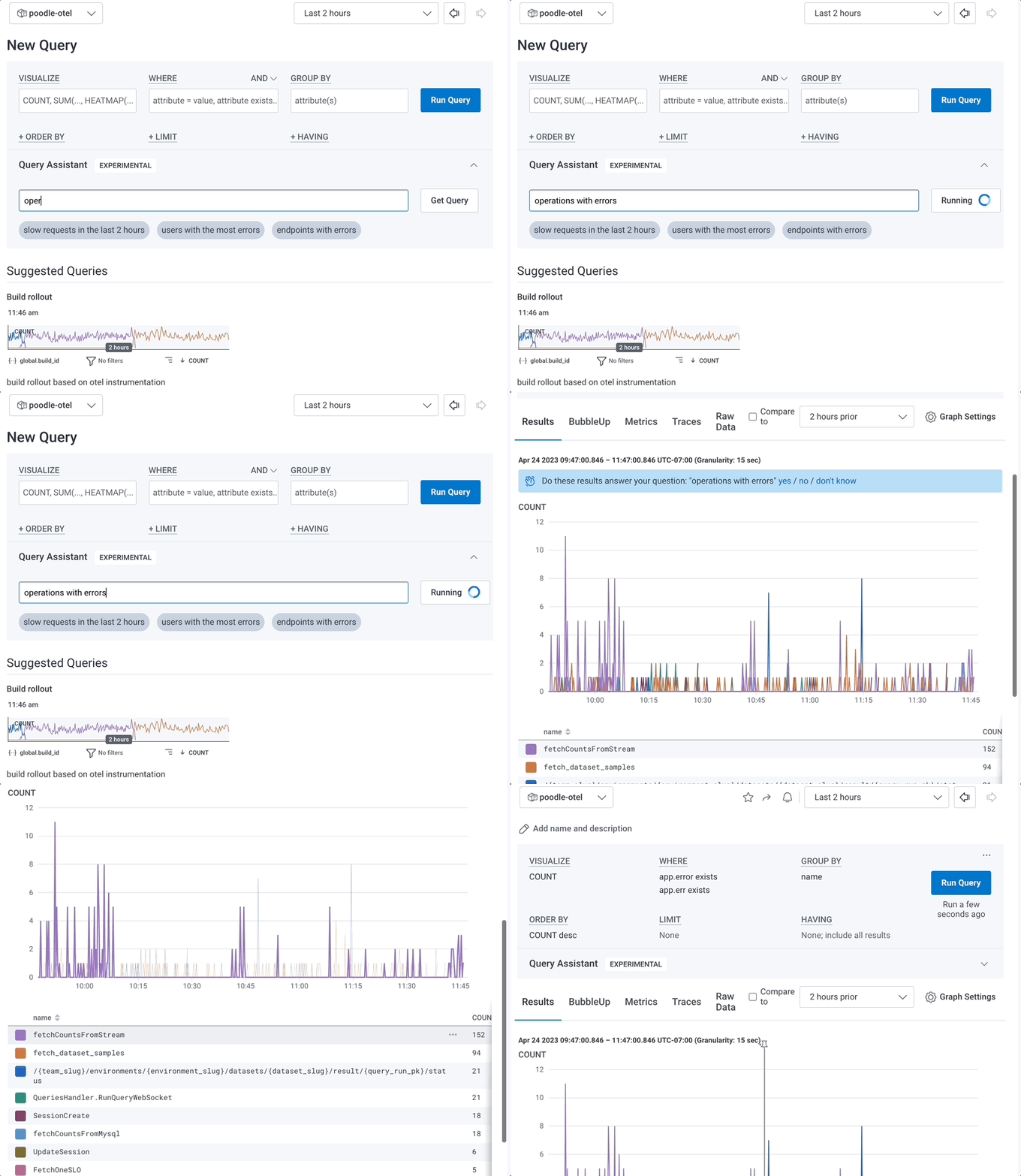
    Honeycomb today added a Query Assistant to its observability platform that uses OpenAI’s ChatGPT generative artificial intelligence (AI) platform to launch queries via a natural language interface rather than having to master a query language.

    That capability complements an existing tool based on machine learning algorithms, dubbed BubbleUP, that DevOps teams already use to debug code.

    Honeycomb CTO Charity Majors said both tools make the Honeycomb observability platform more accessible to IT teams that are tasked with managing complex application environments. Those teams are not going to be able to accomplish that goal without relying more heavily on AI to determine the root causes of an issue.

    Generative AI augments DevOps teams by making it possible to build a relevant, modifiable query that they can continuously iterate as IT staff investigate an issue. This approach means teams don’t necessarily need a deep understanding of code behavior and the underlying infrastructure it depends on, noted Majors.

    That’s critical, because not every IT professional immediately knows what query to launch. One of the challenges with adopting any observability platform is they require a a DevOps team member to frame a query to generate a result. If multiple queries are required, coding them in a query language becomes a cumbersome task.

    As AI continues to improve, algorithms should be able to automatically surface more issues. But given all the dependencies that exist in modern application environments, there will still be a need for a DevOps specialist to ensure application availability and optimize performance, at least for the foreseeable future.

    In general, generative AI represents a significant leap forward compared to AI for IT operations (AIOps) platforms that, in comparison, are not nearly as useful, noted Majors.

    It’s still early days as far as measuring the impact AI will have on DevOps workflows. But the AI genie is already out of the proverbial bottle. Many of the low-level tasks that tend to make DevOps jobs tedious will soon be automated. As a result, job roles within DevOps teams will need to evolve.

    Less clear is what impact the rise of generative AI might have on the adoption of observability platforms. While there is no shortage of observability platforms, adoption has been limited by the number of DevOps professionals that could master a specific query language created for that observability platform. The ability to rely on a natural language interface instead reduces the need to use a proprietary query tool.

    In the longer term, the simpler it becomes to use DevOps best practices, the more widely they will be adopted. AI platforms should enable more organizations to embrace DevOps in a way that reduces the level of cognitive load currently required.

    In the meantime, there’s no doubt that current DevOps professionals are cautiously watching the rise of generative AI, much like everyone else. The difference is that most DevOps professionals are not going to want to work for organizations that don’t provide access to AI-infused tools and platforms that make their jobs easier.

  • Honeycomb Releases the 2021 Observability Maturity Community Research Findings

    Latest research reveals organizations that embrace observability experience higher productivity, code quality, end-user satisfaction, and software developer retention 

    San Francisco, CA, June 16, 2021 – Honeycomb, which provides industry-leading observability software for understanding, troubleshooting, and optimizing cloud-native distributed systems, today released its annual research findings on the maturity of the observability market. The 2021 survey found that 61% of respondents reported that their teams are practicing observability, an 8% increase from 2020, signaling that overall adoption is on the rise. However, the majority of respondents indicated their teams are at the earliest stages of observability maturity.

    With over 400 responses from across multiple industries and organization sizes, the report examines the challenges teams face and the practices they are implementing as they progress on their observability journey to achieve production excellence.

    Key findings include: 

    • Observability is gaining traction. Sixty-one percent of respondents reported that their teams are currently practicing observability, an increase of 8% from last year. That increase is sharply reflected across individual teams (up 7%) as opposed to entire organizations (up only 1%).
    • Teams on the higher end of the maturity spectrum realize more benefits than their less-mature counterparts. Teams that are mature in their observability practice realize even more impactful business outcomes, including deploying more frequently, being able to find bugs more quickly before and after pushing to production, and reduced burnout.
    • More-mature teams are also 3X more likely to deliver higher customer satisfaction. Teams that have achieved Intermediate or Advanced-level maturity reported their end-user customers are “Always Satisfied” with their service quality and capability at a rate of three times more than teams that do not practice observability.
    • Lack of implementation skills is a disproportionate barrier for observability adoption. While interest in observability has gained significant momentum, organizations at the earliest stages of observability maturity report lack of implementation skills as the second-largest hurdle to observability adoption, indicating a need for more training options. All respondents indicated their primary hurdle was competing with other initiatives.

    Now in its second year, the 2021 Observability Maturity Community Research Findings is becoming a benchmark that organizations can use to measure their own journey to observability and related practices against that of the wider business community. The maturity model outlines a progression of five distinct stages ranging from “Planning” or “Novice” (with limited observability capability and processes) to “Advanced” (with comprehensive processes). The highlights of this year’s report indicate that:

    • 10% of those surveyed reported a combination of practices and tooling that reflect a highly observable system in the “Advanced” and “Intermediate” groups. These two groups highly prioritize observability: 50% practice observability across the organization and 43% on a team-by-team basis. Respondents also reported high public cloud use, and most work at large enterprises (57%) and in the tech industry (46%).
    • 37% of survey respondents fall into the “Novice” group.  This group is more likely to self-report that they are practicing observability because they are using tools like logs, metrics, and traces. However, they also do not report having the key capabilities associated with practicing observability, such as having a comprehensive understanding of their systems, which suggests that respondents in this group may be focusing on the data needed for observability but not yet fully adopting the tools or practices of observability.
    • One in four teams are at the “Planning” stage or the very beginning of their observability journey and are starting to practice on a team-by-team basis. In this group, approximately one in five respondents do not currently practice or use observability tooling but have plans to do so within the next year.

    “This year, we’re seeing that teams focused on building up their observability capabilities are identifying problems faster and producing better business outcomes,” said Christine Yen, CEO and co-founder of Honeycomb. “Our observability maturity model can be used as a roadmap for anyone to see how organizations across the industry are approaching a fundamentally new way of understanding their production services. Teams can understand what’s working, what’s not, and how early investments in observability adoption are creating meaningful business impacts, so that they can achieve similar results.“

    Additional Resources

    On Tuesday, June 29, at 12 p.m. ET / 9 a.m. PT, join our webinar, “The State of Observability 2021: Mature Teams Ship Better Code Faster and You Can, Too,” to discuss the findings of this report and hear actionable insights that organizations can use to start or improve their observability approach. Reserve your seat by registering for the webinar.

    To receive a copy of the report, please visit this page.

    The 2021 Observability Maturity Community Research Findings study was conducted by ClearPath Strategies, an independent strategic consulting and public opinion research firm.

    About Honeycomb

    Honeycomb provides observability for modern development teams to learn, debug, and improve their production systems efficiently so that business-critical apps perform with minimal disruption to users. Honeycomb’s customers rely on the product for fast incident response, system optimization, and delivering pain-free releases across the software engineering cycle that translates to happy devs and happy customers. Learn more at www.honeycomb.io and follow us on Twitter.

  • Honeycomb Metrics Modernizes the Use of Metrics for Debugging Cloud-Native Distributed Systems

    New metrics feature helps customers bridge the gap between traditional debugging practices and modern systems, without compromising the powerful insights of observability.

    San Francisco, CA, June 10, 2021 — Honeycomb, which provides industry-leading observability software for understanding, troubleshooting, and optimizing cloud-native distributed systems, today announced the availability of Honeycomb Metrics. The new feature enables customers already using observability to quickly identify and resolve application issues by allowing them to correlate metrics-based indicators of system health from the same interface. This streamlined view bridges the gap between traditional monitoring and modern observability practices, providing engineering teams with simplicity and speed in their investigative workflow.

    Many organizations use multiple third-party traditional monitoring and debugging tools to identify and diagnose systems-level constraints that impact their application-level performance. The complexity of multiple tools adds to the challenges software developers already face when building and maintaining production environments using cloud-native and distributed systems—making it nearly impossible to debug application failures with traditional monitoring tools that use metrics at the application level.

    With Honeycomb Metrics, customers can maximize their technology investments by making it easy for engineering teams to use one interface to identify and diagnose complex application performance problems, whether they originate from application code or system issues. It relieves them from needing to use several legacy monitoring tools that diagnose application-level issues or system-level issues and having to connect the dots themselves. Honeycomb Metrics gives engineering teams an understanding of application-level issues with observability and systems-level issues with metrics.

    Honeycomb Metrics also helps teams get started with observability more easily by allowing them to use their traditional monitoring data in tandem with their new observability data. New customers can use Honeycomb Metrics as a stepping stone from the legacy approach—debugging with application-level metrics—to adopting event-driven observability practices in parallel, without first needing to identify and rewrite existing instrumentation.

    “Honeycomb Metrics help customers new to observability quickly see how their traditional monitoring world fits into the modern world of observability,” said Christine Yen, Honeycomb Co-founder and CEO. “Adding native support for systems-level metrics lowers the barrier for entry into observability, while still providing the essential, event-driven analytical capabilities at the application-level that have made Honeycomb a market leader in the observability space.”

    Honeycomb Metrics works by letting customers send metrics data to Honeycomb using either OpenTelemetry or one of several other metrics formats, including StatsD, Prometheus, and Amazon CloudWatch. Honeycomb Metrics includes usability enhancements that overlay time series metrics data with events data in useful and logical visualizations. Customers can see how their infrastructure-level metrics correlate with their application-level events for one consistent representation of overall system performance. Honeycomb Metrics also introduces suggested queries that guide customers toward seeing the representations they need automatically.

    “With Honeycomb Metrics, we’re able to very easily switch between searching, visualizing, and viewing raw metrics data all in one place,” said Sarah Sherbondy, Principal Engineer, Platform Observability, at Heroku. “That helps us more quickly verify and iterate on instrumentation improvements than we’d been able to do previously. The Honeycomb query interface is awesome for metrics, just as it is for events. With just a few clicks, getting insights and clarity from our metrics has never been easier. Plus, setting it up was a breeze since Honeycomb works with the OpenTelemetry Protocol. That ease of use means improved reliability for very little effort! A win, win situation for us!”

    Honeycomb Metrics is now in open beta for all Enterprise customers. Click here for more information and to sign up.

    About Honeycomb
    Honeycomb provides observability for modern development teams to learn, debug, and improve their production systems efficiently so that business-critical apps perform with minimal disruption to users. Honeycomb’s customers rely on the product for fast incident response, system optimization, and delivering pain-free releases across the software engineering cycle that translates to happy devs and happy customers. Learn more at www.honeycomb.io and follow us on Twitter.

  • Honeycomb’s Strong Performance Drives $20 Million Series B Investment to Secure Leadership in Observability

    e.ventures led investment in Honeycomb’s industry leadership and product innovation, which focuses on observability for modern engineering teams  

    SAN FRANCISCO, February 2, 2021 – Honeycomb, a provider of observability for distributed systems to understand, debug, and improve production systems, announced today the close of a $20 million Series B round led by e.ventures Growth, with participation from Industry Ventures and existing investors Storm Ventures, Scale Ventures Partners, NextWorld Capital, and Merian Ventures. This round of funding comes as Honeycomb continues to see sustained strong business growth and product innovation, and brings Honeycomb’s total amount of capital raised to $46.9 million.

    “We are very pleased Industry Ventures has joined our journey, along with our existing investors, to build an enduring company that developers, DevOps, and Site Reliability Engineering teams both need and trust,” said Christine Yen, CEO of Honeycomb. “With a booming interest in Honeycomb’s solutions, this infusion of capital enables us to accelerate our product roadmap and further our innovative approach to helping customers efficiently manage the performance of complex software at scale. The valuation achieved in this round of investment is reflective of our market leadership and the continued commitment to building upon our industry-defining solutions.”

    The recent round of funding comes on the heels of a banner year for Honeycomb, which doubled its business to support over 300 fast-growth companies to date. Designed to handle the scale and complexity of modern architectures, Honeycomb’s offering empowers engineers and their organizations to manage exponential volumes of data where traditional APM solutions routinely fail. The cloud-based offering provides real-time insights that identify optimizations hidden within complex application systems, enables engineering teams to debug systems faster, and helps businesses focus on building superior customer experiences.

    Since taking in its last funding round in September 2019, Honeycomb has accomplished significant business milestones, including:

    • Adding top industry talent to the leadership bench, including Vice President of Sales, Chad Malchow; Vice President of Engineering, Emily Nakashima; and Vice President of Marketing, Jo Ann Sanders
    • Doubling its headcount, with a focus on building out Honeycomb’s Sales and Marketing teams
    • Doubling its Annual Recurring Revenue in 2020, with record-setting quarter-over-quarter growth, and closing landmark deals that grew the company’s footprint to more than 300 customers
    • Tripling the number of fast-growing enterprise customers like Hello Fresh, Intercom, and Slack, whose digitally enabled business services grew exponentially during the COVID-19 pandemic
    • Strengthening its overall customer base with over 150 percent growth across small, mid-market, and enterprise markets by replacing solutions offered by traditional APM vendors, in addition to propelling growth with increased subscription renewals across the largest enterprise customers
    • Expanding market traction with large enterprises undergoing aggressive digital transformation initiatives to modernize their infrastructure in industries like financial services
    • Offering broader security protection for enterprise customers with solutions like Secure Tenancy, in addition to expanding support and customer success services, and simplifying pricing model and plans and providing a new free usage tier

    “When we led the last round, I was impressed with the community leadership, technology, and market opportunity. Just a year later, we are doubling down because they have added to that an efficient go-to-market effort that is exceeding our expectations. They have attracted top-notch executive leadership across the board, from product, developer relations, and engineering, to sales, that is uniquely suited to succeed here. Together, this team understands the observability needs of engineering and operators better than anyone in the industry, and it shows in the incredible product and customer enthusiasm.” – Ariel Tseitlin, Partner, Scale Ventures 

    “The tremendous results delivered by Honeycomb’s leadership team have given us the confidence to make a rare investment from the growth arm of e.ventures,“ said Thomas Gieselmann, General Partner of e.ventures. “As the de facto observability tool for businesses, Honeycomb’s innovations continue to empower customers with the solutions needed to deliver on the promise of seamless digital experiences. We believe Honeycomb is well positioned and firmly committed to remaining the clear leader within the maturing observability market.”

    About Honeycomb

    Honeycomb provides observability for modern development teams to learn, debug, and improve their production systems efficiently so that business-critical apps perform with minimal disruption to users. Honeycomb’s customers rely on the product for fast incident response, system optimization, and delivering pain-free releases across the software engineering cycle that translates to happy devs and happy customers. Learn more at www.honeycomb.io and follow us on Twitter.