Tag: Hasura

  • Hasura Adds “Supergraph” to Platform for Managing APIs

    Hasura Adds “Supergraph” to Platform for Managing APIs

    Hasura, whose product helps compose GraphQL APIs backed by databases and services, today made available in beta an update to its platform. The company is adding a graph modeling framework that makes it simpler to manage application programming interfaces (APIs) at scale.

    The goal is to make it easier for IT teams to declaratively create APIs and then manage them at scale, said Hasura CEO Tanmai Gopal. As application environments made up of multiple backend services and databases become the enterprise norm, there is a pressing need to simplify the management of what has become thousands of APIs in an enterprise IT environment using query compilers and routing capabilities built into the platform, he added.

    In version 3.0 of the Hasura Data Delivery Network (DDN), the “supergraph” execution engine is based on a serverless runtime engine that, the company says, will replace its previous graph technologies to manage both GraphQL and REST APIs.

    In addition, all connectors provided by Hasura have been rebuilt using an open specification and are now available as open source software on the Hasura Connector Hub. Hasura is also making available a software development kit (SDK) to enable IT teams to build custom connectors.

    Written in the Rust programming language, the supergraph framework eliminates the need to create and manage GraphQL servers or services to deploy a graph. Additional data domains as a result can be added or replaced without breaking the graph used to manage other APIs.

    The update to the Hasura DDN also adds new build system to provide instant API previews and support for rollbacks, a redesigned console featuring a graphical supergraph viewer, API analytics, observability, and auto-generated API documentation capabilities. Every iteration of the Hasura supergraph is instantly available as an immutable build that can be tested in preview. Every change to the supergraph is also validated before build, letting users identify potential bugs, stylistic issues, syntax, and type errors.

    In addition, Hasusa has added a sub-millisecond cold start capability to enable rapid autoscaling and plane to shortly add caching to improve API performance in edge computing environments.

    Longer term, the company plans to add additional a range of artificial intelligence (AI) capabilities to enable IT teams to identify issues requiring troubleshooting earlier and generate reports, Gopal added.

    While REST APIs are still more commonly used than GraphQL, more IT teams are employing the latter. That’s because GraphQL provides more control over how data is accessed and consumed. Most organizations will soon be using a mix of REST and GrapgQL APIs, but it might be years before REST is supplanted as the dominant format simply because those APIs are more familiar to developers and easier to create.

    Regardless of the type of API used, however, their numbers continue to steadily increase with each microservice added to an IT environment. It’s not always clear which teams within an IT organization are managing those APIs but increasingly best DevOps practices are being used to deploy, manage, secure and update them alongside every other type of software artifact. The challenge, of course, is making it simple to manage those API workflows in a way that doesn’t require yet another specialist to be added to the DevOps team.

  • Adopting a Low-Code GraphQL Approach to Build a Core Data Platform

    Adopting a Low-Code GraphQL Approach to Build a Core Data Platform

    Our education platform has relied on an outdated monolithic legacy application for years. It’s an outdated system built of a single service layer on top of a database designed for use cases that have evolved over the last decade. But we’re using the wealth of data in the monolith as a foundation for our current projects, thanks to our newly adopted tools.

    With our product line continually expanding, our need for a centralized API that can sit over commonly used data has become even more critical. This includes data related to our customers’ organizational units, purchased products, licensing information, and student, teacher and class rosters, among other things.

    The stakes are high since we have multiple downstream clients depending on us. Our goal is to move some functionality and data out of the main system while making sure our design is flexible enough to adapt to future product changes. We envision a hub-and-spoke model where all our products interact through a central hub to access shared data. Efficiency, security and reliability are all top priorities. Because we’re a small team, we need to move fast and be open to new ideas. That’s why we’re using a low-code backend solution to minimize manual coding and maximize our productivity.

    A few months ago, we adopted a tool called Hasura. Its core value proposition is that it places a production-grade GraphQL API over any database, saving teams months of recurring effort in building, shipping and maintaining their APIs. We put the open source Hasura community edition to the test and found that it lived up to its claims. In this article, we’ll show you how it worked for us and how it can work for you too.

    Converting GraphQL to SQL

    Before a team can convert GraphQL to SQL, they must undergo a data modeling phase. After this data modeling phase, backend teams must complete some unavoidable tasks. One of these tasks is to build an API that allows clients to read and mutate data. Hasura provides this instantly, freeing engineers from the toil of writing basic CRUD APIs. Hasura compiles a GraphQL string into a GraphQL abstract syntax tree (AST), which is then compiled into a SQL AST. This abstraction lets us do powerful things, like using a bulk GraphQL mutation to transactionally and atomically insert or update data. GraphQL provides a flexible way for us to query our data in the form of a graph. This means that, as engineers, we get to focus more on business logic.

    API Federation, Aggregation and Composition

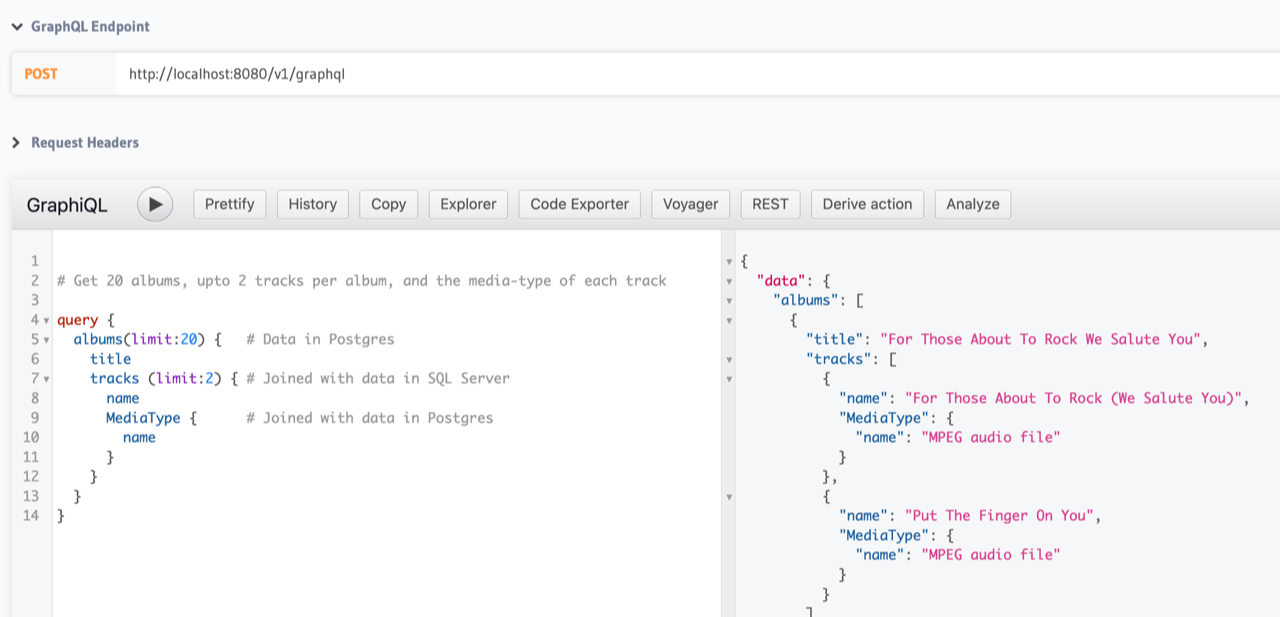
    Hasura’s support for remote GraphQL schemas enables us to design a service-oriented architecture in which Hasura functions as an API federation/composition layer and delegates to other Go microservices that provide specialized business logic for a particular domain. This ability to federate doesn’t just end at remote GraphQL schemas—Hasura also supports remote data sources, opening multiple possibilities for how we traverse through the graph and explore relationships in our data, including how we might join remote databases to each other or to remote APIs (REST or GraphQL).

    In greenfield projects, teams typically spend months crafting a fully-featured API, a common language that all clients can share. With Hasura, we get this in seconds and can spend that saved time writing automated tests or implementing business logic.

    Developer Dashboard

    Hasura’s Dashboard/Console improves developers’ experience. Using the dashboard, developers can craft experimental GraphQL queries and mutations against our local instance of Hasura. The embedded GraphQL playground makes it a breeze for new developers joining the team to introspect and discover our API. We can also visualize our database schema in the UI directly and make changes to it with a few clicks of a mouse (if needed), generating source-controlled SQL migration scripts like you’d find in other web frameworks.

    Observability

    No production-ready system would be complete without observability, or the ability to gauge a system’s internal state based on external output, usually in the form of logs, traces and metrics. Hasura ships logs and traces to our New Relic telemetry platform for each database operation, allowing our team to identify bottlenecks and receive early alerts of unexpected or degraded system performance.

    Authorization

    Hasura’s role-based authentication support allows us to check an additional box on our production-readiness checklist. Clients with certain roles may have permission to execute specific GraphQL API operations or access particular database tables. Hasura can derive a client’s role in one of two ways: Either the client will send Hasura a JWT auth header (which includes a signature containing claims providing the client’s role), or Hasura will refer to an external webhook which, in turn, makes the auth decision. Without Hasura, we would need to write and maintain the code to perform all of this work.

    Change Data Capture

    The last way Hasura enables us to build our core platform is through change data capture (CDC), or the process of tracking changes to a database. Hasura provides this in the form of event triggers, which function like a transactional outbox system. When a record is inserted, updated or deleted, a bona fide database trigger will record this event in a table. Then, a reliable process in Hasura will guarantee that the event is delivered at least once to its intended webhook (one of our microservices). This is tremendously useful for our team since we need to sync data from our new database to the older legacy database.

    There are many tools we could use for CDC, such as AWS SQS or Kafka (some of which we use downstream to integrate our platform with individual products), but having this feature baked into Hasura makes the process simpler, as it frees us from having to provision any new infrastructure or deal with the complexities of bringing on additional tools.

    Conclusion

    For the Teaching Strategies platform modernization team, we’re just getting started. As we continue to evolve and improve our product, we’re considering Hasura for finer-grained authorization, such as attribute-based access control (ABAC) over coarser role-based access control (RBAC). We will also investigate real-time streams so other systems, such as users’ browsers, can see data changes as fast as possible.

    Using the functionality and features of Hasura community edition outlined above, our team is well on the way to building a strong core platform. By leveraging this tool, we can meet our milestones faster and provide even more support for educators and caregivers, making their lives easier.

    Interestingly, Hasura is a combination of the programing language Haskell and the Sanskrit word asura—or demon.  As far as tech choices go, this one feels much more like a guardian angel.

  • Hasura Unfurls Data Delivery Network Based on GraphQL

    Hasura Unfurls Data Delivery Network Based on GraphQL

    At its HasuraCon 2023 conference today, Hasura launched a Data Delivery Network (DDN) based on a set of GraphQL application programming interfaces (APIs) that makes it simpler to integrate distributed sources of data.

    In addition, Hasura is adding Hasura Schema Registry to streamline API governance using graph technology, a MongoDB connector, a Native Data Collector (NDC) for REST APIs and support for the Open Domain Data Specification (OpenDDS), an open framework for modeling APIs originally developed for the travel industry.

    Finally, Hasura is adding support for Native Queries and Logical Models capabilities that convert SQL requests into API calls.

    The Hasura DDN leverages the GraphQL API to enable sub-second integrations across a network that, in concept, is similar to how a content delivery network (CDN) is constructed.

    Hasura CEO Tanmai Gopal said the goal is to enable sub-second integration of data at a global scale across a network with more than 100 regions. Developers can integrate their APIs in less than a second regardless of the number of data models connected. Metadata changes can also be used to create builds that can be independently tested and applied to projects to enable API version control and collaboration among development teams.

    The Hasura DDN is accessed via Hasura Cloud, an instance of a data integration platform that can be deployed on multiple clouds, including Microsoft Azure, and will soon be made available for private clouds managed by internal IT teams.

    GraphQL is gaining traction as an alternative to REST APIs for integrating data, but it’s more complex to implement and manage. The Hasura DDN extends the reach of a Hasura Cloud platform that provides a simpler method for adding GraphQL capabilities to an IT environment in a way the also conserves network bandwidth, noted Gopal.

    GraphQL is a query language for APIs and a runtime for fulfilling queries that provides a complete and digestible description of the data in an API. It can also be used to pull data from multiple sources because it uses a schema that defines the different types of data available. REST APIs, in contrast, can only fetch data from a single source. As such, many organizations that are trying to drive adoption of reusable digital services are relying on GraphQL.

    It’s not always clear who within an organization is assuming responsibility for managing the APIs that developers create, but as the number of APIs increases, DevOps teams, in many cases, are moving to centralize API management. In fact, the more data an organization creates, the greater the corresponding use of APIs to programmatically access that data becomes.

    Hasura is betting that as organizations reach a critical mass of API integration requirements, it will make more economic sense to rely on a purpose-built data integration platform accessed as a cloud service versus relying on a set of tools and platforms they need to configure and manage. Regardless of approach, the one thing that is certain is the number and types of APIs that need to be managed are rapidly exceeding the ability of IT teams to keep pace.

  • Hasura SDK Integrates GraphQL Platform With More Data Sources

    Hasura SDK Integrates GraphQL Platform With More Data Sources

    At its HasuraCon ’22 conference, Hasura today announced the early release of a software development kit (SDK) that extends the reach of its GraphQL platform to additional data sources.

    In addition, Hasura is making generally available integrations with the GitHub repository, support for OpenTelemetry Traces within the Hasura Cloud Platform and Microsoft SQL event triggers.

    Finally, Hasura Cloud can now be deployed on the Google Cloud Platform while the Hasura Cloud Enterprise edition is now available on the Amazon Web Services (AWS) marketplace.

    Hasura CEO Tanmai Gopal said that while the company already provides support for widely used data sources such as the Postgres database, there are many data sources that organizations also want to be able to query via GraphQL application programming interfaces (APIs). Organizations want to be able to join data using GraphQL regardless of what repository it resides in, he added.

    The open source Hasura engine at the core of the company’s offerings automatically generate a GraphQL schema from a data source. That can then be used to accelerate the development of APIs to make it easier for a wider range of developers to build applications that aggregate data across multiple sources.

    That approach eliminates the backend complexity that IT teams encounter when adding GraphQL APIs to an application environment that already has a range of APIs for internal IT teams to support, noted Gopal.

    GraphQL was originally created by Facebook, but it’s still not clear to what degree GraphQL APIs will supplant REST APIs. Developers tend to prefer GraphQL APIs because they provide more granular control over what data is accessed. The challenge is the number of backend services that expose GraphQL APIs is still comparatively limited.

    It’s not likely IT teams will replace REST APIs with GraphQL-based APIs overnight, but the percentage of new applications that rely on GraphQL APIs will steadily increase. Overall, the number of APIs employed within IT environments is rapidly expanding as more microservices-based applications are deployed. Each microservice generates its own API. Over time, IT teams will find themselves managing a wider variety of types of APIs.

    The challenge is that it’s not always clear who within IT organizations will manage those APIs. They are often created by developers and are left to IT operations teams to maintain. It’s not uncommon for IT teams to find themselves managing hundreds, perhaps thousands of APIs.

    In addition, many of those organizations are now consuming data via APIs exposed by other organizations. Over time, the level of interdependency between APIs and applications will serve to make application environments much more complex to manage.

    In the meantime, DevOps teams will need to extend existing DevOps workflows to both support and secure GraphQL-based APIs. The amount of sensitive data being accessed via those APIs is likely to accelerate the rate at which organizations are adopting DevSecOps best practices. Let’s hope this happens before they wake up to discover GraphQL APIs have already proliferated across the enterprise.

  • Hasura Adds Join Capability to GraphQL Engine

    Hasura Adds Join Capability to GraphQL Engine

    Hasura today announced it has extended its GraphQL engine to make it possible to join data generated by multiple sources.

    Hasura CEO Tanmai Gopal said GraphQL Joins makes it possible to join data from across different GraphQL services that can then be accessed via a single GraphQL application programming interface (API). The extension of the federation capabilities enabled by the Hasura GraphQL engine eliminates the need for custom code that would otherwise be required to join that data, he added.

    The Hasura engine automatically generates a GraphQL schema from a data source that can then be used to accelerate the development of APIs. GraphQL Joins extends that federation capability to now include multiple GraphQL and, eventually, other data sources accessed via, for example, legacy REST APIs, said Gopal. That capability will make it easier for a wider range of developers to build applications that aggregate data across multiple sources, he added.

    The core Hasura Engine is based on open source software that the company claims has now been downloaded more than 500 million times. Hasura makes available a cloud service based on that core engine. That approach eliminates the backend complexity that IT teams encounter when adding GraphQL APIs to an application environment that already has a range of APIs that internal IT teams need to support, noted Gopal.

    GraphQL was originally created by Facebook, and it’s still not clear to what degree GraphQL APIs will supplant REST APIs. Developers tend to prefer GraphQL APIs because they provide more granular control over what data is accessed. The challenge is the number of backend services that expose GraphQL APIs is still comparatively limited. Most IT teams will not be replacing REST APIs with GraphQL-based APIs overnight, but the percentage of new applications that rely on GraphQL APIs will steadily increase. DevOps teams looking for easier ways to provide developers with access to backend services via a GraphQL API can employ the Hasura Engine to automate that process.

    Overall, the number of APIs employed within IT environments is rapidly expanding as more microservices-based applications are deployed. Each microservice generates its own API. Over time, IT teams will find themselves managing a range of types of APIs to support multiple digital business transformation initiatives that an organization may have simultaneously launched. In addition to building APIs, many of those organizations are now consuming data via APIs exposed by another organization. Over time, the level of interdependency between APIs and applications will serve to make application environments much more complex. The good news is that APIs make it easier to upgrade—and even replace—backend services without disrupting application services.

    It’s not always clear, though, who within IT organizations will manage those APIs. They are often created by developers that then look to IT operations teams to maintain them. Before too long, it’s not uncommon for IT teams to find themselves managing hundreds, perhaps thousands, of REST and web services APIs—and soon, that may include many built using GraphQL.

  • Hasura Adds Engine to Transform REST APIs to GraphQL

    Hasura Adds Engine to Transform REST APIs to GraphQL

    Hasura today unveiled a Data Hub repository for integrating application programming interfaces (APIs). The repository includes a connector that makes it easier for IT organizations to convert REST APIs into ones based on the GraphQL specification.

    Tanmai Gopal, Hasura CEO, said the connector eliminates the need to write custom code to connect existing REST endpoints to a GraphQL API using an update to the transformation engine developed by Hasura. Instead, the model for the GraphQL API is automatically overlayed on top of the REST API endpoint, explained Gopal.

    Originally developed by Facebook, GraphQL has emerged as a popular alternative to REST APIs because it enables developers to retrieve data at a more granular level, which results in improved performance. Hasura provides an instance of a GraphQL engine the company has developed around a project that is now hosted by the GraphQL Foundation, an arm of the Linux Foundation. GraphQL provides a complete description of the data made available via an API and is organized in terms of types and fields rather than traditional endpoints. In addition to clarifying what data is available via that API, developers can employ types to avoid writing manual parsing code.

    Hasura claims its engine has been downloaded more than 400 million times since its introduction in 2018. It automates the repetitive work involved in mapping models to APIs by providing common access patterns for pagination, filtering, joining, setting up authorization rules and optimizing performance. Hasura also provides APIs that are able to connect to multiple services and data sources, embed domain-specific authorization logic and provide additional layers of security.

    Hasura is now also adding a way to create identity-specific authorization policies for any GraphQL service or data source, enforcing security by limiting the models and fields of the GraphQL APIs in a way that eliminates the need for IT teams to cobble together disparate libraries and frameworks, said Gopal.

    In addition, Hasura is adding support for Google Cloud to Hasura Cloud in beta, a managed API integration service the company already provides via the Amazon Web Services (AWS) cloud. Support for the Microsoft Azure cloud will be forthcoming in 2022, added Gopal.

    It’s not clear the degree to which organizations are looking to replace existing REST APIs with ones based on GraphQL. However, Gopal noted there are plenty of instances where organizations need to overlay a GraphQL API on top of a REST API that they may not own. For example, a software-as-a-service (SaaS) platform that currently exposes a REST API may not have any plans to support GraphQL, he said.

    There’s no doubt the number of GraphQL APIs being employed in the enterprise is about to dramatically increase. The challenge now is finding a way to manage them alongside the previous generations of APIs that remain. The trouble is that many of those APIs were created by developers that may not have documented the APIs they created or, in some cases, never informed DevOps teams that they existed in the first place.

  • Hasura Extends Scope of GraphQL API Platform

    Hasura Extends Scope of GraphQL API Platform

    During its online an HasuraCon ’21 conference, Hasura today announced that it has made it possible for developers to employ GraphQL application programming interface (APIs) to launch queries against data residing in multiple databases.

    At the same time, Hasura announced a preview of schema sharing capabilities along with support for workflows based on GitOps processes that it will make generally available later this year. The Hasura Cloud platform can now deploy local migrations from staging to production with a simple git push in addition to accessing previews of applications on every pull request to the git repository.

    The schema sharing capability added to the Hasura GraphQL Engine is intended to bridge the gap between beginner and power users by allowing them to share and install samples of permissions, relationships and metadata. In addition to improving collaboration, the goal is to make it easier to onboard software engineers as projects evolve and become more complex.

    Originally developed by Facebook, GraphQL has emerged as a popular alternative to REST APIs because it enables developers to retrieve data at a more granular level, which results in improved performance.

    Hasura is a provider of an instance of a GraphQL engine the company has developed around a project that is now hosted by the GraphQL Foundation, an arm of the Linux Foundation. The GraphQL Foundation counts among its members Airbnb, Amazon Web Services (AWS), Apollo, Coursera, Elementl, Facebook, GitHub, IBM, Intuit Hasura, Paypal, Prisma, Shopify and Twitter.

    GraphQL provides a complete description of the data made available via an API and is organized in terms of types and fields rather than traditional endpoints. In addition to clarifying what data is available via that API, developers can employ types to avoid writing manual parsing code.

    Since last summer, Hasura has been making available a pilot of a GraphQL implementation that is capable of supporting remote joins across disparate databases. That capability is critical because data sets that are related to a specific business process may wind up being stored in multiple databases.

    Hasura

    Tanmai Gopal, Hasura CEO, said the open source Hasura GraphQL Engine has already been downloaded more than 250 million times this year. Downloads in 2020 reached 100 million. The challenge is that while GraphQL offers a superior alternative to REST APIs, most of the API tooling that exists within organizations is still designed around REST APIs, noted Gopal.

    To accommodate that reality, Hasura has made a tool available that will convert a query designed using GraphQL into a set of calls that are compatible with REST APIs. Developers still gain the benefits of being able to launch more granular queries, noted Gopal.

    REST APIs, in general, are becoming more problematic as organizations embrace microservices-based applications. It often takes minutes to refresh a simple dashboard because of the amount of data that REST APIs are trying to pull from various data sources. As organizations embrace digital business transformation, they are also encountering application latency issues that can be traced back to the amount of data being called from multiple microservices.

    Hasura says in addition to providing a more efficient method to access data, Hasura is also working on adding caching capabilities to its core engine to further improve performance.

    It’s not clear at what rate GraphQL might replace REST APIs, but DevOps teams should assume organizations will wind up employing a mix of both for years to come. The challenge is going to be determining when to make the transition as organizations become more dependent on APIs.

  • Hasura Releases Enterprise Grade Features so Developers Can Build Mission-Critical Applications Faster

    Hasura’s GraphQL Engine Grew From 0 to 100 Million Downloads in 2.5 Years, Making it the Fastest Growing Open Source GraphQL Project for the Last 2 Years

    SAN FRANCISCO, Feb. 23, 2021 (GLOBE NEWSWIRE) — Hasura, the data access infrastructure company, today announced that it has released version 2.0 of its popular open source GraphQL Engine. The release now enables organizations to simultaneously deploy REST and GraphQL APIs from one configuration to provide a bridge between modern application development and supporting existing REST APIs. This release includes the industry’s first GraphQL API gateway which provides granular authorization to any GraphQL API. Additionally, the release also now supports Google’s BigQuery database in addition to PostgreSQL, SQL Server and MySQL, so developers can easily access the data instantly to accelerate application development.

    Hasura GraphQL Engine has seen explosive growth since it was launched in 2018. Downloads grew to 2 million in 2019 and to 100 million in 2020, making it the fastest growing open source GraphQL project over the past two years. Today the project has more than 20,000 GitHub stars. Today’s release is a major milestone for the open source project as well as the GraphQL community and brings Hasura one step closer to delivering on its vision of providing universal secure data access – across data platforms and information silos.

    “Hasura GraphQL Engine 2.0 confirms that using Hasura as a foundational part of our infrastructure was the right choice,” said Ian Macalinao, Pipe.com’s Head of Product Engineering. “As a startup in the fintech space, we have to continuously innovate while providing the highest levels of data security for our customers. The new enterprise features in Hasura provide us the flexibility to quickly utilize different API formats and data sources, all while securely authorizing highly privileged data to only the right entities.”

    Today Hasura also announced the managed service offering of GraphQL Engine, Hasura Cloud, now has AWS VPC peering capability to securely connect their data and infrastructure to Hasura Cloud in a secure private network. Hasura Cloud and Hasura’s on-premises Enterprise Edition, are both powered by Hasura’s GraphQL Engine.

    Tanmai Gopal, co-founder and CEO of Hasura said, “Hasura GraphQL Engine 2.0 has our most anticipated features that make building mission critical applications in enterprise a reality, accelerating time to market for key initiatives. Hasura’s declarative configuration approach and modern developer experience, coupled with a powerful authorization engine means organizations can innovate fast without compromising on security. Hasura is proving to be the backbone for the next generation of mission critical applications. The days of proprietary data access are over. Technology and user behavior are evolving too fast to completely re-architect systems. Hasura’s vision empowers developers to focus on user experience while re-using their data in new ways.”

    Organizations have valuable data they need to access as they build new applications but it is trapped in siloed databases. Rather than trying to use manual approaches to build APIs and worry about security, performance, or trying to consolidate fast-moving operational data, Hasura provides a new option that makes it easy for developers to access the data: simply connect applications by federating access to where the data lives, using a modern API-based approach. With Hasura, developers get flexible data APIs from those sources within minutes to instantly access online data.

    With Hasura, developers can rapidly build applications that connect to data without waiting for costly, time-consuming integration and infrastructure projects to finish building the pieces they need. Instead, they can concentrate on solving business problems with data and rapidly build and ship applications that add value to their organizations. The speed and flexibility provided by Hasura are truly transformative for organizations constrained by legacy systems.

    “Organizations today want to provide GraphQL access to APIs and data services, while leveraging their existing REST assets with granular controls,” said James Governor, RedMonk co-founder. “Hasura GraphQL Engine 2.0 is designed to meet that need, bridge REST and GraphQL with a single management and authentication model, at the row level, across various database sources.”

    New Hasura GraphQL Engine 2.0 Features

    • Simultaneous auto-generation of REST and GraphQL APIs. To ease the transition to GraphQL, Hasura GraphQL Engine 2.0 provides the ability to auto-generate REST and GraphQL APIs, enabling organizations to support both formats within a single configuration – saving significant time and cost. This also enables organizations to continue to support existing investments in REST APIs.
    • Enhanced security and authorization. Hasura GraphQL Engine 2.0 includes the industry’s first GraphQL gateway with built-in authorization so that developers can easily secure all the GraphQL APIs in their organization – not just ones created by Hasura. Using GUI tools or declarative configuration, developers can easily configure granular role and attribute-based access control rules and inheritance policies to prevent unauthorized data use and security breaches in complex enterprise systems.
    • Expanded database support for Google BigQuery. In addition to relational database support for PostgreSQL, SQL Server, and MySQL, Hasura GraphQL Engine 2.0 provides auto-generated GraphQL APIs for Google BigQuery, eliminating complex data migrations and enabling data unification at the GraphQL layer.

    With New Support for AWS’ VPC Peering, Enterprises Can Securely Connect to Hasura Cloud
    AWS VPC Peering and security certifications for Hasura Cloud. Hasura Cloud users can use its managed, serverless offering in a private, secure cross-premises network to accelerate data access in enterprise environments utilizing AWS’ VPC Peering. Hasura Cloud is also certified SOC2 Type 1 and HIPAA compliant.

    About Hasura
    Hasura is helping to build the modern world of globally relevant, data-driven applications and APIs. Hasura’s range of data access solutions helps organizations accelerate product delivery by instantly connecting data and services to applications with GraphQL APIs. For more information, go to: https://hasura.io or follow @HasuraHQ. 

  • Hasura Brings Instant GraphQL to MySQL and SQL Server for Rapid API Development to Unlock Siloed Data, Raises $25 Million in Series B

    SAN FRANCISCO, Sept. 08, 2020 (GLOBE NEWSWIRE) — Hasura, the data access infrastructure company, today announced that it has added GraphQL support for MySQL and early access support for SQL Server to its existing support for PostgreSQL. Hasura now supports three of the most popular database technologies. A great deal of valuable data lives inside existing MySQL and SQL Server databases, and developers want to access that data to build new applications. By expanding its support to more database types, Hasura makes it easy for developers to access that data with a modern GraphQL-based API with inbuilt security, scalability and governance.

    “Data lives in lots of places, and in many different databases. We want our users to be able to access that data instantly with Hasura’s secure, scalable data access infrastructure so adding support for MySQL and SQL Server was our obvious next step. It opens up huge potential for all the developers who need to access the vast amounts of data that lives in MySQL and SQL Server today. Now they can enjoy instant data access with a modern GraphQL API, and Hasura’s built-in security, governance and scalability features will get their applications into production quickly and safely,” said Hasura co-founder and CEO Tanmai Gopal.

    Organizations already have data they want to use but it is trapped in silos. Rather than trying to use outdated approaches to overcome this problem like consolidating fast-moving operational data into static data warehouses or datalakes, Hasura provides a new option: simply connect applications by federating access to where the data lives, using a modern API-based approach that includes security, governance and scalability as standard features. With support for MySQL, SQL Server and PostgreSQL, using Hasura means developers aren’t forced to migrate data to make it accessible from their applications.

    Hasura’s ability to auto-generate modern, GraphQL based APIs and its built-in security, governance, and scalability features means developers can rapidly build applications that connect to data without waiting for costly, time-consuming infrastructure projects to finish building the pieces they need. Instead, they can concentrate on solving business problems with data and rapidly build and ship applications that add value to their organizations. The speed and flexibility provided by Hasura is truly transformative for organizations trapped in outdated ways of working.

    Major Company Milestones

    • 2017 Hasura was founded by Tanmai Gopal, CEO, and Rajoshi Ghosh, COO, to make access to data easier for application developers struggling with outdated approaches to API development. Hasura has made instant data access possible by auto-generating modern GraphQL APIs with in-built security, governance, and scalability. With secure, rapid access to data, time-to-market for applications reduced dramatically for developers using Hasura.
    • 2018 Hasura announced $1.6 million in seed funding led by Nexus Venture Partners.
    • 2018 Hasura released its popular open source GraphQL engine that connects to databases and microservices and auto-generates a production-ready GraphQL backend to accelerate product development of modern, data-driven applications. The product has tens of millions of downloads and more than 18,500 GitHub stars.
    • 2018 Hasura joined the GraphQL Foundation as a founding member.
    • 2020 Hasura announced $9.9 million in Series A funding led by Vertex Ventures US.
    • 2020 Hasura released its on-premises version with enhanced enterprise features for security, scalability and compliance.
    • 2020 Hasura released Hasura Cloud, a managed service that provides instant and secure access to data across hybrid- and multi-cloud environments with a unified GraphQL API. Hasura Cloud helps organizations create data-driven applications without costly investments in infrastructure or operational management. The service brings new cloud-specific functionality such as dynamic data caching, auto-scaling, global availability and consumption-based pricing.
    • 2020 Hasura held its first user conference Hasura Con ‘20. The virtual conference had speakers from Airbus, Cherre, Credimi, General Assembly, GraphCMS, Krafteer, Lineup Ninja, Meow.vc, NuxtJS, Observable, OneGraph, Philips Healthcare, Prefect, RESULT, Swiggy, SZTAKI, Tarbh, The Chicago Reporter, The Guild, United Health and WorkClout.
    • 2020 Hasura won API World’s Best in DevOps APIs award for being a leader in its sector for innovation and for its developer adoption.

    Today Hasura also announced $25 million in series B funding, bringing the total raised to $36.5 million. The round was led by Lightspeed Venture Partners with participation from existing investors Vertex Ventures US, Nexus Venture Partners, Strive VC and SAP.iO Fund and new angel investors including John Thomspon, the current chairman of Microsoft.

    “We’re very impressed by how developers have taken to Hasura and embraced the GraphQL approach to building applications. Particularly for front-end developers using technologies like React, Hasura makes it easy to connect applications to existing databases where all the data is without compromising on security and performance. Hasura provides a lovely bridge for replatforming applications to cloud-native approaches, so we see this approach being embraced by enterprise developers as well as front-end developers more and more,” said Gaurav Gupta, partner at Lightspeed Venture Partners and Hasura board member.

    Hasura is using the funding to accelerate its hiring and investment in its open source and commercial product development to support its millions of users.

    About Hasura
    Hasura is helping to build the modern world of globally relevant, data-driven applications and APIs. Hasura’s range of data access solutions helps organizations accelerate product delivery by instantly connecting data and services to applications with GraphQL APIs. For more information, go to: https://hasura.io or follow @HasuraHQ.

  • Hasura Launches Hasura Cloud, the First GraphQL Service That Connects to Multi-Cloud Data Sources to Accelerate Development of Modern Applications

    SAN FRANCISCO, June 22, 2020 (GLOBE NEWSWIRE) — Today at Hasura Con ’20, Hasura, the data access infrastructure company, announced its new service, Hasura Cloud, that provides instant and secure access to data across hybrid- and multi-cloud environments with a unified GraphQL API. Hasura Cloud helps organizations create data-driven applications without costly investments in infrastructure or operational management. Hasura Cloud is based on Hasura’s successful enterprise-grade Hasura Pro product and brings new cloud-specific functionality such as dynamic data caching, auto-scaling, global availability and consumption-based pricing.

    Organizations already have data they want to use but it is trapped in silos. Rather than trying to use outdated approaches to overcome this problem like consolidating fast-moving operational data into static data warehouses or datalakes, it is time for a new approach: simply connect applications by federating access to where the data lives, using a modern API-based approach that includes security, governance and scalability as standard features. Hasura’s proven technology helps developers quickly generate GraphQL-based APIs to access data where it is today so they can focus on building useful applications and not on reinventing infrastructure scaffolding.

    “Enterprises building cloud-based applications want to easily create data-driven APIs, without lengthy and expensive data migration exercises or building monolithic data warehouses,” said James Governor, RedMonk co-founder. “Hasura Cloud is designed to solve this need.”

    With Hasura Cloud and its data federation capabilities, organizations can bridge new and old datasets regardless of location, helping developers quickly build new applications without needing to migrate large legacy datasets or getting locked into a specific vendor’s data platform. This flexibility helps organizations to move quickly as they adapt to the rapidly changing world around them without taking on huge operational complexity. Instead, they can react quickly and align the cost of operations with the value provided by these new applications.

    “Hasura Cloud means you can start using a globally available, production-ready GraphQL API service immediately. There’s no need to commission hosting infrastructure or worry about operational management, you can just get started straight away. It’s been the number one request from customers looking for the fastest possible experience,” said Hasura CEO and co-founder Tanmai Gopal. “We know that organizations of all kinds want to use modern APIs to connect data to applications. What makes no sense is spending years reinventing what Hasura has already done for you. Just use Hasura Cloud and get on with inventing the future.”

    Hasura Cloud uses GraphQL, an open-source data query and manipulation specification released in 2015 by Facebook, to automatically create programming interfaces (APIs) that developers use to access and manipulate data in modern applications. Hasura’s deep understanding of the way data is used allows Hasura Cloud to optimize data access with dynamic data caching and auto-scaling, improving performance for applications that have traditionally struggled to scale. Hasura Cloud takes care of the operational challenges so that organizations can concentrate on using their data to create value.

    “Hasura’s GraphQL engine is at the core of our infrastructure, and one of the most impressive features is its ability to scale horizontally. Having scaling handled automatically by Hasura Cloud will give us peace of mind that we can handle spikes in demand without manual effort,” said Damien Tanner, CTO of Konf.co.

    About Hasura Con ‘20
    Hasura Con ‘20 is a free virtual conference that will bring together Hasura’s users and community for six days of learning in June. The conference will have speakers from Airbus, Cherre, Credimi, General Assembly, GraphCMS, Krafteer, Lineup Ninja, Meow.vc, NuxtJS, Observable, OneGraph, Prefect, RESULT, Swiggy, SZTAKI, Tarbh, The Chicago Reporter, The Guild and WorkClout. For more information, simply go to: https://hasura.io/events/hasura-con-2020/.

    About Hasura
    Hasura is helping to build the modern world of globally relevant, data-driven applications and APIs. Hasura’s range of data access solutions helps organizations accelerate product delivery by instantly connecting data and services to applications with GraphQL APIs. For more information, go to: https://hasura.io or follow @HasuraHQ.