Tag: google

  • Open Source Communities Need More Than Funding From Big Tech

    Open Source Communities Need More Than Funding From Big Tech

    In recent years, major players like Microsoft, Amazon and Google have increased their involvement in open source projects, providing both financial and technical support. More consistent contributions from big tech—whether in the form of people or resources—is exactly what the open source community needs. However, underdeveloped collaboration guidelines can lead to friction between large corporations and open source developers, which ultimately harms both parties. Friction jeopardizes tech companies’ ability to rely on open source for operations while leaving the open source community without the support it needs. To make their relationship more sustainable, both parties need to cultivate a greater level of trust, develop clear guidelines for collaboration, and prioritize community.

    Big Tech Contributions: Moving From Cash to Collaboration

    For years, major tech companies have used open source solutions in their tech stacks. But many open source developers—who receive little to no money for their work—have voiced concerns about companies that take more from the open source community than they give.

    In many ways, big tech has answered the call. For example, Amazon recently passed IBM as the fifth-largest contributor to open source projects. Companies like IBM and Amazon have a vested interest in supporting these projects—if open source projects are understaffed and underfunded, the quality of the solutions suffers.

    But many tech companies are grappling with an unstable financial environment, which makes hefty donations more difficult to justify. As a result, support from big tech often involves donations of their developers’ time. However, this is also challenging as tech companies like Twitter and Google continue to lay off the developers who were keeping many open source projects afloat.

    Yet, even before recent layoffs, collaborations between big tech and open source teams were strained. There’s a natural power imbalance between a corporation like Amazon and the open source community, which includes members who contribute to these projects in their free time, sometimes for little or no pay. Big tech developers must juggle the interests of the open source team they’re collaborating with and their own employer—with little guidance on how to do so.

    A lack of transparency and communication from big tech also puts open source developers in a tricky situation. Many developers need financial and personnel support but may not want to relinquish control of their solutions to an outside corporation.

    To alleviate this tension, big tech needs to establish clear, mutually beneficial guidelines for open source collaboration that prioritizes sustainability.

    Reconciling the Fraught History Between Big Tech and Open Source

    Past tensions between big tech and the open source community can affect collaboration if left unaddressed. For example, Microsoft has become one of the biggest contributors to the Linux kernel, but many open source teams still remember former Microsoft CEO Steve Ballmer calling Linux a “cancer” in 2001.

    To overcome this tension, big tech companies need to clarify their intentions from the beginning of a project. They should disclose their reasons for selecting the project, the developers who will work on that project and how their contributions will look. Open source maintainers also have a role to play here. They must properly vet these companies and inquire about their prior open source experience and strategies before welcoming them into the fold.

    One way to reduce the risk of power imbalances or other tension is by collaborating through a project like the Linux kernel. Google, IBM and many other corporations contribute toward Linux kernel, and this distribution of contributors creates a much more balanced playing field. Rather than one company assuming operational control, multiple companies play a small part in keeping the Linux kernel up and running.

    The Benefits of an Open Source Program Office

    While these guardrails certainly help, big tech companies also need to formalize their open source contribution processes. At Aiven, we’ve done this through our open source program office (OSPO), which helps us manage our relationships with the open source communities we rely on. OSPOs ensure organizations remain compliant with open source licensing and provide a foundation to expand their involvement with the community over time.

    When developing an OSPO, tech companies should be intentional about how they measure success. The most obvious metrics relate to the work developers do—for example, the number of features delivered, the number of fixes and the number of projects they contributed to. But OSPOs should also measure how developers contribute to the community itself, not just the projects within it. For example, do developers review work from other developers in the community? Do they attend conferences, write blog posts and share knowledge with other developers?

    Big tech leaders must place as much emphasis on community-building as they do the number of contributions developers make. If they don’t evaluate developers based on their engagement with the community, the developer is less likely to focus their efforts there, injecting toxicity into the communities they’re trying to support.

    Open Source Thrives on Collaboration. Let’s Keep it That Way

    The challenge of reducing the stress and burnout of open source developers can’t be solved solely through financial means. No amount of money will reduce the amount of work it takes to maintain an open source project.

    To make collaborations between open source teams and big tech sustainable, both sides need to prioritize supporting the community above all else and develop guidelines that support this mission. More sustainable collaborations will ensure that the open source community gets the support it needs while big tech continues to reap the rewards of the community’s innovations.

  • npm is Scam-Spam Cesspool ¦ Google in Microsoft Antitrust Thrust

    npm is Scam-Spam Cesspool ¦ Google in Microsoft Antitrust Thrust

    Welcome to The Long View—where we peruse the news of the week and strip it to the essentials. Let’s work out what really matters.

    This week: The npm registry suffers spam infestation, and Microsoft makes Google sad. (more…)

  • The Google Cloud DevOps Awards: Apply Now!

    DevOps continues to be a major business accelerator for our customers and we continually see success from customers applying DevOps Research and Assessment (DORA) principles and findings to their organization. The DevOps Awards are targeted to recognize customers shaping the future of DevOps with DORA. Share your inspirational story, supported by examples of business transformation and operational excellence, today! 

    With inputs from over 33,000 professionals worldwide and eight years of research, the Accelerate State of DevOps Report is the largest and longest running DevOps research of its kind. The different categories of DevOps Awards map closely to the practices and capabilities that drive high performance, as identified by the report. 

    Organizations, irrespective of their size, industry, and region are able to apply to one or all ten categories. Please find the categories and their descriptions below:

    • Leveraging loosely coupled architecture: This award recognizes one customer that successfully transitioned from a tightly coupled architecture to loosely coupled (service-oriented; microservice) architectures.
    • Designing tools of the future: This award recognizes one customer that has meaningfully contributed to an open source DevOps tool or open source security DevOps tool.
    • Securing the software supply chain: This award recognizes one customer that successfully demonstrates high levels of security implementation based on specific examples of how the organization has worked to secure every stage of the software supply chain. 
    • Growing DevOps throughout your organization: This award recognizes one customer that employed DevOps best practices on one team and were able to scale successfully to more teams throughout the organization over a period of time. 
    • DevOps communities of practice award: This award recognizes one customer that has created a community structure in the organization which makes it easier for teams to share DevOps best practices that work in their organization and make them more resilient to reorganizations and product changes.
    • Going beyond the four keys: This award recognizes one customer that not only shows how they have implemented the four key metrics throughout their teams, but also how they have gone beyond the four keys to demonstrate continuous iteration that drives business success. 
    • Nurturing team culture: This award recognizes one customer that implemented effective processes to improve work/life balance, foster a healthy DevOps culture, and ultimately prevent burnout. 
    • Unleashing the full power of the Cloud: This award recognizes one customer that is leveraging all five capabilities of cloud computing to improve software delivery and organizational performance.
      • On demand self-service
      • Broad network access
      • Measured service
      • Rapid elasticity
      • Resource pooling

    Read more about the five essential characteristics of cloud computing

    • Unlocking the secrets of DevOps: This award recognizes one customer that is able to demonstrate the outside benefits that come from adopting DevOps – aside from the operational and organizational performance improvements. This award recognizes one customer that:

    For example, set out to drive DevOps transformation and found increased DEI representation showing up more in their teams (increasing ppt of underrepresented groups) 

    -OR 

    Discuss how your organization creates unique solutions to help build a more diverse, inclusive, and accessible workplace for your customer, leading to higher levels of engagement, productivity, and innovation.

    • Continuous improvement with DORA: This award recognizes one previous DevOps Award winner that continues to integrate DORA practices and guidance into their workflow using Google Cloud Platform tools and who can deliver software with more speed and better stability to quickly meet end user needs. 

    This is your chance to show your innovation globally and become a role model for the industry to improve. Winners will receive invitations to roundtables and discussions, press materials, special announcements and even a trophy award!

    We are excited to see all your great submissions. Applications are open until January 31st, 2023 so apply for what best suits your company and stay tuned for our awards show in March 2022!

    For more information on the awards visit our webpage and check out The Google Cloud DevOps Awards Guidebook.  Feel free to check out the 2021 DevOps Award winner ebook to learn from the winners of the inaugural Google Cloud Awards!

  • Dead Downtown: It’s YOUR Fault | Pentagon’s FOUR Cloud Vendors | Apple Adds MORE Price Flexibility

    Dead Downtown: It’s YOUR Fault | Pentagon’s FOUR Cloud Vendors | Apple Adds MORE Price Flexibility

    Welcome to The Long View—where we peruse the news of the week and strip it to the essentials. Let’s work out what really matters.

    This week: Home working is ripping the heart out of cities, the DoD’s bizarre cloud strategy, and Apple adds a $10,000 app price option. (more…)

  • Kill the Password: Google on Board | 4-Day Week Proves Worthy

    Kill the Password: Google on Board | 4-Day Week Proves Worthy

    Welcome to The Long View—where we peruse the news of the week and strip it to the essentials. Let’s work out what really matters.

    This week: Passkeys is getting another big-tech supporter, and the four-day workweek train picks up speed. (more…)

  • Google Looks to Secure Software Supply Chains

    Google Looks to Secure Software Supply Chains

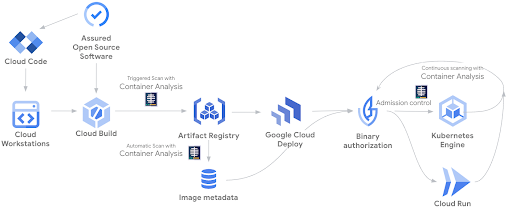
    At the Google Cloud Next ’22 conference, Google today launched a managed Software Delivery Shield (SDS) service to enable DevOps team to store, manage and secure the build artifacts in Artifact Registry. At its core, SDS is based on a trust-based policy engine to establish, maintain and verify a chain of trust across the software supply chain.

    In addition, Google has updated its container analysis tool to include vulnerability scanning for Maven and Go containers along with preview support for non-containerized Maven packages.

    The managed Software Delivery Shield service spans a range of Google runtimes environments, including Google Kubernetes Engine (GKE), Cloud Code, Cloud Build, Cloud Deploy, Artifact Registry and Binary Authorization. Cloud Build also now officially supports Supply chain Levels for Software Artifacts (SLSA) Level 3 best practices by default in addition to generating authenticated and non-falsifiable build provenance for both containerized applications and non-containerized Maven and Python packages.

    GKE, in preview now, provides detailed assessments, assigns severity ratings and surfaces the security posture of the clusters and workloads, including insights into operating system vulnerabilities, workload configurations and other actionable insights. Log data can now also be captured while security event information can be routed to, for example, a security information and event management (SIEM) platform.

    The Google Cloud Run serverless platform can also, in preview, display software supply chain security insights such as SLSA build-level compliance, build provenance and vulnerabilities found in running services.

    At the same time, Google is also making available in preview Cloud Workstations, which provide fully managed secure development environments on Google Cloud that can be accessed via a browser. Built-in security capabilities include virtual private cloud (VPC) controls, no local storage of source code, private ingress/egress, forced image updates and identity access management (IAM) policies.

    Finally, the Cloud Code plug-in for integrated development environments (IDEs) now includes a preview of Source Protect to give developers real-time security feedback in the form of vulnerability dependencies and license reporting as they write code.

    Collectively, Google claimed it now provides more than 250 curated packages across Java and Python with verified provenance. It also automatically generates a software bill of materials (SBOM) to create an inventory of all components and dependencies.

    Historically, cloud service providers have been advocating a shared responsibility approach to cloud security that required organizations to not only secure their applications but also the way cloud infrastructure is provisioned. The challenge is developers generally provision cloud infrastructure themselves even though they generally have limited cybersecurity expertise. Too many developers assume the underlying cloud infrastructure is more secure than it actually is.

    Now, cloud service providers are extending the security services they provide at a time when organizations are making security a bigger factor in determining where to build and deploy applications.

    Sunil Putti, vice president and general manager for Google Cloud Platform, said Google is attempting to make cybersecurity invisible to developers in the sense that guardrails will automatically be embedded within the platform.

    The issue is that cloud computing environments are becoming more complex as new classes of cloud-native applications are deployed alongside legacy monolithic applications. Complexity, as always, is the enemy of cybersecurity.

  • Driving Organizational Success With the 2022 State of DevOps Report

    Driving Organizational Success With the 2022 State of DevOps Report

    “Ship it!”

    We have just completed the research and analysis for the 2022 Accelerate State of DevOps Report (SODR) and oh boy, do we have some interesting things to share! First, let me take a short step back for those of you that may be new to the DevOps Research and Assessment (DORA) and our annual report, the SODR. DORA is an academically rigorous research program that seeks to answer the questions, “What practices enable teams to be high-performing software teams? And how do these practices impact organizational performance?”

    Since 2014, we have surveyed 33,000 practitioners around the world spanning all major industries. The project is intentionally–and staunchly–tool- and platform-agnostic. The research builds on itself, and each year we seek to both evaluate previous findings and expand in other directions or areas of research. This is important to note because many of the core findings, such as “software delivery performance drives organizational performance,” have been validated year after year. I would encourage you to go back and read all the reports from years past.

    Security

    This year, we doubled down on our 2021 research into software supply chain security by looking at the technical practices that improve software supply chain security and the non-technical practices that impact an organization’s ability to excel at securing their software supply chains. We leveraged two frameworks to focus our research: Supply Chain Levels for Software Artifacts (SLSA) and NIST’s Secure Software Development Framework (SSDF). Below is a summary of some of our key findings in this area:

    • Shifting left on security is a broadly adopted practice. Our research shows that two-thirds of respondents are actively pursuing software supply chain security by seamlessly baking security into the development process.
    • Culture is the primary driver of security practice adoption. One might expect that technology is the primary driver, but our research showed that a generative organizational culture (eg. performance-oriented, highly cooperative, shared risk) leads to healthier software practices.
    • Technical practices around CI/CD predict success in security. Companies that use source control, continuous integration (CI) and continuous delivery (CD) have more established SLSA practices. These practices shift security left to the developers and ensure consistent security scanning.
    • Cloud enables secure software practices. The five characteristics of cloud computing as defined by NIST enable the successful adoption of software supply chain security which, in turn, predicts greater organizational performance.

    Our research showed that companies who prioritize and excel at securing the software supply chain experienced fewer service outages, anticipate fewer security breaches and demonstrate high levels of both software delivery performance and organizational performance. The data showed that through the use of modern practices like continuous integration, teams can improve their security posture and even amplify the positive impact these security practices have on software delivery metrics (MTTR, deployment frequency, lead time-to-restore service) and overall organizational performance.

    Culture

    We saw above that the biggest predictor of an organization’s application development security practices was the presence of a generative organizational culture based on shared risk and information sharing. We also see that elements of these types of cultures lead to higher overall organizational performance, as well. Our research showed that high organizational performance can be achieved by fostering environments that are:

    • Supportive: Teams that felt supported and that they had buy-in from leadership (e.g., more financial support, more allocation of resources, sponsorships, etc.) were associated with high-performing organizations.
    • Stable: Teams that did not experience much change in membership over the last 12 months were more likely to be a part of high-performing organizations.
    • Flexible: Organizations with higher levels of working flexibility around where work was performed–remote, in-person or hybrid–were higher-performing overall.

    We also looked at burnout again this year and expanded the scope to understand which elements of culture contributed to lower levels of burnout. We found that generative culture, team stability and work flexibility all contributed to a reduction in burnout among employees.

    Reliability

    In previous years, our research told us that those that excelled in technical practices also excelled at organizational performance. This year, we have more nuanced data about this topic. This year, we saw that software delivery does not predict strong business outcomes unless these practices were paired with reliability. Think about it–will a customer be satisfied with new features if the service isn’t stable? What is the benefit of pushing code quickly into a fragile environment? Reliability is an essential component of driving organizational performance through software delivery performance.

    We also see that site reliability engineering’s (SRE’s) impact on organizational performance is non-linear; reliability engineering practices often do not result in additional reliability or organizational performance until a certain maturity is reached. It’s important for teams to know this and approach their SRE practice as an investment. It will likely not be sparkly ponies and unicorns initially as you build the reliability muscle but, as you advance, high performance and success are likely.

    Cloud

    Public cloud use is up a whopping 36% over 2021, whereas companies reporting no cloud usage at all are down by 50%. The use of hybrid cloud is up by 25%. Unsurprisingly, the use of cloud computing was associated with higher organizational performance. In past years we saw that it wasn’t “using cloud” per se that led to organizational performance, rather it was the achievement of the five essential characteristics of cloud computing–on-demand self-service, broad network access, resource pooling, rapid elasticity and measured service. This year, we saw that cloud computing enabled things like reliability, continuous delivery and improved supply chain security which drive organizational success.

    Over 50% of folks who took our survey reported that they leveraged multiple cloud providers. We asked respondents what benefits they realized from using multiple cloud providers. Here are the top three:

    1. Availability
    2. Leveraging the unique benefits of each provider
    3. Trust is spread across multiple providers

    Given the fact that reliability seemed to be the key to being a successful software delivery shop as well as a successful organization, it is not surprising to see availability listed by almost 63% of respondents as a benefit derived from using multiple clouds.

    Summary

    Our research continues to progress and we continue to dig deeper and deeper into the capabilities and practices that impact your business. We see broad adoption on the topics of security and reliability which are both heavily anchored in culture. Good culture leads to success. Period. There is no magic culture button and it takes work, but it is very achievable. Start by defining organization-wide or line-of-business-wide goals and then just start continuously improving. Don’t worry about creating a three-year plan for improvement; create a one-month plan and just get to work instead. At the end of that month, evaluate your learnings, refine your focus and get back to work. With a commitment to hard work and continuous improvement, your investments should start paying off and, as an added bonus, you’ll have a better culture.

    We hope you have enjoyed these juicy findings as much as we have and we encourage you to read the entire 2022 State of DevOps Report.

    Also, please join us at dora.community to continue the discussion about these findings and to share and discuss your experiences on your journey toward excellent software delivery and operations.

  • Latest DORA Report From Google Surfaces Raft of DevOps Challenges

    Latest DORA Report From Google Surfaces Raft of DevOps Challenges

    The annual Accelerate State of DevOps 2022 report published today by the DevOps Research and Assessment (DORA) team at Google found the percentage of high performers is at a four-year low, with the percentage of low performers rising dramatically from 7% in 2021 to 19% in 2022.

    Based on a survey of 1,350 DevOps professionals, the report evaluated organizations based on the five DORA metrics: Deployment frequency, lead time for changes, time to restore service, change failure rate and operational performance. The DORA team also identified clusters of DevOps teams ranging from “starters” to “flowing” based on their overall maturity. Only 17% of respondents achieved a ‘flow’ state defined by high reliability, high stability and high throughput characteristics.

    The DORA survey sample shifted this year to include more respondents that are earlier in their careers than in previous reports. However, Claire Peters, DORA research lead at Google, said that while there are a lot of factors that impact those metrics, the current hypothesis is that the COVID-19 pandemic has taken a toll on DevOps productivity as more DevOps professionals continue to work remotely.

    The report noted a marked shift in deployment targets requiring new skills, with 54% of respondents now working with container artifacts.

    Overall, the report finds software delivery performance is beneficial to organizational performance when operational performance is also high. The challenge is the number of organizations that have achieved high operational performance is relatively small. In fact, the report also noted that site reliability engineering (SRE) practices had a negative impact on software delivery performance until an organization achieved a high level of SRE maturity.

    The report also concluded that organizations that built software on and for the cloud tended to have 1.4 times higher organizational performance than those that didn’t. The percentage of respondents using public clouds is 76%, up from 56% in 2021, while the number of respondents not using a cloud stands at 10.5%. Usage of multiple public clouds is at 26%, while 35% reported using a private cloud.

    Less clear is the impact on DevOps teams of shifting application security left. The report suggested the biggest challenge organizations face when it comes to achieving application security have more to do with cultural issues than any technical shortcomings. The report notes that organizations that focus on accelerating software delivery without implementing meaningful DevSecOps best practices find themselves in a vicious counterproductive cycle that results in applications being successfully deployed in production environments less often.

    Peters noted that there is greater developer fatigue because organizations attempt to address security issues either just before an application is deployed or they remediate applications after they are deployed. Organizations that have low levels of security practices are 1.4 times more likely to experience developer burnout.

    The DORA team used both the supply-chain levels for secure artifacts (SLSA) framework defined by Google and the Secure Software Development Framework (SSDF) defined by the National Institute of Standards (NIST) to evaluate organizations. The most widely-adopted practice is application security scanning within a continuous integration/continuous delivery (CI/CD) system, with 63% of respondents reporting these tools are “very” or “completely” established. Preserving code history and using build scripts are also highly established, the report finds.

    In general, Peters said the report suggested the biggest predictor of application security success was whether an organization had a high-trust, low-blame culture focused on performance. Organizations that have these cultures tend to have higher organizational performance. Similarly, organizations with teams that felt supported through funding and leadership sponsorships tended to have higher organizational performance, the report noted. In addition, team stability and positive perceptions about one’s team also tended to lead to higher levels of organizational performance. Lastly, companies that offer flexible work arrangements tended to see higher levels of organizational performance.

    Each organization, as always, will implement DevOps best practices in ways that best fit its internal culture. However, the latest DORA report makes it clear that the more empowered a DevOps team is the more proficient they tend to become.

  • Wipro Fires 2-Job Staff | Python Bug from 2007 | Lite Layoffs

    Wipro Fires 2-Job Staff | Python Bug from 2007 | Lite Layoffs

    Welcome to The Long View—where we peruse the news of the week and strip it to the essentials. Let’s work out what really matters.

    This week: Wipro fires 300 for moonlighting at competitors, Python has a nasty 15-year-old bug, and companies are finding new ways to lay people off without calling it a “layoff.” (more…)

  • Five Great DevOps Job Opportunities

    Five Great DevOps Job Opportunities

    devopsy.kinsta.cloud is now providing a weekly DevOps jobs report through which opportunities for DevOps professionals will be highlighted as part of an effort to better serve our audience.

    Our goal in these challenging economic times is to make it easier for DevOps professionals to advance their careers.

    Of course, the pool of available DevOps talent is still relatively constrained, so when one DevOps professional takes on a new role it tends to create an opportunity for others.

    The five job postings shared this week are selected based on the company looking to hire, the vertical industry segment and naturally, the pay scale being offered.

    We’re also committed to providing additional insights into the state of the DevOps job market. In the meantime, for your consideration:

    Monster.com

    Google
    Mountain View, CA
    Software engineer
    $167,149

    ZipRecruiter

    Deloitte
    Boca Raton, FL
    DevSecOps Engineering Lead
    $145,000 to $241,000

    Dice.com

    gWorks
    Omaha, NE
    DevOps Manager
    $150,000 to $180,000

    SimplyHired

    Cubic Corp
    Ashburn, VA
    DevOps Engineer
    $87,000 – $120,000

    Indeed.com

    Blue Cross and Blue Shield of North Carolina
    Remote
    DevOps Engineer
    $94,600 to $120,000